
Generalized Discrete Preference Games
Proceedings of the Twenty-Fifth International Joint Conference on Artificial Intelligence. Pages 53-58.
Abstract
Recently, much attention has been devoted to discrete preference games to model the formation of opinions in social networks. More specifically, these games model the agents' strategic decision of expressing publicly an opinion, which is a result of an interplay between the agent's private belief and the social pressure. However, these games have very limited expressive power; they can model only very simple social relations and they assume that all the agents respond to social pressure in the same way. In this paper, we define and study the novel class of generalized discrete preference games. These games have additional characteristics that can model social relations to allies or competitors and complex relations among more than two agents. Moreover, they introduce different levels of strength for each relation, and they personalize the dependence of each agent to her neighborhood.
- [Acemoglu and Ozdaglar, 2011] D. Acemoglu and A. Oz- daglar. Opinion dynamics and learning in social networks. Dynamic Games and Applications, 1(1):3-49, 2011.
- [Anshelevich et al., 2008] E. Anshelevich, A. Dasgupta, J. Kleinberg, É. Tardos, T. Wexler, and T. Roughgarden. The price of stability for network design with fair cost allo- cation. SIAM Journal on Computing, 38(4):1602-1623, 2008.
- [Auletta et al., 2015] V. Auletta, I. Caragiannis, D. Ferraioli, C. Galdi, and G. Persiano. Minority becomes majority in social networks. In WINE, pages 74-88, 2015.
- [Awerbuch et al., 2008] B. Awerbuch, Y. Azar, A. Epstein, V. S. Mirrokni, and A. Skopalik. Fast convergence to nearly optimal solutions in potential games. In EC, pages 264-273, 2008.
- [Balcan et al., 2013] M.-F. Balcan, A. Blum, and Y. Man- sour. Circumventing the price of anarchy: leading dy- namics to good behavior. SIAM Journal on Computing, 42(1):230-264, 2013.
- [Bhalgat et al., 2010] A. Bhalgat, T. Chakraborty, and S. Khanna. Approximating pure Nash equilibrium in cut, party affiliation, and satisfiability games. In EC, pages 73- 82, 2010.
- [Bhawalkar et al., 2013] K. Bhawalkar, S. Gollapudi, and K. Munagala. Coevolutionary opinion formation games. In STOC, pages 41-50, 2013.
- [Bindel et al., 2011] D. Bindel, J. Kleinberg, and S. Oren. How bad is forming your own opinion? In FOCS, pages 55-66, 2011.
- [Bonzon et al., 2006] E. Bonzon, M.C. Lagasquie-Schiex, J. Lang, and B. Zanuttini. Boolean games revisited. In ECAI, volume 141, pages 265-269, 2006.
- [Caragiannis et al., 2011] I. Caragiannis, A. Fanelli, N. Gra- vin, and A. Skopalik. Efficient computation of approxi- mate pure Nash equilibria in congestion games. In FOCS, pages 532-541, 2011.
- [Caragiannis et al., 2014] I. Caragiannis, A. Fanelli, and N. Gravin. Short sequences of improvement moves lead to approximate equilibria in constraint satisfaction games. In SAGT, pages 49-60, 2014.
- [Chierichetti et al., 2013] F. Chierichetti, J. Kleinberg, and S. Oren. On discrete preferences and coordination. In EC, pages 233-250, 2013.
- [Christodoulou et al., 2012] G. Christodoulou, V. S. Mir- rokni, and A. Sidiropoulos. Convergence and approxima- tion in potential games. Theoretical Computer Science, 438:13-27, 2012.
- [DeGroot, 1974] M. H. DeGroot. Reaching a consens- us. Journal of the American Statistical Association, 69(345):118-121, 1974.
- [Easley and Kleinberg, 2010] D. Easley and J. Kleinberg. Networks, Crowds, and Markets: Reasoning about a Highly Connected World. Cambridge University Press, 2010.
- [Even-Dar et al., 2007] E. Even-Dar, A. Kesselman, and Y. Mansour. Convergence time to Nash equilibrium in load balancing. ACM Transactions on Algorithms, 3(3), 2007.
- [Fabrikant et al., 2004] A. Fabrikant, C. H. Papadimitriou, and K. Talwar. The complexity of pure Nash equilibria. In STOC, pages 604-612, 2004.
- [Ferraioli et al., 2012] D. Ferraioli, P. W. Goldberg, and C. Ventre. Decentralized dynamics for finite opinion games. In SAGT, pages 144-155, 2012.
- [Friedkin and Johnsen, 1990] N. E. Friedkin and E. C. John- sen. Social influence and opinions. Journal of Mathemat- ical Sociology, 15(3-4):193-205, 1990.
- [Harrenstein et al., 2014] P. Harrenstein, P. Turrini, and M. Wooldridge. Hard and soft equilibria in boolean games. In AAMAS, pages 845-852. International Foundation for Autonomous Agents and Multiagent Systems, 2014.
- [Monderer and Shapley, 1996] D. Monderer and L. S. Shap- ley. Potential games. Games and Economic Behavior, 14(1):124-143, 1996.
- [Mossel and Tamuz, 2014] E. Mossel and O. Tamuz. Opin- ion exchange dynamics. arXiv preprint arXiv:1401.4770, 2014.
- [Peleg, 2002] D. Peleg. Local majorities, coalitions and mo- nopolies in graphs: A review. Theoretical Computer Sci- ence, 282:231-257, 2002.
- [Pryymak et al., 2012] O. Pryymak, A. Rogers, and N. R. Jennings. Efficient opinion sharing in large decentralised teams. In AAMAS, pages 543-550, 2012.
- [Tsang and Larson, 2014] A. Tsang and K. Larson. Opinion dynamics of skeptical agents. In AAMAS, pages 277-284, 2014.
- [Wong et al., 2014] L. Z. Wong, T. Q. S. Quek, and M. Padilla. Ordinal potential functions for network selection in heterogeneous wireless networks. In ICASSP, pages 6122-6126, 2014.
- [Wooldridge et al., 2013] M. Wooldridge, U. Endriss, S. Kr- aus, and J. Lang. Incentive engineering for boolean games. Artificial Intelligence, 195:418-439, 2013. IJCAI
References were extracted automatically from the PDF and may contain errors.
Full text extracted automatically from the PDF; figures, tables and equations may differ. The PDF is the version of record.
1 Introduction
Understanding the emergent behavior of groups of interacting agents is an important research challenge in the social sciences and in AI. One of the problems considered along this direction is to understand how opinions are formed and expressed in a social context, e.g., how an opinion diffuses in a social network when each single agent adapts her own belief in response to the opinions expressed by her "friends." The recent research activity on this subject is extensive, both in AI and in multiagent systems [Pryymak et al., 2012; Tsang and Larson, 2014] and in CS at large [Acemoglu and Ozdaglar, 2011; Bindel et al., 2011; Mossel and Tamuz, 2014], as well as in sociology, economics, physics, and epidemiology.
Diodato Ferraioli
University of Salerno dferraioli@unisa.it
Giuseppe Persiano
University of Salerno giuper@unisa.it
A classical model for studying the diffusion and the adoption of opinions in a social network has been proposed by Friedkin and Johnsen [1990] as a refinement of a previous model introduced by DeGroot [1974]. The model assumes that each agent has a private belief, but the opinion she eventually expresses can be different from her belief, and it is given by the outcome of a repeated averaging between her belief and the opinions of individuals with whom she has social relations. Recently, Bindel et al. [2011] considered this model and proved that, under mild assumptions, whenever beliefs and opinions belong to [0↪ 1], the repeated averaging process leads to a unique equilibrium, describing the opinion that each agent eventually expresses.
Two recent papers - by Ferraioli et al. [2012] and by Chierichetti et al. [2013] - focus on a refinement of this model, where beliefs and opinions are discrete and can take two possible values: 0 and 1. This simple restriction has important effects. Clearly, the discrete nature of the preferences does not allow for averaging anymore and several nice properties of the opinion formation models mentioned above - such as the uniqueness of the outcome - are lost. In contrast, it now seems natural to assume that each agent behaves strategically and aims to pick the most beneficial (or less costly) opinion for her, where the benefit (or cost) depends both on her internal belief and on the opinions of individuals with whom she has social relations.
This immediately defines a discrete preference game. With the notation that we will use later, let us define the cost of agent i when the binary strategies of the n agents are given by the vector s = (s(1)↪ ▷ ▷ ▷ ↪ s(n)) as
where b(i) 2 ¶0↪ 1♦ denotes the belief of agent i and N(i) is the set of individuals with whom she has social relations (e.g., friends in the social network). Note that the cost has two components that depend on the distance of the agent's strategy from her internal belief and from the strategies of her neighbors, respectively. The parameter ↵ 2 [0↪ 1] adjusts the relative importance of the two terms. Intuitively, it measures the degree of coordination the agents seek.
The class of discrete preference games was recently considered by Chierichetti et al. [2013]. They assess the quality of states using the total (or social) cost of the agents.
Their findings include tight bounds on the price of stability for discrete preference games as well as conditions that imply that states of minimum social cost are always equilibria. These results come in contrast to the price of anarchy that can be unbounded; the same result has also been observed independently by Ferraioli et al. [2012]. Recently, Auletta et al. [2015] also proved that a best response dynamics can lead from the truthful profile (in which agents' opinion coincides with their belief) to an equilibrium in which the majority has been subverted.
Still discrete preference games have evident limitations. In order to overcome them, we significantly generalize the model; this is our main conceptual contribution. Chierichetti et al. [2013] generalized these games to more than two strategies per agent. However, this kind of generalization faces the problem that it is not clear whether there exists an ideal metric for representing distances among opinions, and different results are obtained by adopting different metrics. In addition, games with two strategies per agent have been proved to be as general (and challenging) as possible from the computational complexity point of view; see [Fabrikant et al., 2004]. For these reasons, we keep the two-strategy restriction and instead consider richer relations among agents. For example, the facts that each agent treats her neighbors equally, she seeks agreement to all of them, and all social relations include only two agents are obvious limitations of discrete preference games. In contrast, we would like to (1) model social relations to both allies or competitors, (2) include complex relations between more than two agents, (3) introduce different levels of strength for each relation, and (4) personalize the dependence of each agent to its neighborhood.
So, motivated by games that are inspired by constraint satisfaction optimization problems - such as cut games and party affiliation games; see, e.g., [Balcan et al., 2013; Caragiannis et al., 2014; Wooldridge et al., 2013] - we define the broader class of generalized discrete preference games. In these games, the strategy of each agent is again a binary opinion. Social relations (or social constraints) are weighted Boolean formulas over the strategies of subsets of agents. Then, the cost of each agent depends on the total weight of the unsatisfied formulas whose outcome depend on the opinion of the agent; the particular dependence can be different from agent to agent. We give the detailed definition of generalized discrete preference games in Section 3, where we also present and discuss several examples.
Our main technical contributions are presented in Section 4. First, we kill many birds with one stone: in Theorem 1, we show that the negative sum of the weights of the satisfied formulas is a generalized ordinal potential function for such a game. Note that the same potential function may correspond to very different games and essentially describes the general structure of the Nash dynamics graph of each of them. In addition, depending on some details in the definition of the agents' costs, the potential function can be proved to be exact, weighted, or ordinal potential. As a consequence, we have that generalized discrete preference games always admit pure Nash equilibria, and that a finite sequence of best-response strategy updates always converges to an equilibrium. Potential functions usually reveal a structure in the underlying game and have turned out to be useful for a more deep understanding of it. For example, they have been useful in proving bounds on the price of stability [Anshelevich et al., 2008] or in bounding the time required to reach equilibria or efficient states after best-response play [Awerbuch et al., 2008]. We hope that the potential function we define can play such important roles for generalized ordinal potential games.
Second, and probably more importantly, in Theorem 4 we show that every game with two strategies per agent that admits a generalized ordinal potential is structurally equivalent (in particular, better-response equivalent) to a generalized discrete preference game. This implies that generalized discrete preference games capture the full generality of twostrategy games in which the existence of pure equilibria is guaranteed by topological arguments. This result is similar in spirit to the equivalence proved by Monderer and Shapley [1996] between exact potential and congestion games. This equivalence has been extremely useful for a deep understanding of the former class of games. On the other side, generalized ordinal potential games are still not well understood, even if it has been proved that they have many important applications such as in load balancing [Even-Dar et al., 2007] and in wireless spectrum management [Wong et al., 2014]. We hope that generalized discrete preference games can play the same role as congestion games for improving our knowledge about generalized ordinal potential games. Ideally, we would like to be able to prove properties of generalized ordinal potential games by focusing on equivalent generalized discrete preference games.
Other Related Work. The paper that is most closely related to ours is the one by Chierichetti et al. [2013] which we have discussed above. Independently, Ferraioli et al. [2012] have considered the same class of games, mostly focusing on the study of (noisy) best-response dynamics with respect to their convergence to equilibria or stable states. An interesting generalization has been proposed by Bhawalkar et al. [2013] who consider beliefs and opinions in [0↪ 1]; according to their model, in addition to the opinion expressed, the social relations of an agent are also part of her strategy and are selected so that connections to agents with similar opinions are more preferable.
In addition to the cited papers that study games involving Boolean variables and constraints, Bonzon et al. [2006] defined boolean games where, like generalized discrete preference games, the interdependence among agents is represented through boolean formulas involving their strategies. However, classical boolean games assume that formulas are not weighted, while we will see that weights are crucial for our equivalence result to hold. Recently, extensions to boolean games that include weights (e.g., see [Harrenstein et al., 2014]) have been proposed, but still they are too restrictive for achieving our results.
Studies in social networks consider several phenomena related to the spread of social influence such as information cascading, network effects, epidemics, and more. The book of Easley and Kleinberg [2010] provides an excellent introduction to the theoretical treatment of such phenomena. From a different perspective, problems of this type have also been considered in the distributed computing literature, motivated by the need to control and restrict the influence of failures in distributed systems; e.g., see the survey by Peleg [2002] and the references therein.
2 Preliminaries
Discrete preference games are formally defined as follows. There are n agents; we use [n] = ¶1↪ 2↪ ▷ ▷ ▷ ↪ n♦ to denote their set. Each agent corresponds to a distinct node of an undirected graph G = (V↪E) that represents the social network; i.e., the network of social relations between the agents. Agent i has an (internal) belief b(i) 2 ¶0↪ 1♦ and her strategy set consists of the two alternatives that she can declare as her opinion (or preference), i.e., s(i) 2 ¶0↪ 1♦. A strategy profile (or, simply, a profile or state) is a vector of strategies, with one strategy per agent. We use bold symbols for profiles; i.e., s = (s(1)↪ ▷ ▷ ▷ ↪ s(n)). For y 2 ¶0↪ 1♦, we denote as y the negation of y; i.e., y = 1 - y.
At a profile s, the cost of agent i is denoted by ci(s) and is defined as in (1). A profile s is a pure Nash equilibrium (or, simply, an equilibrium) if ci(s) ci(s(i)↪ s-i) for every agent i. The notation (s(i)↪ s-i) is used to refer to the state in which all agents besides agent i follow their strategies in state s and agent i follows strategy s(i). As observed in [Chierichetti et al., 2013] and [Ferraioli et al., 2012], discrete preference games always have equilibria. This follows using potential function arguments; we discuss potential functions of different types below.
Following the standard terminology in the game theory literature, we say that a game is an exact potential game if there exists a function Φ defined over the states of the game such that the following condition holds: For every two states (s↪ x-i) and (s0 ↪ x-i) that differ in the strategy of agent i, ci(s↪ x-i) - ci(s0 ↪ x-i) = Φ(s↪ x-i) - Φ(s0 ↪ x-i). It is a weighted potential game if there exists a function Φ and positive weights (vi)i2[n] so that the above condition becomes ci(s↪ x-i) - ci(s0 ↪ x-i) = vi · (Φ(s↪ x-i) -Φ(s0 ↪ x-i)). It is an ordinal potential game if there exists a function Φ such that the condition becomes ci(s↪ x-i) - ci(s0 ↪ x-i) > 0 , Φ(s↪ x-i) - Φ(s0 ↪ x-i) > 0; Finally, it is a generalized ordinal potential game if there exists a function Φ such that ci(s↪ x-i) - ci(s0 ↪ x-i) > 0 ) Φ(s↪ x-i) - Φ(s0 ↪ x-i) > 0. Note that each class generalizes the previous one. It is a folklore result - e.g., see Monderer and Shapley [1996] - that every (finite) generalized ordinal potential game has at least one Nash equilibrium and it can be reached through cost-decreasing strategy updates of the agents. Specifically, any local minimum of the potential function corresponds to an equilibrium of the game. The opposite - i.e., the fact that equilibria always correspond to local minima of the potential function - is true for ordinal potential games but it is not necessarily true for generalized ordinal potential games.
3 Generalized Discrete Preference Games
We are now ready to define the broader class of generalized discrete preference (GDP) games. Like in discrete preference games, again we assume that every agent i has a private belief b(i) 2 ¶0↪ 1♦ and that her strategy s(i) is a preference from the strategy set ¶0↪ 1♦. However, in contrast to discrete preference games, agents are not only interested in agreeing to their neighbors and more complex constraints can be used to represent their preferences. Specifically, we define a social constraint as a Boolean formula involving the opinions (but not the beliefs) of a subset of agents. For example, the social constraint C(s) = (s(i) ^ s(j)) _ (s(i) ^ s(j)) involves agents i and j and is satisfied when the opinions of i and j are different. In addition to social constraints, GDP games have belief constraints; these constraints are true when the expressed opinion of an agent coincides with her belief. Specifically, the belief constraint Bi(s) of agent i is Bi(s) = (s(i) ^ b(i)) _ (s(i) ^ b(i)) and, unlike social constraints, involves only the opinion and the belief of agent i. Sometimes, we will use the equivalent constraint Bi(s) = s(i) (respectively, Bi(s) = s(i)) if b(i) = 0 (respectively, b(i) = 1). A set C of constraints is feasible if, for every agent i, at most one of the two belief constraints s(i) and s(i) belongs to C.
In a generalized discrete preference game, each constraint C has a non-negative weight W(C). For any agent i and for any profile s, we also denote by wi(s) the sum of the weights of the constraints involving agent i that are satisfied at s. Furthermore, we denote by wi the sum of the weights of all constraints that involve agent i and we denote by w(s) the sum of all constraints satisfied at s. Also, we let w denote the sum of the weights of all constraints.
The cost ci(s) of agent i in profile s is defined through a monotone non-decreasing function Fi : R≥0 ! R≥0 on the weight of the constraints that involve i and are unsatisfied at s. More precisely, we have ci(s) = Fi(wi -wi(s))▷ Note that using different functions Fi we can model agents that evaluate their social relationships in different ways. We emphasize that, in the definition of the cost of agent i, the function Fi gets as input the total weight of all unsatisfied constraints that involve i. In a sense, an agent cares about all (belief and social) constraints she is involved in and cannot disregard any constraint. Observe that, through these agent-specific functions is possible to model agents that give different importance to the constraints in which they are involved, even if constraint weights are common to each agent. An example of such a setting is described later.
To sum up, a generalized discrete preference game is a tuple ([n]↪ C↪W↪ (Fi)i2[n]), where C is a feasible set of constraints, W is the weight function and Fi is the cost function of i. Next we give examples showcasing the expressiveness of GDP games.
Examples. We give examples of games that fall within our class, mostly focusing on notions that will be used again later. A constraint C is an equality-constraint if it is satisfied only when all agents involved in C have the same opinion. Formally, C is an equality-constraint on N ✓ [n] if C(s) = (Vi2N si ) _ (Vi2N si ). This allows to easily model a group of agents that want to agree with each other. A constraint C is an or-constraint if it is satisfied in all profiles except the ones in which the agents involved in C have a specific configuration. Formally, C is an or-constraint on N if C(s) = Wi2N `i, where `i 2 ¶si↪ si♦. This allows to model the natural requirement of an agent that wants to avoid a specific configuration.
We also introduce another class of constraints, that, even though it is less natural than previous ones, it will turn out to be sometimes useful for characterizing the behavior of GDP games. Specifically, a constraint C is a switch-constraint if every time an agent that is involved in the constraint switches her preference then the constraint switches between satisfied and unsatisfied. Formally, C is a switch-constraint on set N of agents if C(s) = Li2N `i, where `i 2 ¶si↪ si♦. Informally, a switch constraint represents a parity requirement.
According to the definition of GDP games, the weight of a constraint is the same for all agents involved in the constraint. Nevertheless, as we will show next, this restriction still allows to implement many natural cost functions 1 .
In particular, very natural cost definitions can be obtained using specific choices for the Fi functions. For example, the cost function, according to which an agent tries to minimize the sum of the weights of the unsatisfied constraints in which she is interested, can be modeled by the identity function; that is, Fi(r) = r for each r ≥ 0.
Another natural class of cost functions is the one according to which agents are happy if and only if the sum of weights of the unsatisfied constraints is less than the sum of weights of satisfied constraints. This can be achieved by using the majority function, i.e., Fi(r) = 1 if r ≥ wi 2 and Fi(r) = 0 otherwise. We can also consider threshold functions, according to which the agents are happy if and only if the sum of weights of the unsatisfied constraints is less than some threshold T, i.e., Fi(r) = 1 if r ≥ T and Fi(r) = 0 otherwise.
In another natural example, the cost function assigns to the belief constraint an agent-specific weight that is different from the one assigned to social constraints. For example, consider the following cost function ci(s) = ↵(1 -Bi(s)) + (1 - ↵) di-ni(s) di where di is the number of social constraints in which i is involved and ni(s) is the number of social constraints in which i is involved among those that are satisfied at s. This cost function then balances among the closeness to agent's own belief and the fraction of satisfied constraints in which she is involved. Even though in our definition the weight of a constraint is the same for all agents, we can implement this cost function through a weighted identity function Fi; i.e., Fi(r) = vir for any r ≥ 0, where vi > 0. Indeed, we can set W(Bi) = ↵di for each i 2 [n], W(C) = 1 - ↵ for each social constraint C 2 C and vi = 1 di for each i 2 [n].
Note that discrete preference games are the special case of GDP games in which all non-belief constraints are equality constraints for pairs of agents and the cost of each agent is defined using the identity function.
4 Existence of Equilibria
We present our structural results in this section. We begin by proving that GDP games are generalized ordinal potential games. As such, they always admit a pure Nash equilibrium.
1 Clearly, it is possible to introduce in the game player-specific unrelated weights. However, this will break our equivalence result.
Theorem 1. Let G = ([n]↪ C↪W↪ (Fi)i2[n]) be a generalized discrete preference game. The function -w(s) is a generalized ordinal potential function for G.
Proof. Consider an agent i and profile s. Without loss of generality, let us assume that ci(0↪ s-i) - ci(1↪ s-i) > 0; we will show that w(1↪ s-i) - w(0↪ s-i) > 0.
By the definition of the cost of agent i, we have Fi(wi - wi(0↪ s-i))-Fi(wi-wi(1↪ s-i)) > 0 and, since the function Fi is monotone non-decreasing, wi(0↪ s-i)-wi(1↪ s-i) < 0. Now, for the total weight of constraints that do not depend on the opinion or the belief of agent i, we obviously have
The function -w(s) gives a stronger characterization for special subclasses of GDP games.
Proposition 2. Let G = ([n]↪ C↪W↪ (Fi)i2[n]) be a generalized discrete preference game. Then, the function -w(s) is: An exact potential for G if the Fi's are identity functions; a weighted potential for G if the Fi's are weighted identity functions; an ordinal potential for G if every constraint C 2 C is a switch-constraint and the Fi's are majority functions.
Proof. Consider an agent i and profile s. Let us first assume that Fi is a weighted identity function with Fi(r) = vi · r. Hence, ci(0↪ s-i) - ci(1↪ s-i) = vi · (wi - wi(0↪ s-i)) - vi · (wi - wi(1↪ s-i)) = vi · (wi(1↪ s-i) -wi(0↪ s-i)) = vi · (w(1↪ s-i) -w(0↪ s-i)), where the last equality follows by the observation (2) above. The claim for identity functions follows by setting vi = 1 for every agent i.
Now, let us focus on a generalized discrete preference game with switch constraints and majority functions for the definition of agents' cost. Since we have already proved that -w(s) is a generalized ordinal potential function, all that is left to prove is that w(0↪ s-i) - w(1↪ s-i) < 0 implies ci(0↪ s-i) - ci(1↪ s-i) > 0.
From observation (2), w(0↪ s-i) - w(1↪ s-i) < 0 implies that wi(0↪ s-i) - wi(1↪ s-i) < 0 for every s and i. Furthermore, for switch constraints we have that wi(0↪ s-i) + wi(1↪ s-i) = wi. Therefore we obtain that wi(1↪ s-i) > wi 2 and wi(0↪ s-i) < wi 2 . Since Fi is the majority function, it follows that ci(0↪ s-i) - ci(1↪ s-i) > 0.
Let us note that Proposition 2 is, in a sense, "tight". For the first two cases of Proposition 2, it is easy to construct GDP games with non-identity and non-weighted identity functions that do not admit exact and weighted potential functions, respectively. We give examples indicating that, by slightly deviating from either of the assumptions of switch constraints or majority functions, we obtain games that do not admit an ordinal potential function.
Indeed, we will first show that if Fi are threshold (but not majority) functions, we may have a game that does not admit an ordinal potential function. Consider a game with two agents, the switch constraints C1 = s1⊕s2 and C2 = s1⊕s2 and the belief constraints B1 = s1 and B2 = s2 with weights W(C1) = 1, W(C2) = 2, W(B1) = 1 and W(B2) = 2. F1 is the majority function and F2 is a threshold function with a threshold at 5. Suppose that an ordinal potential Φ exists. It is easy to see that c1(0↪ 0) > c1(1↪ 0) and, hence, it must also be Φ(0↪ 0) > Φ(1↪ 0). On the other side, we can easily verify that c2(0↪ 0) = c2(0↪ 1), c1(0↪ 1) = c1(1↪ 1) and c2(1↪ 1) = c2(1↪ 0). Hence, it should also be Φ(0↪ 0) = Φ(0↪ 1) = Φ(1↪ 1) = Φ(1↪ 0), a contradiction.
The same may happen if the Fi's are majority functions but there are non-switch constraints. Consider a game with three agents, the switch constraint C1 = s1 ⊕ s2, two orconstraints C2 = s1 _ s3 and C3 = s2 _ s3, and belief constraints B1 = s1, B2 = s2, and B3 = s3 with weights W(C1) = W(B1) = W(B2) = W(B3) = 3, W(C2) = 2, W(C3) = 8. We can easily verify that c1(0↪ 1↪ 1) = 1 but c1(1↪ 1↪ 1) = c2(1↪ 1↪ 1) = c2(1↪ 0↪ 1) = c1(1↪ 0↪ 1) = c1(0↪ 0↪ 1) = c2(0↪ 0↪ 1) = c2(0↪ 1↪ 1) = 0. An ordinal potential function Φ should then satisfy Φ(0↪ 1↪ 1) > Φ(1↪ 1↪ 1) = Φ(1↪ 0↪ 1) = Φ(0↪ 0↪ 1) = Φ(0↪ 1↪ 1), a contradiction.
4.1 Better-Response Equivalence
We now define the concept of better-response equivalence in order to state the main theorem of this section.
Definition 3. Two games G = ([n]↪ (Si)i2[n]↪ (ci)i2[n]) and G 0 = ([n]↪ (Si)i2[n]↪ (c0i )i2[n]) with the same set of profiles S are better-response equivalent if, for every pair of profiles s↪ s0 2 S that differ in the strategy of only one agent (say i), we have that ci(s) > ci(s0 ) if and only if c0i (s) > c0i (s0 ).
Clearly, one could construct artificial classes of games that are better-response equivalent to generalized ordinal potential games. The importance of our next statement is that it involves a very natural class of games, namely GDP games.
Theorem 4. Any two-strategy generalized ordinal potential game G is better-response equivalent to a generalized discrete preference game G 0 .
The rest of this subsection is devoted to proving Theorem 4. Without loss of generality, we assume that the strategy set of each agent of G is ¶0↪ 1♦. The profiles can then be identified with the nodes of an n-dimensional undirected hypercube. An undirected edge (s↪ s0 ) of the hypercube connects two profiles that differ in the strategy of a single agent; e.g., s = (0↪ s-i) and s0 = (1↪ s-i), for some i 2 [n]. Sometimes we denote edge (s↪ s0 ) by (s↪ i) or, equivalently, by (s0 ↪ i) and call it a dimension-i edge.
Directing and Tagging Edges. If (s↪ s0 ) is a dimension-i edge and ci(s) > ci(s0 ), then we direct it from s to s0 . If instead ci(s) = ci(s0 ), the edge is left undirected. Notice that, since G is a generalized ordinal potential game, the partially directed hypercube is essentially the Nash dynamics graph of G and contains no cycle consisting only of directed edges. Then we tag undirected edges as good as long as we can do so without creating a cycle consisting solely of directed and good edges. Remaining edges are called bad.
Claim 5. For each pair of profiles s↪ s0 , there is an undirected path on the partially directed hypercube between s and s0 that does not use bad edges.
Proof. Suppose that all undirected paths from s to s0 contain some bad edge. If we tag at least one bad edge as good, no cycle is created, a contradiction.
Defining the Constraints. Let us now start to describe the generalized discrete preference game G 0 that will turn out to be equivalent to G. It has two types of constraints.
Node constraints: For every node s of the hypercube, G 0 has constraint V (s) that is satisfied at all profiles except at s. It is easy to see that V (s) can be expressed as an or-constraint and that every agent is involved in V (s).
Edge constraints: For every edge (s↪ i), G 0 has constraint E(s↪ i) that is satisfied at all profiles except at each endpoints, (0↪ s-i) and at (1↪ s-i). It is easy to see that E(s↪ i) can be expressed as an or-constraint that involves all agents except i.
Defining the Constraint Weights. In order to define the weights of the constraints, let us fix some additional notation. We will identify a constraint with its weight. Thus, the weight of the constraint associated with edge (s↪ i) is E(s↪ i) and the weight of the constraint associated with node s is V (s). We also denote by E(s) the weight of all edge constraints incident to s; that is, E(s) = Pi E(s↪ i). Similarly, for an agent i we denote by E(i) the sum of the weights of all dimensioni edge constraints; that is, E(i) = Ps E(s↪ i). Finally, we denote by V = Ps V (s) the sum of the weights of all node constraints and by E = Ps↪i E(s↪ i) the sum of the weights of all edge constraints.
We assign weight 0 to each edge constraint, except for the ones corresponding to bad edges that have weight 2n .
The weights of the node constraints are determined as follows. We remove all bad edges from the (partially directed) hypercube and contract good edges by merging endpoints into super-nodes. By Claim 5 and by the tagging procedure, the resulting graph is a connected directed acyclic graph (DAG); that is, ignoring direction, for every two super-nodes X and Y , the DAG contains a directed path between X and Y . Weights of the node constraints are determined so that the two following properties hold: If s and s0 belong to the same super-node X of the DAG, then V (s) + E(s) = V (s0 ) + E(s0 ), and we set W(X) = V (s) + E(s); If s and s0 belong to different super-nodes X and Y and there is a directed path from X to Y , then W(X) = V (s) + E(s) > V (s0 ) + E(s0 ) = W(Y ).
Note that an assignment satisfying both these properties always exists. Indeed, we can determine the weights of the node constraints according to a topological ordering of the super-nodes of the DAG. For every super-node X of indegree 0, we determine the node s? with the maximum E(s? ) among all of its nodes and set V (s? ) = N = (n + 1)2n . Then we set V (s) = N - E(s) + E(s? ) for all the other nodes s of X. Observe that W(X) = N + E(s? ). Suppose now that we have set the weights for all super-nodes that have an out-going edge to super-node Y and let X be the such super-node that minimizes W(X). Then for all nodes s0 of Y we set V (s0 ) = W(X) - 1 - E(s0 ). Observe that W(Y ) = W(X) - 1.
We next prove that these weights are non-negative. Let s be a node, Ys be the corresponding super-node. Consider the super-nodes of in-degree 0 from which it is possible to reach Ys in the DAG and let X be the such super-node that minimizes W(X). We have V (s) ≥ W(X)-dist(Ys↪ X)- E(s0 ), where dist(Ys↪X) denotes the distance between X
and Ys in the DAG. Since W(X) ≥ N, dist(Ys↪ X) 2n - 1 and E(s0 ) n2n , we have that our choice of N is sufficient to make V (s) ≥ 0 for every node s.
Consider first a directed edge (s↪ s0 ) and let us denote by X and Y the super-nodes of the endpoints. By construction, we have W(X) = V (s) + E(s) > V (s0 ) + E(s0 ) = W(Y ) which, together with the observation that E(s↪ i) = E(s0 ↪ i), implies wi(s) < wi(s0 ). Therefore, the directed edge (s↪ s0 ) imposes the constraint that Fi is not constant in the interval [wi - wi(s0 )↪ wi - wi(s)].
Determining the Fi's. Remember that wi(s) denotes the sum of the weights of the constraints that involve agent i and that are satisfied at profile s. Note that wi(s) = V - V (s) + E - E(i) - E(s) + E(s↪ i). We next show that, for each agent i, there is a monotone non-decreasing function Fi such that the resulting game G 0 is better-response equivalent to G. It suffices to show that, if (s↪ s0 ) is a dimension-i directed edge, then Fi(wi - wi(s)) > Fi(wi - wi(s0 )); if instead (s↪ s0 ) is a (good or bad) undirected edge, then Fi(wi - wi(s)) = Fi(wi - wi(s0 )).
If (s↪ s0 ) is a good edge, then s and s0 belong to the same super-node and thus V (s) + E(s) = V (s0 ) + E(s0 ), which implies that wi(s) = wi(s0 ).
So, it remains to consider a bad edge (s↪ s0 ) with wi(s) < wi(s0 ). Then, function Fi must be constant in the interval [wi - wi(s0 )↪wi - wi(s)] and this is possible if and only if for every directed dimension-i edge (z↪w), the interval [wi - wi(w)↪wi - wi(z)] is not entirely contained in [wi - wi(s0 )↪wi - wi(s)]. Indeed, we now prove that wi(z) < wi(s). Let X and Z be the super-nodes corresponding to s and z, respectively. Then, wi(z) - wi(s) = W(X)-W(Z)-E(s↪ i)+E(z↪ i) = W(X)-W(Z)-2n , where we have used that (s↪ i) is a bad edge (hence, E(s↪ i) = 2n ) and (z↪ i) is a directed edge (hence, E(z↪ i) = 0). Since W(X) -W(Z) dist(X↪ Z) 2n - 1, we have wi(z) < wi(s), as desired. The proof of Theorem 4 is now complete.
Let us add a technical remark on the above proof. Observe that there exist no or-constraint of cardinality n-1 for n = 2. However, the above proof can be adjusted in order to work with belief constraints in place of or-constraints of cardinality n - 1. Note that, in this case, we need to satisfy the further requirement according to which at most one belief constraint for each agent has a positive weight. However, from Claim 5, it follows that at most one bad edge can exist in this case. If no bad edge exists, the proof above does not require any change. If exactly one bad edge exists, we assume without loss of generality that 1 is the agent involved in this edge. Then, it can be verified that the proof above holds even if agent 2 assigns weight 0 to both her belief constraints, and agent 1 assigns weights 0 and M.
4.2 Impossibility of Isomorphism
Even if structural equivalence between two-strategy generalized ordinal potential games and GDP games is certainly important, one may still wonder whether a stronger result (in the sense of the following definition) is possible.
Definition 6. Two games G = ([n]↪ (Si)i2[n]↪ (ci)i2[n]) and G 0 = ([n]↪ (Si)i2[n]↪ (c0i )i2[n]) with the same set of profiles S
are called isomorphic if for all profiles s 2 S, ci(s) = c0i (s).
In particular, given a two-strategy game that admits a generalized ordinal potential, is there an isomorphic generalized discrete preference game? Unfortunately, this is not possible. To demonstrate the impossibility, we will consider the following simple two-agent game with two strategies per agent:
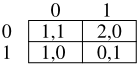
The first value in each cell is the cost of the row agent and the second one is the cost of the column agent. It can be easily verified that the following function is a generalized ordinal potential function for this game: Φ(00) = 3, Φ(01) = 2, Φ(11) = 1 and Φ(10) = 0. In order to build an isomorphic generalized discrete preference game we need to define a non-decreasing function F1 so that the conditions F1 (w1 -w1(01)) > F1 (w1 -w1(00)) and F1 (w1 -w1(10)) > F1 (w1 -w1(11)) are satisfied. These conditions simply require that the row agent strictly prefers profile 00 to profile 01 and profile 11 to profile 10. From the monotonicity of F1, it must be wi(01) < wi(00) and wi(10) < wi(11). Recall that w(s) is the sum of the weights of all constraints satisfied at s. For b 2 ¶0↪ 1♦, let βi(b) be the weight of the belief constraint of agent i if it is satisfied by b, and 0 otherwise. Since there are only two agents, each of them is involved in all constraints, besides the belief constraints of the other agent. Using this notation, the above inequalities can be expressed as
For the column agent, we need a function F2 so that the conditions F2 (w2 -w2(00)) > F2 (w2 -w2(01)) and F2 (w2 -w2(11)) > F2 (w2 -w2(10)) are satisfied. The same arguments as above allow us to rewrite these requirements as
Hence, in order to satisfy (3) and (5) we need that β2(1) > β2(0). But, in order to satisfy (4) and (6) we need that β2(0) > β2(1). We have obtained the desired contradiction.
5 Epilogue
We believe that our findings could open new research lines for understanding the performances and the complexity of equilibria. Even though (approximate) equilibria and convergence issues have been extensively studied in exact potential games - e.g., see [Awerbuch et al., 2008; Bhalgat et al., 2010; Caragiannis et al., 2014; 2011; Christodoulou et al., 2012; Fabrikant et al., 2004] - generalized ordinal potential games are much less understood. Whether generalized discrete preference games could play a role analogous to that of congestion games in this direction certainly deserves investigation.
We also remark that some of our results can be extended to more than two strategies by opportunely choosing a metric for the distances among opinions. Anyway, we refrain to introduce new, possibly unrealistic, metrics, and look forward for the definition of a natural and largely-approved metric.
Acknowledgments. This work was partially supported by COST Action IC1205 on "Computational Social Choice". Ioannis Caragiannis was partially supported by Caratheodory research grant E.114 from the University of Patras. Diodato Ferraioli was partially supported by the "GNCS - INdAM".
@inproceedings{ijcai2016p15,
  title     = {Generalized Discrete Preference Games},
  author    = {Auletta, Vincenzo and Caragiannis, Ioannis and Ferraioli, Diodato and Galdi, Clemente and Persiano, Giuseppe},
  booktitle = {Proceedings of the Twenty-Fifth International Joint Conference on
               Artificial Intelligence, {IJCAI-16}},
  publisher = {AAAI Press / International Joint Conferences on Artificial Intelligence},
  editor    = {Subbarao Kambhampati},
  pages     = {53--58},
  year      = {2016},
  month     = {7},
  url       = {https://ijcai.org/proceedings/2016/15},
}
TY - CPAPER TI - Generalized Discrete Preference Games AU - Auletta, Vincenzo AU - Caragiannis, Ioannis AU - Ferraioli, Diodato AU - Galdi, Clemente AU - Persiano, Giuseppe T2 - Proceedings of the Twenty-Fifth International Joint Conference on Artificial Intelligence, IJCAI-16 PB - AAAI Press / International Joint Conferences on Artificial Intelligence PY - 2016 SP - 53 EP - 58 UR - https://ijcai.org/proceedings/2016/15 ER -Copied
Machine-readable versions of this paper, for tools and AI agents:





