
Preferential Query Answering over the Semantic Web with Possibilistic Networks
Proceedings of the Twenty-Fifth International Joint Conference on Artificial Intelligence. Pages 994-999.
Abstract
In this paper, we explore how ontological knowledge expressed via existential rules can be combined with possibilistic networks (i) to represent qualitative preferences along with domain knowledge, and (ii) to realize preference-based answering of conjunctive queries (CQs). We call these combinations ontological possibilistic networks (OP-nets). We define skyline and k-rank answers to CQs under preferences and provide complexity (including data tractability) results for deciding consistency and CQ skyline membership for OP-nets. We show that our formalism has a lower complexity than a similar existing formalism.
- [Ben Amor et al., 2014] N. Ben Amor, D. Dubois, H. Gouider, and H. Prade. Possibilistic networks: A new set- ting for modeling preferences. In Proc. SUM, pages 1-7, 2014.
- [Benferhat et al., 2000] S. Benferhat, D. Dubois, L. Garcia, and H. Prade. Directed possibilistic graphs and possibilis- tic logic. In Information, Uncertainty and Fusion, pages 365-379. Springer, 2000.
- [Benferhat et al., 2001] S. Benferhat, D. Dubois, and H. Prade. Towards a possibilistic logic handling of prefer- ences. Appl. Intell., 14(3):303-317, 2001. IJCAI
- [Benferhat et al., 2002] S. Benferhat, D. Dubois, L. Garcia, and H. Prade. On the transformation between possibilis- tic logic bases and possibilistic causal networks. Int. J. Approx. Reason., 29(2):135-173, 2002.
- [Benferhat et al., 2004] S. Benferhat, G. Brewka, and D. Le Berre. On the relationship between qualitative choice logic and possibilistic logic. In Proc. IPMU, pages 951- 957, 2004.
- [Bienvenu and Ortiz, 2015] M. Bienvenu and M. Ortiz. Ontology-mediated query answering with data-tractable description logics. In Reasoning Web, pages 218-307. Springer, 2015.
- [Bienvenu et al., 2010] M. Bienvenu, J. Lang, and N. Wil- son. From preference logics to preference languages, and back. In Proc. KR, pages 414-424, 2010.
- [Borgelt and Kruse, 2003] C. Borgelt and R. Kruse. Oper- ations and evaluation measures for learning possibilistic graphical models. Artif. Intell., 148(1/2):385-418, 2003.
- [Boubekeur et al., 2007] F. Boubekeur, M. Boughanem, and L. Tamine-Lechani. Semantic information retrieval based on CP-nets. In Proc. FUZZ-IEEE, pages 1-7, 2007.
- [Boughanem et al., 2009] M. Boughanem, A. Brini, and D. Dubois. Possibilistic networks for information retrieval. Int. J. Approx. Reason., 50(7):957-968, 2009.
- [Boutilier et al., 2004] C. Boutilier, R. I. Brafman, C. Domshlak, H. H. Hoos, and D. Poole. CP-nets: A tool for representing and reasoning with conditional ce- teris paribus preference statements. J. Artif. Intell. Res., 21:135-191, 2004.
- [Calì et al., 2012a] A. Calì, G. Gottlob, and T. Lukasiewicz. A general Datalog-based framework for tractable query answering over ontologies. J. Web Sem., 14:57-83, 2012.
- [Calì et al., 2012b] A. Calì, G. Gottlob, and A. Pieris. To- wards more expressive ontology languages: The query an- swering problem. Artif. Intell., 193:87-128, 2012.
- [Calì et al., 2013] A. Calì, G. Gottlob, and M. Kifer. Tam- ing the infinite chase: Query answering under expressive integrity constraints. J. Artif. Intell. Res., 2013.
- [Di Noia et al., 2013] T. Di Noia, T. Lukasiewicz, and G. I. Simari. Reasoning with semantic-enabled qualitative pref- erences. In Proc. SUM, pages 374-386, 2013.
- [Di Noia et al., 2015] T. Di Noia, T. Lukasiewicz, M. V. Martinez, G. I. Simari, and O. Tifrea-Marciuska. Com- bining existential rules with the power of CP-theories. In Proc. IJCAI, pages 2918-2925, 2015. IJCAI
- [Dubois and Prade, 2004] D. Dubois and H. Prade. Possi- bilistic logic: A retrospective and prospective view. Fuzzy Set. Syst., 144(1):3-23, 2004.
- [Dubois et al., 2013] D. Dubois, H. Prade, and F. Touazi. Conditional preference nets and possibilistic logic. In Proc. ECSQARU, pages 181-193, 2013.
- [Fagin et al., 2005] R. Fagin, P. G. Kolaitis, R. J. Miller, and L. Popa. Data exchange: Semantics and query answering. Theor. Comput. Sci., 336(1):89-124, 2005.
- [Goldsmith et al., 2008] J. Goldsmith, J. Lang, M. Truszczynski, and N. Wilson. The computational complexity of dominance and consistency in CP-nets. J. Artif. Intell. Res., 33:403-432, 2008. IJCAI
- [Joachims, 2002] T. Joachims. Optimizing search engines using clickthrough data. In Proc. SIGKDD, pages 133- 142, 2002.
- Krentel, 1988
- M. W. Krentel. The complexity of optimiza- tion problems. J. Comput. Syst. Sci., 36(3):490-509, 1988.
- Krentel, 1992
- M. W. Krentel. Generalizations of Opt P to the polynomial hierarchy. Theor. Comput. Sci., 97:183- 198, 1992.
- [Lacroix and Lavency, 1987] M. Lacroix and P. Lavency. Preferences: Putting more knowledge into queries. In Proc. VLDB, pages 217-225, 1987.
- [Lukasiewicz and Schellhase, 2007] T. Lukasiewicz and J. Schellhase. Variable-strength conditional preferences for ranking objects in ontologies. J. Web Sem., 5(3):180-194, 2007.
- [Lukasiewicz et al., 2013] T. Lukasiewicz, M. V. Martinez, and G. I. Simari. Preference-based query answering in Datalog+/-ontologies. In Proc. IJCAI, pages 1017-1023, 2013. IJCAI
- [Nin and Torra, 2010] J. Nin and V. Torra. Possibilistic rea- soning for trust-based access control enforcement in social networks. In Proc. FUZZ-IEEE, pages 1-6, 2010.
- [Stefanidis et al., 2011] K. Stefanidis, G. Koutrika, and E. Pitoura. A survey on representation, composition and application of preferences in database systems. ACM T. Database Syst., 36(3):19, 2011.
- [Vardi, 1982] M. Y. Vardi. The complexity of relational query languages. In Proc. STOC, pages 137-146, 1982.
- [Wilson, 2004] N. Wilson. Extending CP-nets with stronger conditional preference statements. In Proc. AAAI, pages 735-741, 2004.
References were extracted automatically from the PDF and may contain errors.
Full text extracted automatically from the PDF; figures, tables and equations may differ. The PDF is the version of record.
1 Introduction
The abundance of information on the Web requires new personalized information filtering techniques that are able to retrieve resources that best fit users' interests and preferences. These systems should also manage the rapid change of users' preferences and have means for coping with trust and uncertainty on the Web. Moreover, the Web is evolving at an increasing pace towards the so-called Social Semantic Web (or Web 3.0), where classical linked information lives together with ontological knowledge and social interactions of users. While the former may allow for more precise and rich results in search and query answering tasks, the latter can be used to enrich the user profile, and it paves the way to more sophisticated personalized access to information. This requires new techniques for ranking search results, fully exploiting ontological and user-centered data, i.e., user preferences.
Conditional preferences are statements of the form "in the context of c, a is preferred over b", denoted c: a ≻ b [Ben Amor et al., 2014; Boutilier et al., 2004; Wilson, 2004]. Two preference formalisms that allow for representing such preferences are possibilistic networks and CP-nets.
Example 1 Bob wants to rent a car and (i) he prefers a new car over an old one, (ii) given he has a new car, he prefers it to be black over not black, and (iii) if he has an old car, he prefers it to be colorful over being black. We have two variables for car type (new (n) or old (o)) and car color (black (b) or colorful (c)), T and C, respectively, such that Dom(T)=¶n↪ o♦ and Dom(C)=¶b↪ c♦. Bob's preferences can be encoded as >: n ≻ o, n: b ≻ c, and o: c ≻ b. In CPnets [Boutilier et al., 2004], we have the following ordering of outcomes: nb ≻ nc ≻ oc ≻ ob. That is, a new and colorful car is preferred over an old and colorful one, which is not a realistic representation of the given preferences. A more desirable order of outcomes for Bob would be nb ≻ oc ≻ nc ≻ ob, which can be induced in possibilistic networks with an appropriate preference weighting in the possibility distribution.
In this paper, we propose a novel language for expressing preferences over the Web 3.0 using possibilistic networks. It has lower complexity compared to a similar existing formalism called OCP-theories [Di Noia et al., 2015], which are an integration of Datalog+/- with CP-theories [Wilson, 2004]. This is because deciding dominance in possibilistic networks can be done in polynomial time, while it is PSPACE-complete in CP-theories. Furthermore, every possibilistic network encodes a unique (numerical) ranking on the outcomes, while CP-theories encode a set of (qualitative) total orders on the outcomes. Additionally, our framework allows to specify the relative importance of preferences [Ben Amor et al., 2014].
We choose existential rules in Datalog+/- as ontology language for their intuitive nature, expressive power for rulebased knowledge bases, and the capability of performing query answering. Possibilistic networks are also a simple and natural way of representing conditional preferences and obtaining rankings on outcomes, and can be easily learned from data [Borgelt and Kruse, 2003]. The integration between the two formalisms is tight, as possibilistic network outcomes are constrained by the ontology, but they also dictate the ranking of answers to a query. The main contributions are as follows:
- ÷ We introduce a novel formalism, called ontological possibilistic networks (OP-nets), combining Datalog+/- with possibilistic networks, to encode preferences over atoms.
- ÷ We define skyline and k-rank answers for conjunctive queries (CQs) relative to the preferences encoded in OP-nets, and describe how to compute such answers.
÷ We analyze the complexity of deciding consistency and skyline membership of answers to CQs, for different types of complexity, and provide results for Datalog+/- languages. We also obtain several tractability results. Notably, these results hold for any preference formalism where dominance between two outcomes can be decided in polynomial time.
Due to space limitations, detailed proofs of all results in this paper will be given in an extended paper.
2 Preliminaries
We first recall the basics on Datalog+/- [Cal`ı et al., 2012a] and on possibilistic networks.
2.1 Datalog+/-
Databases. Let ∆ be a set of constants, ∆N a set of labeled nulls, and V a set of (regular) variables. A term t is a constant, null, or variable. An atom has the form p(t1↪ ▷ ▷ ▷ ↪ tn), where p is an n-ary predicate, and t1↪ ▷ ▷ ▷ ↪ tn are terms. Conjunctions of atoms are often identified with the sets of their atoms. An instance I is a (possibly infinite) set of atoms p(t), where t is a tuple of constants and nulls. A database D is a finite instance that contains only constants. A homomorphism is a substitution h: ∆ [ ∆N [ V ! ∆ [ ∆N [ V that is the identity on ∆. We assume that the reader is familiar with conjunctive queries (CQs). The set of answers to a CQ q over an instance I is denoted q(I). A Boolean CQ (BCQ) q has a positive answer over I, denoted I ♣= q, if q(I) 6= ;.
Datalog+/- Ontologies. A Datalog+/- ontology O=(D↪ ⌃), where ⌃=⌃T [ ⌃NC, consists of a finite database D over ∆, a finite set ⌃T of TGDs, and a finite set ⌃NC of NCs. The set of models of D and ⌃, denoted mods(D↪⌃), contains all instances I with I ◆ D and I ♣= ⌃. The ontology is consistent if this set is not empty.
Dependencies. A tuple-generating dependency (TGD) (or existential rule) σ is a first-order formula 8X8Y '(X↪ Y) ! 9Z p(X↪ Z), where X[Y[Z ✓ V, '(X↪ Y) is a conjunction of atoms, and p(X↪Y) is an atom; '(X↪Y) is the body of σ, denoted body(σ), while p(X↪Z) is the head of σ, denoted head(σ). For clarity, we consider single-atom-head TGDs; however, our results can be extended to TGDs with a conjunction of atoms in the head. An instance I satisfies σ, written I ♣= σ, if the following holds: for all homomorphisms h such that h('(X↪Y))✓I, there exists h0 ◆h♣X[Y, where h♣X[Y is the restriction of h to X [ Y, such that h0 (p(X↪Z))2I. A negative constraint (NC) ⌫ is a first-order formula of the form 8X'(X) ! ?, where X ✓ V, '(X) is a conjunction of atoms and is called the body of ⌫, denoted body(⌫), and ? denotes the truth constant false. An instance I satisfies ⌫, written I ♣= ⌫, if there is no homomorphism h such that h('(X)) ✓ I. Given a set ⌃ of TGDs and NCs, I satisfies ⌃, written I ♣= ⌃, if I satisfies each TGD and NC of ⌃.
Example 2 Consider the database D in Table 1, modeling the domain of an online car booking system. Moreover,
| id | color | feature | type | |
|---|---|---|---|---|
| t1 | s1 | b | f1 | o |
| t2 | s2 | c | f2 | n |
| t3 | s3 | c | f2 | o |
| vendor | price | specs | |
|---|---|---|---|
| t4 | v1 | 30 | s1 |
| t5 | v1 | 40 | s2 |
| t6 | v2 | 50 | s3 |
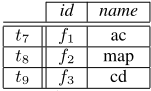
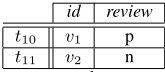
vendor
says that every offer must have a specification and a vendor. It also says that there cannot be two equivalent offers from the same company with different prices (represented via a special equality-generating dependency (EGD), which can be encoded as an NC [Cal`ı et al., 2012a]). We denote by t1 the term specs(s1↪ b↪ f1↪ o) and by t1 the tuple (s1↪ b↪ f1↪ o).
Conjunctive Query Answering. Given a Datalog+/- ontology O = (D↪ ⌃), we only consider answers that are true in all models of O. Formally, the set of answers to a CQ q w.r.t. D and ⌃ is ans(q↪D↪⌃) := TI2mods(D↪⌃) ¶a ♣ a2q(I)♦. The answer to a BCQ q is positive, denoted D [ ⌃ ♣= q, if ans(q↪D↪ ⌃) 6= ;. The problem of CQ answering is the following: given D, ⌃, and q as above and a tuple of constants a, decide whether a 2 ans(q↪D↪⌃). Following Vardi's taxonomy (1982), the combined complexity of CQ answering is calculated by considering all the components, i.e., the database, the set of dependencies, and the query, as part of the input. The bounded-arity combined (ba-combined) complexity is calculated by assuming that the arity of the underlying schema is bounded by a constant. In description logics (DLs) [Bienvenu and Ortiz, 2015], the arity is always bounded by 2. The fixed-program combined (fp-combined) complexity is calculated by considering the set of TGDs and NCs as fixed. Finally, for data complexity, we take only the size of the database into account.
2.2 Possibilistic Networks
We now recall possibilistic networks from [Ben Amor et al., 2014], which are a direct counterpart of Bayesian networks from probability theory, the main differences being that possibilities maximize (rather than summarize) over disjoint events (thus, in the normalized case, one often assumes that the maximum (rather than the sum) over all disjoint elementary events is 1), and we measure the degree of potential surprise of an event, as opposed to the degree of its likelihood.
Syntax. Let X be a finite set of variables with pairwise disjoint, non-empty, finite domains Dom(X), X 2X . A possibilistic network Γ defines a possibility distribution over X using a combination of a graphical and a data component. The former is a directed acyclic graph (DAG) G=(X↪ E), where E is a set of edges encoding conditional (in)dependencies between variables. The data component associates a normalized conditional possibility distribution ⇡(Xi ♣ pa(Xi)) to each Xi 2X, where pa(Xi) is the set of parents of Xi in G. The joint distribution over X = ¶X1↪ ▷ ▷ ▷ ↪ Xn♦ is then given by the chain rule [Ben Amor et al., 2014; Benferhat et al., 2000]:
where ⌦ denotes the product (resp., minimum) in a quantitative (resp., qualitative) setting.
Semantics. A value u for a set of variables U ✓ X assigns to each X2U an element u(X)2Dom(X), and the set of all such values u is called the domain of U, denoted Dom(U). The empty set has a single value, denoted >. Observe that Dom(X) and Dom(¶X♦) are isomorphic, and hence the notation is consistent. The values o2Dom(X) are called outcomes. For two outcomes o↪ o0 , we say that o dominates o0 (in Γ), denoted o≻o0 , if ⇡(o)>⇡(o0 ).
As long as there are no cyclic dependencies between variables or cyclic preferences over the same variable X under the same precondition u, one can encode a conditional preference theory into a possibilistic network [Ben Amor et al., 2014]: The conditional preference ' from above induces several directed edges in the DAG of the possibilistic network, one from each X2U' to X'. The conditional possibility measure must then be chosen such that ⇡(x♣u) > ⇡(x0 ♣u).
Encoding Conditional Preferences. A conditional preference [Ben Amor et al., 2014] has the form '=u: x≻x0 , where u 2Dom(U') for some U'✓X , and x↪ x02Dom(X') for some X' 2X - U'. The intention is that, given u and any t 2Dom(T'), where T' =X -U' - ¶X'♦, we prefer x over x0 . More formally, the outcome obtained from u, t, and x should dominate the one using x0 instead. A conditional preference theory P is a finite set of conditional preferences.
Example 3 Consider again the preference theory from Example 1: P = ¶>: n ≻ o↪ n: b ≻ c↪ o: c ≻ b♦, where X = ¶T↪ C♦, and the outcomes are denoted by nb, nc, ob, and oc. One possibilistic network expressing these conditional preferences is shown in Figure 1, where ↵↪ β↪ γ 2 (0↪ 1). To compare the outcomes, we compute their possibility values (using the quantitative semantics): ⇡(nb) = ⇡(b♣n) · ⇡(n) = 1, ⇡(oc) = ↵, ⇡(nc) = γ, and ⇡(ob) = ↵ · β. To obtain the desired total order nb ≻ oc ≻ nc ≻ ob, it thus suffices to choose the values such that ↵ > γ > ↵ · β.
3 OP-Nets
We now introduce ontological possibilistic networks (OPnets), which extend possibilistic networks by ontologies.
W.l.o.g., the set ∆N of nulls is the set of all ground terms constructed from the set ∆ of constants and a set F of functions used to skolemize all existential variables in TGDs. Let O=(D↪⌃) be a Datalog+/- ontology, and XO be a finite set of variables, where each X2XO corresponds to a predicate from O, denoted pred(X). Each Dom(X) consists of at least two ground atoms of the form p(c1↪ ▷ ▷ ▷ ck) with p=pred(X) and c1↪ ▷ ▷ ▷ ↪ ck 2 ∆ [ ∆N. Hence, every outcome o 2 Dom(XO) can be seen as a conjunction of ground atoms. An ontological possibilistic network (OP-net) is of the form (O↪ Γ), where Γ is a possibilistic network over XO.
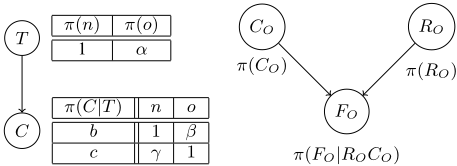
⇡(FO♣ROCO)
Figure 2: DAG for Example 4.
| ⇡(specs(t1)) | ⇡(specs(t2)) ⇡(specs(t3)) |
| 1 0▷5 | 0▷4 |
| ⇡(vendor(t10)) | ⇡(vendor(t11)) |
| 1 | 0▷4 |
| ⇡(·♣·) | t1t10 | t1t11 | t2t10 | t2t11 | t3t10 | t3t11 |
| feature(t7) | 1 | 0▷3 | 0▷2 | 0▷2 | 0▷2 | 0▷2 |
|---|---|---|---|---|---|---|
| feature(t8) | 0▷7 | 0▷5 | 0▷7 | 1 | 0▷4 | 0▷3 |
| feature(t9) | 0▷5 | 0▷3 | 0▷5 | 0▷3 | 1 | 0▷2 |
The possibility distribution could either be learned or derived from explicit preferences, as shown in Section 3.2 below. The possibilities of outcomes are then computed as follows:
For example, the outcome o given by o(CO) = specs(t1), o(RO)=vendor(t10), and o(FO)=feature(t7) encodes the conjunction t1 ^ t10 ^ t7 and has the possibility 1.
3.1 Consistency and Dominance
Since outcomes are conjunctions of ground atoms, some outcomes may be inconsistent, and some may be equivalent. This means that we need a notion of consistency for OP-nets.
An outcome o of (O↪ Γ) is consistent if the ontology Oo = O [ ¶o(X) ♣ X 2 XO♦ is consistent. Two outcomes o and o0 are equivalent, denoted o ⇠ o0 , if Oo and Oo0 have the same models. The dominance o ≺ o0 w.r.t. Γ is defined as in Section 2.2, and can be decided in polynomial time in the size of Γ by comparing the possibility values of o and o0 .
An interpretation I for (O↪ Γ) is a total preorder over the consistent outcomes in Dom(XO). It satisfies (or is a model of) (O↪ Γ) if, for all consistent outcomes o and o0 ,
- ÷ if o ≺ o0 , then (o↪ o0 ) 2 I and (o0 ↪ o) ◁2 I, and
- ÷ if o ⇠ o0 , then (o↪ o0 )↪ (o0 ↪ o) 2 I.
An OP-net is consistent if it has at least one consistent outcome and it has a model.
Theorem 1 An OP-net (O↪ Γ) is consistent iff (i) it has a consistent outcome, and (ii) there are no two equivalent consistent outcomes having different possibility values.
3.2 Encoding Preferences with OP-Nets
In [Di Noia et al., 2015], conditional preferences were generalized to the Datalog+/- setting as follows. Let Dom+(X) be the set of all atoms p(t1↪ ▷ ▷ ▷ ↪ tk), where each ti is a term over ∆, V, and F. An ontological conditional preference ' over X is of the form v : ⇠ ≻ ⇠ 0 , where
- ÷ ⇠↪ ⇠ 0 2 Dom+(X') for some X' 2 X -U'.
- ÷ v 2 Dom+(U') for some U' ✓ X, and
A ground instance v✓ : ⇠✓ ≻ ⇠ 0 ✓ of ' is obtained via a substitution ✓ such that v✓ 2 Dom(U') and ⇠✓↪ ⇠ 0 ✓ 2 Dom(X'). Under suitable acyclicity conditions, we can hence find an OP-net (O↪ Γ) that respects all ground instances of some given ontological conditional preferences in the same way as described in Section 2.2.
Example 5 Consider the ontological conditional preference specs(I↪C↪ F↪ o): vendor(V1↪ p)≻vendor(V2↪ n), which says that for an old car, it is preferable to have a vendor with positive feedback. One ground instance for this preference is specs(t1): vendor(t10)≻vendor(t11). Thus, we could choose ⇡(vendor(t10)♣specs(t1)) = 1 and ⇡(vendor(t11)♣ specs(t1)) = ↵ < 1.
Although possibilistic networks are less expressive than CPtheories [Di Noia et al., 2015], they allow for a compact encoding of conditional preferences over ground atoms and yield lower complexity bounds (see Section 5).
4 Query Answering under OP-Nets
Using the notions of consistency and dominance, we can define the semantics of query answering, as well as skyline and k-rank answers, in the context of OP-nets. We first formalize query answering for a given consistent OP-net (O↪ Γ). Since the semantics of OP-nets is similar to that of OCPtheories [Di Noia et al., 2015], the definitions are similar. Let q(X) = 9Yφ(X↪Y) be a CQ. To extract answers based on the outcomes of a possibilistic network, the atoms in the query must be related to the atoms in conditional preferences. For this purpose, we assume a bijection β from a set of atoms φβ(X↪Y) ✓ φ(X↪Y) in q to a set of variables of (O↪ Γ), such that for every atom p(Z) 2 φβ(X↪Y) there exists some variable X in (O↪ Γ) with pred(X) = p and β(p(Z)) = X. We collect in Yβ those quantified variables fromY that occur in the atoms φβ(X↪Y), and denote by Yβ the set of all remaining variables fromY. When φβ is empty, i.e., the query atoms are not related to the preferences, then the answers for the query are standard CQ answers w.r.t. O.
Definition 1 Let (O↪ Γ) with O = (D↪⌃) be a consistent OP-net, q(X) = 9Yφ(X↪Y) be a CQ, and o be a consistent outcome of (O↪ Γ). An answer to q w.r.t. (O↪ Γ) and o is a tuple a over ∆ [ ∆N for which there exists a homomorphism h: X [ Yβ ! ∆ [ ∆N with (i) h(X) = a, (ii) D [ ⌃ ♣= 9Yβ h(φ(X↪Y)), and (iii) h(a) = o(β(a)) for all a 2 φβ(X↪Y). The set of all such answers is denoted by ans(q↪ O↪ Γ↪ o).
We want to point out that 9Yβ h(φ(X↪Y)) is a BCQ that uses elements from∆[∆N [V as arguments in its atoms. In the following, we call such queries BCQ N s. Since the values of the homomorphism h on Yβ are determined by the outcome o, BCQ N answering w.r.t. o has the same complexity as classical BCQ N answering. k-rank answers are obtained by iteratively computing sets of skyline answers until k answers have been found. However, a tuple may be an answer under more than one outcome. To avoid repetition of answers, we need to keep track of exhausted outcomes and answers.
Definition 2 (Skyline Answer) A skyline answer to q w.r.t. (O↪ Γ) outside a given set Y ✓ Dom(XO) of outcomes is any tuple a 2 ans(q↪O↪ Γ↪ o) for some consistent outcome o ◁2 Y such that there exists no consistent outcome o0 ◁2 Y with o0 ≻ o and ans(q↪ O↪ Γ↪ o0 ) 6= ;. A skyline answer to q w.r.t. (O↪ Γ) is a skyline answer to q w.r.t. (O↪ Γ) and ;.
Example 6 Consider the consistent OP-net (O↪ Γ) of Example 4 and the CQ q(C↪ F↪ T↪ N) =9I specs(I↪ C↪ F↪ T ) ^ feature(F↪N). Then, hb, f1, o, aci is the skyline answer under the consistent outcome t1 ^ t10 ^ t7. The skyline answer for q0 (C↪ T) = 9N q(C↪ f2↪ T↪N) is hc, ni with possibility ⇡(t2t10t8) = 0▷5 · 1 · 0▷7 = 0▷35, while the 2-rank answer is hhc, ni, hc, oii. Hence, if feature f2 is mandatory, the offered new and colorful car is preferred over the old and colorful one, mainly due to positive feedback about vendor v1.
Definition 3 (k-Rank Answer) A k-rank answer to Q w.r.t. (O↪ Γ) outside Y and outside a given set of ground tuples S is a sequence ha1↪ ▷ ▷ ▷ ↪ aki such that either a1↪ ▷ ▷ ▷ ↪ ak are k skyline answers to Q w.r.t. (O↪ Γ) outside Y that do not belong to S; or a1↪ ▷ ▷ ▷ ↪ ai are all the skyline answers to Q w.r.t. (O↪ Γ) outside Y that do not belong to S and hai+1↪ ▷ ▷ ▷ ↪ aki is a (k - i)-rank answer to Q w.r.t. (O↪ Γ) outside Y [ ¶o♦ and S [ ¶a1↪ ▷ ▷ ▷ ↪ ai♦, where o is an undominated outcome w.r.t. (O↪ Γ). A k-rank answer to Q w.r.t. (O↪ Γ) is a k-rank answer to Q w.r.t. (O↪ Γ) outside ; and ;.
5 Computational Complexity
We now analyze the computational complexity of the following problems, and delineate some tractable special cases:
Consistency: Is a given OP-net (O↪ Γ) consistent?
CQ Skyline Membership: Is a tuple a over ∆[∆N a skyline answer to a CQ q w.r.t. an OP-net (O↪ Γ)?
5.1 Complexity Classes
We assume some familiarity with the complexity classes AC0 , P, NP, co-NP, ⌃P2 , ⇧P2 , PSPACE, EXP, and 2EXP. The class D P = NP ^ co-NP (resp., D P2 = ⌃P2 ^ ⇧P2 ) is the class of all problems that are the intersection of a problem in NP (resp., ⌃P2 ) and a problem in co-NP (resp., ⇧P2 ). The class ∆P2 (resp., ∆P3 ) is the class of all problems that can be computed in polynomial time with an oracle for NP (resp., ⌃P2 ). The above complexity classes and their inclusion relationships (which are all currently believed to be strict) are shown below:
5.2 Decidability Paradigms
The main (syntactic) conditions on TGDs that guarantee the decidability of BCQ answering are guardedness [Cal`ı et al., 2013], stickiness [Cal`ı et al., 2012b], and acyclicity. Interestingly, each such condition has its "weak" counterpart: weak guardedness [Cal`ı et al., 2013], weak stickiness [Cal`ı et al., 2012b], and weak acyclicity [Fagin et al., 2005], respectively.
A TGD σ is guarded if an atom a2body(σ) exists that contains (or "guards") all the body variables of σ. Linear TGDs have only one body atom (which is automatically a guard). Weakly guarded TGDs require only "harmful" body variables to appear in the guard. The associated classes are denoted G, L, andWG, respectively. Notice that L⇢G⇢WG.
A set ⌃ of TGDs is acyclic if its predicate graph is acyclic. In fact, an acyclic set of TGDs can be seen as nonrecursive. We say ⌃ is weakly acyclic if its dependency graph enjoys a certain acyclicity condition, which actually guarantees the existence of a finite canonical model. The associated classes are denoted A and WA, respectively. We have A⇢WA⇢WS.
Stickiness is inherently different from guardedness, and its central property is as follows: variables that appear more than once in a body (i.e., join variables) are always propagated (or "stick") to the inferred atoms. Weak stickiness is a relaxation of stickiness where only "harmful" variables are taken into account. Sets of TGDs that enjoy the above properties are sticky and weakly sticky, and the corresponding classes are denoted S and WS, respectively. Observe that S⇢WS.
Another key fragment of TGDs are full TGDs, i.e., TGDs without existentially quantified variables, and the corresponding class is denoted F. If full TGDs enjoy linearity, guardedness, stickiness, or acyclicity, then we obtain the classes LF, GF, SF, and AF, respectively. Note that F⇢WA and F⇢WG.
5.3 Overview of Results
Our complexity results for the consistency and the CQ skyline membership problem for OP-nets over the decidable Datalog+/- languages mentioned above are compactly summarized in Tables 3 and 4, respectively. Observe that compared to OCP-theories [Di Noia et al., 2015], we obtain lower complexities for L, LF, AF, G, S, F, GF, SF, WS, and WA in the fp-combined complexity (completeness for D P and ∆P2 , respectively, rather than PSPACE), and for L, LF, AF, S, F, GF, and SF in the ba-complexity (completeness for D P2 and ∆P3 , respectively, rather than PSPACE). Notice also that the complexity theorems below are generic results, applying also to Datalog+/- languages beyond the ones in Tables 3 and 4. Their proofs even apply to arbitrary preference formalisms, as long as dominance between two outcomes can be decided in polynomial time, e.g., rankings computed by information retrieval methods [Joachims, 2002].
5.4 Combined Complexity
We first show some generic upper bounds for the complexity of consistency and CQ skyline membership w.r.t. OP-nets.
Theorem 2 Let T be a class of OP-nets (O↪ Γ). If checking non-emptiness of the answer set of a CQ N w.r.t. O is in a complexity class C, then consistency in T is in NPC ^ co-NPC and CQ skyline membership in T is in P NPC. If C =NP and we consider the fp-combined complexity, then consistency in T is in D P and CQ skyline membership in T is in ∆P2 .
| Class | Comb. | ba-comb. | fp-comb. | Data |
|---|---|---|---|---|
| L, LF, AF | PSPACE | D P2 | D P | in AC0 |
| G | 2EXP | EXP | D P | P |
| WG | 2EXP | EXP | EXP | EXP |
| S, SF | EXP | D P2 | D P | in AC0 |
| F, GF | EXP | D P2 | D P | P |
| WS, WA | 2EXP | 2EXP | D P | P |
| Class | Comb. | ba-comb. | fp-comb. | Data |
|---|---|---|---|---|
| L, LF, AF | PSPACE | ∆P3 | ∆P2 | in AC0 |
| G | 2EXP | EXP | ∆P2 | P |
| WG | 2EXP | EXP | EXP | EXP |
| S, SF | EXP | ∆P3 | ∆P2 | in AC0 |
| F, GF | EXP | ∆P3 | ∆P2 | P |
| WS, WA | 2EXP | 2EXP | ∆P2 | P |
In particular, for C = PSPACE, we obtain inclusion in PSPACE for both problems, and the same for any deterministic complexity class above PSPACE. For C=NP, we get the classes D P2 and ∆P3 . The lower bounds PSPACE and above follow from consistency and equivalence of outcomes being as powerful as checking entailment of arbitrary ground BCQ N s.
Theorem 3 Let T be a class of OP-nets (O↪ Γ). If ground atomic BCQ N answering w.r.t. O is C-hard, where C ◆ PSPACE is a deterministic complexity class, then consistency and CQ skyline membership in T are C-hard.
The D P (resp., D P2 ) lower bound holds by a reduction from the validity problem of 8Y'(Y) ^ 9Y (Y) (resp., 9X8Y'(X↪Y) ^ 8X9Y (X↪Y)), where '(Y) (resp., '(X↪Y)) is a propositional 3-DNF formula, and (Y) (resp., (X↪Y)) is a propositional 3-CNF formula.
Theorem 4 For OP-nets whose underlying ontology is defined in a Datalog+/- language T that allows for NCs, deciding consistency is hard for D P (resp., D P2 ) in the fp-combined (resp., ba-combined) complexity.
The ∆P2 (resp., ∆P3 ) lower bound holds by a reduction from the problem of deciding, given a valid 9X (X) (resp., 9X8Y'(X↪Y)), where (X) (resp., '(X↪Y)) is a propositional 3-CNF (resp., 3-DNF) formula, whether the lexicographically maximal satisfying truth assignment for X= ¶x1↪ ▷ ▷ ▷ ↪ xn♦ maps xn to true [Krentel, 1988; 1992].
Theorem 5 For OP-nets whose underlying ontology is defined in a Datalog+/- language T that allows for NCs, deciding CQ skyline membership is hard for ∆P2 (resp., ∆P3 ) in the fp-combined (resp., ba-combined) complexity.
From the known complexity results for ontology languages of the Datalog+/- family (see, e.g., [Di Noia et al., 2015]), we obtain the complexity results w.r.t. combined, ba-combined, and fp-combined complexity listed in Tables 3 and 4.
5.5 Data Complexity
We now show that tractability in data complexity for deciding consistency and CQ skyline membership for OP-nets carries over from classical BCQN answering. Here, data complexity means that ⌃ and the variables and possibility distributions of Γ are both fixed, while D is part of the input.
Theorem 6 Let T be a class of OP-nets (O↪ Γ) for which BCQN answering in O is possible in polynomial time (resp., in AC0 ) in the data complexity. Then, deciding consistency and CQ skyline membership in T is possible in polynomial time (resp., in AC0 ) in the data complexity.
As a corollary, we obtain the data tractability results listed in the last column of Tables 3 and 4. Note that all memberships in P are also P-hard, due to a standard reduction of propositional logic programming to guarded full TGDs. These results do not apply to WG, where BCQN answering is data complete for EXP, and data hardness holds even for ground atomic BCQs; however, data completeness for EXP can be proved similarly to Theorems 2 and 3.
6 RelatedWork
Preferences have long been studied in many disciplines, prominently in philosophy, databases, and AI. One of the earliest works on modeling preferences in databases is [Lacroix and Lavency, 1987], which extends the relational calculus with preference modeling mechanisms for query answering. Since then, many approaches go in this direction [Stefanidis et al., 2011]. In AI, preference modeling is more concerned with compact representation and computational issues. In this regard, [Bienvenu et al., 2010] bridges the gaps between the two streams of preference modeling and suggests that most AI formalisms are fragments of a prototypical preference logic. CP-nets [Boutilier et al., 2004] are one of the most widely used preference representation languages. Possibilistic logic [Benferhat et al., 2001; Dubois and Prade, 2004] has recently also been discovered as a useful tool, and a lot of work has been done in bridging the differences between possibilistic logic and CP-nets [Dubois et al., 2013]. More recently, possibilistic networks [Ben Amor et al., 2014] have been advocated as a natural encoding of preferences. Having some computational and expressive benefits over CP-nets, possibilistic networks look very promising.
The work closest in spirit to this paper is perhaps [Di Noia et al., 2015], which is based on CP-theories [Wilson, 2004]. CP-theories admit preferences of the type "given c, we prefer a to b, irrespective of the value of W", which realize a weakening of the ceteris paribus condition. Although possibilistic networks do not allow for such indifference between values of some variables W, they are also based on a weakening of the ceteris paribus condition. This is because possibilistic networks represent total preorders of outcomes, based on the given conditional preferences and the choice of their relative importance (via their conditional possibility), which can only be expressed in possibilistic networks. CP-theories (and CP-nets), in contrast, can handle to some extent cyclic preference dependency graphs, while possibilistic networks assume that these graphs are acyclic. Possibilistic networks can also express certain types of preferences that CP-theories cannot, as we have seen in Example 1. Clearly, all these semantic properties of possibilistic networks, compared to CPtheories (and CP-nets), are inherited by OP-nets. Moreover, OP-nets sometimes have lower combined, ba-combined, and fp-combined complexity than OCP-theories [Di Noia et al., 2015], since consistency and dominance in CP-theories are already PSPACE-hard problems [Goldsmith et al., 2008]. In summary, OP-nets have advantages over OCP-theories, as they are computationally less expensive, while retaining most of the expressivity, and even allow representing some preferences that cannot be represented in OCP-theories.
Other combinations of Semantic Web formalisms with preference representation and reasoning include the work by Lukasiewicz and Schellhase [2007], which presents a system to rank-order ontologically annotated objects, using a ranking function based on conditional preferences. Lukasiewicz et al. [2013] focus on preference-based query answering on ontological data by extending Datalog+/- with preference management capabilities, called PrefDatalog+/-. Preferences in PrefDatalog+/- have the form of general first-order sentences, and so have a higher complexity. Data tractability results also hold only for disjunctions of atomic queries and not conjunctive queries. Di Noia et al. [2013] use ontological axioms to restrict CP-net outcomes. In information retrieval, in [Boubekeur et al., 2007], Wordnet is used to add semantics to CP-net variables. Possibilistic networks have also been used for information retrieval in [Boughanem et al., 2009], where the possibility and the necessity measure are used to evaluate (i) the extent to which a given document is relevant to a query, and (ii) the reasons of eliminating irrelevant documents.
7 Summary and Outlook
We have introduced OP-nets, which are a novel combination of Datalog+/- ontologies with possibilistic networks. We have then defined skyline and k-rank answers for this framework. Furthermore, we have provided a host of complexity (including several data tractability) results for deciding consistency and CQ skyline membership for OP-nets. Due to the lower (polynomial) complexity of dominance testing in possibilistic networks, compared to CP-theories, several resulting complexities for OP-nets are lower than for OCP-theories. The complexity results and these lower complexities are actually independent of possibilistic networks; they hold for all rankings on outcomes where each rank can be computed in polynomial time. For example, they are also applicable to combinations of Datalog+/- with rankings from information retrieval and machine learning [Joachims, 2002].
Interesting topics of ongoing and future research include the implementation and experimental evaluation of the presented approach, as well as a generalization based on possibilistic logic [Benferhat et al., 2002] to gain more expressivity and some new features towards nonmonotonic reasoning and belief revision [Ben Amor et al., 2014]; moreover, an apparent relation between possibilistic logic and quantitative choice logic [Benferhat et al., 2004] may also be exploited.
Acknowledgments. This work was supported by the UK EPSRC grants EP/J008346/1, EP/L012138/1, and EP/M025268/1, by a Google European Doctoral Fellowship, and by the grant PON02 00563 3470993 ("VINCENTE").
@inproceedings{ijcai2016p145,
  title     = {Preferential Query Answering over the Semantic Web with Possibilistic Networks},
  author    = {Borgwardt, Stefan and Fazzinga, Bettina and Lukasiewicz, Thomas and Shrivastava, Akanksha and Tifrea-Marciuska, Oana},
  booktitle = {Proceedings of the Twenty-Fifth International Joint Conference on
               Artificial Intelligence, {IJCAI-16}},
  publisher = {AAAI Press / International Joint Conferences on Artificial Intelligence},
  editor    = {Subbarao Kambhampati},
  pages     = {994--999},
  year      = {2016},
  month     = {7},
  url       = {https://ijcai.org/proceedings/2016/145},
}
TY - CPAPER TI - Preferential Query Answering over the Semantic Web with Possibilistic Networks AU - Borgwardt, Stefan AU - Fazzinga, Bettina AU - Lukasiewicz, Thomas AU - Shrivastava, Akanksha AU - Tifrea-Marciuska, Oana T2 - Proceedings of the Twenty-Fifth International Joint Conference on Artificial Intelligence, IJCAI-16 PB - AAAI Press / International Joint Conferences on Artificial Intelligence PY - 2016 SP - 994 EP - 999 UR - https://ijcai.org/proceedings/2016/145 ER -Copied
Machine-readable versions of this paper, for tools and AI agents:





