
Constructive Preference Elicitation by Setwise Max-Margin Learning
Proceedings of the Twenty-Fifth International Joint Conference on Artificial Intelligence. Pages 2067-2072.
Abstract
In this paper we propose an approach to preference elicitation that is suitable to large configuration spaces beyond the reach of existing state-of-the-art approaches. Our setwise max-margin method can be viewed as a generalization of max-margin learning to sets, and can produce a set of diverse items that can be used to ask informative queries to the user. Moreover, the approach can encourage sparsity in the parameter space, in order to favor the assessment of utility towards combinations of weights that concentrate on just few features. We present a mixed integer linear programming formulation and show how our approach compares favourably with Bayesian preference elicitation alternatives and easily scales to realistic datasets.
- [Ah-Pine et al., 2013] J. Ah-Pine, B. Mayag, and A. Rolland. Identification of a 2-additive bi-capacity by using math- ematical programming. In Algorithmic Decision Theory, pages 15-29. 2013.
- [Boutilier et al., 2006] C. Boutilier, R. Patrascu, P. Poupart, and D. Schuurmans. Constraint-based Optimization and Utility Elicitation using the Minimax Decision Criterion. Artifical Intelligence, 170:686-713, 2006.
- [Boutilier, 2002] C. Boutilier. A POMDP Formulation of Preference Elicitation Problems. In Proceedings of AAAI'02, pages 239-246, 2002.
- [Bradley and Terry, 1952] R. A. Bradley and M. E. Terry. Rank analysis of incomplete block designs: I. the method of paired comparisons. Biometrika, 39(3/4):324-345, 1952.
- [Braziunas and Boutilier, 2007] D. Braziunas and C. Boutilier. Minimax regret based elicitation of gen- eralized additive utilities. In Proceedings of UAI'07, pages 25-32, 2007.
- [Chajewska et al., 2000] U. Chajewska, D. Koller, and R. Parr. Making rational decisions using adaptive utility elicitation. In Proceedings of AAAI'00, pages 363-369, 2000.
- [Gajos and Weld, 2005] K. Gajos and D. Weld. Preference elicitation for interface optimization. In UIST, pages 173- 182, 2005.
- [Greco et al., 2008] S. Greco, V. Mousseau, and R. Słowiński. Ordinal regression revisited: multiple criteria ranking using a set of additive value functions. European Journal of Op- erational Research, 191(2):416-436, 2008.
- [Guo and Sanner, 2010] S. Guo and S. Sanner. Real-time multiattribute bayesian preference elicitation with pairwise comparison queries. In Proceedings of AISTAT'10, pages 289-296, 2010.
- [Hensinger et al., 2010] E. Hensinger, I. Flaounas, and N. Cristianini. Learning the preferences of news readers with svm and lasso ranking. In Artificial Intelligence Appli- cations and Innovations, pages 179-186. 2010.
- [Iyengar et al., 2001] V. S. Iyengar, J. Lee, and M. Campbell. Q-Eval: Evaluating multiple attribute items using queries. In Proceedings of the Third ACM Conference on Electronic Commerce, pages 144-153, 2001.
- [Jacquet-Lagrèze and Siskos, 1982] E. Jacquet-Lagrèze and Y. Siskos. Assessing a set of additive utility functions for multicriteria decision making: the UTA method. European Journal of Operational Research, 10:151-164, 1982.
- [Jacquet-Lagreze and Siskos, 2001] E. Jacquet-Lagreze and Y. Siskos. Preference disaggregation: 20 years of mcda experience. European Journal of Operational Research, 130(2):233-245, 2001.
- [Keeney and Raiffa, 1976] R. L. Keeney and H. Raiffa. De- cisions with Multiple Objectives: Preferences and Value Tradeoffs. John Wiley and Sons, New York, 1976.
- [Louviere et al., 2000] J. J. Louviere, Hensher D. A., and J. D. Swait. Stated Choice Methods: Analysis and Application. Cambridge University Press, Cambridge, 2000.
- [Minka, 2001] T. Minka. Expectation propagation for approx- imate bayesian inference. In Proceedings of UAI'01, pages 362-369, 2001.
- [Peintner et al., 2008] B. Peintner, P. Viappiani, and N. Yorke- Smith. Preferences in interactive systems: Technical chal- lenges and case studies. AI Magazine, 29(4):13-24, 2008.
- [R. et al., 2006] Herbrich R., Minka T., and Graepel T. Trueskill tm : A bayesian skill rating system. In Proceed- ings of NIPS'06, pages 569-576, 2006.
- [Reilly et al., 2007] J. Reilly, J. Zhang, L. McGinty, P. Pu, and B. Smyth. Evaluating compound critiquing recommenders: a real-user study. In Proceedings of the 8th ACM conference on Electronic commerce, pages 114-123. ACM, 2007.
- [Tibshirani, 1996] T. Tibshirani. Regression shrinkage and se- lection via the lasso. Journal of the Royal Statistical Society. Series B (Methodological), 58(1):267-288, 1996.
- [Torra and Narukawa, 2007] V. Torra and Y. Narukawa. Mod- eling decisions -information fusion and aggregation oper- ators. Springer, 2007.
- [Toubia et al., 2004] O. Toubia, J. R. Hauser, and D. I. Simester. Polyhedral methods for adaptive choice- based conjoint analysis. Journal of Marketing Research, 41(1):116-131, 2004.
- [Viappiani and Boutilier, 2010] P. Viappiani and C. Boutilier. Optimal bayesian recommendation sets and myopically op- timal choice query sets. In Proceedings of NIPS'10, pages 2352-2360, 2010.
- [Viappiani and Craig, 2009] P. Viappiani and B. Craig. Regret-based optimal recommendation sets in conversa- tional recommender systems. In Proceedings of RecSys'09, pages 101-108, 2009.
- [Wang and Boutilier, 2003] T. Wang and C. Boutilier. Incre- mental Utility Elicitation with the Minimax Regret Deci- sion Criterion. In Proceedings of IJCAI'03, pages 309-316, 2003. IJCAI
- [White III et al., 1984] C. C. White III, A. P. Sage, and S. Do- zono. A model of multiattribute decisionmaking and trade- off weight determination under uncertainty. IEEE Trans- actions on Systems, Man, and Cybernetics, 14(2):223-229, 1984.
- [Zhang and Huang, 2008] C.-H. Zhang and J. Huang. The sparsity and bias of the lasso selection in high-dimensional linear regression. Ann. Statist., 36(4):1567-1594, 08 2008.
References were extracted automatically from the PDF and may contain errors.
Full text extracted automatically from the PDF; figures, tables and equations may differ. The PDF is the version of record.
1 Introduction
Preferences [Peintner et al., 2008] play an important role in a variety of artificial intelligence applications and the task of eliciting or learning preferences is a crucial one; typically only limited information about the user's preferences will be available and the cost (cognitive or computational) of obtaining additional preference information will be high.
The automated assessment of preferences has received considerable attention, starting with pioneering works in the OR community, such as [White III et al., 1984] and especially the UTA methodology [Jacquet-Lagr`eze and Siskos, 1982] giving rise to a wide variety of extensions [JacquetLagreze and Siskos, 2001; Greco et al., 2008]. Within AI, a number researchers have proposed interactive methods that elicit preferences in an adaptive way [Chajewska et al., 2000; Boutilier, 2002; Wang and Boutilier, 2003; Boutilier et al., 2006; Guo and Sanner, 2010; Viappiani and Boutilier, 2010], observing that, by asking informative questions, it is often possible to make near-optimal decisions with only partial preference information.
While most works assume that items or decisions are available in a (possibly large) dataset, in this paper we propose an adaptive elicitation framework that takes a constructive view on preference elicitation, enlarging its scope from the selection of items among a set of candidates to the synthesis of entirely novel instances. Instances are solutions to a given
Paolo Viappiani
Sorbonne Universit´es UPMC Univ Paris 06 CNRS, LIP6 UMR 7606 Paris, France paolo.viappiani@lip6.fr
optimization problem; they are represented as combinations of basic elements (e.g. the components of a laptop) subject to a set of constraints (e.g. the laptop model determines the set of available CPUs). A utility function is learned over the feature representation of an instance, as customary in many preference elicitation approaches. The recommendation is then made by solving a constrained optimization problem in the space of feasible instances, guided by the learned utility.
Preference elicitation in configuration problems has been previously tackled with regret-based elicitation [Boutilier et al., 2006; Braziunas and Boutilier, 2007], where minimax regret is used both as a robust recommendation criterion and as a technique to drive elicitation. The main limitation of their approach is the lack of tolerance with respect to user inconsistency. Indeed, learning a user utility function requires to deal with uncertain and possibly inconsistent user feedback.
Bayesian preference elicitation approaches deal with this problem by building a probability distribution on candidate functions (endowed with a response or error model to be used for inference) and asking queries maximizing informativeness measures such as expected value of information (EVOI) [Chajewska et al., 2000; Guo and Sanner, 2010; Viappiani and Boutilier, 2010]. These approaches are however computationally expensive and can not scale to fully constructive scenarios, as shown in our experimental results.
We take a space decomposition perspective and jointly learn a set of weight vectors, each representing a candidate utility function, maximizing diversity between the vectors and consistency with the available feedback. These two conflicting objectives tend to generate equally plausible alternative hypotheses for the unknown utility. Our approach to elicitation works by combining weight vector learning with instance generation, so that each iteration of the algorithm produces two outcomes: a set of weight vectors and a set of instances, each maximizing its score according to one of the weight vectors. We evaluate the effectiveness of our approach by testing our elicitation method in both synthetic and realworld problems, and comparing it to state-of-the-art methods.
2 Background
We first introduce some notation. We use boldface letters x to indicate vectors, uppercase letters X for matrices, and calligraphic capital letters X for sets. We abbreviate the set ¶xi ♦ni=1 as ¶xi ♦ whenever the range of the index i is clear from the context, and use [n] as a shorthand for ¶1↪ ▷ ▷ ▷ ↪ n♦. We write kxk1 := Pz ♣xz♣ to indicate the `1 vector norm, h·↪ ·i for the usual dot product, X0 for matrix transposition.
We assume to have a multi-attribute feature space X of configurations x = (x1↪ ▷ ▷ ▷ ↪ xm) over m features. For the sake of simplicity we focus on binary features only, i.e. xz 2 ¶0↪ 1♦ for all z 2 [m], assuming a one-hot encoding of categorical features. This is a common choice for preference elicitation methods [Guo and Sanner, 2010; Viappiani and Boutilier, 2010]. Support for linearly dependent continuous features will be discussed later on.
We further assume that the set of feasible configurations, denoted by Xfeasible, is expressed as a conjunction of linear constraints. This allows to formulate both arithmetic and logical constraints, e.g. under the canonical mapping of True to 1 and False to 0, the Boolean disjunction of two binary variables x1 _ x2 can be rewritten as x1 + x2 ≥ 1.
Consistently with the experimental settings of previous work [Guo and Sanner, 2010; Viappiani and Boutilier, 2010], we model users with additive utility functions [Keeney and Raiffa, 1976]; the user's preferences are represented by a weight vector w 2 Rm and the utility of a configuration x is given by hw↪ xi = Pmz=1 wzxz. In the remainder of the paper we require all weights to be non-negative and bounded: the per-attribute weights wz must lie in a (constant but otherwise arbitrary) interval [w? z ↪w> z ], with w? z ≥ 0. Both requirements are quite natural 1 , and enable the translation of our core optimization problem into a mixed-integer linear problem (as done in Section 3).
During learning, the actual weight vector w is unknown to the learning system, and must be estimated by interacting with the user. We mostly focus on pairwise comparison queries, which are the simplest of the comparative queries. These can be extended to choice sets of more than two options [Viappiani and Craig, 2009; Viappiani and Boutilier, 2010] and are common in conjoint analysis [Louviere et al., 2000; Toubia et al., 2004]. For a pairwise comparison between two configurations x and x0 : either x is preferred to x0 (written x ≻ x0 ), x0 is preferred to x (x ≺ x0 ), or there is no clear preference between the two items (x ⇡ x0 ). We write D to denote the set of preferences (answers to comparison queries) elicited from the user.
In the next Section we describe how informative queries can be generated using our setwise maxmargin learning.
3 Setwise Max-margin Learning
Non-linear Formulation. We first introduce the problem formulation as a non-linear optimization problem, and then show how to reduce it to a mixed integer linear program.
The goal of our setwise max-margin approach is twofold. First, for any given set size k ≥ 1, we want to find a set of k weight vectors w1 ↪ ▷ ▷ ▷ ↪wk , chosen so that all userprovided preferences are satisfied by the largest possible margin (modulo inconsistencies) and so that they are maximally diverse. Second, we want to construct a set of k configurations x1 ↪ ▷ ▷ ▷ ↪ xk , so that each configuration xi is the "best" possible option when evaluated according to the corresponding wi and configurations are maximally diverse among each other. These options will be later used to formulate queries.
1 Utility values are defined on an interval scale, thus it is always possible to scale the values appropriately (see for instance [Torra and Narukawa, 2007] and [Keeney and Raiffa, 1976]).
The first goal is achieved by translating all pairwise preferences D into ranking constraints: preferences of the form yh+ ≻ yh- become linear inequalities of the form hwi ↪ yh+ - yh-i ≥ θ, where θ is the margin variable (which we aim at maximizing) and h ranges over the responses. Non-separable datasets, which occur in practice due to occasional inconsistencies in user feedback, are handled by introducing slack variables (whose sum we aim at minimizing) in a way similar to UTA and its extensions [Jacquet-Lagr`eze and Siskos, 1982; Greco et al., 2008]. When augmented with the slacks, the above inequalities take the form hwi ↪ yh+ - yh-i ≥ θ - "ih where "ih is the penalty incurred by weight vector wi for violating the margin separation of pair h. Indifference preferences, i.e. yh1 ⇡ yh2 , are translated as ♣hwi ↪ yh1 - yh2 i♣ < "ih ; the slack increases with the difference between the estimated utility of the two options.
The second goal requires to jointly maximize the utility of each xi according to its corresponding weight vector wi and its scoring difference with respect to the other configurations xj in the set. We achieve this by maximizing the sum of utilities Pki=1 hwi ↪ xi i and adding ranking constraints of the form hwi ↪ xi - xj i ≥ θ for all i↪ j 2 [k], i 6= j.
A straightforward encoding of the above desiderata leads to the following mixed integer non-linear optimization problem over the non-negative margin θ 2 R≥0 and vectors ¶wi 2 Rm♦, ¶xi 2 ¶0↪ 1♦m♦:
Let us illustrate the above piece by piece. The objective is composed of four parts: we maximize the shared margin θ (first part) and minimize the total sum of the ranking errors "i incurred by each weight vector wi (second part), while at the same time regularizing the magnitude of the weights (third part) and the quality of the configurations ¶xi ♦ (last part). The non-negative hyperparameters ↵↪ β↪ γ control the influence of the various components. The weight regularization term copes with the common scenario in which the user has strong preferences about some attributes, but is indifferent to most of them. The `1 penalty is frequently used to improve the sparsity of learned models [Tibshirani, 1996; Zhang and Huang, 2008; Hensinger et al., 2010], with consequent gains in generalization ability and efficiency, as confirmed by our empirical findings (see Section 4). Constraint (1) enforces the correct ranking of the observed user preferences, while (2) ensures that the generated configurations are diverse in terms of the weight vectors they maximize. Constraints (3) and (4) ensure that the weights and configurations are feasible and guarantees the non-negativity of the slacks. Since we require w? ≥ (0↪ ▷ ▷ ▷ ↪ 0), Eq. (3) also enforces the weights to be non-negative.
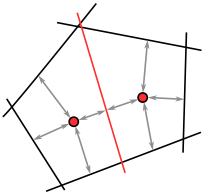
Note that we are choosing the configurations ¶xi ♦ and the weight vectors ¶wi ♦ simultaneously. We look for wi so that the utility loss (see constraint 2) of choosing xj instead of xi , j 6= i, is large (at least θ). Look at Figure 1, where, for simplicity, we need to choose a pair (k = 2). Eq. 2 is represented by a red line, that partitions the space of feasible utility weights in two parts (in general, there will be k subregions). Since we maximize the margin θ, the optimizer will prefer a set of configurations ¶x1 ↪ x2 ♦ that partitions the weight space in an "even" way. 2 In each subregion, we have corresponding wi lying "close" to its centre. If, for example, the user indicates a preference for x1 over x2 , the feasible region will then become the part of the polytope to the left of the red line; moreover the vector w1 will maximize the margin in the classic (k = 1) sense in the new feasible region.
MILP Formulation. This initial formulation is problematic to solve, as Eq. (2) involves quadratic terms over mixed continuous integer variables. However, the problem can be reformulated as a mixed integer linear program (MILP) by a suitable transformation. This technique is rather common in operational research, see e.g. [Boutilier et al., 2006].
Our goal is to replace Eq. (2) with a set of linear constraints. In order to do so, we introduce a set of fresh variables pi↪j z for every i↪ j 2 [k] and z 2 [m]. Assuming for the time being that the new variables do satisfy the equation pi↪j z = wiz xjz , we rewrite the fourth component of the objective function in terms of the new variables as:
and, similarly, Eq. (2) as:
2 This bears similarity with volumetric approaches [Iyengar et al., 2001], but there are important differences: first here we consider real items to find the best separator, second the margin is also expressed in utility terms, third the query is found via an optimization process.
The fact that pi↪j z = wiz xjz is achieved by setting the following additional constraints. We distinguish between two cases: (i) pi↪i z and (ii) pi↪j z for i 6= j. Recall that we are maximizing the margin θ. Now, due to Eq. (5), the optimizer will try to keep pi↪i z as large as possible and pi↪j z as small as possible.
(Case i) We add an explicit upper bound: pi↪i z min¶wmaxxiz ↪wiz ♦, where wmax is a sufficiently large constant. On one hand, if xiz = 0 the product wiz xiz evaluates to 0, and so does the upper bound wmaxxiz = 0. On the other hand, if xiz = 1 then the product wiz xiz amounts to wiz , while the upper bound reduces to min¶wmax↪ wiz ♦. By taking a sufficiently large constant wmax (e.g. wmax := maxz w> z ) the upper bound simplifies to wiz . Since pi↪i z is being maximized, in both cases it will attain the upper bound, and thus satisfy pi↪j z = wiz xiz .
(Case ii) We add an explicit lower bound: pi↪j z ≥ max¶0↪wiz - wmax(1 - xjz )♦. If xjz = 1 the lower bound simplifies to max¶0↪wiz ♦ = wiz , due to the non-negativity of wiz . Otherwise, if xjz = 0 then the lower bound becomes max¶0↪ wiz -wmax♦, where the second term is at most 0. Since pi↪j z is being minimized, in both cases it will attain the lower bound, and thus satisfy pi↪j z = wiz xjz . 3
We thus obtain the following mixed-integer linear problem:
which can be solved by any suitable MILP solver.
Set-wise max-margin. The full SETMARGIN algorithm follows the usual preference elicitation loop. Starting from an initially empty set of user responses D, it repeatedly solves the MILP problem above using D to enforce ranking constraints on the weight vectors ¶wi ♦. The generated configurations ¶xi ♦, which are chosen to be as good as possible with respect to the estimated user preferences, and as diverse as possible, are then employed to formulate a set of user queries. The new replies are added to D and the whole procedure is repeated. Termination can be after a fixed number of iterations, when the difference between utility vectors is very small, or might be left to the user to decide (e.g. [Reilly et al., 2007]).
The procedure is sketched in Algorithm 1. Note that at the end of the preference elicitation procedure, a final recommendation is made by solving the MILP problem for k = 1.
3 Since θ is upper-bounded by Eq. (1), in some cases the pi↪j z variables do not attain the lower bound. As a consequence, the MILP reformulation of Eq. (2) is a (tight) approximation of the original one. This has no impact on the quality of the solutions.
Algorithm 1 The SETMARGIN algorithm. Here k is the set size, ↵↪ β↪ γ are the hyperparameters, and T is the maximum number of iterations. The values of Xfeasible, w> and w? are left implicit.
1: procedure SETMARGIN(k↪ ↵↪ β↪ γ↪ T) 2: D ; 3: for t = 1↪ ▷ ▷ ▷ ↪ T do 4: ¶wi ↪ xi ♦ki=1 SOLVE(D↪ k↪ ↵↪ β↪ γ) 5: for xi ↪ xj 2 ¶x1 ↪ ▷ ▷ ▷ ↪ xk ♦ s.t. i < j do 6: D D[ QUERYUSER(xi ↪ xj ) 7: end for 8: end for 9: w⇤ ↪ x⇤ SOLVE(D↪ 1↪ ↵↪ β↪ γ) 10: return w⇤ ↪ x⇤ 11: end procedureLinearly dependent real attributes. In many domains of interest, items are composed of both Boolean and real-valued attributes, where the latter depend linearly on the former. This is for instance the case for the price, weight and power consumption of a laptop, which depend linearly on the choice of components. In this setting, configurations are composed of two parts: x = (xB; xR), where xB is Boolean and xR is real-valued and can be written as xR = CxB for an appropriately sized non-negative cost matrix C. It is straightforward to extend the MILP formulation to this setting. We rewrite the weight vector as w = (wB; wR). The utility becomes:
The generalized problem is obtained by substituting wi with vi := wiB + C 0wiR. All constraints remain the same. The only notable change occurs in Eq. (9), which becomes:
4 Experiments
We implemented the SETMARGIN algorithm using Python, leveraging Gurobi 6.5.0 for solving the core MILP problem. Both the SETMARGIN source code and the full experimental setup are available at https://github.com/stefanoteso/setmargin.
We compare SETMARGIN against three state-of-the-art Bayesian approaches: i) the Bayesian approach from [Guo and Sanner, 2010], selecting queries according to restricted informed VOI (RIVOI), a computationally efficient heuristic approximation of value-of-information, and inference using TrueSkillTM [R. et al., 2006] (based on expectation propagation [Minka, 2001]); ii) the Bayesian framework of [Viappiani and Boutilier, 2010] using Monte Carlo methods (with 50,000 particles) for Bayesian inference and asking choice queries (i.e. selection of the most preferred item in a set) selected using a greedy optimization of Expected Utility of a Selection (a tight approximation of EVOI, hereafter just called EUS); iii) Query Iteration (referred as QI below), also from [Viappiani and Boutilier, 2010], an even faster query selection method based on sampling sets of utility vectors.
We adopt the indifference-augmented Bradley-Terry user response model introduced in [Guo and Sanner, 2010]. The probability that a user prefers configuration xi over xj is defined according to the classical (without indifference) Bradley-Terry model [Bradley and Terry, 1952] as (1 + exp(-λ1hw↪ xi - xj i))-1 , where w is the weight vector of the true underlying user utility. Support for indifference is modelled as an exponential distribution over the closeness of the two utilities, i.e. exp(-λ2♣hw↪ xi - xj i♣)▷ The parameters λ1 and λ2 were set to one for all simulations, as in [Guo and Sanner, 2010].
In all experiments SETMARGIN uses an internal 5-fold cross-validation procedure to update the hyperparameters ↵, β, and γ after every 5 iterations. The hyperparameters are chosen as to minimize the ranking loss over the user responses collected so far. ↵ is taken in ¶20↪ 10↪ 5↪ 1♦, while β and γ are taken in ¶10↪ 1↪ 0▷1↪ 0▷001♦. 4
Synthetic Dataset. Following the experimental protocol in [Guo and Sanner, 2010] and [Viappiani and Boutilier, 2010], in the first experiment we evaluate the behavior of the proposed method in an artificial setting with increasingly complex problems. We developed synthetic datasets with r attributes, for increasing values of r. Each attribute takes one of r possible values, so that the one-hot encoding of attributes results in m = r2 features. In terms of space of configurations, for r = 3 the synthetic dataset corresponds to Xfeasible = [3] ⇥ [3] ⇥ [3], for r = 4 to Xfeasible = [4] ⇥ [4] ⇥ [4] ⇥ [4], and so on. The cardinality of Xfeasible is rr , and grows (super) exponentially with r. For r = 3, the dataset is comparable in size to the synthetic one used in [Guo and Sanner, 2010] and [Viappiani and Boutilier, 2010]. For larger r the size of the space grows much larger than the ones typically used in the Bayesian preference elicitation literature, and as such represents a good testbed for comparing the scalability of the various methods. The feasible configuration space was encoded in SETMARGIN through appropriate MILP constraints, while the other methods require all datasets to be explicitly grounded. Users were simulated by drawing 20 random utility vectors from each of four different distributions. The first two mimic those used in [Guo and Sanner, 2010] : (1) a uniform distribution over [1↪ 100] for each individual weight, and (2) a normal distribution with mean 25 and standard deviation 25 3 (each attribute is sampled i.i.d). We further produced two novel sparse versions of the uniform and normal distributions setting to zero 80% of the entries (sampled uniformly at random). We set a maximum budget of 100 iterations for all methods for simplicity.
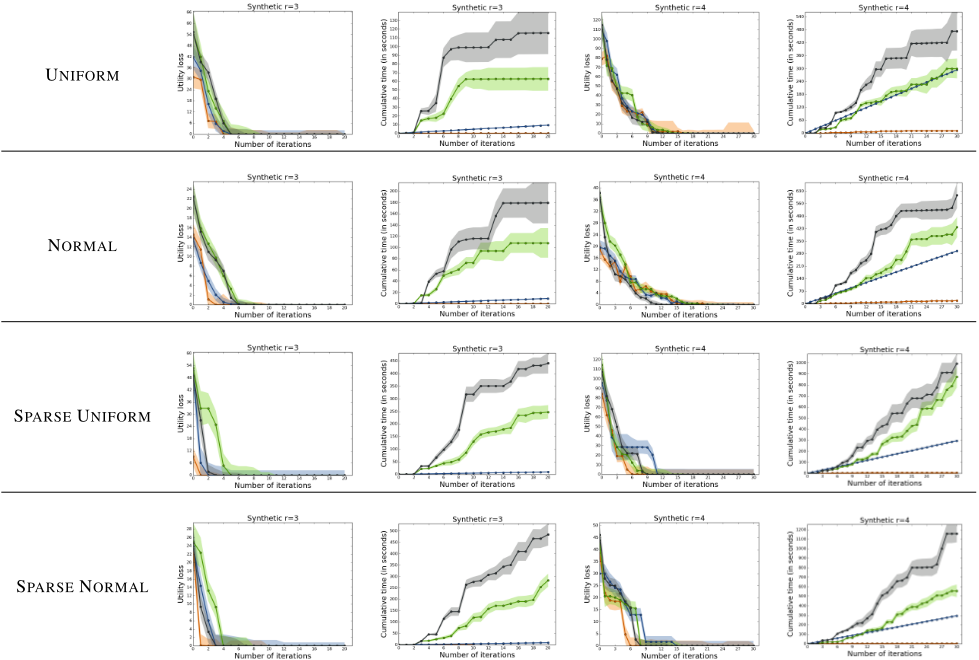
In Figure 2 we report solution quality and timing values for increasing number of collected user responses, for the different competitors on each of the four different utility vector distributions and datasets r = 3 and r = 4. Solution quality is measured in terms of utility loss maxx2Xfeasible (u(x) -u(x⇤ )), where u(·) is the true unknown user utility, and x⇤ is the solution recommended to the user after the elicitation phase (see Algorithm 1). Computational cost is measured in terms of cumulative time. Given that RIVOI, QI and EUS are single-threaded, we disabled multi-threading when running our algorithm in these comparisons. All experiments were run on a 2.8 GHz Intel Xeon CPU with 8 cores and 32 GiB of RAM. For all algorithms, one iteration corresponds to a single pairwise query (we used SETMARGIN with k = 2). For dense weight vector distributions (first two rows), our approach achieves results which are indistinguishable from the competitors in a fraction of their time. Indeed, all Bayesian approaches become quickly impractical for growing values of r, while our algorithm can easily scale to much larger datasets, as will be shown later on. For sparse weight vector distributions (last two rows) our approach, in addition to being substantially faster on each iteration, requires less queries in order to reach optimal solutions. This is an expected result as the sparsification norm in our formulation (kwk1) is enforcing sparsity in the weights, while none of the other approaches is designed to do this.
4 Note that for k = 1 Eq. (7) and Eq. (8) disappear, so ↵ can not be taken to be less than 1, as in this case, the objective can be increased arbitrarily while keeping the right-hand side of Eq. (1) constant, rendering the problem unbounded.
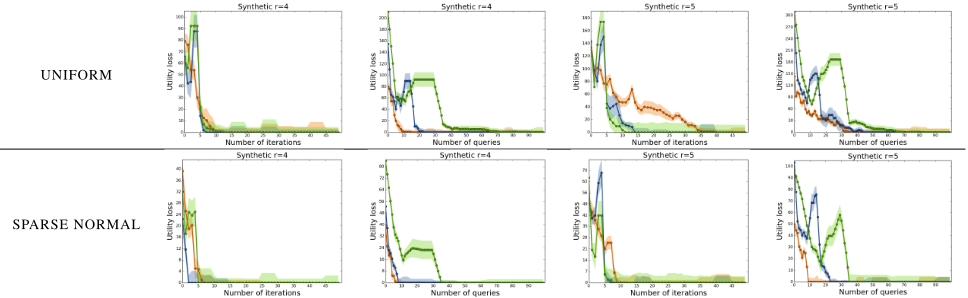
In order to study the effect of increasing the number of weight vectors in our formulation, we also ran SETMARGIN varying the parameter k. Figure 3 reports utility loss results on r=4 and r=5 datasets for the uniform and sparse normal distributions (the toughest and the simplest, for space limitations). The first and third columns report results in terms of number of iterations. It can be seen that increasing the number of weight vectors tends to favour earlier convergence, especially for the more complex dataset (r = 5). However, as in each iteration the user is asked to compare k items, different values of k imply a different cognitive effort for the user. The second and fourth columns report results in terms of number of queries, where we count all (k2) pairs of queries when comparing k items. In this case, k = 2 seems to be the best option. The cognitive cost for the user will likely lay in between these two extremes, but formalizing this concept in an efficient query ordering strategy needs to face the effect of noise. A modified sorting algorithm asking only O(k log k) queries to the user resulted in a performance worsening, likely because of a cascading effect of inconsistent feedback (but could be beneficial with different noise levels).
Constructive dataset. Next, we tested SETMARGIN on a truly constructive setting. We developed a constructive version of the PC dataset used in [Guo and Sanner, 2010]: instead of explicitly enumerating all possible PC items, we defined the set of feasible configurations with MILP constraints.

A PC configuration is defined by eight attributes: computer type (laptop, desktop, or tower), manufacturer (8 choices), CPU model (37), monitor size (8), RAM amount (10), storage (10) size, and price. The price attribute is defined as a linear combination of the other attributes: this is a fair modeling choice, as often the price of a PC is well approximated by the sum of the price of its components plus a bias due to branding. Interactions between attributes are expressed as Horn clauses (e.g. a certain manufacturer implies a set of possible CPUs). The dataset includes 16 Horn constraints (the full list is omitted for space limitations). Note that the search space is of the order of hundreds of thousands of candidate configurations, and is far beyond reach of existing Bayesian approaches.
Figure 4 reports results of SETMARGIN varying k using the sparse uniform distribution (the more complex of the sparse ones, dense distributions being unrealistic in this scenario). The first and third column report utility loss for increasing number of iterations and queries respectively, showing a behaviour which is similar to the one in Figure 3. Overall, between 50 and 70 queries on average are needed in order to find a solution which is only 10% worse than the optimal one, out of the more than 700,000 thousands available. Note that a vendor may ensure a considerably smaller number of queries by cleverly constraining the feasible configuration space; since our primary aim is benchmarking, we chose not to pursue this direction further. The second and fourth columns report cumulative times. Note that in some cases, standard deviations have a bump; this is due to cases in which some of the hyperparameters of the internal cross validation result in ill-conditioned optimization problems which are hard to solve. These exceptions can be easily dealt with by setting an appropriate timeout on the cross validation without affecting the results, as these hyperparameters typically end up having bad performance and being discarded.
5 Conclusion
We presented a max-margin approach for efficient preference elicitation in large configuration spaces. 5 Our approach relies on an extension of max-margin learning to sets, and is effective in the generation of a diverse set of configurations that can be used to ask informative preference queries. The main advantages of this elicitation method are 1) ability to provide recommendations in large configuration problems 2) robustness with respect to erroneous feedback and 3) ability to encourage sparse utility functions. Experimental comparisons against state-of-the-art Bayesian preference elicitation strategies confirm these advantages. Future work includes extending the approach to truly hybrid scenarios (where real valued attributes do not depend on categorical ones) and studying its applicability to other problems, as the identification of Choquet models [Ah-Pine et al., 2013].
5 Note that max-margin learning has been proposed before [Gajos and Weld, 2005] for preference elicitation, but with rudimental methods for query selection.
Acknowledgments ST was supported by the Caritro Foundation through project E62I15000530007. PV was supported by the Idex Sorbonne Universit´es under grant ANR11-IDEX-0004-02. We thank Craig Boutilier for motivating discussion on the topic.
@inproceedings{ijcai2016p295,
  title     = {Constructive Preference Elicitation by Setwise Max-Margin Learning},
  author    = {Teso, Stefano and Passerini, Andrea and Viappiani, Paolo},
  booktitle = {Proceedings of the Twenty-Fifth International Joint Conference on
               Artificial Intelligence, {IJCAI-16}},
  publisher = {AAAI Press / International Joint Conferences on Artificial Intelligence},
  editor    = {Subbarao Kambhampati},
  pages     = {2067--2072},
  year      = {2016},
  month     = {7},
  url       = {https://ijcai.org/proceedings/2016/295},
}
TY - CPAPER TI - Constructive Preference Elicitation by Setwise Max-Margin Learning AU - Teso, Stefano AU - Passerini, Andrea AU - Viappiani, Paolo T2 - Proceedings of the Twenty-Fifth International Joint Conference on Artificial Intelligence, IJCAI-16 PB - AAAI Press / International Joint Conferences on Artificial Intelligence PY - 2016 SP - 2067 EP - 2072 UR - https://ijcai.org/proceedings/2016/295 ER -Copied
Machine-readable versions of this paper, for tools and AI agents:





