
Weight Features for Predicting Future Model Performance of Deep Neural Networks
Proceedings of the Twenty-Fifth International Joint Conference on Artificial Intelligence. Pages 2231-2236.
Abstract
Deep neural networks frequently require the careful tuning of model hyper parameters. Recent research has shown that automated early termination of underperformance runs can speed up hyper parameter searches. However, these studies have used only learning curve for predicting the eventual model performance. In this study, we propose using weight features extracted from network weights at an early stage of the learning process as explanation variables for predicting the eventual model performance. We conduct experiments on hyper parameter searches with various types of convolutional neural network architecture on three image datasets and apply the random forest method for predicting the eventual model performance. The results show that use of the weight features improves the predictive performance compared with use of the learning curve. In all three datasets, the most important feature for the prediction was related to weight changes in the last convolutional layers. Our findings demonstrate that using weight features can help construct prediction models with a smaller number of training samples and terminate underperformance runs at an earlier stage of the learning process of DNNs than the conventional use of learning curve, thus facilitating the speed-up of hyper parameter searches.
- [Bengio, 2000] Yoshua Bengio. Gradient-based opti- mization of hyperparameters. Neural computation, 12(8):1889-1900, 2000.
- [Bergstra and Bengio, 2012] J. Bergstra and Y. Bengio. Ran- dom search for hyper-parameter optimization. Journal of Machine Learning Research, 13, 2012.
- [Bergstra et al., 2013] James Bergstra, Daniel Yamins, and David Cox. Making a science of model search: Hyperpa- rameter optimization in hundreds of dimensions for vision architectures. In Proceedings of The 30th International Conference on Machine Learning, pages 115-123, 2013.
- [Bottou, 2012] Léon Bottou. Stochastic gradient descent tricks. In Neural Networks: Tricks of the Trade, pages 421-436. Springer, 2012.
- [Breiman, 2001] Leo Breiman. Random forests. Machine Learning, 45(1):5-32, 2001.
- [Deng and Yu, 2014] L. Deng and D. Yu. Deep learning: Methods and applications. Foundations and Trends in Sig- nal Processing, 7, 2014.
- [Domhan et al., 2015] T. Domhan, J. T. Springenberg, and F. Hutter. Speeding up automatic hyperparameter op- timization of deep neural networks by extrapolation of learning curves. In Proceedings of the 24th International Joint Conference on Artificial Intelligence, 2015. IJCAI
- [Glorot and Bengio, 2010] Xavier Glorot and Yoshua Ben- gio. Understanding the difficulty of training deep feed- forward neural networks. In International conference on artificial intelligence and statistics, pages 249-256, 2010.
- [Hara et al., 2014] S. Hara, R. Raymond, T. Morimura, and H. Muta. Predicting halfway through simulation: Early scenario evaluation using intermediate features of agent- based simulations. In Proceedings of the Winter Simula- tion Conference, pages 334-343, 2014.
- [Hinton et al., 2012a] Geoffrey Hinton, Li Deng, Dong Yu, George E Dahl, Abdelrahman Mohamed, Navdeep Jaitly, Andrew Senior, Vincent Vanhoucke, Patrick Nguyen, Tara N Sainath, et al. Deep neural networks for acous- tic modeling in speech recognition: The shared views of four research groups. IEEE Signal Processing Magazine, 29(6):82-97, 2012.
- [Hinton et al., 2012b] Geoffrey E Hinton, Nitish Srivastava, Alex Krizhevsky, Ilya Sutskever, and R. R. Salakhutdinov. Improving neural networks by preventing co-adaptation of feature detectors. arXiv preprint arXiv:1207.0580, 2012.
- [Jia et al., 2014] Yangqing Jia, Evan Shelhamer, Jeff Don- ahue, Sergey Karayev, Jonathan Long, Ross Girshick, Ser- gio Guadarrama, and Trevor Darrell. Caffe: Convolutional architecture for fast feature embedding. In Proceedings of the ACM International Conference on Multimedia, pages 675-678, 2014.
- [Krizhevsky et al., 2012] Alex Krizhevsky, Ilya Sutskever, and Geoffrey E Hinton. ImageNet classification with deep convolutional neural networks. In Advances in neural in- formation processing systems, pages 1097-1105, 2012.
- [Krizhevsky, 2009] Alex Krizhevsky. Learning multiple lay- ers of features from tiny images. Master's thesis, Univer- sity of Toronto, 2009.
- [LeCun et al., 1998] Yann LeCun, Léon Bottou, Yoshua Bengio, and Patrick Haffner. Gradient-based learning ap- plied to document recognition. Proceedings of the IEEE, 86(11):2278-2324, 1998.
- [Nair and Hinton, 2010] Vinod Nair and Geoffrey E Hinton. Rectified linear units improve restricted boltzmann ma- chines. In Proceedings of the 27th International Confer- ence on Machine Learning, pages 807-814, 2010.
- [Russakovsky et al., 2015] Olga Russakovsky, Jia Deng, Hao Su, Jonathan Krause, et al. ImageNet large scale vi- sual recognition challenge. International Journal of Com- puter Vision, 115(3):211-252, 2015.
- [Schmidhuber, 2015] J. Schmidhuber. Deep learning in neu- ral networks: An overview. Neural Networks, 61:85-117, 2015.
- [Snoek et al., 2012] Jasper Snoek, Hugo Larochelle, and Ryan P Adams. Practical bayesian optimization of ma- chine learning algorithms. In Advances in neural informa- tion processing systems, pages 2951-2959, 2012.
- [Strobl et al., 2007] Carolin Strobl, Anne-Laure Boulesteix, Achim Zeileis, and Torsten Hothorn. Bias in random forest variable importance measures: Illustrations, sources and a solution. BMC Bioinformatics, 8(1):1-21, 2007.
- [Swersky et al., 2014] Kevin Swersky, Jasper Snoek, and Ryan Prescott Adams. Freeze-thaw bayesian optimization. arXiv preprint arXiv:1406.3896, 2014.
References were extracted automatically from the PDF and may contain errors.
Full text extracted automatically from the PDF; figures, tables and equations may differ. The PDF is the version of record.
1 Introduction
Deep neural networks (DNNs) continue to deliver state-ofthe-art performances on a variety of machine learning tasks such as image processing [Krizhevsky et al., 2012] and speech recognition [Hinton et al., 2012a]. The parameters of the DNN, called network weights, are trained using backpropagation, unsupervised learning, or other discriminative algorithms [Schmidhuber, 2015].
While DNNs have enjoyed many successes, it is well known that they are difficult to optimize, especially for nonexperts. The difficulty mostly comes from the fact that the performance of the DNN heavily depends on the setting of model hyperparameters [Snoek et al., 2012] that include the learning rate, the number of layers, the dropout parameters [Hinton et al., 2012b], and the selection of activation functions [Nair and Hinton, 2010]. One needs to carefully tune the hyperparameters by either manual control or an automated method. There are already several approaches to automated hyperparameter optimization, including a simple grid search, the gradient search [Bengio, 2000], random search with a low effective dimensionality [Bergstra and Bengio, 2012], and Bayesian optimization [Snoek et al., 2012; Bergstra et al., 2013]. While these automated methods can outperform human experts in terms of optimization of the model performance, they require many long training runs until they are convergent and usually come at a high computational cost.
In contrast, human experts can make the optimization more efficient by terminating a simulation run as soon as possible if the run seems to do poorly. In recent years, an automated early termination approach has been proposed in which the eventual model performance at the end of the learning process is predicted [Hara et al., 2014; Swersky et al., 2014; Domhan et al., 2015]. This previous study reported that early termination combined with hyperparameter optimization methods can speed up hyperparameter searches almost two-fold [Domhan et al., 2015]. However, previous research on this topic has been limited to use of the model performance history, which is called the learning curve, and has not examined any other features related to neural networks such as network weights or their changes.
In this study, we propose the use of features extracted from network weights for predicting the eventual model performance of DNNs and compare the prediction performance with the use of learning curve. We conducted hyperparameter searches of DNNs with various types of hyperparameter on three popular datasets for image recognition: the MNIST [LeCun et al., 1998], CIFAR-10 [Krizhevsky, 2009], and ImageNet 2012 datasets [Russakovsky et al., 2015]. Through the experiments, we demonstrate how the use of weight features improves the prediction performance and what kinds of weight feature mainly contribute to this improvement.
2 Prediction of future model performance
We predict the eventual model performance of DNNs using features that can be calculated from the DNNs at an early stage of the learning process. We train n DNNs with different hyperparameters until epoch T , where T is the last epoch of the learning iterations for updating weight parameters. We then obtain n pairs of the eventual model performances at epoch T and features calculated from the DNNs until epoch t (t ⌧ T). Here, n is the training sample number for a prediction model and t is the pre-run epoch for DNNs. We next construct a model that predicts the eventual model performance using the features as explanation variables. In this study, we propose novel features for the explanation variables of the prediction model for the eventual model performance, which are extracted from network weights. We finally evaluate the predictive performance by comparing this model with the conventional approach in which the prediction model uses learning curves as the explanation variables. Better features for the prediction model make it possible to save the number of training samples n and accomplish target predictive accuracies at an earlier stage of the learning process t of DNNs, which will enable more efficient search of the hyperparameters of DNNs.

Here, we describe how to extract the proposed weight features from the DNSs. The weight features were calculated in each layer of DNNs. We first define weight vector wlij in layer l that connects between node i and node j (Figure 1A). In the case of convolutional layers, wlij is a weight row-vector of MN elements, which consists of weight parameter M⇥N filter Kl ij and wlij↪(a-1)N+b = Kl ij↪ab . Using Kl ij , convolutional layer output ylj↪ab in the (a↪ b) component of node j is calculated as
where f is activation function, xli↪ab is input to convolutional layer l in (a↪ b) component of node i, and blj is bias input. In the case of fully connected layers, wlij is a scalar value and weight between neuron i and neuron j. Let wl , wli⇤ , and wl⇤j be defined as wl = [▷▷▷↪wlij ↪ ▷▷▷], wli⇤ = [wli1 ↪ ▷▷▷↪wlij ↪ ▷▷▷], wl⇤j = [wl1j ↪ ▷▷▷↪ wlij ↪ ▷▷▷]. The weight features F (t) are calculated using the wl (t), wli⇤ (t), wl⇤j (t), and wlij (t) of network weights at epoch t, as (e.g., Figures 1B and 1C)
where gc for c 2 {1↪ ▷▷▷↪ 13 represents functions for calculating mean, quantiles (0.25, 0.5, 0.75), standard deviation, skewness, kurtosis, p-th central moment (p=1,2,3,4,5), and entropy estimated using histograms with k bins of the same size (k = 32). The function hd for d 2 {1↪ ▷▷▷↪ 5 calculates mean, median, standard deviation, maximum value, and minimum value. In the case of fully connected layers, we did not calculate weight features using wlij (t) in the manner of Eq. (4) because wlij (t) is a scalar value. In addition, for the wli⇤ (t) and wl⇤j (t), we calculated vectors ml and nl consisting of pair-wise Kolmogorov-Smirnov distances between all possible pairs in wli⇤ (t) and wl⇤j (t), respectively, and obtained weight features as hd (ml ) and hd (nl ). In total, we extracted 218 and 153 weight features from one convolutional layer and one fully connected layer, respectively. We also calculated weight features using the weight changes between two epochs ∆wl⌧ (t) = wl (t)-wl (t-⌧ ) in the same manner.
Regarding learning curves, we used two standard measures that have been used for evaluating the model performance during the learning process: training errors and validation score [Swersky et al., 2014; Domhan et al., 2015]. Training errors are computed using an output layer with softmax activation followed by cross-entropy on training data, where the neural networks learn to minimize the training errors [Bottou, 2012; Schmidhuber, 2015]. Validation score is defined as the accuracy on test data. In this study, we utilized datasets for image recognition and then used, as the validation score, the top-1 classification accuracy that is the proportion of correctly classified images. The eventual model performance was also judged using this top-1 classification accuracy after all learning processes had been completed. For predicting the eventual model performance, we used the history of both training errors and validation scores until epoch t as the explanation variables.
For the prediction model, we used the random forest algorithm [Breiman, 2001], which is implemented in MATLAB (MathWorks Inc., Natick, MA). To evaluate prediction performance, we trained the prediction model using n training samples and calculated root mean square errors (RMSEs) for the other samples to evaluate prediction performance.
3 Experiments
3.1 Experimental setup
To investigate the relationship between eventual model performance and weight features extracted in partially trained Value
| Initial learning rate (lr) lr schedule (choice) | 0▷05↪ 0▷01↪ 0▷005↪ ▷▷▷↪ 5 ⇥ 10-6 ¶fixed, exp. decay♦ |
| γ (exp. decay) | 0▷001↪ 0▷0005↪ 0▷0001↪ ▷▷▷▷↪ 5 ⇥ 10-5 |
| p (exp. decay) | 1.0, 0.75, 0.5 |
| Momentum | 0.9, 0.8, 0.7,..., 0.1, 0 |
| Weight decay | 0▷05↪ 0▷01↪ 0▷005↪ ▷▷▷↪ 1 ⇥ 10-6 |
| Batch size | 300, 200, 100, 50, 20, 10 |
| No. of conv. layers | 6, 5, 4, 3 |
| No. of filters | 128, 64, 32, 16 |
| Filter size | 7, 5, 3 |
| Act. func. (choice) | ¶ReLU, Sig, TanH, Abs♦ |
| Dropout ratio | 0.75, 0.7, 0.65, ..., 0.05, 0 |
| Pooling func. (choice) | ¶Max, Average♦ |
| Initial bias value | 0▷001↪ 0▷0001↪ ▷▷▷↪ 1 ⇥ 10-7 |
| Weight init. (choice) | ¶Constant, Gaussian♦ |
| Gaussian init. σ | 0▷1↪ 0▷01↪ ▷▷▷↪ 1 10-5 |
0▷1↪ 0▷01↪ ▷▷▷↪ 1 ⇥ 10-5
DNNs, we performed hyperparameter searches on the typical image recognition benchmarks MNIST [LeCun et al., 1998], CIFAR-10 [Krizhevsky, 2009], and ImageNet 2012 datasets [Russakovsky et al., 2015]. The MNIST dataset consists of 28 ⇥ 28 pixel grayscale images of handwritten digits from 0 to 9. The dataset has 60,000 training and 10,000 validation examples. The CIFAR-10 dataset consists of 32 ⇥ 32 color images in 10 classes such as airplane and bird. The dataset is divided into 50,000 training images and 10,000 validation images. The ImageNet dataset consists of 227 ⇥ 227 color images in 1,000 classes and contains about 1.3 million training images and 50,000 validation images. We preprocessed the images by subtracting the mean values of each pixel of the training images. The number of training iterations for DNNs, T , was set to 2,000, 40,000, and 250,000 for the MNIST, CIFAR-10, and ImageNet datasets, respectively. All experiments in this study were performed using the software package Caffe [Jia et al., 2014].
We did hyperparameter searches using a convolutional type of DNN [Deng and Yu, 2014]. To explore a broad range of network types, we targeted the following 17 hyperparameters. The hyperparameters related to network weight updates are learning rate and its schedule, momentum, weight decay, and batch size. The learning rate was either fixed or decaying exponentially at a rate defined as ↵t = ↵0(1 + γ t)-p , where ↵t is learning rate at t and γ and p are hyperparameters. We applied stochastic gradient descent [Bottou, 2012] with momentum in all simulations at the end of each batch. We also examined three hyperparameters related to network architectures: the number of convolutional layers, the number of filters, and the size of filters. Activation functions for convolutional layers and fully connected layers were also considered hyperparameters and we chose within four functions: rectified linear (ReLU) [Nair and Hinton, 2010], Sigmoid (Sig), hyperbolic tangent (TanH), and absolute value (Abs). Dropout [Hinton et al., 2012b] was optionally used on the convolutional layers including the input of the network and its ratio was also one of the hyperparameters examined in this
Hyperparameter
Table 2: All hyperparameters of DNNs on ImageNet dataset. Hyperparameter Value
¶ReLU, Sig, TanH♦
| Initial learning rate | 0▷05↪ 0▷02↪ 0▷01↪ 0▷005↪ 0▷002 |
| Weight decay | 0▷005↪ 0▷0025↪ 0▷0005↪ 0▷00025↪ 0▷00005 |
| No. of conv. layers | 6, 5, 4, 3 |
| Dropout ratio | 0.75, 0.5, 0.25 |
| Act. func. (choice) | Sig, |
study. In the pooling layers, max or average type of pooling was selected by one hyperparameter. Weights for convolutional and fully connected layers were initialized with either constant values determined by the method [Glorot and Bengio, 2010] or Gaussian distribution, whose standard deviation was also one of the searched hyperparameters. Bias inputs for each layer were initialized to a constant value.
For the MNIST and CIFAR-10 datasets, we changed all of the above 17 hyperparameters (Table 1). The neural networks contain from three to six convolutional layers and one fully connected layer. After each convolutional layer, we set layers for normalizing over local input regions within channels for suppressing extremely large or small outputs. We generated neural networks by changing one hyperparameter within its range while all others were given randomly selected fixed values. We repeated these procedures 20 and 10 times and trained a total of 2,640 and 1,320 DNNs for the MNIST and CIFAR-10 datasets, respectively.
For ImageNet datasets, we used the AlexNet convolutional neural network architecture [Krizhevsky et al., 2012] and changed five hyperparameters: learning rate, weight decay, number of convolutional layers, dropout ratio, and activation functions (Table 2). The DNNs had from three to six convolutional layers and three fully connected layers. We generated a total of 120 DNNs with different hyperparameters.
Because the number of convolutional layers was different between the DNNs, we extracted weight features from network weights of the first, second, and last convolutional layers, which can be defined in all trained DNNs in this study. In addition, we extracted all fully connected layers. We extracted weight features from these layers using both raw weight values and weight changes. For calculating weight changes, we set the parameter ⌧ as 10, 100, and 100 for the MNIST, CIFAR-10, and ImageNet datasets, respectively.
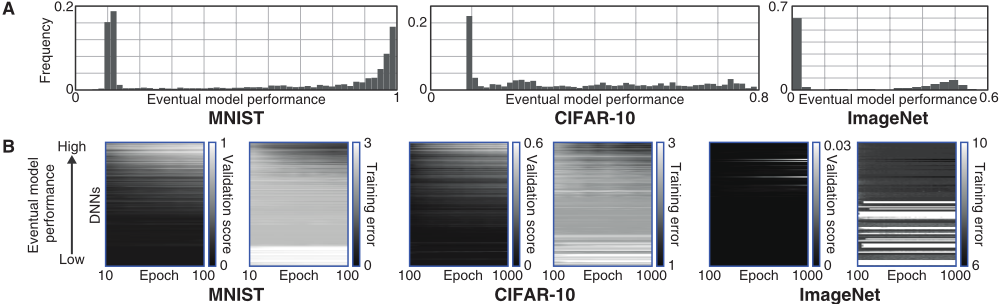
The results of training DNNs showed a broad range of eventual model performance up to 0.996, 0.804, and 0.566 for the MNIST, CIFAR-10, and ImageNet datasets, respectively (Figure 2A). As shown in Figure 2A, there were many DNNs with low scores. Specifically, the runs that showed lower scores less than 0.3 were 40▷3%, 49▷5%, and 65▷8% of all runs for the MNIST, CIFAR-10, and ImageNet datasets, respectively. Figure 2B shows time series of the learning curve (validation scores and training errors) at the early learning processes in which we investigated the prediction performance.
3.2 Prediction performance at each epoch
We constructed prediction models using the random forest algorithm and then evaluated prediction performance by crossvalidation. Regarding the parameter for the random forest algorithm, we set the number of decision trees to 400 through the experiments. We set the number of training samples n for the prediction model to 1,200, 400, and 75 for the MNIST, CIFAR-10, and ImageNet datasets, respectively.
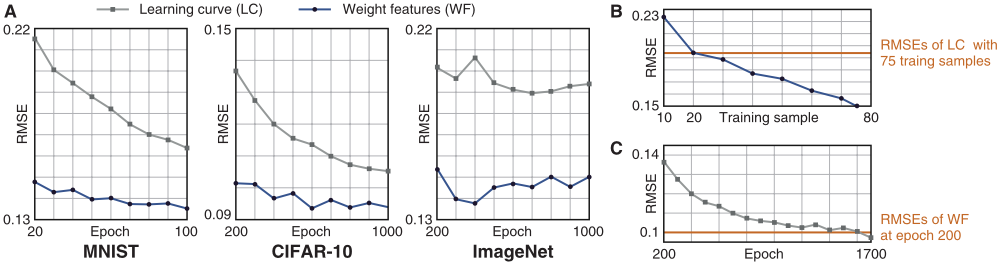
We evaluated the prediction performance over the various pre-run epochs, at which the features were calculated from the DNNs. The results in Figure 3A show that the use of the weight features always provides better prediction performance. Compared with the use of the learning curve, the RMSEs in the case of the weight features at the same epoch decreased by 17-31% over epoch 100 for the MNIST, 10-26% over epoch 1,000 for the CIFAR-10, and 21-33% over epoch 1,000 for the ImageNet datasets.
3.3 Training sample numbers and pre-run epochs
We showed that using the weight features improves prediction performance compared with using the learning curve. Next, we investigated to what extent the use of the weight features can decrease the number of samples n and pre-run epochs t needed for accomplishing the same prediction performance with the learning curve.
First, by decreasing the number of samples for training the prediction model of the weight features, we investigated how many samples are saved for achieving the same prediction performance using the learning curve. Figure 3B shows the relationship between the number of training samples and RMSEs of the prediction model using the weight features at epoch 1,000 for the ImageNet dataset. In this example, the number of required samples declined from 75 for the learning curve to 20 for the weight features. Similarly, the number of samples decreased from 1,200 to 500 at epoch 100 for the MNIST dataset and from 400 to 230 at epoch 1,000 for the CIFAR-10 dataset. On average, relative to the learning curves, the use of the weight features decreased the required sample size by 73% over epoch 100 for the MNIST, 58% over epoch 1,000 for the CIFAR-10, and 76% over epoch 1,000 for the ImageNet dataset.
We also investigated how much earlier the use of the weight features accomplished the same prediction performance of the learning curve by increasing the number of epochs used for the prediction model of the learning curve.
For the reference prediction performance, we utilized the RMSEs of 0.15 and 0.1 for the MNIST dataset and CIFAR10 datasets, respectively. Figure 3C shows the changes in RMSEs in accordance with the increase of pre-run epochs for DNNs on the CIFAR-10 dataset. In this example, the epoch needed for achieving the target prediction performance (RMSE = 0▷1) increased from epoch 200 for the weight features to epoch 1,700 for the learning curve. For the MNIST dataset, the use of the learning curve also increased the required pre-run epoch from 20 to 180.
3.4 Important variables in weight features
To gain insight into what kinds of weight feature contribute to improving the prediction performance, we analyzed variable importance for each explanation variable using the permutation accuracy importance measure for the random forest as a means of variable selection [Breiman, 2001; Strobl et al., 2007].
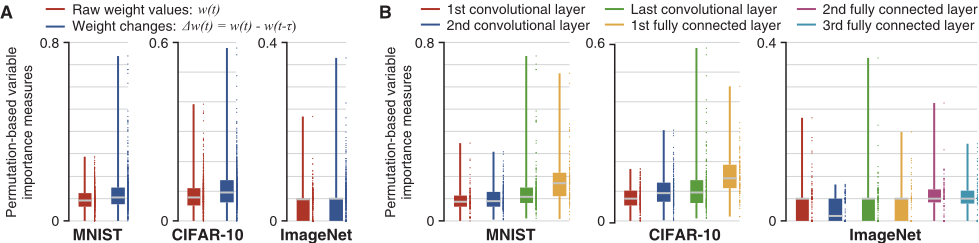
First, we compared the importance measures between weight features extracted from raw weight values and weight changes. The result shows that features extracted fromweight changes had stronger contributions than those of raw weight values (Figure 4A). Next, we compared them among layers and found that weight features extracted from the last convolutional layers showed the highest value compared with those of the other convolutional layers and fully connected layers (Figure 4B). This result was common to all three datasets investigated in this study.
3.5 Weight history and time difference
To clarify the relationship between the prediction performance and the weight features, we conducted additional investigations. First, we compared the prediction performance between the above weight features and their history until epoch t. The weigh features F(t) were calculated from the two items of weight data at epochs t and t-⌧ . Here, we investigated the prediction performance using the history of F(t) at certain intervals in the same way as the learning curve. Figure 5A shows RMSEs of the prediction models using the weight history at intervals of epoch 100 for the CIFAR-10 dataset. For example, the weight history at epoch 400 consists of F (400), F (300), and F (200). The result showed that there was little improvement of the prediction performance using the weight history, suggesting that when the weight features are extracted in the way proposed in this study, just two items of weight data might be sufficient to construct the prediction model.
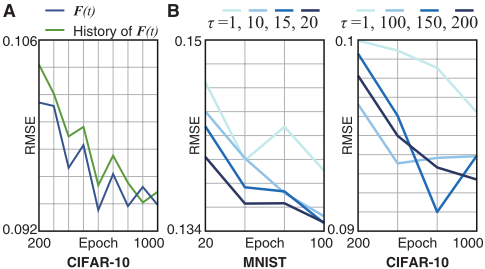
Through the investigation on the variable importance, we found that weight changes contribute to the better prediction performance. We investigated whether and how prediction performance changes in accordance with increasing ⌧ . Figure 5B shows the relationship between the RMSEs of the prediction models and ⌧ for the MNIST and the CIFAR-10 datasets. We observed the tendency that increasing ⌧ improves the prediction performance to a certain degree of ⌧ .
3.6 Correlation with eventual model performance
We found that the proposed weight features provided better prediction performance and that the most important features were related to weight changes in last convolutional layers. To investigate whether these results depend on the random forest algorithm, we additionally investigated the correlation of each variable with the eventual model performance. For the correlation measure, we utilized Spearman's rank correlation coefficient, which is more suitable than the Pearson linear correlation coefficient to investigate variable relation that is not necessarily linear. We used the maximal correlation coefficient among each feature group and compared them.
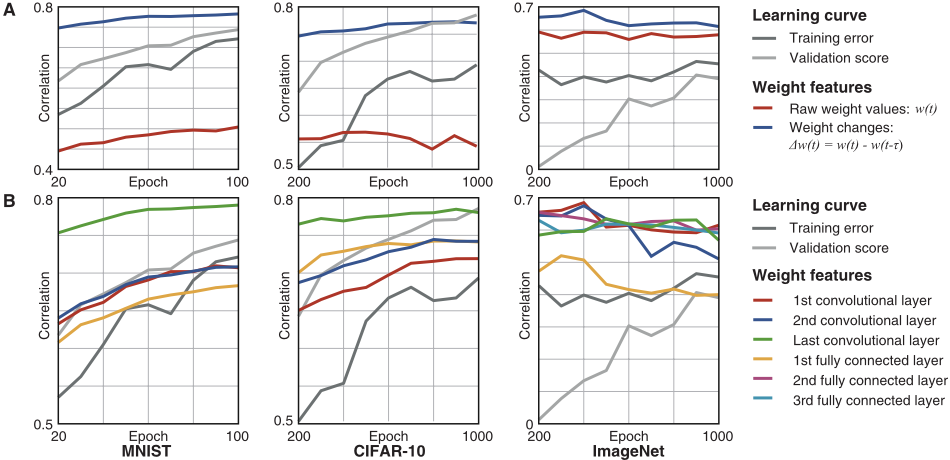
In all three datasets, the weight features showed higher correlation coefficients than learning curve from the early learning process of DNNs (Figure 6). Comparing them between features of raw weight values and weight changes, we found that the features extracted from weight changes are more highly correlated with the eventual model performance of DNNs in all tested epochs (Figure 6A). In addition, we compared correlation coefficients between the features of each layer (Figure 6B). For the MNIST and CIFAR-10 datasets, the features extracted from last convolutional layers always showed the highest values in all tested epochs. For the ImageNet dataset, features in the last convolutional layers were also the greatest numbers of the highest correlation values over the epoch (4 out of 9), although the difference of correlation values with the other layers was comparatively small.
4 Conclusion
Deep neural networks currently deliver a strong performance in many areas such as image recognition and natural language processing. However, they require careful tuning of hyperparameters, which can dramatically affect the model performance. To speed up the hyperparameter searches by predicting the eventual performance at an early stage of the learning process and terminating underperformance runs, we proposed the use of network weight features for the prediction. We changed various types of hyperparameter in DNNs and gathered sets of the eventual model performance and features calculated from the network weights at early stages of the learning processes. Using the weight features as explanation variables, we constructed the prediction model using the random forest algorithm for predicting the eventual model performance of DNNs.
We first showed that the use of the proposed weight features provided better prediction accuracy compared with the use of the learning curve in all three tested datasets. Furthermore, we demonstrated that the use of the weight features decreased the training samples for the prediction model to, at a maximum, one-fourth the number required for achieving the same predictive performance using the learning curve. Regarding the number of pre-running epochs of DNNs, the weight features also accomplished the specific prediction performance at approximately 8 to 9 times earlier training epoch of DNNs.
We also investigated important variables within the weight features using the permutation accuracy importance measure for the random forest algorithm and correlation of each variable with the eventual model performance. The results showed the stronger contribution of weight changes than raw weight values in all three tested datasets. We also found that among the weight features, the weight changes in the last convolutional layers seem to be most important for prediction.
Taken together, our results demonstrate that the use of weight features can help construct prediction models with a smaller number of samples and terminate underperformance runs at an earlier stage of the training process of DNNs than the conventional use of learning curve, thus facilitating the speed-up of hyperparameter searches.
Acknowledgments
This research was partially supported by CREST, JST.
@inproceedings{ijcai2016p318,
  title     = {Weight Features for Predicting Future Model Performance of Deep Neural Networks},
  author    = {Yamada, Yasunori and Morimura, Tetsuro},
  booktitle = {Proceedings of the Twenty-Fifth International Joint Conference on
               Artificial Intelligence, {IJCAI-16}},
  publisher = {AAAI Press / International Joint Conferences on Artificial Intelligence},
  editor    = {Subbarao Kambhampati},
  pages     = {2231--2236},
  year      = {2016},
  month     = {7},
  url       = {https://ijcai.org/proceedings/2016/318},
}
TY - CPAPER TI - Weight Features for Predicting Future Model Performance of Deep Neural Networks AU - Yamada, Yasunori AU - Morimura, Tetsuro T2 - Proceedings of the Twenty-Fifth International Joint Conference on Artificial Intelligence, IJCAI-16 PB - AAAI Press / International Joint Conferences on Artificial Intelligence PY - 2016 SP - 2231 EP - 2236 UR - https://ijcai.org/proceedings/2016/318 ER -Copied
Machine-readable versions of this paper, for tools and AI agents:





