
Collaborative Filtering with Generalized Laplacian Constraint via Overlapping Decomposition
Proceedings of the Twenty-Fifth International Joint Conference on Artificial Intelligence. Pages 2329-2334.
Abstract
Real-world data are seldom unstructured, yet traditional Matrix Factorization (MF) models, as one of the most powerful collaborative filtering approaches, generally rely on this assumption to recover the low-rank structures for recommendation. However, few of them are able to explicitly consider structured constraint with the underlying low-rank assumption to model complex user interests. To solve this problem, we propose a unified MF framework with generalized Laplacian constraint for collaborative filtering. We investigate the connection between the recently proposed Laplacian constraint and the classical normalized cut problem, and make it possible to extend the original non-overlapping prior, to capture the overlapping case via learning the decomposed multi-facet graphs. Experiments on real-world datasets demonstrate the effectiveness of the proposed method.
- [Bach and Jordan, 2002] Francis R. Bach and Michael I. Jordan. Kernel independent component analysis. Journal of Machine Learning Research, 3:1-48, 2002.
- [Ding et al., 2006] Chris H. Q. Ding, Ding Zhou, Xiaofeng He, and Hongyuan Zha. R 1 -pca: rotational invariant L 1 -norm principal component analysis for robust subspace factorization. In Pro- ceedings of ICML, 2006, pages 281-288, 2006.
- [Feng et al., 2014] Jiashi Feng, Zhouchen Lin, Huan Xu, and Shuicheng Yan. Robust subspace segmentation with block- diagonal prior. In Proceedings of CVPR, pages 3818-3825, 2014.
- [Gao et al., 2013] Jing Gao, Jiawei Han, Jialu Liu, and Chi Wang. Multi-view clustering via joint nonnegative matrix factorization. In Proceedings of the 13th SIAM International Conference on Data Mining, pages 252-260, 2013.
- [Golub and van Loan, 1996] Gene H. Golub and Charles F. van Loan. Matrix computations (3. ed.). Johns Hopkins University Press, 1996.
- [Gretton et al., 2005] Arthur Gretton, Olivier Bousquet, Alexan- der J. Smola, and Bernhard Schölkopf. Measuring statistical de- pendence with hilbert-schmidt norms. In Proceedings of ALT, 2005, pages 63-77, 2005.
- [Gu et al., 2011] Quanquan Gu, Zhenhui Li, and Jiawei Han. Joint feature selection and subspace learning. In Proceedings of IJCAI, 2011, pages 1294-1299, 2011. IJCAI
- [Hu et al., 2008] Yifan Hu, Yehuda Koren, and Chris Volinsky. Col- laborative filtering for implicit feedback datasets. In Proceedings of ICDM, December 15-19, 2008, Pisa, Italy, pages 263-272, 2008.
- [Kumar and III, 2011] Abhishek Kumar and Hal Daumé III. A co- training approach for multi-view spectral clustering. In Proceed- ings of ICML, pages 393-400, 2011.
- [Li et al., 2011] Mu Li, Xiao-Chen Lian, James T. Kwok, and Bao- Liang Lu. Time and space efficient spectral clustering via column sampling. In CVPR, pages 2297-2304, 2011.
- [Lin et al., 2011] Zhouchen Lin, Risheng Liu, and Zhixun Su. Lin- earized alternating direction method with adaptive penalty for low-rank representation. In Proceedings of NIPS, pages 612-620, 2011.
- [Masaeli et al., 2010] Mahdokht Masaeli, Glenn Fung, and Jen- nifer G. Dy. From transformation-based dimensionality reduction to feature selection. In Proceedings of ICML, pages 751-758, 2010.
- [Ng et al., 2001] Andrew Y. Ng, Michael I. Jordan, and Yair Weiss. On spectral clustering: Analysis and an algorithm. In Proceed- ings of NIPS, pages 849-856, 2001.
- [Nie et al., 2010] Feiping Nie, Heng Huang, Xiao Cai, and Chris H. Q. Ding. Efficient and robust feature selection via joint l21- norms minimization. In Proceedings of NIPS, pages 1813-1821, 2010.
- [Niu et al., 2010] Donglin Niu, Jennifer G. Dy, and Michael I. Jor- dan. Multiple non-redundant spectral clustering views. In Pro- ceedings of ICML, pages 831-838, 2010.
- [Purushotham and Liu, 2012] Sanjay Purushotham and Yan Liu. Collaborative topic regression with social matrix factorization for recommendation systems. In Proceedings of ICML, 2012.
- [Salakhutdinov and Mnih, 2007] Ruslan Salakhutdinov and Andriy Mnih. Probabilistic matrix factorization. In Proceedings of NIPS, pages 1257-1264, 2007.
- [Shi and Malik, 2000] Jianbo Shi and Jitendra Malik. Normalized cuts and image segmentation. IEEE Trans. Pattern Anal. Mach. Intell., 22(8):888-905, 2000.
- [Trendafilov, 2010] Nickolay T. Trendafilov. P.-A. absil, r. ma- hony, and r. sepulchre. optimization algorithms on matrix man- ifolds. Foundations of Computational Mathematics, 10(2):241- 244, 2010.
- [von Luxburg, 2007] Ulrike von Luxburg. A tutorial on spectral clustering. Statistics and Computing, 17(4):395-416, 2007.
- [Wang and Blei, 2011] Chong Wang and David M. Blei. Collab- orative topic modeling for recommending scientific articles. In Proceedings of KDD, pages 448-456, 2011.
- [Wang and Boyer, 2013] Quan Wang and Kim L. Boyer. Feature learning by multidimensional scaling and its applications in ob- ject recognition. CoRR, abs/1306.3294, 2013.
- [Wang et al., 2014] Xin Wang, Weike Pan, and Congfu Xu. HGMF: hierarchical group matrix factorization for collaborative recom- mendation. In Proceedings of CIKM, pages 769-778, 2014.
- [Wang et al., 2015] Suhang Wang, Jiliang Tang, Yilin Wang, and Huan Liu. Exploring implicit hierarchical structures for recom- mender systems. In Proceedings of IJCAI, pages 1813-1819, 2015. IJCAI
- [Yuan et al., 2014] Ting Yuan, Jian Cheng, Xi Zhang, Shuang Qiu, and Hanqing Lu. Recommendation by mining multiple user be- haviors with group sparsity. In Proceedings of AAAI, pages 222- 228, 2014.
- [Zhang and Wang, 2015] Qing Zhang and Houfeng Wang. Improv- ing collaborative filtering via hidden structured constraint. In Proceedings of CIKM, pages 1935-1938, 2015.
- [Zhang et al., 2006] Sheng Zhang, Weihong Wang, James Ford, and Fillia Makedon. Learning from incomplete ratings using non-negative matrix factorization. In Proceedings of SDM, pages 549-553, 2006.
- [Zhang et al., 2013] Yongfeng Zhang, Min Zhang, Yiqun Liu, Shaoping Ma, and Shi Feng. Localized matrix factorization for recommendation based on matrix block diagonal forms. In Pro- ceedings of WWW, pages 1511-1520, 2013.
References were extracted automatically from the PDF and may contain errors.
Full text extracted automatically from the PDF; figures, tables and equations may differ. The PDF is the version of record.
1 Introduction
Collaborative Filtering (CF) algorithms [Salakhutdinov and Mnih, 2007] have been widely applied in various recommender systems. As one of the most powerful CF approaches, Matrix Factorization (MF) models have become popular and achieve the state-of-the-art performance [Zhang et al., 2013]. The rationale behind the MF approach is the low-rank assumption, that the observed rating data can be explained holistically by a small number of latent factors for both users and items, which, for instance, may be related to user groups and item topics. However, traditional MF models rarely consider the structured constraint explicitly on this underlying low-rank structure. In previous studies, incorporating structured information has been extensively explored based on side information, such as social network [Purushotham and Liu, 2012] and item content [Wang and Blei, 2011].
However, not much research work has been done towards directly incorporating the constraint from optimization perspective in a fundamental setting [Yuan et al., 2014]. The reason is that it is hard to optimize with structured constraint during learning, and it is hard to pre-define a fixed structure as constraint to capture the complex latent user interests. In real applications, one user may have multiple interests, which is usually characterized by multiple views [Gao et al., 2013]. For example, clustering users based on music reviews can be clustered by a genre (rock, jazz, hip hop, etc.) or a sentiment (positive, negative, etc.). This may lead to different solutions for modeling user hidden structures. Motivated by this observation, we generalize the recently proposed non-overlapping Laplacian constraint [Feng et al., 2014] to the overlapping case, with the ability to automatically capture such multiview hidden structures for collaborative filtering. The mechanism proposed in this paper is significantly different from the emerging group-constraint CF methods as shown in Table 1, since this work is proposed from an adaptive multiview perspective in a joint optimization framework, without the non-overlapping assumption [Zhang and Wang, 2015] or pre-partition restriction [Yuan et al., 2014] for hidden group (community) structures.
| Method | Adap. | A.G. | G.O. | Constraint |
|---|---|---|---|---|
| GSMF | p | ⇥ | p | L21 norm (factor) |
| LMF | ⇥ | p | p | permutation |
| HGMF | p | p | ⇥ | Laplacian |
| This work | p | p | p | L21 norm (view)+HSIC |
2 ProblemFormulation and Preliminaries
Definition 1 (Matrix Factorization Models). Given a sparse rating matrix R = [rij], where the observed rij denotes the rating of user i on item j, matrix factorization models aim to factorize R = UV T , where U and V are low rank matrices with rows as latent users uTi and latent items vT j respectively.
Our goal is to predict the missing values in R, by computing the predicted values rij = uTi vj .
Laplacian Constraint for Block-diagonality
We introduce the recently proposed structured constraint, i.e., Laplacian constraint [Feng et al., 2014], to recommendation tasks, for explicitly capturing the latent user community structures while learning matrix factorization. We first define Laplacian matrix, and then present its connection with the structure of affinity matrix.
Definition 2 (Laplacian Matirx). Consider an affinity matrix W 2 Rn⇥n of n samples with weights W(i↪ i0 ). The Laplacian matrix LW 2 Rn⇥n is defined as: LW = D-W, where D = diag(d1↪ ▷▷▷↪ dn) and dn = ⌃i0W(i↪ i0 ). The normalized version is defined as LWsys = D- 12 LWD- 12 .
The following well known theorem relates the rank of the Laplacian matrix to the number of blocks in W.
Theorem 1 ([von Luxburg, 2007]). Let W be an affinity matrix. The multiplicity k of the eigenvalue 0 of the Laplacian LWsys , equals the number of connected blocks in W.
Based on the above theorem, we can enforce a general square matrix to be k-block-diagonal to represent different latent communities. For the hidden graph constructed by latent users uj, we construct the affinity matrix W(j↪ j 0 ) using Gaussian kernel. Then we can define a set of k-blockdiagonal matrix (k-BDMS) as the constraint term in Eq.(2),
where k▷k22 denotes the `2 norm, and σ2 denotes the deviation.
Adaptive Hidden Graph Regularization Framework
To incorporate the above structured constraint, we employ an adaptive hidden graph regularization framework [Zhang and Wang, 2015], which is similar to [Purushotham and Liu, 2012], but the graph used for regularization is learnt automatically with structured prior W 2 K, rather than the pre-defined one based on side information. To achieve the goal, we have the following optimization objective:
where k · kF is the Frobenius norm; W is the same one in Eq.(1); cij is a confidence parameter [Wang and Blei, 2011] for rating rij, and cwii0 is similarly defined for modeling wii0 2 W; λU↪V↪S are used to avoid over-fitting; λW controls the effect of hidden graph regularization; The first term ensures that latent users U and items V can well approximate the observed ratings rij 2 R. Similarly, the fourth term factorizes W into a user-specific matrix U and a factor-specific matrix si0 2 S, to approximate wii0 with constraint W 2 K.
Previous Non-Overlapping Solution [Feng et al., 2014; Zhang and Wang, 2015]. To learn W 2 K, after updating U, V , S, we can obtain the hidden graph W0 using Gaussian kernel in Eq.(1). However, the variable matrix W0 may move out of the constraint set and no longer satisfy a k-block-diagonal structure. To project it back to the k-BDMS constraint set, we have the following optimization problem via Augmented Lagrangian Multiplier method [Lin et al., 2011]:
where J is the Lagrangian multiplier and β is an increasing weight parameter for the term of enforcing the auxiliary variable ˜ Z = LWsys .
3 Generalizing Laplacian Constraint
Although the Laplacian constraint could well capture hidden group structures, the non-overlapping assumption behind it may be too strong in real-world scenarios. In real world, data can often be interpreted in many different ways, which can have different groupings that are reasonable and interesting from different perspectives. In this section, we propose a solution to generalize Laplacian constraint, which relaxes the non-overlapping assumption for real applications.
Connection between Laplacian Constraint and Normalized Cut
For our extension, we first reveal the connection between the recently proposed Laplacian constraint as shown in Eq.(3) and Normalized Cut problem as defined in Def.(3) from optimization perspective.
Definition 3 (Normalized Cut (Ncut)). Given a similarity graph with affinity matrix W, for two disjoint subsets A↪ B 2 V , we define cut(A↪B) = Pi2A↪j2B wij. For arbitrary k disjoint subsets A1↪ ▷▷▷↪Ak, we define cut(A1↪ ▷▷▷↪Ak) = Pki=1 cut(Ai↪ Ai). The normalized cut (Ncut) is defined as:
where vol(Ai) = Pi22Ai↪i02Ai wii0 , the total weights of the edges in group Ai.
The intuition of minimizing Ncut [von Luxburg, 2007] is to find a partition of the graph, such that the edges between different groups have low similarity, and those within a group have high similarity.
Theorem 2 (Rank Constraint Approximation). The solution to Eq.(3) can be approximated in terms of rank constraint, through solving minimal Ncut problem, with the original hidden affinity matrix W0 in Eq.(3).
Proof. As shown in [von Luxburg, 2007; Shi and Malik, 2000], solving minimal Ncut problem is equivalent to solving the following trace minimizing problem: min U2Rn⇥k Tr(U T D- 12LWD- 12U) = Pki=1 λi↪ with constraint U T U = I, where λi is the eigenvalue of matrix U T D- 12LWsys D- 12U. Note LWsys = D- 12LWD- 12 . Based on this trace minimizing problem, our goal is to prove λi also to be the ith smallest eigenvalue of matrix LWsys . According to Courant-Fisher theorem [Golub and van Loan, 1996], the optimal U contains the first smallest k eigenvectors of matrix LWsys as columns. Now, use the optimal U.
U T LWsys U can be written as U T LWsys U = U T LWsys [U(: ↪ 1)↪ ▷▷▷↪U(:↪ k)] = U T [LWsys U(:↪ 1)↪ ▷▷▷↪LWsys U(:↪ k)] = U T [λ1U(:↪ 1)↪ ▷▷▷↪ λkU(:↪ k)] = [λ1U T U(:↪ 1)↪ ▷▷▷↪ λkU T U(: ↪ k)] = [λ1e1↪ ▷▷▷↪ λkek] = diag(λ1↪ ▷▷▷↪ λk), where ek is a column vector containing 1 in kth position and zeros for others. Then, tr(U T LWsys U) = tr(diag(λ1↪ ▷▷▷↪ λk)) = Pki=1 λi▷, which shows that minimizing Ncut problem is equivalent to minimizing the top-k smallest eigenvalues of the Laplacian LWsys . Finally, since the rank of a positive semi-definite (PSD) matrix is equal to the number of nonzero eigenvalues, the rank of LWsys will approximate n - k to satisfy the constraint in Eq.(3), fromwhich the theorem follows.
Theorem 3 (Upper Error Bound). Let W and W0 be an approximatively projected and original affinity matrix respectively. Then in the sense of approximately minimizing the first smallest k eigenvalues of the Laplacian matrix LWsys , the error between W and W0 is upper bounded by
where Q0 = [ Q0xλ1 λ1 ↪ ▷ ▷ ▷ ↪ Q0xλk λk ]. xλk is a normalized eigenvector of W0Q0 with eigenvalue λk. Q0 = U0V T 0 . U0 and V0 are the solutions of computing SVD on W T 0 LWsys .
Proof. We first seek to represent W by a certain form involving W0. Suppose LWsys is the normalized Laplacian matrix of W0. The optimal solution of W is determined by the first smallest k eigenvectors of LWsys for spectral clustering. To establish the relationship between W and W0, we formulate the following optimization problem, min Q0 kLWsys -W0Q0kF ↪
s▷t▷QT0 Q0 = I▷ This problem can be seen as a orthogonal Procrustes problem [Golub and van Loan, 1996], which has the optimal solution Q0 = U0V T 0 , where U0 and V0 are the solutions of computing SVD on W T 0 LWsys . Since LWsys vi = viλi and V = [v1↪ ▷▷▷↪ vk] can be seen as the latent feature matrix, then we can approximatively construct W using V to obtain W = V ⇤ V T . Using the solution of the above formulated optimization problem, we can derive vk = LWsys vk λk t W0Q0vk λk ↪ by substituting LWsys with the optimal W0Q0. Let Q0 = [ Q0xλ1 λ1 ↪ ▷ ▷ ▷ ↪ Q0xλk λk ]. Now we can easily reformulate, kW-W0kF ⇡ kW0Q0Q0T W0-W0kF= kW0(Q0Q0T W0 - I)kF kW0kFkQ0Q0T W0 - IkF ↪ from which the theorem follows.
We have proven that solving Ncut problem as spectral clustering objective, can approximate the original problem in Eq.(3), because it can achieve the same optimization objective, in terms of approximating the original rank constraint (Theorem 2), with bounded graph projection error (Theorem 3).
Overlapping Decomposition via Non-overlapping Multi-facet Graphs
Overlapping is a significant property of real-world structures. However, the original Laplacian constraint could not capture this property. Motivated by the established connection between Laplacian constraint and spectral clustering, we can extend it to handle the overlapping case from the graph clustering view. Without changing the basic framework in Eq.(2), we develop a novel structured prior, as constraint s▷t▷ W 2 K0 in Eq.(2) for collaborative filtering. The key idea is to decompose a complex real-wold overlapping case, into a series of non-overlapping cases (K0 ), as shown in Figure 1.
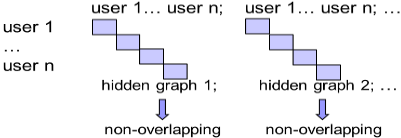
Definition 4 (Multi-facet Graphs). Consider an affinity matrix W i 2 Rn⇥n of n samples with weights W i (i↪ i0 ). The Multi-facet Graphs W 1 ↪ ▷▷▷↪W i are defined as: each W i is a non-overlapping graph with block-diagonality. For different graphs, W i and W j where i 6= j, are expected to reflect the different views of the data.
Multi-facet Graphs. We define multi-facet graphs in Def.(4), using multiple non-overlapping graphs with different views to capture the original overlapping information. Ideally, these decomposed non-overlapping graphs are expected to reflect different views of the original graph. We propose to achieve the goal, through automatic latent factor selection to construct different views while learning matrix factorization.
3.1 Algorithm
Algorithm 1: Algorithm for Learning Multi-facet Graphs
Input: Number of views Q, latent user embedding matrix U, λ1 for HSIC penalty, λ2 for group sparsity.
Output: Uq, Wq, q = 1↪ 2↪ ▷▷▷↪Q.
- 1: while q < Q do
- 2: Update eachWq according to Section 3.1;
- 3: Update each Uq according to Section 3.1;
- 4: q = q + 1;
- 5: end while
- 6: Return Uq, Wq, q = 1↪ 2↪ ▷▷▷↪Q;
To acquire such multi-facet graphs, inspired by the research of multi-facet clustering [Niu et al., 2010], which believes that document is often composed of multiple views. In this paper, we extend this idea to the hidden graph setting jointly with feature selection [Masaeli et al., 2010].
We first define the Hilbert-Schmidt Independence Criterion (HSIC) [Gretton et al., 2005] between two random variables (X↪ Y ). Given n observations, Z := ¶(x1↪ y1)↪ ▷▷▷↪ (xn↪ yn)♦, HSIC can be empirically estimated by HSIC(X↪ Y ) = (n-
1)-2 tr(K1HK2H)↪ where K1, K2 2 Rn⇥n are Kernel matrices, (K1)ij = k1(xi↪ xj), (K2)ij = k2(yi↪ yj), and where (H)ij = δij - n-1 centers the Kernel matrices to have zero mean in the feature space, where δij is Kronecker delta. To achieve learning multi-view hidden structures, we use the HSIC as a penalty term in our spectral clustering objective function to ensure that subspaces in different hidden graphs provide non-redundant information. Moreover, to achieve the goal of automatic feature selection for each view, we propose to do feature selection and hidden graph learning simultaneously in a joint framework, which is based on l21-norm that is used on the projection matrix Wq.
Interpretation. In the above equation, the first term with orthogonal constraint is the spectral clustering objective, to learn hidden group structures in different views. The second term with orthogonal constraint is the multi-facet penalty, to maximize the discrepancy between different views. The third term is the group sparsity penalty, to automatically select latent factors for learning hidden group structures in different views. x = U T is the latent embeddings as column vectors for representing each user in original latent factor space. Note that the notation Uq is the spectral embeddings, while U is the latent user embeddings. LqW is constructed by gaussian kernel with the projected data in each view W T q x. In the following, we use xi to represent the i-th latent user representation.
Discussion on kWqk2↪1. The l2↪1-norm of a matrix was first introduced in [Ding et al., 2006] as rotational invariant l2↪1-norm and also used as group sparsity penalty for subspace learning [Gu et al., 2011]. It is defined as kWqk2↪1 = Pni=1 qPmj=1 (wq ij )2 = Pni=1 kwi▷ q k2, where wi▷ q is the ith row vector. To understand why the proposed kWqk2↪1 penalty leads to a feature selection solution, let us consider how the structure of Wq should be to achieve feature selection. Let wq ij be the elements of transformation matrix Wq. If ith feature in x is not selected by the hidden graph in view q, all the elements of the ith row of Wq should be zero. Thus, ith feature in x will not contribute to the HSIC criterion.
Optimize for Wq for each view. Fixing Uq, optimizing Wq is challenging, since this optimization problem is generally difficult to optimize due to the non-convexity of orthogonal constraints. To solve this challenge, we employ an efficient feasible method for optimization on the Stiefel manifold [Bach and Jordan, 2002]. Following the method, we apply a modified gradient descent on the Stiefel manifold, to ensure the orthogonal constraints to be preserved in each iteration:
Step1: We project the negative gradient of the objective function onto the tangent space [Trendafilov, 2010], ∆WStiefel = - @f @Wq -Wq(- @f @Wq )T Wq▷ Step2: We update Wq on the geodesic [Trendafilov, 2010] in the direction of the tangent space. ∆Wnew = Woldexp(⌧W T old∆WStief el)↪ where exp means matrix exponential and ⌧ is the step size.
Step3: We use the Armijo rule for a backtracking line search to find the step size ⌧ at every iteration.
More specifically, the derivative @f
@Wq is calculated as follows. There are three terms involved for computing the partial derivative with respect to Wq, in the objective function for each view. Note that D- 12 q LqW D- 12 q = I -D- 12 q KqD- 12 q . i) The spectral objective term: We define Lq = D- 12 q KqD- 12 q . The spectral objective can be expressed as a linear combination of each element in matrix Lq with the corresponding element in UqU T q as coefficient. The derivative of the element lq ij in Lq is, (lq ij )0 = (kq ij )0 (dqii )- 12 (dqjj )- 12 - 12 (dqii )- 12 (dqii )0kq ii (dqjj )- 12 - 12 (dqjj )- 12 (dqjj )0 kq ij (dqii )- 12 ↪ where (kq ij )0 , (dqii )0 , (dqjj )0 are derivatives of the similarity
degree matrix with respect to Wq.
ii) The empirical HSIC term: We expand the trace in the HSIC term, tr(KqHKrH) = tr(KqKr) - 2n-11T KqKr1+n-2 tr(Kq)tr(Kr)↪ where 1 is the vector of all ones. Using a Gaussian kernel defined as k(W T q xi↪W T q xj) = exp(-kW T q ∆xij)k2 ◁2σ2 ), where ∆xij is xi - xj, the derivative of kq ij in Kq is, @kq ij @Wq = q ∆xij
σ2 ∆xij∆xTijWq exp( -∆xTij WqW T
)▷
- 1 2σ2 iii) The group sparsity term: The derivative of the column vector in kWqk2↪1 is, @kWqk2↪1 @W ▷j q = RqW ▷j q = diag(▷▷▷↪ 1 kW i▷ q k2 ↪ ▷▷▷)W ▷j q ↪ whereRq is a diagonal matrix, W ▷j q and W i▷ q are the jth column and ith row vectors respectively. Note that Rq is dependent to Wq, we propose to update Rq iteratively too, using the efficient strategy in [Nie et al., 2010]. In each iteration, Rq is calculated with the current Wq, and then Wq is updated based on the current calculated Rq.
Optimize for Uq in each view. Fixing Wq, we can optimize Uq. The solution for Uq is equal to the first cq eigenvectors (corresponding to the smallest cq eigenvalues) of the matrix D- 12 q LqW D- 12 q , where cq is the number of clusters for view q. Then we normalize each row of Uq to have unit length [Ng et al., 2001; Kumar and III, 2011].
Construct W via Multi-facet Graphs. After updating U, V , S (the update rules are omitted, which is similar to [Zhang and Wang, 2015]) and running Algorithm 1, we can update a new hidden graph W as adaptive graph regularization term, for the joint optimization problem in Eq.(2). We construct W via multi-facet graphs, by directly concatenating W = [W 0 q=1 ↪ ▷▷▷↪W 0 q=Q]. For pursuing the sparsity of W, to save computing and enlarge discriminative power, we adopt a discretization way to build the graph W 0 q in view q. In this way, we use simple k-means algorithm to partition the data using each row in Uq as features, and label each data according the group assignment. Then for the data in the same group, the weights between those are set to 1, or 0 otherwise.
Computational Complexity. For large-scale data, to calculate kernel matrix, we can apply incomplete Cholesky decomposition as suggested in [Bach and Jordan, 2002], in which the complexity of eigen-decomposition is O(s2n) (s ⌧ n), where s is the rank of the approximation matrix, n is the number of general users. Therefore, the main computational cost of the algorithm is to calculate the SVD for Uq, which can be efficiently solved in O(nmd) (m↪ d ⌧ n) [Li et al., 2011], where m is the number of selected subset of data; d is number of latent factors. Thus, similar to [Niu et al., 2010], since the complexities of our derivative computation is O(nsd) (s↪ d ⌧ n), Algorithm 1 can achieve the linear complexity O(s2n + nmd + nsd) with respect to general users.
| Data | #User | #Item | Sparsity | #Rating | #Avg.R |
|---|---|---|---|---|---|
| LastFM | 1892 | 18745 | 0.28% | 92834 | 49 |
| Delicious | 1867 | 69223 | 0.08% | 104799 | 56 |
| Epinions | 3474 | 26850 | 0.12% | 111933 | 32 |
4 Experiments
We evaluate our method on three public real-world datasets as shown in Table 2: LastFM and Delicious 1 are used for Top-N recommendation task. Epinions 2 is used for rating prediction task. We use Recall [Purushotham and Liu, 2012] metric to measure Top-N performance, and use RMSE [Yuan et al., 2014] metric to measure rating prediction performance.
Baselines and Settings
We compare the following popular and the state-of-theart constraint MF models, only using rating information. WNMF [Zhang et al., 2006] is a popular MF method, using non-negative matrix factorization. PMF [Salakhutdinov and Mnih, 2007] is a well-known MF method, with sound probabilistic interpretation. GSMF [Yuan et al., 2014] is a constraint MF method, using group sparsity regularization for modeling multiple user interests. GSMF-K denotes using k-means to partition the item set into K groups for GSMF. HGMF [Zhang and Wang, 2015] is a constraint MF method, in an adaptive graph regularization framework using Laplacian constraint. MHGMF is the proposed method in this paper.
Following [Purushotham and Liu, 2012; Yuan et al., 2014], we randomly select 90(70↪ 50)% of the data for training, and the rest for testing. The random selection was carried out 5 times independently, and we report the average results. Using the widely adopted strategy in [Hu et al., 2008], all the baselines can be applied to the both tasks. We implement the compared methods following the original works. The best parameters are chosen by held-out validation. For our method, the kernel parameter σ2 is initialized as the median pairwise distance between original users, and then is well tuned. For top-N task, the confidence parameters are 0▷01 and 1 for unobserved data and observed data respectively. For rating prediction task, those are 0 and 1 respectively. The number of multi-facet graphs is 2. The regularization parameters are optimized in the range of ¶0▷001↪ 0▷01↪ ▷▷▷↪ 10↪ 100♦. The numbers of latent factors, for the original space and the projected space, are set by searching ¶50↪ 150↪ ▷▷▷↪ 350↪ 400♦. We set the number of maximal iteration to 200.
1 http://grouplens.org/datasets/hetrec-2011/
2 http://www.public.asu.edu/⇠jtang20/datasetcode/epinions.zip
Results and Analysis
Performance Comparison. Table 3 and Figure 2(a,b) show that in general, the constraint based models, i.e., MHGMF; HGMF; GSMF-K, are much better than the non-constraint models, i.e., WNMF; PMF, which demonstrates the effectiveness of the underlying structured assumption in real-world data. In addition, the results show that our method MHGMF further outperform the existing constraint based models on all evaluation metrics on all three datasets, which could demonstrate that it is more reasonable to use the proposed overlapping assumption for real-world data from multiple views, compared with the non-overlapping assumption in HGMF from a single view. Although GSMF can deal with overlapping group structures, it is limited to the need of the prepartitioned groups, without adaptive grouping mechanism for the task objective. In contrast, our method can consider the structured property jointly with task-oriented objective from an adaptive multi-view setting. In the following, we show the parameter sensitivity analysis with 90% training case, due to the similar findings for other cases and page limitation.
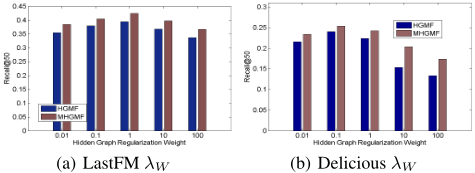
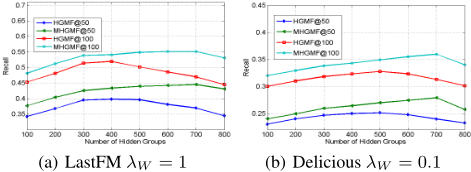
Impact of the Graph Weight and Hidden Group Numbers. Table 4 and Figure 3 show that for the dataset LastFM, higher λW suggests good performance. For other two sparser datasets, using relatively lower value will improve the performance. It could be explained that λW controls the degree of group membership. In the sparser cases, each user may rely on more neighbours which prefers lower value. In the denser case, it is more likely to introduce more noisy patterns. Thus, the larger regularization will improve the discriminative performance. Table 5 and Figure 4 show that fixing the optimal λW , setting larger number of hidden groups will achieve better results. Intuitively, enlarging the number of hidden groups will narrow the range of visible neighbours. When the invisible neighbours are beneficial, the non-overlapping assumption will hurt the performance. In contrast, our method can achieve the same goal of learning discriminative representation but without the restriction. Our results show good and more stable performance in that case, which demonstrates the overlapping assumption is more reasonable for real data.
Impact of Multi-facet Penalty and View Sparsity. Figure 2(c,d,e) shows that in general, when increasing the value of multi-facet penalty λ1 or view sparsity penalty λ2, the performance tends to first increase and then decrease. Among λ1 and λ2, the performance is relatively sensitive to λ2. It could be explained that view sparsity controls the discriminative power through automatic latent factor selection. In this view, the proposed method can be also seen an extension of GSMF, due to the similar goals to enhance discriminative power by modeling user interests with different subset of latent factors, but without needing group pre-partition.
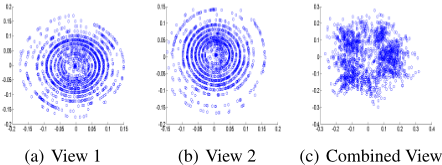
Visualization. In addition, we create 2D plots in Figure 5 using MDS [Wang and Boyer, 2013], to illustrate the overlapping decomposition of data on Lastfm dataset.
| Dataset | Training | WNMF | PMF | GSMF | GSMF-K | HGMF | MHGMF |
|---|---|---|---|---|---|---|---|
| Epinions | 90% | 0.6815 | 0.6732 | 0.6923 | 0.6683 | 0.6447 | 0.6209 |
| 70% | 0.6885 | 0.6789 | 0.6993 | 0.6732 | 0.6482 | 0.6313 | |
| 50% | 0.7639 | 0.7510 | 0.7721 | 0.7291 | 0.7140 | 0.7004 |

| λW/RMSE | 0.01 | 0.1 | 1 | 10 | 100 |
|---|---|---|---|---|---|
| HGMF | 0.6719 | 0.6447 | 0.6991 | 0.7583 | 0.8321 |
| MHGMF | 0.6541 | 0.6209 | 0.6474 | 0.6971 | 0.7509 |
5 RelatedWork
The use of structured information in collaborative filtering is not new [Purushotham and Liu, 2012; Wang and Blei, 2011; Yuan et al., 2014]. Recently, several emerging studies have paid attention to explore implicit or hidden structures for collaborative filtering. [Zhang et al., 2013] proposed a general pipeline framework (LMF), which is independent of specific matrix factorization models. Our model might be further improved by using that framework. [Wang et al., 2014] proposed a hierarchical group matrix factorization method, which needs to obtain the group information in advance, by using side information or pre-clustering. [Wang et al., 2015] proposed an implicit hierarchical matrix factorization approach. It is a direct deeply factorizing approach with fixed tree structures. In contrast, our method focuses on modeling hidden group structures in a graph based regularization framework. [Yuan et al., 2014; Zhang and Wang, 2015] are the most similar works to this paper, which explored modeling hidden group structures by automatic latent factor selection and by Laplacian constraint respectively. However, they either assume the items have already been categorized into multiple semantic groups, or the underlying structures are non-overlapping. In our method, we relax the non-overlapping assumption without requiring pre-grouping in advance, by implicitly seeking the discriminative groupspecific latent factors in an adaptive multi-view setting.
6 Conclusion
In this paper, we present a new viewpoint of hidden graph regularization for collaborative filtering, to explicitly model complex hidden structures while learning matrix factorization. We developed a novel structured prior as constraint on the underlying low-rank structures, which generalizes the recently proposed Laplacian constraint via overlapping decomposition, to automatically capture multi-view hidden structures, by solving a constraint optimization problem jointly with learning user and item representations. Experiments on real-world datasets exhibit the promising performance, compared with the baseline state-of-the-art methods. Future work could consider to incorporate explicit social graph into the proposed framework, to further improve the performance.
| #k/RMSE | 100 | 300 | 500 | 700 | 800 |
|---|---|---|---|---|---|
| HGMF | 0.6796 | 0.6447 | 0.6531 | 0.6603 | 0.6684 |
| MHGMF | 0.6452 | 0.6209 | 0.6142 | 0.6203 | 0.6291 |
7 Acknowledgements
Our work is supported by National Natural Science Foundation of China (No.61370117 & No.61433015) and Major National Social Science Fund of China (No.12&ZD227). The corresponding author of this paper is Houfeng Wang.
@inproceedings{ijcai2016p332,
  title     = {Collaborative Filtering with Generalized Laplacian Constraint via Overlapping Decomposition},
  author    = {Zhang, Qing and Wang, Houfeng},
  booktitle = {Proceedings of the Twenty-Fifth International Joint Conference on
               Artificial Intelligence, {IJCAI-16}},
  publisher = {AAAI Press / International Joint Conferences on Artificial Intelligence},
  editor    = {Subbarao Kambhampati},
  pages     = {2329--2334},
  year      = {2016},
  month     = {7},
  url       = {https://ijcai.org/proceedings/2016/332},
}
TY - CPAPER TI - Collaborative Filtering with Generalized Laplacian Constraint via Overlapping Decomposition AU - Zhang, Qing AU - Wang, Houfeng T2 - Proceedings of the Twenty-Fifth International Joint Conference on Artificial Intelligence, IJCAI-16 PB - AAAI Press / International Joint Conferences on Artificial Intelligence PY - 2016 SP - 2329 EP - 2334 UR - https://ijcai.org/proceedings/2016/332 ER -Copied
Machine-readable versions of this paper, for tools and AI agents:





