
DeepTransport: Prediction and Simulation of Human Mobility and Transportation Mode at a Citywide Level
Proceedings of the Twenty-Fifth International Joint Conference on Artificial Intelligence. Pages 2618-2623.
Abstract
Traffic congestion causes huge economic loss worldwide in every year due to wasted fuel, excessive air pollution, lost time, and reduced productivity. Understanding how humans move and select the transportation mode throughout a large-scale transportation network is vital for urban congestion prediction and transportation scheduling. In this study, we collect big and heterogeneous data (e.g., GPS records and transportation network data), and we build an intelligent system, namely DeepTransport, for simulating and predicting human mobility and transportation mode at a citywide level. The key component of DeepTransport is based on the deep learning architecture that that aims to understand human mobility and transportation patterns from big and heterogeneous data. Based on the learning model, given any time period, specific location of the city or people's observed movements, our system can automatically simulate or predict the persons' future movements and their transportation mode in the large-scale transportation network. Experimental results and validations demonstrate the efficiency and superior performance of our system, and suggest that human transportation mode may be predicted and simulated more easily than previously thought.
- [Cho et al., 2011] Eunjoon Cho, Seth A Myers, and Jure Leskovec. Friendship and mobility: user movement in location-based social networks. In Proceedings of the 17th ACM SIGKDD international conference on Knowl- edge discovery and data mining, pages 1082-1090. ACM, 2011.
- [Dai and Le, 2015] Andrew M Dai and Quoc V Le. Semi- supervised sequence learning. In Advances in Neural In- formation Processing Systems, pages 3061-3069, 2015.
- [Giannotti et al., 2011] Fosca Giannotti, Mirco Nanni, Dino Pedreschi, Fabio Pinelli, Chiara Renso, Salvatore Rinzivillo, and Roberto Trasarti. Unveiling the complexity of human mobility by querying and mining massive trajec- tory data. The VLDB JournalłThe International Journal on Very Large Data Bases, 20(5):695-719, 2011.
- [Gonzalez et al., 2008] Marta C Gonzalez, Cesar A Hidalgo, and Albert-Laszlo Barabasi. Understanding individual hu- man mobility patterns. Nature, 453(7196):779-782, 2008.
- [Hermans and Schrauwen, 2013] Michiel Hermans and Ben- jamin Schrauwen. Training and analysing deep recurrent neural networks. In Advances in Neural Information Pro- cessing Systems, pages 190-198, 2013.
- [Hinton and Salakhutdinov, 2006] Geoffrey E Hinton and Ruslan R Salakhutdinov. Reducing the dimensionality of data with neural networks. Science, 313(5786):504-507, 2006.
- [Hochreiter and Schmidhuber, 1997] Sepp Hochreiter and Jürgen Schmidhuber. Long short-term memory. Neural computation, 9(8):1735-1780, 1997.
- Huang et al., ] Wenhao Huang, Guojie Song, Haikun Hong, and Kunqing Xie. Deep architecture for traffic flow predic- tion: Deep belief networks with multitask learning. IEEE Transactions on Intelligent Transportation Systems.
- [Krizhevsky et al., 2012] Alex Krizhevsky, Ilya Sutskever, and Geoffrey E Hinton. Imagenet classification with deep convolutional neural networks. In Advances in neural in- formation processing systems, pages 1097-1105, 2012.
- [Lee et al., 2008] Honglak Lee, Chaitanya Ekanadham, and Andrew Y Ng. Sparse deep belief net model for visual area v2. In Advances in neural information processing systems, pages 873-880, 2008.
- [Ma et al., 2015a] Xiaolei Ma, Zhimin Tao, Yinhai Wang, Haiyang Yu, and Yunpeng Wang. Long short-term mem- ory neural network for traffic speed prediction using re- mote microwave sensor data. Transportation Research Part C: Emerging Technologies, 54:187-197, 2015.
- [Ma et al., 2015b] Xiaolei Ma, Haiyang Yu, Yunpeng Wang, and Yinhai Wang. Large-scale transportation network con- gestion evolution prediction using deep learning theory. PloS one, 10(3):e0119044, 2015.
- [Ngiam et al., 2011] Jiquan Ngiam, Aditya Khosla, Mingyu Kim, Juhan Nam, Honglak Lee, and Andrew Y Ng. Mul- timodal deep learning. In Proceedings of the 28th Interna- tional Conference on Machine Learning (ICML-11), pages 689-696, 2011.
- [Sak et al., 2014] Hasim Sak, Andrew Senior, and Franc ¸oise Beaufays. Long short-term memory recurrent neural network architectures for large scale acoustic model- ing. In Proceedings of the Annual Conference of In- ternational Speech Communication Association (INTER- SPEECH), 2014.
- [Song et al., 2010] Chaoming Song, Zehui Qu, Nicholas Blumm, and Albert-László Barabási. Limits of pre- dictability in human mobility. Science, 327(5968):1018- 1021, 2010.
- [Song et al., 2013] Xuan Song, Quanshi Zhang, Yoshihide Sekimoto, Teerayut Horanont, Satoshi Ueyama, and Ryosuke Shibasaki. Modeling and probabilistic reason- ing of population evacuation during large-scale disaster. In Proceedings of the 19th ACM SIGKDD international con- ference on Knowledge discovery and data mining, pages 1231-1239. ACM, 2013.
- [Song et al., 2014a] Xuan Song, Quanshi Zhang, Yoshihide Sekimoto, and Ryosuke Shibasaki. Intelligent system for urban emergency management during large-scale disaster. In Twenty-Eighth AAAI Conference on Artificial Intelli- gence, 2014.
- [Song et al., 2014b] Xuan Song, Quanshi Zhang, Yoshihide Sekimoto, and Ryosuke Shibasaki. Prediction of human emergency behavior and their mobility following large- scale disaster. In Proc. of the 20th ACM SIGKDD Con- ference on Knowledge discovery and data mining, pages 5-14. ACM, 2014.
- [Stenneth et al., 2011] Leon Stenneth, Ouri Wolfson, Philip S Yu, and Bo Xu. Transportation mode detection using mobile phones and gis information. In Proceedings of the 19th ACM SIGSPATIAL International Conference on Advances in Geographic Information Systems, pages 54-63. ACM, 2011.
- [Wang et al., 2012] Pu Wang, Timothy Hunter, Alexandre M Bayen, Katja Schechtner, and Marta C González. Under- standing road usage patterns in urban areas. Scientific re- ports, 2, 2012.
- [Yang, 2013] Su Yang. On feature selection for traffic congestion prediction. Transportation Research Part C: Emerging Technologies, 26:160-169, 2013.
- [Ye et al., 2013] Jihang Ye, Zhe Zhu, and Hong Cheng. Whats your next move: User activity prediction in location-based social networks. In Proc. of the SIAM In- ternational Conference on Data Mining. SIAM, 2013.
- [Yuan et al., 2013] Jing Yuan, Yu Zheng, Xing Xie, and Guangzhong Sun. T-drive: Enhancing driving directions with taxi drivers' intelligence. Knowledge and Data Engi- neering, IEEE Transactions on, 25(1):220-232, 2013.
- [Zheng et al., 2008] Yu Zheng, Like Liu, Longhao Wang, and Xing Xie. Learning transportation mode from raw gps data for geographic applications on the web. In Proceed- ings of the 17th international conference on World Wide Web, pages 247-256. ACM, 2008.
References were extracted automatically from the PDF and may contain errors.
Full text extracted automatically from the PDF; figures, tables and equations may differ. The PDF is the version of record.
1 Introduction
With the rapid population growth and urbanization, traffic congestion has become a big and global problem worldwide. The 2014 study by INRIX and the Centre for Economics and Business Research (Cebr) indicates that the combined annual cost of traffic gridlock (such as wasted fuel, decreased productivity, and higher prices for goods) in Europe and the US will soar to 293.1 billion dollars by 2030, almost a 50 percent increase from 2013. They estimate that the traffic congestion costs the average American household dozens of hours and thousands of dollars in 2013. Thus, it is critical to understand how humans move and select the transportation mode throughout a large-scale transportation network in order to plan effective urban congestion prediction and transportation scheduling.
The existing studies mainly rely on simulation techniques or complex network theory to model traffic congestion dynamics in a small-scale network [Wang et al., 2012; Yang, 2013]. However, recent years have witnessed the proliferation of people's mobile phone data, GPS trajectory data, and location-based online social networking data, which have become readily available. Such rapidly growing human mobile sensing data have become today's "Big Data", providing a new way to circumvent the methodological problems faced by previous studies on large-scale transportation planning and human mobility understanding [Song et al., 2010; Gonzalez et al., 2008; Ma et al., 2015a; Song et al., 2013].
Moreover, human mobility and transportation transitions on a large-scale transportation network are the highly non-linear and complex phenomenon, which is almost impossible to be model through the "shallow models". The recent emergence of deep learning technology has been shown to be a highly effective learning approach and has demonstrated superior performance in various domains (e.g., vision, speech, and text) [Hinton and Salakhutdinov, 2006; Lee et al., 2008; Hochreiter and Schmidhuber, 1997]. Therefore, in this study, we aim to understand how humans move and select the transportation mode throughout a large-scale transportation network by using a deep learning approach, and develop an intelligent system for large-scale human mobility and transportation mode prediction and simulation.
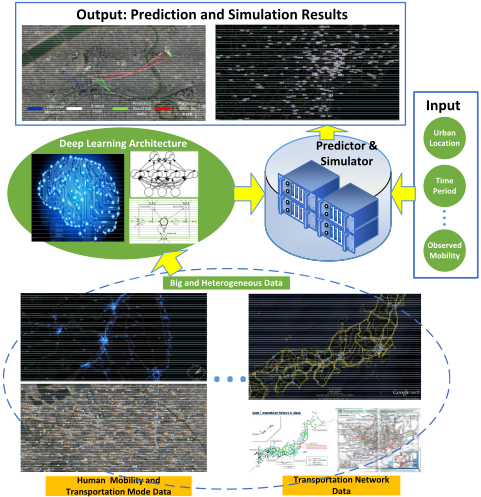
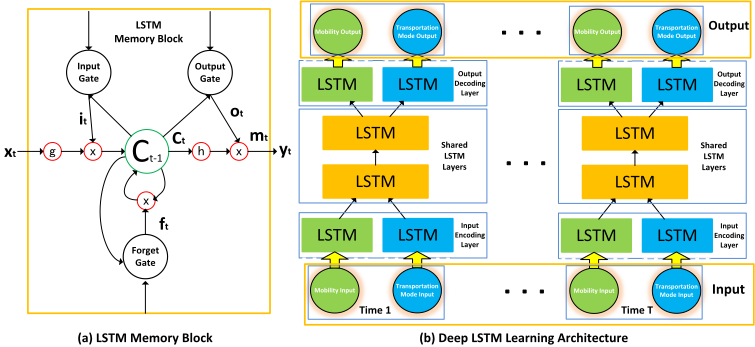
In this article, we collect big and heterogeneous data, and build an intelligent system, namely DeepTransport, for predicting and simulating human mobility and transportation mode on a large-scale transportation network (as shown in Fig.1). The learning component of our system is based on the deep Long Short-Term Memory (LSTM) learning architecture that contains four LSTM layers: one encoding layer for the input sequence, one decoding layer for output sequences, and rest two layers are the hidden layers that share the same parameters. The proposed learning architecture is able to jointly learn human mobility and transportation transition models from the heterogeneous data source, and allows the network to learn at different time scales over the input sequences. Finally, given any location of urban area, time period or observed human mobility, DeepTransport can automatically predict or simulate a large number of people's movements and their transportation transition at a citywide level. To the best of our knowledge, DeepTransport is the first system that applies deep learning approaches to jointly model human mobility and transportation pattern on a large-scale transportation network, and it has the following key characteristics that make it unique:
- ÷ Big and heterogeneous data: DeepTransport is based on a big and heterogeneous data source. It stores and manages the GPS records of 1.6 million users collected over three years and large-scale transportation network data.
- ÷ Deep predictive model: The multi-tasks deep learning architecture ensures the system can learn at different time scales over big sequence data, and the developing predictive model is superior to the traditional shallow ones.
The remainder of this paper is structured as follows. Section 2 briefly reviews some related studies. Section 3 provides an overview of the entire system and the using data source. Section 4 describes the deep learning architecture of our system. Section 5 presents our experimental results and system evaluations. Finally, Section 6 summarizes our findings and concludes this study.
2 RelatedWork
In the past decades, a number of studies have been conducted on urban transportation modeling and understanding [Wang et al., 2012; Yang, 2013]. These studies mainly focus on small-scale transportation networks or rely on either mathematical equations or visualization techniques. However, research on the dynamics of human mobility and transportation evolution on a nation- or city-wide scale is very limited due to the fact that there is no reliable approach for accurately sensing human mobility. Recently, with the increasing prevalence of positioning technologies, human mobile sensing data (e.g. GPS traces of mobile deviece, CDR data, online social networking data, etc.) have become the "big data", which makes it possible to understand human mobility and urban transportation conditions in a citywide level [Song et al., 2010; Gonzalez et al., 2008; Ma et al., 2015a]. Furthermore, understanding, modeling, and mining human mobility and their transportation mode [Giannotti et al., 2011; Zheng et al., 2008; Ma et al., 2015b; Stenneth et al., 2011; Yuan et al., 2013; Cho et al., 2011; Ye et al., 2013] has become the main research focus for smart city development and sustainable urbanization. However, most of these research are based on small dataset, and the models discussed above are "shallow models" that face have difficulties in handling a big and heterogeneous data source.
Recently, deep learning technology [Hinton and Salakhutdinov, 2006; Krizhevsky et al., 2012; Ngiam et al., 2011; Lee et al., 2008; Huang et al., ; Sak et al., 2014] has been shown to be a highly effective learning approach, and it has demonstrated superior performance in various domains (e.g., vision, speech, text, and transportation). Hence, this study constitutes the first attempt to apply the deep learning approach to human mobility and urban transportation modeling.
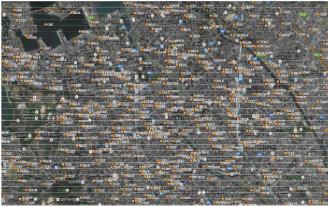
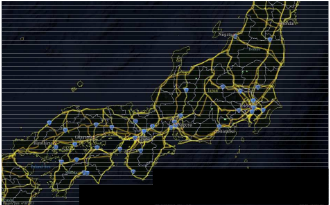
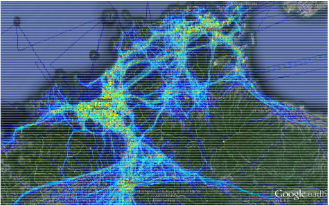
Figure 3: Big and heterogeneous data source. This figure shows the heterogeneous data source of our system. (a) shows human mobility data and the transportation mode label in Osaka. (b) shows transportation network of entire Japan. (c) shows urban mobility graph of Fukuoka. The edge color indicates the edge parameters. Here, it shows the travel frequency; warmer colors indicate higher travel frequency, and these values are normalized from 0 to 1.
3 SystemOverview and Data Source
3.1 SystemOverview
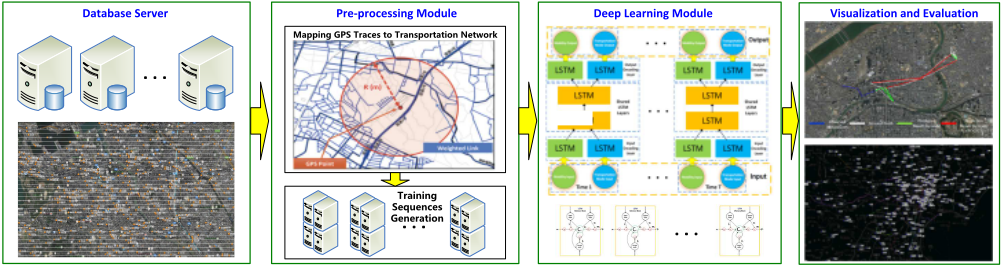
The system architecture is shown in Fig.2. It consists of four main components: database server, pre-processing module, deep learning module, and visualization and evaluation module. The database server module [Song et al., 2014a] stores and manages the data source. It can provide indexing, retrieval, editing, and visualization services. The preprocessing module can clean the data and map the human mobility into the transportation network. Lastly, this module generates a large number of human GPS traces with the transportation mode label on the large-scale transportation network. The deep learning module is the key component of DeepTransport and it includes four LSTM layers for the training: one encoding layer for separated input sequence, one decoding layer for separated output sequences, and rest two layers are the hidden layers that share the same parameters. Further details on this module will be provided in Section 4. Finally, the visualization and evaluation module can visualize the results and evaluate the performance of the overall system.
3.2 Heterogeneous Data Source
In this study, we employ a big and heterogeneous data source to understand human mobility and their transportation mode at a citywide level (as shown in Fig.3). The data can be summarized as follows:
Human mobility data: We collected GPS records of approximately1.6 million anonymized users throughout Japan from August 1, 2010, to July 31, 2013. To manage these data, we employed five computers (Intel Xeon 2.6 GHz CPU, 8 GB RAM, and 2x2 TB HDD) to build a Hadoop cluster that consists of 32 cores, 32 GB memory, and 16 TB storage, and is able to run 28 tasks simultaneously. Furthermore, we installed Hive on top of Hadoop to make the entire system support SQL-like spatial queries. This set up can provide indexing, retrieval, editing, and visualization services. In addtion, the transportation mode labels (e.g., stay, walk, bicycle, car, train) of people were added to the data source (as shown in Fig.3-a).
Transportation network data: We collected the transportation network data of some important cities of Japan. These data include road structure and POI information (as shown in Fig.3-b). Transportation networks might come to a standstill in the event of a major earthquake. Therefore, we also used a large number of human emergency movements to train the urban mobility graph [Song et al., 2014a] that includes transportation information (e.g., road connections, travel time, and travel frequency of each road) for emergencies (as shown in Fig.3-c).
4 Deep Learning Architecture
4.1 Preliminaries
Consider a set of individual people's GPS trajectories Tra = ¶tra1↪ tra2↪ ▷▷▷↪ tran♦ in an urban area or city, which has been mapped to the large-scale transportation network. For each trajectory trai = r1r2▷▷▷rm, it consists of a series of m GPS records and their transportation mode. Each record r is a tuple in the form of r =< uid↪ time↪ latitude↪ longtitude↪mode >, where uid is the id of people, time is the time of the record, and latitude and longtitude specify the geographic position of the record, mode is the transportation mode label (e.g., stay, walk, bicycle, car, train) at current time and location.
Therefore, our goal is to learn a simulation or prediction model from T ra. Given any person's GPS trajectory traob = r1r2▷▷▷rt with the transportation mode from time 1 to time t, we want to predict its mobility and transportation mode at the next several time steps.
4.2 RNN and LSTMNetwork
Human mobility and transportation patterns have a high degree of temporal and spatial correlation. For instance, if the first several time steps of commute traveling pattern is like
��� ��� "walk-train-walk-bus", the possibility of next mode as "bicycle" will be small. Due to the spatial-temporal nature of human mobility, Recurrent Neural Networks (RNN) is especially suitable to capture the temporal and spatial evolution of human moving and transportation transition patterns. However, previous studies [Hochreiter and Schmidhuber, 1997] have shown that the traditional RNNs fail to capture the long temporal dependency for the input sequence due to the vanishing gradient and exploding gradient problems. To address these drawbacks, Long Short-TermMemory (LSTM)- a special RNN architecture is developed [Hochreiter and Schmidhuber, 1997] for sequence labeling and prediction tasks. LSTM is able to learn the time series with long time spans and automatically determine the optimal time lags for prediction. In this study, we choose to use LSTM to model long-term temporal dependency of human mobility and transportation patterns.
An LSTM network (as shown in Fig.4-a) computes a mapping from an input sequence X = (x1↪ ▷▷▷↪ xT ) to an output sequence Y = (y1↪ ▷▷▷↪ yT ) by calculating the network unit activations using the following equations iteratively from t = 1 to T :
where i, f and o are respectively the input gate, forget gate, output gate. c and m are the activation vectors for each cell and memory block, and the weigh matrices W and bias vectors b are utilized to build connects between the input layer, output layer and memory block. Here, ⊙ represents the scalar product of two vectors, σ(·) denotes the standard logistics sigmoid function, and g(·) and h(·) are the cell input and cell output activation functions, generally centered logistic sigmoid function in this study. φ is the network output activation function, and we use softmax in this study.
4.3 Multi-task and Deep LSTMLearning Architecture
In this research, we aim to jointly model a large number of people's movements and transportation patterns in a specific urban area or city (large-scale transportation network of cities). The training data will be huge and vary at different temporal and spatial scales (e.g., different persons, different time, different locations of city, etc.), and the single layer LSTM is difficult to model them. Thus, the training sequences vary at different time scales and need to be processed by a multiple nonlinear hidden layers. Recently, Google's acoustic modeling system [Sak et al., 2014] has demonstrated that multiple layers LSTM [Hermans and Schrauwen, 2013] allowed the network to learn at different time scales over the input. Therefore, we choose to use the deep LSTM learning architecture to build the whole system, which results in inputs going through more non-linear operations per time step.
Besides, persons' location and their transportation mode share important information and are highly correlated with each other. For instance, the "train" mode will only appear at the "train line" of the transportation network; the "walk" and "bicycle" mode will not appear at expressway. Thus, instead of using a joint feature vector, we view mobility and transportation mode prediction as two separated tasks, and propose a multi-task deep LSTM learning architecture to jointly learn the predictive model for persons' movements and transportation mode pattern. The key concept of multi-task learning [Ngiam et al., 2011] is to learn several tasks simultaneously with the aim of gaining mutual benefits; thus, learning performance can be improved through parallel learning while using a shared representation. Therefore, it is reasonable to expect better results from our application through this learning framework. Another advantage of this learning architecture is that we can use a single data source and shared rep-
(c) Prediction results for a large number of persons in Tokyo
(d) Simulation results for a large number of persons in Osaka on weekdays
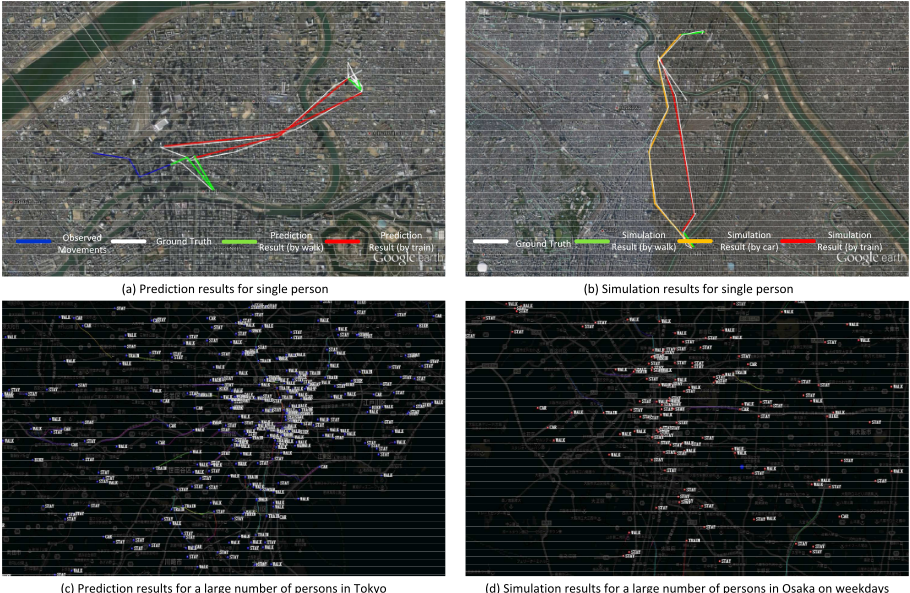
Figure 5: Visualization of the results. (a) Given a person's current observed movements (blue lines), the person's possible movements and transportation mode are predicted as shown in the colorful lines, and the actual movements are shown by white lines. (b) Given any location and time period, the person's possible movements and transportation mode are randomly simulated as shown by colorful lines based on the output distribution of our deep learning models, and the most similar one in the ground truth data is shown by white lines. (c) shows the sample prediction results for a large number of persons in Tokyo, and (d) shows the sample simulation results for a large number of people in Osaka on weekdays.
resentation to train the predictive model for some real-world applications in which we need to predict people's future mobility and transportation mode without transportation mode label or observed human mobility.
Previous study [Dai and Le, 2015] has shown that the recurrent network can be used as encoder to improve the supervised learning performance. Inspired this idea, we add one encoding and decoding layer to the whole learning architecture. Thus, the overall learning architecture is shown in Fig.4b, and it contains four LSTM layers: one encoding layer for separated input sequence, one decoding layer for separated output sequences, and two hidden shared layers that share the same parameters.
5 Experimental Results
In this section, we present extensive experimental results and evaluate our system for the prediction of human mobility and transportation mode.
5.1 Experimental Setup and Parameters Setting
Experimental setup: In the experiments, we randomly retrieved a large number of human GPS traces over random long-term days (including weekdays and weekend days) that had more than 3,000 GPS records from our database server; the selected geotropical regions were some large cities of Japan (e.g., Tokyo, Osaka, Fukuoka, etc.). Then these GPS traces were pre-processed (e.g., data cleaning, noise reduction, etc.) and mapped to the transportation network of the cities. Lastly, the pre-processing module of our system outputted the training and testing sequences of weekdays and weekend. To evaluate the performance of our sytem, K-fold cross-validation was performed. The whole sequence data were randomly partitioned into three subsamples: one sample was used as validation data while the other two were used as training data. The cross-validation process was then repeated three times with each sub-sample used exactly once as validation data. For the prediction task, we input the sequence of the first five time steps, and our system predicted the following sequences. For the simulation task, our system randomly generated the sequences based on the output distribution of the deep learning module.
Parameters setting: The learning architecture of our system contained four LSTM layers, with 80 cells at each layer. We initialized all of the LSTM's parameters with the uniform distribution between -0.02 and 0.02, and used stochastic gradient descent with a learning rate of 0.01 and a momentum of 0.95. It took 8 training epochs to converge.
| Algorithm | Mobility MAPE | Mobility MSE | Trans Mode Precision Accuracy | Trans Mode Recall Accuracy |
|---|---|---|---|---|
| LSTM | 25.37% | 83.77 | 72.32% | 70.21% |
| DLSTM | 19.38% | 63.53 | 80.35% | 79.27% |
| TDNN | 31.87% | 109.52 | 63.76% | 61.23% |
| GM | 39.68% | 138.97 | NA | NA |
| HMM | 27.89% | 88.59 | NA | NA |
| Our System | 17.38% | 57.39 | 83.26% | 81.37% |
5.2 Visualization of Results
The visualization of the results is shown in Fig.5. As shown in Fig.5-a, given a person's observed movements (blue lines), our system can predict his/her future movements and transportation mode (e.g., other colorful lines). From this sample results, we can see that our prediction results are very similar to the real scenarios (white lines). Furthermore, Fig.5-c shows the sample prediction results for a large number of persons in Tokyo.
On the other hand, if we cannot observe a person's mobility, we can just input start location and time period, our system will automatically simulate human mobility and their transportation mode (as shown in Fig.5-b,d) based on the output distribution of deep learning models. Fig.5-b shows the simulation results of single person (the colorful lines) on weekdays, and it was very easy for us to find a very similar GPS traces (white lines) from the ground truth data. Fig.5d shows the sample simulation results for a large number of people in Osaka on weekdays.
5.3 Performance Evaluation
Evaluation metric and baseline models: To measure and evaluate the performance of different systems or algorithms, the Mean Absolute Percentage Errors (MAPE) and Mean Squared Errors (MSE) of distance were used to measure the performance of mobility prediction, and the average precision accuracy and average recall accuracy were used to measure the performance of transportation mode prediction. Furthermore, we consider the following baseline models for the comparisons. (1) Shallow LSTM (LSTM): this model contained only single LSTM layer, and the input vector was the joint feature vector of mobility and transportation mode. (2) Deep LSTM (DLSTM): this model contained four LSTM layers , but it was different from our multi-task deep learning architecture because it used the joint input feature vector of mobility and transportation mode, and it was constructed by four shared LSTM layers. For the above baseline models, the parameters setting was same to our system. (3) Time-delay neural network (TDNN): this model feeds back the previous input values into the current input, and it thus can be considered as a nonlinear AR model for sequence prediction. (4) Gaussian model (GM): This model was proposed by Gonzales et al. [Gonzalez et al., 2008]; it models human mobility or movements as a stochastic process centered around a single location. But this model cannot predict human transportation mode. (5) Hidden Markov model (HMM): This model was proposed by Song et al. [Song et al., 2014b]; it uses an HMM to model dependencies among different human behaviors and mobility. This is a strong baseline model for human mobility prediction, but it cannot predict human transportation mode.
Performance evaluation: We compared the performances of our model and the baseline models. Table 1 summarizes the performances of all the models. From this table, we can see that our approach achieved better performance than the baseline models. For the TDNN, GM and HMM, they are all are shallow models, and they do not have sufficient capabilities to handle the complexity of human mobility and transportation mode. Meanwhile, we can see that our multitasks learning architecture obtained the better performance than traditional LSTM or deep LSTM learning architecture.
6 Conclusion
In this study, we collected big and heterogeneous data to understand and model human mobility and transportation mode, and we built an intelligent system called DeepTransport. The experimental results and validations demonstrated the efficiency and superior performance of our system. To the best of our knowledge, DeepTransport is the first system that applies deep learning approaches to human mobility and transportation pattern modeling.
In the future, our system can be extended and improved in the following aspects. (1) Our transportation network data contains POI information, but it has not been used as the feature for the deep learning model development. Thus, some tensor decomposition approaches can be considered to combine the POI information in the future. (2) Currently, the transportation network is static. But it may change due to some emergency events (e.g., standstill of the train or bus line). Hence, some approaches or models that can be applied to such kind of situations should be explored and developed in the future.
7 Acknowledgements
This work was partially supported by, JST, Strategic International Collaborative Research Program (SICORP); GrantinAid for Young Scientists (26730113) of Japans Ministry of Education, Culture, Sports, Science, and Technology (MEXT); and DIAS/GRENE project of MEXT. We specially thank ZENRIN DataCom CO., LTD for their supporting.
@inproceedings{ijcai2016p372,
  title     = {DeepTransport: Prediction and Simulation of Human Mobility and Transportation Mode at a Citywide Level},
  author    = {Song, Xuan and Kanasugi, Hiroshi and Shibasaki, Ryosuke},
  booktitle = {Proceedings of the Twenty-Fifth International Joint Conference on
               Artificial Intelligence, {IJCAI-16}},
  publisher = {AAAI Press / International Joint Conferences on Artificial Intelligence},
  editor    = {Subbarao Kambhampati},
  pages     = {2618--2623},
  year      = {2016},
  month     = {7},
  url       = {https://ijcai.org/proceedings/2016/372},
}
TY - CPAPER TI - DeepTransport: Prediction and Simulation of Human Mobility and Transportation Mode at a Citywide Level AU - Song, Xuan AU - Kanasugi, Hiroshi AU - Shibasaki, Ryosuke T2 - Proceedings of the Twenty-Fifth International Joint Conference on Artificial Intelligence, IJCAI-16 PB - AAAI Press / International Joint Conferences on Artificial Intelligence PY - 2016 SP - 2618 EP - 2623 UR - https://ijcai.org/proceedings/2016/372 ER -Copied
Machine-readable versions of this paper, for tools and AI agents:





