
Exploring Segment Representations for Neural Segmentation Models
Proceedings of the Twenty-Fifth International Joint Conference on Artificial Intelligence. Pages 2880-2885.
Abstract
Many natural language processing (NLP) tasks can be generalized into segmentation problem. In this paper, we combine semi-CRF with neural network to solve NLP segmentation tasks. Our model represents a segment both by composing the input units and embedding the entire segment. We thoroughly study different composition functions and different segment embeddings. We conduct extensive experiments on two typical segmentation tasks: named entity recognition (NER) and Chinese word segmentation (CWS). Experimental results show that our neural semi-CRF model benefits from representing the entire segment and achieves the state-of-the-art performance on CWS benchmark dataset and competitive results on the CoNLL03 NER dataset.
- [Ando and Zhang, 2005] Rie Kubota Ando and Tong Zhang. A framework for learning predictive structures from mul- tiple tasks and unlabeled data. J. Mach. Learn. Res., 6:1817-1853, December 2005.
- [Andrew, 2006] Galen Andrew. A hybrid markov/semi- markov conditional random field for sequence segmenta- tion. In EMNLP-2006, pages 465-472, Sydney, Australia, July 2006. ACL.
- [Collobert et al., 2011] Ronan Collobert, Jason Weston, Léon Bottou, Michael Karlen, Koray Kavukcuoglu, and Pavel Kuksa. Natural language processing (almost) from scratch. J. Mach. Learn. Res., November 2011.
- [Dyer et al., 2015] Chris Dyer, Miguel Ballesteros, Wang Ling, Austin Matthews, and Noah A. Smith. Transition- based dependency parsing with stack long short-term memory. In ACL-2015, pages 334-343, Beijing, China, July 2015. ACL.
- [Erhan et al., 2010] Dumitru Erhan, Yoshua Bengio, Aaron Courville, Pierre-Antoine Manzagol, Pascal Vincent, and Samy Bengio. Why does unsupervised pre-training help deep learning? J. Mach. Learn. Res., March 2010.
- [Guo et al., 2014] Jiang Guo, Wanxiang Che, Haifeng Wang, and Ting Liu. Revisiting embedding features for simple semi-supervised learning. In EMNLP-2014, pages 110- 120, Doha, Qatar, October 2014. ACL.
- [Hochreiter and Schmidhuber, 1997] Sepp Hochreiter and Jürgen Schmidhuber. Long short-term memory. Neural Comput., 9(8):1735-1780, November 1997.
- [Huang et al., 2015] Zhiheng Huang, Wei Xu, and Kai Yu. Bidirectional LSTM-CRF models for sequence tagging. CoRR, abs/1508.01991, 2015.
- [Jiang et al., 2013] Wenbin Jiang, Meng Sun, Yajuan Lü, Yating Yang, and Qun Liu. Discriminative learning with natural annotations: Word segmentation as a case study. In ACL-2013, pages 761-769, Sofia, Bulgaria, August 2013. ACL.
- [Kong et al., 2015] Lingpeng Kong, Chris Dyer, and Noah A. Smith. Segmental recurrent neural networks. CoRR, abs/1511.06018, 2015.
- [Lafferty et al., 2001] John D. Lafferty, Andrew McCallum, and Fernando C. N. Pereira. Conditional random fields: Probabilistic models for segmenting and labeling sequence data. In ICML 01, pages 282-289, San Francisco, CA, USA, 2001.
- [Ling et al., 2015] Wang Ling, Chris Dyer, Alan W Black, and Isabel Trancoso. Two/too simple adaptations of word2vec for syntax problems. In NAACL-2015, pages 1299-1304, Denver, Colorado, May-June 2015. ACL.
- [Mikolov et al., 2013] Tomas Mikolov, Ilya Sutskever, Kai Chen, Greg Corrado, and Jeffrey Dean. Distributed rep- resentations of words and phrases and their composition- ality. CoRR, abs/1310.4546, 2013.
- [Okanohara et al., 2006] Daisuke Okanohara, Yusuke Miyao, Yoshimasa Tsuruoka, and Jun'ichi Tsujii. Improv- ing the scalability of semi-markov conditional random fields for named entity recognition. In ACL-2006, pages 465-472, Sydney, Australia, July 2006. ACL.
- [Passos et al., 2014] Alexandre Passos, Vineet Kumar, and Andrew McCallum. Lexicon infused phrase embeddings for named entity resolution. In CoNLL-2014, pages 78-86, Ann Arbor, Michigan, June 2014. ACL.
- [Pei et al., 2014] Wenzhe Pei, Tao Ge, and Baobao Chang. Max-margin tensor neural network for chinese word seg- mentation. In ACL-2014, pages 293-303, Baltimore, Maryland, June 2014. ACL.
- [Ratinov and Roth, 2009] Lev Ratinov and Dan Roth. De- sign challenges and misconceptions in named entity recog- nition. In CoNLL-2009, pages 147-155, Boulder, Col- orado, June 2009. ACL.
- [Sarawagi and Cohen, 2004] Sunita Sarawagi and William W. Cohen. Semi-markov conditional ran- dom fields for information extraction. In NIPS 17, pages 1185-1192. MIT Press, Cambridge, MA, 2004.
- [Sun et al., 2009] Xu Sun, Yaozhong Zhang, Takuya Mat- suzaki, Yoshimasa Tsuruoka, and Jun'ichi Tsujii. A dis- criminative latent variable chinese segmenter with hybrid word/character information. In NAACL-2009, pages 56- 64, Boulder, Colorado, June 2009. ACL.
- [Tseng, 2005] Huihsin Tseng. A conditional random field word segmenter. In In Fourth SIGHAN Workshop on Chi- nese Language Processing, 2005.
- [Wang et al., 2011] Yiou Wang, Jun'ichi Kazama, Yoshi- masa Tsuruoka, Wenliang Chen, Yujie Zhang, and Kentaro Torisawa. Improving chinese word segmentation and pos tagging with semi-supervised methods using large auto- analyzed data. In IJCNLP-2011, pages 309-317, Chiang Mai, Thailand, November 2011. AFNLP.
- [Yang and Cardie, 2012] Bishan Yang and Claire Cardie. Extracting opinion expressions with semi-markov condi- tional random fields. In EMNLP-2012, pages 1335-1345, Jeju Island, Korea, July 2012. ACL.
- [Zhang and Clark, 2007] Yue Zhang and Stephen Clark. Chinese segmentation with a word-based perceptron algo- rithm. In ACL-2007, pages 840-847, Prague, Czech Re- public, June 2007. ACL.
- [Zheng et al., 2013] Xiaoqing Zheng, Hanyang Chen, and Tianyu Xu. Deep learning for Chinese word segmenta- tion and POS tagging. In EMNLP-2013, pages 647-657, Seattle, Washington, USA, October 2013. ACL.
References were extracted automatically from the PDF and may contain errors.
Full text extracted automatically from the PDF; figures, tables and equations may differ. The PDF is the version of record.
1 Introduction
Given an input sequence, segmentation is the problem of identifying and assigning tags to its subsequences. Many natural language processing (NLP) tasks can be cast into the segmentation problem, like named entity recognition [Okanohara et al., 2006], opinion extraction [Yang and Cardie, 2012], and Chinese word segmentation [Andrew, 2006]. Properly representing segment is critical for good segmentation performance. Widely used sequence labeling models like conditional random fields [Lafferty et al., 2001] represent the contextual information of the segment boundary as a proxy to entire segment and achieve segmentation by labeling input units (e.g. words or characters) with boundary tags. Compared with sequence labeling model, models that directly represent segment are attractive because they are not bounded by local tag dependencies and can effectively adopt segment-level information. Semi-Markov CRF (or semi-CRF) [Sarawagi and Cohen, 2004] is one of the models that directly represent the entire segment. In semiCRF, the conditional probability of a semi-Markov chain on the input sequence is explicitly modeled, whose each state corresponds to a subsequence of input units, which makes semi-CRF a natural choice for segmentation problem.
⇤Email corresponding.
However, to achieve good segmentation performance, conventional semi-CRF models require carefully hand-crafted features to represent the segment. Recent years witness a trend of applying neural network models to NLP tasks. The key strengths of neural approaches in NLP are their ability for modeling the compositionality of language and learning distributed representation from large-scale unlabeled data. Representing a segment with neural network is appealing in semiCRF because various neural network structures [Hochreiter and Schmidhuber, 1997] have been proposed to compose sequential inputs of a segment and the well-studied word embedding methods [Mikolov et al., 2013] make it possible to learn entire segment representation from unlabeled data.
In this paper, we combine neural network with semi-CRF and make a thorough study on the problem of representing a segment in neural semi-CRF. Kong et al. [2015] proposed a segmental recurrent neural network (SRNN) which represents a segment by composing input units with RNN. We study alternative network structures besides the SRNN. We also study segment-level representation using segment embedding which encodes the entire segment explicitly. We conduct extensive experiments on two typical NLP segmentation tasks: named entity recognition (NER) and Chinese word segmentation (CWS). Experimental results show that our concatenation alternative achieves comparable performance with the original SRNN but runs 1.7 times faster and our neural semiCRF greatly benefits from the segment embeddings. In the NER experiments, our neural semi-CRF model with segment embeddings achieves an improvement of 0.7 F-score over the baseline and the result is competitive with state-of-the-art systems. In the CWS experiments, our model achieves more than 2.0 F-score improvements on average. On the PKU and MSR datasets, state-of-the-art F-scores of 95.67% and 97.58% are achieved respectively. We release our code at https://github.com/ExpResults/segrep-for-nn-semicrf.
2 ProblemDefinition
Figure 1 shows examples of named entity recognition and Chinese word segmentation. For the input word sequence in the NER example, its segments ("Michael Jordan":PER, "is":NONE, "a":NONE, "professor":NONE, "at":NONE, "Berkeley":ORG) reveal that "Michaels Jordan" is a person name and "Berkeley" is an organization. In the CWS example, the subsequences (" /Pudong", " /development",
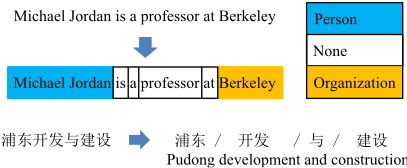
" /and", " /construction") of the input character sequence are recognized as words. Both NER and CWS take an input sequence and partition it into disjoint subsequences.
Formally, for an input sequence x = (x1↪ ▷▷↪ x♣x♣) of length ♣x♣, let xa:b denote its subsequence (xa↪ ▷▷▷↪ xb). A segment of x is defined as (u↪ v↪ y) which means the subsequence xu:v is associated with label y. A segmentation of x is a segment sequence s = (s1↪ ▷▷↪ sp), where sj = (uj ↪ vj ↪ yj ) and uj+1 = vj +1. Given an input sequence x, the segmentation problem can be defined as the problem of finding x's most probable segment sequence s.
3 Neural Semi-Markov CRF
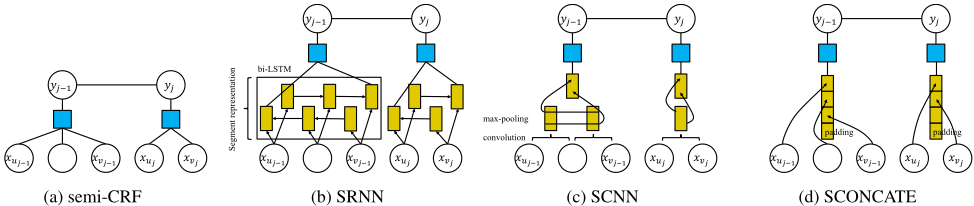
Semi-Markov CRF (or semi-CRF, Figure 2a) [Sarawagi and Cohen, 2004] models the conditional probability of s on x as
where G(x↪ s) is the feature function, W is the weight vector and Z(x) = Ps02S exp¶W ·G(x↪ s0 )♦ is the normalize factor of all possible segmentations S over x.
By restricting the scope of feature function within a segment and ignoring label transition between segments (0order semi-CRF), G(x↪ s) can be decomposed as G(x↪ s) = Ppj=1 g(x↪ sj) where g(x↪ sj) maps segment sj into its representation. Such decomposition allows using efficient dynamic programming algorithm for inference. To find the best segmentation in semi-CRF, let ↵j denote the best segmentation ends with j th input and ↵j is recursively calculated as
where L is the maximum length manually defined and (j - l↪ j↪ y) is the transition weight for s = (j - l↪ j↪ y) in which (j - l↪ j↪ y) = W · g(x↪ s).
Previous semi-CRF works [Sarawagi and Cohen, 2004; Okanohara et al., 2006; Andrew, 2006; Yang and Cardie, 2012] parameterize g(x↪ s) as a sparse vector, each dimension of which represents the value of corresponding feature function. Generally, these feature functions fall into two types: 1) the CRF style features which represent input unit-level information such as "the specific words at location i" 2) the semi-CRF style features which represent segment-level information such as "the length of the segment".
Kong et al. [2015] proposed the segmental recurrent neural network model (SRNN, see Figure 2b) which combines the semi-CRF and the neural network model. In SRNN, g(x↪ s) is parameterized as a bidirectional LSTM (bi-LSTM). For a segment sj = (uj↪ vj↪ yj), each input unit x in subsequence (xuj ↪ ▷▷↪ xvj ) is encoded as embedding and fed into the biLSTM. The rectified linear combination of the final hidden layers from bi-LSTM is used as g(x↪ s). Kong et al. [2015] pioneers in representing a segment in neural semi-CRF. BiLSTM can be regarded as "neuralized" CRF style features which model the input unit-level compositionality. However, in the SRNN work, only the bi-LSTM was employed without considering other input unit-level composition functions. What is more, the semi-CRF styled segment-level information as an important representation was not studied. In the following sections, we first study alternative input unit-level composition functions (3.1). Then, we study the problem of representing a segment at segment-level (3.2).
3.1 Alternative Seg-Rep. via Input Composition Segmental CNN
Besides recurrent neural network (RNN) and its variants, another widely used neural network architecture for composing and representing variable-length input is the convolutional neural network (CNN) [Collobert et al., 2011]. In CNN, one or more filter functions are employed to convert a fix-width segment in sequence into one vector. With filter function "sliding" over the input sequence, contextual information is encoded. Finally, a pooling function is used to merge the vectors into one. In this paper, we use a filter function of width 2 and max-pooling function to compose input units of a segment. Following SRNN, we name our CNN segment representation as SCNN (see Figure 2c).
However, one problem of using CNN to compose input units into segment representation lies in the fact that the maxpooling function is insensitive to input position. Two different segments sharing the same vocabulary can be treated without difference. In a CWS example, " " (racket for sell) and " " (ball audition) will be encoded into the same vector in SCNN if the vector of " " that produced by filter function is always preserved by max-pooling.
Segmental Concatenation
Concatenation is also widely used in neural network models to represent fixed-length input. Although not designed to handle variable-length input, we see that in the inference of semiCRF, a maximum length L is adopted, which make it possible to use padding technique to transform the variable-length representation problem into fixed-length of L. Meanwhile, concatenation preserves the positions of inputs because they are directly mapped into the certain positions in the resulting vector. In this paper, we study an alternative concatenation function to compose input units into segment representation, namely the SCONCATE model (see Figure 2d). Compared with SRNN, SCONCATE requires less computation when representing one segment, thus can speed up the inference.
3.2 Seg-Rep. via Segment Embeddings
For segmentation problems, a segment is generally considered more informative and less ambiguous than an individual input. Incorporating segment-level features usually lead performance improvement in previous semi-CRF work. Segment representations in Section 3.1 only model the composition of input units. It can be expected that the segment embedding which encodes an entire subsequence as a vector can be an effective way for representing a segment.
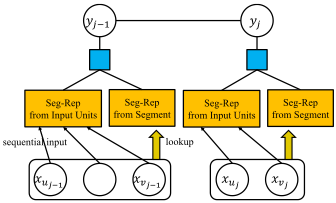
In this paper, we treat the segment embedding as a lookupbased representation, which retrieves the embedding table with the surface string of entire segment. With the entire segment properly embed, it is straightforward to combine the segment embedding with the composed vector from the input so that multi-level information of a segment is used in our model (see Figure 3). However, how to obtain such embeddings is not a trivial problem.
A natural solution for obtaining the segment embeddings can be collecting all the "correct" segments from training data into a lexicon and learning their embeddings as model parameters. However, the in-lexicon segment is a strong clue for a subsequence being a correct segment, which makes our model vulnerable to overfitting. Unsupervised pre-training has been proved an effective technique for improving the robustness of neural network model [Erhan et al., 2010]. To mitigate the overfitting problem, we initialize our segment embeddings with the pre-trained one.
Word embedding gains a lot of research interest in recent years [Mikolov et al., 2013] and is mainly carried on English texts which are naturally segmented. Different from the word embedding works, our segment embedding requires largescale segmented data, which cannot be directly obtained. Following Wang et al. [2011] which utilize automatically segmented data to enhance their model, we obtain the autosegmented data with our neural semi-CRF baselines (SRNN, SCNN, and SCONCATE) and use the auto-segmented data to learn our segment embeddings.
Another line of research shows that machine learning algorithms can be boosted by ensembling heterogeneous models. Our neural semi-CRF model can take knowledge from heterogeneous models by using the segment embeddings learned on the data segmented by the heterogeneous models. In this paper, we also obtain the auto-segmented data from a conventional CRF model which utilizes hand-crafted sparse features. Once obtaining the auto-segmented data, we learn the segment embeddings in the same with word embeddings.
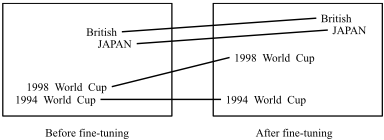
A problem that arises is the fine-tuning of segment embeddings. Fine-tuning can learn a task-specific segment embeddings for the segments that occur in the training data, but it breaks their relations with the un-tuned out-of-vocabulary segments. Figure 4 illustrates this problem. Since OOV segments can affect the testing performance, we also try learning our model without fine-tuning the segment embeddings.
3.3 Model details
In this section, we describe the detailed architecture for our neural semi-CRF model.
Input Unit Representation
Following Kong et al. [2015], we use a bi-LSTM to represent the input sequence. To obtain the input unit representation, we use the technique in Dyer et al. [2015] and separately use two parts of input unit embeddings: the pre-trained embeddings Ep without fine-tuning and fine-tuned embeddings Et . For the ith input, Ep i and Et i are merged together through linear combination and form the input unit representation
| fixed input unit embedding Ep i size | 100 |
| fine tuned input unit embedding Et i size | 32 |
| input unit representation Ii size | 100 |
| LSTM hidden layer Hi size | 100 |
| seg-rep via input composition SCOMP | 64 |
| seg-rep via segment embedding SEMB | 50 |
| label embedding EY yi size | 20 |
| final segment representation Si size | 100 |
where the notation of W[X1; ▷▷;Xn] equals to X1↪ ▷▷↪Xn's linear combination W1X1 + ▷▷ +WnXn and bI is the bias. After obtaining the representation for each input unit, a sequence (I1↪ ▷▷▷↪ I♣x♣) is fed to a bi-LSTM. The hidden layer of forward LSTM -! Hi and backward LSTM - Hi are combined as
and used as the ith input unit's final representation.
Segment Representation
Given a segment sj = (uj↪ vj↪ yj), a generic function SCOMP(Huj ↪ ▷▷▷↪Hvj ) stands for the segment representation that composes the input unit representations (Huj ↪ ▷▷↪Hvj ). In this work, SCOMP is instantiated with three different functions: SRNN, SCNN and SCONCATE. Besides composing input units, we also employ the segment embeddings as segment-level representation. Embedding of the segment sj = (uj↪ vj↪ yj) is denoted as a generic function SEMB(xuj ▷▷▷xvj ) which converts the subsequence (xuj ↪ ▷▷▷↪ xvj ) into its embedding through a lookup table. At last, the representation of segment sj is calculated as
where EY is the embedding for the label of a segment.
Throughout this paper, we use the same hyper-parameters for different experiments as listed in Table 1.
Training Procedure
In this paper, negative log-likelihood is used as learning objective. We follow Dyer et al. [2015] and use stochastic gradient descent to optimize model parameters. Initial learning rate is set as ⌘0 = 0▷1 and updated as ⌘t = ⌘0◁(1 + 0▷1t) on each epoch t. Best training iteration is determined by the evaluation score on development data.
4 Experiment
We conduct our experiments on two NLP segmentation tasks: named entity recognition and Chinese word segmentation.
4.1 Dataset andWord Embedding
For NER, we use the CoNLL03 dataset which is widely adopted for evaluating NER models' performance. F-score is used as evaluation metric. 1
For CWS, we follow previous study and use three Simplified Chinese datasets: PKU and MSR from 2 nd SIGHAN
1 conlleval script in CoNLL03 shared task is used.
bakeoff and Chinese Treebank 6.0 (CTB6). For the PKU and MSR datasets, last 10% of the training data are used as development data as [Pei et al., 2014] does. For CTB6 data, recommended data split is used. We convert all the double byte digits and letters in the PKU data into single byte. Like NER, CWS performance is evaluated by F-score. 2
Unlabeled data are used to learn both the input unit embeddings (word embedding for NER, character embedding for CWS) and segment embeddings. For NER, we use RCV1 data as our unlabeled English data. For CWS, Chinese gigawords is used as unlabeled Chinese data. Throughout this paper, we use the word embedding toolkit released by Ling et al. [2015] to obtain both the input unit embeddings and segment embeddings. 3
4.2 Baseline
We compare our models with three baselines:
- SPARSE-CRF: The CRF model using sparse handcrafted features.
- NN-LABELER: The neural network sequence labeling model making classification on each input unit.
- NN-CRF: The neural network CRF which models the conditional probability of a label sequence over the input sequence.
BIESO-tag schema is used in all the CRF and sequence labeling models. 4 For SPARSE-CRF, we use the baseline feature templates in Guo et al. [2014] for NER and Jiang et al. [2013]'s feature templates for CWS. Both NN-LABELER and NN-CRF take the same input unit representation as our neural semi-CRF models but vary on the output structure and do not explicitly model segment-level information.
4.3 Comparing Different Input Composition Functions
We first consider the problem of representing segments via composing input units and compare different input composition functions. Results on NER and CWS data are shown in Table 2. From this table, the SRNN and SCONCATE achieve comparable results and perform better than the SCNN. Although CNN can model input sequence at any length, its invariance to the exact position can be a flaw in representing segments. The experimental results confirm that and show the importance of properly handling the input position. Considering SCNN's relatively poor performance, we only study SRNN and SCONCATE in the following experiments.
Comparing with NN-LABELER, structure prediction models (NN-CRF and neural semi-CRF) generally achieve better performance. The best structure prediction model outperforms NN-LABELER by 0.4% on NER and 1.11% averagely on CWS according to Table 2. But the difference between the neural structure prediction models is not significant. NNCRF performs better than the best neural semi-CRF model iter
2 score script in 2 nd SIGHAN bakeoff is used.
3 https://github.com/wlin12/wang2vec
4 O tag which means OUTSIDE is not adopted in CWS experiments since CWS doesn't involve assigning tags to segments.
| NER CoNLL03 | ||||||||||
|---|---|---|---|---|---|---|---|---|---|---|
| model | test | CTB6 | test | CWS PKU | test | MSR | ||||
| dev | dev | dev | dev | test | spd | |||||
| NN-LABELER | 93.03 | 88.62 | 93.70 | 93.06 | 93.57 | 92.99 | 93.22 | 93.79 | 3.30 | |
| baseline | NN-CRF | 93.06 | 89.08 | 94.33 | 93.65 | 94.09 | 93.28 | 93.81 | 94.17 | 2.72 |
| SPARSE-CRF | 88.87 | 83.43 | 95.68 | 95.08 | 95.85 | 95.06 | 96.09 | 96.54 | ||
| semi-CRF | SRNN | 92.97 | 88.63 | 94.56 | 94.06 | 94.86 | 93.91 | 94.38 | 95.21 | 0.62 |
| neural SCONCATE | 92.96 | 89.07 | 94.34 | 93.96 | 94.41 | 93.57 | 94.05 | 94.53 | 1.08 | |
| SCNN | 91.53 | 87.68 | 87.82 | 87.51 | 79.64 | 80.75 | 85.04 | 85.79 | 1.46 | |
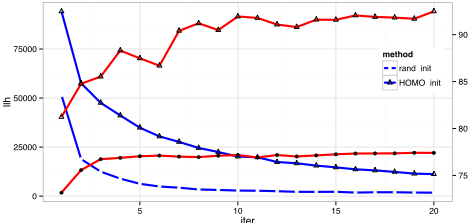
Figure 5: Negative log-likelihood (blue lines) and development F-score (red lines) by iterations. Solid lines show the model with randomly initialized segment embeddings. Dashed lines show that initialized with pre-trained.
(SCONCATE) on NER while the both SRNN and SCONCATE outperform NN-CRF on three CWS datasets. We address this to the fact either the NN-CRF or the neural semiCRF merely takes input-level information and not sufficiently adopts segment-level information into the models.
A further comparison on inference speed shows that SCONCATE runs 1.7 times faster than SRNN, but slower than the NN-LABELER and NN-CRF, which is resulted from the intrinsic difference in time complexity.
4.4 Comparing Different Segment Embeddings
Next we study the effect of different segment embeddings. Using a segmentation model, we can obtain auto-segmented unlabeled data, then learn the segment embeddings. In this paper, we tried two segmentation models. One is the neural semi-CRF baseline which represents segment by composing input and another one is the CRF model using sparse handcrafted features. For convenience, we use SEMB-HOMO and SEMB-HETERO to note the segment embeddings learned from their auto-segmented data respectively.
Effect of Pre-trained Segment Embeddings
We first incorporate randomly initialized segment embeddings into our model and tune the embeddings along with other parameters. However our preliminary experiments of adding these embeddings into SRNN witness a severe drop of F-score on the CoNLL03 development set (from 92.97% to 77.5%). A further investigation shows that the randomly initialized segment embeddings lead to severe overfitting. Figure 5 shows the learning curve in training the NER model.
| model | CoNLL03 | CTB6 | PKU | MSR |
|---|---|---|---|---|
| SRNN | 92.97 | 94.56 | 94.86 | 94.80 |
| +SEMB-HOMO W/FT | 92.97 | 95.83 | 96.70 | 97.32 |
| +SEMB-HOMO WO/FT | 93.14 | 95.91 | 96.64 | 96.59 |
| SCONCATE | 92.96 | 94.34 | 94.41 | 94.05 |
| +SEMB-HOMO W/FT | 93.07 | 95.79 | 96.75 | 97.29 |
| +SEMB-HOMO WO/FT | 93.36 | 95.88 | 96.50 | 96.44 |
| OOV | 46.02 | 5.45 | 5.80 | 2.60 |
From this figure, the model with randomly initialized segment embeddings converge to the training data at about 5 th iteration and the development performance stops increasing at the same time. However, by initializing with SEMB-HOMO, the development set performance increase to 93%, which shows the necessity of pre-trained segment embeddings.
Effect of Fine-tuning Segment Embeddings
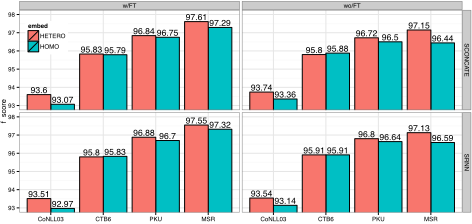
We study the effect of fine-tuning the segment embeddings by imposing SEMB-HOMO into our model. Table 3 shows the experimental results on development data. We find that our models benefit from fixing the segment embeddings on CoNLL03. While on MSR, fine-tuning the embeddings helps. Further study on the out-of-vocabulary rate shows that the OOV rate of MSR is very low, thus fine-tuning on segment embeddings help to learn a better task-specified segment representation. However, on CoNLL03 data whose OOV rate is high, fine-tuning the segment embedding harms the generalization power of pre-trained segment embeddings.
Effect of Heterogeneous Segment Embeddings
In previous sections, our experiments are mainly carried on the segment embeddings obtained from homogeneous models. In this section, we use our SPARSE-CRF as the heterogeneous model to obtain SEMB-HETERO. We compare the models with SEMB-HETERO and SEMB-HOMO on the development data in Figure 6. These results show that SEMB-HETERO generally achieve better performance than the SEMB-HOMO. On the CoNLL03 and MSR dataset, the differences are significant. Meanwhile, we see that finetuning the segment embedding can narrow the gap between SEMB-HETERO and SEMB-HOMO.
| model | CoNLL03 | CTB6 | PKU | MSR |
|---|---|---|---|---|
| NN-LABELER | 88.62 | 93.06 | 92.99 | 93.79 |
| NN-CRF | 89.08 | 93.65 | 93.28 | 94.17 |
| SPARSE-CRF | 83.43 | 95.08 | 95.06 | 96.54 |
| SRNN | 88.63 | 94.06 | 93.91 | 95.21 |
| +SEMB-HETERO | 89.59 | 95.48 | 95.60 | 97.39 |
| +0.96 | +1.42 | +1.69 | +2.18 | |
| SCONCATE | 89.07 | 93.96 | 93.57 | 94.53 |
| +SEMB-HETERO | 89.77 | 95.42 | 95.67 | 97.58 |
| +0.70 | +1.43 | +2.10 | +3.05 |
Final Result
At last, we compare our neural semi-CRF model leveraging additional segment embeddings with those only represent segment by composing input. Table 4 shows the result on the NER and CWS test data. Style of segment embeddings (HOMO or HETERO) and whether fine-tune it is decided by the development data. From this result, we see that segmentlevel representation greatly boost up model's performance. On NER, an improvement of 0.7% is observed and that improvement on CWS is more than 2.0% on average.
We compare our neural semi-CRF model leveraging multilevels segment representation with other state-of-the-art NER and CWS systems. Table 5 shows the NER comparison results. The first block shows the results of neural NER models and the second one shows the non-neural models. All these work employed hand-crafted features like capitalization. Collobert et al. [2011], Guo et al. [2014], and Passos et al. [2014] also utilize lexicon as an additional knowledge resource. Without any hand-crafted features, our model can achieve comparable performance with the models utilizing domain-specific features.
Table 6 shows the comparison with the state-of-the-art CWS systems. The first block of Table 6 shows the neural CWS models and second block shows the non-neural models. Our neural semi-CRF model with multi-level segment representation achieves the state-of-the-art performance on PKU and MSR data. On CTB6 data, our model's performance is also close to Wang et al. [2011] which uses semi-supervised features extracted auto-segmented unlabeled data. According to Pei et al. [2014], significant improvements can be achieved by replacing character embeddings with characterbigram embeddings. However we didn't employ this trick considering the unification of our model.
| genre | model | CoNLL03 |
|---|---|---|
| NN | [Collobert et al., 2011] [Huang et al., 2015] | 89.59 |
| 90.10 | ||
| non-NN | [Ando and Zhang, 2005] | 89.31 |
| [Guo et al., 2014] | 88.58 | |
| [Passos et al., 2014] | 90.90 | |
| our best | 89.77 | |
| genre | model | CTB6 | PKU | MSR |
|---|---|---|---|---|
| NN | [Zheng et al., 2013] | - | 92.4 | 93.3 |
| [Pei et al., 2014] | 94.0 | 94.9 | ||
| [Pei et al., 2014] w/bigram | - | 95.2 | 97.2 | |
| [Kong et al., 2015] | 90.6 | 90.7 | ||
| [Tseng, 2005] | - | 95.0 | 96.4 | |
| non-NN | [Zhang and Clark, 2007] | - | 95.1 | 97.2 |
| [Sun et al., 2009] | - | 95.2 | 97.3 | |
| [Wang et al., 2011] | 95.7 | - | - | |
| our best | 95.48 | 95.67 | 97.58 | |
5 RelatedWork
Semi-CRF has been successfully used in many NLP tasks like information extraction [Sarawagi and Cohen, 2004], opinion extraction [Yang and Cardie, 2012] and Chinese word segmentation [Andrew, 2006; Sun et al., 2009]. Its combination with neural network is relatively less studied. To the best of our knowledge, our work is the first one that achieves stateof-the-art performance with neural semi-CRF model.
Domain specific knowledge like capitalization has been proved effective in named entity recognition [Ratinov and Roth, 2009]. Segment-level abstraction like whether the segment matches a lexicon entry also leads performance improvement [Collobert et al., 2011]. To keep the simplicity of our model, we didn't employ such features in our NER experiments. But our model can easily take these features and it is hopeful the NER performance can be further improved.
Utilizing auto-segmented data to enhance Chinese word segmentation has been studied in Wang et al. [2011]. However, only statistics features counted on the auto-segmented data was introduced to help to determine segment boundary and the entire segment was not considered in their work. Our model explicitly uses the entire segment.
6 Conclusion
In this paper, we systematically study the problem of representing a segment in neural semi-CRF model. We propose a concatenation alternative for representing segment by composing input units which is equally accurate but runs faster than SRNN. We also propose an effective way of incorporating segment embeddings as segment-level representation and it significantly improves the performance. Experiments on named entity recognition and Chinese word segmentation show that the neural semi-CRF benefits from rich segment representation and achieves state-of-the-art performance.
Acknowledgments
This work was supported by the National Key Basic Research Program of China via grant 2014CB340503 and the National Natural Science Foundation of China (NSFC) via grant 61133012 and 61370164.
@inproceedings{ijcai2016p409,
  title     = {Exploring Segment Representations for Neural Segmentation Models},
  author    = {Liu, Yijia and Che, Wanxiang and Guo, Jiang and Qin, Bing and Liu, Ting},
  booktitle = {Proceedings of the Twenty-Fifth International Joint Conference on
               Artificial Intelligence, {IJCAI-16}},
  publisher = {AAAI Press / International Joint Conferences on Artificial Intelligence},
  editor    = {Subbarao Kambhampati},
  pages     = {2880--2885},
  year      = {2016},
  month     = {7},
  url       = {https://ijcai.org/proceedings/2016/409},
}
TY - CPAPER TI - Exploring Segment Representations for Neural Segmentation Models AU - Liu, Yijia AU - Che, Wanxiang AU - Guo, Jiang AU - Qin, Bing AU - Liu, Ting T2 - Proceedings of the Twenty-Fifth International Joint Conference on Artificial Intelligence, IJCAI-16 PB - AAAI Press / International Joint Conferences on Artificial Intelligence PY - 2016 SP - 2880 EP - 2885 UR - https://ijcai.org/proceedings/2016/409 ER -Copied
Machine-readable versions of this paper, for tools and AI agents:





