
Robust Natural Language Processing - Combining Reasoning, Cognitive Semantics, and Construction Grammar for Spatial Language
Proceedings of the Twenty-Fifth International Joint Conference on Artificial Intelligence. Pages 2908-2913.
Abstract
We present a system for generating and understanding of dynamic and static spatial relations in robotic interaction setups. Robots describe an environment of moving blocks using English phrases that include spatial relations such as across and in front of. We evaluate the system in robot-robot interactions and show that the system can robustly deal with visual perception errors, language omissions and ungrammatical utterances.
- [Allen, 1983] J. Allen. Maintaining knowledge about tem- poral intervals. Commun. ACM, pages 832-843, 1983.
- [Bastianelli et al., 2014] E. Bastianelli, G. Castellucci, D. Croce, R. Basili, and D. Nardi. Effective and ro- bust natural language understanding for human-robot interaction. In ECAI, pages 57-62, 2014.
- [Bhatt et al., 2011] M. Bhatt, J. Lee, and C. Schultz. CLP(QS): A declarative spatial reasoning framework. In Spatial Information Theory -10th International Confer- ence, COSIT 2011, pages 210-230, 2011.
- [Bhatt et al., 2013] Mehul Bhatt, Carl Schultz, and Christian Freksa. The 'Space' in Spatial Assistance Systems: Con- ception, Formalisation and Computation. In Representing space in cognition: Interrelations of behavior, language, and formal models. Oxford University Press, 2013.
- [Bhatt, 2012] Mehul Bhatt. Reasoning about space, actions and change: A paradigm for applications of spatial reason- ing. In Qualitative Spatial Representation and Reasoning: Trends and Future Directions. IGI Global, USA, 2012.
- [Cantrell et al., 2010] R. Cantrell, M. Scheutz, P. Schermer- horn, and X. Wu. Robust spoken instruction understanding for hri. In Human-Robot Interaction (HRI), ACM/IEEE In- ternational Conference on, pages 275-282. IEEE, 2010.
- [Chen and Mooney, 2011] D. Chen and R. Mooney. Learn- ing to interpret natural language navigation instructions from observations. In AAAI, pages 1-2, 2011.
- [Croft and Cruse, 2004] W. Croft and D. A. Cruse. Cognitive linguistics. Cambridge University Press, 2004.
- [Fasola and Mataric, 2013] J. Fasola and M. Mataric. Us- ing semantic fields to model dynamic spatial relations in a robot architecture for natural language instruction of ser- vice robots. In Intelligent Robots and Systems (IROS), 2013, pages 143-150. IEEE, 2013.
- [Galton, 2000] A. Galton. Qualitative spatial change. Ox- ford University Press, 2000.
- [Gapp, 1995] K. Gapp. Angle, distance, shape, and their re- lationship to projective relations. In Proceedings of the 17th Annual Conference of the Cognitive Science Society, pages 112-117, 1995.
- [Johnson-Laird, 1977] P. N. Johnson-Laird. Procedural se- mantics. Cognition, pages 189-214, 1977.
- [Kelleher et al., 2006] J. Kelleher, G.-J. Kruijff, and F. Costello. Proximity in context: an empirically grounded computational model of proximity for process- ing topological spatial expressions. In Proceedings of the 44th ACL, pages 745-752. ACL, 2006.
- [Levinson, 2003] S. C. Levinson. Space in Language and Cognition: Explorations in Cognitive Diversity. Cam- bridge University Press, 2003.
- [Ligozat, 2011] G. Ligozat. Qualitative Spatial and Tempo- ral Reasoning. Wiley-ISTE, 2011.
- [Muller, 1998] P. Muller. A qualitative theory of motion based on spatio-temporal primitives. KR, 98:131-141, 1998.
- [Randell et al., 1992] D. Randell, Z. Cui, and A. Cohn. A spatial logic based on regions and connection. In KR'92. Principles of Knowledge Representation and Reasoning: Proceedings of the Third International Conference, pages 165-176.
- Morgan Kaufmann, 1992.
- [Retz-Schmidt, 1988] G. Retz-Schmidt. Various views on spatial prepositions. AI magazine, 9(2):95-105, 1988.
- [Schiffer et al., 2013] S. Schiffer, N. Hoppe, and G. Lake- meyer. Natural language interpretation for an interactive service robot in domestic domains. In Agents and Arti- ficial Intelligence, pages 39-53. Springer Berlin Heidel- berg, 2013.
- [Scivos and Nebel, 2005] A. Scivos and B. Nebel. The Finest of its Class: The Natural Point-Based Ternary Calcu- lus LR for Qualitative Spatial Reasoning, pages 283- 303. International Conference on Spatial Cognition 2004. Springer, 2005.
- [Skubic et al., 2004] M. Skubic, D. Perzanowski, S. Blisard, A. Schultz, W. Adams, M. Bugajska, and D. Brock. Spatial language for human-robot dialogs. Systems, Man, and Cy- bernetics, Part C: Applications and Reviews, IEEE Trans- actions on, 34(2):154-167, 2004.
- [Spranger and Pauw, 2012] M. Spranger and S. Pauw. Deal- ing with perceptual deviation -vague semantics for spatial language and quantification. In Language Grounding in Robots, pages 173-192. Springer, 2012.
- [Spranger et al., 2012a] M. Spranger, M. Loetzsch, and L. Steels. A Perceptual System for Language Game Exper- iments. In Language Grounding in Robots, pages 89-110. Springer, 2012.
- [Spranger et al., 2012b] M. Spranger, S. Pauw, M. Loetzsch, and L. Steels. Open-ended Procedural Semantics. In Language Grounding in Robots, pages 153-172. Springer, 2012.
- [Spranger et al., 2014] M. Spranger, J. Suchan, M. Bhatt, and M. Eppe. Grounding dynamic spatial relations for embodied (robot) interaction. In PRICAI 2014: Trends in Artificial Intelligence, pages 958-971. Springer, 2014.
- [Steels, 2011] L. Steels, editor. Design Patterns in Fluid Construction Grammar. John Benjamins, 2011.
- [Suchan et al., 2014] J. Suchan, M. Bhatt, and P. Santos. Per- ceptual narratives of space and motion for semantic inter- pretation of visual data. In Computer Vision -ECCV 2014 Workshops, Proceedings, pages 339-354. Springer, 2014.
- [Svorou, 1994] S. Svorou. The Grammar of Space. John Benjamins, 1994.
- [Tellex et al., 2011] S. Tellex, T. Kollar, S. Dickerson, M. Walter, A. Banerjee, S. Teller, and N. Roy. Ap- proaching the symbol grounding problem with probabilis- tic graphical models. AI magazine, 32:64-76, 2011.
References were extracted automatically from the PDF and may contain errors.
Full text extracted automatically from the PDF; figures, tables and equations may differ. The PDF is the version of record.
1 Introduction
Spatial language is no doubt important for robots, if they need to be able to communicate with humans. For instance, robots need to be able to understand descriptions such as the following.
- The block moves across the red region.
Example 1 focusses on the path of the object [Croft and Cruse, 2004]. English speakers also have other means of conceptualizing movement events. They can, for instance, focus on the source of the movement or the goal.
(2) The block moves from left of you, to right of me.
These examples include various aspects of English language syntax, semantics and pragmatics [Levinson, 2003; Svorou, 1994]. A complete language processing system for robots needs to be able to understand and also generate such utterances.
Importantly, natural language processing systems need to be robust against various sources of errors. Humans invariably make mistakes and robots need to be able to deal with missing or misunderstood words, grammatical errors etc. At the same time, visual processing of scenes is not perfect. Objects might be occluded and errors in visual tracking might impact tracked paths, and visual recognition of events. Robustness against visual and language perturbations is crucial.
In this paper, we present a complete system that allows robots to describe and understand descriptions of spatial scenes involving movement events (see Figure 1). The system is robust against perceptual errors, missing words and grammatical errors.
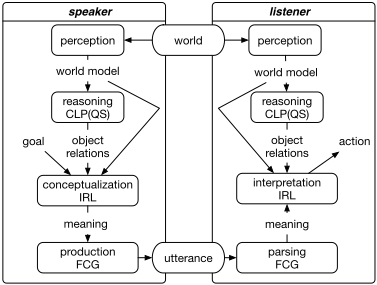
This paper starts by outlining related work, followed by a description of main components of the system 1) a qualitative spatial reasoner that provides qualitative descriptions of dynamic scenes, 2) a cognitive semantics system that picks distinctive qualitative aspects of a dynamic scene in order to describe events, and 3) a construction grammar implementation of spatial phrase processing that allows to produce and parse English sentences. Each of these components and their integration make the system robust against various sources of errors. In the final sections we evaluate the system and show that it is robust against perceptual and language errors.
2 RelatedWork
Earliest systems for spatial language [Retz-Schmidt, 1988; Gapp, 1995; Skubic et al., 2004] showed how artificial agents can understand static spatial relations such as "front", "back". This work has continued. We have now various ways of modeling static spatial relations: proximity fields for proximal relations [Kelleher et al., 2006], prototypes for projective and absolute spatial relations [Spranger and Pauw, 2012]. Models of static spatial relations are interesting but they only cover relations not encoding dynamic qualities.
Recent models of dynamic spatial relations use semantic fields [Fasola and Mataric, 2013] and probabilistic graphical models [Tellex et al., 2011] for dealing with temporal aspects of spatial relations. In some cases, the work is on (hand-) modeling spatial relations. Others rely on large taskdependent data sets in order to learn the representations of spatial relations. In general there are fewer approaches using formal methods for spatial language [Spranger et al., 2014].
Formal aspects (e.g., logical, relational-algebraic) and efficient reasoning with spatio-temporal information is a vibrant research area within knowledge representation and reasoning [Ligozat, 2011]. From this perspective, commonsense spatial, temporal, and spatio-temporal relations (e.g., "left", "overlap", "during", "between", "split", "merge") as abstractions for the spatio-linguistic grounding of visual perception and embodied action & interaction have been investigated [Bhatt et al., 2013; Suchan et al., 2014]. Researchers have investigated movement on the basis of an integrated theory of space, action, and change [Bhatt, 2012], based on theories of time, objects, and position [Galton, 2000] or defined continuous change using 4-dimensional regions in space-time [Muller, 1998].
One important aspect of robot natural language processing is robustness [Bastianelli et al., 2014]. Researchers have proposed large coverage, data-driven approaches [Chen and Mooney, 2011], as well as precision grammar-based approaches for dealing with language problems [Cantrell et al., 2010]. There are also systems that integrate planning for handling robustness issues [Schiffer et al., 2013]. More often than not, systems are evaluated only with respect to natural language errors. In this paper, we investigate how the integration of formal reasoning methods with incremental semantic processing and fluid parsing and production grammars can contribute to robust, grounded language processing.
3 Grounded Spatial Language Processing
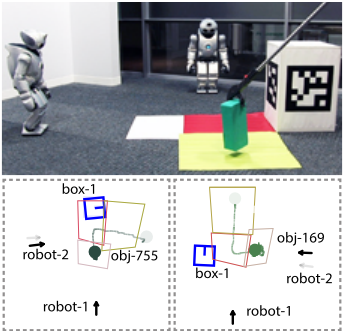
Two robots interact in an environment such as the one shown in Figure 2. For the experiments discussed in this paper, we used Sony humanoid robots. The vision system of these robots fuses information from the robot's camera (30 fps) with proprioceptive sensors distributed across the body (gyroscope, internal body model from motor position sensors), in order, to single out and track various objects in the environment [Spranger et al., 2012a].
The environment features four types of objects: blocks, boxes, robots and regions. The vision system extracts the objects (as blobs) from the environment and computes a number of raw, continuous-valued features such as x, y position, width, and height and colour values (YCbCr). Objects are tracked over time and assigned unique identifiers as long as there is spatio-temporal continuity. For instance, the green block has been given the arbitrary id obj-755 by the left robot.
3.1 Reasoning about Space andMotion
The robots generate qualitative representations of the spatiotemporal dynamics in the scene as perceived by their vision system. Towards this, we use a general theory of space and motion implemented based on CLP(QS) [Bhatt et al., 2011] - a declarative spatial reasoning framework, which implements declarative spatial relations in constraint logic programming within the PROLOG programming environment. We use the framework for defining events grounded in the visual observations of the robots, using qualitative spatial and temporal relations between objects in the scene, i.e. topology, orientation, and movement.
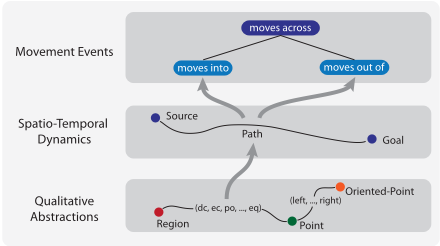
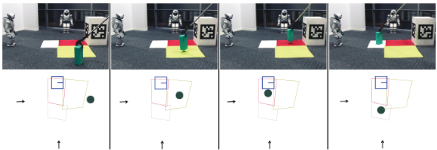
In order to reason about the perceived dynamics of scenes (for example the scene in Figure 2), we generate sequences of movement events based on the perceptual data of the robots, as depicted in Figure 3. Towards this, objects are represented using qualitative abstractions of spatial properties, e.g. position, orientation, extend in space, using primitives such as regions, points, oriented points, line segments. Perceived spatio-temporal dynamics, i.e. the movement of the block is represented by the source and the goal of the movement, and the path, on which the object moves from the source to the goal. For describing the movement and involved movement events, we use spatio-temporal relations, e.g. for representing the source and goal locations of the movement with respect to the observing robots or the characteristics of the path.
The spatial configuration of objects in the scene is represented using n-ary spatial relations R = ¶r1↪ r2↪ ▷▷▷↪ rn♦, in particular, we use topological relations of the RCC8 fragment of the RCC calculus [Randell et al., 1992], Rtop ⌘ ¶dc, ec, po, eq, tpp, ntpp, tpp-1 , ntpp-1 ♦ and orientation relations of the LR calculus [Scivos and Nebel, 2005] Rorient ⌘ ¶l, r, i, s, e, f, b♦. Predicates holds-at(φ↪ r↪ t) and holds-in(φ↪ r↪ δ) are used to denote that the fluent φ has the value r at time point t, resp. in the time interval δ. Movement events are used to describe spatio-temporal dynamics of the perceived scene, i.e. how the spatial configuration of objects changes during the movement of the block. We use the predicate occurs-in(✓↪ δ) to denote that an event ✓ occurred in a time interval δ.
In particular, movement events are defined by spatiotemporal relations holding between the involved objects and changes within these relations, happening as a part of the event, using the relations of Allen's interval algebra [Allen, 1983] ¶before↪ after↪ during↪ contains↪ starts↪ started by↪ finishes↪ finished by↪ overlaps↪ overlapped by↪ meets↪ met by↪ equal♦ for representing temporal aspects of the event. E.g. the event moves into, representing that a block moves into a region is defined as follows.
occurs-in(moves into(o1↪ o2)↪ δ) ⊃ holds-at(φtop(position(o1)↪ region(o2))↪ outside↪ t1) ^ holds-at(φtop(position(o1)↪ region(02))↪ inside↪ t2) ^ starts(t1↪ δ) ^ finishes(t2↪ δ) ^ meets(t1↪ t2)▷ (1)Accordingly, movement events describing a range of perceivable spatial changes can be defined, e.g. moves to, moves across, etc. Complex interactions can be described by combining multiple movement events.
To describe the dynamics observed by one of the robots we generate a temporally-ordered sequence of movement events. E.g. the following Movement Sequence ( ) describes the movement in a scene (Figure 2), as observed by the robot to the left.
To reason about the possibility of a movement event to happen at a certain time point, we introduce predicates to describe in which spatial situations an event might happen, i.e. we use the predicate poss-at(✓↪ t), to describe the spatial preconditions of an event.
Further, we use the predicate causes(✓↪ φ↪ r) to describe how an event changes the spatial configuration in the scene.
These predicates are used to reason about whether an event is a possible subsequent event given observed events.
Mechanisms for Robustness The reasoning system abstracts from the numerical values of the visual data stream, thereby generalizing observations. Consequently, small perceptual errors have less or no effect on computed movement events. Similarly, missing observations have little effect on the extracted movement sequence, as long as there is at least one observation for each qualitative state. For example, for moves into only one observation outside the region and one observation inside the region is needed. Lastly, reasoning about the possibility of movement events increases the chances of agreement between two robots. E.g. if a robot observes a moves into event in a particular region, the robot can reason, that the next possible event could be a moves out of event from that region. The possibility of a moves out of event together with the observed moves into leads to the possibility of a moves across event. If now he hears from the other robot that there was a moves across event - he can conclude that this is a possible description (taking into account that there might have been perception errors).
3.2 Spatio-Temporal Semantics
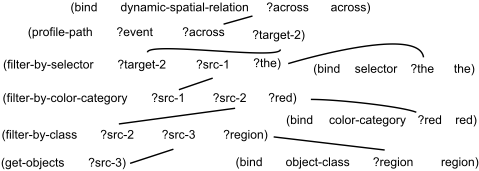
We model the semantics of spatial phrases using a computational cognitive semantics system called Incremental Recruitment Language (IRL) [Spranger et al., 2012b]. The key idea in IRL is that semantics of natural language phrases can be modeled as a program (henceforth IRL-program) [JohnsonLaird, 1977]. The meaning of an utterance consists of an algorithm and data pointers that when executed by the hearer will lead him to identify the topic (i.e. some event or object).
Figure 4 shows a graphical representation of the IRLprogram (i.e. meaning) underlying some part of the phrase from Example 1. The IRL-program consists of 1) cognitive operations (e.g. filter-by-class) implementing algorithms such as categorization and 2) semantic entities - the data that cognitive operations work with. Semantic entities can be prototypes, concepts and categories or more generally representations of the current context, as well as data exchanged between cognitive operations. They can be introduced explicitly in the network via bind-statements. The statement (bind dynamic-spatial-relation ?acr across) encodes the access to the agent-internal, dynamic spatial relation across which will be bound to the variable ?across. Semantic entities are linked with particular parameters of cognitive operations via variables (starting with ?). In IRL-programs (meaning structures) many cognitive operations can be combined. Most relevant for this paper are the spatio-temporal aspects of these programs.
Profiling operations pick out aspects of movement events. We implemented Source-Path-Goal image schemas (known from Cognitive Semantics). The operation apply-path picks out the trajectory of an event. Other operations deal with the source position or goal locations (e.g. apply-source). In English source and goal are specifically marked using the prepositions "to" and "from". Profiling operations work directly on predicates extracted by the reasoning system.
Dynamic Spatial Relations are concerned with describing aspects of the path of an event. Here we focus on the major relations such as "across", "in to", "out of". The operation apply-dynamic-spatial-relations computes whether a event or set of events fulfills a trajectory condition, for example that the undergoer of the movement event moves across some region (all input parameters). This operation checks the object relations computed by CLP(QS).
Static Spatial Relations are for characterizing source and goal aspects of movement events. We implemented operations that take care of locating an object based on its position with respect to various landmark objects (robots and boxes), various frames of reference (absolute, relative and intrinsic) and various spatial relations (proximal, projective, absolute etc). The system integrates previous work [Spranger and Pauw, 2012].
Conceptualization and Interpretation IRL includes mechanisms for the autonomous construction of IRL-programs. Agents use these facilities in two ways. First, when the speaker wants to talk about a particular scene, he constructs an IRL-program for reaching that goal. Secondly, a listener trying to interpret an utterance will construct and evaluate programs, in order to find the best possible interpretation of the utterance (see conceptualization/interpretation in Figure 1). The processes are constrained by the particular goal given to the system. For instance, if the system needs to discriminate an object or event - it automatically selects features that are most dissimilar with other objects and events. If the goal is to describe, then features that are most similar to the object or event are selected without attention to other objects. Interpretation and conceptualization are implemented as heuristics-guided search processes that traverse the space of possible IRL-programs by automatic programming.
Mechanisms for Robustness The system features a number of mechanisms for robustness. For instance, the implementation of static spatial categories follows a lenient approach that increases tolerance for errors in perception [Spranger and Pauw, 2012]. The most important mechanism for the purpose of this paper though is the interpretation of partial networks. For instance, suppose the hearer only parsed a partial sentence (because of transmission errors) and can only recover a partial IRL-program. The system then tries to complete the network thereby generating various hypotheses that are tested with the perceptual data and the object relations available at that moment in time. This completion allows hearers to understand sentences even when there are utterance transmission errors and/or ungrammatical sentences.
3.3 Spatial Construction Grammar
In order to compute utterances for meaning (production) and meaning of utterances (parsing), we use a recent version of a computational construction grammar system called Fluid Construction Grammar (FCG) [Steels, 2011]. FCG allows to specify bidirectional mappings between meanings and utterances in the form of a single grammar. Robots operate a spatial grammar comprised of roughly 70 constructions (bidirectional rules) - primarily lexical constructions for basic concepts (e.g. block, box), events (e.g. move), spatial relations (e.g. along, across, into, out of), as well as a number of phrasal constructions.
Constructions The most important constructions are lexical and phrasal. Lexical constructions are bidirectional mappings between semantic entities and words. For instance, there is a lexical construction for "across" that maps (bind dynamic-spatial-relation ?acr across) to the stem "across". Phrasal constructions take into account the larger syntactic and semantic context. An example is the adjective-noun-phrase construction, which looks for an adjective and a noun as well as a particular linkage of operations in the IRL-program and adds word order information. Similar constructions are implemented for determined noun phrases, prepositional phrases and verb phrases.
Mechanisms for Robustness The single most important robustness mechanism for the grammar is that the system applies as many constructions as possible. This is helpful when there are transmission errors, words can not be recognized and there are grammatical problems with word order etc. Even in such cases, the system will try to catch the lexical items that are recognizable in a phrase and they will be mapped to semantic entities, concepts etc. Moreover, fragments of utterances such as noun phrases that are recognizable will be processed as well. This information can be used by the semantics system to try and understand even phrases with errors.
4 Evaluation and Results
In order to evaluate the whole system we developed scenarios in which two robots interact with each other. Robots interact on roughly 200 pre-recorded spatial scenes (similar to the one depicted in Figure 2). Scenes vary in spatial configurations of the two robots, objects, regions boxes etc.
In an interaction, one of the agents acts as the speaker, the other as the hearer. Roles are randomly assigned. The speaker picks some aspect of the scene and describes it to the hearer. For instance, the speaker might choose to describe the path of the moving object. The speaker describes the scene and the hearer tries to see if this is a possible description of the scene from his perspective. The interaction is a success if the hearer can agree with the description. The following details the interaction steps (see also Figure 1)
- The robots perceive the scene and reason about spatiotemporal relations of objects.
- The speaker conceptualizes a meaning comprised of dynamic or static spatial relations, and construal operations for describing the scene.
- The speaker expresses the conceptualization using an English grammar. E.g., the speaker produces "the green block moves from left of you, across the red region, to right of me".
- The hearer parses the phrase using his English grammar and computes the meaning underlying the phrase.
- When the hearer was able to parse the phrase or parts of the phrase, he examines the observed scene to find out whether the scene satisfies the conceptualization.
- The hearer signals to the speaker whether he agrees with the description.
- The interaction is a success if the hearer agrees with the speaker. Otherwise it is considered a failure.
There are a few important points about this setup. Most importantly, each robot sees the world from his perspective. This means that robots always deal with issues of perceptual deviation [Spranger and Pauw, 2012]. Robots have different viewpoints on the scene, which impacts on issues of egocentric spatial language. For instance, "the block to the left" can mean different objects depending on the viewpoint. But even on a more basic level robots will estimate the world and its properties from their viewpoints. This leads to different estimations of distance and direction and in some cases can lead to dramatic differences in perception of the scene. The spatiotemporal continuity of objects can be disrupted, which means that events can be missed by some robot.
Another important aspect is that robots are not only interpreting but also speaking using the same system. Therefore, our setup allows us to quantify the impact of particular algorithms on the ability of robots to communicate.
4.1 General Evaluation
We evaluate the performance of the system on roughly 200 spatial scenes on which robots interact 10000 times. Each time one of the scenes is randomly drawn. Each time speaker and hearer are randomly assigned some perspective. The number of descriptions that can be generated for a scene is infinite - in particular because agents can generate arbitrarily long descriptions. For the purpose of this paper though, we restrict generation to simple sentences that include just 1 preposition and 2 noun phrases, e.g. "the object moves into the red region" or "the object moves from left of you".
The simplicity constraint allows us to compute all the meanings and utterances for descriptions of a scene from the viewpoint of any of the robots. In total we observed for this data set about 40 different utterances exchanged between robots. Each utterance was checked by 3 different English speakers. All of them were syntactically correct and intelligible.
For each interaction of two robots, we track 1) whether it was successful (SUCC), 2) how often the speaker was able to construe a meaning in production (CM), 3) how often the speaker produced an utterance (PU), 4) how often the hearer parsed a meaning (PM) and 5) how often the hearer was able to interpret the meaning in the current scene (IM). We also do one more check, which is whether the initial meaning that the speaker had in mind is part of the meanings recuperated by the hearer (overlap or OL)
| SUCC | CM | PU | PM | IM | OL |
| .78 | .99 | .99 | .99 | .78 | .79 |
Results show that in roughly 80% of interactions, the hearer can agree with the description. In case of failure it is more likely to be a failure of the listener to interpret the description of the speaker (IM), then 1) a speaker coming up with a description (CM), 2) speaker producing an utterance (PU), or 3) the hearer failing to parse the utterance (PM).
Upon further examination we observe that in cases where communication fails, there are perceptual problems. If we ask the hearer to conceptualize and produce utterances using his viewpoint on the world, we can see that the utterance of the speaker is not actually part of those descriptions produced by the hearer in 20% of the cases (.79 OL). The reason is that hearer and speaker in some scenes extract different events. For instance, the hearer might miss important parts of the trajectory and cannot agree to a description (for example "across the red region").
This is also confirmed by examining F-scores for utterances and meanings. For this, we have the two robots (a and b) produce all utterances and all meanings for a scene. We then compare utterances and meanings. True positives are those utterances produced both by b and by a. False negatives are utterances produced by a AND not produced by b. False positives are utterances produced by b AND not by a.
| precision | recall | f-score |
| 85.54 | 89.97 | 87.70 |
We can conclude that there are problems prior to language processing in how the scene is perceived and subsequently conceptualized, which leads to different utterances being produced and then false positives and false negative utterances subsequently.
4.2 Evaluation of Robustness
Results in the previous section beg the question how robust the system is. In further studies, we manipulated the two inputs to the system: visual information and language. Each of these can be individually perturbed to see when the system breaks down.
| drop | precision | recall | f-score |
|---|---|---|---|
| baseline | 85.54 | 89.97 | 87.70 |
| 10%, both | 85.28 | 89.97 | 87.56 |
| 25%, both | 85.17 | 89.87 | 87.45 |
| 40%, both | 83.97 | 89.47 | 86.63 |
| 50%, both | 83.99 | 89.18 | 86.50 |
| 75%, both | 77.04 | 81.47 | 79.19 |
| 10%, only-a | 85.35 | 89.95 | 87.59 |
| 25%, only-a | 85.12 | 90.23 | 87.60 |
| 40%, only-a | 84.20 | 89.96 | 86.98 |
| 50%, only-a | 83.14 | 90.25 | 86.55 |
| 75%, only-a | 68.19 | 91.51 | 78.15 |
| 10%, only-b | 85.51 | 89.77 | 87.59 |
| 25%, only-b | 85.77 | 89.63 | 87.66 |
| 40%, only-b | 86.22 | 89.72 | 87.94 |
| 50%, only-b | 86.21 | 87.97 | 87.09 |
| 75%, only-b | 88.87 | 73.10 | 80.22 |
Visual Perturbations - Missing Observations Firstly, we investigated dropping random frames of object observations in the visual system. The camera computes object positions roughly 30 frames per second. We randomly dropped object observations in 10%, 25%, 40%, 50% and 75% of frames - with 75% meaning that on average 45 frames for every 60 frames are dropped. We varied the selectivity of this effect in three cases: both robots, only-a and only-b. For the latter conditions only one of the robots experiences missing object perceptions. We measured precision, recall and f-score for all utterances by a and b.
Results in Table 1 show that the system copes well with missing object perceptions. Performance degrades gracefully and even when many frames of object perception are omitted the system is still performing well. Event with 50% percent of frames dropped is the performance still comparable to baseline. Performance starts to degrade more rapidly around 75%. The reason for this is an interplay of various systems, but, in particular, the resilience of the reasoning system to missing frames of observations. The systemmanages to extract stable object relations over time.
Visual Perturbations - Misaligned Events Secondly, we investigated the impact of misalignment of events recognized by the spatio-temporal reasoning system. For this we measured performance of the robots in scenes where robot-a and robot-b have different event perceptions. For instance, a sees the block move into a green region after it had crossed a red region. b only sees the move into the red region, but fails to observe the move into the green region. The dataset is a subset of the dataset used for general evaluation.
To see the impact of the reasoning system, we tested two sets of agents. In one the hearer was allowed to reason about the next possible events given his observation (wr), in the other, agents were not allowed to reason about possible events (wor). The following table shows results for two populations each interacting 10000 times.
| SUCC | CM | PU | PM | IM | OL | |
| wor | .70 | .98 | .98 | .98 | .70 | .70 |
|---|---|---|---|---|---|---|
| wr | .79 | .99 | .99 | .99 | .79 | .79 |
Reasoning boosts success in roughly 10% of the cases and helps establish agreement in description.
Language Perturbations We were also interested in impact of perturbations of utterances computed by the speaker on the overall success. We looked at two manipulations: word order and missing words.
The first manipulation is to drop random words from the string the speaker has uttered (this is similar to nonunderstood words). So for instance, when the speaker said "the block moves into the red region", the hearer will only see "the moves into the red region". The second manipulation is to permutate words. A sentence such as "the block moves into the red region" might be passed to the hearer as "the red moves block region the into".
The following table shows results for 0 to 3 dropped words (d=0 to d=3) and permutations of words (p=T - permutation; p=F - no permutation).
| COND | SUCC | CM | PU | PM | IM | OL |
|---|---|---|---|---|---|---|
| d=0, p=F | .78 | .99 | .99 | .99 | .78 | .79 |
| d=1, p=F | .89 | .99 | .99 | .99 | .89 | .79 |
| d=2, p=F | .78 | .99 | .99 | .99 | .78 | .69 |
| d=3, p=F | .82 | .99 | .99 | .99 | .82 | .70 |
| d=0, p=T | .70 | .99 | .99 | .99 | .70 | .60 |
| d=1, p=T | .74 | .99 | .99 | .99 | .74 | .60 |
| d=2, p=T | .78 | .99 | .99 | .99 | .78 | .65 |
| d=3, p=T | .83 | .99 | .99 | .99 | .83 | .70 |
Results suggest that agents are well capable of dealing with language perturbations. If anything communicative success improves because the hearer can rearrange the words in such a way or imagine missing words so as to make the sentence fit his observation of the scene.
5 Discussion
The system presented in this paper is a fully working system able to interpret and produce natural language phrases with dynamic and static spatial relations. Such a system is useful for human-robot interaction about aspects of the environment. For instance, components of these phrases can be used in question-answer scenarios or in command-driven humanrobot interfaces. Robots can understand the need to move to a certain location. Description of regions path, source and goal can be used to drive behavior and action planning systems. Part of our ongoing work is to test the system for command language with human subjects.
This paper reviewed the proposed system primarily with respect to perturbations in visual processing and language transmission. We believe that this is a fruitful way of analyzing the robustness of Natural Language systems, something that is often not done in the AI/Robotics community. Importantly, we found that robustness is primarily a function of integration of various cues from vision, reasoning, semantics and syntax. Only if each part of the system has some notion of dealing with perturbations can the system as a whole cope with various robustness issues.
@inproceedings{ijcai2016p413,
  title     = {Robust Natural Language Processing - Combining Reasoning, Cognitive Semantics, and Construction Grammar for Spatial Language},
  author    = {Spranger, Michael and Suchan, Jakob and Bhatt, Mehul},
  booktitle = {Proceedings of the Twenty-Fifth International Joint Conference on
               Artificial Intelligence, {IJCAI-16}},
  publisher = {AAAI Press / International Joint Conferences on Artificial Intelligence},
  editor    = {Subbarao Kambhampati},
  pages     = {2908--2913},
  year      = {2016},
  month     = {7},
  url       = {https://ijcai.org/proceedings/2016/413},
}
TY - CPAPER TI - Robust Natural Language Processing - Combining Reasoning, Cognitive Semantics, and Construction Grammar for Spatial Language AU - Spranger, Michael AU - Suchan, Jakob AU - Bhatt, Mehul T2 - Proceedings of the Twenty-Fifth International Joint Conference on Artificial Intelligence, IJCAI-16 PB - AAAI Press / International Joint Conferences on Artificial Intelligence PY - 2016 SP - 2908 EP - 2913 UR - https://ijcai.org/proceedings/2016/413 ER -Copied
Machine-readable versions of this paper, for tools and AI agents:





