
Heuristics for Numeric Planning via Subgoaling
Proceedings of the Twenty-Fifth International Joint Conference on Artificial Intelligence. Pages 3228-3233.
Abstract
The paper presents a new relaxation for hybrid planning with continuous numeric and propositional state variables based on subgoaling, generalising the subgoaling principle underlying the hmax and hadd heuristics to such problems. Our relaxation improves on existing interval-based relaxations by taking into account some negative interactions between effects when achieving a subgoal, resulting in better estimates. We show conditions on the planning model ensuring that this new relaxation leads to tractable, and, for the hmax version, admissible, heuristics. The new relaxation can be combined with the interval-based relaxation, to derive heuristics applicable to general numeric planning, while still providing more informed estimates for the subgoals that meet these conditions. Experiments show the effectiveness of its inadmissible and admissible version on satisficing and optimal numeric planning,respectively. As far as we know, this is the first admissible heuristic enabling cost-optimal numeric planning.
- Aldinger, J.; Mattmüller, R.; and Göbelbecker, M. 2015. Complexity of interval relaxed numeric planning. In Proc. of KI 2015: Advances in Artificial Intelligence, 19-31.
- Bellman, R. 1958. On a Routing Problem. Quarterly of Applied Mathematics 16:87-90.
- Bonet, B., and Geffner, H. 2001. Planning as heuristic search. Artificial Intelligence 129:5-33.
- Coles, A. J.; Coles, A. I.; Fox, M.; and Long, D. 2010. Forward-chaining partial-order planning. In Proc. of Inter- national Conference on Automated Planning and Schedul- ing (ICAPS 2010).
- Coles, A. J.; Coles, A.; Fox, M.; and Long, D. 2012. Colin: Planning with continuous linear numeric change. Journal of Artificial Intelligence Research (JAIR) 44:1-96.
- Coles, A. J.; Coles, A.; Fox, M.; and Long, D. 2013. A hy- brid LP-RPG heuristic for modelling numeric resource flows in planning. Journal of Artifificial Intelligence Research (JAIR) 46:343-412.
- Dornhege, C.; Eyerich, P.; Keller, T.; Trúg, S.; Brenner, M.; and Nebel, B. 2009. Semantic attachments for domain- independent planning systems. In Proc. of International Conference on Automated Planning and Scheduling (ICAPS 2009).
- Eyerich, P.; Mattmüller, R.; and Röger, G. 2009. Using the context-enhanced additive heuristic for temporal and nu- meric planning. In 19th International Conference on Auto- mated Planning and Scheduling (ICAPS 2009).
- Fox, M., and Long, D. 2003. Pddl2.1: An extension to pddl for expressing temporal planning domains. Journal of Arti- ficial Intelligence Research 20:61-124.
- Francès, G., and Geffner, H. 2015. Modeling and computa- tion in planning: Better heuristics from more expressive lan- guages. In Proc. of the Conference on Automated Planning and Scheduling, (ICAPS 2015), 70-78.
- Gerevini, A.; Saetti, I.; and Serina, A. 2008. An approach to efficient planning with numerical fluents and multi-criteria plan quality. Artificial Intelligence 172(8-9):899-944.
- Getoor, L.; Ottosson, G.; Fromherz, M. P. J.; and Carlson, B. 1997. Effective redundant constraints for online scheduling. In Proceedings of the Fourteenth National Conference on Artificial Intelligence and Ninth Innovative Applications of Artificial Intelligence Conference, AAAI 97, IAAI 97, July 27-31, 1997, Providence, Rhode Island., 302-307.
- Gregory, P.; Long, D.; Fox, M.; and Beck, J. C. 2012. Plan- ning modulo theories: Extending the planning paradigm. In Proceedings of the Twenty-Second International Conference on Automated Planning and Scheduling (ICAPS 2012).
- Haslum, P., and Geffner, H. 2000. Admissible heuristics for optimal planning. In Proceedings of the Fifth Interna- tional Conference on Artificial Intelligence Planning Sys- tems (AIPS 2000), 140-149.
- Haslum, P. 2009. h m (P) = h 1 (P m ): Alternative character- isations of the generalisation from h max to h m . In Proc. of the International Conference on Automated Planning and Scheduling, (ICAPS 2009).
- Helmert, M. 2002. Decidability and undecidability results for planning with numerical state variables. In Proc,. of In- ternational Conference on Artificial Intelligence Planning and Scheduling (AIPS 2002), 44-53.
- Hoare, C. A. R. 1969. An axiomatic basis for computer programming. Commun. ACM 12(10):576-580.
- Hoffmann, J. 2003. The metric-ff planning system: Translat- ing "ignoring delete lists" to numeric state variables. Journal of Artificial Intelligence Research (JAIR) 20:291-341.
- Koehler, J. 1998. Planning under resource constraints. In Proc. 13th European Conference on Artificial Intelligence (ECAI 1998), 489-493.
- Moore, R. E.; Kearfott, R. B.; and Cloud, M. J. 2009. Intro- duction to Interval Analysis. SIAM.
- Scala, E. 2013. Numeric kernel for reasoning about plans involving numeric fluents. In et al., M. B., ed., AI*IA 2013, LNAI 8249, Springer International Publishing Switzerland.
References were extracted automatically from the PDF and may contain errors.
Full text extracted automatically from the PDF; figures, tables and equations may differ. The PDF is the version of record.
Introduction
A lesson from classical planning is that one source of complexity is the requirement to satisfy conditions simultaneously. Relaxing this requirement, that is, assuming that subgoals can be (recursively) considered in isolation, is the basic idea of both the inadmissible hadd and the admissible hmax heuristics (Bonet and Geffner 2001; Haslum and Geffner 2000). The objective of this paper is to bring this perspective to the design of new domain-independent heuristics for hybrid planning with propositional and continuous numeric state variables.
Planning with integrated continuous and discrete representations is crucial to applying planning to many real world problems, where interactions between qualitative and quantitative constraints cannot be ignored (Dornhege et al. 2009). The numeric extension to classical planning made in PDDL 2.1 (Fox and Long 2003) provides a unified action model, where qualitative conditions are modelled with propositional variables and quantitative conditions are modelled with expressions over numeric state variables.
Heuristic search, using domain-independent heuristics automatically obtained from relaxations of the planning model, is a widely used and often effective approach to planning. Most heuristics for numeric planning are based on extending the delete-free relaxation to the numeric case,
Copyright c© 2015, Association for the Advancement of Artificial Intelligence (www.aaai.org). All rights reserved.
yielding the so called interval-based relaxation (Hoffmann 2003; Gerevini, Saetti, and Serina 2008; Coles et al. 2010; Aldinger, Mattm¨uller, and G¨obelbecker 2015). While this yields general and tractable heuristics, it fails to provide effective guidance for some simple yet important cases. Previous work on improving this heuristic has targeted a different weakness, but still reasoning about reachable values, for the restricted class of numeric variables modelling resources (Coles et al. 2013). Eyerich et al. (2009) extended the context-enhanced additive heuristic to numeric planning; however, they consider the numeric part only qualitatively. To the best of our knowledge, no previous work has looked at numeric planning relaxations from the subgoaling decomposition viewpoint.
Our main contribution is a generalisation of the subgoaling principle to hybrid propositional and numeric planning problems. This enables using different relaxations for different types of subgoals/conditions: we distinguish between propositional, simple numeric and hard numeric conditions. For simple numeric conditions our heuristics are tractable, and we are also able to formulate a version that is admissible. Combining this with the interval-based relaxation, we obtain a (inadmissible) heuristic that applies to general numeric planning, but benefits from more accurate estimates of the cost of achieving simple subgoals. The only remaining restriction, inherited from the interval-based relaxation, is that the dependency relation over numeric action effects is acyclic (Aldinger, Mattm¨uller, and G¨obelbecker 2015). As a spin-off of this characterisation, we also show how to generate redundant constraints to mitigate the harmful effects of considering subgoals separately. Experiments evaluate two inadmissible and one admissible heuristic, on a variety of numeric domains.
Motivating Example
To illustrate the limits of interval relaxation-based heuristics, let us take as an example the following sailing domain.
There is a sailing boat whose task is to rescue people in an unbounded area of the ocean. The positions of the boat and people to be rescued are described by their coordinates (x↪ y) 2 Q2 . To save a person, the boat must reach an area described by one or more linear inequalities. A (sequential) numeric planning formulation of the problem encodes each of the 7 possible movements of the boat (see Figure 1; the boat cannot sail straight into the wind) as a translation in the geometrical space defined by Q2 . Speed is implicit: each action changes each of the two variables by a given amount.
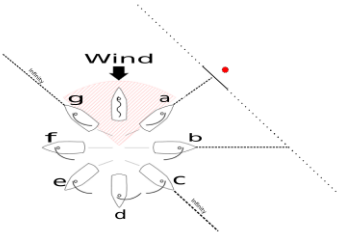
In Figure 1, the rescue requires satisfying the inequality x + y > 10 starting from position hx = 0↪ y = 0i. In the interval based relaxation, all actions that contribute positively to at least to one of the variables are considered useful for satisfying this condition. This includes the two actions a and b, but also the misleading actions c and g. The latter two actions increase either x or y but decrease the other, and thus fail to bring the state any closer to satisfying x+y > 10. Ignoring this internal negative effect inevitably leads to searching large parts of the space that are not relevant (i.e, neither c or g are useful to reach the goal).
This problem is representative of a variety of domains featuring multi-variable numeric conditions. Our approach contrasts with the value reachability view, by performing a relevance analysis for the subgoal at hand. Analogously to the propositional case, this analysis focuses on determining why certain actions are required, but also additionally here in the numeric case, how many of them are necessary.
Notation and Background Material
This paper focuses on sequential numeric planning with grounded actions; see PDDL 2.1 level 2 (Fox and Long 2003) for a deeper understanding of the semantics.
A state of the system is defined as a total assignment of propositional Xp and continuous numeric variables Xn . A propositional condition is a positive literal, while a numeric condition is a tuple h⇠↪D↪ 0i where ⇠ is an arithmetical expression and D 2 ¶>↪ ≥↪ =♦ a relational operator. We write [x]s and [⇠]s for the value of variable x and expression ⇠ in s. With slight abuse of notation we write x 2 ⇠ to mean that variable x appears in expression ⇠.
Let C be a set of (propositional and numeric) conditions. s ♣= C denotes that state s satisfies all conditions in C.
Definition 1 (Numeric Action). An action is a pair hpre(a)↪ e↵(a)i, where pre(a) is a set of propositional and numeric conditions and e↵(a) is a set of assignments. A classic assignment is p = > or p = ?; a numeric assignment is x = ⇠, where ⇠ is an arithmetical expression over variables in Xn . We require that e↵(a) does not contain multiple assignments to the same variable.
We use subscripts to distinguish the propositional and numeric parts (e.g., e↵num(a) is the set of numeric effects of a).
Moreover, let e be an effect of a, then lhs(e) and rhs(e) denote the left- and right-hand sides of the assignment. lhs(e) is the variable affected by e, while rhs(e) is, in the numeric case, an expression, or, in the classical case, either > or ?.
An action a is applicable in s iff s ♣= pre(a), and its execution results in the state s0 = s[a] such that 8x 2 X:
Increase/decrease effects can be formulated as assignments of the form x = x◦e, where e is an arithmetical expression.
Definition 2 (Numeric Planning Problem). A numeric planning problem is the tuple ⇧ = hs0↪A↪G↪X↪ γi, where X = Xp [ Xn is the set of variables, s0 is a state over X, A is a set of actions, and G is a set of propositional and numeric conditions. γ : A ! Q≥0 is a function assigning a non-negative, rational cost to each action.
Definition 3 (Plan). A plan ⇡ for ⇧ = hs0↪A↪G↪X↪ γiis a finite sequence of actions a0↪ ▷▷▷↪ an-1 from A such that every action in ⇡ is applicable in the state resulting from the application of its predecessors: s0 ♣= pre(a0), s0[a0] ♣= pre(a1), etc, and s♣⇡♣ = s0[a0↪ ▷▷↪ an-1] ♣= G. The cost of plan ⇡ is cost(⇡) = Pa2⇡ γ(a).
As usual, the minimum cost of a plan achieving condition c from state s is denoted h? (s↪ c).
Numeric Planning via Interval-Based Relaxation
Pioneered by Hoffman (2003), the interval-based relaxation (Aldinger, Mattm¨uller, and G¨obelbecker 2015; Gregory et al. 2012) is the principle most used to do numeric reasoning in planning. In different flavors (e.g., building metric extension of the relaxed planning graph), the majority of numeric planning systems exploit this theoretical framework to devise heuristics (Koehler 1998; Hoffmann 2003; Gerevini, Saetti, and Serina 2008; Coles et al. 2012; 2013).
The interval-based relaxation approximates each numeric state variable using an interval that contains its possible values. The interval of an expression is calculated by Interval Analysis (Moore, Kearfott, and Cloud 2009), and a numeric condition is satisfied if at least one value in the expression's interval satisfies it; applicable action effects monotonically widen the bounds of the intervals, so a relaxed solution is computed by extending intervals until the goal is reached. Aldinger et al. (2015) defined a numeric dependency relation over actions and showed that termination and safe pruning can be ensured when the planning task is acyclic w.r.t. this dependency relation. For acyclic tasks, the set of reachable states (denoted by the larger intervals for each variable) can be computed by executing applicable actions as many times as necessary, in the order defined by the dependency relation. Given ⇧ = hs0↪A↪G↪X↪ γi, ⇧+ = hs+0 ↪ A+↪ G↪ Xi denotes the interval-based relaxation of ⇧ (Aldinger, Mattm¨uller, and G¨obelbecker 2015).
Subgoaling Relaxation in the Propositional Case
The idea underlying the classical hmax heuristic (Bonet and Geffner 2001; Haslum and Geffner 2000) is to estimate the state-goal distance of atomic subgoals independently. hmax is defined as the point-wise maximal fixpoint of the equation
where ach(C) denotes the set of achievers for C. The maximal fixpoint is unique (Haslum 2009). hmax is admissible; an inadmissible, but usually more informative, heuristic hadd is obtained by summing, instead of maxing, over the estimated costs of subgoals in a non-singleton set.
Numeric Regression
Regression can be extended to numeric planning by building the so called weakest precondition (Scala 2013). As in Hoare's (1969) calculus, the weakest precondition is computed by substitution ('[]') of the affected variables:
Definition 4 (Effect Regressor). Given a numeric condition c : h⇠↪ D↪ 0i and an action a, the effect regressor cr(a) transforms c into h⇠[x1◁⌧(a↪ x1)↪ ▷ ▷ ▷ ↪ xk◁⌧(a↪ xk)]↪ D↪ 0i where
and x1↪ ▷ ▷ ▷ ↪ xk are the numeric variables assigned by a. cr(a) is the necessary and sufficient condition for c to hold after applying the effects of a. Numeric regression is defined by additionally incorporating the action precondition:
Proposition 1 (Numeric Regression). Let a be an action and c a numeric condition. s[a] ♣= c iff s ♣= ¶cr(a) ♦[pre(a). ¶cr(a) ♦ [ pre(a) denotes the regression of c through a.
Regression and Action Repetition
Unlike in the propositional case, numeric actions are not idempotent operations, since the repeated action application in a state does not generally retain its initial effect - the one obtained after its first application. Dually, also the numeric regression operation, and in particular the effect regressor is not idempotent: s 2 cr(a) ; s 2 cr(a)r(a) ▷▷▷ ;
s 2 c . While there could be idempotent numeric actions (e.g., assigning a specific value for a variable), this does not apply in general. Several real world problems feature the accumulation of resources or translation in geometrical spaces (e.g., the sailing problem). While a state of the system might not be consistent with a condition arising from a single step of regression, it is possible that it will eventually satisfy the condition if a given number of action repetitions is allowed to be executed just before; or dually, if the repeated regression is satisfied.
Some restrictions on the form of action effects allows us to formulate repeated regression in closed form.
Definition 5 (Self-interfering effects). An action a is said to have self-interfering effects whenever 9 e↪ e0 2 e↵num(a) : e 6= e0 and lhs(e) occurs in rhs(e).
Definition 6 (Linear effects action). An action has linear effects if 8e 2 e↵num(a), e can be written as x = Py2Xn wy↪a↪xy + kx↪a, with wy↪a↪x↪ kx↪a 2 Q, where x is the variable modified by e.
An action is said to be LSF (Linear and Self-interference Free) if it complies with Def. 6 and does not have selfinterfering effects. The closed form is as follows:
Theorem 2 (m-times effect regressor). Given a linear numeric condition c ⌘ Px2Xn wx↪cx + kc D 0, where wx↪c↪ kc 2 Q, an LSF action a, and a state s, it follows:
where cr(a↪m) = (Px2Xn wx↪c(fx↪a(m)) + kc ) D 0
Proof sketch. By induction on m.
fx↪a(m) is the value of x after applying action a m times in the current state (which is implicitly an argument). Note that mappears in the exponent of the last term; thus, the function is non-linear if wx↪a↪e is not 0 or 1.
Proposition 3 (Sufficient and Necessary Condition). A numeric condition c is reachable using an LSF action a from state s only if there exists an m 2 N+ such that s ♣= cr(a↪m) and s ♣= pre(a) (necessary part). The condition is also sufficient if the action does not assign any variable occurring in its precondition.
Proof sketch. Direct consequence of Theorem 2, and Proposition 1. s ♣= cr(a↪m) effectively captures m steps of regression, so the condition can be effectively reached using action a, repeating it m times.
Definition 7 (Possible Achiever). An LSF action a is said to be a (possible) achiever of a numeric condition c from s whenever there exists an m 2 N+ such that s ♣= cr(a↪m) .
From Theorem 2 follows that a is a possible achiever of c ⌘ Px2Xn wx↪cx + kc D 0 iff there exists m such that
In the following, we use ach(c) to denote the set of possible achievers for c.
Subgoaling in the Numeric Case
Extending the subgoaling relaxation to both propositional (PCs) and numeric conditions (NCs) is easy from a declarative perspective, since different regression mechanisms can be recursively interleaved depending on the condition's type (PC or NC):
The hbd subscript indicates the new HyBriD formulation. By substituting sum for max, we obtain an inadmissible variant hadd hbd . As in the propositional case, hmax hbd and hadd hbd are defined as any point-wise maximal fixpoint of these equations. Here, however, we do not have a proof that this fixpoint is unique. On the other hand, uniqueness is not essential: all properties of the heuristics that we establish in the following hold for any maximal fixpoint.
Two practical problems arise with this formulation: First, deciding if an action is a possible achiever (a 2 ach(c)) is not easy because (i) it is state dependent, and (ii) it may require solving of a non-linear optimization problem, even if we limit ourselves to LSF actions (Eq. 1 depends on m, which occurs in the exponent in fx↪a(m)). Second, regression can generate an unbounded number of different numeric subgoals. For instance, in the motivating example, regressing the goal of crossing a line generates an infinite set of areas from which that goal can be reached. This is not surprising since, in general, even a single numeric condition planning problem can be semi-decidable (Helmert 2002). Thus, the regression tree is infinite, and the minimization done in the heuristic is not guaranteed to terminate. The next section studies sufficient conditions that make variations of this formulation tractable.
The Simple Numeric Condition Case
We define simple numeric conditions as those only affected by actions having constant increase and decrease effects:
Definition 8 (Simple Numeric Condition). Let c: h⇠↪B↪ 0i. c is said to be a simple numeric condition (SC) if: (i) 8e 2 ¶e0 ♣e0 2 e↵num(a)↪ a 2 A↪ ⇠ \ lhs(e) 6= ;♦, e is of the form x = x + kx↪a with kx↪a a constant in Q; (ii) B 2 ¶>↪ ≥♦, i.e., c is not an equality condition 1 ; and (iii) ⇠ is linear.
Proposition 4. If all the numeric conditions in ⇧ = hs0↪A↪G↪X↪ γi are SCs:
- reachability of numeric conditions can be computed in closed form using the m-times effect regressor (Th. 2);
- the m-times effect regressor is commutative, that is cr(a↪n)r(b↪m) ⌘ cr(b↪m)r(a↪n) for any SC c, actions a↪ b and n↪ m 2 N;
- the effect of each action on each condition is stateindependent.
Proof sketch. (a) is a consequence of Theorem 2. For SCs, fx↪a(m) simplifies to mkx↪a +x. Hence (c), the change in x caused by a is an additive constant. This implies (b).
An immediate consequence of Prop. 4 is that the number of relevant numeric conditions that can be generated by hmax hbd
1 An equality h⇠↪ =↪ 0i can however be expressed as the conjuction of ¶h⇠↪ ≥↪ 0i↪ h⇠↪ ↪ 0i♦.
(hadd hbd ) is finite. Relevant numeric conditions are those generated by regressing through possible achievers only, and the simple closed form fx↪a = mkx↪a + x enables us to find the possible achievers efficiently.
Theorem 5 (Termination with SCs ). If numeric conditions are regressed only through possible achievers, then computation of hmax hbd and hadd hbd with only SCs terminates in a finite number of steps.
Explicit Regression for hadd hbd
Although finite, a naive implementation of hhbd is not tractable. Fortunately, the SC properties allow us to minimize cost over just the numbers of action repetitions rather than regressing through all relevant action sequences.
Theorem 6 (Explicit Regression for hadd hbd ).
where c is a single simple numeric condition.
Proof sketch. Like hmax hbd , hadd hbd is defined by recursively minimizing over the regression tree, but adding instead of maxing hadd hbd (s↪ pre(a)) and hadd hbd (s↪ cr(a) ). Thus the precondition cost hadd hbd (s↪ pre(a)) is counted for every repetition of a. Because of this, choosing mi as the number of times action ai is repeated in the path that minimizes hadd hbd (s↪ c) gives the same cost.
Because solving the above integer optimization problem is intractable, we replace it with its continuous relaxation 2 . Moreover, to reduce over-estimation we count the precondition cost for each action used in the solution only once, i.e, replace Pj=1▷▷n mj [hadd hbd (pre(aj)) +γ(aj)] with the more optimistic estimate P j=1▷▷n s.t. mj>0 [hadd hbd (pre(aj)) + mjγ(aj)].
We denote the resulting heuristic ˆhadd hbd .
An Admissible Estimate: ˆhmax hbd
To get a practical and admissible version of hmax hbd , wewill go through three main steps. First, observe that a lower bound on the cost of achieving condition c is given by the optimal solution to the following Mixed Integer Problem:
This problem accounts only for the cost of the actions needed, ignoring their precondition costs. Second, we take the continuous relaxation of the above problem, which is not only tractable but whose optimal solution is also a lower bound on the cost of the optimal solution of the integer version. We can show there always exists an optimal solution to the continuous relaxation where just one action is used (i.e., ma > 0 for just one a 2 A). This allows us to solve this problem by evaluating each action independently. Third, we can improve this estimate by considering only reachable actions (A+ ✓ A) and their precondition costs. However, to maintain admissibility we can only add the smallest precondition cost among the possible achievers of the condition. Combining these steps and letting s and c be a state and a single numeric condition, we obtain the following estimate:
2 The continuous relaxation of an integer problem is obtained by allowing integer variables to take rational values. This makes it an LP that can be solved in polynomial time.
where A+ is the set of actions with ˆhmax hbd (s↪ pre(a)) 6=1.
Theorems 6 and 7 provide tractable ways of computing best achievers, without generating new numeric conditions that do not appear in the problem (either as preconditions or goals). As in the case of propositional hmax , this enables us to use a label correcting algorithm (such as the BellmanFord algorithm (Bellman 1958)) to compute these heuristics in polynomial time.
Theorem 8 (Tractability). ˆhmax hbd and ˆhadd hbd can be computed in time polynomial in the size of the problem.
Limitations. Dealing with a larger fragment of numeric planning (e.g., involving only LSF actions and linear numeric condition) is possible in principle; however, when action effects depend on some other actions, ignoring indirect effects makes the heuristic inadmissible and even not safe to use for pruning. Take as an example a domain with actions a : h;↪ x = yi and b : h;↪ y = y + 5i, and a condition c : hx↪≥↪ 10i. Assume that the current state is s0 : hx = 0↪ y = 0i. c can be achieved only by the ordered sequence of actions b↪ b↪ a.
Integration with the Interval Based Relaxation
To handle more general numeric conditions, including indirect effects of actions, the following formulation integrates ˆhadd hbd with the interval-based relaxation, where numeric conditions are categorized in SCs and HCs (Hard Numeric Conditions):
HCs denotes the set of the numeric conditions that are not simple (Def. 8). The subscript hbd+ denotes the support for HCs. Each case (PCs, SCs, HCs) is treated with a specialized reasoning, but just for that particular subgoal. The implementation of the interval-based relaxation is similar to Metric-FF in the spirit, but does not require transforming the task into Linear Normal Form (Hoffmann 2003). Instead it follows a fixpoint analysis using actions reachable for ˆhadd hbd+ (A+) where termination and safe pruning are guaranteed by the transitive closure of the action effects dependency relation. Fixpoint analysis returns the actions sufficient to reach each complex condition, then their preconditions are recursively evaluated using ˆhadd hbd+; if those actions have any simple numeric precondition, its evaluation is done with the more accurate estimate. Thus, the heuristic interleaves both relaxations. There is no extraction of a relaxed plan so the heuristic can be less accurate than Metric-FF-like heuristics (Hoffmann 2003; Coles et al. 2012). An admissible formulation (ˆhmax hbd+) can be obtained by using any admissible approximation of the interval-based relaxation for HCs - the simplest such being to just assign them an estimate of zero - while using the lower bound ˆhmax hbd for SCs and maxing over subgoals. All the above heuristic variants provide safe pruning, giving infinite values only for unsolvable problems.
More Information via Redundant Constraints
The subgoaling relaxation fails to capture negative interactions arising between actions used to achieve parts of a conjunctive condition simultaneously. To alleviate this, we use redundant constraints to tighten the relaxation. This is possible because even simple numeric conditions can express some interaction between variables, which is considered in our heuristic, leading to better accuracy.
We automatically add, to each numeric precondition and goal set, redundant constraints that are implied by the simultaneous satisfaction of each pair of conditions in that set. Let c1 : h⇠↪≥↪ 0i and c2 : h⇠ 0 ↪≥↪ 0i be two SCs: the implied redundant constraint is c3 : h⇠ + ⇠ 0 ↪≥↪ 0i.
Redundant constraints capture conflicting effects and are known to be a useful technique to prune the search space of invalid partial solutions in areas such as scheduling (Getoor et al. 1997). As an example of their usefulness in planning, consider the goal ¶c1↪ c2♦ where c1 : hx - y↪≥↪ 0i and c2 : hz↪≥↪ 0i, an action a : h;↪ ¶x = x + 1↪ z = z - 1♦i and s0 : hx = 0↪ y = 1↪ z = 0i. c1 is achieved by applying action a1 once; c2 is already true. The problem is however unsolvable since action a1 falsifies c2, and there is no way to recover it. The redundant constraint obtained from c1 and c2 is c3 : x - y + z ≥ 0. Using the condition of Eq. 1, we can show that action a1 is not an achiever of c3. Thus, even though c1 and c2 can be achieved, c3 cannot, making the problem unsolvable also in the relaxed version. Situations like this one may be quite frequent in planning problems. Redundant constraints preserve admissibility and safe pruning, but if used in the inadmissible setting, they may exacerbate the overestimation of the actual distance to goal.
Implementation and Experimental Analysis
We evaluate three planners: two satisficing planners, using the inadmissible additive heuristic ˆhadd hbd+ and its extension with redundant constraints ˆhradd hbd+, and one optimal planner using the admissible heuristic with redundant constraints
| Coverage | Average Time | Plan length | Exp. Nodes | ||||||||||
|---|---|---|---|---|---|---|---|---|---|---|---|---|---|
| I | IBR | ˆhadd hbd+ | ˆhradd hbd+ | IBR | ˆhadd hbd+ | ˆhradd hbd+ | IBR | ˆhadd hbd+ | ˆhradd hbd+ | IBR | ˆhadd hbd+ | ˆhradd hbd+ | |
| COUNT | 55(10) | 17 | 23 | 25 | 0.1 | 3.3 | 2 | 20.7 | 13.7 | 13 | 21.7 | 1811.1 | 974.2 |
| GARD | 51(16) | 0 | 16 | 26 | NA | 21.2 | 4.3 | NA | 176.7 | 123.7 | NA | 49393 | 5757.7 |
| SAIL | 40(33) | 0 | 40 | 33 | NA | 1.9 | 2.7 | NA | 459.8 | 476.3 | NA | 745.8 | 648.4 |
| FARM | 50(50) | 0 | 50 | 50 | NA | 0.9 | 1.8 | NA | 400.2 | 416 | NA | 405.6 | 419.2 |
| ZENO | 23(6) | 6 | 21 | 19 | 0.0 | 0.3 | 0.5 | 14.7 | 13.3 | 13.3 | 15.7 | 15.7 | 15.7 |
| ROVER | 20(2) | 2 | 7 | 7 | 166.3 | 0.4 | 0.5 | 14 | 9 | 9 | 350 | 11 | 11 |
| SATEL | 20(6) | 1 | 6 | 6 | NA | 9.1 | 5.2 | NA | 20.6 | 20.6 | NA | 123.6 | 123.6 |
| DEPOT | 20(3) | 1 | 3 | 3 | NA | 1.5 | 1.1 | NA | 17.3 | 17.3 | NA | 19 | 19 |
| TPP | 40(3) | 6 | 3 | 1 | 0.1 | 0.5 | NA | 8 | 9.7 | NA | 9 | 14.3 | NA |
(a) Results of experiments with satisficing planners. Entries are calculated on instances solved by all systems (if appropriate). The size of this set is given in brackets next to the number of instances. Times are given in seconds. The timeout for all planners was 1↪ 800 seconds.
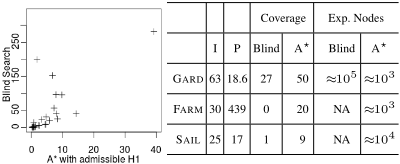
| Coverage | Exp. Nodes | |||||
|---|---|---|---|---|---|---|
| I | P | Blind | A? | Blind | A? | |
| GARD | 63 | 18.6 | 27 | 50 | ⇡105 | ⇡103 |
| FARM | 30 | 439 | 0 | 20 | NA | ⇡103 |
| SAIL | 25 | 17 | 1 | 9 | NA | ⇡104 |
Figure 2: Experimental Results
ˆhrmax hbd . The latter is used within A? , while all other heuristics are used in a Greedy Best First Search (GBFS). For comparison, we also run GBFS with the interval-based relaxation (IBR) heuristic, obtained from Metric-FF (Hoffmann 2003) by disabling Enforced Hill Climbing. The optimal planner is compared with blind search.
Benchmarks include IPC domains (http://www.icapsconference.org/), numeric reformulation of the COUNTERS and GARDENING domains by Franc´es and Geffner (2015), our motivating example (SAILING) and a new domain called FARMLAND. SAILING instances are scaled by the numbers of boats and people to be rescued. The FARMLAND domain models allocating manpower to farms, with a hard constraint on a metric measuring benefit. The contribution of each farm to the benefit is a function of the number of workers assigned. Each farm requires at least one worker. The number of workers ranges from 100 to 1↪ 000, and the number of farms from 2 to 10. The experimental setting has been conceived to stress numeric reasoning. Most of the domains feature only SCs, except TPP and DEPOT which also have HCs. We expect our heuristics to perform well on domains featuring mostly SCs.
Evaluation Figure 2a reports the performance of the satisficing planners. Both variants of the hybrid heuristic outperform the IBR heuristic in every domain but TPP. IBR is very weak for domains where numeric conditions involve several variables. This is prominent in SAILING and FARMLAND. The hhbd+ heuristics also performs well in classical IPC domains where the propositional part of the problem is important, showing synergy between the numeric and propositional relaxations. ˆhradd hbd+ is well-informed for problems with many interacting goals, e.g., COUNTERS and GARDENING, producing plans of higher quality. However, the redundant constraints are also misleading in some domains, so they must be added with care.
Figure 2b shows results for the optimal planner. Experiments were run on a smaller set of instances of three domains: GARDENING, with up to 3 plants and 10x10 grids, FARMLAND, with 4 farms, and SAILING, with smaller metric distance to the goals. As expected, the number of goals is crucial for the effectiveness of the heuristic. In GARDENING, the optimal planner solves all instances with 1 plant, 90▷5% with 2 plants and about 50% with 3 plants. Blind search solves 19 instances out of 21 with 1 plant, 8 with 2 plants and none with 3 plants. In FARMLAND, the optimal planner solves 20 out of 30 instances, blind search none at all. In SAILING, performance is poorer because of the large number of subgoals, which leads to more decompositions and lower heuristic accuracy. Average runtime is around 5 seconds in FARMLAND, around 68 seconds in GARDENING, though the largest instances took over 1↪ 000 seconds, and on average 38 seconds in SAILING.
Conclusion
In the classical setting, considering subgoals in isolation implies a delete-free relaxation; this is not the case in numeric planning, where the analogue of delete relaxation, known as the interval-based relaxation, ignores negative interactions also between numeric variables in a single numeric condition. Our generalisation of the principle underlying the hmax and hadd heuristics to hybrid planning takes such interactions into account, making it more accurate. For the class of simple numeric conditions, tractable heuristics based on this relaxation can be devised. General numeric conditions can be handled by interleaving it with the interval-based relaxation. For problems with only simple numeric conditions, we formulated an admissible heuristic. As far as we know, it is the first of its kind.
Future work includes lifting the remaining restriction - to acyclic numeric dependencies - posed by the interval-based relaxation, and integrating ˆhadd hbd+ with state-of-the-art search strategies by identifying preferred operators.
Acknowledgements
This work is supported by ARC project DP140104219, "Robust AI Planning for Hybrid Systems". NICTA is funded by the Australian Government through the Department of Communications and the Australian Research Council through the ICT Centre of Excellence Program.
@inproceedings{ijcai2016p457,
  title     = {Heuristics for Numeric Planning via Subgoaling},
  author    = {Scala, Enrico and Haslum, Patrik and Thiébaux, Sylvie},
  booktitle = {Proceedings of the Twenty-Fifth International Joint Conference on
               Artificial Intelligence, {IJCAI-16}},
  publisher = {AAAI Press / International Joint Conferences on Artificial Intelligence},
  editor    = {Subbarao Kambhampati},
  pages     = {3228--3233},
  year      = {2016},
  month     = {7},
  url       = {https://ijcai.org/proceedings/2016/457},
}
TY - CPAPER TI - Heuristics for Numeric Planning via Subgoaling AU - Scala, Enrico AU - Haslum, Patrik AU - Thiébaux, Sylvie T2 - Proceedings of the Twenty-Fifth International Joint Conference on Artificial Intelligence, IJCAI-16 PB - AAAI Press / International Joint Conferences on Artificial Intelligence PY - 2016 SP - 3228 EP - 3233 UR - https://ijcai.org/proceedings/2016/457 ER -Copied
Machine-readable versions of this paper, for tools and AI agents:





