
Video-Based Person Re-Identification by Simultaneously Learning Intra-Video and Inter-Video Distance Metrics
Proceedings of the Twenty-Fifth International Joint Conference on Artificial Intelligence. Pages 3552-3558.
Abstract
Video-based person re-identification (re-id) is an important application in practice. However, only a few methods have been presented for this problem. Since large variations exist between different pedestrian videos, as well as within each video, it's challenging to conduct re-identification between pedestrian videos. In this paper, we propose a simultaneous intra-video and inter-video distance learning (SI2DL) approach for video-based person re-id. Specifically, SI2DL simultaneously learns an intra-video distance metric and an inter-video distance metric from the training videos. The intra-video distance metric is to make each video more compact, and the inter-video one is to make that the distance between two truly matching videos is smaller than that between two wrong matching videos. To enhance the discriminability of learned metrics, we design a video relationship model, i.e., video triplet, for SI2DL. Experiments on the public iLIDS-VID and PRID 2011 image sequence datasets show that our approach achieves the state-of-the-art performance.
- [Ahmed et al., 2015] Ejaz Ahmed, Michael Jones, and Tim K. Marks. An improved deep learning architecture for person re-identification. In CVPR, pages 3908-3916, 2015.
- [Bedagkar-Gala and Shah, 2011] Apurva Bedagkar-Gala and Shishir K Shah. Multiple person re-identification using part based spatio-temporal color appearance model. In ICCV Workshops, pages 1721-1728, 2011.
- [Cong et al., 2009] Dung Nghi Truong Cong, Catherine Achard, Louahdi Khoudour, and Lounis Douadi. Video sequences association for people re-identification across multiple non-overlapping cameras. In ICIAP, pages 179- 189. 2009.
- [Gorski et al., 2007] Jochen Gorski, Frank Pfeuffer, and Kathrin Klamroth. Biconvex sets and optimization with bi- convex functions: a survey and extensions. Mathematical Methods of Operations Research, 66(3):373-407, 2007.
- [Gu et al., 2014] Shuhang Gu, Lei Zhang, Wangmeng Zuo, and Xiangchu Feng. Projective dictionary pair learning for pattern classification. In NIPS, pages 793-801, 2014.
- [Hirzer et al., 2011] Martin Hirzer, Csaba Beleznai, Peter M Roth, and Horst Bischof. Person re-identification by de- scriptive and discriminative classification. In Image Anal- ysis, pages 91-102. 2011.
- [Huang et al., 2015a] Zhiwu Huang, Ruiping Wang, Shiguang Shan, and Xilin Chen. Hybrid euclidean-and- riemannian metric learning for image set classification. In ACCV, pages 562-577. 2015.
- [Huang et al., 2015b] Zhiwu Huang, Ruiping Wang, Shiguang Shan, and Xilin Chen. Projection metric learning on grassmann manifold with application to video based face recognition. In CVPR, pages 140-149, 2015.
- [Huang et al., 2015c] Zhiwu Huang, Ruiping Wang, Shiguang Shan, Xianqiu Li, and Xilin Chen. Log- euclidean metric learning on symmetric positive definite manifold with application to image set classification. In ICML, 2015.
- [Jing et al., 2015] Xiao-Yuan Jing, Xiaoke Zhu, Fei Wu, Xinge You, Qinglong Liu, Dong Yue, Ruimin Hu, and Baowen Xu. Super-resolution person re-identification with semi-coupled low-rank discriminant dictionary learning. In CVPR, pages 695-704, 2015.
- [Kostinger et al., 2012] M Kostinger, Martin Hirzer, Paul Wohlhart, Peter M Roth, and Horst Bischof. Large scale metric learning from equivalence constraints. In CVPR, pages 2288-2295, 2012.
- [Li et al., 2015a] Sheng Li, Ming Shao, and Yun Fu. Cross-view projective dictionary learning for person re- identification. In IJCAI, pages 2155-2161, 2015.
- [Li et al., 2015b] Yan Li, Ruiping Wang, Zhiwu Huang, Shiguang Shan, and Xilin Chen. Face video retrieval with image query via hashing across euclidean space and rie- mannian manifold. In CVPR, pages 4758-4767, 2015.
- [Liao et al., 2015] Shengcai Liao, Yang Hu, Xiangyu Zhu, and Stan Z. Li. Person re-identification by local maximal occurrence representation and metric learning. In CVPR, pages 2197-2206, June 2015.
- [Liu et al., 2015] Kan Liu, Bingpeng Ma, Wei Zhang, and Rui Huang. A spatio-temporal appearance representa- tion for viceo-based pedestrian re-identification. In ICCV, pages 3810-3818, 2015.
- [Lu et al., 2013] Jiwen Lu, Gang Wang, and Philippe Moulin. Image set classification using holistic multiple order statistics features and localized multi-kernel metric learning. In ICCV, pages 329-336, 2013.
- [Wang and Chen, 2009] Ruiping Wang and Xilin Chen. Manifold discriminant analysis. In CVPR, pages 429-436, 2009.
- [Wang et al., 2012] Ruiping Wang, Huimin Guo, Larry S Davis, and Qionghai Dai. Covariance discriminative learn- ing: A natural and efficient approach to image set classifi- cation. In CVPR, pages 2496-2503, 2012.
- [Wang et al., 2014] Taiqing Wang, Shaogang Gong, Xiatian Zhu, and Shengjin Wang. Person re-identification by video ranking. In ECCV, pages 688-703. 2014.
- [Weinberger and Saul, 2009] K.Q. Weinberger and L.K. Saul. Distance metric learning for large margin nearest neighbor classification. Journal of Machine Learning Re- search, 10:207-244, 2009.
- [Wu et al., 2012] Yang Wu, Michihiko Minoh, Masayuki Mukunoki, and Shihong Lao. Set based discriminative ranking for recognition. In ECCV, pages 497-510. 2012.
- [Yang et al., 2014] Yang Yang, Jimei Yang, Junjie Yan, Shengcai Liao, Dong Yi, and Stan Z Li. Salient color names for person re-identification. In ECCV, pages 536- 551. 2014.
- [Zhao et al., 2013] Rui Zhao, Wanli Ouyang, and Xiaogang Wang. Unsupervised salience learning for person re- identification. In CVPR, pages 3586-3593, 2013.
- [Zhao et al., 2014] Rui Zhao, Wanli Ouyang, and Xiao- gang Wang. Learning mid-level filters for person re- identification. In CVPR, pages 144-151, 2014.
- [Zheng et al., 2013] Wei-Shi Zheng, Shaogang Gong, and Tao Xiang. Reidentification by relative distance compar- ison. Pattern Analysis and Machine Intelligence, IEEE Transactions on, 35(3):653-668, 2013.
- [Zhu et al., 2013] Pengfei Zhu, Lei Zhang, Wangmeng Zuo, and Dejing Zhang. From point to set: Extend the learning of distance metrics. In ICCV, pages 2664-2671, 2013.
References were extracted automatically from the PDF and may contain errors.
Full text extracted automatically from the PDF; figures, tables and equations may differ. The PDF is the version of record.
1 Introduction
The task of person re-identification (re-id) is to match pedestrian images or videos observed from multiple cameras. It has recently drawn much attention in the computer vision and machine learning communities due to its importance in the automated video surveillance and forensics. In recent years, various methods have been presented to tackle this problem. Most of the existing methods focus on the imagebased person re-id [Ahmed et al., 2015; Jing et al., 2015; Li et al., 2015a; Liao et al., 2015]. These methods can be further divided into two categories: feature learning and distance learning methods. The former aims to extract distinctive features from pedestrian images, e.g., salience features [Zhao et al., 2013], mid-level features [Zhao et al., 2014], and salient color features [Yang et al., 2014]. The distance learning methods focus on learning effective distance metrics, which can maximize matching accuracy regardless the choice of representation, to measure the similarity between two images. Popular distance learning methods include large margin nearest neighbor (LMNN) [Weinberger and Saul, 2009], the keep it simple and straightforward metric (KISSME) [Kostinger et al., 2012] and relative distance comparison (RDC) [Zheng et al., 2013], and so on.
⇤Corresponding author.
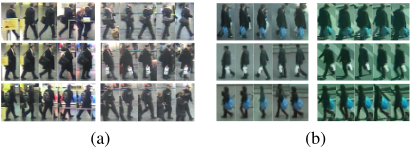
Since videos inherently contain more information than independent images, video-based person re-id has attracted much attention. Recently, two methods have been presented for video-based person re-id [Wang et al., 2014; Liu et al., 2015]. Both methods focus on extracting spatialtemporal features to represent each pedestrian video, and then perform video-based person re-id with these features. Specifically, they break down each video to generate several fragments (walking cycles), and extract spatial-temporal feature from each fragment, and then represent each video with a set of the extracted spatial-temporal features. Therefore, reidentification between two videos can be considered as a set to set matching problem. In practice, due to changes in illumination, pose, viewpoint, occlusions, there not only exist severe variations between different pedestrian videos, but also large variations between the frames within each video. Figure 1 shows some demo person sequences in the iLIDSVID [Wang et al., 2014] and PRID 2011 [Hirzer et al., 2011] datasets. These variations determine that there still exist large variations between spatial-temporal features extracted from different videos (called inter-video variations), and between different spatial-temporal features extracted from the same video (called intra-video variations). However, both methods don't deal with inter-video and intra-video variations simultaneously, which will directly hamper their performance.
Set-based distance learning is an effective technique to reduce the variations between sets. Recently, a few setbased distance learning methods have been presented, including manifold discriminant analysis (MDA) [Wang and Chen, 2009], set-based discriminative ranking (SBDR) [Wu et al., 2012], covariance discriminative learning (CDL) [Wang et al., 2012], set-to-set distance metric learning (SSDML) [Zhu et al., 2013] and localized multi-kernel metric learning (LMKML) [Lu et al., 2013].
1.1 Motivation and Contribution
Existing distance learning based person re-id methods [Kostinger et al., 2012; Zheng et al., 2013] have demonstrated the effectiveness of distance learning technique for the person re-id task. However, these methods were designed for imagebased person re-id, rather than for video-based person re-id particularly. Although a pedestrian video can be regarded as a sample set, existing set-based distance learning methods were not designed to tackle the video-based person re-id. Due to the existence of large intra-video and inter-video variations in the pedestrian video data, it's necessary and meaningful to investigate how to learn the more discriminative distance metric by reducing the influence of these variations.
The main contribution of this paper can be summarized as follows.
(1) We propose a novel video-based person re-id approach, namely simultaneous intra-video and inter-video distance learning (SI2DL). To the best of our knowledge, this is the pioneer work to solve video-based person re-id by employing set-based distance learning technique.
- We design a new set-based distance learning model, which aims to learn a pair of intra-video and inter-video distance metrics to deal with the intra-video and inter-video variations, respectively. By using the learned intra-video metric, each video becomes more compact. Then by using the learned inter-video metric, the distance between truly matching videos becomes smaller than that between wrong matching videos.
- To enhance the discriminability of the learned intervideo distance metric, we design a new video relationship model, i.e., video triplet, which is constituted by a pair of truly matching videos and an "impostor" video.
- We evaluate the performance of SI2DL and related methods on the public iLIDS-VID and PRID 2011 pedestrian sequence datasets. Experimental results demonstrate that our approach achieves the state-of-the-art performance.
2 RelatedWork
In this section, we briefly review two types of works that are related to our approach: (1) Video based person reidentification methods, (2) Set-based distance learning methods.
Video-based Person Re-identification. Video-based person re-identification is an important application in practice. Some early researches related to video-based person reidentification include [Cong et al., 2009; Bedagkar-Gala and Shah, 2011]. Recently, video-based person re-identification methods [Wang et al., 2014] and [Liu et al., 2015] are presented. Both methods focus on extracting spatio-temporal features from videos. Method in [Wang et al., 2014] divides each video into several fragments by employing the flow energy profile signal, and then learns a ranking model with the HOG3D features extracted from these fragments. Method in [Liu et al., 2015] divides each video sequence into small segments corresponding to the action primitives, then each segment is further divided to a series of body-action units, finally, Fisher vectors extracted from all body-action units are concatenated as the representation of the video. The major differences between our SI2DL approach and methods [Wang et al., 2014; Liu et al., 2015] are two-folds. Firstly, these methods focus on extracting spatial-temporal features, while SI2DL focuses on learning a pair of distance metrics simultaneously. Secondly, these methods don't deal with the intra-video and inter-video variations simultaneously, while SI2DL copes with them by learning an intra-video distance metric and an inter-video distance metric.
Set-based Distance Learning. Video-based classification is an important problem in several computer vision tasks. Since a video can be considered as an image set, a few setbased distance learning methods have been presented to solve this problem [Huang et al., 2015c]. Method in [Wang and Chen, 2009; Huang et al., 2015b] models each set as a manifold, and learns an embedding space to maximize manifold margin. Methods [Wang et al., 2012] learn a set-to-set distance metric by modeling each set as a covariance matrix. Method [Zhu et al., 2013] extends the point-to-point distance learning to the set-to-set distance learning by modeling each set as a convex hull. The major differences between our approach and these methods can be summarized into two aspects. Firstly, these methods are designed for image classification tasks (e.g., face recognition and object categorization), while our approach is designed for video-based person re-id particularly. Secondly, these methods learn a common distance metric to deal with the within-set and between-set variations, while our approach learns a pair of distance metrics to cope with intra-video and inter-video variations.
3 Simultaneous Intra-video and Inter-video Distance Learning (SI2DL)
3.1 ProblemFormulation
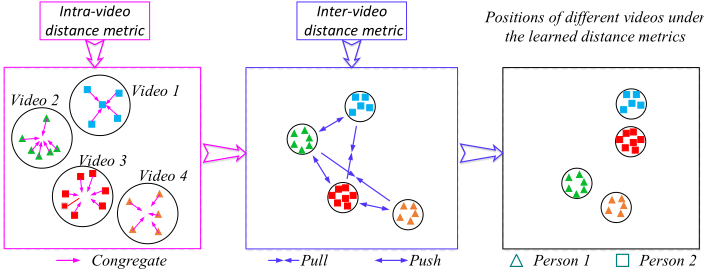
Denote by X = [X1↪ ▷▷▷↪Xi↪ ▷▷▷↪XK] a set of p-dimensional training samples from K pedestrian videos, where Xi 2 Rp⇥ni is the training sample set corresponding to the ith video, and ni is the sample number in Xi. Denote by xij the j th sample in Xi. Since there exist large variations both within each video and between different videos, it's not an easy task to directly match between two videos. Intuitively, reducing the intra-video variation is beneficial to enhancing the inter-video separability. If we can make each video more compact, it will be easier to learn a video-to-video distance metric that has favorable discriminative capability. Therefore, we intend to jointly learn an intra-video distance metric and an inter-video distance metric from the training samples. The intra-video distance metric is to increase the compactness of each video, and the inter-video one is to enhance the separability of videos after intra-video distance learning. The basic idea of our SI2DL approach is illustrated in Figure 2.
Therefore, we design the framework of SI2DL as follows:
where V 2 Rp⇥K1 and W 2 RK1⇥K2 separately represent the intra-video and inter-video distance metrics to be learned, K1 and K2 are positive integers. vi and wi are the ith column vectors in V and W, respectively. f(V↪X) is the intra-video congregating term, which requires that each sample should move close to the center of video to which it belongs. The second term g(W↪ V↪X) is the inter-video discriminant term to ensure that the distance between two truly matching videos is smaller than that between two wrong matching videos. θ is a balancing factor. The constraints are used to restrict the scale of V andW.
There are several models that can be employed to represent a set [Li et al., 2015b]. Considering that the intra-video distance learning results should be able to be directly used for learning the inter-video distance metric, we select the firstorder statistics, which shows the averaged position of the sample set in the high dimensional space, to represent each video. For feature set Xi, its first-order statistics, denoted by mi, can be computed with (2):
Therefore, we design f(V↪ X) as follows:
where N is the total image number in X, mi represents the first-order statistics of Xi. g(W↪ V↪ X) is designed as follows:
where D represents the collection of video triplets, with each triplet consisting of a truly matching video pair and one of its "impostor" videos under V . Detailed information about the construction of a video triplet can be found in Definition 1. ♣D♣ denotes the number of video triplets in D. ⇢ = exp(-kV T (mi-mk)k22 ◁kV T (mi-mj)k22 ) is a penalty factor. By substituting (3) and (4) into (1), the objective function of our approach can be written as:
The learned intra-video distance metric V ensures that all samples in each video move close to the corresponding firstorder statistics, such that the first-order statistics can better represent each video, which will facilitate the learning of inter-video distance metric W. Furthermore, W is learned by exploiting the information provided by impostor videos according to the characteristics of pedestrian data, and therefore owns favorable discriminative ability.
Definition 1 (Video Triplet) Given the intra-video distance metric V and videos Xi, Xj and Xk as well as their corresponding first-order statistics representations mi, mj and mk, where Xj is a true matching of Xi, while Xk is a wrong matching of Xi. If kV T (mi -mk)k22 < kV T (mi -mj)k22 , Xk is called an impostor video of Xi under V , then Xi, Xj and Xk constitute a video triplet, denoted by < i↪ j↪ k >.
3.2 The Optimization of SI2DL
The objective function (5) is not jointly convex to (V , W). To update V and W, we introduce two variable matrices A and B, and relax (5) to the following problem:
where M1 and M2 are matrices with corresponding columns being respectively q θ ♣D♣(mi-mj) and q θ⇢ ♣D♣ (mi -mk), <
i↪ j↪ k >2 D. k · kF represents the Frobenius norm. Then we can solve (6) by updating A, B, V and W iteratively. Detailed steps are as follows.
÷ Update A and B by fixing V and W.
Firstly, we should initialize V and W. Here, V is initialized by solving (7).
By constructing the Lagrange function and setting the derivative to zero, we get
where Q1 = Pni=1 Pni j=1 (xij -mi)(xij -mi)T . It is clear that (8) is an eigen-decomposition problem and can be solved easily. We select eigenvectors corresponding to the smallest K1 eigenvalues as V . After initializing V , we initialize W by solving (9):
Similar to (7), this problem can also be solved by eigendecomposition. Finally, W is set as the eigenvectors corresponding to the smallest K2 eigenvalues.
When V and W are fixed, A and B can be easily obtained by solving problems (10) and (11), respectively.
÷ Update V by fixing A, B and W.
When A, B and W are fixed, the objective function regarding V can be written as
where
We optimize (12) with a similar way as [Gu et al., 2014], i.e., introducing a variable S:
The optimal solution of (14) can be obtained by the ADMM algorithm:
÷ Update W by fixing A, B and V .
By fixing A, B and V , the objective function regarding W can be written as
Similar to (12), problem (16) can also be solved with the ADMM algorithm by introducing a variable S. The proposed SI2DL algorithm is summarized in Algorithm 1.
Algorithm 1 Simultaneous intra-video and inter-video distance learning (SI2DL)
Require: Training sample set X
Ensure: The learned distance metrics V andW
- 1: Initialize V andW by Eq. (7) and (9), respectively;
- 2: while not converge do
- 3: Fix V and W, update A and B by (10) and (11), respectively;
- 4: Fix A, B andW, update V according to (15);
- 5: Fix A, B and V , update W by Eq. (16);
- 6: end while
- 7: return V andW;
3.3 Complexity and Convergence
In the training phase of SI2DL, V and W are firstly initialized, and then V and W are updated alternatively. The time complexity of initializing V and W are respectively O(Np2 +p3 ) and O(L(K1p+K1 2 )+K1 3 ), where L = ♣D♣. In each iteration, M1M1 T and M2M2 T as well as Q1 are not changed, thus the time complexities of updating A, B, V and W are O(K1 2K2+K1 3 +K1 2p), O(K1 2K2+K1 3 +K1 2p), O(K1p2 +T1(p2K1 +p3 )) and O(K1p2 +K1 2 p+T2(K1 3 + K1 2K2)), respectively, where T1 and T2 are the iteration numbers in ADMM algorithm for updating V and W, respectively. We experimentally found that in most cases T1 and T2 are less than 10. In practice, the dimension p and N are much smaller than L.
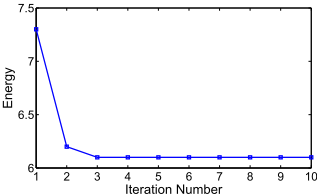
The objective function in (6) is a bi-convex problem for ¶(V , W), (A, B)♦, i.e., by fixing (A, B) the function is convex for (V , W), and by fixing (V , W) the function is convex for (A, B). The convergence of such a problem has already been intensively studied in [Gorski et al., 2007]. Figure 3 shows the convergence curve of our algorithm on the PRID 2011 dataset. One can see that the energy drops quickly and becomes stable after 3 iterations. In most of our experiments, our algorithm will converge in less than 5 iterations.
3.4 Video-based Person Re-identification with the Learned Distance Metrics
With the learned intra-video and inter-video distance metrics (V , W), we can perform video-based person re-identification easily. Let Y = [Y1↪ ▷▷▷↪ Yi↪ ▷▷▷↪ Yn] be a set of p-dimensional samples from n gallery pedestrian videos, where Yi 2 Rp⇥li is the sample set corresponding to the ith gallery video, and li is the number of samples in Yi. Denote by Zi 2 Rp⇥ni the sample set corresponding to the ith probe video, where ni is the number of training samples in Zi. Let yij (zij) represent the j th sample in Yi (Zi). Detailed re-identifying steps between Zi and Y are as follows.
(1) Calculating the first-order statistics representations of Zi and each gallery video Yi under V and W according to Eq. (17).
- Computing the distance between the probe video and each gallery video by kr(Zi) - r(Yk)k22 ↪ k = 1↪ 2↪ ▷▷▷↪ n.
- Sorting the obtained distances, and the gallery video with the smallest distance is the true matching of Zi.
4 Experimental Results
To evaluate the effectiveness of our approach, we conduct extensive experiments on two publicly available person sequence datasets, including iLIDS-VID [Wang et al., 2014] and PRID 2011 [Hirzer et al., 2011].
4.1 Experimental Settings
Baselines. We compare our approach with the state-of-the-art video-based person re-id methods, including discriminative video fragments selection and ranking (DVR) [Wang et al., 2014], and its two enhancements Salience+DVR and MSColour&LBP+DVR [Wang et al., 2014], spatial-temporal fisher vector representation (STFV3D) and its enhancement method STFV3D+KISSME [Liu et al., 2015].
Feature Extraction. In experiments, we employ the effective feature (i.e., STFV3D) provided by the author of [Liu et al., 2015] for both the iLIDS-VID and PRID 2011 datasets, which is the latest pedestrian video feature reported in existing video-base person re-id works. In particular, each video is represented with a sample set, with each sample being a Fisher vector extracted from a waling cycle. The dimensionality of each sample is 2208 and 2512 in the iLIDS-VID and PRID 2011 datasets, respectively.
Parameter Settings. There are three parameters in our SI2DL model, i.e., θ, ⌧1 and ⌧2. In experiments, we choose these parameters by 5-fold cross-validation on each dataset. With respect to K1 and K2, we set them as (2200, 80) for iLIDS-VID, and (2500, 100) for PRID 2011, respectively. The choice of the values of K1 and K2 will be discussed in Section 4.4.
Evaluation Settings. We follow the evaluation protocol in [Wang et al., 2014] for both iLIDS-VID and PRID 2011 datasets. In particular, we randomly split all sequence pairs into two sets of equal size, with one for training and the other for testing. Then we further select sequences from the first camera in the testing set to form the probe set, and those from the other camera are used as the gallery set. We employ the standard cumulated matching characteristics (CMC) curve as our evaluation metric, and report the Rank-k average matching rates of 10 trials.
4.2 Evaluation on the iLIDS-VIDDataset
The iLIDS-VID dataset [Wang et al., 2014] consists of 600 image sequences for 300 persons, with each person having a pair of image sequences from two camera views. The length of each image sequence ranges from 22 to 192 frames, with an average number of 71. Due to clothing similarities among people, lighting and viewpoint variations across camera views, cluttered background and occlusions, the iLIDSVID dataset is very challenging. Figure 1 (a) shows some example image sequences in iLIDS-VID. The parameters θ, ⌧1 and ⌧2 are set as 0.00005, 0.2 and 0.2, respectively.
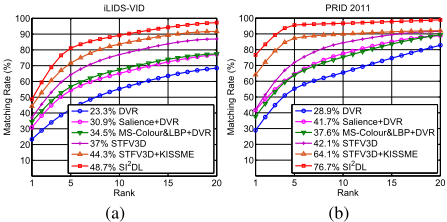
Figure 4 (a) shows the CMC curves of the compared methods. Table 1 shows the detailed rank-1, rank-5, rank-10, and rank-20 matching rates of all the compared methods. We can observe that our SI2DL approach achieves higher matching rates in each rank, especially the rank-5 matching rate is improved by at least 9.4% (81.1%-71.7%). Compared with the competing methods, the main advantage of SI2DL is that SI2DL learns a pair of distance metrics with favorable discriminability, which can be used for reducing the intra-video and inter-video variations simultaneously.
| Method | r=1 | r=5 | r=10 | r=20 |
|---|---|---|---|---|
| DVR | 23.3 | 42.4 | 55.3 | 68.4 |
| Salience+DVR | 30.9 | 54.4 | 65.1 | 77.1 |
| MS-Colour&LBP+DVR | 34.5 | 56.7 | 67.5 | 77.5 |
| STFV3D | 37.0 | 64.3 | 77.0 | 86.9 |
| STFV3D+KISSME | 44.3 | 71.7 | 83.7 | 91.7 |
| SI2DL | 48.7 | 81.1 | 89.2 | 97.3 |
4.3 Evaluation on the PRID 2011 Dataset
The PRID 2011 person sequence dataset [Hirzer et al., 2011] consists of image sequences recorded from two disjoint cameras (Cam-A and Cam-B). Cam-A and Cam-B contain 385 and 749 person sequences, respectively. Each sequence contains 5 to 675 image frames, with an average number of 84. Among them, the first 200 persons appear in both views. For the PRID 2011 dataset, the sequence pairs with less than 20 frames are ignored due to the requirement on the sequence length for extracting walking cycles [Liu et al., 2015].
| Method | r=1 | r=5 | r=10 | r=20 |
|---|---|---|---|---|
| DVR | 28.9 | 55.3 | 65.5 | 82.8 |
| Salience+DVR | 41.7 | 64.5 | 77.5 | 88.8 |
| MS-Colour&LBP+DVR | 37.6 | 63.9 | 75.3 | 89.4 |
| STFV3D | 42.1 | 71.9 | 84.4 | 91.6 |
| STFV3D+KISSME | 64.1 | 87.3 | 89.9 | 92.0 |
| SI2DL | 76.7 | 95.6 | 96.7 | 98.9 |
Some example person sequences of the PRID 2011 dataset are shown in Figure 1 (b). The parameters θ, ⌧1 and ⌧2 are set as 0.00005, 0.1 and 0.1, respectively.
Table 2 and Figure 4 (b) report the top ranked matching rates of compared methods on the PRID 2011 dataset. It is observed that our SI2DL approach obtains much higher matching rates than other methods. In particular, taking the rank-1 matching rate as an example, SI2DL improves the average matching rate at least by 12.6% (=76.7%-64.1%).
4.4 Discussion
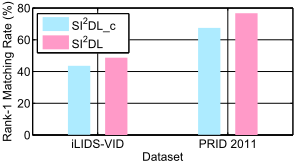
Learning a pair of distance metrics or a common one? Our approach learns an intra-video distance metric and an inter-video distance metric to handle the intra-video and intervideo variations, respectively. To evaluate the effectiveness of the manner that we learn the distance metrics, we compare SI2DL with the modified SI2DL version that learns a common distance metric. We call the modified version SI2DL c. Figure 5 reports the rank-1 matching rates of SI2DL and SI2DL c on the iLIDS-VID and PRID 2011 datasets. We can see that SI2DL significantly outperforms SI2DL c, which indicates that the manner of learning a common distance metric to catch both the intra-video and inter-video variations will lead to a compromise to the discriminability of the learned distance metric. Therefore, we should learn different distance metrics to handle variations of different levels.
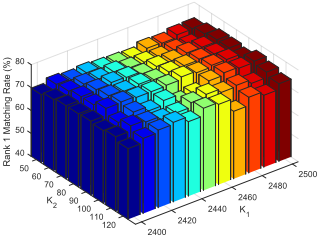
Dimensionality of intra-video and inter-video distance metrics. Since the inter-video distance learning depends on the results of intra-video distance learning, selecting proper dimensionality for the intra-video metric (V ), i.e., K1, is important in the learning of our SI2DL model. Since V is initialized by Eq. (8), which is solved by eigen-decomposition, the value of K1 should be smaller than the sample dimension, i.e., 2512 for PRID 2011. In experiments, we found that the value of K1 should be close to the dimensionality of each training sample (p), while K2 should be small. Figure 6 shows the Rank-1 matching rates of SI2DL with K1 in the range [2400, 2500] and K2 in the range [50, 120] on the PRID 2011 dataset. We can see that SI2DL is not very sensitive to the choices of K1 and K2 in the observed ranges, and SI2DL achieves the best performance when K1 and K2 are separately set as 2500 and 100. Similar performance-stable ranges can be observed on the iLIDS-VID dataset.
Comparison with set-based distance learning methods. In experiments, we also compared SI2DL with three stateof-the-art set-based distance learning methods, including covariance discriminative learning (CDL) [Wang et al., 2012], set-to-set distance metric learning (SSDML) [Zhu et al., 2013], and hybrid euclidean-and-riemannian metric learning
(HERML) [Huang et al., 2015a]. These methods used the same features and settings as SI2DL. Experimental results showed that the competing methods obtain rather poor matching rates, so the detailed results of these methods are not provided. The main reasons for this phenomenon can be summarized into three aspects: (i) These methods are designed for image classification tasks, where each class has several image sets (more than two). However, in the setting of video-based person re-id, there is only one video per person for one camera. (ii) They assume that training and testing sets contain the same classes, and conduct the matching between testing samples and training samples. However, in video-based person re-id, people in the training set will not appear in the testing set, and the matching is conducted between two videos from different cameras. (iii) They learn a common distance metric and don't deal with the intra-video variations particularly. All these factors will bring large difficulties to them.
5 Conclusion
This paper proposes a novel set-based distance learning approach for video-based person re-identification, which simultaneously learns a pair of intra-video and inter-video distance metrics. The learned intra-video distance metric can make each video more compact, such that the extracted first-order statistics feature can better represent each video. The learned inter-video distance metric can make the distance between truly matching videos smaller than that of wrong matching videos. Experimental results on the public iLIDS-VID and PRID 2011 datasets show that our approach achieves the best matching rates, and also demonstrate the effectiveness of the manner of learning a pair of distance metrics to deal with intra-video and inter-video variations.
Acknowledgments
The authors want to thank the Editor and anonymous reviewers for their constructive comments and suggestions. The work described in this paper was supported by the National Nature Science Foundation of China under Project Nos. 61272273 and the Research Project of NJUPT (XJKY14016).
@inproceedings{ijcai2016p501,
  title     = {Video-Based Person Re-Identification by Simultaneously Learning Intra-Video and Inter-Video Distance Metrics},
  author    = {Zhu, Xiaoke and Jing, Xiao-Yuan and Wu, Fei and Feng, Hui},
  booktitle = {Proceedings of the Twenty-Fifth International Joint Conference on
               Artificial Intelligence, {IJCAI-16}},
  publisher = {AAAI Press / International Joint Conferences on Artificial Intelligence},
  editor    = {Subbarao Kambhampati},
  pages     = {3552--3558},
  year      = {2016},
  month     = {7},
  url       = {https://ijcai.org/proceedings/2016/501},
}
TY - CPAPER TI - Video-Based Person Re-Identification by Simultaneously Learning Intra-Video and Inter-Video Distance Metrics AU - Zhu, Xiaoke AU - Jing, Xiao-Yuan AU - Wu, Fei AU - Feng, Hui T2 - Proceedings of the Twenty-Fifth International Joint Conference on Artificial Intelligence, IJCAI-16 PB - AAAI Press / International Joint Conferences on Artificial Intelligence PY - 2016 SP - 3552 EP - 3558 UR - https://ijcai.org/proceedings/2016/501 ER -Copied
Machine-readable versions of this paper, for tools and AI agents:





