
Inferring Motif-Based Diffusion Models for Social Networks
Proceedings of the Twenty-Fifth International Joint Conference on Artificial Intelligence. Pages 3677-3682.
Abstract
Existing diffusion models for social networks often assume that the activation of a node depends independently on their parents' activations. Some recent work showed that incorporating the structural and behavioral dependency among the parent nodes allows more accurate diffusion models to be inferred. In this paper, we postulate that the latent temporal activation patterns (or motifs) of nodes of different social roles form the underlying information diffusion mechanisms generating the information cascades observed over a social network. We formulate the inference of the temporal activation motifs and a corresponding motif-based diffusion model under a unified probabilistic framework. A two-level EM algorithm is derived so as to infer the diffusion-specific motifs and the diffusion probabilities simultaneously. We applied the proposed model to several real-world datasets with significant improvement on modelling accuracy. We also illustrate how the inferred motifs can be interpreted as the underlying mechanisms causing the diffusion process to happen in different social networks.
- [Anderson et al., 2015] A. Anderson, D. Huttenlocher, J. Klein- berg, J. Leskovec, and M. Tiwari. Global diffusion via cascading invitations: Structure, growth, and homophily. In Proceedings of the 24th International Conference on World Wide Web, pages 66-76, Florence, Italy, 2015.
- [Bao et al., 2013] Q. Bao, W.K. Cheung, and Y. Zhang. Incorpo- rating structural diversity of neighbors in a diffusion model for social networks. In Proceedings of the 2013 IEEE/WIC/ACM International Joint Conference on Web Intelligence, pages 431- 438, Atlanta, GA, USA, 2013.
- [Bao et al., 2015] Q. Bao, W.K. Cheung, J. Liu, and Y. Song. In- ferring latent co-activation patterns for information diffusion. In Proceedings of the 2015 IEEE/WIC/ACM International Joint Conference on Web Intelligence, pages 485-492, Singapore, 2015.
- [Fang and Tang, 2015] Z. Fang and J. Tang. Uncovering the for- mation of triadic closure in social networks. In Proceedings of the 25th International Joint Conference on Artificial Intelligence, pages 2062-2068, Buenos Aires, Argentina, 2015. IJCAI
- [Goldenberg et al., 2001] J. Goldenberg, B. Libai, and E. Muller. Using complex systems analysis to advance marketing theory development. Academy of Marketing Science Review, 9:1-18, 2001.
- [Gomez-Rodriguez et al., 2011] M. Gomez-Rodriguez, David Bal- duzzi, and B. Schölkopf. Uncovering the temporal dynamics of diffusion networks. In Proceedings of the 28th International Conference on Machine Learning, pages 561-568, Bellevue, WA, USA, 2011.
- [Goyal et al., 2010] A. Goyal, F. Bonchi, and L. V.S. Lakshmanan. Learning influence probabilities in social networks. In Proceed- ings of the 3rd ACM International Conference on Web Search and Data Mining, pages 241-250, New York, NY, USA, 2010.
- [Granovetter, 1978] M. Granovetter. Threshold models of collec- tive behavior. The American Journal of Sociology, 83:1420- 1443, 1978.
- [Gruhl et al., 2004] D. Gruhl, R. Guha, D. Liben-Nowell, and A. Tomkins. Information diffusion through blogspace. In Pro- ceedings of the 13th International Conference on World Wide Web, pages 491-501, New York, NY, USA, 2004.
- [He et al., 2015] X. He, T. Rekatsinas, J. Foulds, L. Getoor, and Y. Liu. Hawkestopic: A joint model for network inference and topic modeling from text-based cascades. In Proceedings of the 32th International Conference on Machine Learning, pages 871- 880, Lille, France, 2015.
- [Jackson and Yariv, 2007] M. O Jackson and L. Yariv. Diffusion of behavior and equilibrium properties in network games. The American Economic Review, 97:92-98, 2007.
- [Jamali and Ester, 2010] M. Jamali and M. Ester. A matrix fac- torization technique with trust propagation for recommendation in social networks. In Proceedings of the 4th ACM Interna- tional Conference on Recommender Systems, pages 135-142, New York, NY, USA, 2010.
- [Kempe et al., 2003] D. Kempe, J. Kleinberg, and É. Tardos. Max- imizing the spread of influence through a social network. In Pro- ceedings of the 9th ACM SIGKDD International Conference on Knowledge Discovery and Data Mining, pages 137-146, New York, NY, USA, 2003.
- [Kempe et al., 2005] D. Kempe, J. Kleinberg, and É. Tardos. Influ- ential nodes in a diffusion model for social networks. In Proceed- ings of the 32nd International Conference on Automata, Lan- guages and Programming, pages 1127-1138, Berlin, Heidelberg, 2005.
- [Kim et al., 2008] N. Kim, K. Tharakaraman, L. Mariño-Ramírez, and J. L. Spouge. Finding sequence motifs with Bayesian models incorporating positional information: an application to transcrip- tion factor binding sites. BMC Bioinformatics, 9:1-11, 2008.
- [Lee et al., 2012] W. Lee, J. Kim, and H. Yu. CT-IC: Continuously activated and time-restricted Independent Cascade Model for vi- ral marketing. In Proceedings of the 12th International Confer- ence on Data Mining, pages 960-965, Brussels, Belgium, 2012.
- [Lerman and Ghosh, 2010] K. Lerman and R. Ghosh. Information contagion: an empirical study of the spread of news on Digg and Twitter social networks. In Proceedings of the 4th AAAI Inter- national Conference on Weblogs and Social Media, pages 90-97, Washington, DC, USA, 2010.
- Leskovec et al., ] J. Leskovec, L. Backstrom, and J. Kleinberg. MemeTracker: Download MemeTracker data. [Online]. Avail- able: http://www.memetracker.org/data.html. Link
- [Liu et al., 2013] K. Liu, W.K. Cheung, and J. Liu. Detecting stochastic temporal network motifs for human communication patterns analysis. In Proceedings of the 2013 IEEE/ACM Interna- tional Conference on Advances in Social Networks Analysis and Mining, pages 533-540, Niagara, Ontario, Canada, 2013.
- [Milo et al., 2002] R. Milo, S. Shen-Orr, S. Itzkovitz, N. Kashtan, D. Chklovskii, and U. Alon. Network motifs: Simple building blocks of complex networks. Science, 298(5594):824-827, 2002.
- [Scripps et al., 2007] J. Scripps, P. Tan, and A. Esfahanian. Ex- ploration of link structure and community-based node roles in network analysis. In Proceedings of the 7th International Con- ference on Data Mining, pages 649-654, Omaha NE, USA, 2007.
- [Sun et al., 2009] E. Sun, I. Rosenn, C. Marlow, and T. M. Lento. Gesundheit! Modeling contagion through Facebook news feed. In Proceedings of the 3rd AAAI Conference on Weblogs and So- cial Media, pages 146-153, San Jose, California, 2009.
- [Ugander et al., 2012] J. Ugander, L. Backstrom, C. Marlow, and J. Kleinberg. Structural diversity in social contagion. Proceed- ings of the National Academy of Sciences, 109:5962-5966, 2012.
- [Yang and Zha, 2013] S. Yang and H. Zha. Mixture of mutually ex- citing processes for viral diffusion. In Proceedings of the 30th International Conference on Machine Learning, pages 1-9, At- lanta, GA, USA, 2013.
- [Zhang et al., 2013] J. Zhang, B. Liu, J. Tang, T. Chen, and J. Li. Social influence locality for modeling retweeting behaviors. In Proceedings of the 23rd International Joint Conference on Artifi- cial Intelligence, pages 2761-2767, Beijing, China, 2013. IJCAI
- [Zhou et al., 2013] K. Zhou, H. Zha, and L. Song. Learning social infectivity in sparse low-rank networks using multi-dimensional hawkes processes. In Proceedings of the 6th International Con- ference on Artificial Intelligence and Statistics, pages 641-649, Scottsdale, AZ, USA, 2013.
References were extracted automatically from the PDF and may contain errors.
Full text extracted automatically from the PDF; figures, tables and equations may differ. The PDF is the version of record.
1 Introduction
How information spreads from one node to another over online social and information networks is well known to be highly related to the influence between the nodes. In the literature, different diffusion models have been proposed and the underlying diffusion networks can be inferred to explain the observed information cascades [Goldenberg et al., 2001; Lee et al., 2012; Goyal et al., 2010; Gomez-Rodriguez et al., 2011]. Most of them share the assumption that the activation of a node is caused independently by its parents. This assumption limits our understanding on how a node is influenced by the interactions of its parent node activations. For instance, sometimes people may not respond to discussions of their so-so friends until an more influencial friend steps in.
The long-standing framework which associates the probability of adopting a behavior with multiple neighbors [Granovetter, 1978; Jackson and Yariv, 2007] has recently been observed also for the user engagement behavior in Facebook [Ugander et al., 2012]. This notion was later on incorporated into diffusion models for social networks [Bao et al., 2013], where a component-based diffusion model was proposed in which the influence on a node by its parents is exerted independently by the connected components of the parents. In [Bao et al., 2015], a set of inferred co-activation patterns of the parents of each node are assumed to be independently exerting their influence on the node, where the co-activation patterns are assumed to be static in nature.
In this paper, we propose a diffusion model with the dynamic interaction patterns of nodes incorporated. Motifs, often defined as over-represented patterns, have widely been applied for characterizing the structural and functional properties of sequential data (e.g., genomic DNA [Kim et al., 2008]) and network data (e.g., [Milo et al., 2002]). We postulate that the information cascades over the whole network are embedded with a common set of latent temporal activation patterns as the underlying interaction mechanisms of the nodes causing the information to diffuse over the social network. We propose a stochastic temporal activation motif model to represent the temporal activation patterns, and thus define a novel diffusion model based on the motifs. Also, we assume that the motifs are attributed with social roles (as in [Scripps et al., 2007]). We formulate the motif detection problem and the diffusion network inference problem under a unified probabilistic framework. A two-level EM algorithm is derived so as to infer the diffusion-specific motifs and the diffusion probabilities simultaneously. For performance evaluation, we apply the proposed model to three real-world social network datasets with significant improvement on modelling accuracy compared with some recent work. We also illustrate how the inferred temporal activation motifs can be interpreted as the underlying interaction mechanisms causing the diffusion to happen in different social networks.
To the best of our knowledge, this is the first work where the identification of temporal activation motifs and the inference of the information diffusion network are solved within a unified framework. Also, the temporal activation motifs discovered are diffusion-specific ones, which also makes this work unique compared to other motif detection work.
2 RelatedWork
Diffusion models have been studied for the past decade to gain theoretical understanding of how information spreads within social networks [Goldenberg et al., 2001; Lee et al.,
2012; Goyal et al., 2010; Gomez-Rodriguez et al., 2011]. Two commonly used models are the Independent Cascade (IC) model [Goldenberg et al., 2001] and the Linear Threshold (LT) model [Kempe et al., 2005], which have also been put under the unified framework of General Threshold and Cascade Models [Kempe et al., 2003]. Point process models such as Hawkes process diffusion models have recently been proposed so as to model the inter-activation time [Yang and Zha, 2013; Zhou et al., 2013; He et al., 2015]. Also, instead of the conventional way to represent information spread as cascade sequences, some recent work assumes that a cascade takes the form of a tree [Sun et al., 2009]. Some also studied how the diffusion processes in social networks are affected by factors like the cascade structure, its size, and the roles of the users involved [Anderson et al., 2015]. In parallel, the basic IC model has also been extended to uncover temporal dynamics [Lee et al., 2012], and to take continuous time [Goyal et al., 2010] and et al.
Most of the extensions of the ICmodel still share the same assumption that a node is influenced independently by any of its parents. By exploring the structural and behavioral properties of neighboring nodes and their relationship with information diffusion, a component-based diffusion model was recently proposed [Bao et al., 2013] where the influence of the parent nodes to a node is not exerted individually but by connected components of nodes. A structural diversity factor was applied to each such component to quantify the information redundancy. In [Zhang et al., 2013], a related notion called social influence locality has been studied for modeling retweeting behaviors. In [Bao et al., 2015], a set of inferred co-activation patterns of the parents of each node are assumed to be independently influencing the node. To contrast, our proposed motif-based diffusion model makes contribution to identifying latent temporal interaction patterns of nodes which cause the information diffusion to happen in social networks.
Recently, network motifs have been applied to characterize online social networks [Liu et al., 2013]. However, to the best of our knowledge, there does not exist work on inferring application-specific motifs with social roles integrated. In this paper, we adopt the roles defined in [Scripps et al., 2007]. There also exist other definitions proposed in the literature, e.g., Pagerank Scores and Structural Hole Spanner Scores [Fang and Tang, 2015].
3 AMotif-based DiffusionModel
In this section, we first present some key concepts needed for defining the information diffusion modeling problem. In particular, we make use of also social roles in our formulation. Then, we present a stochastic temporal activation motif model, followed by a corresponding diffusion model and a two-level EM algorithms for the model learning.
3.1 Preliminaries
Social Network and Information Cascade
We represent a social network as a directed graph G = (V↪ E) where V is the set of nodes and E is the set of edges. Let e = (v↪w) be an edge from node v to node w, and f(w)
and b(w) be the sets of child nodes and parent nodes of node w respectively, given as: f(w) = ¶u : (w↪ u) 2 E♦ and b(w) = ¶v : (v↪ w) 2 E♦▷
Let Ds = ¶Ds(0)↪Ds(1) · · ·Ds(Ts)♦ be the sth observed information cascade where Ds(t) is the set of nodes activated at time step t and Ts is the final time step for the cascade Ds.
Social Role
In our model, we assume that each node v carries a social role R(v) := ¶r1↪ ▷▷▷rn♦ based on [Scripps et al., 2007]. In particular, there are four different social roles, namely ambassadors, big fish, bridges and loners, defined based on the local structural information of different nodes. Ambassadors have both high degrees and many connections to different communities, representing the ones with high global influence. Big fish (big fish in a small pool) have high degrees but connections to only a limited number of communities, standing for those with high local influence, like leaders in a small research field. Bridges have low degrees but are connected to many communities, playing the roles of bringing knowledge exchange among communities although not influential. Meanwhile, loners have both lower degrees and less connections to different communities, representing the ones being alone. By adopting these roles, we can then try to discover and see if there exist patterns characterizing how discussions are developed via the interactions of the roles. In general, other role definitions can also be used according to the specific need of analysis.
Activation Sequence and Subsequence
Diffusion models for social networks explain how the activations of some user nodes makes influence on their neighbors so that they will activate as well. Given that in the sth cascade, assume that a node w is activated at time t and t - Ls(w↪ t) consecutively where Ls(w↪ t) is defined as the interval between the latest activation of the node w prior to time step t in the sth cascade. To explain the activation of w at t, the set of activations being considered are those found in b(w) (parents of w) and activated in the time interval [t -Ls(w↪ t)↪ t]. The activations are then sorted in ascending order, each tagged with a pre-computed social roles to form a particular temporal activation sequence for node w.
In addition, we make the conjectures that (i) there exist temporal subsequence patterns embedded in the set of temporal activation sequences for all nodes in G and that (ii) the parent activations even though sorted in time may not necessarily mean that they happen in response to each other one by one exactly according to the temporal order. We thus sample subsequences from a temporal activation sequence by grouping adjacent activations happening within a pre-set ∆t in an overlapping manner. We implement a depth-first search with a First-In First-Out stack. We first push all the individual activations in a temporal activation sequence (each as a subsequence candidate) into the stack. Then, we pop a subsequence candidate X from the stack. Suppose xi is the last activation in the candidate X. We search for the activation xj happening later than xi in the original activation sequence. If such xj can be found and happens within a ∆t time window, we will add xj to the end of X and push the new subsequence candidate into the stack again. Otherwise, the candidate will be finalized. The process repeats until there are no more candidates in the stack. We can also set a limit on the maximum number of activations allowed for a subsequence as l. In the sequel, we denote the corresponding set of subsequences for node w observed at time t in the sth cascade as X(s) w (t).
3.2 Formulation
To formulate a motif-based diffusion model under a probabilistic framework, we first define a stochastic temporal activation motif to represent the patterns of the aforementioned activation subsequence.
Temporal Activation Motif
Let M = ¶M1↪ ▷ ▷ ▷ ↪Mk♦ be a set of k stochastic temporal activation motifs, which are parameterized as a set of probability matrices ⇥ = ¶⇥1↪ ▷ ▷ ▷ ↪⇥k♦. In particular, ⇥m = (✓m ij )n⇥n is defined so that ✓m ij is the probability of transiting from role ri to role rj as represented in the mth motif where n is the number of social roles. The probability that a particular subsequence h 2 X(s) w (t) is generated by the mth motif is given as:
where 0 ✓ij 1, 1 m k, uh1 denotes the initial probability of observing the first element of the subsequence h. ehi (t) is an indicator which will be 1 if ht = ri where ht is the tth element in h. Also, a background model M0 is used to account for subsequences of activations which may happen at random. For simplicity, we compute the probability of generating h by M0 as Qt p(ht), where p(ht) is estimated as Nr◁Ntotal if ht = r, where Nr and Ntotal denote the total number of activations with role r and the total number of all activations respectively.
Motif-based Information Diffusion
For a node to be influenced by a set of parent nodes causing information diffusion, we postulate that it is the interaction patterns of the parent node activations (i.e., the temporal activation motifs) which form the underlying mechanisms. Therefore, we assume that each subsequence of parent node activations will contribute to the probability that one of the motifs is in effect. And given a particular motif and a particular node, we define the corresponding motif-based diffusion probability.
We denote ⌧m↪w = p(w = 1♣⇥m) as the motif-based diffusion probabilities between Mm and a node w, and the prior probabilities of the Mm as ↵m = p(⇥m). The diffusion process of a particular cascade proceeds as follows. Given the initial set of activated nodes in the sth cascade (Ds(0)), we assume that each of them tries to activate its child nodes. For each such child node w, the probability that it will be activated by a subsequence h 2 X(s) w (t) is then given as:
With the independency assumption that node w will be activated if at least one of those subsequences succeeds, the probability for w to activate at time step t + 1 in the sth cascade is given as:
The diffusion process proceeds until there are no more nodes being activated and the cascade stops.
The likelihood function of the set of observed cascades ¶Ds♦ is then given as:
3.3 Learning Algorithms
To infer the latent temporal activation motifs and the diffusion probabilities simultaneously, we propose a two-level EM algorithm to maximize the likelihood function L(⇥) with respect to the parameters ⇥ = ¶¶⌧m↪w = p(w♣⇥m)♦↪ ¶↵m = p(⇥m)♦↪ ¶⇥m♦♦. The inferred temporal motifs will be those making the information diffusion mostly likely to happen.
First level EM
Let Ih↪m be a latent variable that takes the value of 1 when a parent subsequence h belongs to the latent pattern m, and 0 otherwise, given the constraint Pkm=0 Ih↪m = 1. Let I = ¶Ih↪m♦ denote the whole set of the latent variables. If we assume that I is known, the complete likelihood function can be written as:
where
where
As I is missing in most of the cases, we can do the E-step by first computing the posterior probabilities of I with the current parameter estimates ˆ ⌧m↪w = p(w♣ ˆ⇥m), ˆ↵m = p( ˆ⇥m) and ˆ⇥m, given as
Note that for the case when w is not activated, we substitute ˆ ⌧m↪w with (1-ˆ ⌧m↪w) for ⌘h↪m. Then, the expected likelihood function can be defined as:
For the M-step, we maximize Q(⇥♣ ˆ⇥) by taking the derivative of Q with respect to ⇥ to obtain the updating rule of the model parameters.
To update ¶↵m♦, according to the Lagrange multiplier method, maximizing Q(⇥♣ ˆ⇥) with constraint Pkm=0 ↵m = 1 yields
Thus, 8↵m PSs=1 PTs-1 t=0 Pw Ph2X(s) w (t) ⌘h↪m ↵m - λ = 0▷ Then it can be easily shown that
To update ¶⇥m♦, we consider p(h♣⇥m), and
where m 6= 0. Since p(h♣⇥0) is estimated as constant, there is no corresponding parameters for m = 0.
To update ¶p(w♣⇥m)♦, setting to zero the derivative for the first term EI [log p(w(s↪ t + 1)↪ I ♣X(s) w (t))] in Eq.(1) does not have a simple solution. So, within this M-step, we introduce another level of the EM algorithm.
Second level EM
Let Y (s) h↪w (t) denote a latent variable that indicates whether the activation of a node w at time step t in the sth cascade is due to w's parent subsequence h or not. We further define Ys = ¶Ys(0)↪ Ys(1) · · · Ys(Ts)♦ where Ys(t) := ¶Y (s) h↪w (t)♦ represents the set of latent variables corresponding to the activations at time step t in the sth cascade. Then, we compute the posterior probability of Y (s) h↪w (t), given as
where ˆ ⌧m↪w stands for the current estimate of ⌧m↪w, and
The corresponding Q0 function can then be defined as Q0 (⇥♣ ˆ⇥)
We define T + w↪s as the set of time steps ¶t♦ with reference to the sth cascade satisfying the condition that node w is activated at time step t + 1 and at least one of its parents have been activated since t - Ls(w↪ t). Meanwhile, T - w↪s is the set of time steps ¶t♦ where node w is not activated at t + 1, but at least one of its parents have been activated since t - Ls(w↪ t). Moreover, we define a set of cascades where T + w↪s is not empty as S+ w = ¶Ds : 9t(X(s) w (t) 6= ; ^ w 2 Ds(t +1))♦, and a set of cascades where T - w↪s is not empty as Sw = ¶Ds : 9t(X(s) w (t) 6= ; ^w 62 Ds(t +1))♦. Then @Q◁@⌧m↪w = 0 yields:
4 Experiments
We compare our model with some recently proposed diffusion models using three real-world social and information network datasets.
4.1 Experimental Settings
We compare our model (abbreviated as Motif-IC) with the basic IC model, a component-based IC model (abbreviated as COMP-IC [Bao et al., 2013]) and a co-activation pattern based IC model (abbreviated as LCM-IC [Bao et al., 2015]). The two variants of the IC models are chosen for comparison as both considered structural and behavioral dependency of the parent nodes. For all three models, we allow a node to be activated multiple times in a single cascade for fair performance comparison.
For all the experiments performed, the initial values of ¶ˆ ⌧m↪w♦ are within [0↪ 0▷1] as the diffusion probabilities in real data are known to be very small (e.g., with a mean value of 0▷04 and standard deviation of 0▷07 [Gruhl et al., 2004]). The initial values of ¶ˆ ✓m ij ♦ are generated within [0↪ 1]. And the initial values of ↵m are generated within [0↪ 1] satisfying Pm ˆ↵m = 1. Also, for COMP-IC, LCM-IC and Motif-IC, we obtain the optimal number of model components using the cross-validation method.
As the ground-truth is unknown for real data, we use perplexity as the metric for performance evaluation. The perplexity over a set of observed cascades is defined as
where P(Ds) is the probability for the sth cascade to be generated, and W is the number of activations due to the influence of the corresponding nodes' parents. A smaller perplexity value indicates the inferred model to be more accurate, and thus better performance. Also, five-fold cross-validation is adopted to avoid experimental bias.
4.2 Performance Evaluation
Three real datasets are used for the evaluation, namely MemeTracker [Leskovec et al., ], Digg [Lerman and Ghosh, 2010] and Flixster [Jamali and Ester, 2010] where both the network structure and the information cascades are available. (i) The MemeTracker dataset records the posts of mass media and weblogs from August 1 2008 to April 30 2009. Websites with news articles and blog posts are modeled as nodes which are further connected by directed edges (hyperlinks). It contains 4 million nodes, 13 million edges, and 71↪ 568 cascades. Each cascade is defined based on a set of posts reporting the same event. (ii) The Digg dataset records the story voting process under a directed friendship network over one month in 2009. Users are modeled as nodes and following relations are modeled as edges. It contains 280k nodes, 2▷6 million edges and 3↪ 553 cascades. Each cascade is defined based on a particular frequently voted story. (iii) The Flixster dataset records the movie rating process under an undirected friendship network of users over a period from November 2005 to November 2009. Users are modeled as nodes and friend relations are modeled as edges. It contains 787k nodes and 5▷9 million edges. We select 5↪ 318 cascades for the frequently rated movies in the dataset.
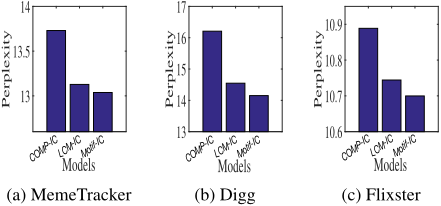
Figure 1 shows the experimental results. For all the three datasets, the proposed Motif-IC model achieves the best performance consistently. Compared with COMP-IC and LCMIC, Motif-IC results in decreases in perplexity by 0▷69 and 0▷09 respectively for MemeTracker, by 2▷06 and 0▷40 for Digg, and by 0▷19 and 0▷04 for Flixster. The optimal number of motifs, k, is found to be 5 for MemeTracker, 5 for Flixster, and 15 for Digg. The basic IC Model has much worse performance and thus the result is not shown in the figure.
4.3 Discussion on the InferredMotifs
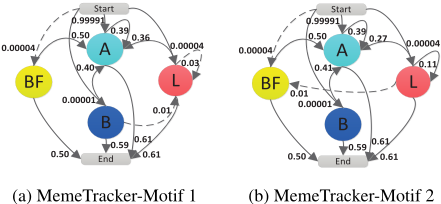
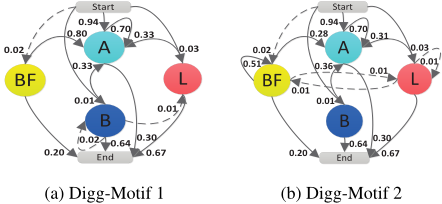
The temporal activation motifs of parent nodes ⇥m inferred from the three datasets are reported in Figures 2, 3 and 4. The roles of Ambassador, Big Fish, Bridge, and Loner are indicated as "A", "BF", "B" and "L" respectively. We show only two motifs with the highest value for their mixing portions due to the page limit.
| Role | Representative websites |
|---|---|
| Ambassador (covering various topics) | news.bbc.co.uk |
| galvestondailynews.com | |
| articlesbase.com | |
| Big Fish | climateark.org |
| waugh.standard.co.uk | |
| (featuring specific domains) | funkmysoul.gr |
| Bridge (news of several domains) | ronsen.org |
| threadden.com | |
| merchantlaw.com | |
| Loner (weblog | humppazoid.blogspot.com |
| matthewkeegan.com | |
| sites) | dpwriters.wordpress.com |
For the Digg and Flixter datasets, the interpretation of the social roles is straight-forward based on the role definitions. For the MemeTracker dataset, Ambassadors are referring to the websites covering various topics (e.g., news.bbc.co.uk a major news media). Big Fish are referring to the websites featuring specific domains (e.g., climateark.org that publishes news about climate). Bridges are referring to the websites covering news of several domains (e.g., merchantlaw.com containing business laws in several practice areas like agriculture law and so on). The weblog sites often turn out to be Loners (e.g., humppazoid.blogspot.com). Some examples can be found in Table 1.
In the following, we provide interpretations on the inferred motifs as diffusion mechanisms:
MemeTracker-Motifs: Referring to Figure 2, we can interpret MemeTracker-Motif 1 as the pattern of first starting with a posting at some famous websites (e.g., major news media) and then following up again by famous websites, with occasional starts at some domain specific websites and then picked up by famous websites afterwards. MemeTrackerMotif 2 is another pattern with some posting interactions among weblogs before it is being picked up by some famous websites. There is the possibility that MemeTrackerMotif 1 accounts for the diffusion of major news, while MemeTracker-Motif 2 accounts for the diffusion of news of some more specific topics which gain momentum of diffusion within the weblogs at the earlier stage.
Digg-Motifs: According to Figure 3, Digg-Motif 1 reveals a pattern that the globally reputable users starting the voting and then followed by also other reputable users, again with occasional starting votes from users of other types and then being followed by reputable users. Digg-Motif 2 refers to a pattern with occasional starts by big fish users and the voting process is retained among the big fish before the reputable users react. So, the first motif may refer to story votings among the circle of reputable users, while the second one may refer to story votings first among big fish users and got spread also to reputable users. A user in principle can respond differently to these different mechanisms.
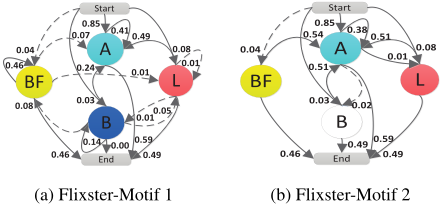
Flixster-Motifs: According to Figure 4, Flixster-Motifs 1 and 2 are more different from those inferred from the other two datasets. In particular, there is a much higher chance of transiting from globally reputable movie lovers to other types of users, and that there is a much higher chance that the movies are kept being evaluated within big fish, bridge, or loner circles. This could be because views on movies are more personal, resulting in more diverse parent activation patterns (instead of globally dominated by some users).
Note that in order to further validate the insights gained from the inferred motifs as discussed, more in-depth analysis and evaluation efforts will be needed. However, we believe that the inferred patterns form new hypotheses which are data-driven and worth further investigation for deepening our understanding on user behaviors and information diffusion in large-scale social networks.
5 Conclusion
In this paper, we proposed a novel motif-based diffusion model for social networks and a corresponding learning algorithm to infer both the latent temporal activation motifs as well as the diffusion model under a unified framework. The empirical results carried out on a number of real-world datasets consistently show that the proposed model achieves a higher modeling accuracy compared with a number of recently proposed models. Also, we have shown how the inferred temporal activation motifs can be interpreted as the underlying interaction mechanisms for the diffusion to happen in different social and information networks.
Possible extensions of this work may include fusing multimodal information in the cascades to infer more informative "colored" motifs. Also, the stochastic motif models can be further extended to increase its representation power. In general, we believe that this work provides a bridge between work of diffusion modeling and motif-based network characterization. Both have been used to support different social science related studies. Bridging them implies that it opens up a number of new opportunities. For instance, it will be interesting to perform careful studies to evaluate how the inferred diffusion specific motifs are related to the different types of events happening in social networks under different topics of concern. In addition, how each user responds to different activation motifs can also be studied to achieve better user characterization and influence maximization.
Acknowledgments
This work was partially supported by Hong Kong Baptist University Strategic Development Fund.
@inproceedings{ijcai2016p517,
  title     = {Inferring Motif-Based Diffusion Models for Social Networks},
  author    = {Bao, Qing and Cheung, William K. and Liu, Jiming},
  booktitle = {Proceedings of the Twenty-Fifth International Joint Conference on
               Artificial Intelligence, {IJCAI-16}},
  publisher = {AAAI Press / International Joint Conferences on Artificial Intelligence},
  editor    = {Subbarao Kambhampati},
  pages     = {3677--3682},
  year      = {2016},
  month     = {7},
  url       = {https://ijcai.org/proceedings/2016/517},
}
TY - CPAPER TI - Inferring Motif-Based Diffusion Models for Social Networks AU - Bao, Qing AU - Cheung, William K. AU - Liu, Jiming T2 - Proceedings of the Twenty-Fifth International Joint Conference on Artificial Intelligence, IJCAI-16 PB - AAAI Press / International Joint Conferences on Artificial Intelligence PY - 2016 SP - 3677 EP - 3682 UR - https://ijcai.org/proceedings/2016/517 ER -Copied
Machine-readable versions of this paper, for tools and AI agents:





