
Logic-Based Inductive Synthesis of Efficient Programs
Proceedings of the Twenty-Fifth International Joint Conference on Artificial Intelligence. Pages 3980-3980.
Abstract
Inductive programming approaches typically rely on an Occamist bias to select hypotheses with minimal textual complexity. This approach, however, fails to distinguish between the efficiencies of hypothesised programs, such as merge sort (O(n log n)) and bubble sort (O(n2)). We address this issue by introducing techniques to learn logic programs with minimal resource complexity. We describe an algorithm proven to learn minimal resource complexity robot strategies, and we propose future work to generalise the approach to a broader class of programs.
- [Ahlgren and Yuen, 2013] John Ahlgren and Shiu Yin Yuen. Effi- cient program synthesis using constraint satisfaction in inductive logic programming. The Journal of Machine Learning Research, 14(1):3649-3682, 2013.
- [Cropper and Muggleton, 2015] Andrew Cropper and Stephen H. Muggleton. Learning efficient logical robot strategies involving composable objects. In IJCAI 2015, pages 3423-3429, 2015. IJCAI
- [Cropper and Muggleton, 2016] Andrew Cropper and Stephen H. Muggleton. Learning higher-order logic programs through ab- straction and invention. In IJCAI 2016, 2016. To appear. IJCAI
- [Eiter et al., 2003] Thomas Eiter, Wolfgang Faber, Nicola Leone, Gerald Pfeifer, and Axel Polleres. Answer set planning under action costs. Journal of Artificial Intelligence Research, pages 25-71, 2003.
- [Laird, 2008] J. E. Laird. Extending the soar cognitive architecture. Frontiers in Artificial Intelligence and Applications, pages 224- 235, 2008.
- [Lin et al., 2014] D. Lin, E. Dechter, K. Ellis, J.B. Tenenbaum, and S.H. Muggleton. Bias reformulation for one-shot function induc- tion. In Proceedings of the 23rd European Conference on Artificial Intelligence (ECAI 2014), pages 525-530, Amsterdam, 2014. IOS Press.
- [Muggleton et al., 2014] S.H. Muggleton, D. Lin, N. Pahlavi, and A. Tamaddoni-Nezhad. Meta-interpretive learning: application to grammatical inference. Machine Learning, 94:25-49, 2014.
- [Muggleton et al., 2015] Stephen H. Muggleton, Dianhuan Lin, and Alireza Tamaddoni-Nezhad. Meta-interpretive learning of higher- order dyadic datalog: predicate invention revisited. Machine Learning, 100(1):49-73, 2015.
- [Xing et al., 2006] Zhao Xing, Yixin Chen, and Weixiong Zhang. Optimal strips planning by maximum satisfiability and accumula- tive learning. In Proceedings of the International Conference on Autonomous Planning and Scheduling (ICAPS), pages 442-446, 2006.
References were extracted automatically from the PDF and may contain errors.
Full text extracted automatically from the PDF; figures, tables and equations may differ. The PDF is the version of record.
1 Introduction
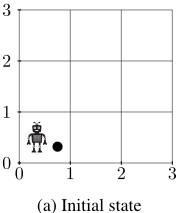
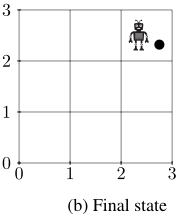
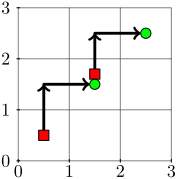
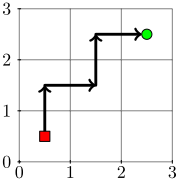
Suppose we are machine learning robot plans from initial/final state examples. Figure 1 shows a scenario where a robot is learning to move a ball from square 1/1 to square 3/3. Assume the robot can move north, south, east, and west, and can grab and drop the ball, then Figure 2 shows two plans with corresponding Prolog programs for this problem. Both programs transform the initial state to the final state and both have the same textual complexity. However, the programs differ in their efficiencies. Program (a) is inefficient because it involves two grab and two drop operations, whereas program (b) is efficient because it requires only one grab and one drop operation.
However, most inductive programming approaches rely on an Occamist bias to select hypotheses with minimal textual complexity and cannot distinguish between the efficiencies of hypothesised programs. Clearly, learning efficient programs
move(X,Y):-p3(X,Z),p3(Z,Y).
p3(X,Y):-p2(X,Z),drop(Z,Y).
p2(X,Y):-grab(X,Z),p1(Z,Y).
p1(X,Y):-north(X,Z),east(Z,Y).
- (a) Inefficient solution
move(X,Y):-p3(X,Z),drop(Z,Y).
p3(X,Y):-grab(X,Z),p2(Z,Y).
p2(X,Y):-p1(X,Z),p1(Z,Y).
p1(X,Y):-north(X,Z),east(Z,Y).
(b) Efficient solution
Figure 2: Prolog programs for the planning example in Figure 1. A red square denotes a grab action and a green circle denotes a drop action.
is valuable in many AI domains. For example, if learning to sort lists, we want to learn an efficient strategy, such as merge sort (O(n log n)), rather than an inefficient strategy, such as bubble sort (O(n2 )), regardless of their respective textual complexities.
We address this issue by introducing techniques to learn minimal resource complexity logic programs. Resource complexity is a generalisation of the notion of time-complexity of algorithms, in which time is a particular resource. Our main contribution, thus far, is the introduction of a framework for minimising the resource complexity of logical robot strategies, and the demonstration of a learning algorithm proven to learn minimal resource complexity robot strategies.
2 Related work
Logic-based learning literature has addressed efficiently learning logic programs [Ahlgren and Yuen, 2013]. Likewise, AI planning literature has addressed developing efficient planners [Xing et al., 2006]. By contrast, we want to learn logic programs which are optimal with respect to an objective function by which the quality of a hypothesis is measured. A common objective function, based on Occam's razor, is the length of the hypothesis, which in planning is often the number of actions required to execute a plan. However, if certain actions are costly, we may prefer a hypothesis which minimises the overall cost of the actions. Action costs have been used in answer set programming to learn optimal plans [Eiter et al., 2003]. By contrast, we want to learn recursive programs, including recursive robot strategies [Cropper and Muggleton, 2015]. In contrast to traditional AI planning, which involves the generation of a plan as a sequence of actions transforming a particular initial state to a particular final state, a strategy is a potentially infinite set of plans, applicable to a class of initial/final state pairs. Although existing approaches support the construction of strategies [Laird, 2008], we are unaware of any approach which provides a provable convergent means for finding optimal strategies, nor of any approach which generalises to the broad class of programs which we propose.
3 Completed work
In [Cropper and Muggleton, 2015], we describe an approach to learn optimal resource complexity robot strategies based on the meta-interpretive learning (MIL) framework [Muggleton et al., 2014; 2015; Cropper and Muggleton, 2016], a form of inductive logic programming which supports predicate invention and learning recursive theories. A strategy is a logic program composed of actions and fluents which transforms an initial state Si to a final state Sj. The resource complexity of a strategy is defined as follows.
Definition 1 Let e = hS1↪ S2i be an example where S1 and S2 are initial/final states respectively and H a strategy. Then the resource complexity r(H(e)) is the sum of the action costs in applying the strategy H to e to transform S1 to S2.
We assume a user-provided function r : Pa ! N which defines the resource cost of calling an action p 2 Pa. In robot strategies, energy consumption and consumption of materials may be considered as resources. We define the resource complexity of a strategy over a set of examples.
Definition 2 Let E+ be a set of positive examples. Then the resource complexity of a strategy H is defined as follows:
To find the minimal resource complexity strategy given a set of examples, we introduced MetagolO, an implementation of the MIL framework which uses iterative descent to find resource optimal strategies. The main idea of iterative descent is to first find the minimal textual complexity strategy H1, which is the most tractable to learn because the hypothesis space is exponential in the solution length [Lin et al., 2014]. The resource complexity r(H1↪ E+) of strategy H1 provides an upper bound from which to descend, i.e. to search for a more efficient strategy with a resource complexity less than H1. In [Cropper and Muggleton, 2015], we prove convergence of this search procedure to resource optimal strategies. Our experimental results agree with the theoretical optimal predictions and show, for instance, that when learning to sort lists, MetagolO learns an efficient quick sort strategy, rather than an inefficient bubble sort strategy.
4 Conclusions and future work
By focusing on robot strategies, we have made an initial attempt at inducing logic programs with optimal resource complexity. We intend to generalise the approach to a broader class of logic programs and non-logic programs.
In [Cropper and Muggleton, 2015], the resource complexity of a hypothesised strategy is maintained in the state description. Each dyadic action has an input state as the first term and an output state as the second term. Executing a dyadic action increments the resource cost in the input state to form the output state. However, predicates in logic programs do not not necessarily have input and output arguments, for instance when learning a monadic predicate. Therefore, to generalise the approach to arbitrary logic programs, we need a more general representation to calculate the resource complexity.
In addition, we have assumed a user-provided function to assign resource costs to each robot action. However, such information is not necessarily available and in future work we intend to investigate whether we can learn efficient timecomplexity algorithms without user-provided costs.
We believe that the ideas proposed in this paper open exciting avenues in the emerging field of program synthesis, applicable to variety of AI domains. We also believe that this work raises the potential of discovering novel algorithms which are more efficient than existing ones.
@inproceedings{ijcai2016p564,
  title     = {Logic-Based Inductive Synthesis of Efficient Programs},
  author    = {Cropper, Andrew},
  booktitle = {Proceedings of the Twenty-Fifth International Joint Conference on
               Artificial Intelligence, {IJCAI-16}},
  publisher = {AAAI Press / International Joint Conferences on Artificial Intelligence},
  editor    = {Subbarao Kambhampati},
  pages     = {3980--3980},
  year      = {2016},
  month     = {7},
  url       = {https://ijcai.org/proceedings/2016/564},
}
TY - CPAPER TI - Logic-Based Inductive Synthesis of Efficient Programs AU - Cropper, Andrew T2 - Proceedings of the Twenty-Fifth International Joint Conference on Artificial Intelligence, IJCAI-16 PB - AAAI Press / International Joint Conferences on Artificial Intelligence PY - 2016 SP - 3980 EP - 3980 UR - https://ijcai.org/proceedings/2016/564 ER -Copied
Machine-readable versions of this paper, for tools and AI agents:





