
On Ranking and Choice Models
Proceedings of the Twenty-Fifth International Joint Conference on Artificial Intelligence. Pages 4050-4052.
Abstract
In today's big data era, huge amounts of ranking and choice data are generated on a daily basis, and consequently, many powerful new computational tools for dealing with ranking and choice data have emerged in recent years. This paper highlights recent developments in two areas of ranking and choice modeling that cross traditional boundaries and are of multidisciplinary interest: ranking from pairwise comparisons, and automatic discovery of latent categories from choice survey data.
- [Agarwal and Saha, 2016] S. Agarwal and A. Saha. Automatic dis- covery of categories from choice data. Forthcoming, 2016.
- [Bradley and Terry, 1952] R. A. Bradley and M. E. Terry. Rank analysis of incomplete block designs: I. The method of paired comparisons. Biometrika, pages 324-345, 1952.
- [Brandt et al., 2016] F. Brandt, M. Brill, and P. Harrenstein. Tour- nament solutions. In Handbook of Computational Social Choice. Cambridge University Press. Forthcoming, 2016.
- [Braverman and Mossel, 2008] M. Braverman and E. Mossel. Noisy sorting without resampling. In SODA, 2008.
- [Busa-Fekete and Hüllermeier, 2014] R. Busa-Fekete and E. Hüllermeier. A survey of preference-based online learn- ing with bandit algorithms. In ALT, 2014.
- [Keener, 1993] J. P. Keener. The Perron-Frobenius theorem and the ranking of football teams. SIAM Review, 35(1):80-93, 1993.
- [Kendall, 1955] Maurice G. Kendall. Further contributions to the theory of paired comparisons. Biometrics, 11(1):43-62, 1955.
- [Luce, 1959] R. D. Luce. Individual Choice Behavior: A Theoreti- cal Analysis. Wiley, 1959.
- [Marden, 1995] J. I. Marden. Analyzing and Modeling Rank Data. Chapman & Hall, 1995.
- [McFadden, 1974] D. McFadden. Conditional logit analysis of qualitative choice behavior. In P. Zarembka, editor, Frontiers in Econometrics, pages 105-142. Academic Press, 1974.
- [Moulin, 1986] H. Moulin. Choosing from a tournament. Social Choice and Welfare, 3(4):271-291, 1986.
- [Negahban et al., 2012] S. Negahban, S. Oh, and D. Shah. Iterative ranking from pair-wise comparisons. In NIPS, 2012.
- [Rajkumar and Agarwal, 2014] A. Rajkumar and S. Agarwal. A statistical convergence perspective of algorithms for rank aggre- gation from pairwise data. In ICML, 2014.
- [Rajkumar and Agarwal, 2016a] A. Rajkumar and S. Agarwal. Ranking from pairwise comparisons: The role of the pairwise preference matrix. Forthcoming, 2016.
- [Rajkumar and Agarwal, 2016b] A. Rajkumar and S. Agarwal. When can we rank well from comparisons of O(n log n) non- actively chosen pairs? Forthcoming, 2016.
- [Rajkumar et al., 2015] A. Rajkumar, S. Ghoshal, L.-H. Lim, and S. Agarwal. Ranking from stochastic pairwise preferences: Re- covering Condorcet winners and tournament solution sets at the top. In ICML, 2015.
- [Wauthier et al., 2013] F. L. Wauthier, M. I. Jordan, and N. Jojic. Efficient ranking from pairwise comparisons. In ICML, 2013.
References were extracted automatically from the PDF and may contain errors.
Full text extracted automatically from the PDF; figures, tables and equations may differ. The PDF is the version of record.
1 Introduction
In today's big data era, huge amounts of data are generated in the form of rankings and choices on a daily basis: restaurant ratings, product choices, employer ratings, hospital rankings, and so on. Given the increasing universality of such ranking and choice data, many powerful new computational tools for dealing with such data have emerged over the last few years in areas related to AI, including in particular machine learning, statistics, operations research, and computational social choice. Here we briefly highlight such developments in two broad areas: ranking from pairwise comparisons, and automatic discovery of latent categories from choice data.
As is well known, humans generally find it easier to express preferences in the form of comparisons between two items, rather than directly ranking a large number of items. Indeed, in many domains, one is given outcomes of pairwise comparisons among some set of items (such as movies, candidates in an election, or sports teams), and must estimate a ranking of all the items from these observed pairwise comparisons. Due to the ubiquitous nature of the problem, several different algorithms have been developed for ranking from pairwise comparisons in different communities, including e.g. maximum likelihood estimation methods [Bradley and Terry, 1952; Luce, 1959], spectral ranking methods [Kendall, 1955; Keener, 1993; Negahban et al., 2012], noisy sorting methods [Braverman and Mossel, 2008], and many others; however, little has been understood about when one algorithm should be preferred over another. In the first part of the paper (Section 2), we discuss recent developments in understanding these issues, including understanding the conditions under which different ranking algorithms succeed or fail, and how to design new algorithms for ranking form pairwise comparisons that achieve desirable goals under various conditions [Rajkumar and Agarwal, 2014; 2016a; Rajkumar et al., 2015; Rajkumar and Agarwal, 2016b].
In marketing, when presenting products to users in a store or on a website, it is important to categorize related products together so that users can quickly find what they are looking for. These categories should ideally be based on how users themselves make choices, so that products that tend to be liked or disliked together are grouped together. In the second part of the paper (Section 3), we describe a new approach for automatic discovery of categories from choice data, which brings together ideas from random utility choice models and topic models in order to automatically discover latent categories from choice survey data [Agarwal and Saha, 2016].
2 Ranking fromPairwise Comparisons
Ranking from pairwise comparisons is a ubiquitous problem that arises in a variety of applications. The basic types of questions of interest here are the following: Say there are n items, denoted [n] = ¶1↪ ▷ ▷ ▷ ↪ n♦, and we observe the outcomes of a number of pairwise comparisons among them (such as pairwise preferences among movies, pairwise judgments among job candidates, or pairwise game outcomes among sports teams). Based on these pairwise comparisons, can we find a good ranking of the n items, or identify a 'best' item or a 'good' set of items among them? How many comparisons do we need? What sorts of algorithms can we use? Under what conditions do these algorithms succeed?
A natural statistical framework for analyzing such questions assumes that for each pair of items (i↪ j), there is an underlying pairwise preference probability Pij 2 [0↪ 1] such that whenever items i and j are compared, item i beats item j with probability Pij and j beats i with probability Pji = 1 - Pij . Collectively, these pairwise preference probabilities form an underlying pairwise preference matrix P 2 [0↪ 1]n⇥n (with Pii = 12 8i). Different statistical models for pairwise comparisons lead to different conditions on P. For example, if the pairwise preference probabilities follow the wellknown Bradley-Terry-Luce (BTL) statistical model for pairwise comparisons, then there is a score vector w 2 Rn++ such that Pij = wi wi+wj 8i↪ j [Bradley and Terry, 1952; Luce, 1959]; if they follow the 'noisy permutation' (NP)
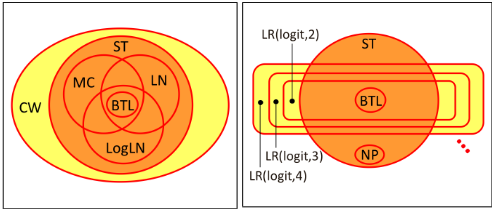
| Condition on P | Property satisfied by P |
|---|---|
| Bradley-Terry-Luce (BTL) | 9w 2 Rn++ : Pij = wi wi+wj |
| Low-noise (LN) | Pij > 12 ) Pik > Pjk |
| Logarithmic LN (LogLN) | Pk Pk Pij > 12 ) ln( Pik Pki ) > Pk ln( Pjk Pkj ) |
| Markov consistency (MC) | Pk Pij > 12 ) ⇡i > ⇡j |
| Stochastic transitivity (ST) | Pij > 12 ↪ Pjk > 12 )Pik > 12 |
| Condorcet winner (CW) | 9i : Pij > 12 8j 6= i |
| Noisy permutation (NP) | 9σ 2 Sn↪ p < 12 : Pij = n 1-p if i ≻σ j p otherwise |
| Low rank (LR( ↪ r)) | rank( (P)) r ( : [0↪ 1]!R↪ r 2 [n]) |
model, then there is a permutation σ 2 Sn and noise parameter p 2 [0↪ 12 ) such that 8i 6= j, Pij = 1 - p if σ(i) < σ(j) (which we also denote as i ≻σ j), and Pij = p otherwise [Braverman and Mossel, 2008; Wauthier et al., 2013]. Several other conditions on P are also of interest: see Figure 1.
One of our goals in recent work has been to understand how the matrix of underlying pairwise probabilities P affects the ranking goals that can be achieved, the success of different algorithms in achieving those goals, and the number of pairwise comparisons that are needed. We focus here mostly on settings where item pairs to be compared are selected randomly (or fixed in advance), but similar concerns also apply when pairs to be compared are selected in an active fashion. 1
As it turns out, the matrix P plays a huge role in determining the success of different algorithms for ranking from pairwise comparisons. For example, spectral ranking algorithms such as Rank Centrality perform well when P satisfies the BTL condition or the slightly more general Markov consistency (MC) condition, but can fail miserably under more general settings of P; indeed, if P is known only to satisfy stochastic transitivity (ST), then using an SVMbased ranking algorithm or a topological sort based algorithm can be a better choice [Rajkumar and Agarwal, 2014; 2016a]. If P does not satisfy ST, then all these algorithms fail to even recover a good set of items at the top, but one can use other algorithms for this purpose [Rajkumar et al., 2015]. When comparisons can be made among only O(n log n) nonactively sampled pairs, then under suitable conditions on P, one can use algorithms based on low-rank matrix completion [Rajkumar and Agarwal, 2016b]. Below we summarize some of these findings and give pointers for further investigation.
2.1 Finding an Optimal Ranking
Let us start by considering the setting where all (n2 ) pairs are compared a fixed number of times, say K times each. 2
1 The literature on dueling bandits provides a nice entry point for understanding similar issues when item pairs are allowed to be actively selected; e.g. see [Busa-Fekete and H¨ullermeier, 2014] for a recent survey.
2 The results we discuss in this setting also extend to settings where for each pairwise comparison to be made, a pair of items to be compared is selected randomly and independently according to some probability distribution θ 2 ∆([n] 2 ) with θij > 0 8i < j (see
[Rajkumar and Agarwal, 2014] for details); we consider the basic
Thus the input pairwise comparison data here is of the form ¶y1 ij ↪ ▷ ▷ ▷ ↪ yK ij ♦i<j , with yk ij = 1 denoting that the k-th comparison between i and j resulted in i beating j, and yk ij = 0 denoting the reverse; under the statistical model discussed above, each comparison outcome yk ij is a random draw from a Bernoulli random variable with parameter Pij. Given this pairwise comparison data, consider the goal of finding a good σ 2 Sn.
ranking or permutation of the n items, b A natural measure of the quality of a permutation σ is its pairwise disagreement error w.r.t. the underlying pairwise preference probabilities P:
An optimal ranking or permutation σ⇤ is then one that minimizes this pairwise disagreement error:
Under what conditions on P can we find an optimal ranking from the observed pairwise comparison data? Clearly, as the number of comparisons K per pair increases, we expect to be able to construct increasingly accurate estimates of P. Which ranking algorithms have the property that as K increases, the rankings they produce approach an optimal ranking?
In recent work [Rajkumar and Agarwal, 2014; 2016b], we show that if the underlying pairwise probabilities P satisfy the LN condition, then both the simple matrix Borda algorithm and the popular method of maximum likelihood estimation under a BTL model succeed in recovering (with high probability) an optimal ranking (for sufficiently large K); if P satisfies the LogLN condition, then the least squares ranking algorithm succeeds in recovering such an optimal ranking; and if P satisfies the MC condition, then the Rank Centrality algorithm recovers an optimal ranking. Outside these conditions on P, however, all these algorithms can fail miserably. We also give alternative algorithms for ranking from pairwise comparisons, including an SVM-based ranking algorithm and a topological sort based algorithm, that provably recover an optimal ranking from pairwise comparisons under more general P satisfying only stochastic transitivity. See Table 1 for a summary, and [Rajkumar and Agarwal, 2014; 2016a] for further details.
setting here, with all (n2 ) pairs compared K times, for simplicity.
| Ranking Algorithm | Finds optimal ranking? | Finds Condorcet winner? | Finds top cycle? | Finds Copeland | ||||
|---|---|---|---|---|---|---|---|---|
| BTL | LN | LogLN | MC | ST | set? | |||
| Matrix Borda | X | X | ⇥ | ⇥ | ⇥ | ⇥ | ⇥ | ⇥ |
| BTL-MLE | X | X | ⇥ | ⇥ | ⇥ | ⇥ | ⇥ | ⇥ |
| Least Squares Ranking | X | ⇥ | X | ⇥ | ⇥ | ⇥ | ⇥ | ⇥ |
| Rank Centrality | X | ⇥ | ⇥ | X | ⇥ | ⇥ | ⇥ | ⇥ |
| SVM-Based Ranking | X | X | X | X | X | ⇥ | ⇥ | ⇥ |
| Topological Sort | X | X | X | X | X | ⇥ | ⇥ | ⇥ |
| Matrix Copeland | X | X | X | X | X | X | X | X |
In general, when P does not satisfy ST, finding an optimal ranking is hard even under exact knowledge of P; indeed, this corresponds to the minimum weighted feedback arc set (MWFAS) problem, which is known to be NP-hard. 3 In such cases, one may still like to be able to find a ranking that places 'good' items at the top; we discuss this next.
2.2 Finding Good Items at the Top
As discussed above, when the underlying pairwise probabilities P do not satisfy stochastic transitivity, then even under exact knowledge of P, finding an optimal ranking of all n items as above is NP-hard. In such settings, it is natural to ask that an algorithm return a ranking that places 'good' items at the top. For example, when P admits a Condorcet winner (an item that beats each other item with probability greater than half), it is natural to ask this item be placed at the top. More generally, when there is no Condorcet winner, one can consider various notions of tournament solutions, each of which gives a different way to define sets of winners in a tournament with cycles [Moulin, 1986; Brandt et al., 2016], and ask that the items in the corresponding tournament solution be ranked at the top. For example, the top cycle is the smallest set of items W ✓ [n] for which each item in the set beats each item outside the set with probability greater than half (i.e. for which Pij > 12 8i 2 W↪ j ◁2 W); the Copeland set is the set of items C ✓ [n] that beat the largest number of items with probability greater than half (i.e. C = argmaxi Pj 1(Pij > 12 )); and so on.
As we showed recently [Rajkumar et al., 2015], when the underlying preference probabilities P do not satisfy ST, most commonly used algorithms for ranking from pairwise comparisons are unable to find even the Condorcet winner when it exists, and more generally, fail to rank items in various natural tournament solutions at the top (see Table 1). However, it is possible to design ranking algorithms that do find such tournament solutions at the top. For example, given enough pairwise comparisons (i.e. for large enough K), the Matrix Copeland algorithm successfully places both the top cycle and the Copeland set at the top (Table 1). 4 See [Rajkumar et al., 2015] for further examples and discussion.
3 When P satisfies ST, the graph induced by P is acyclic, and in this case the MWFAS problem under knowledge of P is easy.
4 The Copeland set is always a subset of the top cycle.
| Ranking Algorithm | Condition for Performance Guarantee |
|---|---|
| Rank Centrality | BTL |
| Balanced Rank Estimation | NP |
| Low-Rank Pairwise Ranking | LR( ↪ r) \ ST |
2.3 Ranking fromComparisons of O(n logn) Pairs
The above discussion focused on the setting when all (n2 ) pairs can be compared. However, when n is large, comparing all pairs is impractical. A natural question that arises then is: Under what conditions on P can we find a good ranking from comparisons of only O(n logn) (randomly sampled) pairs? Previous work has shown this is possible under the BTL condition via the Rank Centrality algorithm [Negahban et al., 2012] and under the NP condition via the Balanced Rank Estimation algorithm [Wauthier et al., 2013]; in recent work, we show that this is in fact possible under a broader family of 'low-rank' conditions (which includes the BTL condition as a special case, but is considerably more general; see Figure 1), via a low-rank matrix completion based algorithm that we call Low-Rank Pairwise Ranking. See Table 2 for a summary, and [Rajkumar and Agarwal, 2016b] for further details.
3 Discovery of Categories fromChoice Data
Consider now a marketing situation with n items or products, which need to be grouped into categories based on their being liked (or disliked) together. Say we have choice survey data from M users, in which each user m is shown some subset of items Sm ✓ [n] and is asked to indicate his or her preferences among these items, e.g. by indicating his or her top few choices in the set, or by assigning a rating (say 1-5) to each item in the set. Can we automatically discover meaningful categories from such choice data?
Suppose there are K unknown categories to be discovered. We model each category k via a random utility model (RUM) that associates n random variables Xk1↪ ▷ ▷ ▷ ↪Xkn with the n items. In order to allow different users to have different preferences among these categories, we posit that each user m has a hidden preference vector ✓m 2 ∆K indicating his or her preferences among the K categories. We then posit a generative model for the observed choice data, whose parameters are the parameters of the K RUMs (i.e. parameters of the distributions of Xki), as well as parameters of a shared Dirichlet prior on the preference vectors ✓m; given the observed choice data, we then fit these parameters to the data using a variational expectation-maximization procedure.

Under our generative model, given a set of items Sm ✓ [n], user m picks her first choice as follows: she draws a category k1 according to her preference vector ✓m, then draws utility values x1i for all items i 2 Sm according to ¶Xk1↪i : i 2 Sm♦ and picks an item with the highest drawn utility: i1 2 argmaxi2Sm x1i . Having picked her first choice i1, in order to pick her second choice, she draws a category k2 according to ✓m, then draws utility values x2i for all items i in Sm except the previously chosen item i1 according to ¶Xk2↪i : i 2 Sm ∩ ¶i1♦♦, and then picks an item i2 2 argmaxi2Sm∩¶i1♦ x2i . This process is repeated until the desired number of choices have been made. To model ratings data, which can be viewed as partial ranking data, we average over all choices that are consistent with the observed ratings.
As one example, Figure 2 shows the results obtained by applying our method to sports choice survey data in which 253 respondents each rated 7 sports on a scale of 1-5 based on how much they enjoyed each sport. 5 As can be seen, the method accurately discovers two categories corresponding to individual and team sports, and identifies a third category for jogging; this is consistent with previous studies that have found that people tend to have strong likes or dislikes for jogging independent of their liking for other sports [Marden, 1995]. Further examples and details can be found in [Agarwal and Saha, 2016].
4 Conclusion
Given the increasing availability of ranking and choice data, there is considerable need for new and innovative computational approaches to ranking and choice modeling. In this brief paper, we have highlighted some recent developments in ranking from pairwise comparisons and in automatic discovery of categories from choice data. There are many fascinating questions that remain open, and ranking and choice models will likely continue to be active areas of research in AI and related fields for many years to come.
5 Here we modeled each category via a multinomial logit choice model, which corresponds to taking Xki to be independent Gumbel random variables [McFadden, 1974].
Acknowledgments
Parts of the work described here are joint with Arun Rajkumar, Suprovat Ghoshal, Lek-Heng Lim, and Aadirupa Saha. Parts of this work have been supported by a Ramanujan Fellowship from DST; an Indo-US Joint Center Award from the Indo-US Science & Technology Forum; and the William & Flora Hewlett Foundation Fellowship at the Radcliffe Institute for Advanced Study, Harvard University.
@inproceedings{ijcai2016p598,
  title     = {On Ranking and Choice Models},
  author    = {Agarwal, Shivani},
  booktitle = {Proceedings of the Twenty-Fifth International Joint Conference on
               Artificial Intelligence, {IJCAI-16}},
  publisher = {AAAI Press / International Joint Conferences on Artificial Intelligence},
  editor    = {Subbarao Kambhampati},
  pages     = {4050--4052},
  year      = {2016},
  month     = {7},
  url       = {https://ijcai.org/proceedings/2016/598},
}
TY - CPAPER TI - On Ranking and Choice Models AU - Agarwal, Shivani T2 - Proceedings of the Twenty-Fifth International Joint Conference on Artificial Intelligence, IJCAI-16 PB - AAAI Press / International Joint Conferences on Artificial Intelligence PY - 2016 SP - 4050 EP - 4052 UR - https://ijcai.org/proceedings/2016/598 ER -Copied
Machine-readable versions of this paper, for tools and AI agents:





