
Detecting Student Emotions in Computer-Enabled Classrooms
Proceedings of the Twenty-Fifth International Joint Conference on Artificial Intelligence. Pages 4125-4128.
Abstract
Affect detection is a key component of intelligent educational interfaces that can respond to the affective states of students. We use computer vision, learning analytics, and machine learning to detect students' affect in the real-world environment of a school computer lab that contained as many as thirty students at a time. Students moved around, gestured, and talked to each other, making the task quite difficult. Despite these challenges, we were moderately successful at detecting boredom, confusion, delight, frustration, and engaged concentration in a manner that generalized across students, time, and demographics. Our model was applicable 98% of the time despite operating on noisy real-world data.
- [Arroyo et al., 2009] Arroyo, I., Cooper, D. G., Burleson, W., Woolf, B. P., Muldner, K., & Christopherson, R. (2009). Emotion sensors go to school. In V. Dimitrova, R. Mizoguchi, B. Du Boulay, & A. Graesser (Eds.), Pro- ceedings of the 14th International Conference on Artifi- cial Intelligence in Education (Vol. 200, pp. 17-24). IOS Press.
- [Bosch, 2015] Bosch, N. (2015). Multimodal affect detec- tion in the wild: Accuracy, availability, and generaliza- bility. In Proceedings of the 17th International Confer- ence on Multimodal Interaction (ICMI 2015 doctoral consortium) (pp. 645-649). New York, NY: ACM.
- [Bosch, Chen, Baker, Shute, & D'Mello, 2015] Bosch, N., Chen, H., Baker, R., Shute, V., & D'Mello, S. (2015). Accuracy vs. availability heuristic in multimodal affect detection in the wild. In Proceedings of the 17th Interna- tional Conference on Multimodal Interaction (ICMI 2015) (pp. 267-274). New York, NY: ACM. .50 .60 .70 .80 .90
- 00 Face Interaction Multimodal Mean AUC Availability [
- [Bosch, Chen, & D'Mello, 2014] Bosch, N., Chen, Y., & D'Mello, S. (2014). It's written on your face: detecting affective states from facial expressions while learning computer programming. In S. Trausan-Matu, K. E. Boy- er, M. Crosby, & K. Panourgia (Eds.), Proceedings of the 12th International Conference on Intelligent Tutor- ing Systems (ITS 2014) (pp. 39-44). Switzerland: Springer International Publishing.
- [Calvo & D'Mello, 2010] Calvo, R. A., & D'Mello, S. (2010). Affect detection: An interdisciplinary review of models, methods, and their applications. IEEE Transac- tions on Affective Computing, 1(1), 18-37.
- [Calvo & D'Mello, 2011] Calvo, R. A., & D'Mello, S. K. (2011). New perspectives on affect and learning tech- nologies. New York, NY: Springer.
- [D'Mello, 2013] D'Mello, S. (2013). A selective meta- analysis on the relative incidence of discrete affective states during learning with technology. Journal of Edu- cational Psychology, 105(4), 1082-1099.
- [D'Mello, Blanchard, Baker, Ocumpaugh, & Brawner, 2014] D'Mello, S., Blanchard, N., Baker, R., Oc- umpaugh, J., & Brawner, K. (2014). I feel your pain: A selective review of affect-sensitive instructional strate- gies. In R. Sottilare, A. Graesser, X. Hu, & B. Goldberg (Eds.), Design Recommendations for Intelligent Tutoring Systems -Volume 2: Instructional Management (pp. 35- 48).
- [Ekman, Freisen, & Ancoli, 1980] Ekman, P., Freisen, W. V., & Ancoli, S. (1980). Facial signs of emotional expe- rience. Journal of Personality and Social Psychology, 39(6), 1125-1134.
- [Ekman & Friesen, 1978] Ekman, P., & Friesen, W. V. (1978). Facial action coding system. Consulting Psy- chologist Press, Palo Alto, CA.
- [Jeni, Cohn, & de la Torre, 2013] Jeni, L. A., Cohn, J. F., & de la Torre, F. (2013). Facing imbalanced data- Recommendations for the use of performance metrics. In Proceedings of the 5th International Conference on Af- fective Computing and Intelligent Interaction (pp. 245- 251).
- [Kai et al., 2015] Kai, S., Paquette, L., Baker, R., Bosch, N., D'Mello, S., Ocumpaugh, J., … Ventura, M. (2015). Comparison of face-based and interaction-based affect detectors in physics playground. In C. Romero, M. Pechenizkiy, J. Boticario, & O. Santos (Eds.), Proceed- ings of the 8th International Conference on Educational Data Mining (EDM 2015) (pp. 77-84). International Ed- ucational Data Mining Society.
- [Kapoor, Burleson, & Picard, 2007] Kapoor, A., Burleson, W., & Picard, R. W. (2007). Automatic prediction of frustration. International Journal of Human-Computer Studies, 65(8), 724-736.
- [Kononenko, 1994] Kononenko, I. (1994). Estimating at- tributes: Analysis and extensions of RELIEF. In F. Bergadano & L. D. Raedt (Eds.), Machine Learning: ECML-94 (pp. 171-182). Berlin Heidelberg: Springer.
- [Lepper, Woolverton, Mumme, & Gurtner, 1993] Lepper, M. R., Woolverton, M., Mumme, D. L., & Gurtner, J. (1993). Motivational techniques of expert human tutors: Lessons for the design of computer-based tutors. Com- puters as Cognitive Tools, 1993, 75-105.
- [Littlewort et al., 2011] Littlewort, G., Whitehill, J., Wu, T., Fasel, I., Frank, M., Movellan, J., & Bartlett, M. (2011). The computer expression recognition toolbox (CERT). In 2011 IEEE International Conference on Automatic Face Gesture Recognition and Workshops (FG 2011) (pp. 298-305).
- Monkaresi, Bosch, Calvo, & D'Mello, in press] Monkaresi, H., Bosch, N., Calvo, R. A., & D'Mello, S. K. (in press). Automated detection of engagement using video-based estimation of facial expressions and heart rate. IEEE Transactions on Affective Computing.
- [Ocumpaugh, Baker, & Rodrigo, 2015] Ocumpaugh, J., Baker, R., & Rodrigo, M. M. T. (2015). Baker Rodrigo Ocumpaugh Monitoring Protocol (BROMP) 2.0 Tech- nical and Training Manual. In Technical Report. New York, NY: Teachers College, Columbia University. Ma- nila, Philippines: Ateneo Laboratory for the Learning Sciences.
- [Shute, Ventura, & Kim, 2013] Shute, V. J., Ventura, M., & Kim, Y. J. (2013). Assessment and learning of qualita- tive physics in Newton's Playground. The Journal of Educational Research, 106(6), 423-430.
- [Whitehill, Serpell, Lin, Foster, & Movellan, 2014] Whitehill, J., Serpell, Z., Lin, Y.-C., Foster, A., & Movellan, J. R. (2014). The faces of engagement: Auto- matic recognition of student engagement from facial ex- pressions. IEEE Transactions on Affective Computing, 5(1), 86-98.
- [Witten & Frank, 2000] Witten, I. H., & Frank, E. (2000). Data Mining: Practical machine learning tools and techniques. San Francisco, CA: Morgan Kaufmann.
References were extracted automatically from the PDF and may contain errors.
Full text extracted automatically from the PDF; figures, tables and equations may differ. The PDF is the version of record.
1 Introduction
Learning with educational interfaces elicits a range of affective states that can have both positive and negative connections to learning [D'Mello, 2013]. A human teacher or tutor can observe students' affect in a classroom or one-on-one tutoring situation and use that information to determine when help is needed to adjust the pace or content of learning materials [Lepper, Woolverton, Mumme, & Gurtner, 1993]. However, computerized learning environments rarely consider student affect in selecting instructional strategies - a particularly critical omission given the central role of affect in learning [Calvo & D'Mello, 2011].
We believe that next-generation intelligent learning technologies should have some mechanism to respond to the affective states of students, whether by providing encouragement, altering materials to better suit the student, or redirecting the student to a different task when he/she becomes disengaged. Although some initial progress has been made in laboratory settings (see [D'Mello, Blanchard, Baker, Ocumpaugh, & Brawner, 2014] for a recent review), much work remains before affect-sensitive learning interfaces can be fielded at scale in the wild. A core challenge is the ability to detect student affect in real-world learning settings, which
Valerie Shute, Matthew Ventura, Lubin Wang, Weinan Zhao
Florida State University, Tallahassee, FL {vshute, mventura, lw10e}@fsu.edu, weinan.zhao@gmail.com
we address in this work by detecting the affective states that students naturally experience while interacting with an educational game in a computer-enabled classroom.
We focus on detecting the affective states that are common during interactions with technology, namely boredom, confusion, engagement/flow, frustration, happiness/delight, and anxiety [D'Mello, 2013]. We adapt a multimodal approach, combining facial features (primary) and interaction patterns (secondary). Facial features have long been linked to affect [Ekman, Freisen, & Ancoli, 1980], but are not robust for affect detection in the wild due to occlusion, movement, and lighting issues frequently encountered in computer-enabled classrooms. Interaction patterns are derived from logs of the student's actions within the learning environment, and are thus less vulnerable to these factors. A multimodal approach is thus expected to capitalize on each approach's benefits while mitigating their weaknesses.
We address several unique challenges of learningcentered affect detection in the wild: 1) detecting naturalistic (as opposed to acted) affective states in a relatively uncontrolled group setting (classroom); 2) testing generalization of these detectors across time and student demographics; and 3) exploring a tradeoff between more accurate affect detectors and those that are more robust to data availability issues that arise in the wild.
1.1 Related Work
Drawing from the ample body of research on affect detection [Calvo & D'Mello, 2010] we review key studies on affect detection with facial and multimodal features.
In one classic study, Kapoor et al. [2007] used multimodal data channels including facial features, a posture-sensing chair, a pressure-sensitive mouse, skin conductance, and interaction log-files to predict frustration while students interacted with an automated learning companion. They were able to predict when a student would self-report frustration with 79% accuracy, an improvement of 21% over chance.
Whitehill et al. [2014] used facial features to detect engagement as students interacted with cognitive skills training software. They were able to detect engagement with an average area under the ROC curve (AUC) of .729 (AUC of .5 represents chance-level detection). More recently, Monkaresi et al. [in press] used facial features and heart rate estimated from face videos to detect engagement during writing. They achieved an AUC of .758, which we could consider to be state-of-the-art.
Bosch et al. [2014] built detectors of novice programming students' affective states using facial features (action units, or AUs [Ekman & Friesen, 1978]) estimated by the Computer Expression Recognition Toolbox (CERT) [Littlewort et al., 2011]. They were able to detect confusion and frustration at levels above chance (22.1% and 23.2% better than chance, respectively), but accuracy was much lower for other states (11.2% above chance for engagement, 3.8% above chance for boredom).
Perhaps the study most relevant to the current work is [Arroyo et al., 2009]. The authors tracked emotions of high school and college mathematics students using both interaction features from log-files and facial features. Their best models explained 52% of the variance (R 2 ) for confidence, 46% for frustration, 69% for excitement, and 29% for interest. However, these results should be interpreted with a modicum of caution, because the models were not crossvalidated with a separate testing set, The dataset was also limited in size with as few as 20-36 instances in some cases, raising concerns of overfitting.
In summary, despite active research on affect detection, there is a paucity of research on learning-centered affect detection with naturalistic facial expressions in the wild. The present study addresses this challenge, and explores the generalizability of face-based affect detectors and the advantage afforded by a multimodal combination of face- and interaction- based affect detection.
2 Method
2.1 Data Collection
The sample consisted of 137 8 th and 9 th grade students (57 male, 80 female) enrolled in a public school in the Southeastern U.S. The study took place in one of the school's computer-enabled classroom, which was equipped with about 30 desktop computers for schoolwork. Inexpensive webcams ($30) were mounted to the top of each computer monitor.
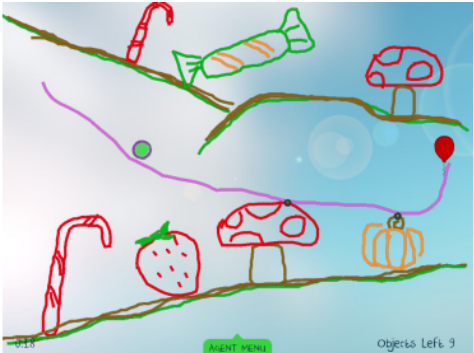
The main learning activity consisted of students interacting with the educational game Physics Playground [Shute, Ventura, & Kim, 2013] in groups of about 20 in 55 minute class periods over four days (data from two days is used here). Physics Playground is a two-dimensional game that requires the player to apply principles of Newtonian Physics in an attempt to guide a green ball to a red balloon in many challenging configurations (key goal). The primary way to move the ball is to draw simple machines (ramps, pendulums, levers, and springboards) on the screen that -come to life‖ once drawn (example in Fig. 1).
Students' affective states were observed during their interactions with Physics Playground using the Baker-Rodrigo Observation Method Protocol (BROMP) field observation system [Ocumpaugh, Baker, & Rodrigo, 2015]. These observations served as affect labels for training detectors. In BROMP, trained observers use side glances to make a holistic judgment of students' affect based on facial expressions, speech, posture, gestures, and interaction with the game (e.g., whether a student is progressing or struggling). We obtained 1,767 affect observations during the two days of data used in this study. The most common affective state observed was engagement (77.6%), followed by frustration (13.5%), boredom (4.3%), delight (2.3%), and confusion (2.3%).
2.2 Model Building
Video-based Features. We used FACET 1 , a commercialized version of CERT (see above), to estimate the likelihood of the presence of 19 AUs as well as head pose (orientation) and head position. Gross body movement was also estimated by the proportion of pixels in each video frame that differed from a constantly updated background image. Features were created by aggregating AUs, orientation, position, and body movement estimates in a window of time (3, 6, 9, 12, or 20 seconds) leading up to each BROMP observation using maximum, median, and standard deviation for aggregation. Feature selection was applied to obtain a sparser set of features for classification. RELIEF-F [Kononenko, 1994] was run on the training data in order to rank features and a set of the highest ranked features were then used in the models.
About a third (34%) of the instances were discarded because FACET was not able to register the face, and thus could not estimate the presence of AUs. Poor lighting, extreme head pose or position, occlusions from hand-to-face gestures, and rapid movements can all cause face registration errors; these issues were not uncommon due to the nature of the game and the active behaviors of the young students in this study.
1 Currently available as Emotient Module from iMotions (https://imotions.com)
Supervised Learning. We built separate detectors for each affective state, which allowed the parameters (e.g., window size, features used) to be optimized for that particular affective state. A two-class approach was used for each affective state, where that affective state was discriminated from all others (e.g., confusion vs. all other). We experimented with supervised classifiers including C4.5 trees and Bayesian classifiers, using WEKA [Witten & Frank, 2000].
Models were cross-validated at the student level. Data from 66% of randomly-chosen students were used to train each classifier and the remaining students' data were used to test its performance. Each model was trained and tested over 150 iterations. The students in the training and testing data for each iteration were chosen randomly with replacement to amortize random sampling errors. This approach ensures that the models are generalizable to new students since training and testing data sets are student-independent.
The affective distributions led to large class imbalances (e.g., .04 vs. .96 priors in the boredom vs. all other classification). Majority-class downsampling and synthetic oversampling were used to equalize base rates in the training data to help combat this disadvantage.
3 Results
Baseline Results. The best results for baseline face-based affect detection (student-level cross-validation) are presented in Table 1. The number of instances refers to the total number of instances used to train the model, including negative examples. This number varied based on the window size because shorter windows represent fewer video frames, and thus have a lower probability of containing valid video data.
Accuracy (recognition rate) is not an ideal metric for evaluation when base rates are highly skewed, as they were here. For example, delight occurred 2.3% of the time, so a detector that always predicted -Not delight‖ would have a 97.7% recognition rate. AUC is recommended for skewed data and is used here as the primary metric of detection accuracy [Jeni, Cohn, & de la Torre, 2013].
Classification accuracy was better than chance for all affective states including the infrequently-occurring states with large class imbalances. Delight was detected best, likely due to overt facial features that often accompany it. Classification accuracy may have been lower for other affective states because they manifest more gradually and less dramatically on students' faces over time.
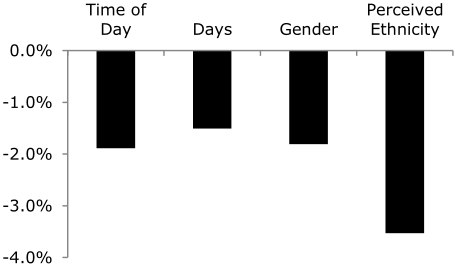
Generalization. We also tested the generalizability of face-based detectors across days, time of day, gender, and ethnicity [Bosch, 2015] (as annotated by researchers). Detector accuracy was not greatly influenced by these differences. We found less than 4% decrease relative to withingroup baseline accuracies. Fig. 2 illustrates the effect of generalization across key dimensions.
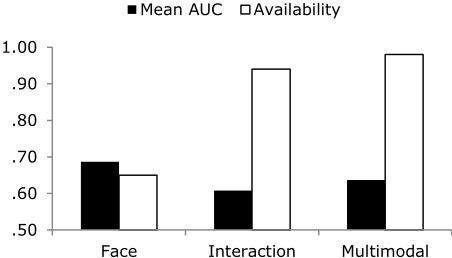
Availability. The face-based affect detection results discussed thus far are derived from 65% of instances. The remaining instances are unclassifiable due to factors such as hand-to-face occlusion, rapid movement, and poor lighting. To increase availability (proportion of all instances from which features could be extracted), we developed multimodal affect detectors including features from the log-files recorded while students interacted with the game [Bosch, Chen, Baker, Shute, & D'Mello, 2015]. Interaction features were distilled from log-files and comprised 76 gameplay attributes theoretically linked to affect. Example features included the amount of time between start and end of level and the total number of objects. See [Kai et al., 2015] for additional details of interaction features computed for Physics Playground. Interaction-based detection was available in 94% of instances, but was less accurate than the face-based detectors (see Figure 3). Fusing these detectors at the decision-level using logistic regression yielded a multimodal detector that was nearly as accurate as the face-based detectors, but available in 98% of instances.
| Classification | AUC | Accuracy | Classifier | No. Instances | No. Features | Window Size (secs) |
|---|---|---|---|---|---|---|
| Boredom | 0.610 | 64% | Classification Via Clustering | 1305 | 20 | 12 |
| Confusion | 0.649 | 74% | Bayes Net | 1293 | 15 | 12 |
| Delight | 0.867 | 83% | Updateable Naïve Bayes | 1003 | 24 | 3 |
| Engagement | 0.679 | 64% | Bayes Net | 1228 | 51 | 9 |
| Frustration | 0.631 | 62% | Bayes Net | 1132 | 51 | 6 |
4 Discussion
Affect detection is a crucial component for affect-sensitive user interfaces, which aspire to improve students' engagement and learning by dynamically responding to sensed affect. This paper advances research in this area by demonstrating the efficacy of detectors for learning-centered affective states in a computer-enabled classroom. Our key contributions were the development and validation of face-based detectors for learning-centered affect in a noisy school environment, and multimodal affect detectors with improved applicability over face-only detectors. The inexpensive, ubiquitous nature of webcams on computers makes facial expression recognition an attractive modality for affect detection. Similarly, interaction-based detectors are sensorfree, requiring no additional equipment cost.
We demonstrated that automatic detection of boredom, confusion, delight, engagement, and frustration in natural environments was possible for students using an educational game in class-despite the many real-world challenges for these classification tasks, such as classroom distractions and large imbalances in affective distributions. With respect to class distractions, students in the current study fidgeted, talked with one another, asked questions, left to go to the bathroom, and even occasionally used their cellphones (against classroom policy). In some situations multiple students crowded around the same screen to view something that another student had done. Essentially, students behaved as expected in a school computer lab. Furthermore, lighting conditions were inconsistent, in part due to placement of computers. In some videos, students' faces were wellilluminated while barely visible in others.
We were able to develop detectors without excluding any of these difficult but realistic situations. Although we were unable to register the face in 35% of instances using modern computer vision techniques-an illustration of just how much uncontrolled lighting and the way students move, occlude, and pose their faces can make affect detection difficult in the wild-by incorporating interaction features, we were able to develop multimodal detectors that could be used in 98% of instances, despite the noisy nature of the data.
We also showed that our approach generalized across days, time of day, gender, and ethnicity (as perceived by researchers). Accuracy decreased by less than 4% for each of these generalization tests, demonstrating that detectors can be applied quite broadly.
Despite these encouraging findings, this study is not without its limitations. First, the number of instances was limited for some affective states. Second, though the students in this study varied widely across some demographic variables, they were all approximately the same age and in the same location. Further research is needed to test detectors on a larger dataset and with more demographic variability.
A next step is to use the detectors to guide intelligent instructional strategies in an affect-sensitive version of Physics Playground. Given the moderate detection accuracy, the interventions must be fail-soft so that they are not harmful if delivered due to detection errors. Subtle strategies, such as re-ordering the problems to display an easier problem after a frustrating experience, may be used.
In summary, affect-sensitive interfaces offer the exciting possibility of endowing computes with the ability to sense and respond to student emotions, just like a gifted human teachers. This research takes an important step toward making this vision a reality, by demonstrating the feasibility of automated detection of student affect in a noisy real-world environment: a school.
Acknowledgements
This research was supported by the National Science Foundation (NSF) (DRL 1235958 and IIS 1523091) and the Bill & Melinda Gates Foundation. Any opinions, findings and conclusions, or recommendations expressed in this paper are those of the authors and do not necessarily reflect the views of the NSF or the Bill & Melinda Gates Foundation.
@inproceedings{ijcai2016p615,
  title     = {Detecting Student Emotions in Computer-Enabled Classrooms},
  author    = {Bosch, Nigel and D'Mello, Sidney K. and Baker, Ryan S. and Ocumpaugh, Jaclyn and Shute, Valerie and Ventura, Matthew and Wang, Lubin and Zhao, Weinan},
  booktitle = {Proceedings of the Twenty-Fifth International Joint Conference on
               Artificial Intelligence, {IJCAI-16}},
  publisher = {AAAI Press / International Joint Conferences on Artificial Intelligence},
  editor    = {Subbarao Kambhampati},
  pages     = {4125--4128},
  year      = {2016},
  month     = {7},
  url       = {https://ijcai.org/proceedings/2016/615},
}
TY - CPAPER TI - Detecting Student Emotions in Computer-Enabled Classrooms AU - Bosch, Nigel AU - D'Mello, Sidney K. AU - Baker, Ryan S. AU - Ocumpaugh, Jaclyn AU - Shute, Valerie AU - Ventura, Matthew AU - Wang, Lubin AU - Zhao, Weinan T2 - Proceedings of the Twenty-Fifth International Joint Conference on Artificial Intelligence, IJCAI-16 PB - AAAI Press / International Joint Conferences on Artificial Intelligence PY - 2016 SP - 4125 EP - 4128 UR - https://ijcai.org/proceedings/2016/615 ER -Copied
Machine-readable versions of this paper, for tools and AI agents:





