
A Demonstration of Interactive Task Learning
Proceedings of the Twenty-Fifth International Joint Conference on Artificial Intelligence. Pages 4248-4248.
Abstract
We will demonstrate a tabletop robotic agent that learns new tasks through interactive natural language instruction. The tasks to be demonstrated are simple puzzles and games, such as Tower of Hanoi, Eight Puzzle, Tic-Tac-Toe, Three Men's Morris, and the Frog and Toads puzzle. We will include a live, interactive simulation of a mobile robot that learns new tasks using the same system.
- [Argall et al., 2009] B. Argall, S. Chernova, M. Veloso, and B. Browning. A Survey of Robot Learning from Demon- stration. Robotics and Autonomous Systems, 2009.
- [Barbu et al., 2010] A. Barbu, S. Narayanaswamy, and J. Siskind. Learning physically-instantiated game play through visual observation. In IEEE International Con- ference on Robotics and Automation (ICRA), pages 1879- 1886, 2010.
- [Chao et al., 2011] C. Chao, M. Cakmak, and A. Thomaz. Towards Grounding Concepts for Transfer in Goal Learn- ing from Demonstration. In Proceedings of the Interna- tional Conference on Development and Learning, 2011.
- [Hinrichs and Forbus, 2014] T. R. Hinrichs and K. D. For- bus. X goes first: Teaching simple games through multi- modal interaction. Advances in Cognitive Systems, 3:31- 46, 2014.
- [Kaiser, 2012] L. Kaiser. Learning games from videos guided by descriptive complexity. In AAAI, 2012.
- [Kirk and Laird, 2014] J. R. Kirk and J. Laird. Interactive task learning for simple games. Advances in Cognitive Systems, 3:11-28, 2014.
- [Laird, 2012] J. E. Laird. The Soar cognitive architecture. MIT Press, 2012.
- [Mohan et al., 2012] S. Mohan, J. R. Kirk, A. Mininger, and J. E. Laird. Acquiring Grounded Representations of Words with Situated Interactive Instruction. Advances in Cogni- tive Systems, 2:113-130, 2012.
- [Nicolescu and Mataric, 2003] M. Nicolescu and M. Mataric. Natural Methods for Robot Task Learn- ing: Instructive Demonstrations, Generalization and Practice. In Proceedings of AAMAS, pages 241-248, 2003.
References were extracted automatically from the PDF and may contain errors.
Full text extracted automatically from the PDF; figures, tables and equations may differ. The PDF is the version of record.
1 Demonstration Details
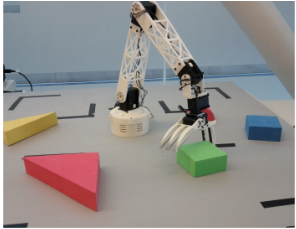
We will demonstrate our tabletop robot, which consists of a small robot arm and a Kinect sensor (see Figure 1). We will give live demonstrations of Rosie learning and solving simple puzzles, such as Tower of Hanoi and the Frog and Toad puzzle. We will also show Rosie learning simple games such as Tic-Tac-Toe, that can then be played with spectators.
It would not be feasible for us to demonstrate task learning for a real mobile robot, but we can teach the same kinds of tasks with a simulated robot and environment. We will show live demonstrations of teaching the agent tasks involving navigation, manipulation, and communication, such as delivering an object to a person, fetching an object, telling a person a message, and guiding a person to a desired location.
2 RelatedWork
Although there has been a variety of research on task learning, they often depend on learning from many examples or on off-line processing. For example, Kaiser [Kaiser, 2012] and Barbu et al. [Barbu et al., 2010] describe systems that extract the relevant goal-state predicates for games, by viewing many iterations of game play. Most learning from demonstration systems [Argall et al., 2009][Chao et al., 2011][Nicolescu and Mataric, 2003] for robotic tasks teach action sequences and not descriptions of goals or conditions. Closely related to our work is the work of Hinrich et al. [Hinrichs and Forbus, 2014], where a computer agent learns to play Tic-Tac-Toe from interactions and gestures with a human instructor.
Acknowledgments
The work described here was supported by the National Science Foundation under Grant Number 1419590 and the Office of Naval Research under Grant Number N00014-08-1-0099. The views and conclusions contained in this document are those of the authors and should not be interpreted as representing the official policies, either expressly or implied, of the NSF, ONR, or the U.S. Government.
@inproceedings{ijcai2016p644,
  title     = {A Demonstration of Interactive Task Learning},
  author    = {Kirk, James R. and Mininger, Aaron and Laird, John E.},
  booktitle = {Proceedings of the Twenty-Fifth International Joint Conference on
               Artificial Intelligence, {IJCAI-16}},
  publisher = {AAAI Press / International Joint Conferences on Artificial Intelligence},
  editor    = {Subbarao Kambhampati},
  pages     = {4248--4248},
  year      = {2016},
  month     = {7},
  url       = {https://ijcai.org/proceedings/2016/644},
}
TY - CPAPER TI - A Demonstration of Interactive Task Learning AU - Kirk, James R. AU - Mininger, Aaron AU - Laird, John E. T2 - Proceedings of the Twenty-Fifth International Joint Conference on Artificial Intelligence, IJCAI-16 PB - AAAI Press / International Joint Conferences on Artificial Intelligence PY - 2016 SP - 4248 EP - 4248 UR - https://ijcai.org/proceedings/2016/644 ER -Copied
Machine-readable versions of this paper, for tools and AI agents:





