
Eddy: A Graphical Editor for OWL 2 Ontologies
Proceedings of the Twenty-Fifth International Joint Conference on Artificial Intelligence. Pages 4252-4252.
Abstract
We demonstrate Eddy, a new tool for designing ontologies specified in the Graphol language. Graphol is completely visual and fully captures OWL 2. Thus Eddy is the first ontology editor that allows to create OWL 2 ontologies by only using simple graphical editing features.
- [Brockmans et al., 2004] Sara Brockmans, Raphael Volz, Andreas Eberhart, and Peter Löffler. Visual modeling of OWL DL ontolo- gies using UML. In Proc. of ISWC, volume 3298 of LNCS, pages 198-213. Springer, 2004.
- [Console et al., 2014] Marco Console, Domenico Lembo, Valerio Santarelli, and Domenico Fabio Savo. Graphol: Ontology rep- resentation through diagrams. In Proc. of DL, pages 483-495, 2014.
- [Falco et al., 2014] Riccardo Falco, Aldo Gangemi, Silvio Peroni, David Shotton, and Fabio Vitali. Modelling OWL ontologies with Graffoo. In ESWC 2014 Satellite Events, volume 8798 of LNCS, pages 320-325, 2014.
- [Fillottrani et al., 2012] Pablo R Fillottrani, Enrico Franconi, and Sergio Tessaris. The ICOM 3.0 intelligent conceptual modelling tool and methodology. Semantic Web, 3(3):293-306, 2012.
- [Guizzardi, 2005] Giancarlo Guizzardi. Ontological Foundations for Structural Conceptual Models. PhD thesis, University of Twente, The Netherlands, 2005.
- [Lanzenberger et al., 2009] Monika Lanzenberger, Jennifer Samp- son, and Markus Rester. Visualization in ontology tools. In Proc. of CISIS, pages 705-711, 2009.
- [Lembo et al., 2016] Domenico Lembo, Daniele Pantaleone, Vale- rio Santarelli, and Domenico Fabio Savo. Easy OWL drawing with the Graphol visual ontology language. In Proc. of KR, 2016.
References were extracted automatically from the PDF and may contain errors.
Full text extracted automatically from the PDF; figures, tables and equations may differ. The PDF is the version of record.
1 Introduction
Ontology development is a complex activity that is usually carried out with the help of ontology engineering tools that in particular allow editing and browsing of ontologies, among their basic functionalities (see, e.g., Prot`eg`e 1 , TopBraid Composer R©2 , or OntoStudio R©3 ). Such tools usually also offer visualization services, providing overviews of portions of the ontology in some graphical format (see, e.g., [Lanzenberger et al., 2009]). However, they have little or no graphical editing features, and thus basically require designers to be able to specify ontologies in terms of logic formulae, especially for asserting complex axioms. In fact, several graphical models for knowledge representation have been proposed during the years, in many areas of computer science, but none of them succeeded to impose itself as a reference graphical language (whereas instead a huge standardization effort led to establish OWL 4 as a reference formal language for ontologies, equipped with textual standard syntaxes). Among the most recent proposals, there are interesting efforts to extend to the OWL expressiveness diagrammatic conceptual modeling languages, such as the UML class diagram or the Entity-Relationship (ER) model, i.e, the de facto standard for software and database design. Such extensions however typically require using textual formulas besides the graphical representation of the ontology (see, e.g., [Falco et al., 2014; Fillottrani et al., 2012; Guizzardi, 2005]), and in some cases did not evolve towards OWL 2, the current version of the standard for ontologies [Brockmans et al., 2004].
1 http://protege.stanford.edu/
2 http://www.topquadrant.com/tools
3 http://www.semafora-systems.com/en/products/ontostudio/
4 https://www.w3.org/TR/owl2-syntax/
In our demonstration we will present Eddy, a novel tool for ontology editing. Eddy aims to overcome the main drawbacks of previous proposals by providing a completely graphical environment for ontology specification. Notably, in Eddy OWL 2 ontologies can be specified in a fully diagrammatic way through GRAPHOL, a recent visual ontology language [Console et al., 2014; Lembo et al., 2016]. GRAPHOL basic elements are borrowed from the ER model, to facilitate its usage and understanding by non-experts in logic and ontologies but with some skills in conceptual modeling languages. GRAPHOL has formal syntax and semantics, and a precise relationship with Description Logics (DLs), OWL 2, UML, and ER, and has been successfully used in industrial projects (cf. [Lembo et al., 2016]).
2 The Eddy Tool
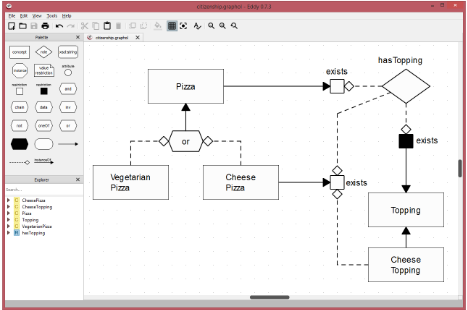
Eddy is a stand-alone software written in Python 3, with a GUI implemented through the PyQt5 bindings for the Qt5 framework, and distributed under the GPL v3 license 5 . It presents a central viewport area for drawing GRAPHOL ontologies through point-and-click and drag-and-drop mechanisms, based on the selection of GRAPHOL symbols from a palette in the left-hand side docking area, shown in Figure 1.
Concepts, roles, and attributes are represented in GRAPHOL with rectangles, diamonds, and circles, respectively, as in ER diagrams. Complex OWL expressions are built through graphical operators taking as input other expressions. This is rendered by dashed directed edges terminating with a small diamond going from an expression to the operator. Only two shapes are used for operators, boxes (blank or solid) and hexagons. Labels allow to distinguish between operators. For instance, the label or for a hexagon indicates union, whereas the label exists for a blank (resp. solid) box indicates an existential restriction over a role or attribute (resp. the inverse of a role or attribute). Solid directed arrows specify inclusions between expressions. For example, the ontology in Figure 1 asserts that the union of VegetarianPizza and CheesePizza is contained in Pizza, that Pizza is contained in the unqualified existential restriction on hasTopping, i.e., each pizza has at least a topping, that the unqualified existential restriction on the inverse of hasTopping is contained in Topping, i.e., every individual in the range of hasTopping is a topping, that CheeseTopping is contained in Topping, and that a cheese pizza must have at least a cheese topping (corresponding to the OWL formula, in DL syntax, CheesePizza v 9hasTopping.CheeseTopping).
5 http://www.dis.uniroma1.it/graphol/download.html
3 Evaluation Study
We conducted a first evaluation study for Eddy, involving ten participants from the industrial world, who have some background in conceptual design, which is basically the knowhow we assume for Eddy users. After a brief introduction to GRAPHOL and Eddy, participants were asked to perform ten editing tasks on the Pizza ontology 6 specified in GRAPHOL. Each user was also asked to indicate the time it took him to complete the task, how clear it was to him how to perform the task, and how easy it was to carry out the task. In Figure 2 we
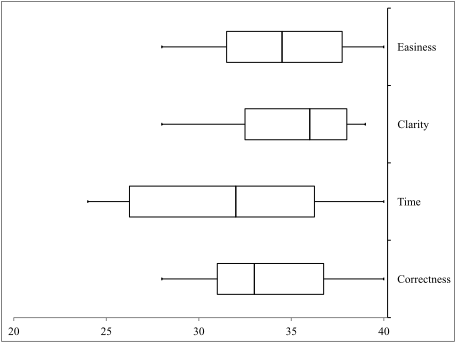
show a synthesis of the results. Clearness, easiness and correctness are scored on a scale from 0, worst, to 4, best, so the max possible total score is 40. Moreover, the predetermined benchmark average for time per task was set at 3.5 minutes.
6 http://protege.stanford.edu/ontologies/pizza/pizza.owl
Each box plot in the figure shows the full range of variation, from minimum to maximum, indicated by the whiskers, the likely range of variation, indicated by the two boxes, and the median value. The test results show a good ability in performing the required tasks through the editor. The high scores for clarity and easiness also indicate that the users were able to understand what they were required to do in each task and that Eddy allowed them to achieve their goal comfortably.
4 Demonstrating Eddy
We plan to both show the usage of Eddy and involve attendees in testing our tool. In particular, they will be able to use Eddy to create, modify, and export ontologies. We will prepare a set of small GRAPHOL models, featuring excerpts of some popular ontologies, such as Pizza, which describe realworld domains that can be easily understood by the participants, and assign a set of model editing tasks on these ontologies. By performing these tasks, users will exploit Eddy's advanced drawing functionalities, custom-tailored for quickly and effectively constructing GRAPHOL diagrams. We will also demonstrate Eddy's syntactic validation functionalities, which will guide the user in designing a syntactically correct OWL 2 ontology. After completing the tasks, users will export the GRAPHOL ontologies in the standard OWL 2 syntax.
The demonstrators will provide laptops, GRAPHOL ontologies, the tasks to perform, and a link to download Eddy and the material handed out during the demonstration.
Acknowledgments. This research has been partially supported by the EU under FP7 project Optique (n. FP7318338).
@inproceedings{ijcai2016p646,
  title     = {Eddy: A Graphical Editor for OWL 2 Ontologies},
  author    = {Lembo, Domenico and Pantaleone, Daniele and Santarelli, Valerio and Savo, Domenico Fabio},
  booktitle = {Proceedings of the Twenty-Fifth International Joint Conference on
               Artificial Intelligence, {IJCAI-16}},
  publisher = {AAAI Press / International Joint Conferences on Artificial Intelligence},
  editor    = {Subbarao Kambhampati},
  pages     = {4252--4252},
  year      = {2016},
  month     = {7},
  url       = {https://ijcai.org/proceedings/2016/646},
}
TY - CPAPER TI - Eddy: A Graphical Editor for OWL 2 Ontologies AU - Lembo, Domenico AU - Pantaleone, Daniele AU - Santarelli, Valerio AU - Savo, Domenico Fabio T2 - Proceedings of the Twenty-Fifth International Joint Conference on Artificial Intelligence, IJCAI-16 PB - AAAI Press / International Joint Conferences on Artificial Intelligence PY - 2016 SP - 4252 EP - 4252 UR - https://ijcai.org/proceedings/2016/646 ER -Copied
Machine-readable versions of this paper, for tools and AI agents:





