
Body Movement Analysis of Human-Robot Interaction
Proceedings of the Eighteenth International Joint Conference on Artificial Intelligence. Pages 177-181.
Abstract
This paper presents a method for analyzing human-robot interaction by body movements . Future intelligent robots will communicate with humans and perform physical and communicative tasks to participate in daily life. A human-like body will provide an abundance of non-verbal information and enable us to smoothly communicate with the robot. To achieve this, we have developed a humanoid robot that autonomously interacts with humans by speaking and making gestures. It is used as a testbed for studying embodied communication. Our strategy is to analyze human-robot interaction in terms of body movements using a motion capturing system, which allows us to measure the body movements in detail. We have performed experiments to compare the body movements with subjective impressions of the robot. The results reveal the importance of well-coordinated behaviors and suggest a new analytical approach to human-robot interaction.
- [Breazeal eta/., 1999] C. Breazeal and B. Scassellati, A context-dependent attention system for a social robot, Proc. Int. Joint Conf on Artificia/Jntelligence, pp.1146-1151, 1999. IJCAI
- [Hall, 1966] E. Hall, The Hidden Dimension, Anchor Books/Doubleday [
- [Hirai eta/., 1998] K. Hirai, M. Hirose, Y. Haikawa, and T. Takenaka, The development of Honda humanoid robot, Proc. IEEE Int. Conf. on Robotics and Automation, 1998.
- [Jebara and Pentland, 1999] T. Jebara and A. Pentland, Ac- tion Reaction Learning: Automatic Visual Analysis and Synthesis of Interactive Behaviour, Int. Conf on Computer Vision Systems, 1999.
- [Kanda eta/., 2002a] T. Kanda, H. Ishiguro, T. Ono, M. Imai, and R. Nakatsu, Development and Evaluation of an Interactive Humanoid Robot "Robovie", IEEE Int. Conf on Robotics and Automation, pp.l848-1855, 2002 .
- [Kanda eta/., 2002b] T. Kanda, H. Ishiguro, M. Imai , T. Ono, and K. Mase, A constructive approach for developing interactive humanoid robots, IEEEIRSJ Int. Conf on Intel- ligent Robots and Systems, pp. 1265-1270, 2002. [Nakadai eta/., 200 I]
- K . Nakadai, K. Hidai, H. Mizoguchi, H. G. Okuno, and H. Kitano, Real-Time Auditory and Visual Multiple-Object Tracking for Robots, Proc. Int. Joint Conf on Artificial Intelligence, pp. 1425-1432, 2001.
- [Nakauchi eta/., 2002] Y. Nakauchi and R. Simmons, A Social Robot that Stands in Line, Autonomous Robots, Vol. 12, No.3, pp. 313 -324,2002.
- Ono eta/. 2001]
- T. Ono, M. Imai, and H. Ishiguro, A Model of Embodied Communications with Gestures between Hu- mans and Robots, Proc. of Twenty-third Annual Meeting of the Cognitive Science Society, pp. 732-737, 2001.
- [Reeves and Nass, 1996] B. Reeves and C. Nass, The Media equation, CSLI Publications, 1996. [Scassellati eta/., 2000]
- B. Scassellati, Investigating Models of Social Development Using a Humanoid Robot, Bioro- botics, MIT Press, 2000.
References were extracted automatically from the PDF and may contain errors.
Full text extracted automatically from the PDF; figures, tables and equations may differ. The PDF is the version of record.
1 Introduction
Over the past several years, many humanoid robots such as Honda's [Hirai et a!., 1998] have been developed. We believe that in the not-too-distant future humanoid robots will interact with humans in our daily life. Their hu man-like bodies enable humans to intuitively understand their gestures and cause people to unconsciously behave as if they were communicating with humans [Kanda et a!., 2002a]. That is, if a humanoid robot effectively uses its body, people will naturally communicate with it. This could allow robots to perform communicative tasks in human society such as route guides.
Several researchers have investigated about social re lationships between humans and robots. For example, Kismet was developed for studying early caregiver-infant interaction [Breazeal, 2001] . Also, a robot that stands in a line [Nakauchi et a!., 2002] and a robot that talks with multiple persons [Nakadai eta!., 2001] have been developed. Furthermore, various communicative behaviors using a robot's body have been discovered, such as a joint-attention mechanism [Scassellati eta!., 2000] .
This research was supported in part by the Telecommunica tions Advancement Organization of Japan.
On the other hand, methods of analyzing social robots, especially with respect to human-robot interaction, are still lacking. To effectively develop any systems in general, it is essential to measure the systems' performance. For example, algorithms are compared with respect to time and memory, and mechanical systems are evaluated by speed and accuracy. Without analyzing current perform ance, we cannot argue advantages and problems. For so cial robots, no analysis method has yet been established, thus, it is vital to determine what types of measurements we can apply. Although questionnaire-based methods have been often used, they are rather subjective, static and obtrusive (that is, we would interrupt the interaction when we apply a questionnaire) . Less commonly, human be haviors are employed for this purpose, such as distance [Hall, 1966], attitude [Reeves and Nass, 1996], eye gaze (often used in psychology), and synchronized behaviors [Ono eta!. , 2001]. Although those methods are more dif ficult to apply, the results are more objective and dynamic. Sometimes, interactive systems observe human behaviors for synthesizing behaviors [J ebara and Pentland, 1999]. However, they are still fragments rather than a systematic analysis method applicable for human-robot interaction.
In this paper, we present our exploratory analysis of human-robot interaction. Our approach is to measure the body movement interaction between a humanoid robot and humans, and compare the results with traditional subjective evaluation. We have developed an interactive humanoid robot that has a human-like body as the testbed of this embodied communication. Furthermore, many interactive behaviors have been implemented. It encourages people to treat the robot as a human child. We employ a motion cap turing system for measuring time and space accurately.
2 An Interactive Humanoid Robot
2.1 Hardware
Figures 1 and 2 display an interactive humanoid robot "Robovie," which is characterized by its human-like body expression and various sensors. The human-like body consists of eyes, a head and arms, which generate the complex body movements required for communication. The various sensors, such as auditory, tactile, ultrasonic, and visual, enable it to behave autonomously and to in teract with humans. Furthermore, the robot satisfies me chanical requirements of autonomy. It includes all com putational resources needed for processing the sensory data and for generating behaviors. It can continually op erate for four hours with its battery power supply.
2.2 Software
Using its body and sensors, the robot performs diverse interactive behaviors with humans. Each behavior is gen erated by a situated module, each of which consists of communicative units. This implementation is based on a constructive approach [Kanda eta!., 2002b]: "combining as many simple behavior modules (situated modules) as possible." We believe that the complexity of the relations among appropriate behaviors enriches the interaction and creates perceived intelligence of the robot.
Communicative Unit
Previous works in cognitive science and psychology have highlighted the importance of eye contact and arm movement in communication. Communicative units are designed based on such knowledge to effectively use the robot's body, and each unit is a sensory-motor unit that realizes certain communicative behavior. For example, we have implemented "eye contact," "nod," "positional rela tionship," "joint attention (gaze and point at object)." When developers create a situated module, they combine the communicative units at first. Then, they supplement it with other sensory-motor units such as utterances and positional movements for particular interactive behaviors.
Situated Modules
In linguistics, an adjacency pair is a well-known term for a unit of conversation where the first expression of a pair requires the second expression to be of a certain type. For example, "greeting and response" and "question and an swer" are considered pairs. We assume that embodied communication is materialized with a similar principle: the action-reaction pair. This involves certain pairs of actions and reactions that also include non-verbal expres sions. The continuation of the pairs forms the communi cation between humans and a robot.
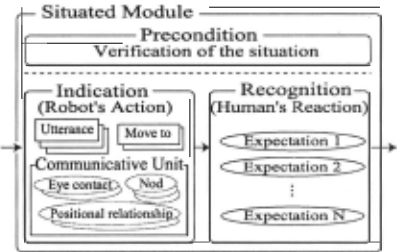
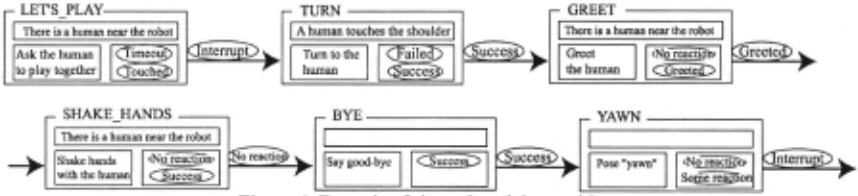
Although the action and reaction happen equally, the recognition ability provided by current computer science is not as powerful as that of humans. Thus, the robot takes the initiative and acts rather than reacting to humans actions. This allows the flow of communication to be maintained. Each situated module is designed to realize a certain ac tion-reaction pair in a particular situation (Fig. 3), where a robot mainly takes an action and recognizes the humans' reaction. Since it produces a particular situation by itself, it can recognize humans' complex reactions under limited conditions; that is, it expects the human's reaction. This pol icy enables developers to easily implement many situated modules. On the other hand, when a human takes an action toward the robot, it recognizes the human's action and reacts by using reactive transition and reactive modules; that is, some of the situated modules can catch the human's initiating behaviors and interrupt its operations to react to them (as shown in Fig. 4: the second module TURN).
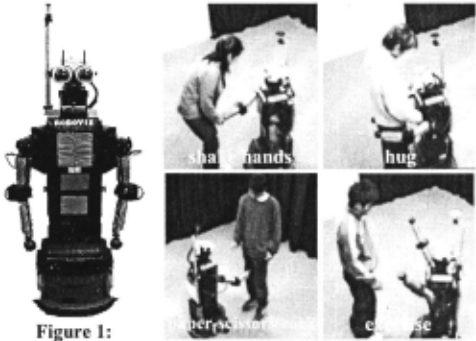
Figure 1: "Robovie"
A situated module consists of precondition, indication, and recognition parts (Fig. 3). By executing the precon dition, the robot checks whether the situated module is in an executable situation. For example, the situated module that performs a handshake is executable when a human is in front of the robot. By executing the indication part, the robot interacts with humans. With the handshake module, the robot says "Let's shake hands," and offers its hand. This be havior is implemented by combining communicative units of eye contact and positional relationships (it orients its body to ward the human), and by supplementing a particular utterance ("Let's shake hands") and a particular body movement (offering its hand). The recognition part is designed to recognize several expected human reactions toward the robot's action. As for the handshake module, it can detect human hand shake behavior if a human touches its offered hand.
The robot system sequentially executes situated mod ules (Fig. 4). At the end of the current situated module execution, it records the recognition result obtained by the recognition part, and progresses to the next executable situated module. The next module is determined by the results and the execution history of previous situated modules, which is similar to a state transition model.
2.3 Realized Interactive Behaviors
We installed this mechanism on "Robovie." The robot's task is to perform daily communication as children do. The number of developed situated modules has reached a hundred: 70 of which are interactive behaviors such as handshake (Fig. 2, upper-left), hugging (Fig. 2, up per-right), playing paper-scissors-rock (Fig. 2, lower-left), exercising (Fig. 2, lower-right), greeting, kissing, singing a song, short conversation, and pointing to an object in the surroundings; 20 are idling behaviors such as scratching its head, and folding its arms; and 10 are moving-around behaviors, such as pretending to patrol an area and going to watch an object in the surroundings.
Basically, the transition among the situated modules is implemented as follows: it sometimes asks humans for interaction by saying "Let's play, touch me," and exhibits idling and moving-around behaviors until a human acts in response; once a human reacts to the robot (touches or speaks), it starts and continues the friendly behaviors while the human reacts to these; when the human stops reacting, it stops the friendly behaviors, says "good bye" and re-starts its idling or moving-around behaviors.
3 Body Movement Analysis
3.1 Experiment Settings
We performed an experiment to investigate the interaction of body movements between the developed robot and a human. We used 26 university students (19 men and 7 women) as our subjects. Their average age was 19.9. First, they were shown examples how to use the robot, then they freely observed the robot for ten minutes in a rectangular room 7.5 m by 10m. As described in section 2.3, the robot autonomously tries to interact with subjects. At the be ginning of the free observation, the robot asks subjects to talk and play together, and then subjects usually start touching and talking.
After the experiment, subjects answered a questionnaire about their subjective evaluations of the robot with five adjective pairs shown in Table 1, which was compared with the body movements. We chose these adjective pairs because they had high loadings as evaluation factors for an interactive robot in a previous study [Kanda eta!., 2002a].
3.2 Measurement of Body Movements
We employed an optical motion capturing system to measure the body movements. The motion capturing systern consisted of 12 pairs of infrared cameras and infrared lights and markers that reflect infrared signals. These cameras were set around the room. The system calculates each marker's 3-D position from all camera images. The system has high resolution in both time (120Hz) and space (accuracy is 1 mm in the room)
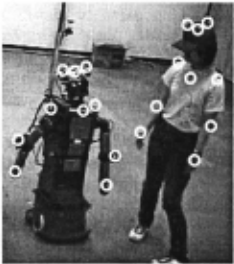
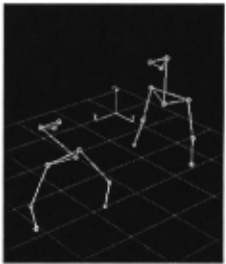
As shown in Fig. 5, we attached ten markers to the heads (subjects wore a cap attached with markers), shoulders, necks, elbows, and wrists of both the robot and the sub jects. By attaching markers to corresponding places on the robot and subjects, we could analyze the interaction of body movements. The three markers on the subjects' head detect the individual height, facing direction, and potential eye contact with the robot. The markers on the shoulders and neck are used to calculate the distance between the robot and subjects, and distance moved by them. The markers on the arms provide hand movement information (the relative positions of hands from the body) and the duration of synchronized movements (the period where the movements of hands of the subject and robot highly correlate). We also analyzed touching behaviors via an internal log of the robot's touch sensors.
3.3 Results
Comparison between the body movements and the sub jective evaluations indicates meaningful correlation. From the experimental results, well-coordinated behaviors such as eye contact and synchronized arm movements proved to be important. This suggests that humans make evaluations based on their body movements.
Subjective Evaluation: "Evaluation Score"
The semantic differential method is applied to obtain subjective evaluations with a 1-to-7 scale, where 7 denotes the most positive point on the scale. Since we chose the adjective pairs that had high loadings as evaluation factors for an interactive robot, the results of all adjective pairs represent subjective evaluation of the robot. Thus, we calculated the evaluation score as the average of all ad jective-pairs' scores. Table I indicates the adjective pairs used, the averages, and standard deviations.
Correlation between Body Movements and Sub jective Impressions
Table 2 displays the measured body movements. Re garding eye contact, the average time was 328 seconds, which is more than half of the experiment time. Since the robot's eye height was 1.13 m and the average of subject eye height was 1.55 m, which was less than their average standing eye height of 1.64 m, several subjects sat down or stooped to bring their eyes to the same height as the robot's. The distance moved was farther than what we expected, and it seemed that subjects were always moving lit tle-by-little. For example, when the robot turned, the subjects would then correspondingly turn around the r~bot. Some subjects performed arm movements synchromzed with the robot's behaviors, such as exercising.
Next, we calculated the correlation between the evaluation score and the body movements (Table 3). Since the number of subjects is 26, each correlation value whose absolute value is larger than 0.3297 is significant. We highlight these significant values with bold face in the table. From the calculated results, we found that eye contact and synchronized movements indicated higher significant correlations with the evaluation score.
According to the correlations among body movements, the following items showed significant correlations: eye contact - distance, eye contact - distance moved, syn chronized behaviors - distance moved by hands, and synchronized behaviors - touch. However, these items (distance, distance moved, distance moved by hands, and touch) do not significantly correlate with the evaluation score. That is, only the well-coordinated behaviors cor relate with the subjective evaluation. Isolated active body movements of subjects, such as standing near the robot, moving their hands energetically, and touching the robot repetitively, do not correlate to the subjective evaluation.
Estimation of Momentary Evaluation: "En trainment Score"
The results indicate that there are correlations between subjective evaluation and body movements. We performed multiple linear regression analysis to estimate the evalua tion score from the body movements, which confirms the above analysis and reveals how much each body move ment affects the evaluation. We then applied the relations among body movements to estimate a momentary evalua tion score called the entrainment score.
As a result of the multiple linear regression analysis, standardized partial regression coefficients were obtained, as shown in Table 4. The obtained multiple linear regres sion is as follows:
| Adjective-pairs | Mean | Std. Dev. | |
|---|---|---|---|
| Good | Bad | 4.88 | 0.95 |
| Kind | Cruel | 4.85 | 1.29 |
| Pretty | Ugly | 5.08 | 0.93 |
| Exciting | Dull | 4.46 | 1.61 |
| Likable | Unlikable | 4.77 | 1.03 |
| Evaluation score | 4.81 | 0.92 | |
| Mean | Std. Dev. | |
|---|---|---|
| Distance (m) | 0.547 | 0.103 |
| Eye contact (s) | 328 | 61.8 |
| Eye height (m) | 1.55 | 0.124 |
| Distance moved (m) | 35.2 | 17.0 |
| Distance moved by hands (m) | 108 | 29.5 |
| Synchronized movements (s) | 7.95 | 6.58 |
| Touch (num. of times) | 54.9 | 20.8 |
where DIST, EC, EH, DM, DMH, SM, and TOUCH are the standardized values of the experimental results for the body movements. Since the evaluation was scored on a 1-to-7 scale, evaluation score E is between 1 and 7. The multiple correlation coefficient is 0.77, thus 59% of the evaluation score is explained by the regression. The va lidity of the regression is proved by analysis of variance (F(7,18) = 3.71, P < 0.05).
The coefficients (Table 4) also indicate the importance of well-coordinated behaviors. Eye contact and synchro nized movements positively affected the evaluation score; on the contrary, distance, distance moved and touch seem to have negatively affected the evaluation score. In other words, the subjects who just actively did something (standing near the robot, moved around, and touched re peatedly), especially without cooperative behaviors, did not evaluate the robot highly.
Because we can momentarily observe all terms involved in the body movements of the regression (I), we can es timate a momentary evaluation score by using the same relations among body movements as follows:
where designations such as DIST(t) are the momentary values of the body movements at time t. We named this momentary evaluation score the "entrainment score," with the idea that the robot entrains humans into interaction through its body movements and humans move their body according to their current evaluation of the robot. The evaluation score and entrainment score satisfy the fol lowing equation, which represents our hypothesis that the evaluation forms during the interaction occurring through the exchange of body movements:
| Evaluation | Dist. | E. C. | E. H. | D.M. | D.M.H. | S. M. | Touch | |
|---|---|---|---|---|---|---|---|---|
| Dist. | -0.04 | 1.00 | ||||||
| E.C. | 0.57 | -0.47 | 1.00 | |||||
| E.H. | 0.08 | -0.39 | 0.29 | 1.00 | ||||
| D.M. | -0.32 | 0.20 | -0.43 | 0.02 | 1.00 | |||
| D.M.H. | 0.01 | -0.04 | -0.21 | -0.09 | 0.49 | 1.00 | ||
| S. M. | 0.54 | -0.05 | 0.28 | -0.05 | 0.15 | 0.61 | 1.00 | |
| Touch | 0.21 | -0.45 | 0.49 | -0.07 | -0.15 | 0.35 | 0.41 | 1.00 |
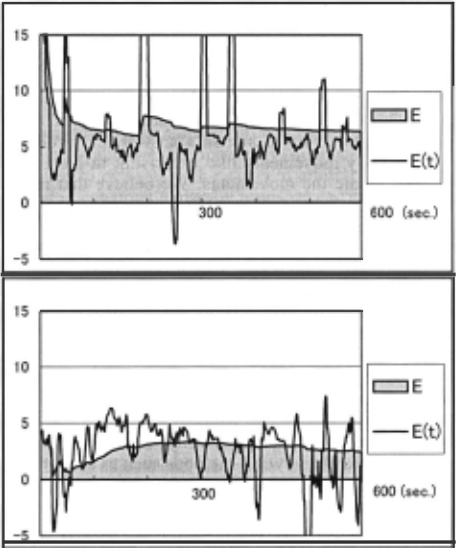
Let us show the validity of the estimation by examining the obtained entrainment score. Figure 6 shows the en trainment scores of two subjects . The horizontal axis in dicates the time from start to end (600 seconds) of the experiments. The solid line indicates the entrainment score E(t), while the colored region indicates the average of the entrainment score E(t) from the start to time t (this inte gration value grows the estimation of Eat the end time).
The upper graph shows the score of the subject who interacted with the robot very well. She reported after the experiment that, " It seems that the robot really looked at me because of its eye motion. I nearly regard the robot as a human child that has an innocent personality." This en trainment-score graph hovers around 5 and sometimes goes higher. This is because she talked to the robot while maintaining eye contact. She performed synchronized movements corresponding to the robot's exercising be haviors, which caused the high value around 200 sec.
At the other extreme, the lower graph is for the subject who became embarrassed and had difficulty in interacting with the robot. The graph sometimes falls below 0. In particular, at the end of the experiment, it became unstable and even lower. He covered the robot's eye camera, touched it like he was irritated, and went away from the robot. We consider that those two examples suggest the validity of the entrainment score estimation.
Evaluation of the implemented behaviors
In the sections above, we explained the analysis of body movement interaction. Here, we evaluate the implemented behaviors , Although the application of this result is limited to our approach, our findings also prove the validity and applicability of the entrainment score.
We calculated the evaluation score of each situated module based on the average of the entrainment score while each module was being executed. Tables 5 and 6 indicate the worst and best five modules, respectively, and their scores. The worst modules were not so interactive. SLEEP _POSE and FULLY _FED do not respond to human action and exhibit behavior similar to the sleeping pose. NOT_TURN is the behavior for brushing off a human's hand while saying "I'm busy" when someone touches on its shoulder. The best modules were rather interactive modules that entrain humans into the interaction. EXERCISE and CONDUCTOR produce the exercising and imitating of musical conductor behaviors, which in duced human synchronized body movements. Other highly rated modules also produce attractive behaviors, such asking and calling, which induce human reactions. We believe that the entrainment scores provide plenty of information for developing interactive behaviors of robots that communicate with humans.
| Coefficient | Value | |
|---|---|---|
| Distance | adisr | 0.173 |
| Eye contact | a ec | 0.476 |
| Eye height | a eh | 0.019 |
| Distance moved | a dm | -0.228 |
| Distance moved by hands | admh | -0.029 |
| Synchronized movements | a sm | 0.535 |
| Touch | a/ouch | -0.186 |
(upper: subject who treated the robot as if it were a humans child, lower:
subject who was embarrassed by interacting with it)
4 Discussions
The experiment reveals the correlation between humans' subjective evaluations and body movements. If a human
| ID | Contents | Evaluation |
|---|---|---|
| TICKLE | Tickle | -2.09 |
| APOLOGIZE | Apologize | -1.96 |
| NOT TURN | Say, "I'm busy," and refuse to play together | -0.51 |
| SLEEP POSE | A pose of sleeping | -0.42 |
| FULLY FED | A pose of being fully fed | 0.32 |
evaluates the robot highly, then the human behaves co operatively with it, which will further improve its evalua tion. That is, once they establish cooperative relationships with the robot, they interact well with the robot and evaluate the robot highly. Regarding evaluation of the implemented behaviors, the modules that entrain humans into interaction were highly evaluated, such as asking something that induces human's answer and producing cheerful body movements like exercising to let humans join and mimic the movements. We believe that the en trainment can help us to establish cooperative relation ships between humans and robots .
Meanwhile, the multiple linear regression explains 59% of the subjective evaluation. This is remarkable because it is performed without regard to the contents or context of language communication. With speech recognition, the robot can talk with humans, although its ability is similar to that of a little child. Some of the subjects spoke to the robot. Often, there were requests for the robot to present particular behaviors (especially behaviors it had per formed just previously), to which it sometimes responded correctly and sometimes incorrectly. To analyze this, we could use several analytical methods such as conversation analysis, however, these methods are rather subjective. On the other hand, our evaluation employed objective meas ures only: numerically obtained body movements without context, which means there could be a lot of potential usages. For example, an interactive robot could learn and adjust its behavior by using this method. It would be ap plicable to different subjects (age, culture, etc.), different agents (physical-virtual, body shape, behaviors, etc.), and inter-human communication.
5 Conclusions
This paper reported a new approach to analyzing embod ied communication between humans and a robot. Our interactive humanoid robot is able to autonomously in teract with humans. This complexity and autonomy is achieved by many simple behaviors. We measured hu mans' body movements while they observed and inter acted with the robot, and the result of the analysis indicates positive correlations between cooperative body move ments and subjective evaluations. Furthermore, the mul tiple linear regression explains 59% of the subjective evaluation without regard to language communication. We consider our approach of body movement analysis to be widely applicable in embodied communication.
| ID | Contents | Evaluation |
|---|---|---|
| EXERCISE | Exercise | 5.75 |
| ASK SING | Ask humans, "May I sing a song?" | 5.59 |
| CONDUCTOR | Pose imitating a musical con- ductor | 4.85 |
| WHERE FROM | Ask humans, "Where are you from?' | 4.55 |
| LET'S PLAY | Say, "Let's play, touch me" | 4.24 |
@inproceedings{ijcai2003p25,
  title     = {Body Movement Analysis of Human-Robot Interaction},
  author    = {Kanda, Takayuki and Ishiguro, Hiroshi and Imai, Michita and Ono, Tetsuo},
  booktitle = {Proceedings of the Eighteenth International Joint Conference on
               Artificial Intelligence, {IJCAI-03}},
  publisher = {International Joint Conferences on Artificial Intelligence},
  editor    = {Georg Gottlob and Toby Walsh},
  pages     = {177--181},
  year      = {2003},
  url       = {https://ijcai.org/proceedings/2003/25},
}
TY - CPAPER TI - Body Movement Analysis of Human-Robot Interaction AU - Kanda, Takayuki AU - Ishiguro, Hiroshi AU - Imai, Michita AU - Ono, Tetsuo T2 - Proceedings of the Eighteenth International Joint Conference on Artificial Intelligence, IJCAI-03 PB - International Joint Conferences on Artificial Intelligence PY - 2003 SP - 177 EP - 181 UR - https://ijcai.org/proceedings/2003/25 ER -Copied
Machine-readable versions of this paper, for tools and AI agents:





