
Balancing Utility and Deal Probability for Auction-Based Negotiations in Highly Nonlinear Utility Spaces
Proceedings of the Twenty-First International Joint Conference on Artificial Intelligence. Pages 214-218.
Abstract
Negotiation scenarios involving nonlinear utility functions are specially challenging, because traditional negotiation mechanisms cannot be applied. Even mechanisms designed and proven useful for nonlinear utility spaces may fail if the utility space is highly nonlinear. For example, although both contract sampling and constraint sampling have been successfully used in auction based negotiations with constraint-based utility spaces, they tend to fail in highly nonlinear utility scenarios. In this paper, we will show that the performance of these approaches decrease drastically in highly nonlinear utility scenarios, and propose a mechanism which balances utility and deal probability for the bidding and deal identification processes. The experiments show that the proposed mechanisms yield better results than the previous approaches in highly nonlinear negotiation scenarios.Ivan Marsa-Maestre, Miguel A. Lopez-Carmona, Juan R. Velasco, Takayuki Ito, Mark Klein, Katsuhide Fujita
- [Bayati et al., 2008] M. Bayati, D. Shah, and M. Sharma. Max-product for maximum weight matching: Conver- gence, correctness, and lp duality. IEEE Transactions on Information Theory, 54(3):1241-1251, 2008.
- [Faratin et al., 2000] P. Faratin, C. Sierra, and N.R. Jennings. Using similarity criteria to make negotiation trade-offs. In Proceedings of the 4th International Conference on Multi- Agent Systems, pages 119-126, 2000.
- [Hindriks et al., 2006] Koen Hindriks, Catholijn M Jonker, and Dmytro Tykhonov. Eliminating interdependencies be- tween issues for multi-issue negotiation. In Cooperative Information Agents X, volume 4149 of Lecture Notes in Computer Science, pages 301-316, 2006.
- [Ito et al., 2007] Takayuki Ito, Mark Klein, and Hiromitsu Hattori. Multi-issue negotiation protocol for agents: Ex- ploring nonlinear utility spaces. In Proceedings of the 20th International Joint Conference on Artificial Intelligence (IJCAI07), pages 1347-1352, 2007. IJCAI
- [Lai et al., 2008] G. Lai, K. Sycara and C. Li A Decentral- ized Model for Multi-Attribute Negotiations with Incom- plete Information and General Utility Functions. Studies in Computational Intelligence, 89:39-57, 2008.
- [Lopez-Carmona and Velasco, 2006] Miguel A. Lopez- Carmona and Juan R. Velasco. An expressive approach to fuzzy constraint based agent purchase negotiation. In Proceedings of the International Joint Conference on Autonomous Agents and Multiagent Systems (AAMAS06), 2006.
- [Marsa-Maestre et al., 2008] Ivan Marsa-Maestre, Miguel A. Lopez-Carmona, and Juan R. Velasco. Bidding mechanisms for nonlinear scenarios. Technical Report TR-2008-301, Telematic Engineering Research Group. Universidad de Alcala, 2008.
- [Miller and Goldberg, 1995] B. L. Miller and D. E. Gold- berg. Genetic algorithms, tournament selection, and the effects of noise. Complex Systems, 9(3):193-212, 1995.
- [Nash, 1953] J.F. Nash. Two-person cooperative games. Econometrica, 21:128-140, 1953.
- [Robu et al., 2005] V. Robu, D.J.A. Somefun and J.A La Poutre Modeling Complex Multi-Issue Negotiations Us- ing Utility Graphs. In Proceedings of the International Joint Conference on Autonomous Agents and Multiagent Systems (AAMAS05), 2005.
- [Weinberger, 1990] E.D. Weinberger. Correlated and uncor- related fitness landscapes and how to tell the difference. Biol. Cybern, 63:325-336, 1990.
- [Yokoo, 2001] M. Yokoo. Distributed Constraint Satisfac- tion. Springer, 2001.
- [Zhang and Pu, 2004] J. Zhang and P. Pu. Survey on solv- ing multi-attribute decision problems. Technical Report IC/2004/54, EPFL, 2004.
References were extracted automatically from the PDF and may contain errors.
Full text extracted automatically from the PDF; figures, tables and equations may differ. The PDF is the version of record.
1 Introduction
Complex negotiations scenarios where agents negotiate about multiple, interdependent issues are specially challenging, since issue interdependency yields nonlinear utility functions for the agents, and thus the classic mechanisms for linear negotiation models are not applicable. In particular, this work focuses on multilateral mediated negotiation, where several agents try to reach an agreement over a range of issues using a bidding based negotiation protocol with the aid of a mediator. The utility spaces for the agents are generated using weighted constraints, which results in nonlinear utility functions.
In [Ito et al., 2007], a bidding mechanism is proposed, which is based on taking random samples of the contract space and applying simulated annealing to these samples to identify high utility regions for each agent, sending these regions as bids to a mediator, and then performing a search in the mediator to find overlaps between the bids of the different agents. In a similar scenario [Marsa-Maestre et al., 2008], Katsuhide Fujita Nagoya Institute of Technology Nagoya, Japan fujita@itolab.mta.nitech.ac.jp samples are taken from the constraints space instead. Experiments show that these approaches achieve high effectiveness (measured as high optimality rates and low failure rates for the negotiations) in the evaluation scenario they describe (Section 2). However, as we will show empirically in Section 5.2, these approaches performworse as the circumstances of the scenario turn harder (that is, when the utility functions are highly nonlinear, like in B2B interactions or distributed automated control systems). Under these circumstances, the failure rate increases drastically, raising the need for an alternative approach.
∗Visiting from Nagoya Institute of Technology
Furthermore, as described in [Ito et al., 2007], their bidding-based negotiation protocol presents some scalability concerns due to the extensive search for overlaps performed in the mediator, which finally limits the maximum number of bids each agent may send depending on the number of agents in the negotiation. In this paper, we intend to address these problems in the following ways:
- We propose a mechanism to take into account both the utility of a bid for an agent and its viability (a measure of the likelihood of the bid to yield a deal), and integrate this mechanism in the contracts sampling and constraint sampling approaches (Section 3). We will show that this balance between bid utility and deal probability yields a significant improvement in terms of optimality rate and failure rate over the previous approaches in highly nonlinear scenarios.
- We propose a heuristic search mechanism for the mediator which lowers the scalability problem while achieving acceptable optimality rates (Section 4).
A highly-nonlinear simulated scenario has been devised to validate our hypothesis and evaluate the effects of our contributions. This scenario is described in Section 5, along with the discussion of the results obtained. Finally, our proposal is briefly compared to the most closely-related works in the state-of-the-art (Section 6). The last section summarizes our conclusions and sheds light on some future research.
Issue 1
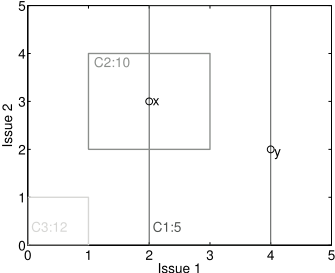
Figure 1: Example of a utility space with two issues and three constraints.
2 Contract and Constraint Sampling for Negotiation in Nonlinear Utility Spaces
2.1 Constraint-based Nonlinear Utility Spaces
Nonlinear agent preferences can be described by using different categories of functions [Zhang and Pu, 2004]. In this work we focus on nonlinear utility spaces generated by means of weighted constraints [Ito et al., 2007]. In these cases, agents' utility functions are described by defining a set of constraints. Each constraint represents a region with one or more dimensions, and has an associated utility value. The number of dimensions of the space is given by the number of issues n under negotiation, and the number of dimensions of each constraint must be lesser or equal than n. The utility yielded by a given potential solution (contract) in the utility space for an agent is the sum of the utility values of all the constraints that are satisfied by that contract. Figure 1 shows a very simple example of an agent's utility space for two issues and three constraints: a unary constraint C1 and two binary constraints C2 and C3. The utility values associated to the constraints are also shown in the figure. In this example, contract x would yield a utility value for the agent u(x) = 15, since it satisfies both C1 and C2, while contract y would yield a utility value u(y) = 5, because it only satisfies C1.
More formally, we can define the issues under negotiation as a finite set of variables x = {xi|i = 1, ..., n}, and a contract (or a possible solution to the negotiation problem) as a vector s = {xsi |i = 1, ..., n} defined by the issues' values. Issues take values from the domain of integers [0,X].
Agent utility space is defined as a set of constraints C = {ck|k = 1, ..., l}. Each constraint is given by a set of intervals which define the region where a contract must be contained to satisfy the constraint. In this way a constraint c is defined as c = {I c i |i = 1, ..., n}, where I c i = [xmin i , xmax i ] defines the minimum and maximum values for each issue to satisfy the constraint. Each constraint ck has an associated utility value u(ck).
A contract s satisfies a constraint c if and only if xsi ∈ I c i ∀i. For notation simplicity, we denote this as s ∈ x(ck), meaning that s is in the set of contracts that satisfy ck. An agent's utility for a contract s is defined as u(s) = ∑ck∈C|s∈x(ck) u(ck), that is, the sum of the utility values of all constraints satisfied by s. This kind of utility functions produce nonlinear utility spaces, with high points where many constraints are satisfied, and lower regions where few or no constraints are satisfied.
For this work, we will consider as the optimal contract of a negotiation the contract which satisfies the Nash product [Nash, 1953], that is, the contract which maximizes the product of the utilities of all agents involved in the negotiation. Though the search for such a contract could be performed in a complete information scenario using distributed constraint optimization techniques [Yokoo, 2001] or well-known nonlinear optimization techniques such as evolutionary algorithms, we are assuming a competitive scenario, where agents are unwilling to fully reveal their preference information. In these scenarios, these optimization techniques are not applicable, and therefore other approaches are needed, like the ones described in the following sections.
2.2 Contracts Sampling and Simulated Annealing in Bidding-based Nonlinear Negotiation
Ito et al. [Ito et al., 2007] presented a bidding-based protocol to deal with nonlinear utility spaces generated using weighted constraints. The protocol consists on the following four steps:
- Sampling: Each agent takes a fixed number of random samples from the contract space, using a uniform distribution.
- Adjusting: Each agent applies simulated annealing to each sample to try to find a local optimum in its neigborhood. This results in a set of high-utility contracts.
- Bidding: Each agent generates a bid for each highutility, adjusted contract. The bids are generated as the intersection of all constraints which are satisfied by the contract. Each agent sends its bids to the mediator, along with the utility associated to each bid.
- Deal identification: The mediator employs breadth-first search with branch cutting to find overlaps between the bids of the different agents. The regions of the contract space corresponding to the intersections of at least one bid of each agent are tagged as potential solutions. The final solution is the one that maximizes joint utility, defined as the sum of the utilities for the different agents.
2.3 MaximumWeight Independent Set and the Max-product Algorithm
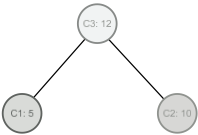
In [Marsa-Maestre et al., 2008], an alternative perspective for the bidding process is given, looking at the constraint-based agent utility space as a weighted undirected graph. Consider again the simple utility space example shown in Figure 1. Think about each constraint as a node in the graph, with an associated weight which is the utility value associated to the constraint. Now we will connect all nodes whose corresponding constraints are incompatibles, that is, they have no intersection. The resulting graph is shown in Figure 2.
To find the highest utility bid in such a graph can be seen as finding the set of unconnected nodes which maximizes the sum of the nodes' weights. Since only incompatible nodes are connected, the corresponding constraints will have nonnull intersection. In the example, this would be achieved by taking the set {C1, C2}. The problem of finding a maximum weight set of unconnected nodes is a well-known problem called maximum weight independent set (MWIS). Though MWIS problems are NP-hard, in [Bayati et al., 2008], a message passing algorithm is used to estimate MWIS. The algorithm is a reformulation of the classical max-product algorithm called "min-sum", and works as follows. Initially, every nodes i send their weights ωi to their neighbors N(i) as messages. At each iteration, each node i updates the message to send to each neighbor j by substracting from its weight ωi the sum of the messages received from all other neighbors except j. If the result is negative, a zero value is sent as message. Upon receiving the messages, a node is included in the estimation of the MWIS if and only if its weight is greater than the sum of al messages received from its neighbors. Message passing continues until MWIS converges or the maximum number of iterations is exceeded. This is formally shown in Algorithm 1.
Input:
i = 1, ..., n: nodes (constraints) in the weighted graph ωi|i = 1, ..., n: weight (utility) of each node (constraint) N(i): set of neighbors of each node (incompatible constraints) tmax: maximum number of iterations Output: MWIS: estimation of the MWIS t = 0; mti→j = ωi∀j ∈ N(i) while t < tmax do t = t +1; foreach i do mti→j = max{0, ωi - ∑k̸=j,k∈N(i) mt-1 k→i } end MWIS t = {i|ωi > ∑k∈N(i) mt-1 k→i } if t > 1 andMWIS t =MWIS t-1 then return MW IStSince the algorithm is deterministic, only one bid can be generated for a given set of constraints. To solve this, in [Marsa-Maestre et al., 2008], the algorithm is applied to a subset of constraints C′ = {c′k |k = 1, ..., nc; nc < l; c′k ∈ C}. The constraints c′k are randomly chosen from the constraint set C. In this way, a different constraint subset C′ is passed to the algorithm at each run, which will result in different, non-deterministic bids.
3 Bidding Mechanisms for Highly-nonlinear Utility Spaces
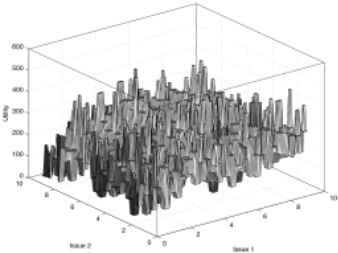
The use of weighted constraints generates a "bumpy" utility space, with many peaks and valleys. However, the degree of "bumpiness" is highly dependent on the way the constraint set is generated, and specially on the average width of the constraints. In [Ito et al., 2007], constraints are generated by choosing the width of each constraint in each issue randomly within the [3,7] interval. Since the domain is chosen to be [0,9], this generates rather "wide" constraints. Figure
3 shows an utility space obtained using "narrow" constraints, choosing their widths from the [1,5] interval. Though both utility spaces are nonlinear, the space generated using narrow constraints is more complex, with narrower peaks and valleys. As the number of issues under consideration increases, the differences between having wide or narrow constraints become more relevant. Though the approaches proposed in [Ito et al., 2007] and [Marsa-Maestre et al., 2008] work in scenarios defined using wide constraints, we will see that their performance (in terms of optimality and failure rate) decreases drastically in highly nonlinear scenarios defined using narrow constraints, and therefore an alternative approach is needed to deal with these highly nonlinear utility spaces.
3.1 Constraint/Bid Quality Factor
The main difference between utility spaces generated using wide or narrow constraints is the width of the peaks. Highlynonlinear scenarios will yield narrower peaks. Since the mechanisms outlined above lead agents to choose those peaks (or high-utility regions) as bids, the result is that narrower bids will be sent to the mediator. The width of the bids (or more generally, the volume of the bids, computed as the cardinality of the set of contracts which match the bid), will directly impact the probability that the bid overlaps a bid of another agent, and thus its viability, that is, the probability of the bid resulting in a deal. Intuitively, an agent with no knowledge of the other agents' preferences should try to adequately balance the utility of their bids (to maximize its own profit) and the volume of those bids (to maximize the probability of a successful negotiation). To formally represent this, we define the quality factor of a constraint or a bid as Qc = uαc · v1-α c , where uc and vc are, respectively, the utility and volume of the bid or constraint c, and α ∈ [0, 1] is a parameter which models the risk attitude of the agent. A risk averse agent (α < 0.5) will tend to qualify as better bids those that are wider, and thus are more likely to result in a deal. A risk willing or selfish agent (α > 0.5) will, in contrast, give more importance to bid utility.
Our hypothesis is that by taking into account this quality factor in the bidding mechanisms, with adequate values for the parameter α, will result in a better balance between utility and "width" in agent bids, and thus negotiations will yield higher optimality rates and lower failure rates.
3.2 Using the Quality Factor within the Simulated Annealing Algorithm
To make the simulated annealing bidding approach to take advantage of the quality factor Q is fairly straightforward. We just need to make the simulated annealing optimizer to search for contracts which maximize the quality factor Q instead of the agent utility. Since the quality factor Q is a feature of a region, not a contract, the adjusted contracts must be mapped to the high utility regions where they are contained before they are accepted or rejected by the simulated annealing engine. This can be easily done by checking all constraints in the agent preference model and computing the intersection of the constraints which are satisfied by the candidate contract. The volume of this intersection can then be used to compute the quality factor Q of the region.
3.3 Q-based Tournament Selection for the MWIS approach
The quality factor Q cannot be directly introduced into the max-product or min-sum algorithm, because the algorithm is based in a weighted graph where weights are additive, and the quality factor is not additive (that is, the quality factor of the intersection of a set of constraints is not the sum of the quality factor of the constraints). Thus, a different approach is needed to introduce this factor in the algorithm. We propose to use a tournament selection [Miller and Goldberg, 1995] based on the constraint quality factor Q when generating the subset of constraints C′ to be passed to the max-product algorithm. This tournament selection works as follows. For each bid to generate, a number nt of candidate constraint subsets are randomly generated. From these subsets, the one which maximizes the product of the quality factors Q of its constraints is chosen as the subset C′ to be used for the maxproduct algorithm. In this way, since high-Q constraints are more likely to be selected, we expect the average Q for the resulting bids to be higher.
4 A Probabilistic Mechanism for Deal-Identification
Scalability is identified as one of the main drawbacks in a bidding based negotiation protocol [Ito et al., 2007]. Once agents have placed their bids, the mediator performs an exhaustive search for overlaps between the bids using a breadthfirst algorithmwith branch cutting. In a worst case scenario, this means searching through a total of nna b bid combinations, where nb is the number of bids per agent, and na is the number of negotiating agents. In the experiments, the authors limit the number of combinations to 6, 400, 000. This means that, for 4 negotiating agents, the maximum number of bids per agent is na√6400000 = 50. This limit becomes harder as the number of agents increases. For example, for 10 agents, the limit is 4 bids per agent, which drastically reduces the probability of reaching a deal. This is specially true for highly-nonlinear utility spaces, where the bids are narrower.
To address this scalability limitation, we propose to perform a probabilistic search in the mediator instead of an exhaustive search. This means that the mediator will try a certain number nbc of randomly chosen bid combinations, where nbc < nna b . In this way, nbc acts as a performance parameter in the mediator, which limits the computational cost of the deal identification phase. Of course, restricting the search for solutions to a limited number of combinations may cause the mediator to miss good deals. Taking this into account, the random selection of combinations is biased to maximize the probability of finding a good deal. Again, the parameter used to bias the random selection is Q, so that higher-Q bids have more probability of being selected for bid combinations at the mediator.
5 Experimental Evaluation
The hypothesis of this work is that the proposed mechanisms provide an improvement to the optimality of the negotiation process over the previous works described in Section 2. To evaluate this, we have performed a set of experiments to compare the results of the basic approaches with the results obtained introducing the quality factor Q in the bidding and deal identification mechanisms.
5.1 Experimental Settings
Several experiments have been conducted to validate our hypothesis. In each experiment, we ran 100 negotiations between agents with randomly generated utility functions. Each negotiation was run for each of the different approaches analyzed. For each set of utility functions we applied a nonlinear optimizer to the product of all agents' utility functions to find the optimal contract using the Nash criterion and its associated joint utility value. As opposed to the optimization performed in the mediator during the negotiation, this optimal contract is computed using complete information about the agents preferences, so that it can be used to assess the optimality of the different approaches.
We ran experiments with the following parameters:
- Number of agents na = {4,...,14}. Number of issues n = {4,...,20}. Domain for issue values [0, 9].
- l uniformly distributed randomgenerated constraints per agent: 5 unary constraints, 5 binary contraints, 5 trinary constraints, etc.
- Utility for each m-ary constraint drawn from a uniform distribution in the domain [0, 100 × m].
- Different average widths for constraints, ranging from 2 to 7.
- Settings for simulated annealing: initial temperature T0 = 30. Number of iterations: 30.
- Maximum number of bids generated per agent nb = 200 × n.
- Parameters for Q calculation: α = 0.5.
- Parameters for tournament selection nc = min (20, l/2), nt = 10.
- Joint utility for a failed negotiation: 0.
Experiments were coded in Java and run on a 2x3.2Ghz Qad-Core Intel Xeon processor with 4Gb memory under Mac OS X 10.5.4.
5.2 Experimental Results
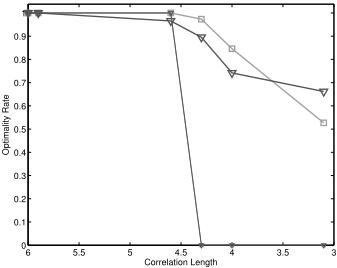
Figure 4 shows the results of 100 runs of the experiments for 6 agents and 6 issues. The vertical axis represents the median optimality rates of the experiments, while the horizontal axis represents the degree of non-linearity of the utility spaces of the agents, measured using a correlation length, which has been widely used to asses fitness landscape complexity in evolutionary computation [Weinberger, 1990]. Correlation length is defined as the minimum distance between samples in the utility space which makes the correlation between samples drop below a given threshold. For the purpose of this work, we have chosen a threshold of 0.7. Four sets of values have been represented: Q-based approaches are depicted using solid lines, while basic approaches are depicted using dashed lines. In each case, simulated annealing approaches have been represented using triangle vertices, while MWIS approaches have been represented using square vertices.
We can see that both basic contract sampling and basic constraint sampling yield high optimality rates for high correlation lengths, but the median optimality rate decreases drastically (in fact, it drops to zero) as the correlation length decreases (that is, for highly nonlinear utility spaces). The Q-based approaches yield slightly lower optimality rates for wider constraints, which is reasonable, since the Q is used to make a trade-off between utility and deal probability. However, as the agents' preference model turns highly nonlinear, introducing the quality factor Q in the bidding and deal identification mechanisms significantly outperforms the previous approaches, yielding acceptable optimality rates even with the lowest correlation lengths. From these results we can conclude that the quality factor Q can be used to improve failure rate in highly-nonlinear utility spaces, and both simulated annealing and tournament constraint selection with MWIS are suitable ways to select which constraints to use for bid generation.
| n | |||||
|---|---|---|---|---|---|
| na | Approach | 6 | 10 | 14 | 20 |
| 6 | MWIS MWIS-Q | 0.9915 0.9757 | 0.7521 0.9280 | 0 0.8964 | 0 0.8491 |
| 10 | MWIS MWIS-Q | 0.6732 0.9491 | 0 0.9329 | 0 0.9124 | 0 0.8331 |
| 14 | MWIS MWIS-Q | 0 0.9450 | 0 0.9420 | 0 0.8966 | 0 0.8313 |
| Approaches | Time Ratio | |
|---|---|---|
| median | conf. interval | |
| Tb; SA-Q / SA | 5.767 | [5.668, 5.866] |
| Tb; MWIS-Q / MWIS | 2.007 | [1.942, 2.071] |
| Td; Q-mediator / mediator | 1.8060 | [0.597, 3.016] |
| TT ; SA-Q / SA | 4.947 | [4.675, 5.219] |
| TT ; MWIS-Q / MWIS | 1.748 | [1.514, 1.982] |
| TT ; MWIS-Q / SA-Q | 0.1688 | [0.1665, 0.1710] |
Regarding scalability, Table 1 shows the optimality rates obtained for one of the studied approaches (MWIS) for a fixed maximum constraint width (5) when the number of agents and issues increases, comparing the results obtained using the basic approach with those obtained introducing the quality factor. We can see that introducing the quality factor Q in the mechanisms significantly improves scalability with the number of agents and issues.
Finally, Table 2 shows the medians and their 95% confidence intervals for the ratio between the times of our proposed approaches and their corresponding basic approaches. Separate results are shown for the bidding time (Tb), the deal identification time (Td), and the total negotiation time (TT ). We can see that for both contracts and constraints sampling the use of the quality factor Q introduces a certain overhead over the bidding and deal identification times, and that this overhead is specially significant in the case of simulated annealing bidding, due to the high number of times that the utility function must be evaluated. The comparison has been made for a high correlation distance (5), since for highly nonlinear utility spaces the basic approaches fail to find a solution.
6 Discussion and RelatedWork
In [Ito et al., 2007], the authors propose a single-shot, auction-based protocol which samples the contracts space and uses simulated annealing to identify high utility regions in the agent's utility spaces to be sent as bids to a mediator. In [Marsa-Maestre et al., 2008], instead of performing a direct sampling of the contract space, different techniques are used over the constraint space to generate bids. We use these works as a starting point to provide effective bidding and deal identification mechanisms for highly-nonlinear utility spaces, where the "narrowness" of the agents' high-utility regions makes the failure rate of their approaches drastically higher. Our approach is based on using a quality factor Q, which balances bid utility and bid volume to take into account the likelihood of the bid resulting in a deal. This is a somewhat similar approach to the notion of viability seen in [Lopez-Carmona and Velasco, 2006] for fuzzy-constraint based negotiation or the similarity criteria used in [Faratin et al., 2000] for linear utility spaces. Graph theory is also used in the context of negotiation in [Robu et al., 2005], where utility graphs are used to model issue inter-dependencies for binary-valued issues. We take advantage of graph theory in a different way, to perform a utility optimization in a constraint-based framework. There are other techniques for addressing non-linearity in negotiation. Instead of an auction based protocol, an alternating offers protocol is used in [Lai et al., 2008] for unmediated bilateral negotiation. Other technique is to approximate the utility functions by means of linear regression techniques or average weighting methods, as proposed in [Hindriks et al., 2006]. However, as authors acknowledge, these approaches are not useful for highly-nonlinear spaces.
7 Conclusions and Future work
The performance of existing auction-based approaches for negotiation in nonlinear scenarios dramatically decreases when confronted with highly nonlinear scenarios where the negotiating agents' high utility regions are very "narrow" and so it is very unlikely that high utility bids overlap. This paper presents a mechanisms to balance bid "width" and bid utility, and integrate this mechanism into two previous approaches. The experiments show that the proposed mechanisms significantly improve the previous approaches in highly nonlinear utility spaces in terms of failure rate and optimality. However, there is still plenty of research to be done in this area. The impact of the parameter α, which model the risk attitude of the agents, in the optimality rate should be analyzed, both to establish collective optimal strategies and to determine the incentive compatibility of the approach when agents involved in a negotiation may have different attitudes. Another challenge is the extension of the proposed approaches to handle other utility models not based on constraints, like quasi-concave functions. Finally, we are working on iterative negotiation protocols, where agents may change their attitudes or relax their bids as the protocol iterates.
Acknowledgments
This work has been partially developed in the framework of the ITEA-2 project 2008005, "Do-it-Yourself Smart Experiences", and partially supported by the Spanish Ministry of Education and Science grant TIN2008-06739-C04-04.
@inproceedings{ijcai2009p45,
  title     = {Balancing Utility and Deal Probability for Auction-Based Negotiations in Highly Nonlinear Utility Spaces},
  author    = {Marsá-Maestre, Ivan and López-Carmona, Miguel A. and Velasco, Juan R. and Ito, Takayuki and Klein, Mark and Fujita, Katsuhide},
  booktitle = {Proceedings of the Twenty-First International Joint Conference on
               Artificial Intelligence, {IJCAI-09}},
  publisher = {International Joint Conferences on Artificial Intelligence},
  editor    = {Craig Boutilier},
  pages     = {214--218},
  year      = {2009},
  url       = {https://ijcai.org/proceedings/2009/45},
}
TY - CPAPER TI - Balancing Utility and Deal Probability for Auction-Based Negotiations in Highly Nonlinear Utility Spaces AU - Marsá-Maestre, Ivan AU - López-Carmona, Miguel A. AU - Velasco, Juan R. AU - Ito, Takayuki AU - Klein, Mark AU - Fujita, Katsuhide T2 - Proceedings of the Twenty-First International Joint Conference on Artificial Intelligence, IJCAI-09 PB - International Joint Conferences on Artificial Intelligence PY - 2009 SP - 214 EP - 218 UR - https://ijcai.org/proceedings/2009/45 ER -Copied
Machine-readable versions of this paper, for tools and AI agents:





