
Efficient Searching Top-k Semantic Similar Words
Proceedings of the Twenty-Second International Joint Conference on Artificial Intelligence. Pages 2373-2377.
Abstract
Measuring the semantic meaning between words is an important issue because it is the basis for many applications, such as word sense disambiguation, document summarization, and so forth. Although it has been explored for several decades, most of the studies focus on improving the effectiveness of the problem, i.e., precision and recall. In this paper, we propose to address the efficiency issue, that given a collection of words, how to efficiently discover the top-k most semantic similar words to the query. This issue is very important for real applications yet the existing state-of-the-art strategies cannot satisfy users with reasonable performance. Efficient strategies on searching top-k semantic similar words are proposed. We provide an extensive comparative experimental evaluation demonstrating the advantages of the introduced strategies over the state-of-the-art approaches.
- [Bollegala et al., 2007] D. Bollegala, Y. Matsuo, and M. Ishizuka. Measuring semantic similarity between words using web search engines. In WWW, 2007.
- [Budanitsky and Hirst, 2006] A. Budanitsky and G. Hirst. Evalu- ating wordnet-based measures of lexical semantic relatedness. Comput. Linguist., 2006.
- [Deerwester et al., 1990] S. Deerwester, S. T. Dumais, G. W. Fur- nas, T. K. Landauer, and R. Harshman. Indexing by latent se- mantic analysis. JASIST, 1990.
- [Fagin et al., 2001] R. Fagin, A. Lotem, and M. Naor. Optimal ag- gregation algorithms for middleware. In PODS, 2001.
- [Hellerstein et al., 1999] J. M. Hellerstein, R. Avnur, A. Chou, C. Hidber, C. Olston, V. Raman, T. Roth, and P. J. Haas. Interactive data analysis: The control project. Computer, 1999.
- [Jiang and Conrath, 1997] J. Jiang and D. Conrath. Semantic sim- ilarity based on corpus statistics and lexical taxonomy. In RO- CLING, 1997.
- [Leacock and Chodorow, 1998] C. Leacock and M. Chodorow. Combining local context and WordNet similarity for word sense identification. In C. Fellbaum (Ed.), MIT Press, 1998.
- [Li et al., 2003] Y. Li, Z. A. Bandar, and D. McLean. An approach for measuring semantic similarity between words using multi- ple information sources. IEEE Trans. on Knowl. and Data Eng., 2003.
- [Miller, 1995] G. A. Miller. Wordnet: a lexical database for english. Commun. ACM, 1995.
- [Pantel et al., 2009] P. Pantel, E. Crestan, A. Borkovsky, A. M. Popescu, and V. Vyas. Web-scale distributional similarity and entity set expansion. In EMNLP, 2009.
- [Rada et al., 1989] R. Rada, H. Mili, E. Bicknell, and M. Blettner. Development and application of a metric on semantic nets. IEEE Trans. Sys., Man, and Cyber., 1989.
- [Resnik, 1995] P. Resnik. Using information content to evaluate semantic similarity in a taxonomy. In IJCAI, 1995. IJCAI
- [Shannon, 1948] C. E. Shannon. A mathematical theory of com- munication. Bell System Technical Journal, 1948.
- [Tsatsaronis et al., 2010] G. Tsatsaronis, I. Varlamis, and M. Vazir- giannis. Text relatedness based on a word thesaurus. J. Artif. Int. Res., 2010.
- [Turney, 2001] P. D. Turney. Mining the web for synonyms: Pmi-ir versus lsa on toefl. In ECML, 2001.
- [Ukkonen, 1992] E. Ukkonen. Approximate string-matching with q-grams and maximal matches. Theor. Comp. Sci., 1992.
- [Wu and Palmer, 1994] Z. Wu and M. Palmer. Verbs semantics and lexical selection. In ACL, 1994.
- [Yang et al., 2010] Z. Yang, J. Yu, and M. Kitsuregawa. Fast algo- rithms for top-k approximate string matching. In AAAI, 2010.
References were extracted automatically from the PDF and may contain errors.
Full text extracted automatically from the PDF; figures, tables and equations may differ. The PDF is the version of record.
1 Introduction
Searching semantic similar words is an important issue because it involves many applications, such as query suggestion, word disambiguation, machine translation, and so forth. From a given collection of words, such queries ask for those words that are most (i.e., top-k) semantically similar to a given one.
Intuitively, the problem can be solved by firstly measuring the semantic similarity score between the query and each word in the collection using the state-of-the-art techniques [Resnik, 1995; Turney, 2001; Li et al., 2003; Budanitsky and Hirst, 2006; Bollegala et al., 2007; Tsatsaronis et al., 2010], and then sorting them with regard to the score, and finally extracting those top-k ones. However, the scale of the problem has dramatically increased and prevented existing strategies from conducting on large volume of data (i.e., the Web). Note that almost all the previous work focus on improving the effectiveness of the problem (i.e., precision and recall) yet this paper is the first study in the literature on addressing the efficiency issue, which is rather challenging especially when conducting on large datasets. Another issue is that most of the previous works are rooted in a threshold-based framework and the similarity threshold is difficult to predefine by common users because many answers may be returned if the value is too small and there may be no answers if the value is too large. Therefore, searching for the top-k most similar words is an interesting problem, as will be tackled in this paper.
The issue of finding similar words can be traced back to the 1940s [Shannon, 1948] in the theory field where n-gram was first introduced. Two words are considered similar to each other if they have enough common subsequences (i.e., n-grams). While there are quite a few works on studying and extending n-gram based strategies [Ukkonen, 1992] and they have been successfully applied in some applications such as spell checking, this line of work only takes into account the syntax of words and ignore the semantic meaning.
To remedy this problem, extensive studies have been explored and they can be classified into three main groups: (1) knowledge-based 1 strategies [Rada et al., 1989; Resnik, 1995]; (2) corpus-based strategies [Turney, 2001]; and (3) hybrid methods [Bollegala et al., 2007].
Due to the large datasets we may have, there are two main issues existing in the top-k semantic similar word extraction: (1) progressiveness [Hellerstein et al., 1999]. The first results should be output to the user almost instantly, and the algorithm should produce more and more results the longer the execution time (i.e., first the top-1, then the top-2, and finally the top-k answer); and (2) inefficiency on similarity measuring. Evaluating the similarities of all candidate pairs is time consuming. This issue becomes even worse if more features are taken into account. In this work we aim to address these two challenges.
Materializing all the similarities of word pairs in the preprocessing may (partially) tackle the mentioned issues [Pantel et al., 2009]. However, the difficulty is that the data (e.g., the Web) is frequently updated. Re-computing and storing all the similarities is space and time consuming. Moreover, it is possible that new similarity metric will be introduced. Therefore, computing the similarities on-the-fly seems to be a practical solution. Furthermore, it is impossible to materialize the string similarity beforehand. The reason is that we cannot predict a user's query, that it may be never seen before (i.e., misspelled word).
It should be noted that there exists some other optimization strategies (e.g., caching, parallel computing). However, all of these methods require specific techniques (e.g., appropriate caching algorithm) and thus, the extension to these strategies is out of the scope of this paper.
1 It is also called dictionary-based or lexicon-based.
The contributions of this paper are as follows:
- We propose to tackle the efficiency issue of searching top-k semantic similar words, which is different from most previous works that concern on the effectiveness aspect. The comprehensive similarity employed in this paper is composed of three representative kinds of measures. More similarities can be taken into account for the framework, as will be discussed in this paper.
- We propose efficient strategies to extract the top-k results. For each similarity measure, we introduce a corresponding best first search method to minimize the number of candidates to be evaluated. A rank aggregation approach is presented to optimally obtain the top-k results when assembling the features.
- We conduct comprehensive experiments on two real datasets, and evaluate the query efficiency of the proposed strategies in terms of several aspects. The results show that the proposed strategies exhibit a superior performance compared with the state-of-the-art approaches (i.e., more than two orders of magnitude improvement).
2 Problem Statement and Analysis
We consider the top-k semantic similar word query on a given collection of words W. Formally, for a query word Q, finding a set of k words R in W most similar to Q, that is, ∀r ∈ R and ∀s ∈ (W - R) will yield sim(Q, r) ≥ sim(Q, s).
To measure the similarity sim(Q, P) between two words Q and P , we apply the state-of-the-art strategy by assembling multiple similarity metric features together [Li et al., 2003; Bollegala et al., 2007]. Because we focus on tackling the efficiency issue in this paper, for simplicity we select three representative features from the main categories in word similarity measuring literature.
- Knowledge-based Similarity: Word dictionaries, e.g., WordNet [Miller, 1995], have been acted as the knowledge base for text processing. The words are linked manually with labels and organized in a taxonomy manner (i.e., tree). An intuitive idea on measuring similarity is that words are similar to each other if the shortest path between them is small [Rada et al., 1989]. This edge counting strategy has been extended later by taking into account the depth [Wu and Palmer, 1994; Leacock and Chodorow, 1998], semantic density [Jiang and Conrath, 1997], and information content [Resnik, 1995] of the words in the knowledge base. In this paper, we consider a representative metric, Leacock & Chodorow [Leacock and Chodorow, 1998], defined as:
where length is the length of the shortest path between two concepts (that the two words w1 and w2 belong to) using node-counting, and D is the maximum depth of the taxonomy.
- Corpus-based Similarity: Corpus-based measures of word semantic similarity try to recognize the degree of similarity between words using large corpora. The intuitive idea is that two words are similar to each other if they co-occur frequently in the large corpus. There are several kinds of strategies: PMI-IR (Pointwise Mutual Information-Information Retrieval) [Turney, 2001] uses web search engine (i.e., AltaVista) to gather the existence information from the Web; LSA (Latent Semantic Analysis) ([Deerwester et al., 1990]) applies Singular Value Decomposition (SVD) to analyze the statistical information between words and then further obtain their semantic relationship. Some other strategies include log-likelihood, chi-square, MI (Mutual Information), and so forth. In this paper, we choose PMI-IR as one of the representative similarity measures between two words, w1 and w2, defined as:
where pagecount(wi) is the number of documents retrieved when wi is submitted to the search engine (i.e., Google).
- String similarity: String similarity measures the difference of syntax between words. An intuitive idea is that two words are similar to each other if they have enough common subsequences (i.e., n-gram [Shannon, 1948]). We focus on a representative string similarity measure, i.e., edit distance, denoted as Simed(w1, w2).
2.1 AGeneral Framework
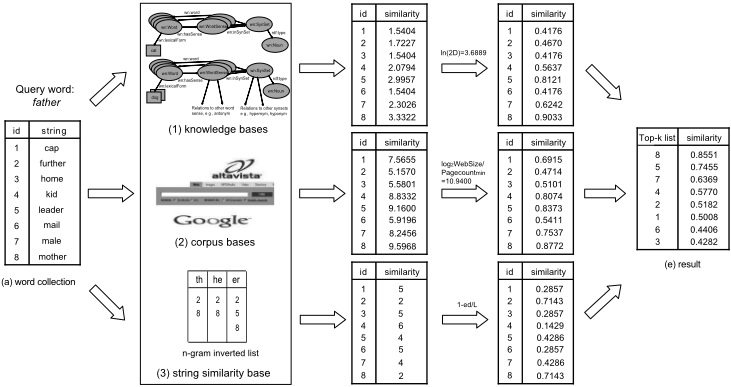
A general framework of searching top-k similar words is illustrated in Fig. 1, with a concrete example presented to ground our discussion. The query word and each candidate in the collection are sent to the three modules (i.e. knowledge bases, web search engine, and string similarity evaluator), respectively, to obtain the corresponding similarity score. Then, the scores from different modules are normalized, assembled, and ranked, resulting in the final ranked lists [Li et al., 2003; Bollegala et al., 2007].
˜
To normalize the scores, we have Simlch(Q, P) = Simlch(Q,P ) ln(2∗Dmax) , where Dmax 2 denotes the maximum value of D for all the taxonomies of the collection. The PMI-IR similarity is normalized as ˜ Simpmi-ir = Simpmi-ir log2 WebSize pagecountmin ,
where pagecountmin(P)3 denotes the minimum value of pagecount for words in the collection. WebSize is set to 1012 according to the report of Google 4 . The edit distance is normalized as ˜ Simed(Q, P ) = 1Simed(Q,P ) Lmax , whereLmax5 is the maximum word length in the collection.
The assembling strategy follows the state-of-the-art approaches on measuring semantic similarity [Li et al., 2003;
2 For this concrete example, by querying WordNet Dmax=20.
3 We have pagecountmin(P )=5.09 ∗ 108 by querying Google.
4 http://googleblog.blogspot.com/2008/07/we-knew-web-wasbig.html
5 For this example, the value of Lmax is 7.
(b) features used to measure similarity (c) raw similarity score of each feature (d) normalized similarity score
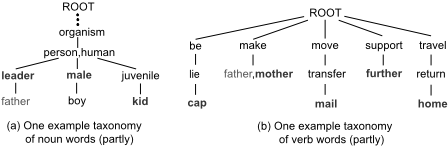
Figure 2: Top-k word searching on WordNet
Fig. 2 (a)). According to the definition of Simlch 6 (i.e., Eq. 1), we know that the ranking of a candidate only depends on its shortest path to the query. We can simply start from the node of the query, then expand to its neighbors in a recursive manner to find similar words.
The query word could be polysemous and we next address the issue when the query and the candidates exist in more than one taxonomy (i.e., Fig. 2 (a) and (b)). In this case, the ranking of a candidate not only depends on the shortest path in a taxonomy but also the maximum depth of the taxonomy. Derived from Eq. 1, we have the following lemma:
Lemma 1 (ordering inWordNet) Let Q be the query. Let P and S be two candidates which exist in the same taxonomy of Q, i.e., TP and TS, respectively. The shortest path between P (or S) and Q is LP (or LS) in TP (or TS). The maximum depth of TP (or TS) is DP (or DS). Compared with S, P is more similar to Q if we have DP LP > DS LS .
This lemma tells us that the similarity ordering between candidates in WordNet is dependent on the integration of the shortest path and the maximum depth of the taxonomy. Therefore, a best first search strategy can be constructed and the self-explanatory pseudo code for searching top-k similar words is shown in Algorithm 1.
We illustrate the main process of the algorithm (i.e., order of nodes accessed) in Fig. 3 by using the aforementioned example. The sequentially accessed nodes should
6 Normalization does not affect the ranking here.
Bollegala et al., 2007]:
˜
where Simi represents a specific feature of similarity measure, wi denotes the corresponding weight of the feature, and n is the total number of features taken into account.
Due to lack of large labeled data, the existing state-ofthe-art assembling techniques on semantic similarity measure commonly set the weight values arbitrarily [Li et al., 2003]. We apply the same strategy by emphasizing the effect of semantic similarity (i.e., wlch=wpmi-ir=2wed) and ∑ni=1 wi=1. While obtaining optimal values of these weights is certainly an interesting issue, it is out of the scope of this paper. We argue that this work is orthogonal to the existing effectiveness-oriented studies in a complementary manner.
For the example as illustrated in Fig. 1, all the eight candidates need to be evaluated with the query father and the top-3 semantic similar words are mother, leader, and male.
3 Proposed Approaches
We first introduce best first search strategies for different similarity measures in Section 3.1-3.3, and then present a rank aggregation algorithm to assemble the features in Section 3.4.
3.1 Knowledge based Feature
WordNet is employed as the knowledge base in this paper. The traditional strategy is to measure the similarity of each candidate word and the query, by traversing the topology of WordNet. However, it is inefficient because every candidate needs to be tested. Fig. 2 illustrates the example aforementioned, where every pair of red word (query) and blue word (candidate) is evaluated.
We propose a best first search strategy to efficiently obtain the top-k similar words. We first tackle the issue when the query and the candidate exist in the same taxonomy (e.g.,
---------------------------------
--------------------------------- Input: Query Q, word collection WC, WordNet WN, k Output: Top-k similar words inWC // preprocessing n=number of taxonomies inWN; 1 D[1,n]=a list of maximal depth of taxonomies inWN; 2 I=an index that associates nodes inWN to words inWC; 3 // query processing m=number of polysemous meaning of Q; 4 T[1,m]=a list of taxonomy ID that Q belongs to; 5 L[1,m]=a list of lengths (hops fromQ), initialized as 1; 6 N[1,m]=a list of visited nodes in taxonomies, initialized as the nodes that Q 7 belongs to; while not k words are output do 8 τmax=0; IDmax=0; 9 for i=1 to m do // look for node to expand 10 τi= D[T [i]] L[i] ; 11 if τi > τmax then τmax=τi; IDmax=i; 12 forall p ∈ NIDmax do // expand nodes 13 NN=neighbor nodes of p that are unvisited; 14 foreach node e ∈ NN do 15 if e ∈ WC based on I then output e; k=k-1; 16 N[IDmax]=N[IDmax] ∪ NN; 17 L[IDmax]++; 18 End 19---------------------------------
order of nodes accessed
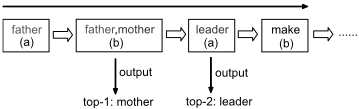
be: (1) father in the noun taxonomy (i.e., DL =20) 7 ; (2) father,mother in the verb taxonomy (i.e., DL =14); (3) leader in the noun taxonomy (i.e., DL =10); and so forth. As we can see, the top-k results are output in a progressive manner (i.e., mother, leader, etc).
3.2 Corpus based Feature
To obtain the top-k similar words based on large corpus (i.e., the Web), the traditional strategy is to submit the query and each candidate to the search engine and compute their similarity (i.e., PMI-IR [Turney, 2001]). Although this technique can benefit a lot from the power of search engine, evaluating every candidate pair words may cause large computation cost (i.e., network delay time used to transfer words to search engine and return answer, computation time at server, and parsing time on the answer stream). This issue becomes worse when testing on huge word collection.
In this paper, we propose to evaluate as few candidates as possible. We achieve this by constructing a simple index in the preprocessing, according to the following lemma.
Lemma 2 (upper bound of word pagecount) Let Qbe the query word and P be the top-k candidate similar word so far. Q and P have the PMI-IR similarity score as τtop-k. We denote the set R of the remaining untested words. If ∀r ∈ R, pagecount(r) > WebSize 2τtop-k , then the top-k similar words w.r.t. PMI-IR score have been found.
7 The maximum depths of the two taxonomies are 20 for noun and 14 for verb by querying WordNet in the preprocessing.
Proof [Sketch of Proof] (Proof by Contradiction) Assume there is one candidate word r which has pagecount(r) > WebSize 2τtop-k in R and it is ranked in the top-k list. Then we have
τtop-k ≤ log2 pagecount(Q ∩ r) ∗ WebSize pagecount(Q) ∗ pagecount(r) ≤ log2 pagecount(Q) ∗ WebSize pagecount(Q) ∗ pagecount(r) , hence pagecount(r) ≤ WebSize 2τtop-kwhich contradicts the assumption.
□
This lemma tells us that we can sort all the candidates in ascending order of their pagecount in the preprocessing, and measure the similarity while querying one by one. If we find that the pagecount of the current candidate word is greater than WebSize 2τtop-k , we can terminate the process and thus, avoid to evaluate the remaining candidates. The pseudo code is shown in Algorithm 2. To progressively extract the top-k similar words, we partition the whole process into k iterations. In each iteration only the best one word is output (lines [9-11]). Therefore, in each iteration we set the threshold as the top-1 score of the visited words (line [7,15]).
---------------------------------
--------------------------------- Input: Query Q, word collection WC, k Output: Top-k similar words inWC // preprocessing n=number of words in WC; 1 H[1,n]=a list of pagecount in ascending order by querying Google; 2 τtop-1=0; m=1; 3 // query processing pagecount(Q)=pagecount of Q; 4 while not k words are output do 5 if |q| > 0 then // q: max queue stores visited words 6 τtop-1=the score value τ of q.top; 7 foreach i=m to n do 8 if H[i] > WebSize 2τtop-1 then 9 pop and output q.top; 10 m=i; break; 11 P=the word corresponding to H[i]; 12 τ =log2 pagecount(Q∩P )·W ebSize pagecount(Q)·pagecount(P ) ; 13 push P into q with value τ ; 14 τtop-1=the score value τ of q.top; 15 End 16 ---------------------------------3.3 String Similarity Feature
There are not many studies on exploring how to efficiently search top-k similar words with respect to string similarity [Yang et al., 2010]. In this paper, we apply the existing efficient strategies. Specifically, they are (1) count filtering; (2) length filtering; and (3) divide-merge-skip.
3.4 Assembling Similarity Features
Given the progressively extracted words in each feature, i.e., the result obtained from the above sections 8 , we introduce an efficient approach to hasten the process of searching top-k similar words, based on the traditional rank aggregation algorithm [Fagin et al., 2001].
8 The transformation from the raw score to its normalized value is achieved by the approach presented in Section 2.1.
Lemma 3 (threshold filtering) Let ˜ Simtop-k i be the normalized similarity score of the top-k word in feature i. Let t be the threshold where t=∑ wi · ˜ Simtop-k i . A word P is in the top-k list if the following condition holds: ∑ wi · ˜ Simi(P, Q) ≥ t.
One interesting observation is that if we have a candidate word P whose total similarity score ∑ wi · ˜ Simi(P, Q) ≥ t, there is at least for one feature that ˜ Simi(P, Q) ≥ ˜ Simtop-k i . This intuition introduces a possible way to progressively output the top-k results. To illustrate the process, we use the aforementioned example to explain, as shown in Fig. 4.
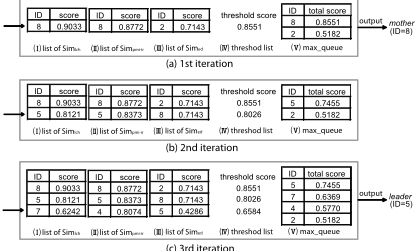
In the first iteration, we obtain the top-1 words with their scores in all the features, as shown in Fig. 4 (a) (I-III). Next we can calculate the threshold t=∑ wi · ˜ Simtop-1 i =0.8551, where the weights are set as described in Section 2.1. Moreover, we compute the comprehensive score of the accessed words (i.e., whose IDs are 8 and 2) 9 and put them into a maximum queue, as shown in Fig. 4 (a) (V). Because the score of word mother (i.e., whose ID is 8) is not smaller than the threshold, mother can be output immediately as the top-1 result (Lemma 3). We can see that for this example, the performance of obtaining the top-1 result is very efficiently because we avoid to evaluate many candidates. The remaining processes are executed in a similar way, as illustrated in Fig. 4.
4 Performance Analysis
We performed the experiments using a Intel(R) Core(TM) 2 Dual CPU PC (3GHz) with a 2G memory, running Redhat linux. The Naive algorithm was implemented based on the general top-k framework (Section 2.1). The BFS-WSM (Best First Search for Word Semantics Measure) algorithm was designed using the proposed strategies in this paper. We conducted experiments on two real life datasets: (1) Dict. It was downloaded from the Web site of GNU Aspell project 10 . It included 51K words; and (2) Word. It was downloaded from the Web site of WordNet in US 11 , which includes 149K words. We randomly selected 10K words from this data as our word collection.
9 Here we need to randomly access the value in each feature, by measuring it using traditional techniques.
10 http://www.aspell.net/
11 http://wordnet.princeton.edu/
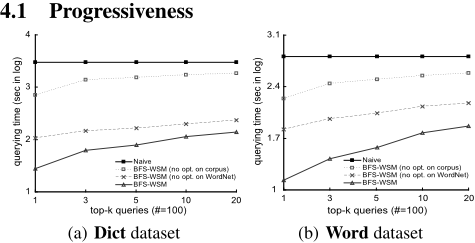
Figure 5: Progressiveness of query performance The progressiveness performance of the proposed algorithm was evaluated by varying k. We randomly selected 100 queries from the datasets and reported the average value. To test the effect of the proposed strategies, we disable each one of them while keeping others unchanged 12 .
The result is shown in Fig. 5. We can see that Naive outputs all the top-k results at the same time, and much slower than BSF-WSM (i.e., more than two orders of magnitude slower for top-1 query on Dict data, as illustrated in Fig. 5 (a)). In contrast, our algorithm can extract the top-k (i.e., 1) answer efficiently, and progressively extract more results the longer the execution time. For the effect of different optimization strategies, optimization on corpus-based similarity measuring seems to dominate the whole query processing (i.e., red line in the figure). This is not surprising because the cost of requesting word pagecount to search engine is high. Moreover, we can see that the proposed two optimizations (i.e., measuring on WordNet and corpus similarities) account for most of the performance improvement.
4.2 Number of CandidateWords Accessed
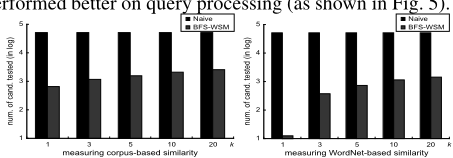
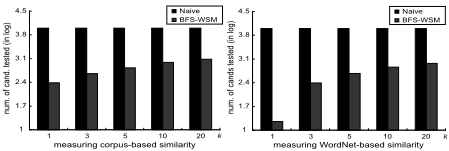
We evaluate the number of candidates tested in algorithms when varying k. As illustrated in Fig. 6, we can see that BSF -WSM accesses much smaller sets of words compared with Naive. This is the intrinsic reason why our algorithm performed better on query processing (as shown in Fig. 5).
12 We focus on the effect of optimizing WordNet and corpus based measure, because the cost of measuring string similarity is much smaller and can be neglected compared with others.
4.3 Effect of Pagecount and Depths
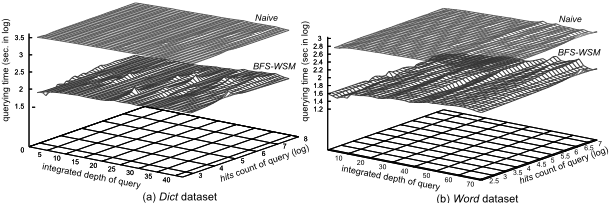
While conducting experiments, we mentioned that different queries may have distinct performance from each other. A "popular" word, i.e., that with large value of pagecount and more meanings, has a high probability to be tested with more candidates. We also found that the depths of a word in the synsets of WordNet are critical to the performance because of the definition of the Simlch and the computation of the shortest path. Specifically, we define the integrated depth of a word as the sum of all the depths of the word in the corresponding synsets of WordNet. Fig. 7 illustrates the performance of each randomly selected query. We can see that for Naive, the performance fluctuation is not obvious. The reason is that the cost of obtaining pagecount is constant and it dominants the performance. In contrast, BFS-WSM largely reduces the number of candidates for acquiring pagecount. Therefore, the performance of queries may be very different from each other by taking into account the effect of optimization on WordNet similarity. Moreover, the result illustrates that many queries with high pagecount and large value of integrated depth spend more time on extracting the result, which is in accordance with the intuition mentioned above.
5 Discussion
Other similarity measures can be taken into account in a similar way to the proposed strategies. For example, for the information content based measures (e.g., [Resnik, 1995]), we can build an index similar to the n-gram list. Each word in the information content can be seen as a unigram and the corresponding list contains all the words whose information contents have the same gram. Then the candidate whose frequency is the highest in the lists of the query's grams is firstly evaluated, and so forth. For the other path-based measures (e.g., [Wu and Palmer, 1994]), we can optimally choose the nearest candidates to the query based on the specific measure.
6 Conclusion
We have studied the top-k similar word searching issue. This is the first work on tackling the efficiency issue that is very important for searching on large data. Several efficient strategies are proposed following the best first search manner. Our strategies are experimentally demonstrated to be efficient on answering the top-k semantic similar word queries.
@inproceedings{ijcai2011p395,
  title     = {Efficient Searching Top-k Semantic Similar Words},
  author    = {Yang, Zhenglu and Kitsuregawa, Masaru},
  booktitle = {Proceedings of the Twenty-Second International Joint Conference on
               Artificial Intelligence, {IJCAI-11}},
  publisher = {AAAI Press/International Joint Conferences on Artificial Intelligence},
  editor    = {Toby Walsh},
  pages     = {2373--2377},
  year      = {2011},
  month     = {7},
  doi       = {10.5591/978-1-57735-516-8/IJCAI11-395},
  url       = {https://doi.org/10.5591/978-1-57735-516-8/IJCAI11-395},
}
TY - CPAPER TI - Efficient Searching Top-k Semantic Similar Words AU - Yang, Zhenglu AU - Kitsuregawa, Masaru T2 - Proceedings of the Twenty-Second International Joint Conference on Artificial Intelligence, IJCAI-11 PB - AAAI Press/International Joint Conferences on Artificial Intelligence PY - 2011 SP - 2373 EP - 2377 DO - 10.5591/978-1-57735-516-8/IJCAI11-395 UR - https://doi.org/10.5591/978-1-57735-516-8/IJCAI11-395 ER -Copied
Machine-readable versions of this paper, for tools and AI agents:





