
Leadership in Singleton Congestion Games
Proceedings of the Twenty-Seventh International Joint Conference on Artificial Intelligence. Main track. Pages 447-453.
https://doi.org/10.24963/ijcai.2018/62
Keywords
- Agent-based and Multi-agent Systems: Noncooperative Games
- Agent-based and Multi-agent Systems: Algorithmic Game Theory
Abstract
We study Stackelberg games where the underlying structure is a congestion game. We recall that, while leadership in 2-player games has been widely investigated, only few results are known when the number of players is three or more. The intractability of finding a Stackelberg equilibrium (SE) in normal-form and polymatrix games is among them. In this paper, we focus on congestion games in which each player can choose a single resource (a.k.a. singleton congestion games) and a player acts as leader. We show that, without further assumptions, finding an SE when the followers break ties in favor of the leader is not in Poly-APX, unless P = NP. Instead, under the assumption that every player has access to the same resources and that the cost functions are monotonic, we show that an SE can be computed efficiently when the followers break ties either in favor or against the leader.
- [Ackermann et al., 2008] Heiner Ackermann, Heiko Röglin, and Berthold Vöcking. On the impact of combinato- rial structure on congestion games. Journal of the ACM (JACM), 55(6):25, 2008.
- [Basilico et al., 2017] Nicola Basilico, Stefano Coniglio, and Nicola Gatti. Methods for finding leader-follower equilibria with multiple followers. CoRR, abs/1707.02174, 2017.
- [Coniglio et al., 2017] Stefano Coniglio, Nicola Gatti, and Alberto Marchesi. Pessimistic leader-follower equilibria with multiple followers. In IJCAI, pages 171-177, 2017. IJCAI
- [Conitzer and Korzhyk, 2011] Vincent Conitzer and Dmytro Korzhyk. Commitment to correlated strategies. In AAAI, pages 632-637, 2011.
- [Conitzer and Sandholm, 2006] Vincent Conitzer and Tuo- mas Sandholm. Computing the optimal strategy to commit to. In Proceedings of the 7th ACM conference on Elec- tronic commerce, pages 82-90, 2006.
- [De Nittis et al., 2018] Giuseppe De Nittis, Alberto March- esi, and Nicola Gatti. Computing the optimal strategy to commit to in polymatrix games. In AAAI, pages 82-90, 2018.
- [Fotakis, 2010] Dimitris Fotakis. Stackelberg strategies for atomic congestion games. Theory of Computing Systems, 47(1):218-249, 2010.
- [Garey and Johnson, 1979] M. R Garey and D. S. Johnson. Computers and Intractability: A Guide to the Theory of NP-completeness. WH Freeman and Company, 1979.
- [Ieong et al., 2005] Samuel Ieong, Robert McGrew, Eugene Nudelman, Yoav Shoham, and Qixiang Sun. Fast and com- pact: A simple class of congestion games. In AAAI, pages 489-494, 2005.
- [Monderer and Shapley, 1996] Dov Monderer and Lloyd S Shapley. Potential games. Games and economic behav- ior, 14(1):124-143, 1996.
- [Rosenthal, 1973] Robert W Rosenthal. A class of games possessing pure-strategy nash equilibria. International Journal of Game Theory, 2(1):65-67, 1973.
- [Roughgarden, 2004] Tim Roughgarden. Stackelberg scheduling strategies. SIAM Journal on Computing, 33(2):332-350, 2004.
- [Shoham and Leyton-Brown, 2008] Yoav Shoham and Kevin Leyton-Brown. Multiagent systems: Algorithmic, game-theoretic, and logical foundations. Cambridge University Press, 2008.
- [Tambe, 2011] Milind Tambe. Security and Game Theory: Algorithms, Deployed Systems, Lessons Learned. Cam- bridge University Press, 2011.
- [Von Stengel and Zamir, 2010] Bernhard Von Stengel and Shmuel Zamir. Leadership games with convex strategy sets. Games and Economic Behavior, 69(2):446-457, 2010.
References were extracted automatically from the PDF and may contain errors.
Full text extracted automatically from the PDF; figures, tables and equations may differ. The PDF is the version of record.
1 Introduction
The problem of finding a Stackelberg equilibrium (SE) when mixed-strategy commitments are allowed is receiving a lot of attention in the artificial intelligence literature, also thanks to the many successful real-world applications in, e.g., security [Tambe, 2011]. In Stackelberg games, a player acts as leader, committing to a (potentially) mixed strategy, while the other players act as followers [Von Stengel and Zamir, 2010]. Different versions of SEs can be defined based on how the followers break ties: optimistic (OSE) if in favor of the leader, and pessimistic (PSE) if against her.
Finding an OSE or a PSE in 2-player normal-form games is easy, as shown by, respectively, Conitzer and Sandholm [2006] and Von Stengel and Zamir [2010]. The same holds for finding an OSE in n-player games where the followers play simultaneously in a correlated fashion [Conitzer and Korzhyk, 2011]. Inmore general situations, though, the problem is hard. Indeed, computing an O/PSE for normal-form games with two followers who play simultaneously a Nash equilibrium (NE) is not in Poly-APX unless P = NP [Basilico et al., 2017]. In polymatrix games with the followers restricted to pure strategies, finding an OSE is not in Poly-APX unless P = NP if the number of followers is not fixed, while it is easy if their number is a constant [De Nittis et al., 2018]. Finding a PSE is NP-hard in normal-form games even with two followers playing pure strategies [Coniglio et al., 2017]. Finding an OSE is also NP-hard [Conitzer and Sandholm, 2006] with multiple followers playing sequentially.
We focus, here, on congestion games (CGs)-game models which, in spite of their simplicity, enjoy nice computational properties even with many players-with the aim of investigating whether, in these games, a Stackelberg paradigm is computationally tractable. In CGs, given a set of resources, the players' actions are subsets of the resources and the costs the players perceive depend (monotonically or not) on the level of resource utilization (congestion). CGs always admit pure-strategy NEs which are achievable by best-response dynamics [Rosenthal, 1973; Monderer and Shapley, 1996]. CGs where each player cannot use more than a single resource are called singleton CGs (SCGs). Computing their NEs is easy [Ackermann et al., 2008]. Furthermore, in SCGs in which all the players have the same action space, finding a social-cost minimizing NE is also easy [Ieong et al., 2005].
Original contributions. We apply a Stackelberg paradigm to SCGs, assuming the presence of a special player acting as leader. We also allow the leader to perceive costs which are potentially different from the followers'. The leader commits to a (potentially) mixed strategy, while all the other players, acting as followers, observe the leader's commitment and then play, simultaneously, reaching an NE. 1 In particular, we study the case in which the followers play pure strategies after observing the leader's commitment, which is reasonable as this followers' game always admits at least a purestrategy NE reachable by some best-response dynamics. A simple practical scenario is when a player has a higher priority to decide which resource to use before the other players, e.g., when the resources can be used for free, but gaining a higher priority requires a payment. We show that, when no further assumptions are made, computing an OSE is not in Poly-APX unless P = NP, even when the leader has only one available action and her costs are equal to the followers'. This shows that the same inapproximability result also holds for finding an NE minimizing the cost for a given player in an SCG without leadership. Instead, when every player has access to the same set of resources and the costs are monotonically increasing functions of the congestion, the problem of finding an OSE or a PSE can be solved in polynomial time. Such result holds even when leader's and followers' costs are different. While the derivation is straightforward when the leader's commitment is a pure strategy, the analysis is more involved with mixed-strategy commitments, and the result follows from the fact that mixed-strategy commitments do not allow the leader to incur a cost smaller than the one she gets with pure-strategy ones. Furthermore, we show that the previous result holds only when the resource cost functions are monotonic, as, in the non-monotonic case, the leader's cost with mixed-strategy commitments can be strictly smaller than that obtained with a commitment in pure strategies.
1 To our knowledge, the only works related to ours are [Roughgarden, 2004; Fotakis, 2010] and their extensions. However, they analyze a different Stackelberg paradigm where the leader is an authority whose objective is to minimize the social cost of the NE reached by the followers.
2 Preliminaries
In this work, we analyze CGs in which a leader commits to a strategy beforehand, and, then, the followers simultaneously decide how to play, reaching an NE in the game that results from observing the leader's commitment. Following the notation by Shoham and Leyton-Brown (2008), we formally define a Stackelberg SCG (SSCG) as a tuple (N,R,A, cℓ, cf) where: N = F ∪ {ℓ} is a finite set of players, with player ℓ denoting the leader and F the set of followers, R is a finite set of resources, A = {Ap}p∈N, where Ap ⊆ R represents the set of player p's actions, and cℓ = {ci,ℓ}i∈R and cf = {ci,f}i∈R are, respectively, the leader's and followers' cost functions, with ci,ℓ, ci,f : N → Q denoting the costs of resource i as a function of its congestion. As usual, we assume ci,ℓ(0) = ci,f (0) = 0 for every i ∈ R. In the following, let |N| = n and |R| = r be the number of players and resources, respectively.
A strategy σp of player p ∈ N is a probability distribution over Ap where σp(ap) denotes the probability that ap ∈ Ap is played. Let ∆p be the set of player p's strategies. A strategy σp ∈ ∆p is said pure if it prescribes to always play action ap ∈ Ap, i.e., σp(ap) = 1; otherwise, σp is called mixed. A collection of players' strategies is called strategy profile in general, and action profile if all the strategies are pure. In this work, we use σ = (σℓ, a) to collectively denote a strategy profile in which the leader plays a (potentially) mixed strategy σℓ ∈ ∆ℓ and the followers play pure strategies which determine an action profile a = (ap)p∈F ∈ ×p∈FAp.
In the following, given a followers' action profile a = (ap)p∈F ∈ ×p∈FAp, let ν a i = |{p ∈ F | ap = i}| be the number of followers selecting resource i ∈ R in a, i.e., the resource congestion caused by the followers' presence only. We define the followers' configuration induced by a as the vector ν a ∈ Nr whose i-th component is ν a i . In addition, for σℓ ∈ ∆ℓ we define cσℓ i,f : N → Q, the followers' expected cost of resource i ∈ R given σℓ, as a function of the number x of followers selecting i, i.e., cσℓ i,f (x) = σℓ(i)ci,f(x + 1) + (1 - σℓ(i))ci,f(x). Indeed, given a leader's strategy σℓ, all followers who select resource i ∈ R experience a congestion that may (with probability σℓ(i)) or may not (with probability 1 - σℓ(i)) be incremented by one, depending on whether the leader would or would not choose resource i. Finally, given σ = (σℓ, a), let cσℓ = ∑i∈Aℓ σℓ(i)ci,ℓ(ν a i +1) be the leader's cost.
Notice that, after observing a leader's strategy σℓ, the followers play a new CG where resource costs are specified by functions cσℓ i,f , for i ∈ R. Being a CG, such game always admits an NE in which the players adopt pure strategies [Rosenthal, 1973]. Moreover, we assume that the followers play pure-strategy NEs, which are reached by playing some bestresponse dynamics [Monderer and Shapley, 1996].
Given strategy profile σ = (σℓ, a), a is an NE for σℓ if, for every p ∈ F and a′p ∈ Ap, cσℓ ap,f (ν a ap ) ≤ cσℓ a′p ,f (ν a a′p + 1), i.e., if no follower has an incentive to unilaterally deviate from ap by selecting another resource a′p . For σℓ ∈ ∆ℓ, let Eσℓ be the set of NEs in the followers' game resulting from σℓ.
In the second part of the work, we restrict our attention to a subclass of SSCGs where each player can select every resource, i.e., where Ap = R for all p ∈ N. We refer to these games as Simple SSCGs (SSSCGs). Formally, an SSSCGs is a tuple (N,R, cℓ, cf) whose elements are defined as in an SSCG where all the followers are identical as they are allowed to choose the same resources. Thus, only the number of followers selecting each resource is significant. As a consequence, a followers' action profile a can be equivalently represented with the followers' configuration ν a induced by it. Thus, when studying SSSCGs, we do not explicitly refer to followers' action profiles but, rather, use ν ∈ Nr with ∑i∈R νi = n-1 to denote a followers' configuration. Moreover, let us notice that a followers' configuration ν is an NE for σℓ ∈ ∆ℓ if, for every i ∈ R : νi > 0 and j ∈ R, cσℓ i,f (νi) ≤ cσℓ j,f (νj + 1).
Observe that, given a leader's strategy, there might be multiple NEs in the followers' game and, hence, different definitions of SE can be considered depending on the equilibriumselection rule adopted by the followers. As customary in the literature, we consider two definitions: optimistic SE (OSE) and pessimistic SE (PSE). In the first one, the followers act in favor of the leader, thus selecting an NE minimizing her cost, while, in the second one, the followers always select an NE which results in the maximum leader's cost. Formally:
Definition 1. A strategy profile σ = (σℓ, a) is an OSE if it solves the following bilevel problem:
As it is clear, an OSE always exists in SSCGs.
Definition 2. A PSE, if it exists, is a strategy profile σ = (σℓ, a) which solves the following bilevel problem:
Let us recall that, in general, the problem in Definition 2 may not admit a minimum (but only an infimum) and, thus, a PSE may not exist [Von Stengel and Zamir, 2010].
3 SSCGNP-Hardness and Inapproximability
Let us start our analysis with a negative result, showing that the problem of computing an OSE in SSCGs is computationally intractable, even if the leader can select a single resource and her costs are monotonic. Our result is based on a reduction from 3SAT, a well-known NP-complete problem [Garey and Johnson, 1979] which reads as follows:
Definition 3 (3SAT). Given a finite set C of 3-literal clauses defined over a finite set V of variables, is there a truth assignment to the variables which satisfies all clauses?
Theorem 1. Computing an OSE in SSCGs is NP-hard.
Proof. We provide a reduction from 3SAT showing that the existence of a polynomial-time algorithm for computing an OSE in SSCGs would allow us to solve any 3SAT instance in polynomial time. Specifically, given a 3SAT instance (C, V ) and a number 0 < ϵ < 4, we build an SSCG Γϵ(C, V ) such that there exists an OSE where the leader's cost is ϵ if and only if (C, V ) is satisfiable (if not, the leader's cost is 4 in any OSE). In the following, l ∈ φ denotes a literal (i.e., a variable or its negation) appearing in φ ∈ C, while v(l) denotes the variable corresponding to that literal. Moreover, we let |C| = m and |V | = s be, respectively, the number of clauses and variables.
Mapping. Γϵ(C, V ) is defined as follows:
- N = F ∪ {ℓ}, with F = {pφ, pφ,t | φ ∈ C} ∪ {pv,t, pv , p¯ v | v ∈ V } ∪ {pφ,v, pφ,¯ v | φ ∈ C, v ∈ V };
- R = {rt} ∪ {rφ | φ ∈ C} ∪ {rv,t, rv, r¯ v | v ∈ V } ∪ {rφ,v, rφ,¯ v | φ ∈ C, v ∈ V };
- Apφ = {rφ}∪{rφ,l | l ∈ φ},Apφ,t = {rφ, rt} ∀φ ∈ C;
- Apv = {rv,t, rv},Ap¯ v = {rv,t, r¯ v},Apv,t = {rv,t, rt} ∀ v ∈ V ;
- Apφ,v = {rv, rφ,v},Apφ,¯ v = {r¯ v, rφ,¯ v} ∀ φ ∈ C, v ∈ V ;
- Aℓ = {rt}.
| x | crφ,f | crv,f | crv,t,f | crφ,v,f | crt,f |
|---|---|---|---|---|---|
| 1 | 2 | 7 | 7 | 1 | ϵ |
| [2, m] | 5 | 7 | 3 | 6 | 4 |
| m+1 | 5 | 0 | 3 | 6 | 4 |
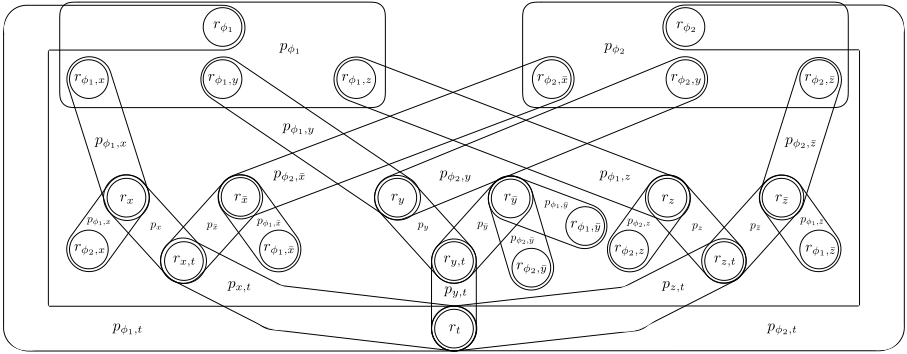
Figure 1 shows an example of game Γϵ(C, V ). Clearly, given (C, V ), Γϵ(C, V ) can be constructed in polynomial time, as it features n = 2m + 3s + 2ms + 1 players and r = m + 3s + 2ms + 1 resources. Observe that, in Γϵ(C, V ), the leader has a single resource available. Hence, the only leader's commitment is to select resource rt, setting σℓ(rt) = 1. As a result, the leader's cost is ϵ if and only if no follower selects resource rt; otherwise, it is 4.
If. Suppose that (C, V ) is satisfiable, and let τ : V → {T, F} be a truth assignment satisfying all clauses in C. Using τ , we recover a followers' action profile a = (ap)p∈F ∈ ×p∈FAp such that a ∈ Eσℓ , with σ = (σℓ, a) providing the leader with a cost of ϵ. Since ϵ is the minimum cost the leader can achieve and the followers behave optimistically, σ is an OSE. In particular, let apφ,t = rφ, for all φ ∈ C, and apv,t = rv,t, for all v ∈ V . Moreover, if τ(v) = T, let apv = apφ,v = rv, ap¯ v = rv,t, and apφ,¯ v = rφ,¯ v for all φ ∈ C, while, if τ(v) = F, let ap¯ v = apφ,¯ v = r¯ v, apv = rv,t, and apφ,v = rφ,v for all φ ∈ C. Notice that, since either
τ(v) = T or τ(v) = F, one between rv and r¯ v is selected by m+1 followers and the other one by none, respectively. Say, w.l.o.g., ν a rv = m+ 1 and ν a r¯ v = 0, as the other case is analogous. First, no follower pφ,v would deviate from rv to rφ,v, as, otherwise, she would incur a cost of at least 1, rather than 0. The same holds for followers pφ,¯ v, as their cost is at most 6 while, if any of them switched to r¯ v, she would incur a cost of 7. Similarly, since there are exactly two followers selecting rv,t, follower pv would not deviate from rv (as 0 < 3), while p¯ v and pv,t would not switch from rv,t, as they would get 7 and 4, respectively, rather than 3. Furthermore, since τ is a truth assignment satisfying (C, V ), at least one literal l ∈ φ evaluates to true under τ for every φ ∈ C. Let apφ = rφ,l for every φ ∈ C. Since l evaluates to true, it must be apφ,l = rl, thus pφ is the only follower who selects rφ,l. As a result, pφ experiences a cost equal to 1, and she has no incentive to deviate. Finally, pφ,t does not deviate from rφ to rt as 2 < 4. Thus, we can conclude that a is an NE and, since there is no follower using rt, the leader's cost is ϵ.
Only if. Suppose there exists an OSE σ = (σℓ, a) in which the leader's cost is ϵ. We show that a = (ap)p∈F ∈ ×p∈FAp can be employed to recover, in polynomial-time, a truth assignment τ that satisfies all clauses in C. First, let us note that no follower selects rt in a as, otherwise, the leader's cost would be 4 > ϵ. As a consequence, all followers pφ,t and pv,t must select the other resource they have available, i.e, apφ,t = rφ and apv,t = rv,t. Moreover, there cannot be two followers using resource rφ, for every φ ∈ C, as, otherwise, pφ,t would have an incentive to deviate from rφ to rt, as 5 > 4. Thus, apφ ̸= rφ, i.e., there must be a literal l ∈ φ such that apφ = rφ,l, for all φ ∈ C. In addition, there cannot be two followers selecting rφ,l as, otherwise, pφ would have an incentive to deviate to rφ, as 5 < 6. Thus, it must be the case that apφ,l = rl. This implies that ν a rl =m+1 as, otherwise, the cost of pφ,l would be 7 > 6, and the follower would change resource, paying rφ,l. Furthermore, at least one between pv and p¯ v must select rv,t as, otherwise, player pv,t's cost would be 7 < 4, and she would prefer switching to resource rt. As a result, at least one between rv and r¯ v must be selected by a number of followers strictly smaller than m+1; in that case, no follower pφ,v (or pφ,¯ v) selects that resource as, otherwise, she would incur a cost of 7 and she would have an incentive to deviate. We thus define a truth assignment τ such that: τ(v) = T if ν a rv = m+1, τ(v) = F if ν a r¯ v =m+1, and τ(v) is either T or F whenever ν a rv = ν a r¯ v = 0. Clearly, τ is well-defined. Moreover, we previously showed that, for every φ ∈ C, there exists a literal l ∈ φ such that apφ,l = rl, which implies that rl = m+ 1, and, thus, τ(v(l)) = T if l is positive, while τ(v(l)) = F if it is negative. Therefore, τ satisfies all clauses.
The proof of Theorem 1 also shows the following:
Observation 1. In SCGs without leadership, computing an NE minimizing the cost of a given player is NP-hard.
Furthermore, from Theorem 1, it directly follows that the leader's cost in an OSE cannot be efficiently approximated to within any approximation factor which depends polynomially on the size of the input:
Corollary 1. The problem of computing an OSE in SSCGs is not in Poly-APX unless P = NP.
Proof. Given a 3SAT instance (C, V ), let us build an SSCG Γϵ(C, V ) as in the proof of Theorem 1. We have already proven that Γϵ(C, V ) has an OSE in which the leader's cost is ϵ if and only if (C, V ) is satisfiable and that, otherwise, the leader's cost is 4. Let ϵ = 4 2n+r . Assume that there exists a polynomial-time approximation algorithm A with approximation factor poly(n, r), i.e., a polynomial function of n and r. Assume (C, V ) is satisfiable. A applied to Γϵ(C, V ) would return a solution with leader's cost at most 4 2n+r poly(n, r). Since, for n and r large enough, 4 2n+r poly(n, r) < 4, A would allow us to decide in polynomial time whether (C, V ) is satisfiable, a contradiction unless P = NP.
Notice that, since the followers break ties in favour of the leader in the reduction, the result in Theorem 1 does not apply to the problem of finding a PSE. Our conjecture is that, as it is the case for all the problems with known results on computing SEs, computing a PSE is as hard as finding an OSE.
4 SSSCGs withMonotonic Costs
We focus, in this section, on SSSCGs, showing that, assuming players' costs which are monotonic functions of the resource congestion, an O/PSE can be computed efficiently. Formally, we call the players' cost functions weakly monotonic if, for every resource i ∈ R, ci,ℓ(x) ≤ ci,ℓ(x + 1) and ci,f(x) ≤ ci,f(x + 1) for all x ∈ N, and strictly monotonic if all the inequalities are strict.
First, notice that, in these games, searching for an O/PSE is not as easy as it might appear, for the following reason:
Observation 2. There are SSSCGs with weakly monotonic cost functions where some followers' configurations are NEs only for leader's mixed strategies.
Consider a game with three followers, R = {r1, r2, r3}, and followers' costs as in Figure 2(a). The followers' configuration in which each follower selects a different resource is not an NE if the leader commits to a pure strategy, while, for instance, it is an NE for σℓ(r1) = σℓ(r3) = 12 , σℓ(r2) = 0.
In the following, we show that, when searching for an OSE, one can restrict the attention without loss of generality to pure strategies of the leader, provided that the players' cost functions are weakly monotonic.
Intuitively, given an OSE in which the leader plays a mixed strategy, we can easily construct another equilibrium in which, instead, the leader's strategy is pure.
Theorem 2. Every SSSCG with weakly monotonic cost functions admits an OSE σ = (σℓ, ν) in which σℓ is pure.
Proof. Given an OSE σ = (σℓ, ν), with σℓ mixed, we construct another OSE ˆσ = (ˆσℓ, ˆ ν) such that ˆσℓ is pure. Let S = {i ∈ R | σℓ(i) > 0} be the set of resources played by the leader with positive probability in σℓ, and let i⋆ ∈ argmini∈S ci,ℓ(νi + 1). Clearly, cσℓ = ∑i∈Aℓ σℓ(i)ci,ℓ(νi + 1) ≥ ci⋆ ,ℓ(νi⋆ + 1). Moreover, given that ν is an NE for σℓ, the following holds:
Let us define ˆσℓ such that ˆσℓ(i⋆ ) = 1. We now show that such ˆσℓ is part of an OSE. Notice that c ˆσℓ i,f (x) = ci,f (x) ∀ x ∈ N for every i ̸= i⋆ ∈ R, while c ˆσℓ i⋆ ,f (x) = ci⋆ ,f (x+1) ∀ x ∈ N. Given that the followers behave optimistically, it is sufficient to provide a ˆ ν ∈ E ˆσℓ such that ˆσ = (ˆσℓ, ˆ ν) satisfies c ˆσℓ ≤ cσℓ . Specifically, we construct a sequence of followers' configurations reaching such ˆ ν. Given ˆσℓ, let us consider the sequence (ν(0) = ν, ν(1), . . . , ν(T) = ˆ ν) such that each configuration differs from the previous one in that a single follower has changed resource, strictly decreasing her cost in the followers' game resulting from ˆσℓ. Formally, for all 0 ≤ t < T , there exists i, j ∈ R such that ν(t)i > 0, ν(t+1)i = ν(t)i-1, ν(t + 1)j = ν(t)j + 1, and c ˆσℓ i,f (ν(t)i) > c ˆσℓ j,f (ν(t + 1)j ). Moreover, let us assume that a follower deviates to resource i⋆ , i.e., ν(t + 1)i⋆ > ν(t)i⋆, only if this is the only way of strictly decreasing some follower's cost. Now, we prove:
By contradiction, suppose there exists 0 ≤ t < T such that ν(t + 1)i⋆ > ν(t)i⋆. Then, in ν(t), there exists a follower who can strictly decrease her cost by choosing i⋆ instead of resource j ̸= i⋆ ∈ R : ν(t)j > 0. Thus,
where the first inequality holds since ν(t)i⋆ = νi⋆. Two cases are possible. In the first one, ν(t)j ≤ νj, implying cj,f(ν(t)j) ≤ cj,f(νj) ≤ cσℓ j,f (νj), which, together with Equations (1) and (3), leads to a contradiction. In the second case, ν(t)j > νj implies that there exists k ̸= i⋆ ∈ R such that ν(t)k < νk (and νk > 0), otherwise ∑i∈R ν(t)i > n-1. It follows that cj,f(ν(t)j) ≤ ck,f(ν(t)k + 1) ≤ cσℓ k,f (νk), where the first inequality holds since, due to our assumptions on the sequence, it cannot be cj,f (ν(t)j) > ck,f (ν(t)k+1) as ν(t + 1)i⋆ > ν(t)i⋆, and the second inequality follows from ν(t)k < νk. Thus, Equations (1) and (3) give a contradiction. As a result, Equation (2) holds, and, thus, ˆ νi⋆ ≤ νi⋆. Given the monotonicity of the costs, ˆσ is an OSE.
Now, we prove that a similar result holds for the pessimistic case. The result is weaker though, as it requires the stronger assumption that the followers' cost functions be strictly monotonic.
Theorem 3. Every SSSCG in which leader's and followers' cost functions are weakly monotonic and strictly monotonic, respectively, admits a PSE σ = (σℓ, ν) in which σℓ is pure.
Proof. Suppose there exists a PSE σ = (σℓ, ν) in which σℓ is mixed. We show that there must be another PSE ˆσ = (ˆσℓ, ˆ ν) such that ˆσℓ is pure. Let us define i⋆ ∈ R as in the proof of Theorem 2, so that cσℓ ≥ ci⋆ ,ℓ(νi⋆ + 1) and Equation (1) holds. Given that the followers behave pessimistically, we need to show that, for every ˆ ν ∈ E ˆσℓ , ˆσ = (ˆσℓ, ˆ ν) satisfies c ˆσℓ ≤ cσℓ . By contradiction, assume that c ˆσℓ > cσℓ , which implies ci⋆ ,ℓ(ˆ νi⋆ + 1) > ci⋆ ,ℓ(νi⋆ + 1). It easily follows from the monotonicity of the costs that ˆ νi⋆ > νi⋆. Thus, there must be a resource j ∈ R such that ˆ νj < νj, otherwise ∑i∈R ˆ νi > n-1. Moreover, let us notice that νj > 0. Thus,
where the first inequality follows from νi⋆ < ˆ νi⋆, the second one from the fact that ˆ ν is an NE for ˆσℓ, while the third one from ˆ νj < νj . Equation (1) implies cσℓ j,f (νj ) ≤ cσℓ i⋆ ,f (νi⋆ +1). If cσℓ j,f (νj) < cσℓ i⋆ ,f (νi⋆ + 1), then Equation (4) leads to a contradiction. Otherwise, if cσℓ j,f (νj) = cσℓ i⋆ ,f (νi⋆ + 1), all inequalities in Equation (4) must hold as equalities. However, this would imply cσℓ i⋆ ,f (νi⋆ + 1) = ci⋆ ,f(ˆ νi⋆ + 1) and cj,f (ˆ νj + 1) = cσℓ j,f (νj), a contradiction as σℓ is mixed and the followers' cost functions are strictly monotonic.
Moreover, let us notice that Theorem 3 fails to hold whenever the followers' cost functions are weakly monotonic.
| x | cr1,f | cr2,f | cr3,f | x | cr1,ℓ cr1,f | cr2,ℓ | cr2,f | |
| 1 | 1 | 4 | 0 | 1 | 1 | 1 | 1 | 1 |
| 2 | 3 | 7 | 2 | 2 | 2 | 1 | 2 | 1 |
| 3 | 5 | 7 | 5 | |||||
| (a) | (b) | |||||||
|---|---|---|---|---|---|---|---|---|
| x | cr1,ℓ | cr1,f | cr2,ℓ | cr2,f | x cr1,ℓ | cr1,f | cr2,ℓ | cr2,f |
| 1 | 1 | 2 | 1 | 2 | 1 2 | 1 | 2 | 1 |
| 2 | 2 | 1 | 2 | 1 | 2 0 | 2 | 0 | 2 |
| (c) | (d) | |||||||
Observation 3. There are SSSCGs with weakly monotonic cost functions where any PSE prescribes the leader to play a mixed strategy.
Consider a game with two followers, R = {r1, r2}, and players' costs as in Figure 2(b). Clearly, any followers' configuration is an NE, independently of the leader's commitment. Thus, whenever the leader commits to a pure strategy, she incurs a cost of 2, while she can pay only 1 by uniformly randomizing between the two resources.
Theorems 2 and 3 provide the fundamental insights which allow us to efficiently compute O/PSEs in SSSCGs with monotonic cost functions. Specifically, we can compute an OSE (resp., PSE) by enumerating the leader's pure strategies and, for each of them, computing the followers' NE which results in the leader's cost being minimized (resp., maximized). An O/PSE is then obtained by picking a pure strategy which minimizes then leader's cost. The detailed procedure is described in Algorithm 1, where function O-Pick(S) (resp., P-Pick(S)) returns some resource j ⋆ ∈ S, giving precedence to resources j ⋆ ̸= i (resp., j ⋆ = i).
Algorithm 1: Algorithm computing an O/PSE of an SSSCG.
input : An SSSCG Γ = (N,R, cℓ, cf) output: σ that is an O/P-LFE of Γ Function Compute-O/P-LFE(Γ) for i ∈ R do σℓ[i] ← σℓ ∈ ∆ℓ : σℓ(i) = 1; ν[i, j] ← 0 ∀ i, j ∈ R; while ∑j∈R ν[i, j] < n do S ← argminj∈R cσℓ[i] j,f (ν[i, j] +1); j ⋆ ← O/P-Pick(S); ν[i, j ⋆ ] ← ν[i, j ⋆ ] + 1; cℓ[i] ← ci,ℓ(ν[i, i] + 1); i⋆ ← arg mini∈R cℓ[i]; return σ = (σℓ[i⋆ ], ν[i⋆ , ·]);Let us remark that, in Algorithm 1, σℓ[·], ν[·, ·], and cℓ[·] are the algorithm's variables, and, for every i ∈ R, ν[i, j] denotes the number of followers selecting resource j ∈ R in the NE that is reached when the leader's strategy is σℓ[i].
Theorem 4. Algorithm 1 is correct and it runs in time O(nr log r).
Proof. In order to show that Algorithm 1 is correct, due to Theorems 2 and 3 we only need to prove that, for every i ∈ R and after the execution of the while loop, the followers' configuration ν is such that νj = ν[i, j] for j ∈ R is an NE for σℓ[i] minimizing (or maximizing) the leader's cost. First, let us show that ν is an NE. Suppose, by contradiction, it is not. Then, there exists j ∈ R : νj > 0 and k ∈ R such that cσℓ [i] j,f (νj) > cσℓ[i] k,f (νk +1). Let ¯ νk be the value of ν[i, k] during the step in which ν[i, j] is set to its final value νj . Clearly, cσℓ [i] j,f (νj) > cσℓ[i] k,f (νk+1) ≥ cσℓ[i] k,f (¯ νk+1), and the algorithm would have not incremented ν[i, j] during that step, a contradiction. In the rest of the proof, we focus on the optimistic case, as the pessimistic one can be treated analogously. Suppose, by contradiction, that ν is not an NE minimizing the leader's cost for σℓ[i]. Then, there exists another NE ˆ ν for σℓ[i] such that ci,ℓ(ˆ νi + 1) < ci,ℓ(νi + 1). Given the monotonicity of the costs, ˆ νi < νi. Therefore, there must exist j ̸= i ∈ R such that ˆ νj > νj. Let us consider the step in which ν[i, i] is set to νi, and let ¯ νj be the value of ν[i, j] during that step. It must be that cσℓ[i] i,f (νi) < cσℓ[i] j,f (¯ νj+1) as, otherwise, the algorithm would have incremented ν[i, j] instead of ν[i, i]. But then cσℓ[i] j,f (¯ νj +1) ≤ cσℓ[i] j,f (νj+1) ≤ cσℓ[i] j,f (ˆ νj ), which implies cσℓ[i] i,f (ˆ νi + 1) ≤ cσℓ[i] i,f (νi) < cσℓ[i] j,f (¯ νj + 1) ≤ cσℓ [i] j,f (ˆ νj), contradicting the fact that ˆ ν is an NE for σℓ[i].
Clearly, the while loop is executed exactly r times, and each execution performs n steps. Moreover, using efficient data structures each step takes time O(log r). Thus, the overall running time is O(nr log r)
We conclude the section by showing that, in SSSCGs with monotonic costs and under the additional assumption that leader's and followers' costs be equal, all O/PSEs in which the leader plays a pure strategy are NEs in the game where all players play simultaneously (i.e., without leadership).
Theorem 5. Given an SSSCG with monotonic costs and cℓ = cf = {ci}i∈R, any O/PSE σ = (σℓ, a) with σℓ pure is an NE.
Proof. Let σ = (σℓ, ν) be an O/PSE with σℓ(i⋆ ) = 1 for some i⋆ ∈ R. Clearly, given that ν ∈ Eσℓ , for every i ∈ R : νi > 0 and j ∈ R, cσℓ i (νi) ≤ cσℓ j (νj + 1). Therefore, there is no follower who has an incentive to change resource, and, thus, it is sufficient to prove that the leader does not deviate from resource i⋆ either, unilaterally. If νi⋆ > 0, we have ci⋆ (νi⋆ +1) = cσℓ i⋆ (νi⋆) ≤ cσℓ j (νj +1) = cj(νj +1) for every j ̸= i⋆ ∈ R, and it immediately follows that the leader does not deviate and σ is an NE. The case in which νi⋆ = 0 is more involved. By contradiction, suppose that σ is not an NE. As a consequence, the leader must have an incentive to deviate for some j ̸= i⋆ ∈ R, i.e., ci⋆(νi⋆ + 1) = ci⋆(1) > cj(νj + 1). Suppose the leader commits to a strategy ˆσℓ such that ˆσℓ(j) = 1. We prove that, for every ˆ ν ∈ E ˆσℓ , ˆσ = (ˆσℓ, ˆ ν) provides the leader with a cost strictly smaller than ci⋆(1). Suppose, instead, cj(ˆ νj + 1) ≥ ci⋆(1). Three cases are possible. In the first case, ˆ νj < νj and ci⋆(1) > cj(νj + 1) ≥ cj(ˆ νj + 1) ≥ ci⋆(1). In the second one, ˆ νj = νj and cj(ˆ νj + 1) ≥ ci⋆(1) > cj(νj +1). Finally, in the third case, ˆ νj > νj , which implies that there must be a resource k ̸= i⋆ ∈ R such that ˆ νk < νk, and ci⋆(1) > cj(νj + 1) ≥ ck(νk) ≥ ck(ˆ νk + 1) ≥ cj (ˆ νj + 1) ≥ ci⋆(1). As all cases lead to a contradiction, it must be cj(ˆ νj + 1) < ci⋆(1). The proof is complete as, in ˆσ, the leader's cost is cj(ˆ νj +1) < ci⋆(1), contradicting the fact that σ is an O/PSE.
5 SSSCGs with Arbitrary Costs
Finally, let us shift our attention to general SSSCGs, i.e., games in which the costs need not be monotonic functions of the resource congestion.
Observation 4. Given an SSSCG, an optimal leader's pure strategy to commit to can be computed efficiently, both in the optimistic and the pessimistic case.
Clearly, when the followers' costs are monotonic functions, we can find an optimal leader's pure strategy using Algorithm 1. In general, we can apply a procedure similar to that of Algorithm 1, enumerating the leader's pure strategies while computing, for each of them, an NE minimizing/maximizing the leader's cost in the resulting followers' game. In order to find one such NE, we can adapt an algorithm proposed in [Ieong et al., 2005], which relies on dynamic programming to compute in O(r5n6 ) an NE minimizing the social-cost in SSSCGs without leadership. It suffices to change the objective function from the social cost to the leader's cost of the resource selected in the current pure strategy. Thus, in general, the overall computation requires O(r6n6 ).
Unfortunately, the assumption that the leader always plays pure strategies is not safe in SSSCGs with arbitrary costs, as Theorems 2 and 3 do not hold if the monotonicity assumption is dropped.
Observation 5. There are SSSCGs such that:
- the followers' costs only are non-monotonic, and any O/PSE prescribes the leader to play a mixed strategy;
- the leader's costs only are non-monotonic, and any O/PSE prescribes the leader to play a mixed strategy.
Consider a game with a single follower, R = {r1, r2}, and players' costs as in Figure 2(c). Clearly, the follower selects r2 whenever σℓ(r1) ≤ 1 2 , while, if σℓ(r1) ≥ 12 , she chooses r1, providing the leader with a cost of 2 - σℓ(r1) and 1+σℓ(r1), respectively. Thus, any O/PSE prescribes the leader to play σℓ such that σℓ(r1) = 1 2 .
Moreover, when the players' costs are as in Figure 2(d), the follower selects r2 if σℓ(r1) ≥ 1 2 , and r1 if σℓ(r1) ≤ 12 , providing the leader with a cost of 2σℓ(r1) and 2 - 2σℓ(r1), respectively. As a result, any O/PSE of the game prescribes the leader to play σℓ such that σℓ(r1) = 12 .
6 Conclusions and FutureWorks
We analyzed Stackelberg games where the underlying structure is a congestion game, focusing on the case in which the players' actions are singletons. We proved that, without further assumptions on the players' action spaces and the resource cost functions, it is not possible to approximate in polynomial time the leader's cost in an OSE up to within a polynomial factor in the size of the game, unless P = NP.
Differently, when each player can select any resource and the cost functions are monotonic, an O/PSE can be computed efficiently, as there is always a leader's optimal pure strategy.
In the future, we will study the computational complexity of finding an O/PSE in SSSCGs with arbitrary costs in order to establish whether the problem can be solved efficiently or not, in spite of the fact that the leader's optimal commitment may be a mixed strategy. Moreover, we will extend our results for SSCGs-studying the complexity of finding a PSE, also considering the special case where cost functions are monotonic in the resource congestion-and we will analyze other classes of CGs with different combinatorial structures.
@inproceedings{ijcai2018p62,
  title     = {Leadership in Singleton Congestion Games},
  author    = {Marchesi, Alberto and Coniglio, Stefano and Gatti, Nicola},
  booktitle = {Proceedings of the Twenty-Seventh International Joint Conference on
               Artificial Intelligence, {IJCAI-18}},
  publisher = {International Joint Conferences on Artificial Intelligence Organization},
  editor    = {Jérôme Lang},
  pages     = {447--453},
  year      = {2018},
  month     = {7},
  note      = {Main track},
  doi       = {10.24963/ijcai.2018/62},
  url       = {https://doi.org/10.24963/ijcai.2018/62},
}
TY - CPAPER TI - Leadership in Singleton Congestion Games AU - Marchesi, Alberto AU - Coniglio, Stefano AU - Gatti, Nicola T2 - Proceedings of the Twenty-Seventh International Joint Conference on Artificial Intelligence, IJCAI-18 PB - International Joint Conferences on Artificial Intelligence Organization PY - 2018 SP - 447 EP - 453 DO - 10.24963/ijcai.2018/62 UR - https://doi.org/10.24963/ijcai.2018/62 ER -Copied
Machine-readable versions of this paper, for tools and AI agents:





