
AutoVideo: An Automated Video Action Recognition System
Proceedings of the Thirty-First International Joint Conference on Artificial Intelligence. Demo Track. Pages 5952-5955.
https://doi.org/10.24963/ijcai.2022/862
Keywords
- Machine Learning: Automated Machine Learning
- Computer Vision: Video analysis and understanding
Abstract
Action recognition is an important task for video understanding with broad applications. However, developing an effective action recognition solution often requires extensive engineering efforts in building and testing different combinations of the modules and their hyperparameters. In this demo, we present AutoVideo, a Python system for automated video action recognition. AutoVideo is featured for 1) highly modular and extendable infrastructure following the standard pipeline language, 2) an exhaustive list of primitives for pipeline construction, 3) data-driven tuners to save the efforts of pipeline tuning, and 4) easy-to-use Graphical User Interface (GUI). AutoVideo is released under MIT license at https://github.com/datamllab/autovideo
- [Bergstra et al., 2013] James Bergstra, Dan Yamins, David D Cox, et al. Hyperopt: A python library for optimizing the hyperparameters of machine learning algorithms. In Proceedings of the 12th Python in science conference, volume 13, page 20. Citeseer, 2013.
- [Carreira and Zisserman, 2017] Joao Carreira and Andrew Zisserman. Quo vadis, action recognition? a new model and the kinetics dataset. In CVPR, pages 6299-6308, 2017.
- [Demšar et al., 2004] Janez Demšar, Blaž Zupan, Gregor Leban, and Tomaz Curk. Orange: From experimental ma- chine learning to interactive data mining. In PKDD, pages 537-539. Springer, 2004.
- [Gao et al., 2018] Yongbin Gao, Xuehao Xiang, Naixue Xiong, Bo Huang, Hyo Jong Lee, Rad Alrifai, Xiaoyan Jiang, and Zhijun Fang. Human action monitoring for healthcare based on deep learning. Ieee Access, 6:52277- 52285, 2018.
- [Herath et al., 2017] Samitha Herath, Mehrtash Harandi, and Fatih Porikli. Going deeper into action recognition: A sur- vey. Image and vision computing, 60:4-21, 2017.
- [Hou et al., 2019] Rui Hou, Chen Chen, Rahul Sukthankar, and Mubarak Shah. An efficient 3d cnn for action/object segmentation in video. arXiv preprint arXiv:1907.08895, 2019.
- [Lai et al., 2021a] Kwei-Herng Lai, Daochen Zha, Guanchu Wang, Junjie Xu, Yue Zhao, Devesh Kumar, Yile Chen, Purav Zumkhawaka, Minyang Wan, Diego Martinez, et al. Tods: An automated time series outlier detection system. In AAAI, volume 35, pages 16060-16062, 2021.
- [Lai et al., 2021b] Kwei-Herng Lai, Daochen Zha, Junjie Xu, Yue Zhao, Guanchu Wang, and Xia Hu. Revisiting time series outlier detection: Definitions and benchmarks. In NeurIPS, 2021.
- [Li et al., 2020] Yuening Li, Daochen Zha, Praveen Venu- gopal, Na Zou, and Xia Hu. Pyodds: An end-to-end out- lier detection system with automated machine learning. In WWW, pages 153-157, 2020.
- [Meng et al., 2007] Hongying Meng, Nick Pears, and Chris Bailey. A human action recognition system for embedded computer vision application. In CVPR, pages 1-6. IEEE, 2007.
- [Milutinovic et al., 2020] Mitar Milutinovic, Brandon Schoenfeld, Diego Martinez-Garcia, Saswati Ray, Sujen Shah, and David Yan. On evaluation of automl systems. In ICML Workshop, 2020.
- [Moritz et al., 2018] Philipp Moritz, Robert Nishihara, Stephanie Wang, Alexey Tumanov, Richard Liaw, Eric Liang, Melih Elibol, Zongheng Yang, William Paul, Michael I Jordan, et al. Ray: A distributed framework for emerging {AI} applications. In OSDI, pages 561-577, 2018.
- [Piergiovanni et al., 2019] AJ Piergiovanni, Anelia An- gelova, Alexander Toshev, and Michael S Ryoo. Evolving space-time neural architectures for videos. In ICCV, pages 1793-1802, 2019.
- [Poppe, 2010] Ronald Poppe. A survey on vision-based hu- man action recognition. Image and vision computing, 28(6):976-990, 2010.
- [Ryoo et al., 2019] Michael S Ryoo, AJ Piergiovanni, Mingxing Tan, and Anelia Angelova. Assemblenet: Searching for multi-stream neural connectivity in video ar- chitectures. arXiv preprint arXiv:1905.13209, 2019.
- [Team, 2021] PytorchVideo Team. Pytorchvideo. https: //github.com/facebookresearch/pytorchvideo, 2021. Ac- cessed: 2022-05-22. Link
- [Tran et al., 2015] Du Tran, Lubomir Bourdev, Rob Fergus, Lorenzo Torresani, and Manohar Paluri. Learning spa- tiotemporal features with 3d convolutional networks. In ICCV, pages 4489-4497, 2015.
- [Wang et al., 2016] Limin Wang, Yuanjun Xiong, Zhe Wang, Yu Qiao, Dahua Lin, Xiaoou Tang, and Luc Van Gool. Temporal segment networks: Towards good practices for deep action recognition. In ECCV, pages 20- 36. Springer, 2016.
- [Wang et al., 2022] Guanchu Wang, Zaid Pervaiz Bhat, Zhi- meng Jiang, Yi-Wei Chen, Daochen Zha, Alfredo Costilla Reyes, Afshin Niktash, Gorkem Ulkar, Erman Okman, and Xia Hu. Bed: A real-time object detection system for edge devices. arXiv preprint arXiv:2202.07503, 2022.
- [Yue Zhao, 2019] Dahua Lin Yue Zhao, Yuanjun Xiong. Mmaction. https://github.com/open-mmlab/mmaction, 2019. Accessed: 2022-05-22. Link
- [Zha et al., 2019] Daochen Zha, Kwei-Herng Lai, Kaixiong Zhou, and Xia Hu. Experience replay optimization. In IJCAI, pages 4243-4249, 2019. IJCAI
- [Zha et al., 2020] Daochen Zha, Kwei-Herng Lai, Mingyang Wan, and Xia Hu. Meta-aad: Active anomaly detection with deep reinforcement learning. In ICDM, pages 771- 780. IEEE, 2020.
- [Zha et al., 2021a] Daochen Zha, Kwei-Herng Lai, Songyi Huang, Yuanpu Cao, Keerthana Reddy, Juan Vargas, Alex Nguyen, Ruzhe Wei, Junyu Guo, and Xia Hu. Rlcard: a platform for reinforcement learning in card games. In IJ- CAI, pages 5264-5266, 2021. IJCAI
- [Zha et al., 2021b] Daochen Zha, Wenye Ma, Lei Yuan, Xia Hu, and Ji Liu. Rank the episodes: A simple approach for exploration in procedurally-generated environments. In ICLR, 2021.
- [Zha et al., 2021c] Daochen Zha, Jingru Xie, Wenye Ma, Sheng Zhang, Xiangru Lian, Xia Hu, and Ji Liu. Douzero: Mastering doudizhu with self-play deep reinforcement learning. In ICML, pages 12333-12344. PMLR, 2021.
- [Zolfaghari et al., 2018] Mohammadreza Zolfaghari, Ka- maljeet Singh, and Thomas Brox. Eco: Efficient convolu- tional network for online video understanding. In ECCV, pages 695-712, 2018.
References were extracted automatically from the PDF and may contain errors.
Full text extracted automatically from the PDF; figures, tables and equations may differ. The PDF is the version of record.
1 Introduction
Action recognition is one of the most important tasks in video understanding [Herath et al., 2017]. Given a video clip, it aims to identify the human actions in the video, such as brush hair, cartwheel, catch, chew, clap, climb, etc. It has broad applications, such as security [Meng et al., 2007], healthcare [Gao et al., 2018] and behavior analysis [Poppe, 2010].
Deep learning has achieved promising performance in action recognition [Tran et al., 2015; Wang et al., 2016; Carreira and Zisserman, 2017; Zolfaghari et al., 2018; Hou et al., 2019]. However, developing a deep learning solution heavily relies on human efforts. First, we often need a very complex training pipeline, including but not limited to data loading, frame extraction, video cropping/scaling, video augmentation, model training, etc., which requires huge engineering efforts. Second, to achieve a good performance, a practitioner often needs extensive laborious trials on different combinations of the modules and their hyperparameters.
To bridge this gap, in this demo, we present an automated video action recognition system named AutoVideo, which has several desirable features. First, it is highly modular and extendable. It is designed using the standard pipeline language under D3M infrastructure [Milutinovic et al., 2020; Lai et al., 2021a], which defines primitives as basic building blocks and uses Directed Acyclic Graph (DAG) to describe pipelines. The inputs, the outputs, and the hyperparameters of each module are well formatted so that we can easily develop and integrate new modules into the system with minimum engineering costs. Second, it supports an exhaustive list of primitives for pipeline construction. Specifically, we have so far supported 188 primitives from video processing to recognition models. Users can create various training pipelines via combining these primitives in different ways. Third, it provides data-driven tuners to save the efforts of pipeline tuning. We have implemented two commonly used AutoML tuners, including random search and Hyperopt [Bergstra et al., 2013]. They can automatically explore different primitive combinations and tune the hyperparameters to identify the best pipeline design. Fourth, it provides a Graphical User Interface (GUI). In the GUI, users can manually construct pipelines in a drag-and-drop fashion, launch the training or search, and monitor the training progress.
∗Those authors contribute equally to this project
| Module | Number | Examples |
|---|---|---|
| Data Processing Video Processing Video Transformation Video Augmentation Action Recognition | 5 1 3 170 9 | DatasetToDataFrame FrameExtraction GroupScale, GroupCenterCrop AdditiveGaussianNoise, Rotate TSN, TSM, C3D, ECO |
| Total | 188 | - |
While there are some other open-sourced video understanding libraries out there [Yue Zhao, 2019; Team, 2021], they only provide a model zoo for users. In contrast, we provide an exhaustive list of primitives to allow users to create various pipelines or search with AutoML tuners. Unlike some other research-oriented AutoML studies for videos [Piergiovanni et al., 2019; Ryoo et al., 2019], we target an easy-to-use and open-sourced package with unified interfaces for users. Thus, AutoVideo complements the existing efforts.
2 AutoVideo System
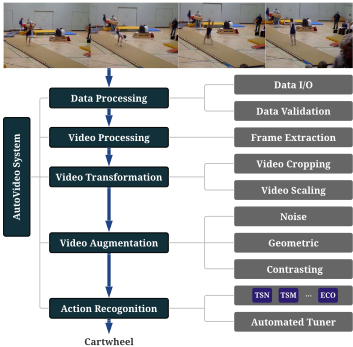
Figure 1 shows an overview of the AutoVideo system. It implements a complete training pipeline consisting of data processing, video processing, video transformation, video augmentation, and action recognition, where each of the pipeline steps can be instantiated with customized choices of primitives, which leads to a large number of possible pipelines. Then two automated tuners are provided to automatically discover the best pipelines based on the performance. This section first introduces the standard pipeline language and then elaborates on our programming interface and GUI.
2.1 Primitives and Pipelines
We build AutoVideo upon D3M infrastructure [Milutinovic et al., 2020; Lai et al., 2021a], which provides generic and extendable descriptions for modules and pipelines. The interface can accommodate various modules. Here, we provide an overview of the basic concepts. More details of the pipeline language can be found in [Milutinovic et al., 2020].
Primitive is the basic build block. It is an implementation of a function with some hyperparameters. A pipeline is a Directed Acyclic Graph (DAG) consisting of several primitive steps. Data types, such as DataFrame and NumPy Ndarrays, can be passed between steps in a pipeline. Each of the above concepts is associated with metadata to describe parameters, hyper-parameters, etc. Following this pipeline language, we wrap each component in AutoVideo (e.g., an action recognition algorithm or an augmentation module) as a primitive with some associated hyperparameters. We have so far supported 188 primitives, which are summarized in Table 1, where data processing is designed for reading videos and the labels, video processing converts videos into frames, video transformation transforms the videos into the target size through cropping or scaling, video augmentation augments the videos in training, and action recognition trains deep learning models. Various pipelines can be constructed by combining these primitives in different ways. The genericity of the pipeline language allows AutoVideo to be easily extended to support other video-related tasks in the future.
2.2 Programming Interface
From the programming view, AutoVideo enables users to easily train any manually designed pipelines and also use automated tuners to help discover the best pipelines. A minimum example of fitting a pipeline is given below.
from autovideo import fit, build_pipeline # Build pipeline based on config pipeline = build_pipeline({ "transformation": [("Scale", {"scale_size": (128,128)})], "augmentation": [ ("arithmetic_AdditiveGaussianNoise", {"scale": (0, 0.2*255)}), ("geometric_Rotate", {"rotate": (-45, 45)}), ("contrast_LogContrast", {"gain": (0.6, 1.4)}), ], "multi_aug": "meta_Sometimes", "algorithm": "tsn", "load_pretrained": False, "epochs": 50, }) # Fit fit(train_dataset, train_media_dir, target_index=target_index, ↪→ pipeline=pipeline)train dataset is the DataFrame describing the video file names and labels, train media dir contains the directory of the video files, and target index specifies which column is label. Pipelines are described with a configuration dictionary specifying the primitives and hyperparameters in each pipeline step. Users can customize the configuration in build pipeline to build pipelines with different combinations of the primitives and the hyperparameters. The fit function will return the fitted pipeline that can be saved for making predictions. However, manually tuning the pipeline is laborious and tedious. Thus, we can alternatively use automated tuners. An example is presented below.
from ray import tune from autovideo.searcher import RaySearcher search_space = { "augmentation": { "aug_0": tune.choice([ ("arithmetic_AdditiveGaussianNoise",), ("arithmetic_AdditiveLaplaceNoise",), ]), "aug_1": tune.choice([ ("geometric_Rotate",), ("geometric_Jigsaw",), ]), }, "multi_aug": tune.choice([ "meta_Sometimes", "meta_Sequential", ]), "algorithm": tune.choice(["tsn"]), "learning_rate": tune.uniform(0.0001, 0.001), "momentum": tune.uniform(0.9,0.99), "weight_decay": tune.uniform(5e-4,1e-3), "num_segments": tune.choice([8,16,32]), } config = { "searching_algorithm": "hyperopt", "num_samples": 100, } searcher = RaySearcher(train_dataset, train_media_dir, ↪→ valid_dataset=valid_dataset, valid_media_dir=valid_media_dir) best_config = searcher.search( search_space=search_space, config=config )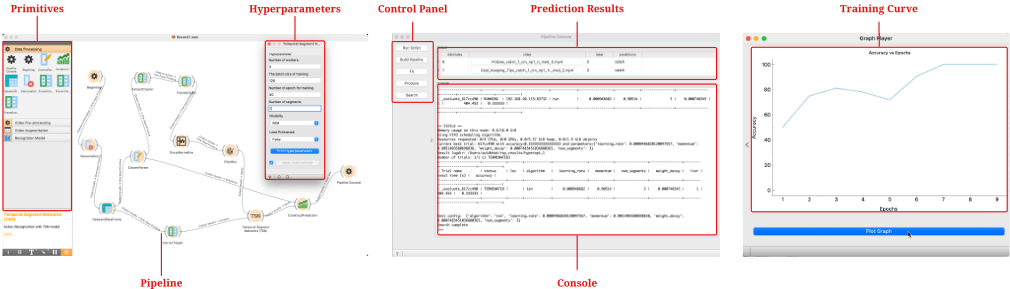
Here, valid dataset is the DataFrame associated with the validation data. search space is a dictionary specifying the augmentation methods, recognition models, and the ranges of hyperparameters the tuner will cover. We follow the search space definitions in Ray [Moritz et al., 2018], which allows the users to flexibly design the search space. config specifies some tuning configurations, such as the type of the tuner and the search budget. The automated tuner will search for the best pipeline designs within the search space and return the best-discovered pipeline configuration in best config, which can be then used to re-fit the pipeline.
2.3 GUI
Figure 2 presents our GUI to help users construct pipelines, fit the constructed pipelines, and make predictions. The GUI is implemented based on Orange [Demˇsar et al., 2004].
The left-hand side of Figure 2 illustrates the canvas for pipeline building. Users can construct a pipeline in a dragand-drop fashion by dragging icons (primitives in the left) to the canvas and connecting them with lines. For each of the primitives, we can double-click the icon to modify the default hyperparameters of the primitive. Once a pipeline is built, the GUI will convert the constructed pipeline into the configuration dictionary as in Example 1 and the backend will instantiate the pipeline. In addition, users can save a pipeline and load it later just like editing a document in Microsoft Word.
The middle and right-hand sides of Figure 2 show the popup windows for pipeline fitting and training progress monitoring, respectively. Specifically, the users can fit the pipeline, make predictions with a fitted pipeline, or perform automated searching by simply clicking a button in the control panel. For example, by clicking the "fit" button, the backend will train the model and visualize the training curve once the training is finished. By clicking the "produce" button, the backend will make predictions on the testing data. The "search" button will launch the automated tuners for pipeline search and save the best pipeline. The prediction results will be displayed at the top of the window, where the users can watch each of the testing videos and check its predictions and labels. In addition, we also provide an interactive console, where the users can interact with the backend with command lines. This design provides flexibility to meet different needs of the users.
| HMDB-6 | HMDB-51 | |
|---|---|---|
| Default Pipeline | 80.00% | 34.84% |
| Random Search | 94.8% | 51.24% |
| Hyperopt | 94.5% | 54.71% |
3 Effectiveness of Pipeline Search
We conduct a preliminary experiment to showcase the effectiveness of pipeline search. We define a search space that allows choosing 3 augmentation primitives from the categories of arithmetic, geometric, and color, and tuning the hyperparameters of the TSN model with learning rate [0.001,0.0001], momentum [0.9,0.99], weight decay [5e4,1e-3], number of segments 8,16,32. We separate 5% of the training data for validation purposes. We apply the random search and Hyperopt tuners to search the pipeline configurations. We run the search with 50 samples and evaluate the best configuration discovered in the search.
In Table 2, we compare the two tuners as well as the default pipeline configuration on HMDB-51 1 , a task that aims to identify 51 human actions, and a subset of it with the first six actions named HMDB-6. Both the tuners outperform the default pipeline by a large margin, which verifies the effectiveness of pipeline search and hyperparameter tuning. We defer a more comprehensive evaluation to our future work since it is out of the scope of our demo presentation.
4 Conclusions and FutureWork
We present AutoVideo, an automated video action recognition system. It provides a highly modular implementation of 188 primitives, on which users can flexibly create pipelines. It also supports automated tuners and an easy-touse GUI to help researchers/practitioners develop prototypes. We will actively maintain AutoVideo and develop more features based on our previous research. We plan to wrap more primitives beyond action recognition from our research codes in object detection [Wang et al., 2022] and outlier detection [Zha et al., 2020; Li et al., 2020; Lai et al., 2021b], and tuners with reinforcement learning [Zha et al., 2021c; Zha et al., 2021a; Zha et al., 2019; Zha et al., 2021b].
1 https://serre-lab.clps.brown.edu/resource/ hmdb-a-large-human-motion-database/
@inproceedings{ijcai2022p862,
  title     = {AutoVideo: An Automated Video Action Recognition System},
  author    = {Zha, Daochen and Bhat, Zaid Pervaiz and Chen, Yi-Wei and Wang, Yicheng and Ding, Sirui and Chen, Jiaben and Lai, Kwei-Herng and Bhat, Mohammad Qazim and Jain, Anmoll Kumar and Costilla Reyes, Alfredo and Zou, Na and Hu, Xia},
  booktitle = {Proceedings of the Thirty-First International Joint Conference on
               Artificial Intelligence, {IJCAI-22}},
  publisher = {International Joint Conferences on Artificial Intelligence Organization},
  editor    = {Luc De Raedt},
  pages     = {5952--5955},
  year      = {2022},
  month     = {7},
  note      = {Demo Track},
  doi       = {10.24963/ijcai.2022/862},
  url       = {https://doi.org/10.24963/ijcai.2022/862},
}
TY - CPAPER TI - AutoVideo: An Automated Video Action Recognition System AU - Zha, Daochen AU - Bhat, Zaid Pervaiz AU - Chen, Yi-Wei AU - Wang, Yicheng AU - Ding, Sirui AU - Chen, Jiaben AU - Lai, Kwei-Herng AU - Bhat, Mohammad Qazim AU - Jain, Anmoll Kumar AU - Costilla Reyes, Alfredo AU - Zou, Na AU - Hu, Xia T2 - Proceedings of the Thirty-First International Joint Conference on Artificial Intelligence, IJCAI-22 PB - International Joint Conferences on Artificial Intelligence Organization PY - 2022 SP - 5952 EP - 5955 DO - 10.24963/ijcai.2022/862 UR - https://doi.org/10.24963/ijcai.2022/862 ER -Copied
Machine-readable versions of this paper, for tools and AI agents:





