
Certified Policy Verification and Synthesis for MDPs under Distributional Reach-Avoidance Properties
Proceedings of the Thirty-Third International Joint Conference on Artificial Intelligence. Main Track. Pages 3-12.
https://doi.org/10.24963/ijcai.2024/1
Keywords
- Planning and Scheduling: PS: Markov decisions processes
- Agent-based and Multi-agent Systems: MAS: Formal verification, validation and synthesis
- Agent-based and Multi-agent Systems: MAS: Trust and reputation
- Planning and Scheduling: PS: Planning under uncertainty
Abstract
Markov Decision Processes (MDPs) are a classical model for decision making in the presence of uncertainty. Often they are viewed as state transformers with planning objectives defined with respect to paths over MDP states. An increasingly popular alternative is to view them as distribution transformers, giving rise to a sequence of probability distributions over MDP states. For instance, reachability and safety properties in modeling robot swarms or chemical reaction networks are naturally defined in terms of probability distributions over states. Verifying such distributional properties is known to be hard and often beyond the reach of classical state-based verification techniques.
In this work, we consider the problems of certified policy (i.e. controller) verification and synthesis in MDPs under distributional reach-avoidance specifications. By certified we mean that, along with a policy, we also aim to synthesize a (checkable) certificate ensuring that the MDP indeed satisfies the property. Thus, given the target set of distributions and an unsafe set of distributions over MDP states, our goal is to either synthesize a certificate for a given policy or synthesize a policy along with a certificate, proving that the target distribution can be reached while avoiding unsafe distributions. To solve this problem, we introduce the novel notion of distributional reach-avoid certificates and present automated procedures for (1) synthesizing a certificate for a given policy, and (2) synthesizing a policy together with the certificate, both providing formal guarantees on certificate correctness. Our experimental evaluation demonstrates the ability of our method to solve several non-trivial examples, including a multi-agent robot-swarm model, to synthesize certified policies and to certify existing policies.
- [Agrawal et al., 2015] Manindra Agrawal, S. Akshay, Blaise Genest, and P. S. Thiagarajan. Approximate verification of the symbolic dynamics of markov chains. J. ACM, 62(1):2:1-2:34, 2015.
- [Ahmadi and Majumdar, 2016] Amir Ali Ahmadi and Anirudha Majumdar. Some applications of polynomial optimization in operations research and real-time decision making. Optim. Lett., 10(4):709-729, 2016.
- [Akshay et al., 2015] S. Akshay, Timos Antonopoulos, Joël Ouaknine, and James Worrell. Reachability problems for markov chains. Inf. Process. Lett., 115(2):155-158, 2015.
- [Akshay et al., 2018] S. Akshay, Blaise Genest, and Nikhil Vyas. Distribution-based objectives for markov decision processes. In LICS, pages 36-45. ACM, 2018.
- [Akshay et al., 2023] S. Akshay, Krishnendu Chatterjee, To- bias Meggendorfer, and Dorde Zikelic. Mdps as distri- bution transformers: Affine invariant synthesis for safety objectives. In CAV (3), volume 13966 of Lecture Notes in Computer Science, pages 86-112. Springer, 2023.
- [Akshay et al., 2024] S. Akshay, Krishnendu Chatterjee, To- bias Meggendorfer, and Ðor de Žikelić. Certified policy verification and synthesis for mdps under distributional reach-avoidance properties, 2024.
- [Alshiekh et al., 2018] Mohammed Alshiekh, Roderick Bloem, Rüdiger Ehlers, Bettina Könighofer, Scott Niekum, and Ufuk Topcu. Safe reinforcement learning via shielding. In AAAI, pages 2669-2678. AAAI Press, 2018.
- [Asadi et al., 2021] Ali Asadi, Krishnendu Chatterjee, Hongfei Fu, Amir Kafshdar Goharshady, and Moham- mad Mahdavi. Polynomial reachability witnesses via stellensätze. In PLDI, pages 772-787. ACM, 2021.
- [Badings et al., 2022] Thom S. Badings, Alessandro Abate, Nils Jansen, David Parker, Hasan A. Poonawala, and Mar- iëlle Stoelinga. Sampling-based robust control of au- tonomous systems with non-gaussian noise. In Thirty-Sixth AAAI Conference on Artificial Intelligence, AAAI 2022, Thirty-Fourth Conference on Innovative Applications of Artificial Intelligence, IAAI 2022, The Twelveth Symposium on Educational Advances in Artificial Intelligence, EAAI 2022 Virtual Event, February 22 -March 1, 2022, pages 9669-9678. AAAI Press, 2022.
- [Badings et al., 2023] Thom S. Badings, Licio Romao, Alessandro Abate, and Nils Jansen. Probabilities are not enough: Formal controller synthesis for stochastic dynam- ical models with epistemic uncertainty. In AAAI, pages 14701-14710. AAAI Press, 2023.
- [Baier and Katoen, 2008] Christel Baier and Joost-Pieter Ka- toen. Principles of model checking. MIT Press, 2008.
- [Baldoni et al., 2008] Roberto Baldoni, François Bonnet, Alessia Milani, and Michel Raynal. On the solvability of anonymous partial grids exploration by mobile robots. In OPODIS, volume 5401 of Lecture Notes in Computer Science, pages 428-445. Springer, 2008.
- [Beauquier et al., 2006] Danièle Beauquier, Alexan- der Moshe Rabinovich, and Anatol Slissenko. A logic of probability with decidable model checking. J. Log. Comput., 16(4):461-487, 2006.
- [Cauchi and Abate, 2019] Nathalie Cauchi and Alessandro Abate. Stochy-automated verification and synthesis of stochastic processes. In Proceedings of the 22nd ACM International Conference on Hybrid Systems: Computation and Control, pages 258-259, 2019.
- [Chadha et al., 2011] Rohit Chadha, Vijay Anand Kor- thikanti, Mahesh Viswanathan, Gul Agha, and YoungMin Kwon. Model checking mdps with a unique compact in- variant set of distributions. In Eighth International Confer- ence on Quantitative Evaluation of Systems, QEST 2011, Aachen, Germany, 5-8 September, 2011, pages 121-130. IEEE Computer Society, 2011.
- [Cimatti et al., 2013] Alessandro Cimatti, Alberto Griggio, Bastiaan Schaafsma, and Roberto Sebastiani. The Math- SAT5 SMT Solver. In Nir Piterman and Scott Smolka, editors, Proceedings of TACAS, volume 7795 of LNCS. Springer, 2013.
- [Colón and Sipma, 2001] Michael Colón and Henny Sipma. Synthesis of linear ranking functions. In TACAS, volume 2031 of Lecture Notes in Computer Science, pages 67-81. Springer, 2001.
- [Colón et al., 2003] Michael Colón, Sriram Sankara- narayanan, and Henny Sipma. Linear invariant generation using non-linear constraint solving. In CAV, volume 2725 of Lecture Notes in Computer Science, pages 420-432. Springer, 2003.
- [de Moura and Bjørner, 2008] Leonardo Mendonça de Moura and Nikolaj S. Bjørner. Z3: an efficient SMT solver. In TACAS, volume 4963 of Lecture Notes in Computer Science, pages 337-340. Springer, 2008.
- [Doyen et al., 2014] Laurent Doyen, Thierry Massart, and Mahsa Shirmohammadi. Limit synchronization in markov decision processes. In FoSSaCS, volume 8412 of Lecture Notes in Computer Science, pages 58-72. Springer, 2014.
- [Dutertre, 2014] Bruno Dutertre. Yices 2.2. In CAV, volume 8559 of Lecture Notes in Computer Science, pages 737-744. Springer, 2014.
- [Farkas, 1902] Julius Farkas. Theorie der einfachen ungle- ichungen. Journal für die reine und angewandte Mathe- matik (Crelles Journal), 1902(124):1-27, 1902.
- [Gario and Micheli, 2015] Marco Gario and Andrea Micheli. Pysmt: a solver-agnostic library for fast prototyping of smt-based algorithms. In SMT workshop, volume 2015, 2015.
- [Grover et al., 2022] Kush Grover, Jan Kretínský, Tobias Meggendorfer, and Maximilian Weininger. Anytime guar- antees for reachability in uncountable markov decision pro- cesses. In CONCUR, volume 243 of LIPIcs, pages 11:1- 11:20. Schloss Dagstuhl -Leibniz-Zentrum für Informatik, 2022.
- [Gulwani et al., 2008] Sumit Gulwani, Saurabh Srivastava, and Ramarathnam Venkatesan. Program analysis as con- straint solving. In PLDI, pages 281-292. ACM, 2008.
- [Henzinger et al., 2009] Thomas A. Henzinger, Maria Ma- teescu, and Verena Wolf. Sliding window abstraction for infinite markov chains. In CAV, volume 5643 of Lecture Notes in Computer Science, pages 337-352. Springer, 2009.
- [Jansen et al., 2020] Nils Jansen, Bettina Könighofer, Sebas- tian Junges, Alex Serban, and Roderick Bloem. Safe re- inforcement learning using probabilistic shields (invited paper). In CONCUR, volume 171 of LIPIcs, pages 3:1- 3:16. Schloss Dagstuhl -Leibniz-Zentrum für Informatik, 2020.
- [Jarvis-Wloszek et al., 2003] Zachary Jarvis-Wloszek, Ryan Feeley, Weehong Tan, Kunpeng Sun, and Andrew Packard. Some controls applications of sum of squares program- ming. In 42nd IEEE international conference on decision and control (IEEE Cat. No. 03CH37475), volume 5, pages 4676-4681. IEEE, 2003.
- [Korthikanti et al., 2010] Vijay Anand Korthikanti, Mahesh Viswanathan, Gul Agha, and YoungMin Kwon. Reasoning about mdps as transformers of probability distributions. In QEST, pages 199-208. IEEE Computer Society, 2010.
- [Kwiatkowska et al., 2007] Marta Z. Kwiatkowska, Gethin Norman, and David Parker. Stochastic model checking. In SFM, volume 4486 of Lecture Notes in Computer Science, pages 220-270. Springer, 2007.
- [Kwon and Agha, 2011] YoungMin Kwon and Gul A. Agha. Verifying the evolution of probability distributions gov- erned by a DTMC. IEEE Trans. Software Eng., 37(1):126- 141, 2011.
- [Lavaei et al., 2020] Abolfazl Lavaei, Mahmoud Khaled, Sadegh Soudjani, and Majid Zamani. AMYTISS: par- allelized automated controller synthesis for large-scale stochastic systems. In CAV (2), volume 12225 of Lec- ture Notes in Computer Science, pages 461-474. Springer, 2020.
- [Lechner et al., 2022] Mathias Lechner, Dorde Zikelic, Kr- ishnendu Chatterjee, and Thomas A. Henzinger. Stability verification in stochastic control systems via neural network supermartingales. In Thirty-Sixth AAAI Conference on Ar- tificial Intelligence, AAAI 2022, Thirty-Fourth Conference on Innovative Applications of Artificial Intelligence, IAAI 2022, The Twelveth Symposium on Educational Advances in Artificial Intelligence, EAAI 2022 Virtual Event, Febru- ary 22 -March 1, 2022, pages 7326-7336. AAAI Press, 2022.
- [Lipton et al., 2022] Richard Lipton, Florian Luca, Joris Nieuwveld, Joël Ouaknine, David Purser, and James Wor- rell. On the skolem problem and the skolem conjecture. In LICS, pages 5:1-5:9. ACM, 2022.
- [Meurer et al., 2017] Aaron Meurer, Christopher P. Smith, Mateusz Paprocki, Ondrej Certík, Sergey B. Kirpichev, Matthew Rocklin, Amit Kumar, Sergiu Ivanov, Jason Keith Moore, Sartaj Singh, Thilina Rathnayake, Sean Vig, Brian E. Granger, Richard P. Muller, Francesco Bonazzi, Harsh Gupta, Shivam Vats, Fredrik Johansson, Fabian Pe- dregosa, Matthew J. Curry, Andy R. Terrel, Stepán Roucka, Ashutosh Saboo, Isuru Fernando, Sumith Kulal, Robert Cimrman, and Anthony M. Scopatz. Sympy: symbolic computing in python. PeerJ Comput. Sci., 3:e103, 2017.
- [Ouaknine and Worrell, 2012] Joël Ouaknine and James Wor- rell. Decision problems for linear recurrence sequences. In RP, volume 7550 of Lecture Notes in Computer Science, pages 21-28. Springer, 2012.
- [Prajna et al., 2007] Stephen Prajna, Ali Jadbabaie, and George J. Pappas. A framework for worst-case and stochas- tic safety verification using barrier certificates. IEEE Trans. Autom. Control., 52(8):1415-1428, 2007.
- [Puterman, 1994] Martin L. Puterman. Markov Decision Pro- cesses: Discrete Stochastic Dynamic Programming. Wiley Series in Probability and Statistics. Wiley, 1994.
- [Soudjani et al., 2015] Sadegh Esmaeil Zadeh Soudjani, Cas- par Gevaerts, and Alessandro Abate. FAUST 2 : Formal abstractions of uncountable-state stochastic processes. In TACAS, volume 9035 of Lecture Notes in Computer Sci- ence, pages 272-286. Springer, 2015.
- [Xue et al., 2021] Bai Xue, Renjue Li, Naijun Zhan, and Mar- tin Fränzle. Reach-avoid analysis for stochastic discrete- time systems. In ACC, pages 4879-4885. IEEE, 2021.
- [Zikelic et al., 2023a] Dorde Zikelic, Mathias Lechner, Thomas A. Henzinger, and Krishnendu Chatterjee. Learn- ing control policies for stochastic systems with reach-avoid guarantees. In AAAI, pages 11926-11935. AAAI Press, 2023.
- [Zikelic et al., 2023b] Dorde Zikelic, Mathias Lechner, Abhi- nav Verma, Krishnendu Chatterjee, and Thomas A. Hen- zinger. Compositional policy learning in stochastic control systems with formal guarantees. In Advances in Neural Information Processing Systems 36: Annual Conference on Neural Information Processing Systems 2023, NeurIPS 2023, New Orleans, LA, USA, December 10 -16, 2023, 2023.
References were extracted automatically from the PDF and may contain errors.
Full text extracted automatically from the PDF; figures, tables and equations may differ. The PDF is the version of record.
1 Introduction
State transformer view of MDPs. Markov decision processes (MDPs) are a classical model for decision making in the presence of uncertainty. The prevalent view of MDPs defines them as state transformers. Under a policy that resolves non-determinism, an MDP defines a purely stochastic system that performs probabilistic moves from a state to another. This gives rise to a probability space over the set of all runs, i.e. infinite sequences of states, in the MDP [Baier and Katoen, 2008]. MDPs are a central object of study within the AI, planning, and formal methods communities. There is a rich body of work on scalable techniques for reasoning about various properties in MDPs such as discounted-sum and long-run average reward on one hand [Puterman, 1994] and the computation of precise probabilities with which a qualitative objective is satisfied on the other hand, including model checking over expressive logics such as PCTL* [Kwiatkowska et al., 2007].
Distribution transformer view of MDPs. While there is a lot of literature on analyzing MDPs as state transformers, there are several application domains where these approaches fall short. For instance, consider a path planning problem for a robot swarm consisting of an arbitrary number of robots distributed over a set of states. The states are arranged in a topology that has obstacles that must be avoided and a target set of states that must be reached. We want that at least 90% of the robots must reach the target eventually, but at any intermediate step less than 10%must be stuck in an obstacle. In other words, we want to synthesize a policy to control the robot swarm such that a distributional reach-avoid property defined with respect to distributions of robots is satisfied. To do this under state-based view, we would need to take the product of state spaces for each agent and define policies over this product space, which would be highly inefficient for systems with many agents.
An alternative to the state-based view is to view MDPs as distribution transformers. In this view, starting from some initial probability distribution over MDP states and under a policy that resolves non-determinism, the MDP at each time step induces a new distribution over states, giving rise to a sequence of distributions. Reasoning about this sequence provides a much more natural framework for controlling multi-agent systems under specifications defined in terms of positions of each agent. This allows one to define distributional policies that prescribe actions to be performed by each agent based on the current distribution of positions of all other agents, thus providing an effective and compact way for agents to "communicate" their positions to each other. Hence, in contrast to the state-based view, distributional policies are more convenient for controlling multiagent systems with large number of agents where it suffices to only reason about distributions of their positions and not about positions of each individual agent. In addition to robotswarms [Baldoni et al., 2008], the distribution transformer view of MDPs also naturally arises in other applications such as bio-chemical reaction networks [Korthikanti et al., 2010; Henzinger et al., 2009] where populations/concentration of cells are distributed across states.
Certification of policies. In this work, we consider the problem of automated and formal certification of correctness of policies with respect to distributional reach-avoidance properties in MDPs. This is important in safety-critical applications including robot-swarms or bio-chemical reaction networks, where it is imperative to provide guarantees on correctness prior to policy deployment. In order to ensure safe and correct behavior of such systems, we are interested in computing policies together with certificates that serve as formal proofs of correctness of policies and allow for safe and trustworthy policy deployment. We ask the following research questions:
- Certificates for policies. What should be a certificate for formally reasoning about distributional reach-avoidance properties in MDPs? A good certificate should be an object that simultaneously allows formal and automated reasoning about its correctness.
- Formal policy verification with certificates. Given an MDP and a policy, how do we compute such a certificate that formally proves correctness of the policy?
- Formal policy synthesis with certificates. Given an MDP, how do we compute a policy together with a certificate that formally proves its correctness? Can we synthesize not only memoryless but also distributional policies?
Prior work and challenges. Recent years have seen increased interest in formal analysis of MDPs under the distributional view. It was shown [Akshay et al., 2015] that the problem of deciding whether a policy is correct with respect to distributional reachability (and hence distributional reachavoidance) properties is extremely hard; in fact as hard as the so-called Skolem problem, a long-standing number-theoretic problem whose decidability is unknown [Lipton et al., 2022; Ouaknine and Worrell, 2012]. Moreover, it was shown in [Beauquier et al., 2006] that distributional properties such as reachability and safety cannot be expressed in PCTL*, hence classical model checking methods are not applicable to them. Over the years, the verification community has often studied MDPs under the distributional view, however existing works are either theoretical in nature and focus on decidability of the problem or its variants for different subclasses of MDPs [Kwon and Agha, 2011; Agrawal et al., 2015; Beauquier et al., 2006; Doyen et al., 2014; Akshay et al., 2018] or study specialized logics for reasoning about distributional properties [Agrawal et al., 2015; Beauquier et al., 2006]. Existing automated methods are restricted to distributional safety [Akshay et al., 2023].
To the best of our knowledge, there exists no prior automated method for formal policy verification or synthesis in MDPs with respect to distributional reachability or reachavoidance properties. Given the Skolem-hardness of the problem, a natural question to ask is how to address this problem in a way which provides formal correctness guarantees while at the same time being practically applicable. Motivated by the success of termination and safety analysis in program verification, we consider an over-approximative approach which may not terminate in all cases but which works in practice while preserving formal guarantees on the correctness of its outputs.
Contributions. Our contributions are as follows:
- Certificate for distributional reach-avoidance. We introduce the novel notion of distributional reach-avoid certificates, and show that they provide a sound and complete proof rule for distributional reach-avoidance (Section 4).
- Algorithms for formal verification and synthesis. We develop novel template-based synthesis algorithms for the formal synthesis and verification problems with respect to distributional reach-avoidance properties in MDPs.
- (a) First, we develop an algorithm for synthesizing memoryless policies along with affine distributional reach-avoid certificates. Memoryless policies can be efficiently deployed and executed and are thus preferred in practice. The algorithm is sound and relatively complete for deciding the existence of and for computing a memoryless policy and an affine distributional reach-avoid certificate, whenever they exist. While our notion of distributional reach-avoid certificates in Section 4 applies in the general case and provides a sound and complete proof rule for distributional reach-avoidance, our algorithm focuses on the family of affine distributional reach-avoid certificates for practical reasons, in order to allow for their fully automated and efficient computation. (Section 5).
- (b) While memoryless policies are preferred in practice, they are not always sufficient for solving distributional reach-avoid tasks and one may even require unbounded memory. To that end, we show that it suffices to restrict to the so-called distributionally memoryless policies (Section 4) and develop an algorithm for synthesizing them together with affine distributional reach-avoid certificates. The algorithm is sound but incomplete (Section 6).
- (c) Finally, in both cases, we also develop a certification algorithm that proves the correctness of a given policy by computing an affine distributional reachavoidance certificate for it (Sections 5 and 6).
- Experimental evaluation. We implement a prototype of our approach and show that it is able to solve several distributional reach-avoid tasks, including robot-swarms in gridworld environments. Our prototype tool achieves impressive results even when restricted to memoryless strategies, thus showing the effectiveness of our approach as well as the generality of the relative completeness guarantees provided by our first algorithm (Section 7).
Related work. Unlike in the distributional case discussed above, probabilistic reach-avoidance over MDP states is solvable in polynomial time [Baier and Katoen, 2008] and formal policy synthesis for state properties in finite MDPs has been extensively studied. In addition, recent years have seen increased interest in formal policy synthesis [Soudjani et al., 2015; Lavaei et al., 2020; Cauchi and Abate, 2019; Badings et al., 2022; Badings et al., 2023; Xue et al., 2021; Zikelic et al., 2023a; Zikelic et al., 2023b; Grover et al., 2022] and certification of policies [Alshiekh et al., 2018; Jansen et al., 2020; Lechner et al., 2022] for continuous-state MDPs. However, none of these methods are applicable to the distributional reach-avoidance problem.
Of works considering distributional properties, the most closely related is the recent work of [Akshay et al., 2023] which considers distributional safety and also proposes a template-based synthesis method. However, our work differs in three important ways. First, our method supports distributional reachability and reach-avoidance. Formal analysis of distributional reachability and reach-avoidance, and even the very definition of a certificate, is significantly more involved and as a result the proofs of our Theorems 1 and 2 are more challenging than the distributional safety setting. Second, we consider both universal and existential distributional problems (see Section 3 for definition), whereas they only considered the existential case, i.e. for a single initial distribution. Third, our automated method allows target and safe sets to be specified both in terms of strict and non-strict inequalities. This is one of the highlighted open problems in [Akshay et al., 2023, Section 8].
Template-based synthesis was also extensively used for controller synthesis for state properties in deterministic [JarvisWloszek et al., 2003; Ahmadi and Majumdar, 2016] and stochastic systems [Prajna et al., 2007], as well as in program analysis [Gulwani et al., 2008]. In particular, our distributional reach-avoid certificate draws insights from ranking functions for termination [Colón and Sipma, 2001] and invariants for safety analysis in programs [Colón et al., 2003].
2 Preliminaries
A probability distribution on a (countable) set X is a mapping µ : X → [0, 1], such that ∑x∈X µ(x) = 1. We write supp(µ) = {x ∈ X | µ(x) > 0} to denote its support, and ∆(X) to denote the set of all probability distributions on X.
Markov decision processes. A Markov decision process (MDP) is a tuple M = (S, Act , δ), where S is a finite set of states, Act is a finite set of actions, overloaded to yield for each state s the set of available actions Act(s) ⊆ Act, and δ : S × Act → ∆(S) is a transition function that for each state s and (available) action a ∈ Act(s) yields a probability distribution over successor states. A Markov chain is an MDP where each state only has a single available action.
An infinite path in an MDP is a sequence ρ = s1a1s2a2 · · · ∈ (S × Act)ω such that ai ∈ Act(si) and δ(si, ai, si+1) > 0 for every i ∈ N. A finite path is a finite prefix of an infinite path. We use ρi and ϱi to refer to the i-th state in the given (in)finite path, and IPathsM and FPathsM for the set of all (in)finite paths of M.
Dynamics of MDPs are defined in terms of policies. A policy in an MDP is a map π : FPathsM → ∆(Act), which given a finite path ϱ = s0a0s1a1 . . . sn yields a probability distribution π(ϱ) ∈ ∆(Act(sn)) on the actions to be taken next. A policy is memoryless if the probability distribution over actions only depends on the current state and not on the whole history, i.e. if π(ϱ) = π(ϱ′ ) whenever ϱ and ϱ′ end in the same state. Fixing a policy π and initial distribution µ0 induces a unique probability measure PrMπ ,µ0 over infinite paths of M [Puterman, 1994].
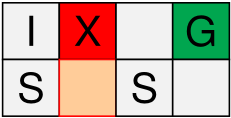
MDPs as distribution transformers. MDPs are traditionally viewed as random generators of paths, and one investigates the (expected) behaviour of a generated path, i.e. path properties. However, in this work we treat probabilistic systems as (deterministic) transformers of distributions.
First, fix a Markov chain M. For a given initial distribution µ0, we define the distribution at step i by µi(s) = Prµ0 [{ρ ∈ IPathsM | ρi = s}], i.e. the probability to be in state s at step i. We write µi = M(µ0, i) for the i-th distribution and µ1 = M(µ0) for the one-step application of this transformation. Likewise, we obtain the same notion for an MDP M combined with a policy π, and write µi = Mπ (µ0, i), µ1 = Mπ (µ0). In summary, for a given initial distribution, a Markov chain induces a unique stream of distributions, and an MDP provides one for each policy. This naturally invites questions related to this induced stream of distributions. In their path interpretation, queries on MDPs such as reachability or safety, i.e. asking the probability of reaching or avoiding a set of states, allow for simple, polynomial time solutions [Puterman, 1994; Baier and Katoen, 2008]. However, the corresponding problems in the space of distributions are surprisingly difficult. Our goal is to enable efficient and automated reachability and safety analyses under the distribution transformer interpretation of Markov chains and MDPs. We start with an example.
Example 1. Consider a 2×4 grid as depicted in Figure 1. Let us say that a robot swarm starts at the initial cell marked I in the top-left of the grid. From any cell any robot can move horizontally or vertically to an adjacent cell via non-deterministic moves, as long as the adjoining cell is not marked X. Cells marked X are obstacles that cannot be moved to. Cells marked S are stochastic where 10% of the robots remain in the cell while remaining 90% can move to adjoining cell. Further, orange cells are distributional obstacles, i.e. at any point only 10% of all robots in the swarm may be in the set of orange cells. One could visualize this as a narrow path that ensures that only few robots can go through it safely at any point. Finally, there is a goal cell G. The problem is then to go from I to G (at least 90% of the swarm must reach G), while the dynamics must follow the stochastic constraints in S cells, and at the same time avoid obstacles X and satisfy distributional constraints in orange cells.
3 Distributional Reach-avoidance Problems
Consider a target set of distributions T and a safe set of distributions H, i.e. complement of the set of unsafe distributions. We consider a safe set rather than its complement for the simplicity of the presentation. Distributional reach-avoidance is concerned with verifying or computing an MDP policy under which the induced stream of distributions stays in H until it reaches T . There are several natural variants of the problem, depending on whether policy and initial distribution are given.
Consider an MDPM= (S,Act, δ), a set of initial distributions Init ⊆ ∆(S),T ⊆ ∆(S), and H ⊆ ∆(S). Let π be a (memoryless/general) policy for M. Then:
- For µ0 ∈ Init, we say that the MDPMsatisfies (T,H)- reach-avoidance from µ0 under policy π, if there exists i ≥ 0 such that Mπ (µ0, i) ∈ T and if for all 0 ≤ j < i we have Mπ (µ0, j) ∈ H. When µ0 is fixed, we also say that M satisfies unit-(T, H)-reach-avoidance under π.
- We sayMsatisfies existential-(T,H)-reach-avoidance under π if there exists a distribution µ0 ∈ Init such that M satisfies (T, H)-reach-avoidance from µ0 under π.
- We say MDP M satisfies universal-(T,H)-reach - avoidance under π if for all µ0 ∈ Init, M satisfies (T, U)-reach-avoidance from µ0 under π.
Existential and universal reach-avoidance are relevant when the input distribution is not precise. While universal reachavoidance is more restrictive than existential, it is motivated by robustness questions, where we do not precisely know the initial distribution so we ask that all distributions belonging to some uncertainty set behave in a certain way. We are now ready to formally define the problems that we consider:
Distributional Reach-avoidance
Given an MDPM= (S,Act, δ), a set of initial distributions Init ⊆∆(S), µ0 ∈ Init, a target set T ⊆∆(S), and a safe set H ⊆ ∆(S):
- (i) The (unit/existential/universal) Policy Certification problem asks if, given a policy π, there exists a certificate C which ensures that M satisfies (unit/existential/universal) (T, H)-reach-avoidance under π and allows automated reasoning about certificate correctness. We refer to the pair (π, C) as a certified policy.
- (ii) The (unit/existential/universal) Policy Verification problem asks to, given a policy π, compute a certificate C such that (π, C) as a certified policy.
- (iii) The (unit/existential/universal) Policy Synthesis problem asks to compute a policy π together with a certificate C such that (π, C) as a certified policy.
We note that these problems are not yet fully well defined: Since ∆(S) is an uncountably infinite space, we need to describe how the sets Init, T, and H are represented. As common for continuous scenarios, we restrict to affine sets. Concretely, we assume that these sets are specified via a finite number of affine inequalities and are of the form
where S = {s1, . . . , sn} are MDP states, tij , hji , and aji are real-valued constants, ▷◁ ∈ {≥, >}, and NT , NH, NInit are resp. numbers of affine inequalities defining T , H, and Init .
Hardness. Note that Policy Verification and Synthesis problems ask only to compute a certificate for a given policy (or policy and certificate), and not to decide their existence. The reason is that, as it turns out, both decision problems are computationally hard even in the setting of affine sets. This hardness emerges already in the case of (memoryless) policy verification for distributional reachability: Even if M is a Markov chain, |Init | = 1, T = {µ | µ(s1) = 1 4 }, H = ∆(S), the problem is SKOLEM-hard 1 [Akshay et al., 2015].
Proposition 1. The decision problem variants of the unit/existential/universal Policy Verification and Synthesis problems for MDPs with respect to distributional reachavoidance are as hard as the Skolem problem.
As a result, we cannot expect to obtain an efficient, sound and complete decision procedure for our problem. To overcome this, we focus on asking for certificates and policies of a certain special form, and come up with a sound and relatively complete procedure to synthesize them, as explained below.
4 Proving Distributional Reach-avoidance
We now consider the Policy Certification problem discussed in Section 3. First, we show that in order to reason about distributional reach-avoidance, it suffices to restrict to the so-called distributionally memoryless policies. Second, we introduce our novel certificate for formally proving distributional reachavoidance, which we call distributional reach-avoid certificate. We show that distributional reach-avoid certificates provide a sound and complete proof rule for proving distributional reach-avoidance under distributionally memoryless policies.
Distributionally memoryless policies. Let M = (S,Act, δ) be an MDP, π : FPathsM → ∆(Act) a policy and µ0 ∈ ∆(S) an initial distribution. Let µ0, µ1, . . . be the stream of distributions induced by π from µ0. We say that π is distributionally memoryless, if for any initial distribution µ0 ∈ ∆(S) and for any two finite paths ϱ = s0a0s1a1 . . . sn and ϱ′ = s′0a′0 s′1a′1 . . . s′m with µn = µm, we have π(ϱ) = π(ϱ′ ). Thus, probability distribution over actions only depends on the current distribution over states and not on the whole history. The following theorem shows that, in order to reason about distributional reach-avoidance, it suffices to restrict to distributionally memoryless policies. The proof of the following theorem can be found in the extended version [Akshay et al., 2024].
Theorem 1. Let T,H ⊆ ∆(S) be target and safe sets. MDP M satisfies unit/existential/universal-(T , H)-reach-avoidance under some policy if and only if there exists a distributionally memoryless policy π such that M satisfies satisfies unit/existential/universal-(T, H)-reach-avoidance under π.
1 Intuitively, the SKOLEM problem asks for a given rational (or integer or real) matrix M, whether there exists n ∈ N, such that (M n )1,1 = 0 [Ouaknine and Worrell, 2012]. This problem (and its variants) has been the subject of intense research over the last 40 years, see e.g. [Lipton et al., 2022]. Yet, quite surprisingly, it still remains open, even for matrices of size 5 and above.
Sound and complete certificate. Intuitively, given a target set of distributions T and a safe set of distributions H, a distributional (T,H)-reach-avoid certificate under policy π is a pair C = (R, I) of a distributional ranking function R and a distributional invariant I. The distributional invariant I is a set of distributions that is required to contain all distributions that are reachable under policy π and also to be contained in H, while the distributional ranking function R is a function that maps distributions over MDP states to reals, which is required to be nonnegative at all distributions contained in I and to decrease by at least 1 after every one-step evolution of the MDP until the target T is reached. We formalize this intuition.
Definition 1 (Distributional reach-avoid certificate). LetM be an MDP, µ0 ∈ Init be an initial distribution and π be a policy. A distributional (T,H)-reach-avoid certificate forM from µ0 under π is a pair (R, I), comprising of a function R : ∆(S) → R and a set of distributions I ⊆ ∆(S) such that the following conditions hold:
- Initial distribution in I. We have µ0 ∈ I.
- Inductiveness of I until T. The set I is closed under application of Mπ to any non-target distribution contained in I, i.e. Mπ (µ) ∈ I holds for every µ ∈ I\T .
- Safety. I is a subset of the safe set H, i.e. I ⊆H.
- Nonnegativity of R. For every µ ∈ I, we have R(µ) ≥ 0.
- Strict decrease of R until T . For every µ ∈ I\T , we have R(µ) ≥ R(Mπ (µ)) + 1.
Furthermore, a distributional (T, U)-reach-avoid certificate for M under π is said to be universal, if it satisfies conditions 2-5 and in addition condition 1 is strengthened to Init ⊆ I, i.e. the set I must contain all distributions in Init.
The following theorem establishes that distributional reachavoid certificates provide a sound and complete proof rule for proving distributional reach-avoidance in MDPs under distributionally memoryless policies. The intuition behind the proof is as follows. Take the distribution transformer view of MDPs and consider the stream µ0, µ1, µ2, . . . of distributions over MDP states induced by starting in µ0 and repeatedly applying policy π. Then conditions 1-3 in Definition 1 together ensure that distributions in the stream stay in H at least until T is reached. On the other hand, conditions 4 and 5 in Definition 1 together ensure that a distribution in T must be eventually reached since R cannot be decreased by 1 indefinitely while remaining non-negative. Hence, T is eventually reached while H is not left in the process, and distributional reach-avoid certificates provide a sound proof rule. To prove completeness, we simply let I = {µ0, µ1, µ2, . . . } be the stream of induced distributions, k be the smallest index such that µk ∈ T and define R(µi) = max{0, k - i}. One can then verify that (R, I) is indeed a correct distributional reach-avoid certificate. The formal proof can be found in [Akshay et al., 2024].
Theorem 2 (Sound and complete certificates). LetMbe an MDP, µ0 ∈ Init and π be a distributionally memoryless policy. Then M satisfies
- unit-(T,H)-reach-avoidance under π iff there exists a distributional (T,H)-reach-avoid certificate forMfrom µ0 under π.
- existential-(T,H)-reach-avoidance under π iff there exists a µ0 ∈ Init and distributional (T,H)-reach-avoid certificate for M from µ0 under π.
- universal-(T,H)-reach-avoidance under π iff there exists a universal distributional (T,H)-reach-avoid certificate forMunder π.
From Proposition 1, it follows that giving a complete procedure for synthesizing (or indeed even checking existence of) distributional certificates is Skolem-hard. Hence in what follows, we provide an automated template-based overapproximation approach that exploits the advances in SMT-solvers to give as an implementable procedure. First, we restrict to memoryless policies in Section 5, then we address the general case of distributionally memoryless policies in Section 6.
5 Algorithm for Memoryless Policies
We now consider the (unit/existential/universal) Policy Synthesis and Verification problems defined in Section 3 under memoryless policies and present our algorithms for solving these problems. Due to space restrictions, in what follows we directly present our algorithm for solving the existential Policy Synthesis problem under memoryless policies. We then explain how this algorithm can be straightforwardly extended to solve the other problems under the memoryless restriction.
Our algorithm simultaneously synthesizes an initial distribution (for the existential problem), a memoryless policy and an affine distributional reach-avoid certificate. Restricting to affine distributional reach-avoid certificates (formalized below) ensures efficient and automated computation. While we cannot provide completeness guarantees due to this restriction, we show that the algorithm is sound and relatively complete, i.e. it is guaranteed to compute a memoryless policy and an affine distributional reach-avoid certificate when they exist.
A distributional reach-avoid certificate C = (R, I) is affine if it can be specified via affine expressions and inequalities over the distribution space ∆(S). That is, the distributional ranking function R is of the form R = r0 + ∑ni=1 ri · µ(si) and the distributional invariant I is of the form
where S = {s1, . . . , sn} are MDP states, bij are real-valued constants and NI is the number affine inequalities that define I. While the values of variables ri and bji will be computed by our algorithm, NI is an algorithm parameter which we refer to as the template size. Note that we require all affine inequalities that specify I to be non-strict. This is the technical requirement for our method to provide relative completeness.
Input. The algorithm takes as input an MDP M = (S, Act , δ) together with affine sets of initial distributions Init , target distributions T and safe distributions H. It also takes as input the template size parameter NI .
Algorithm outline. The algorithm employs a templatebased synthesis approach and proceeds in three steps. First, it fixes symbolic templates for an initial distribution µ0 ∈ Init , a memoryless policy π, and an affine distributional reach-avoid certificate C = (R, I). Symbolic variables that define the templates are at this stage of unknown value. Second, the algorithm collects a system of constraints over the symbolic template variables that encode that µ0 ∈ Init, π is a memoryless policy, and C is a correct distributional reach-avoid certificate. Third, it solves the resulting system of constraints, to get concrete instances of µ0, π, and C. We detail these steps.
Step 1 - Fixing templates. The algorithm fixes templates for µ0, π and C = (R, I):
- Template for µ0. For each MDP state si, 1 ≤ i ≤ n, the algorithm introduces a symbolic template variable mi to encode the probability of initially being in si.
- Template for π. Since the algorithm searches for a memoryless policy, for each state action pair si ∈ S and aj ∈ Act we fix a symbolic template variable psi,aj to encode the probability of taking action aj in state si. If aj ̸∈ Act(si), we set psi,aj = 0.
- Template for R. The template for R is defined by introducing n + 1 real-valued symbolic template variables r0, . . . , rn and letting R = r0 + ∑ni=1 ri · µ(si).
- Template for I. The template for R is defined by introducing real-valued symbolic template variables bji for each 1 ≤ j ≤ NI and 0 ≤ i ≤ n, with
Step 2 - Constraint collection. The algorithm now collects constraints over the template variables that together encode that µ0 ∈ Init , π is a memoryless policy and C is a distributional reach avoid certificate. The constraint Φinit encodes that µ0 ∈ Init , Φπ encodes that π is a memoryless policy, whereas Φ1, . . . , Φ5 encode the 5 defining conditions in Definition 1:
- Φinit ≡ (µ0 ∈ Init) ≡ ∧NInit j=1 (aj0 + ∑ni=1 aji · mi) ▷◁ 0, where recall aji 's are real constants defining Init .
- Φπ ≡ ∧ni=1 ( ∑|Act | j=1 psi,aj = 1 ∧ ∧|Act| j=1 (psi,aj ≥ 0))
- Φ1 ≡ ∀x ∈ Rn . Init(x) ⇒ I(x).
- Φ2 ≡ ∀x ∈ Rn . I(x) ⇒ I(step(x)), where step(x)(xi) = ∑sk∈S,aj∈Act(sk) psk,aj · δ(sk, aj, si) · xj yields the distribution after applying one step of policy π.
- Φ3 ≡ ∀x ∈ Rn . I(x) ⇒ H(x).
- Φ4 ≡ ∀x ∈ Rn . I(x) ⇒ R(x) ≥ 0.
- Φ5 ≡ ∀x ∈ Rn . I(x)\T (x) ⇒ R(x) ≥ R(step(x))-1, where step(x) is defined as above.
Step 3 - Constraint solving. The initial constraint Φinit and the policy constraint Φπ are purely existentially quantified over template variables. However, Φ1, . . . , Φ5 all contain alternation of an existential quantifier over the symbolic template variables followed by a universal quantifier over the distribution x ∈ Rn over the MDP state probabilities. Quantifier alternation over real-valued arithmetic is in general hard to handle directly and can lead to inefficiency in solvers. To that end, our algorithm first translates these constraints into equisatisfiable purely existentially quantified constraints, before feeding the resulting constraints to an off-the-shelf solver.
We begin by noting that Φ1, Φ2, Φ4, Φ5 can all be expressed as conjunctions of finitely many constraints of the form
with each affexpi (x) and affexp(x) being an affine expression over x whose affine coefficients are either concrete real values or symbolic template variables, and each ▷◁∈ {≥,>}. The inequalities on the left-hand-side of the implication may be both strict and non-strict, however the inequalities on the righthand-side of each of Φ1,Φ2,Φ4,Φ5 are always non-strict, since we assumed that the template for I is specified via nonstrict affine inequalities. Now, to remove quantifier alternation, we apply the translation of [Asadi et al., 2021, Corollary 1] which is an extension of Farkas' lemma [Farkas, 1902] that allows strict inequalities on the left-hand-side of the implication (we provide this translation in the extended version of the paper [Akshay et al., 2024]). This allows us to translate each constraint of the form as in Eq. (1) into an equisatisfiable purely existentially quantified system of quadratic constraints with real-valued variables, where variables are either symbolic template variables or fresh symbolic variables introduced in translation.
On the other hand, Φ3 ≡ ∀x ∈ Rn . I(x) ⇒ H(x) is a conjunction of constraints of the form
since I is specified in terms of non-strict inequalities but H can be specified in terms of both strict and non-strict inequalities. However, since the set of distributions contained in I is topologically closed and bounded as I ⊆ ∆(S), Eq. (2) is equivalent to the constraint obtained by replacing affexp(x) ▷◁ 0 above by affexp(x) ≥ ϵ, with ϵ > 0 being a newly introduced symbolic variable. The latter constraint is of the form as in Eq. (1), hence we may again apply the above translation.
Finally, the algorithm feeds the resulting system to an offthe-shelf SMT solver, and any solution gives a concrete instance of initial distribution µ0 ∈ Init , memoryless policy π and affine distributional reach-avoid certificate C.
The following theorem (proved in [Akshay et al., 2024]) establishes soundness, relative completeness and an upper bound on the computational complexity of our algorithm. Soundness and relative completeness follow from the fact that the quantifier removal procedure yields an equisatisfiable system of constraints. The PSPACE upper bound follows since the quantifier removal procedure reduces the problem to solving a sentence in the existential first-order theory of the reals.
Theorem 3. Soundness: If the algorithm returns initial distribution µ0 ∈ Init , memoryless policy π, and affine inductive distributional reach-avoid certificate C, then the MDP M satisfies existential (T,H)-reach-avoidance under π.
Relative completeness: If there exists µ0 ∈ Init , a memoryless policy π, and an affine distributional (T, H)-reach-avoid certificate C from µ0 under π, then there exists a template size NI ∈ N such that µ0, π, and C are computed by the algorithm.
Complexity: The runtime of the algorithm is in PSPACE in the size of the encoding of the MDP, Init, T, H, and the template size parameter NI ∈ N.
Extension to unit/universal policy synthesis. We now show how the above algorithm can be extended to solve unit and universal Policy Synthesis problems as well. For unit Policy Synthesis, the initial distribution µ0 is given, hence in Step 1 of the algorithm we do not need to fix a template for it and in Step 2 we remove the constraint Φinit. For universal Policy Synthesis, we now need distributional reach-avoidance to hold from all initial distributions in Init . Hence, in Step 1 we again do not need to fix a template for µ0 whereas in Step 2 we set Φ1 ≡ ∀x ∈ Rn . (Init(x) ⇒ I(x)). In both cases, the rest of the algorithm proceeds analogously as above. Moreover, as in Theorem 3, both algorithms are sound, relatively complete and of PSPACE runtime in the size of the problem.
Extension to policy verification. The above algorithm is also easily extended to solve the unit/existential/universal Policy Verification problems. In particular, in these problems the memoryless policy π is given and need not be computed. Thus, in Step 1 above we need not fix the templates psi,aj for the policy as these are given concrete values, and in Step 2 we remove the constraint Φπ. The rest of the algorithms proceed analogously as in the Policy Synthesis case, and as a corollary of Theorem 3 we can show that they are sound, relatively complete and of PSPACE runtime in the size of the problem.
6 Extension to General Policies
We also extend the algorithms for memoryless policies in Section 5 to sound but incomplete procedures for solving unit/existential/universal Policy Synthesis and Verification problems under distributionally memoryless policies. While memoryless policies are preferred in practice since they can be efficiently deployed and executed, it was shown in [Akshay et al., 2023] that there exist MDPs for which memoryless or even bounded memory policies are insufficient for ensuring distributional safety, and the same example shows that bounded memory strategies are insufficient for distributional reach-avoidance. However, by Theorem 1, it always suffices to restrict to distributionally memoryless policies.
The key challenge in extending our algorithms in Section 5 is the design of an appropriate policy template, since now it is insufficient to introduce one template variable psi,aj for each state-action pair as these probabilities may depend on history. However, it turns out that distributionally memoryless policies do admit a sufficiently simple template specified in terms of quotients of symbolic affine expressions over x. In [Akshay et al., 2024], we show how to extend our algorithm for existential Policy Synthesis to compute distributionally memoryless policies. We also provide extensions to unit/universal Policy Synthesis and to Policy Verification. Finally, we prove that the algorithm is sound and runs in PSPACE. However, the algorithm does not provide relative completeness guarantees, since our policy templates are not general and only allow affine expressions over distribution probabilities.
7 Experimental Evaluation
We implemented a prototype of our method in Python 3, using SymPy [Meurer et al., 2017] for symbolic expressions and PySMT [Gario and Micheli, 2015] to manage SMT solvers.
We employ Yices 2.6 [Dutertre, 2014] as solving backend. We also evaluated z3 [de Moura and Bjørner, 2008] and mathsat [Cimatti et al., 2013], but Yices seemed to consistently perform best. Our experiments were executed on consumer hardware (AMD Ryzen 3600 CPU with 16 GB RAM). Our implementation is publicly available at https://zenodo.org/records/11082466.
As mentioned in the Introduction, we are not aware of any existing automated methods for solving this task in the distributional reach-avoidance setting, thus we do not have a reasonable baseline to compare against. The evaluation of our prototype is aimed at showing that distributional certificates can be found on reasonably sized systems, without heuristics and optimization.
Benchmarks. We evaluate our method on several distributional reach-avoid tasks. Most are modelling a robot swarm in different gridworld environments. Each model requires that at some point in time at least 90% of the robots are in the target set of states, while no more than 10% of robots may be in the unsafe set of states at any intermediate step. Here, we present the following five models: Running, i.e. the environment in Example 1, Double, a 3x5 grid where the robots start in two different locations and need to reach two goal states, and three grids of size 5x4, 8x8, and 20x10, comprising various transition dynamics as well as limited and forbidden regions. For all grid world models, we consider both (unit) Policy Verification task in which a policy is fixed and needs to be verified, and (unit) Policy Synthesis task where a policy together with a certificate needs to be computed. For all examples, we find the template size NI = 1 to be sufficient. We also present results on Insulin, a pharmacokinetics system [Agrawal et al., 2015, Ex. 2], based on [Chadha et al., 2011], and PageRank [Agrawal et al., 2015, Fig. 3]. As these two are Markov chains, the verification and synthesis tasks coincide. A more detailed description of models can be found in [Akshay et al., 2024].
Results. Our results are shown in Table 1. Our prototype is able to solve 7/7 Policy Verification tasks with ease, and 3/5 Policy Synthesis tasks. A notable feature of this performance is that it is applicable to robot swarms with arbitrarily many agents, where the model size in the state-based view of MDPs would be intractable for classical model checking tools. This shows that our method is capable of solving highly non-trivial distributional reach-avoidance tasks. Furthermore, our results show that memoryless policies are sufficient in many scenarios.
We believe that the reason behind better scalability of our tool on Policy Verification compared to Policy Synthesis is that the final SMT query in Policy Verification tasks is structurally simpler. In particular, observe that the query for verification of Grid 20x10 is larger than the synthesis query for Grid 8x8, yet it is solved much faster. To provide further insight, we provide an example SMT query generated for the Grid 5x4 example in [Akshay et al., 2024]. Thus, improvements in SMT solvers will improve the scalability of our approach.
Practical observations. Somewhat surprisingly, we often observe that the computationally more expensive part of our implementation is construction of constraints (Steps 1 and 2 in Section 5), especially for the larger certification examples.
| Model | |S| | Act. | Inv. | SMT | Var. | Con. | Ops |
|---|---|---|---|---|---|---|---|
| Running | 7 | 19 | 1s | <1s | 64 | 81 | 556 |
| Double | 11 | 30 | 2s 3s 7s | <1s <1s <1s | 82 88 115 | 105 113 148 | 776 795 1114 |
| Grid 5x4 | 15 | 29 | 2s 6s | <1s 1s | 112 133 | 145 173 | 1018 1395 |
| Grid 8x8 | 32 | 99 | 8s 19s | 1s T/O | 216 312 | 284 410 | 2086 |
| Grid 20x10 | 88 | 280 | 68s 238s | 2s T/O | 642 921 | 910 1276 | 3144 6556 9507 |
| Insulin PageRank | 5 5 | - - | 2s 2s | 3s <1s | 74 52 | 88 65 | 790 571 |
We believe that this is due to our naive usage of SymPy to extract constraints, since in theory this procedure should run in polynomial time without any complicated data structures. In our prototype implementation, we did not aim for efficient extraction and manipulation of affine expressions. Improvements on this end, e.g. by manually implementing a tailored polynomial representation, would further decrease the runtime of our tool.
We also observe that performance of SMT solvers is highly volatile, with their runtimes sometimes increasing 10- or 100fold on the same instance, presumably due to running into a bad randomized initialization. Implementing a tighter integration with such solvers and, in particular, providing them with heuristical guidance could further improve performance.
8 Conclusion
We considered the distributional reach-avoidance problem in MDPs, for which we introduced distributional reach-avoid certificates and proposed fully automated template-based synthesis algorithms for solving policy verification and synthesis problems under distributional reach-avoidance. Our work opens several avenues for future work. It would be interesting to consider practical heuristics for template-based synthesis. One could also consider more general distributional properties, ultimately paving the way towards distributional LTL. Finally, our template-based synthesis assumes that the structure of the template, i.e. the number of conjunctive clauses in invariants, is provided a priori. This is a known limitation of many template-based synthesis methods, and exploring effective heuristics for template search is an interesting direction.
Acknowledgements
This work was supported in part by the ERC-2020-CoG 863818 (FoRM-SMArt), the Singapore Ministry of Education (MOE) Academic Research Fund (AcRF) Tier 1 grant, Google Research Award 2023 and the SBI Foundation Hub for Data and Analytics.
@inproceedings{ijcai2024p1,
  title     = {Certified Policy Verification and Synthesis for MDPs under Distributional Reach-Avoidance Properties},
  author    = {Akshay, S. and Chatterjee, Krishnendu and Meggendorfer, Tobias and Žikelić, Đorđe},
  booktitle = {Proceedings of the Thirty-Third International Joint Conference on
               Artificial Intelligence, {IJCAI-24}},
  publisher = {International Joint Conferences on Artificial Intelligence Organization},
  editor    = {Kate Larson},
  pages     = {3--12},
  year      = {2024},
  month     = {8},
  note      = {Main Track},
  doi       = {10.24963/ijcai.2024/1},
  url       = {https://doi.org/10.24963/ijcai.2024/1},
}
TY - CPAPER TI - Certified Policy Verification and Synthesis for MDPs under Distributional Reach-Avoidance Properties AU - Akshay, S. AU - Chatterjee, Krishnendu AU - Meggendorfer, Tobias AU - Žikelić, Đorđe T2 - Proceedings of the Thirty-Third International Joint Conference on Artificial Intelligence, IJCAI-24 PB - International Joint Conferences on Artificial Intelligence Organization PY - 2024 SP - 3 EP - 12 DO - 10.24963/ijcai.2024/1 UR - https://doi.org/10.24963/ijcai.2024/1 ER -Copied
Machine-readable versions of this paper, for tools and AI agents:





