
InViTe: Individual Virtual Transfer for Personalized 3D Face Generation System
Proceedings of the Thirty-Third International Joint Conference on Artificial Intelligence. Demo Track. Pages 8683-8686.
https://doi.org/10.24963/ijcai.2024/1008
Keywords
- Computer Vision: CV: Applications
- Computer Vision: CV: 3D computer vision
Abstract
With the expansion of the virtual communication industry using VR/AR, it has attracted increasing attention to enable users to represent their personalities in a 3D avatar. As the face of 3D avatars plays a crucial role in conveying human personality, a system that generates and manipulates 3D faces is desired. However, establishing the system is challenging due to the need for human effort and specialized knowledge. To fill this void, we present the Individual Virtual Transfer (InViTe), which enables the creation and customization of a 3D face according to the user's preference. Our proposed system is featured for 1) 3D face reconstruction with high fidelity texture map, 2) 3D face personalization, 3) realistic rendering results, and 4) real-time mobile virtual applications. We conduct an experiment to demonstrate that the proposed system can achieve sufficient individual personalization of 3D faces. Furthermore, we evaluate the system's data transmission protocol and demonstrate its efficiency. The demonstration video is available at https://www.youtube.com/watch?v=D 4pXZvGUWU.
- [Abdal et al., 2021] Rameen Abdal, Peihao Zhu, Niloy J Mi- tra, and Peter Wonka. Styleflow: Attribute-conditioned ex- ploration of stylegan-generated images using conditional continuous normalizing flows. ACM Transactions on Graphics (ToG), 40(3):1-21, 2021.
- [Ahn et al., 2018] Sewoong Ahn, Woojae Kim, Jinwoo Kim, Jaekyung Kim, and Sanghoon Lee. Visual preference pre- diction for enhanced images on ultra-high-definition dis- play. In 2018 25th IEEE International Conference on Im- age Processing (ICIP), pages 3548-3552. IEEE, 2018.
- [Bai et al., 2023] Haoran Bai, Di Kang, Haoxian Zhang, Jin- shan Pan, and Linchao Bao. Ffhq-uv: Normalized facial uv-texture dataset for 3d face reconstruction. In Proceed- ings of the IEEE/CVF Conference on Computer Vision and Pattern Recognition, pages 362-371, 2023.
- [Daněček et al., 2022] Radek Daněček, Michael J Black, and Timo Bolkart. Emoca: Emotion driven monocular face capture and animation. In Proceedings of the IEEE/CVF Conference on Computer Vision and Pattern Recognition, pages 20311-20322, 2022.
- [Dastjerdi et al., 2023] Mohammad Reza Karimi Dastjerdi, Jonathan Eisenmann, Yannick Hold-Geoffroy, and Jean- Franc ¸ois Lalonde. Everlight: Indoor-outdoor editable hdr lighting estimation. In Proceedings of the IEEE/CVF In- ternational Conference on Computer Vision, pages 7420- 7429, 2023.
- [Deng et al., 2019] Jiankang Deng, Jia Guo, Niannan Xue, and Stefanos Zafeiriou. Arcface: Additive angular mar- gin loss for deep face recognition. In Proceedings of the IEEE/CVF conference on computer vision and pattern recognition, pages 4690-4699, 2019.
- [Jang et al., 2022] Mingyu Jang, Seongmin Lee, Jiwoo Kang, and Sanghoon Lee. Technical consideration towards robust 3d reconstruction with multi-view active stereo sen- sors. Sensors, 22(11):4142, 2022.
- [Kachur et al., 2020] Alexander Kachur, Evgeny Osin, De- nis Davydov, Konstantin Shutilov, and Alexey Novok- shonov. Assessing the big five personality traits using real- life static facial images. Scientific Reports, 10(1):8487, 2020.
- [Kartynnik et al., 2019] Yury Kartynnik, Artsiom Ablavatski, Ivan Grishchenko, and Matthias Grund- mann. Real-time facial surface geometry from monocular video on mobile gpus. In Third Workshop on Computer Vision for AR/VR, 2019.
- [Kim et al., 2016] Haksub Kim, Sewoong Ahn, Woojae Kim, and Sanghoon Lee. Visual preference assessment on ultra-high-definition images. IEEE Transactions on Broadcasting, 62(4):757-769, 2016.
- [Kim et al., 2021] Woojae Kim, Anh-Duc Nguyen, Jinwoo Kim, Jongyoo Kim, Heeseok Oh, and Sanghoon Lee. Di- verse and adjustable versatile image enhancer. IEEE Ac- cess, 9:80883-80896, 2021.
- [Lee et al., 2023] Kyungjune Lee, Jeonghaeng Lee, Hyuck- sang Lee, Mingyu Jang, Seongmin Lee, and Sanghoon Lee. Faceclone: Interactive facial shape and motion cloning system using multi-view images. In 2023 IEEE International Conference on Multimedia and Expo Work- shops (ICMEW), pages 512-513. IEEE, 2023.
- [Li et al., 2017] Tianye Li, Timo Bolkart, Michael J Black, Hao Li, and Javier Romero. Learning a model of facial shape and expression from 4d scans. ACM Trans. Graph., 36(6):194-1, 2017.
- [Li et al., 2018] Tingting Li, Ruihe Qian, Chao Dong, Si Liu, Qiong Yan, Wenwu Zhu, and Liang Lin. Beautygan: Instance-level facial makeup transfer with deep genera- tive adversarial network. In Proceedings of the 26th ACM international conference on Multimedia, pages 645-653, 2018.
- [Li et al., 2021] Tianye Li, Shichen Liu, Timo Bolkart, Ji- ayi Liu, Hao Li, and Yajie Zhao. Topologically consis- tent multi-view face inference using volumetric sampling. In Proceedings of the IEEE/CVF International Conference on Computer Vision, pages 3824-3834, 2021.
- [Paysan et al., 2009] Pascal Paysan, Reinhard Knothe, Brian Amberg, Sami Romdhani, and Thomas Vetter. A 3d face model for pose and illumination invariant face recognition. In 2009 sixth IEEE international conference on advanced video and signal based surveillance, pages 296-301. Ieee, 2009.
- [Wang et al., 2020] Wencheng Wang, Xiaojin Wu, Xiaohui Yuan, and Zairui Gao. An experiment-based review of low-light image enhancement methods. Ieee Access, 8:87884-87917, 2020.
- [Yang et al., 2023] Xingchao Yang, Takafumi Taketomi, and Yoshihiro Kanamori. Makeup extraction of 3d representa- tion via illumination-aware image decomposition. In Com- puter Graphics Forum, volume 42, pages 293-307. Wiley Online Library, 2023.
- [Zheng et al., 2023] Yujian Zheng, Zirong Jin, Moran Li, Haibin Huang, Chongyang Ma, Shuguang Cui, and Xi- aoguang Han. Hairstep: Transfer synthetic to real us- ing strand and depth maps for single-view 3d hair mod- eling. In Proceedings of the IEEE/CVF Conference on Computer Vision and Pattern Recognition, pages 12726- 12735, 2023.
References were extracted automatically from the PDF and may contain errors.
Full text extracted automatically from the PDF; figures, tables and equations may differ. The PDF is the version of record.
1 Introduction
3D avatar personalization enables users to represent their personalities in the virtual space. It is continuously emerging due to the growth of the virtual communication industry because users have a desire to express their personality [Kim et al., 2016; Ahn et al., 2018; Wang et al., 2020; Kim et al., 2021]. The personality can be affected by the human face [Kachur et al., 2020], so it is necessary to develop a system that personalizes 3D faces for avatars to represent one's personality.
The 3D face personalization system can be conducted through two steps: 3D face reconstruction and 3D face manipulation. These two steps have been achieved through various computer graphics or computer vision approaches [Paysan et al., 2009; Li et al., 2017]. However, they heavily rely on human efforts and require professional knowledge. To reconstruct a 3D face, sophisticated hardware like
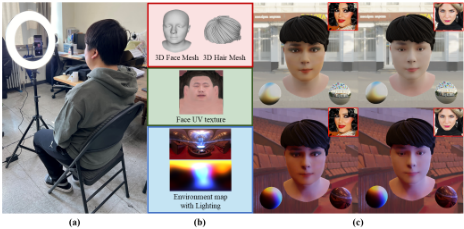
3D scanners or multi-view camera systems is used to obtain a face mesh, which also needs refinement for highquality geometry details [Jang et al., 2022; Lee et al., 2023; Li et al., 2021]. For 3D face manipulation, a texture map is employed, obtained either with specialized equipment or designed manually by a 3D artist.
To alleviate this problem, in this paper, we propose a system called Individual Virtual Transfer (InViTe), designed to create and customize the 3D virtual face for personalization. Our proposed system has four desirable properties. First, our system performs accurate 3D face reconstruction with a high fidelity texture map. To do this, we utilize a 3D Morphable Model (3DMM) [Li et al., 2017], which enables us to obtain both a 3D face geometry and textures through a linear combination of coefficients. However, since the texture computed from the coefficients can result in coarse results, our system additionally produces high-quality texture maps using a generative model-based face normalization [Bai et al., 2023]. Second, our system can personalize the obtained 3D face avatars. The personalization preserves the identity while editing its appearance. To represent the detail of identity, our proposed system additionally recovers the hair from the input image. For editing appearance, we stylize the face UV texture by giving a 2D style image to manipulate the face appearance. Third, our system provides realistic rendered results for a more immersive experience. We include a Physically Based Rendering (PBR) process, which renders an image by considering the illumination effects. Specifically, our system takes an image for the illumination condition as input and automatically estimates surrounding lighting information. Finally, our system supports real-time mobile virtual applications. However, the computation of the personalization process is complex to perform on a mobile device. Therefore, we employ a client-server system framework to reduce both computation costs and data transmission for realtime processing.
To demonstrate the effectiveness of the proposed system, we conduct a personalization experiment. Moreover, we additionally experiment the latency efficiency of our proposed system. Experimental results demonstrate that the proposed system is not only well-suited for 3D avatar personalization but also enables real-time rendering processes for immersive virtual applications.
2 SystemFramework
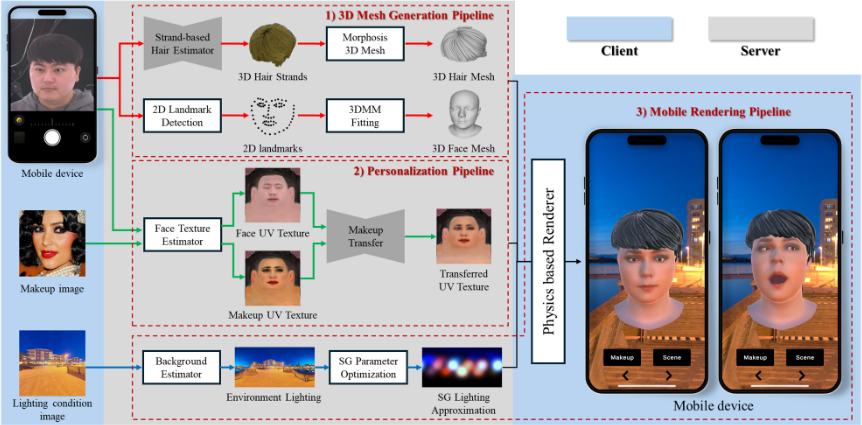
In this section, we describe our framework for creating and manipulating personalized 3D virtual faces as shown in Fig. 2. InViTe is broadly divided into client and server components. On the client side, the system receives a single portrait image, a makeup image, and a lighting condition image through a mobile device, which is then transmitted to the server. After that, on the server side, the system runs three pipelines as follows: 1) 3DMesh Generation Pipeline, 2) Personalization Pipeline, and 3) Mobile Rendering Pipeline. The system's server generates a 3D face mesh and 3D hair mesh in the 3D mesh generation pipeline. Simultaneously, a face UV texture is generated in the Personalization Pipeline. Specifically, we employ a makeup style transfer approach to personalize a face UV texture. In the third pipeline, accounting for lighting effects, our system generates lighting information as Spherical Gaussian parameters. Finally, our system transmits all generated data to the mobile device for mobile rendering.
The mobile device uses the front camera to track the 3D landmarks of the face [Kartynnik et al., 2019] and deform the rendered 3D face mesh following the user's movement.
2.1 3DMesh Generation Pipeline
To generate a 3D face mesh, we employ 3D face mesh estimation [Danˇeˇcek et al., 2022], which fits the FLAME model [Li et al., 2017] from a single 2D image. However, it is insufficient to represent the user's identity since the Flame model does not support hair. The most effective method for processing hair is to generate each 3D hair strand, but it is generally a challenging task due to the extreme computing power required for physics calculations. Also, hair material possesses an anisotropic reflection characteristic which makes it difficult to achieve realistic rendering. Therefore, to accomplish plausible of rendering 3D hair mesh in the mobile device, we handle hair as a single mesh while the mesh is generated from separated strands. To generate a 3D hair mesh, we first employ a strand-based hair estimator [Zheng et al., 2023]. Subsequently, we generate a solid 3D hair mesh along each strand by calculating directions within each point on every strand and consolidate all strands into a single mesh, as depicted in the morphosis 3D mesh in Fig. 2. As a result, it is possible to deliver realism induced by detailed geometry, while maintaining moderate computational burden.
2.2 Personalization Pipeline
In our proposed system, the personalization pipeline consists of the texture estimator and the makeup transfer. The texture estimator extracts the face texture from a single image. The makeup transfer takes two face textures as content and style respectively, and stylizes the makeup attributes of the makeup UV texture into the content face UV texture. Specifically, the personalized results may rely on the quality of the face UV texture, but it is still a challenging task due to occlusion or various head poses/expressions in the single face image. To alleviate this problem, we adopt the face normalization approach used in previous work [Bai et al., 2023], which produces a completed face UV texture from normalized multiview faces using styleGAN-based facial image editing. After obtaining the face UV texture, we design the makeup transfer network that produces an alpha blending map and makeup layer similar to [Yang et al., 2023]. In particular, for more high-fidelity results, we employ the styleGAN [Abdal et al., 2021] based architecture. We train the network using the MT dataset following the training strategy in the previous work [Yang et al., 2023]. Finally, to transfer the makeup style, we blend the makeup layer and the face UV texture using the alpha blending map to obtain the transferred texture.
2.3 Mobile Rendering Pipeline
In our framework, the rendering pipeline with all of the 3D face data in Sec. 2.1 and 2.2 is processed on mobile client through PBR. To express lighting to the user's movement described in Sec. 2, environment lighting is applied to the rendering process. We employ a GAN-based model similar to [Dastjerdi et al., 2023] which generates 360 high dynamic range image (HDRI) from a single image selection of the user as background estimator. The environment lighting enables superior rendering results, but high resolution 360 HDRI with intense computation is usually required. However, considering a lightweight mobile environment, we utilize a Spherical Gaussian (SG) representation. The SG approximation of HDRI is compact and efficient, where any HDRI can be compressed into a small vector with simple irradiance calculation coming from the nature of the Gaussian function. The HDRI is approximated into 19 by 3 vectors by optimizing the RGB strengths of 19 lobes with fixed location and width. Therefore, fast and efficient rendering of faces with user selectionbased environment lighting on a mobile device is possible.
| Data type | Ours | Video stream | Mesh stream |
| Latency(s) | 0.03 | 0.17 | 0.31 |
| Relative ratio | 1.0 | 5.7 | 10.3 |
3 SystemEvaluation
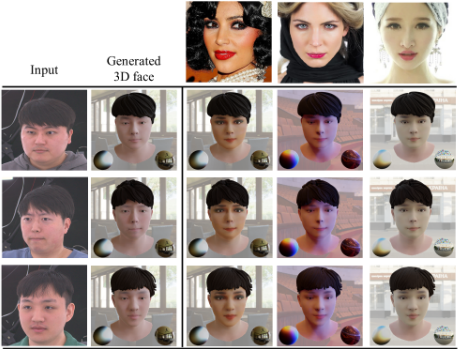
We first show qualitative results as shown in Fig. 3. As depicted in the figure, our system supports various personalizations through makeup transfer and produces rendering results by introducing PBR. To verify the effectiveness of our system, we conduct two quantitative experiments: personalization and data transmission.
(1) Personalization. To evaluate personalization performance, we generate 10 fitted 3DMM parameters and 3D hair from 10 volunteers years old to 32 years old. Then, we randomly select 15 makeup images from the MT test set [Li et al., 2018] and perform makeup transfer to each face texture. We render each 3D face with the transferred texture using selected makeup images. After that, we measure the accuracy of face verification using ArcFace [Deng et al., 2019] to determine whether the face in the rendered view matches the face in the portrait image. Furthermore, we also conduct a subjective test in which participants were asked to answer a question; How well does this result reflect personalization without altering the identity?. The participants can score the scene from 1 (worst) to 5 (best). The results achieved a verification task accuracy of 91.4% and received a subjective score of 4.3. Therefore, the results show that our proposed system achieves proper personalization by only manipulating the face appearance.
(2) Data transmission. To verify the transmission efficiency of our system architecture, we conduct experiments on the data transmission protocol. We categorize data transmission in our system into three cases: Our approach, video stream, and mesh stream. The video stream renders the 3D face on the server using 3D landmarks and continuously transmits the rendered view to the mobile device. In contrast, for the mesh stream, the server directly transmits the 3D face mesh, and the client is responsible for rendering. The results are shown in Table 1. Compared to other methods, Ours achieves a transmission efficiency of 82.4% compared to video stream and 90.3% compared to mesh stream, which proves that InViTe can serve real-time rendering to users.
4 Conclusion
We propose a 3D face personalization system, called InViTe, which enables both the generation of 3D faces and customization of their textures for personalization. Furthermore, we incorporate a PBR process into our system to achieve realistic rendered results. Based on a server-client architecture, our proposed system supports real-time mobile virtual applications. Evaluation results demonstrate the effectiveness of the system's data transmission and personalization.
Acknowledgements
This research was supported by Culture, Sports and Tourism R&D Program through the Korea Creative Content Agency grant funded by the Ministry of Culture, Sports and Tourism in 2024 (Project Name: Global Talent for Generative AI Copyright Infringement and Copyright Theft, Project Number: RS-2024-00398413, Contribution Rate: 100%).
Contribution Statement
Mingyu Jang and Kyungjune Lee are equally contributed to this work. Sanghoon Lee is the corresponding author of this work.
@inproceedings{ijcai2024p1008,
  title     = {InViTe: Individual Virtual Transfer for Personalized 3D Face Generation System},
  author    = {Jang, Mingyu and Lee, Kyungjune and Lee, Seongmin and Tong, Hoseok and Chung, Juwan and Ro, Yusung and Lee, Sanghoon},
  booktitle = {Proceedings of the Thirty-Third International Joint Conference on
               Artificial Intelligence, {IJCAI-24}},
  publisher = {International Joint Conferences on Artificial Intelligence Organization},
  editor    = {Kate Larson},
  pages     = {8683--8686},
  year      = {2024},
  month     = {8},
  note      = {Demo Track},
  doi       = {10.24963/ijcai.2024/1008},
  url       = {https://doi.org/10.24963/ijcai.2024/1008},
}
TY - CPAPER TI - InViTe: Individual Virtual Transfer for Personalized 3D Face Generation System AU - Jang, Mingyu AU - Lee, Kyungjune AU - Lee, Seongmin AU - Tong, Hoseok AU - Chung, Juwan AU - Ro, Yusung AU - Lee, Sanghoon T2 - Proceedings of the Thirty-Third International Joint Conference on Artificial Intelligence, IJCAI-24 PB - International Joint Conferences on Artificial Intelligence Organization PY - 2024 SP - 8683 EP - 8686 DO - 10.24963/ijcai.2024/1008 UR - https://doi.org/10.24963/ijcai.2024/1008 ER -Copied
Machine-readable versions of this paper, for tools and AI agents:





