
AUTODRAITEC: An Infrastructure-Based AUTOnomous DRiving System Using Artificial Intelligence and TEleCommunication Technologies
Proceedings of the Thirty-Third International Joint Conference on Artificial Intelligence. Demo Track. Pages 8704-8707.
https://doi.org/10.24963/ijcai.2024/1013
Keywords
- Machine Learning: ML: Explainable/Interpretable machine learning
- Machine Learning: ML: Deep reinforcement learning
- Multidisciplinary Topics and Applications: MDA: Transportation
- Robotics: ROB: Motion and path planning
Abstract
This paper introduces AUTODRAITEC, a novel AI-based system that is deployed on the road infrastructure to control the driving of Connected and Autonomous Vehicles (CAVs). For this purpose, we present a convincing proof of concept that demonstrates the effectiveness of our solution. The system deploys a hybrid machine learning approach comprised of a supervised learning classifier to characterize the behaviors of human drivers, with a deep reinforcement learning policy to provide speed recommendations for CAVs. This system is implemented using perception sensors and an industrial computer (IPC), which are intended to be deployed on the road infrastructure. Using a 1:18 scale testbed that faithfully replicates real-world driving scenarios, we demonstrate that AUTODRAITEC improves driving safety and efficiency while preserving the traffic flow rate.
- [Carreras et al., 2018] Anna Carreras, Xavier Daura, Jacque- line Erhart, and Stefan Ruehrup. Road infrastructure sup- port levels for automated driving. pages 17-21, 2018.
- [Coll-Perales et al., 2022] Baldomero Coll-Perales, Joschua Schulte-Tigges, Michele Rondinone, Javier Gozalvez, Michael Reke, Dominik Matheis, and Thomas Wal- ter. Prototyping and evaluation of infrastructure-assisted transition of control for cooperative automated vehicles. IEEE Transactions on Intelligent Transportation Systems, 23(7):6720-6736, 2022.
- [FHWA, 2005] FHWA. Traffic congestion and reliability trends and advanced strategies for congestion mitigation. = www.camsys.com, 2005. Link
- [Fujimoto et al., 2018] Scott Fujimoto, Herke Van Hoof, and David Meger. Addressing function approximation error in actor-critic methods. 35th International Conference on Machine Learning, ICML 2018, 4:2587-2601, 2 2018.
- [He et al., 2015] Kaiming He, X. Zhang, Shaoqing Ren, and Jian Sun. Deep residual learning for image recognition. 2016 IEEE Conference on Computer Vision and Pattern Recognition (CVPR), pages 770-778, 2015.
- [Kherroubi et al., 2022] Zine El Abidine Kherroubi, Samir Aknine, and Rebiha Bacha. Novel decision-making strat- egy for connected and autonomous vehicles in highway on-ramp merging. IEEE Transactions on Intelligent Trans- portation Systems, 23:12490-12502, 8 2022.
- [Knight, 2021] Will Knight. Why tesla is designing chips to train its self-driving tech. https://www.wired.com/story/ why-tesla-designing-chips-train-self-driving-tech/, 2021. Accessed: 10-01-2024. Link
- [Lang et al., 2019] Alex H. Lang, Sourabh Vora, Holger Caesar, Lubing Zhou, Jiong Yang, and Oscar Beijbom. Pointpillars: Fast encoders for object detection from point clouds. In 2019 IEEE/CVF Conference on Computer Vision and Pattern Recognition (CVPR), pages 12689- 12697, 2019.
- [Liu and Niu, 2021] Meng Liu and Jianwei Niu. Bev-net: A bird's eye view object detection network for lidar point cloud. IEEE International Conference on Intelligent Robots and Systems, pages 5973-5980, 2021.
- [Liu et al., 2017] Shaoshan Liu, Liyun Li, Jie Tang, Shuang Wu, and Jean-Luc Gaudiot. Creating autonomous vehi- cle systems. Synthesis Lectures on Computer Science, 6(1):i-186, 2017.
- [Liu, 2022] Shaoshan Liu. The business case for infrastructure-vehicle cooperative autonomous driving. IEEE Engineering Management Review, 50:189-194, 2022.
- [LSLiDAR, 2024] LSLiDAR. The world's leading lidar and whole solutions provider, 2024. https://www.lslidar.com, Accessed: 10-01-2024. Link
- [NHTSA, 2003] NHTSA. Analysis of lane change crashes. Technical report, U.S. Department of Transportation, 2003. [NILIM, 2023] NILIM. Autonomous driving: Au- tonomous driving with the support of road infras- tructure. https://www.nilim.go.jp/lab/qcg/research/ automated-driving en.html, 2023. Accessed: 10-01-2024. Link
- [Statista, 2022] Research Department Statista. Projected autonomous vehicle registration share worldwide between 2021 and 2030. https://www.statista.com/statistics/ 875080/av-market-penetration-worldwide-forecast/, 2022. Accessed: 10-01-2024. Link
- [USDOT, 2022] USDOT. Next generation simu- lation (ngsim) vehicle trajectories and support- ing data, department of transportation, data por- tal. https://data.transportation.gov/Automobiles/ Next-Generation-Simulation-NGSIM-Vehicle-Trajector/ 8ect-6jqj, 2022. Accessed: 10-01-2024. Link
- [Waveshare, 2023] Waveshare. Jetracer ai kit. https://www. waveshare.com/wiki/JetRacer AI Kit, 2023. Accessed: 10-01-2024. Link
- [Yin et al., 2021] T. Yin, X. Zhou, and P. Krahenbuhl. Center-based 3d object detection and tracking. In 2021 IEEE/CVF Conference on Computer Vision and Pattern Recognition (CVPR), pages 11779-11788, Los Alamitos, CA, USA, jun 2021. IEEE Computer Society.
- [Yuming et al., 2017] Ge Yuming, Liu Xiaoman, Tang Libo, and M. West Darrell. Smart transportation in china and the united states. Technical report, Brookings Institution, 12 2017.
- [Zaidi et al., 2022] Syed Sahil Abbas Zaidi, Moham- mad Samar Ansari, Asra Aslam, Nadia Kanwal, Mamoona Asghar, and Brian Lee. A survey of modern deep learning based object detection models. Digital Signal Processing, 126:103514, 2022.
References were extracted automatically from the PDF and may contain errors.
Full text extracted automatically from the PDF; figures, tables and equations may differ. The PDF is the version of record.
1 Introduction
Although the potential of CAV technologies in improving traffic safety and efficiency, major technical challenges lock this potential. Indeed, current autonomous driving systems suffer from limited perception capabilities (i.e., limited range, limited accuracy, presence of blind spots, etc.) and limited computational power (i.e., cost-effective embedded calculators)[Knight, 2021]. Furthermore, the coexistence of CAVs with human-driven vehicles [Statista, 2022], which could not be controlled, add complexity and uncertainty for those autonomous driving systems. Regarding these challenges, the road infrastructure has become a key enabler for reaching a higher level of autonomy. Indeed, systems on the road could provide extended perception and computational-power capabilities. The extended perception capabilities [Carreras et al., 2018] are achieved thanks to some factors such as higher-altitude sensors mounting, Birds-Eye-View (BEV) installation [Liu and Niu, 2021], geo-stationary calibration, etc., while a higher computational power could be guaranteed using multi-access edge computing (MEC) to offload an estimated 80% of autonomous driving calculations [Liu et al., 2017]. Furthermore, the road infrastructure is stationary; hence, it could share its perception and calculation functionalities with all road participants, even at low CAVs penetration rate. Many research projects have shown that the infrastructure-based autonomous driving is safer, more efficient, and more economical [Liu, 2022; Yuming et al., 2017]. The most recent development in this direction includes a merging support information provision system, which provides only cooperative sensing information for vehicles without control [NILIM, 2023], and the Transition Areas for Infrastructure-Assisted Driving project, TransAID, funded by the European Union [Coll-Perales et al., 2022]. Although there is increasing interest and standardization efforts [Carreras et al., 2018], questions on how roadinfrastructure systems could be designed and used to support autonomous driving of CAVs are still awaiting answers.
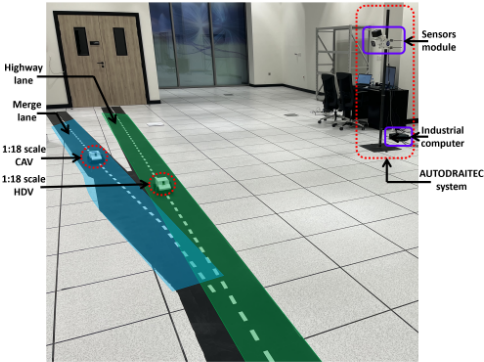
The objective of this paper is to demonstrate AUTODRAITEC 1 , a first and unique AI-based system on the road infrastructure to support the driving of connected and autonomous vehicles (see Fig. 1). The system is built upon a hybrid machine learning approach comprised of (1) a supervised learning classifier that characterizes the behaviors of human-driven vehicles and (2) an actor policy that provides speed recommendations for CAV. In order to test and validate the performance of the system, we also designed a 1:18 scale testbed that replicates real-world driving scenarios with high fidelity, as shown in Figure 1. To the best of our knowledge, this is the first AI-based infrastructure-assisted driving system that is implemented and experimented on a scaled testbed.
1 https://youtu.be/rq4seJzfxaA
2 Use Case
The system is composed of a sensors module (LiDAR and Camera), which is mounted on the off-board infrastructure, and an industrial computer, which is deployed on the edge, as illustrated in Figure 1. Furthermore, a 1:18 scale testbed is used to test and validate our system, as shown in Figure 1. This latter allows for the mitigation of safety and cost risks when experimenting and validating driving systems. Our proof of concept is used to provide speed recommendations for a 1:18 scale CAV to perform highway on-ramp merging. The motivations for using this use case are mainly related to the complexity of driving tasks that are required, the high number of collisions that occur [NHTSA, 2003], and the considerable rate of congestion associated with on-ramp merging zones [FHWA, 2005]. Using a reduced 1:18 scale ratio, we faithfully replicated the geometry of a real-world highway on-ramp located on a segment of Interstate 80 in Emeryville (San Francisco), California, USA, as shown in Figure 1. Furthermore, the traffic conditions were extracted from the realworld traffic dataset NGSIM [USDOT, 2022].
3 SystemDesign and Architecture
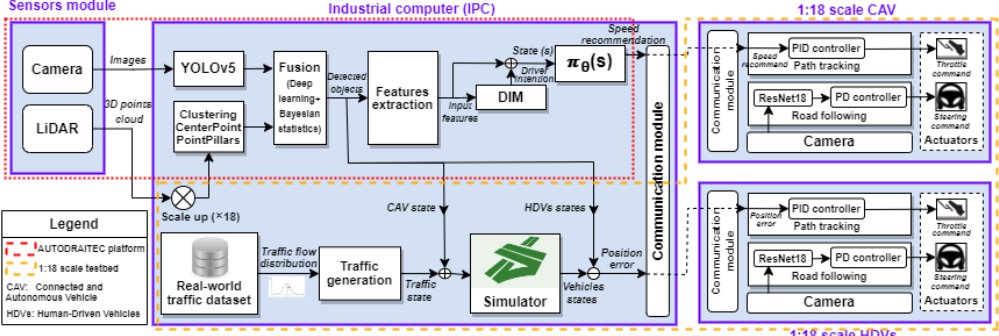
AUTODRAITEC platform is illustrated in Figure 2. The system is composed of:
- Sensors Module: It comprises two types of sensors: Camera and LiDAR [LSLiDAR, 2024]. For objects detection, the Camera uses the framework YOLOv5 [Zaidi et al., 2022] while the LiDAR uses, for clustering, CenterPoint [Yin et al., 2021] with PointPillars [Lang et al., 2019].
- Fusion Module: A fusion method, with deep learning and Bayesian statistics, is used to improve the accuracy and classification rate compared to using a single sensor individually.
- The detection accuracy reaches a level of 98% [LSLiDAR, 2024].
- Features Extraction Module: It uses the detected objects information to extract input features for the Driver Intention Model, DIM, and input state, s, for the actor policy, πθ(s).
- Driver Intention Model (DIM): It is a supervised classifier that provides prediction on the intention (i.e., behavior) of human-driven vehicles. To cite, the intention to 'yield' or to 'not yield' is used for the scenario of highway on-ramp merge. It was shown that this auxiliary model provides meaningful input state for the actor policy [Kherroubi et al., 2022]. The accuracy of this model in our use case reaches 99%.
- Actor Policy (πθ(s)): The actor policy provides speed recommendations for CAV. This policy is trained using a Twin Delayed Deep Deterministic Policy Gradient (TD3) [Fujimoto et al., 2018] which belongs to the actor-critic algorithms for continuous action spaces.
For test and validation purposes, a 1:18 scale testbed system is integrated, and its architecture is also shown in Figure 2. It is composed of:
- Traffic Generation Module: It uses traffic data from a realworld dataset to generate traffic conditions that mimic realistic scenarios [USDOT, 2022]. Specifically, it extracts the statistical features from real datasets, such as the statistical distributions of speed and the traffic flow rate.
- Traffic Simulator (Software-In-the-Loop (SIL)): It uses the traffic information as an input to simulate the behaviors of vehicles and the evolution of traffic at a given driving situation and road geometry. The simulator replicates the motion of CAV that is controlled by AUTODRAITEC platform, while it provides motions to Human-Driven Vehicles, HDVs,
- through a parameterized model that emulates their behaviors.
- 1:18 Scale HDVs: A miniature Ackermann-steering vehicles with a 1:18 size ratio compared to real-world vehicles [Waveshare, 2023]. It comprises two main components: (1) Path tracking module: it receives motion references to emulate human behaviours and uses a PID controller to provide longitudinal control; (2) Road following module: it comprises an integrated Camera and a trained ResNet18 network
(b) Accident case with aggressive driver
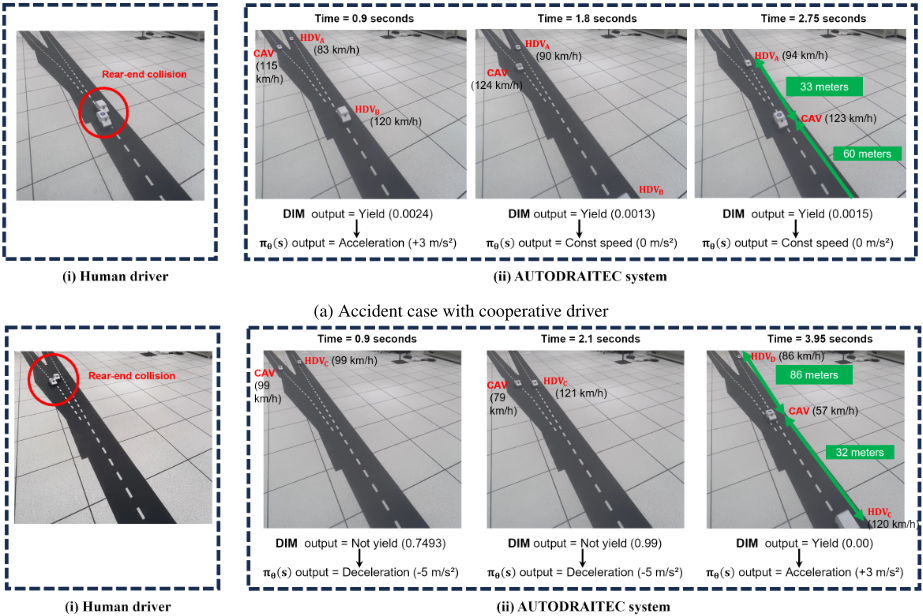
Figure 3: Demonstration of an accident case with two types of drivers: (a) cooperative driver, and (b) aggressive driver.
[He et al., 2015] to emulate human-vision and uses a PD controller to provide lateral control.
- 1:18 Scale CAV: It is similar to the 1:18 scale HDVs except that it uses speed recommendation provided by AUTODRAITEC platform to perform longitudinal control.
4 Demonstration Overview
In an initial stage, we evaluated the performance of our system through simulation. Over 10,000 testing episodes of highway on-ramp merging, where the AUTODRAITEC system provides speed recommendation for CAV at merge lane (i.e., longitudinal control), safety and efficiency metrics were assessed. In terms of traffic safety, the simulation results indicate that the system could improve the safety distance with preceding and following vehicles on the highway on-ramp by 30%, eliminate collisions, and reduce the number of emergency brakings. Regarding traffic efficiency, the results also demonstrate that the system could enhance the average merging speed by 15% while maintaining the traffic flow rate.
To demonstrate our proof of concept, we faithfully replicate an accident case, which is the worst case scenario among the 10,000 testing episodes, on the 1:18 scale testbed. For consistency, and to check the robustness of our system, the accident case was replicated for two different types of drivers at the main highway: cooperative and aggressive (see Figs. 3.(a)-i and 3.(b)-i, respectively). The AUTODRAITEC
system is then used to provide speed recommendations for CAV in these two accident-like scenarios. When the driver is cooperative (see Fig. 3.(a)-ii), DIM predicts their intention to 'yield' early at the entry to the merge lane. Consequently, πθ(s) provides recommendations of accelerating to merge before the cooperative driver. Conversely, for the aggressive driver (see Fig. 3.(b)-ii), DIM predicts an intention to 'not yield' and, therefore, πθ(s) provides recommendations of decelerating, rather than accelerating, to merge after the aggressive driver. Regardless of the driver type or their level of aggressiveness, the AUTODRAITEC system consistently succeeds in avoiding accidents, maintaining safety distances, and executing successful merges at the highway on-ramp.
5 Conclusion
We presented AUTODRAITEC, an AI-based system that is deployed on the road infrastructure to support the autonomous driving of CAV. This system improves driving safety and efficiency, while preserving traffic flow rate. We also presented an integrated testbed architecture that allows to test and validate our system safely, cost-effectively, and faithfully. Our proof of concept has shown the ability of our system to prevent accidents and preserve appropriate safety distances while enhancing the driving speed.
As future perspectives, the system should be scaled to further driving scenarios and use cases.
@inproceedings{ijcai2024p1013,
  title     = {AUTODRAITEC: An Infrastructure-Based AUTOnomous DRiving System Using Artificial Intelligence and TEleCommunication Technologies},
  author    = {Kherroubi, Zine el abidine and Boukhalfa, Fouzi and Lestable, Thierry and Bader, Carlos-Faouzi},
  booktitle = {Proceedings of the Thirty-Third International Joint Conference on
               Artificial Intelligence, {IJCAI-24}},
  publisher = {International Joint Conferences on Artificial Intelligence Organization},
  editor    = {Kate Larson},
  pages     = {8704--8707},
  year      = {2024},
  month     = {8},
  note      = {Demo Track},
  doi       = {10.24963/ijcai.2024/1013},
  url       = {https://doi.org/10.24963/ijcai.2024/1013},
}
TY - CPAPER TI - AUTODRAITEC: An Infrastructure-Based AUTOnomous DRiving System Using Artificial Intelligence and TEleCommunication Technologies AU - Kherroubi, Zine el abidine AU - Boukhalfa, Fouzi AU - Lestable, Thierry AU - Bader, Carlos-Faouzi T2 - Proceedings of the Thirty-Third International Joint Conference on Artificial Intelligence, IJCAI-24 PB - International Joint Conferences on Artificial Intelligence Organization PY - 2024 SP - 8704 EP - 8707 DO - 10.24963/ijcai.2024/1013 UR - https://doi.org/10.24963/ijcai.2024/1013 ER -Copied
Machine-readable versions of this paper, for tools and AI agents:





