
DFRP: A Dual-Track Feedback Recommendation System for Educational Resources
Proceedings of the Thirty-Third International Joint Conference on Artificial Intelligence. Demo Track. Pages 8741-8744.
https://doi.org/10.24963/ijcai.2024/1022
Keywords
- Data Mining: DM: Recommender systems
- Multidisciplinary Topics and Applications: MDA: Education
- Search: S: Applications
- Humans and AI: HAI: Computer-aided education
Abstract
The educational disparities among different regions are remarkably significant. The educational resource platform can effectively bridge the educational capability gap between regions. Most of the existing recommendation algorithms only consider interaction history, while we argue that the dependencies between knowledge points and education-related features are crucial for education resource recommendations. To address this, we propose DFRP, an educational resource recommendation platform based on knowledge graphs(KGs) and educational scale feedback. DFRP employs a recommendation algorithm based on teaching pathways and educational dimensions to achieve accurate recommendations and active feedback on educational resources. We also provide a detailed description of the system framework and present a demonstration scenario that uses educational scales for active feedback and KGs to show knowledge point dependencies.
- [Balabanović and Shoham, 1997] Marko Balabanović and Yoav Shoham. Fab: content-based, collaborative recom- mendation. Communications of the ACM, 40(3):66-72, 1997.
- [Chen et al., 2019] Minmin Chen, Alex Beutel, Paul Cov- ington, Sagar Jain, Francois Belletti, and Ed H Chi. Top-k off-policy correction for a reinforce recommender system. In Proceedings of the Twelfth ACM International Confer- ence on Web Search and Data Mining, pages 456-464, 2019.
- [Feng et al., 2019] Yifan Feng, Haoxuan You, Zizhao Zhang, Rongrong Ji, and Yue Gao. Hypergraph neural net- works. In Proceedings of the AAAI conference on artificial intelligence, volume 33, pages 3558-3565, 2019.
- [Jiang et al., 2019] Jianwen Jiang, Yuxuan Wei, Yifan Feng, Jingxuan Cao, and Yue Gao. Dynamic hypergraph neural networks. In IJCAI, pages 2635-2641, 2019. IJCAI
- [Jimenez-Diaz et al., 2017] Guillermo Jimenez-Diaz, Pe- dro Pablo Gómez-Martín, Marco Antonio Gómez-Martín, and Antonio A Sánchez-Ruiz. Similarity metrics from so- cial network analysis for content recommender systems. AI Communications, 30(3-4):223-234, 2017.
- [Tao et al., 2020] Zhulin Tao, Yinwei Wei, Xiang Wang, Xi- angnan He, Xianglin Huang, and Tat-Seng Chua. Mgat: Multimodal graph attention network for recommendation. Information Processing & Management, 57(5):102277, 2020.
- [Toledo and Mota, 2014] Raciel Yera Toledo and Yailé Ca- ballero Mota. An e-learning collaborative filtering ap- proach to suggest problems to solve in programming on- line judges. International Journal of Distance Education Technologies (IJDET), 12(2):51-65, 2014.
- [Yu et al., 2015] Ruiguo Yu, Zhiyong Cai, Xiuping Du, Muwen He, Zan Wang, Binlan Yang, and Peng Chang. The research of the recommendation algorithm in online learning. International Journal of Multimedia and Ubiq- uitous Engineering, 10(4):71-80, 2015.
- [Yu et al., 2021] Junliang Yu, Hongzhi Yin, Jundong Li, Qinyong Wang, Nguyen Quoc Viet Hung, and Xiangliang Zhang. Self-supervised multi-channel hypergraph convo- lutional network for social recommendation. In Proceed- ings of the web conference 2021, pages 413-424, 2021.
References were extracted automatically from the PDF and may contain errors.
Full text extracted automatically from the PDF; figures, tables and equations may differ. The PDF is the version of record.
1 Introduction
The educational resources and the proficiency of educators in remote areas often lag significantly behind their urban counterparts. Bridging this educational gap requires innovative approaches. The resource recommendation platform provides educators in remote areas with high-quality teaching resources such as lesson plans, teaching videos, PowerPoint presentations, and after-school exercises, effectively narrowing this gap.
Unlike commercial recommendation algorithms relying on user preferences [Jimenez-Diaz et al., 2017; Balabanovi´c and Shoham, 1997], the teaching resource recommendation algorithm needs to recommend resources based on educators' teaching needs. These resources should be interactive, individualized, and adaptable to various learning levels. Resources that cater to these specific needs can significantly enhance student engagement and proficiency. In the education sector, evaluation scales serve as primary tools for assessing the diversity, interactivity, and effectiveness of educational resources. However, current teaching resource recommendation algorithms heavily depend on collaborative filtering and frequently overlook supplementary factors like teaching objectives and resource validity assessment[Yu et al., 2015; Toledo and Mota, 2014]. Hence, the development of a recommendation algorithm seamlessly integrating knowledge dependencies and scale feedback is crucial.
∗Corresponding author
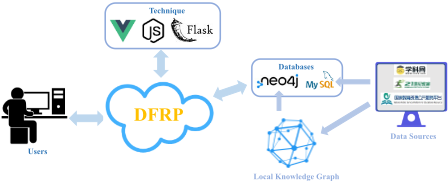
To address these challenges, we propose an innovative teaching resource recommendation platform based on KGs and educational scale feedback. This platform efficiently utilizes KGs to reveal interdependencies among knowledge points and structure course sequences appropriately. Furthermore, our platform incorporates two distinct types of feedback: passive and active. Passive feedback is derived from click counts and user browsing history, while active feedback is fostered by creating teaching scales grounded in Bloom's Educational Objectives Taxonomy. Finally, we design a multi-modal hypergraph neural network that integrates both feedback mechanisms. This comprehensive approach significantly enhances the accuracy of recommendations and the overall effectiveness of the model. The platform, designed as a web application, aims to assist and guide users in navigating the platform. Fig. 1 illustrates the architecture of DFRP, detailing the main components of the front-end and back-end and their interactions.
2 Framework
The framework of DFRP is illustrated in Fig. 2. We will give a brief presentation of the methodology of DFRP and specify each step in the following sections.
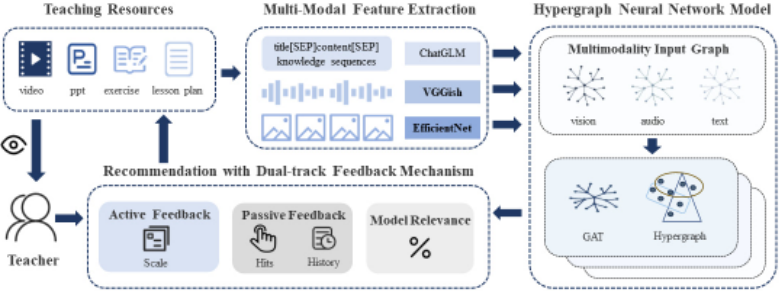
work in terms of smoothness, nodes are unable to acquire information from distant nodes. We introduce the concept of hypergraphs [Jiang et al., 2019], [Feng et al., 2019] to realize higher-order connectivity. The node representations obtained based on the graph attention network use the selfgating module[Yu et al., 2021] to construct the incidence matrix of the hypergraph. After obtaining node representations from the hypergraph, the independent representations of various modalities are fused to obtain the final representations of educational resources and users.
2.3 Recommendation with Dual-track Feedback Mechanism
When teachers perform keyword searches, they need to choose the grade, version, and type of instructional material. The system conducts a fuzzy search on the titles and knowledge points using the provided keywords. The results of this fuzzy search are subsequently processed through the aforementioned hypergraph-driven multi-modal model to compute the similarity between user and educational resources. This similarity is calculated as follows:sim = euser · eitem. In addition to computing user-resource similarity, it is essential to take into account the passive feedback factors such as the click counts of resources, the total viewing time of the user on the resource, and the evaluations for that resource through a rating scale as the active feedback (as detailed later). The following formula can be used to calculate an educational resource's overall relevance to a user: Relev(sim, cnt, time, scale) =W[sim||cnt||time||scl]. In the formula, where sim ∈ [0, 1], cnt ∈ R, time ∈ R, and scl ∈ [0, 1] represent the similarity, the click counts of resources, the total viewing time of the user on the resource, and the rating scale score. W represents the weight matrix. The total viewing time is calculated from the user's browsing history, and the rating scale score is obtained through educational analytics methods. To avoid the randomness of active feedback such as malicious clicks, we use the top-k off-policy correction method[Chen et al., 2019] based on reinforcement learning to reorder the top 50 recommendation results. Thus, it achieves a more sophisticated, data-driven approach to per-
2.1 Data Source
The platform includes four types of teaching resources: videos, lesson plans, PowerPoint, and exercises, encompassing the majority of teaching needs. The majority of teaching resources are sourced from the 'One Teacher, One Excellent Lesson' website. To achieve this, we utilize a web crawler to pinpoint and access the relevant materials.
To construct KGs, we chose three mathematics textbooks widely used in Chinese primary and secondary schools: People's Education Press (PEP), Su Ke (SJET), and Beijing Normal University Press (BNUP). The knowledge points for each chapter are indicated by the titles of these textbooks, we use its original descriptions as knowledge point names and extract knowledge point entities to construct a mathematical KG. The knowledge points within each chapter are linked as sub-entities to the respective chapter entity. Furthermore, each educational resource entity is associated with its corresponding knowledge point entity.
2.2 Hypergraph-DrivenMulti-Modal Fusion
To enhance the precision of search and recommendations, acquiring multi-modal representations of teaching resources is crucial. For text representations, we concatenate the title, content, and knowledge sequences to create a prompt. After processing with ChatGLM, we obtain the text representations by employing an average pooling strategy at the final output layer. The knowledge sequence comprises intrinsic knowledge points from educational resources and linked knowledge points within the same chapter in the KG. The images are processed through the pre-trained EfficientNet-B0 model, followed by summation and averaging to generate visual representations. Audio representations are obtained using the pre-trained VGGish model. Then, the representations of three different modalities are stored in the MySQL server.
Inspired by [Tao et al., 2020], we construct graph structures based on user-resource interactions, create input graphs for each modality using multi-modal representations of educational resources and user embeddings, and update the node representations within the graphs using graph attention networks. Due to the limitations of the graph attention netsonalized content recommendations. The final recommendation results are sorted in descending order based on the relevance score of educational resources.
In the scale, each question corresponds to a different dimension in Bloom's Taxonomy of Educational Objectives, which divides the cognitive process in education into six levels, from low to high. We used a five-point Likert scale method to quantify each question, with scores ranging from one to five. During the quantification process, each question is assigned a particular score weight based on its Bloom's Taxonomy level. This approach ensures that the final rating scale score accurately reflects teachers' evaluation of educational resources.
Bloom's Taxonomy provides a well-defined hierarchical structure of cognitive objectives, from basic knowledge to higher-order thinking skills. This clarity facilitates the definition and organization of assessment objectives. As Bloom's Taxonomy provides specific cognitive objectives, it is easier to develop measurement methods to assess educational resources in these objectives accurately. The evaluation indicators of the platform include four key dimensions: perception, interaction, collaboration, and evolution. Furthermore, our rating scales comprise six influencing factors, covering important aspects such as knowledge, comprehension, application, analysis, synthesis, and evaluation. These elements provide a comprehensive view of education, ranging from the selection of materials to instructional design and from student assessment to reflective practices.
3 Demonstration
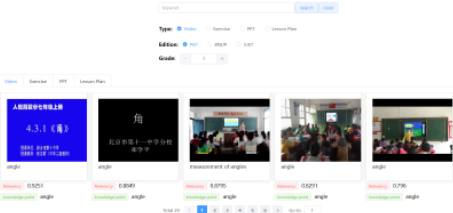
The demonstration is available at tinyurl.com/DFRP. In the demonstration, teachers can interact with DFRP to obtain desired educational resources. First, the teacher browses the "Hot Ranking" on the homepage of the platform. If the resource she wants is not in the "Hot Ranking", she can enter keywords in the search box above the rankings and then select options to locate the specific resource she wants. Educational resources that satisfy the conditions of the entered keyword and related options will be selected to calculate relevance through the aforementioned model. Then, as shown in Figure 3, the page displays the results in descending order of relevance, with five video educational resources per page. The four tabs at the top left of the educational resource list allow users to switch between resource types. She can select the resources of her interest and click on the cover to enter the details page.
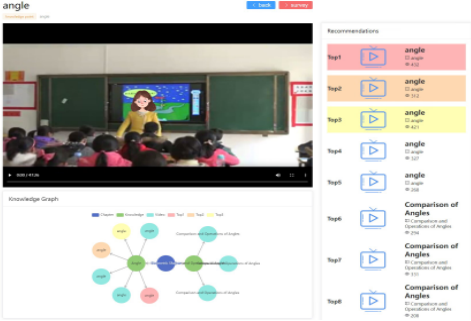
In the educational resource detail page, as shown in Figure 4, the platform displays the titles, knowledge points, and educational resource content. On the right side are recommendations for related educational resources of the same type. The recommended educational resources are obtained based on the constructed KG and ranked by relevance. The top three video educational resources with the highest relevance are marked with different colors. The KG below displays the knowledge point presented in this video, along with its associated knowledge points. This can be used to reveal dependencies among knowledge points contained in diverse educational resources.
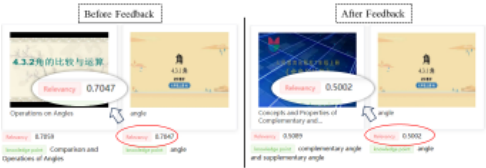
After browsing the educational resources, the teacher can click the "Survey" button to fill out the educational scale. The teacher's browsing history and scale results will influence his search results in the subsequent search, generating a feedback loop. As depicted in Figure 5, the left side displays the search results for the keyword "angle," while the right side showcases the results obtained after the user has browsed the videos and completed the scale. As a result, the relevance of the same video has decreased from 0.7047 to 0.5002.
Acknowledgments
This work was supported by the National Key R&D Program of China under Grant (2022YFC3303600), Jinhua Science and Technology Plan under Grant 2023-3-003a, the National Natural Science Foundation of China under Grant (62077015), and Zhejiang Key Laboratory of Intelligent Education Technology and Application, Zhejiang Normal University, Zhejiang, China.
@inproceedings{ijcai2024p1022,
  title     = {DFRP: A Dual-Track Feedback Recommendation System for Educational Resources},
  author    = {Meng, ChaoJun and Pan, Changfan and Li, Zilong and Zhou, Cong and Cao, Xinran and Zhu, Jia},
  booktitle = {Proceedings of the Thirty-Third International Joint Conference on
               Artificial Intelligence, {IJCAI-24}},
  publisher = {International Joint Conferences on Artificial Intelligence Organization},
  editor    = {Kate Larson},
  pages     = {8741--8744},
  year      = {2024},
  month     = {8},
  note      = {Demo Track},
  doi       = {10.24963/ijcai.2024/1022},
  url       = {https://doi.org/10.24963/ijcai.2024/1022},
}
TY - CPAPER TI - DFRP: A Dual-Track Feedback Recommendation System for Educational Resources AU - Meng, ChaoJun AU - Pan, Changfan AU - Li, Zilong AU - Zhou, Cong AU - Cao, Xinran AU - Zhu, Jia T2 - Proceedings of the Thirty-Third International Joint Conference on Artificial Intelligence, IJCAI-24 PB - International Joint Conferences on Artificial Intelligence Organization PY - 2024 SP - 8741 EP - 8744 DO - 10.24963/ijcai.2024/1022 UR - https://doi.org/10.24963/ijcai.2024/1022 ER -Copied
Machine-readable versions of this paper, for tools and AI agents:





