
DFMDA-Net: Dense Fusion and Multi-dimension Aggregation Network for Image Restoration
Proceedings of the Thirty-Third International Joint Conference on Artificial Intelligence. Main Track. Pages 1525-1533.
https://doi.org/10.24963/ijcai.2024/169
Keywords
- Machine Learning: ML: Convolutional networks
- Computer Vision: CV: Machine learning for vision
- Computer Vision: CV: Representation learning
- Machine Learning: ML: Attention models
Abstract
The U-shape (encoder-decoder) architecture, combined with effective blocks, has shown significant
success in image restoration. In U-shape models, there is insufficient focus on the feature fusion
problem between encoder and decoder features at
the same level. Current methods often employ simplistic operations like summation or concatenation,
which makes it difficult to strike a balance between
performance and complexity. To address this issue,
we propose a compression-in-the-middle mechanism, termed Integration-Compression-Integration
(ICI), which effectively conducts dense fusion and
avoids information loss. From the block design
perspective, we design a multi-dimension aggregation (MDA) mechanism, capable of effectively
aggregating features from both the channel and
spatial dimension. Combining the IntegrationCompression-Integration feature fusion and the
multi-dimension aggregation, our dense fusion and
multi-dimension aggregation network (DFMDANet) achieves superior performance over state-ofthe-art algorithms on 16 benchmarking datasets for
numerous image restoration tasks.
- [Abdelhamed et al., 2018] Abdelrahman Abdelhamed, Stephen Lin, et al. A high-quality denoising dataset for smartphone cameras. In Proc. of CVPR, 2018.
- [Abuolaim and Brown, 2020] Abdullah Abuolaim and Michael S Brown. Defocus deblurring using dual-pixel data. In Proc. of ECCV, 2020.
- [Agustsson and Timofte, 2017] Eirikur Agustsson and Radu Timofte. Ntire 2017 challenge on single image super- resolution: Dataset and study. In Proc. of CVPR, 2017.
- [Arbelaez et al., 2010] Pablo Arbelaez, Michael Maire, et al. Contour detection and hierarchical image segmentation. IEEE TPAMI, 2010.
- [Chen et al., 2021a] Hanting Chen, Yunhe Wang, et al. Pre- trained image processing transformer. In Proc. of CVPR, 2021.
- [Chen et al., 2021b] Liangyu Chen, Xin Lu, et al. Hinet: Half instance normalization network for image restoration. In Proc. of CVPR, 2021.
- [Chen et al., 2022a] Liangyu Chen, Xiaojie Chu, et al. Sim- ple baselines for image restoration. In Proc. of ECCV, 2022.
- [Chen et al., 2022b] Zheng Chen, Yulun Zhang, et al. Cross aggregation transformer for image restoration. Proc. of NeurIPS, 2022.
- [Cheng et al., 2021] Shen Cheng, Yuzhi Wang, et al. Nbnet: Noise basis learning for image denoising with subspace projection. In Proc. of CVPR, 2021.
- [Cho et al., 2021] Sung-Jin Cho, Seo-Won Ji, et al. Rethink- ing coarse-to-fine approach in single image deblurring. In Proc. of ICCV, 2021.
- [Cui et al., 2023a] Yuning Cui, Wenqi Ren, et al. Focal net- work for image restoration. In Proc. of ICCV, 2023.
- [Cui et al., 2023b] Yuning Cui, Wenqi Ren, et al. Image restoration via frequency selection. IEEE TPAMI, 2023.
- [Cui et al., 2023c] Yuning Cui, Wenqi Ren, et al. Irnext: Re- thinking convolutional network design for image restora- tion. In Proc. of ICML, 2023.
- [Cui et al., 2023d] Yuning Cui, Yi Tao, et al. Selective fre- quency network for image restoration. In Proc. of ICLR, 2023.
- [Dabov et al., 2007] Kostadin Dabov, Alessandro Foi, et al. Image denoising by sparse 3-d transform-domain collabo- rative filtering. IEEE TIP, 2007.
- [Fu et al., 2017] Xueyang Fu, Jiabin Huang, et al. Removing rain from single images via a deep detail network. In Proc. of CVPR, 2017.
- [He et al., 2016] Kaiming He, Xiangyu Zhang, et al. Deep residual learning for image recognition. In Proc. of CVPR, 2016.
- [Huang et al., 2015] Jia-Bin Huang, Abhishek Singh, et al. Single image super-resolution from transformed self- exemplars. In Proc. of CVPR, 2015.
- [Jiang et al., 2020] Kui Jiang, Zhongyuan Wang, et al. Multi-scale progressive fusion network for single image deraining. In Proc. of CVPR, 2020.
- [Lee et al., 2019] Junyong Lee, Sungkil Lee, et al. Deep de- focus map estimation using domain adaptation. In Proc. of CVPR, 2019.
- [Lee et al., 2021] Junyong Lee, Hyeongseok Son, et al. Iter- ative filter adaptive network for single image defocus de- blurring. In Proc. of CVPR, 2021.
- [Li et al., 2023] Yawei Li, Yuchen Fan, et al. Efficient and explicit modelling of image hierarchies for image restora- tion. Proc. of CVPR, 2023.
- [Liang et al., 2021] Jingyun Liang, Jiezhang Cao, et al. Swinir: Image restoration using swin transformer. In Proc. of ICCV, 2021.
- [Liu et al., 2021] Ze Liu, Yutong Lin, et al. Swin trans- former: Hierarchical vision transformer using shifted win- dows. In Proc. of ICCV, 2021.
- [Ma et al., 2016] Kede Ma, Zhengfang Duanmu, et al. Wa- terloo exploration database: New challenges for image quality assessment models. IEEE TIP, 2016.
- [Mao et al., 2021] Xintian Mao, Yiming Liu, et al. Deep residual fourier transformation for single image deblur- ring. arXiv preprint arXiv:2111.11745, 2021.
- [Martin et al., 2001] David Martin, Charless Fowlkes, et al. A database of human segmented natural images and its ap- plication to evaluating segmentation algorithms and mea- suring ecological statistics. In Proc. of ICCV, 2001.
- [Mou et al., 2021] Chong Mou, Jian Zhang, et al. Dynamic attentive graph learning for image restoration. In Proc. of ICCV, 2021.
- [Nah et al., 2017] Seungjun Nah, Tae Hyun Kim, et al. Deep multi-scale convolutional neural network for dynamic scene deblurring. In Proc. of CVPR, 2017.
- [Peng et al., 2019] Yali Peng, Lu Zhang, et al. Dilated resid- ual networks with symmetric skip connection for image denoising. Neurocomputing, 2019.
- [Purohit et al., 2021] Kuldeep Purohit, Maitreya Suin, et al. Spatially-adaptive image restoration using distortion- guided networks. In Proc. of ICCV, 2021.
- [Quan et al., 2023] Yuhui Quan, Zicong Wu, et al. Neumann network with recursive kernels for single image defocus deblurring. In Proc. of CVPR, 2023.
- [Ren et al., 2019] Dongwei Ren, Wangmeng Zuo, et al. Pro- gressive image deraining networks: A better and simpler baseline. In Proc. of CVPR, 2019.
- [Rim et al., 2020] Jaesung Rim, Haeyun Lee, et al. Real- world blur dataset for learning and benchmarking deblur- ring algorithms. In Proc. of ECCV, 2020.
- [Ronneberger et al., 2015] Olaf Ronneberger, Philipp Fis- cher, et al. U-net: Convolutional networks for biomedical image segmentation. In Proc. of MICCAI, 2015.
- [Ruan et al., 2022] Lingyan Ruan, Bin Chen, et al. Learn- ing to deblur using light field generated and real defocus images. In Proc. of CVPR, 2022.
- [Shen et al., 2019] Ziyi Shen, Wenguan Wang, et al. Human- aware motion deblurring. In Proc. of ICCV, 2019.
- [Son et al., 2021] Hyeongseok Son, Junyong Lee, et al. Sin- gle image defocus deblurring using kernel-sharing parallel atrous convolutions. In Proc. of ICCV, 2021.
- [Suin et al., 2020] Maitreya Suin, Kuldeep Purohit, et al. Spatially-attentive patch-hierarchical network for adaptive motion deblurring. In Proc. of CVPR, 2020.
- [Tao et al., 2018] Xin Tao, Hongyun Gao, et al. Scale- recurrent network for deep image deblurring. In Proc. of CVPR, 2018.
- [Tu et al., 2022] Zhengzhong Tu, Hossein Talebi, et al. Maxim: Multi-axis mlp for image processing. In Proc. of CVPR, 2022.
- [Vaswani et al., 2017] Ashish Vaswani, Noam Shazeer, et al. Attention is all you need. In Proc. of NeurIPS, 2017.
- [Wang et al., 2022] Zhendong Wang, Xiaodong Cun, et al. Uformer: A general u-shaped transformer for image restoration. In Proc. of CVPR, 2022.
- [Xia et al., 2023] Bin Xia, Yulun Zhang, et al. Diffir: Effi- cient diffusion model for image restoration. In Proc. of ICCV, 2023.
- [Xiao et al., 2023] Jie Xiao, Xueyang Fu, et al. Random shuffle transformer for image restoration. In Proc. of ICML, 2023.
- [Yang et al., 2017] Wenhan Yang, Robby T. Tan, et al. Deep joint rain detection and removal from a single image. In Proc. of CVPR, 2017.
- [Yue et al., 2019] Zongsheng Yue, Hongwei Yong, et al. Variational denoising network: Toward blind noise mod- eling and removal. Proc. of NeurIPS, 2019.
- [Zamir et al., 2020] Syed Waqas Zamir, Aditya Arora, et al. Learning enriched features for real image restoration and enhancement. In Proc. of ECCV, 2020.
- [Zamir et al., 2021] Syed Waqas Zamir, Aditya Arora, et al. Multi-stage progressive image restoration. In Proc. of CVPR, 2021.
- [Zamir et al., 2022] Syed Waqas Zamir, Aditya Arora, et al. Restormer: Efficient transformer for high-resolution im- age restoration. In Proc. of CVPR, 2022.
- [Zhang and Patel, 2018] He Zhang and Vishal M. Patel. Density-aware single image de-raining using a multi- stream dense network. In Proc. of CVPR, 2018.
- [Zhang et al., 2011] Lei Zhang, Xiaolin Wu, et al. Color de- mosaicking by local directional interpolation and nonlocal adaptive thresholding. JEI, 2011.
- [Zhang et al., 2017a] Kai Zhang, Wangmeng Zuo, et al. Be- yond a gaussian denoiser: Residual learning of deep cnn for image denoising. IEEE TIP, 2017.
- [Zhang et al., 2017b] Kai Zhang, Wangmeng Zuo, et al. Learning deep cnn denoiser prior for image restoration. In Proc. of CVPR, 2017.
- [Zhang et al., 2018] Kai Zhang, Wangmeng Zuo, et al. Ffd- net: Toward a fast and flexible solution for cnn-based im- age denoising. IEEE TIP, 2018.
- [Zhang et al., 2020a] He Zhang, Vishwanath Sindagi, et al. Image de-raining using a conditional generative adversar- ial network. IEEE TCSVT, 2020.
- [Zhang et al., 2020b] Kaihao Zhang, Wenhan Luo, et al. De- blurring by realistic blurring. In Proc. of CVPR, 2020.
- [Zhang et al., 2021] Kai Zhang, Yawei Li, et al. Plug-and- play image restoration with deep denoiser prior. IEEE TPAMI, 2021.
- [Zhou et al., 2023] Man Zhou, Jie Huang, et al. Fourmer: an efficient global modeling paradigm for image restoration. In Proc. of ICML, 2023.
References were extracted automatically from the PDF and may contain errors.
Full text extracted automatically from the PDF; figures, tables and equations may differ. The PDF is the version of record.
1 Introduction
Bad weather or physical limitations of the camera can degrade the quality of captured images and further negatively impact the robustness of downstream tasks. Image restoration aims to eliminate those annoying degradation (such as noise, rain, and blur), and therefore plays an important role in surveillance, autonomous driving, remote sensing, etc. Due to the ill-posed nature, earlier model-based methods restrict the solution space by relying on handcrafted statistical priors. However, in complex real-world scenarios, it is difficult for these methods to recover faithful results.
With the fast development of deep learning, convolutional neural networks (CNN)- and transformer-based methods have achieved remarkable success by learning generalizable priors from large-scale datasets. In these methods, ingenious architecture or blocks are designed or borrowed from the highlevel computation vision tasks. For example, the U-shape (encoder-decoder) architecture [Ronneberger et al., 2015] is widely adopted for the effective hierarchy representation. The blocks are commonly designed based on residual learning and different attention mechanisms. Representative blocks include the residual block [Nah et al., 2017] and transformer block [Zamir et al., 2022].
∗Corresponding author. The authors are also with the Guangdong Province Engineering Laboratory for Digital Creative Technology and the Shenzhen Key Laboratory of Digital Creative Technology.
This paper aims to address the restoration task from both the U-shape architecture and the block design. In the encoder-decoder architecture, to assist the recovery, the features from the encoder are passed through to the decoder at the same level. For the feature fusion problem, current methods directly conduct the concatenation operation [Wang et al., 2022], the summation operation [Chen et al., 2022a], and first concatenation and then compression [Zamir et al., 2022]. These operations either cause information loss or make the complexity higher 1 . To alleviate this challenge, this paper proposes an Integration-Compression-Integration (ICI) mechanism for feature fusion. Our ICI first conducts integration to avoid information loss, then applies information compression to maintain efficiency, and finally conducts integration again for better information utilization. In this way, our ICI implements effective feature fusion while keeping efficient.
For block design, we revisit existing blocks from the perspective of information aggregation direction. Existing blocks either aggregate features from the spatial dimension such as the residual block [Nah et al., 2017] and windowbased attention [Liu et al., 2021] or from the channel dimension such as transposed attention [Zamir et al., 2022], and have achieved remarkable success. Nevertheless, how to effectively aggregate the information from both the channel and spatial dimensions, which can further strengthen the performance, deserves attention 2 . Since the window-based attention shares weights across channels, it is compatible with the transposed attention, as the shared operation limits the diversity of channel features. Moreover, the residual block Restormer SFNet ShuffleFormer Ours and window-based attention can only aggregate the local spatial information, which limits the receptive field. To address the issue, we resort to Fourier frequency learning since the Fourier features embrace global properties and can apply different weights to adjust the frequency points at different channels. To this end, we propose a multi-dimension aggregation (MDA) mechanism, capable of effectively aggregating features from both the channel and spatial dimensions.
1 More details will be illustrated in Section 3.3.
2 Note that aggregating information from channels in this paper means applying self-attention across channels.
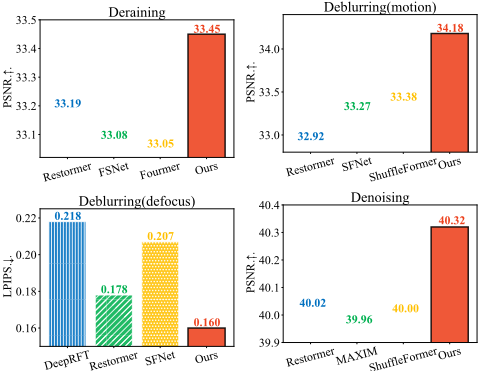
Figure 1: Our method achieves significant performance gain on different image restoration tasks (Tables 2, 3, 4, 7).
By introducing ICI and MDA into a U-shape backbone, we construct the dense fusion and multi-dimension aggregation network (DFMDA-Net). The contributions of this paper can be summarized in four aspects:
- We propose dense fusion and multi-dimension aggregation network for image restoration from the perspective of both the U-shape architecture and block design.
- We propose a dense mechanism for feature fusion, termed Integration-Compression-Integration (ICI). This process is designed to prevent information loss by integration, maintain efficiency through compression in the middle, and thus enhance overall information utilization.
- We propose a multi-dimension aggregation (MDA) mechanism, capable of effectively aggregating features from both the channel and spatial dimension, thus enhancing the restoration performance.
- We conduct extensive experiments on 16 benchmark datasets for numerous image restoration tasks including image deraining, image real denoising, Gaussian image denoising, image motion deblurring, and image defocus deblurring. The results demonstrate that the proposed method achieves state-of-the-art performance, as illustrated in Fig. 1.
2 RelatedWork
Since image restoration is an ill-posed problem, earlier model-based methods restrict the solution space by exploiting handcrafted statistical priors, such as discriminative prior, channel prior, and gradient prior. These methods are heuristic and usually involve complex optimization problems. Limited by approximate models and the above factors, these methods are usually less effective, especially in complex real-world scenarios.
2.1 CNN-basedMethods
With the fast development of deep learning, deep neural networks, especially convolutional neural networks (CNN) have motivated numerous advanced image restoration methods [Cui et al., 2023d; Cui et al., 2023c] by learning dense priors from large-scale datasets. In these methods, there are several excellent convolutional designs which are commonly employed. For example, based on residual learning [He et al., 2016], Resblock [Nah et al., 2017] is proposed and has become the basic module for many image restoration methods. The underlying reason for the effectiveness can be attributed to the fact that the restoration task can be seen as the process of learning the residual between the degraded image and the ground-truth. Spatial and channel attention, which can enhance the desirable features and suppress the detrimental signals, have also achieved remarkable success [Zamir et al., 2021; Cui et al., 2023a]. Moreover, based on U-Net [Ronneberger et al., 2015], the U-shape (encoder-decoder) architecture has become the backbone of most successful image restoration models.
Albeit achieving significant performance gain over modelbased methods, CNN-based methods suffer limited receptive field and have poor content adaptation which originates from the basic convolution operation, which is crucial for effective image restoration.
2.2 Transformer-basedMethods
Motivated by the great success of transformers [Vaswani et al., 2017], researchers have proposed several excellent restoration models. The self-attention mechanism, which is a core component in transformers [Vaswani et al., 2017], can deal well with the shortcomings of the convolution operation. IPT [Chen et al., 2021a] applies the vanilla transformer on local patches, and has achieved promising performance gain. However, IPT depends on costly pretraining, and cannot be applied to high-resolution images due to the quadratic complexity of self-attention.
To address the quadratic complexity of self-attention, a line of methods applies self-attention on windows [Liu et al., 2021]. For example, SwinIR [Liang et al., 2021] and Uformer [Wang et al., 2022] adopt window-based selfattention (WSA). Although WSA reduces the complexity from quadratic to linear compared to self-attention, it dissevers the global pixel dependencies. Another line of methods applies self-attention across channels instead of spatial dimensions. Notably, Restormer [Zamir et al., 2022] proposes transposed attention (TA) with linear complexity, and has achieved remarkable success in multiple image restoration tasks. In essence, TA is a kind of channel self-attention, which aggregates the channel features with the similarity matrix of channels. Therefore, it still has limited receptive field.
2.3 Discussions
In this part, we discuss the significance of our work. First, most of the research focuses on exploring effective backbones while ignoring the architectural effects of the U-shape backbone. This paper aims to explore an effective and efficient feature fusion paradigm for the features from the encoder and the decoder at the same level. Second, this paper aims to aggregate desirable features (information) from both the spatial and channel dimensions for effective image restoration. Although Fourier domain learning is not new in image restoration [Mao et al., 2021; Zhou et al., 2023], these methods only achieve the aggregation of spatial information, and fail to adaptively aggregate the features from the channel dimension. The excellent performance of our work demonstrates that effectively aggregating information from both channel and spatial dimensions contributes to image restoration, which is expected to motivate more future research.
3 Methodology
3.1 Overall Pipeline
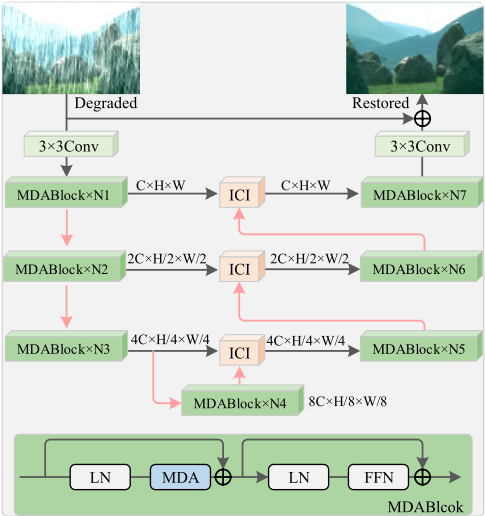
The over pipeline of the proposed dense fusion and multidimension aggregation (DFMDA-Net) is given in Fig. 2. Following most image restoration methods [Wang et al., 2022; Zamir et al., 2022], our DFMDA-Net is constructed based on the hierarchical encoder-decoder architecture. The detailed process is described as follows.

Given an input, our DFMDA-Net first applies a 3 × 3 convolution to obtain the embeddings. Then these embeddings are sequentially passed through a 3-level encoder, a bottleneck, and a 3-level decoder. Each level consists of several multi-dimension aggregation (MDA) blocks. After each level of the encoder, the output features are halved in spatial size and doubled in channel dimension with a 3 × 3 convolution and the pixel-unshuffle operation. Before each level of the decoder, the input features from the last level are doubled in spatial size and halved in channel dimension with a 3×3 convolution and the pixel-shuffle operation. In addition, to assist the recovery process, the output features from the same level of the encoder and the upsampled features are fused with the proposed Integration-Compression-Integration (ICI) module. Finally, the output features from the last level of the decoder are refined with a 3 × 3 convolution, and then added to the degraded image to obtain the restored image.
In the following, we introduce the proposed MDA and ICI mechanism.
3.2 Multi-dimension Aggregation
Analysis and Motivation
For block design, we revisit existing blocks from the perspective of information aggregation direction. Existing blocks can be divided into two groups: 1) aggregation from the spatial dimension and 2) aggregation from the channel dimension. CNN-based blocks such as the residual block [Nah et al., 2017], and transformer-based blocks such as recently window-based attention [Liu et al., 2021], lie in category 1. Transposed attention, i.e., applying self-attention across channels, lies in category 2. The effectiveness of these blocks demonstrates that aggregating information from either the spatial or channel direction is vital for effective image restoration. Therefore, joint spatial and channel information aggregation is an intuitive idea to strengthen the performance.
However, directly combining the attention in categories 1 and 2 cannot well accomplish the purpose. Specifically, since the window-based attention shares weights across channels, it is compatible with the transposed attention, as the shared operation limits the diversity of channel features. Moreover, the residual block and window-based attention can only aggregate the local spatial information. Therefore, to effectively integrate information from different dimensions, the spatially aggregated module should be equipped with the global properties and the weights on channels cannot be shared.
To this end, we resort to Fourier frequency learning with two utilizable properties. i) According to the spectral convolution theorem, the Fourier features embrace global properties. Updating a single value in the frequency domain globally affects all original spatial features. ii) Fourier transform can transfer the features into different frequency components, which can be seen as a frequency disentanglement and rearrangement. This property allows us to selectively enhance the necessary frequencies and suppress the detrimental frequencies in different channels.
Solution
Based on the above analysis, we propose a multi-dimension aggregation (MDA) block, capable of effectively aggregating features from both the channel and spatial dimension, as illustrated in Fig. 3. Specifically, we first transfer the input tensor X into Fourier domain with fast Fourier transform. Then we conduct two group 1 × 1 convolutions to conduct feature transformation. A GELU activation function is followed with each convolution. Finally, we transfer the obtained features back into the original space with inverse Fourier transform, and add the output features to those of the channel aggregation branch [Zamir et al., 2022] to get the result of MDA. Mathematically, the overall process is defined as:
where C 1 g and C 2 g are group 1 × 1 convolutions. σ denotes the GELU activation function. FFT and IFFT denote fast Fourier transform and inverse fast Fourier transform, respectively. XA is the result of the channel aggregation branch.
3.3 Integration-Compression-Integration Mechanism
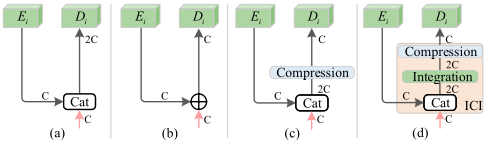
In most of the existing U-shape-based image restoration methods, the features from the encoder are passed through to the decoder at the same level. For the feature fusion problem, current methods directly conduct the concatenation operation [Wang et al., 2022], the summation operation [Chen et al., 2022a], and first concatenation and then compression [Zamir et al., 2022], as illustrated in Fig. 4a-c, respectively. Since the parameters and computational cost of these transformer blocks are proportional to C 2 , where C is the number of channels, the concatenation manner (Fig. 4a) is parameter and computation costly. For the summation operation (Fig. 4b), it is ineffective since there exists the misaligned problem between the features of the encoder and the decoder. For the third case (Fig. 4c), it is too rough to conduct the direct compression with a 1×1 convolution to reduce channels, resulting in information loss.
| Fig. 4a | Fig. 4c | Fig. 4d (ICI) | |
|---|---|---|---|
| Parameters | O(4mC 2 ) | O(mC 2 ) | O((m + 3m1)C 2 ) |
| MACs | O(4mC 2HW) | O(mC 2HW) | O((m+3m1)C 2HW) |
To alleviate this challenge, this paper revisits the existing feature fusion mechanisms in Fig. 4a-c. By deeming the Di which consists of stacked blocks as integration, we can abstract them into two categories, i.e., Integration (Fig. 4a), and Compression 3 -Integration (Fig. 4b-c). As demonstrated above, the former is parameter and computation costly, and the latter suffers information loss. This paper proposes an Integration-Compression-Integration (ICI) mechanism for feature fusion, as illustrated in Fig. 4d. Our ICI first conducts integration to avoid information loss, then applies information compression to maintain efficiency, and finally conducts integration again for better information utilization. In this way, our ICI implements effective feature fusion while keeping efficient.
4 Relationship with Existing Feature Fusion Methods
Assume there are m blocks used for integration. The parameters and MACs of each block is O(C 2 ) and O(C 2HW). Fig. 4a means that the m blocks are directly applied to integrate the features with 2C channels. Fig. 4c means that the m blocks are used to integrate the features with C channels. We omit the analysis of the manner in Fig. 4b, since Fig. 4b can be seen as a particular case of Fig. 4c. ICI applies m1 ∈ [0,m] blocks for the first integration, and m-m1 blocks for the second integration (Di). In other words, m1 blocks are used to integrate the features with 2C channels, and m - m1 blocks are used to integrate the features with C channels. Therefore, the proposed ICI is a dense feature fusion paradigm compared to existing feature fusion manners shown in Fig. 4a-c. We also list the parameters and MACs of different feature fusion methods in Table 1 for better comparison.
5 Experiments
5.1 Setups
Evaluation Metrics
Following most of image restoration literature [Li et al., 2023; Zamir et al., 2022], we adopt PSNR and SSIM as the evaluation metrics. For defocus deblurring, extra metrics MAE and LPIPS are employed. It is worth noting that the PSNR and SSIM values are only calculated on the Y channel in YCbCr space for image deraining. We introduce the datasets in Appendix A.
Implementation Details
For different image restoration tasks, we train separate models. Unless otherwise specified, all the experiments are with the following settings. The number of blocks [N1, N2, N3, N4, N5, N6, N7] is set to [4, 6, 6, 8, 6, 6, 4]. The number of attention heads and groups of 1 × 1 convolution in MDA are both set to [1, 2, 4, 8, 4, 2, 1]. The initial channel dimension is 48. The channel expansion ratio in FFN is set to 2.66. m1 is set to 1. We adopt the progressive learning strategy [Zamir et al., 2022] to train our models for 300K iterations with L1 loss. The optimizer is AdamW (β1 = 0.9, β2 = 0.999, weight decay 1×10⁻⁴ ). The initial learning rate is 3×10⁻⁴ , and declines to 1 × 10⁻⁶ with the cosine annealing. For data augmentation, vertical and horizontal flips are employed. The visual results are given in Appendix B.
3 Summation can be regarded as a kind of compression.
| Test100 | Rain100H | Rain100L | Test2800 | Test1200 | Average | |||||||
|---|---|---|---|---|---|---|---|---|---|---|---|---|
| Method | PSNR | SSIM | PSNR | SSIM | PSNR | SSIM | PSNR | SSIM | PSNR | SSIM | PSNR | SSIM |
| PreNet [Ren et al., 2019] | 24.81 | 0.851 | 26.77 | 0.858 | 32.44 | 0.950 | 31.75 | 0.916 | 31.36 | 0.911 | 29.42 | 0.897 |
| MSPFN [Jiang et al., 2020] | 27.50 | 0.876 | 28.66 | 0.860 | 32.40 | 0.933 | 32.82 | 0.930 | 32.39 | 0.916 | 30.75 | 0.903 |
| MPRNet [Zamir et al., 2021] | 30.27 | 0.897 | 30.41 | 0.890 | 36.40 | 0.965 | 33.64 | 0.938 | 32.91 | 0.916 | 32.73 | 0.921 |
| HINet [Chen et al., 2021b] | 30.29 | 0.906 | 30.65 | 0.894 | 37.28 | 0.970 | 33.91 | 0.941 | 33.05 | 0.919 | 33.03 | 0.926 |
| SPAIR [Purohit et al., 2021] | 30.35 | 0.909 | 30.95 | 0.892 | 36.93 | 0.969 | 33.34 | 0.936 | 33.04 | 0.922 | 32.91 | 0.926 |
| Restormer [Zamir et al., 2022] | 32.00 | 0.923 | 31.46 | 0.904 | 38.99 | 0.978 | 34.18 | 0.944 | 33.19 | 0.926 | 33.96 | 0.935 |
| MAXIM-2S [Tu et al., 2022] | 31.17 | 0.922 | 30.81 | 0.903 | 38.06 | 0.977 | 33.80 | 0.943 | 32.37 | 0.922 | 33.24 | 0.933 |
| IRNext [Cui et al., 2023c] | 31.53 | 0.919 | 31.64 | 0.902 | 38.14 | 0.972 | - | - | - | - | - | - |
| Fourmer [Zhou et al., 2023] | 30.54 | 0.911 | 30.76 | 0.896 | 37.47 | 0.970 | - | - | 33.05 | 0.919 | - | - |
| FSNet [Cui et al., 2023b] | 31.05 | 0.919 | 31.77 | 0.906 | 38.00 | 0.972 | 33.64 | 0.936 | 33.08 | 0.916 | 33.51 | 0.930 |
| DFMDA-Net (Ours) | 32.32 | 0.928 | 32.01 | 0.911 | 39.15 | 0.977 | 34.21 | 0.946 | 33.45 | 0.928 | 34.23 | 0.938 |
| GoPro | HIDE | RealBlur-R | RealBlur-J | Average | ||||||
|---|---|---|---|---|---|---|---|---|---|---|
| Method | PSNR | SSIM | PSNR | SSIM | PSNR | SSIM | PSNR | SSIM | PSNR | SSIM |
| SRN [Tao et al., 2018] | 30.26 | 0.934 | 28.36 | 0.915 | 35.66 | 0.947 | 28.56 | 0.867 | 30.71 | 0.915 |
| DBGAN [Zhang et al., 2020b] | 31.10 | 0.942 | 28.94 | 0.915 | 33.78 | 0.909 | 24.93 | 0.745 | - | - |
| Suin et al. [Suin et al., 2020] | 31.85 | 0.948 | 29.98 | 0.930 | - | - | - | - | - | - |
| SPAIR [Purohit et al., 2021] | 32.06 | 0.953 | 30.29 | 0.931 | - | - | 28.81 | 0.875 | - | - |
| MIMO-UNet+ [Cho et al., 2021] | 32.45 | 0.957 | 29.99 | 0.930 | 35.54 | 0.947 | 27.63 | 0.837 | - | - |
| IPT [Chen et al., 2021a] | 32.52 | - | - | - | - | - | - | - | - | - |
| MPRNet [Zamir et al., 2021] | 32.66 | 0.959 | 30.96 | 0.939 | 35.99 | 0.952 | 28.70 | 0.873 | 32.08 | 0.931 |
| Uformer [Wang et al., 2022] | 33.06 | 0.962 | 30.90 | 0.940 | 36.19 | 0.956 | 29.09 | 0.886 | 32.31 | 0.936 |
| Restormer [Zamir et al., 2022] | 32.92 | 0.961 | 31.22 | 0.942 | 36.19 | 0.957 | 28.96 | 0.879 | 32.32 | 0.935 |
| SFNet [Cui et al., 2023d] | 33.27 | 0.963 | 31.10 | 0.941 | - | - | - | - | - | - |
| GRL [Li et al., 2023] | 33.93 | 0.968 | 31.65 | 0.947 | - | - | - | - | - | - |
| DiffIR [Xia et al., 2023] | 33.20 | 0.963 | 31.55 | 0.947 | - | - | - | - | - | - |
| ShuffleFormer [Xiao et al., 2023] | 33.38 | 0.965 | 31.25 | 0.943 | 36.34 | 0.958 | 29.19 | 0.890 | 32.54 | 0.939 |
| DFMDA-Net (Ours) | 34.18 | 0.969 | 32.13 | 0.950 | 36.31 | 0.958 | 29.14 | 0.887 | 32.94 | 0.941 |
5.2 Results on Image Deraining
The image deraining results on five datastets (Test100 [Zhang et al., 2020a], Rain100H [Yang et al., 2017], Rain100L [Yang et al., 2017], Test2800 [Fu et al., 2017], and Test1200 [Zhang and Patel, 2018]) are given in Table 2. On all five datasets, our DFMDA-Net achieves the best results on PSNR. Compared with the best transformer-based method, Restormer, our DFMDA-Net brings 0.27 dB PSNR improvement on average. When paying attention to the individual dataset Rain100H, our DFMDA-Net achieves 0.55 dB PSNR improvement. Compared with the frequency method Fourmer, our DFMDA-Net achieves a performance gain of more than 1 dB on three datasets including Test100, Rain100H, and Rain100L. Moreover, compared with the recent method FSNet, our DFMDA-Net brings 0.72 dB PSNR improvement on average. When paying to the individual datasets Test100 and Rain100L, the improvements are up to 1.27 dB and 1.15 dB, respectively.
5.3 Results onMotion Deblurring
We gives the image motion deblurring results on datastets (GoPro [Nah et al., 2017], HIDE [Shen et al., 2019], and Realbur [Rim et al., 2020] (Realbur-R and Realbur-J)) in Table 3. Compared with Restormer, our DFMDA-Net brings the PSNR improvement as large as 0.62 dB on average. When averaged across all the datasets, our DFMDA-Net achieves 0.40 dB PSNR improvement over the global ShuffleFormer. Moreover, compared with the global modeling method, GRL, which simultaneously models the pixel, region, and global level interactions, our DFMDA-Net achieves 0.25 dB and 0.48 dB improvements on GoPro and HIDE, respectively.
5.4 Results on Defocus Deblurring
Table 4 presents the results of image defocus deblurring on the DPDD [Abuolaim and Brown, 2020] dataset. Our DFMDA-Net achieves basically consistent performance gain on both scene categories. Compared with Restormer, our DFMDA-Net brings 0.38 dB PSNR improvement on the combined category. When paying attention to the indoor scene category, our DFMDA-Net achieves 0.48 dB PSNR improvement. Compared with GRL, our DFMDA-Net achieves a performance gain of 0.18 dB on the combined category. Moreover, compared with the recent FSNet, our DFMDA-Net brings 0.047 LPIPS improvement on average. When paying to the outdoor scene category, the improvement is up to 0.057.
| Indoor Scenes | Outdoor Scenes | Combined | ||||||||||
|---|---|---|---|---|---|---|---|---|---|---|---|---|
| Method | PSNR | SSIM | MAE | LPIPS | PSNR | SSIM | MAE | LPIPS | PSNR ↑ | SSIM ↑ | MAE ↓ | LPIPS ↓ |
| DMENet [Lee et al., 2019] | 25.50 | 0.788 | 0.038 | 0.298 | 21.43 | 0.644 | 0.063 | 0.397 | 23.41 | 0.714 | 0.051 | 0.349 |
| DPDNet [Abuolaim and Brown, 2020] | 26.54 | 0.816 | 0.031 | 0.239 | 22.25 | 0.682 | 0.056 | 0.313 | 24.34 | 0.747 | 0.044 | 0.277 |
| KPAC [Son et al., 2021] | 27.97 | 0.852 | 0.026 | 0.182 | 22.62 | 0.701 | 0.053 | 0.269 | 25.22 | 0.774 | 0.040 | 0.227 |
| IFAN [Lee et al., 2021] | 28.11 | 0.861 | 0.026 | 0.179 | 22.76 | 0.720 | 0.052 | 0.254 | 25.37 | 0.789 | 0.039 | 0.217 |
| DeepRFT [Mao et al., 2021] | - | - | - | - | - | - | - | - | 25.71 | 0.801 | 0.039 | 0.218 |
| DRBNet [Ruan et al., 2022] | - | - | - | - | - | - | - | - | 25.73 | 0.791 | - | 0.183 |
| Restormer [Zamir et al., 2022] | 28.87 | 0.882 | 0.025 | 0.145 | 23.24 | 0.743 | 0.050 | 0.209 | 25.98 | 0.811 | 0.038 | 0.178 |
| NRKNet [Quan et al., 2023] | - | - | - | - | - | - | - | - | 26.11 | 0.810 | - | 0.210 |
| GRL [Li et al., 2023] | 29.06 | 0.886 | 0.024 | 0.139 | 23.45 | 0.761 | 0.049 | 0.196 | 26.18 | 0.822 | 0.037 | 0.168 |
| FocalNet [Cui et al., 2023a] | 29.10 | 0.876 | 0.024 | 0.173 | 23.41 | 0.743 | 0.049 | 0.246 | 26.18 | 0.808 | 0.037 | 0.210 |
| FSNet [Cui et al., 2023b] | 29.14 | 0.878 | 0.024 | 0.166 | 23.45 | 0.747 | 0.050 | 0.246 | 26.22 | 0.811 | 0.037 | 0.207 |
| DFMDA-Net (Ours) | 29.35 | 0.891 | 0.024 | 0.129 | 23.52 | 0.760 | 0.049 | 0.189 | 26.36 | 0.824 | 0.037 | 0.160 |
| Set12 | BSD68 | Urban100 | |||||||
|---|---|---|---|---|---|---|---|---|---|
| Method | σ=15 | σ=25 | σ=50 | σ=15 | σ=25 | σ=50 | σ=15 | σ=25 | σ=50 |
| DnCNN [Zhang et al., 2017a] | 32.67 | 30.35 | 27.18 | 31.62 | 29.16 | 26.23 | 32.28 | 29.80 | 26.35 |
| FFDNet [Zhang et al., 2018] | 32.75 | 30.43 | 27.32 | 31.63 | 29.19 | 26.29 | 32.40 | 29.90 | 26.50 |
| IRCNN [Zhang et al., 2017b] | 32.76 | 30.37 | 27.12 | 31.63 | 29.15 | 26.19 | 32.46 | 29.80 | 26.22 |
| DRUNet [Zhang et al., 2021] | 33.25 | 30.94 | 27.90 | 31.91 | 29.48 | 26.59 | 33.44 | 31.11 | 27.96 |
| Restormer [Zamir et al., 2022] | 33.35 | 31.04 | 28.01 | 31.95 | 29.51 | 26.62 | 33.67 | 31.39 | 28.33 |
| DFMDA-Net (Ours) | 33.39 | 31.09 | 28.05 | 31.96 | 29.52 | 26.63 | 33.82 | 31.60 | 28.62 |
| CBSD68 | Kodak24 | McMaster | Urban100 | |||||||||
|---|---|---|---|---|---|---|---|---|---|---|---|---|
| Method | σ=15 | σ=25 | σ=50 | σ=15 | σ=25 | σ=50 | σ=15 | σ=25 | σ=50 | σ=15 | σ=25 | σ=50 |
| IRCNN [Zhang et al., 2017b] | 33.86 | 31.16 | 27.86 | 34.69 | 32.18 | 28.93 | 34.58 | 32.18 | 28.91 | 33.78 | 31.20 | 27.70 |
| FFDNet [Zhang et al., 2018] | 33.87 | 31.21 | 27.96 | 34.63 | 32.13 | 28.98 | 34.66 | 32.35 | 29.18 | 33.83 | 31.40 | 28.05 |
| DnCNN [Zhang et al., 2017a] | 33.90 | 31.24 | 27.95 | 34.60 | 32.14 | 28.95 | 33.45 | 31.52 | 28.62 | 32.98 | 30.81 | 27.59 |
| DSNet [Peng et al., 2019] | 33.91 | 31.28 | 28.05 | 34.63 | 32.16 | 29.05 | 34.67 | 32.40 | 29.28 | - | - | - |
| DRUNet [Zhang et al., 2021] | 34.30 | 31.69 | 28.51 | 35.31 | 32.89 | 29.86 | 35.40 | 33.14 | 30.08 | 34.81 | 32.60 | 29.61 |
| Restormer [Zamir et al., 2022] | 34.39 | 31.78 | 28.59 | 35.44 | 33.02 | 30.00 | 35.55 | 33.31 | 30.29 | 35.06 | 32.91 | 30.02 |
| DFMDA-Net (Ours) | 34.40 | 31.79 | 28.60 | 35.49 | 33.07 | 30.06 | 35.62 | 33.39 | 30.35 | 35.22 | 33.11 | 30.29 |
5.5 Results on Image Denoising
For image denoising, we conduct the experiments on both synthetic and real datasets.
Gaussian Image Denoising
For Gaussian image denoising, we generate the synthetic benchmark datasets by adding additive white Gaussian noise on DIV2K [Agustsson and Timofte, 2017], Flickr2K, BSD500 [Arbelaez et al., 2010] and WED [Ma et al.,
2016]. The testing datasets are Set12 [Zhang et al., 2017a], BSD68 [Martin et al., 2001], Urban100 [Huang et al., 2015], Kodak24, and McMaster [Zhang et al., 2011]. We list the results in Table 5 for grayscale images and Table 6 for color images. Following DRUNet [Zhang et al., 2021], three noise levels (15, 25, and 50) are tested. Overall, our DFMDANet has consistent performance gain on different datasets and noise levels. Compared with Restormer, our DFMDA-Net brings 0.29 dB and 0.27 dB PSNR improvement on the challenging 50 noise level on grayscale and color images of Urban100, respectively.
Real Image Denoising
We conduct the real image denoising on the SIDD [Abdelhamed et al., 2018] dataset, and the result is shown in Table 7. Compared with the recent best method, Restormer, our DFMDA-Net achieves 0.30 dB PSNR improvement. Compared with the recent global model, ShuffleFormer, our DFMDA-Net brings 0.32 dB PSNR gain.
| Method | DnCNN [Zhang et al., 2017a] | BM3D [Dabov et al., 2007] | VDN [Yue et al., 2019] | MIRNet [Zamir et al., 2020] | MPRNet [Zamir et al., 2021] | HINet [Chen et al., 2021b] | NBNet [Cheng et al., 2021] |
|---|---|---|---|---|---|---|---|
| PSNR SSIM | 23.66 0.583 | 25.65 0.685 | 39.28 0.956 | 39.72 0.959 | 39.71 0.958 | 39.99 0.958 | 39.75 0.959 |
| Method | DAGL [Mou et al., 2021] | Uformer [Wang et al., 2022] | Restormer [Zamir et al., 2022] | MAXIM-3S [Tu et al., 2022] | CAT [Chen et al., 2022b] | ShuffleFormer [Xiao et al., 2023] | DFMDA-Net Ours |
| PSNR SSIM | 38.94 0.953 | 39.89 0.960 | 40.02 0.960 | 39.96 0.960 | 40.00 0.960 | 40.01 0.960 | 40.32 0.963 |
| Method | MDA | ICI | PSNR | Params (M) | MACs (G) |
|---|---|---|---|---|---|
| baseline | × | × | 33.16 | 11.74 | 64.29 |
| baseline1 | ✓ | × | 33.34 | 12.10 | 70.54 |
| baseline2 | × | ✓ | 33.26 | 12.49 | 69.23 |
| Ours | ✓ | ✓ | 33.45 | 12.86 | 75.58 |
| m1 | 0 | 1 | 2 | 3 | 4 | 5 | 6 |
|---|---|---|---|---|---|---|---|
| PSNR | 33.34 | 33.45 | 33.47 | 33.48 | 33.49 | 33.49 | 33.50 |
| Params (M) | 12.10 | 12.86 | 13.62 | 14.39 | 15.15 | 15.91 | 16.68 |
| MACs (G) | 70.54 | 75.58 | 80.62 | 85.66 | 90.70 | 95.74 | 100.78 |
5.6 Ablation Study
In this section, we first ablate the proposed two modules, ICI and MDA. Then we investigate the design choices of these modules. The models are trained on the GoPro [Nah et al., 2017] dataset for 150K iterations. The initial channel dimension is set to 32. Unless specified otherwise, other model configurations and training settings are the same as those in Section 5.1.
Effectiveness of Each Module
The results are given in Table 8. The baseline model is Restormer [Zamir et al., 2022], and achieves 33.16 dB PSNR. When equipped with MDA and ICI, the models bring 0.18 dB and 0.10 dB performance gains over the baseline model. With the introduction of both MDA and ICI, the model achieves 33.45 dB PSNR. The above results demonstrate the effectiveness of the proposed two modules.
Number of Blocks (m1) in ICI
We investigate the effects of the number of blocks (m1) used for the first integration in ICI. Table 9 lists the results. As m1 increases, the performance boosts rapidly when m1=1, and then tends to saturate when m1=4. This phenomenon demonstrates that without the first integration, the performance drops significantly. However, applying all the blocks (m1=6) is parameter- and complexity-costly. These results demonstrate the effectiveness and necessity of the proposed ICI. Considering the performance and efficiency, we empirically choose m1=1.
Number of Groups in 1 × 1 Convolution in MDA
We investigate the effects of the number of groups in 1 × 1 convolution. The results are given in Table 10. 1 represents that the regular 1×1 convolution is employed. H denotes that the number of groups is the same as the number of heads in self-attention. 2H denotes that the number of groups is twice the number of heads in self-attention, and the same meaning for 4H. As can be seen, the H case achieves the best result.
| Group | 1 | H | 2H | 4H |
|---|---|---|---|---|
| PSNR | 33.42 | 33.45 | 33.41 | 33.25 |
| Params (M) | 14.23 | 12.86 | 12.68 | 12.59 |
| MACs (G) | 79.36 | 75.58 | 72.40 | 70.82 |
| Method | Fig. 4a | Fig. 4b | Fig. 4c | ICI (Ours) |
|---|---|---|---|---|
| PSNR | 33.50 | 33.27 | 33.34 | 33.45 |
| Params (M) | 16.68 | 12.06 | 12.10 | 12.86 |
| MACs (G) | 100.78 | 70.27 | 70.54 | 75.58 |
Alternatives to ICI
We also give the results of different alternatives of ICI in Table 11. As can be seen, our ICI achieves a better trade-off between performance and efficiency.
6 Conclusions
This paper presents a dense fusion and multi-dimension aggregation network (DFMDA-Net) for image restoration. For the fusion of features between the encoder and the decoder at the same level, we propose an Integration-CompressionIntegration (ICI) mechanism. ICI effectively conducts dense fusion, and achieves a better trade-off between effectiveness and efficiency. In addition, we also propose a multidimension aggregation (MDA) mechanism, capable of effectively aggregating features from both the channel and spatial dimensions. Extensive experiments on 16 benchmark datasets demonstrate that DFMDA-Net achieves state-of-theart performance on image restoration tasks including image deraining, image motion deblurring, image defocus deblurring, real image denoising, and Gaussian image denoising.
Acknowledgments
This work was supported in part by the National Natural Science Foundation of China under Grants 62101336 and in part by the Guangdong Basic and Applied Basic Research Foundation under Grants 2022A1515011301.
@inproceedings{ijcai2024p169,
  title     = {DFMDA-Net: Dense Fusion and Multi-dimension Aggregation Network for Image Restoration},
  author    = {Yan, Huibin and Wang, Shuoyao},
  booktitle = {Proceedings of the Thirty-Third International Joint Conference on
               Artificial Intelligence, {IJCAI-24}},
  publisher = {International Joint Conferences on Artificial Intelligence Organization},
  editor    = {Kate Larson},
  pages     = {1525--1533},
  year      = {2024},
  month     = {8},
  note      = {Main Track},
  doi       = {10.24963/ijcai.2024/169},
  url       = {https://doi.org/10.24963/ijcai.2024/169},
}
TY - CPAPER TI - DFMDA-Net: Dense Fusion and Multi-dimension Aggregation Network for Image Restoration AU - Yan, Huibin AU - Wang, Shuoyao T2 - Proceedings of the Thirty-Third International Joint Conference on Artificial Intelligence, IJCAI-24 PB - International Joint Conferences on Artificial Intelligence Organization PY - 2024 SP - 1525 EP - 1533 DO - 10.24963/ijcai.2024/169 UR - https://doi.org/10.24963/ijcai.2024/169 ER -Copied
Machine-readable versions of this paper, for tools and AI agents:





