
Sparse Multi-Relational Graph Convolutional Network for Multi-type Object Trajectory Prediction
Proceedings of the Thirty-Third International Joint Conference on Artificial Intelligence. Main Track. Pages 1697-1705.
https://doi.org/10.24963/ijcai.2024/188
Keywords
- Computer Vision: CV: Video analysis and understanding
- Computer Vision: CV: Action and behavior recognition
Abstract
Object trajectory prediction is a hot research issue with wide applications in video surveillance and autonomous driving. The previous studies consider the interaction sparsity mainly among the pedestrians instead of multi-type of objects, which brings new types of interactions and consequently superfluous ones. This paper proposes a Multi-type Object Trajectory Prediction (MOTP) method with a Sparse Multi-relational Graph Convolutional Network (SMGCN) and a novel multi-round Global Temporal Aggregation (GTA). MOTP introduces a novel adaptive sparsification and multi-scale division method to model interactions among multitype of objects. It further incorporates a Sparse Multi-relational Temporal Graph to capture the temporal division of multi-type trajectories, along with a multi-round Global Temporal Aggregation (GTA) mechanism to mitigate error accumulation, and enhances the trajectory prediction accuracy. The extensive evaluation on the ETH, UCY and SDD datasets shows that our method outperforms the typical state-of-the-art works by significant margins. Codes will be available in https://github.com/ sounio/SMGCN.
- [Alahi et al., 2014] Alexandre Alahi, Vignesh Ramanathan, and Li Fei-Fei. Socially-aware large-scale crowd forecast- ing. In 2014 IEEE Conference on Computer Vision and Pattern Recognition, pages 2211-2218, 2014.
- [Alahi et al., 2016] Alexandre Alahi, Kratarth Goel, Vignesh Ramanathan, Alexandre Robicquet, Li Fei-Fei, and Silvio Savarese. Social LSTM: Human trajectory prediction in crowded spaces. In 2016 IEEE Conference on Computer Vision and Pattern Recognition (CVPR), pages 961-971, 2016.
- [Bae and Jeon, 2021] Inhwan Bae and Hae-Gon Jeon. Dis- entangled multi-relational graph convolutional network for pedestrian trajectory prediction. Proceedings of the AAAI Conference on Artificial Intelligence, 35(2):911-919, May 2021.
- [Bai et al., 2018] Shaojie Bai, J. Zico Kolter, and Vladlen Koltun. An empirical evaluation of generic convolutional and recurrent networks for sequence modeling, 2018.
- [Cawley and Talbot, 2003] Gavin C. Cawley and Nicola L. C. Talbot. Efficient leave-one-out cross-validation of kernel fisher discriminant classifiers. Pattern Recognit., 36(11):2585-2592, 2003.
- [Chang et al., 2019] Ming-Fang Chang, John Lambert, Pat- sorn Sangkloy, Jagjeet Singh, Slawomir Bak, Andrew Hartnett, De Wang, Peter Carr, Simon Lucey, Deva Ra- manan, and James Hays. Argoverse: 3d tracking and fore- casting with rich maps. In IEEE Conference on Computer Vision and Pattern Recognition, CVPR 2019, Long Beach, CA, USA, June 16-20, 2019, pages 8748-8757. Computer Vision Foundation / IEEE, 2019.
- [Gao et al., 2022] Jiashi Gao, Xinming Shi, and James J. Q. Yu. Social-dualcvae: Multimodal trajectory forecasting based on social interactions pattern aware and dual con- ditional variational auto-encoder. CoRR, abs/2202.03954, 2022.
- [Gupta et al., 2018] Agrim Gupta, Justin Johnson, Li Fei- Fei, Silvio Savarese, and Alexandre Alahi. Social-gan: Socially acceptable trajectories with generative adversar- ial networks. In 2018 IEEE/CVF Conference on Computer Vision and Pattern Recognition, pages 2255-2264, 2018.
- [He et al., 2015] Kaiming He, Xiangyu Zhang, Shaoqing Ren, and Jian Sun. Delving deep into rectifiers: Surpass- ing human-level performance on imagenet classification. In 2015 IEEE International Conference on Computer Vi- sion (ICCV), pages 1026-1034, 2015.
- [Hu et al., 2021] Tao Hu, Chengjiang Long, and Chunxia Xiao. A novel visual representation on text using diverse conditional gan for visual recognition. IEEE Transactions on Image Processing, 30:3499-3512, 2021.
- [Huang et al., 2022] Yanjun Huang, Jiatong Du, Ziru Yang, Zewei Zhou, Lin Zhang, and Hong Chen. A survey on trajectory-prediction methods for autonomous driving. IEEE Transactions on Intelligent Vehicles, 7(3):652-674, 2022.
- [Kipf and Welling, 2017] Thomas N. Kipf and Max Welling. Semi-supervised classification with graph convolutional networks, 2017.
- [Kosaraju et al., 2019] Vineet Kosaraju, Amir Sadeghian, Roberto Martín-Martín, Ian Reid, S. Hamid Rezatofighi, and Silvio Savarese. Social-BiGAT: Multimodal Trajec- tory Forecasting Using Bicycle-GAN and Graph Attention Networks, volume 13.
- Curran Associates Inc., Red Hook, NY, USA, 2019.
- [Lerner et al., 2007] Alon Lerner, Yiorgos Chrysanthou, and Dani Lischinski. Crowds by example. Computer Graphics Forum, 26(3), 2007.
- [Li et al., 2022] Ruochen Li, Stamos Katsigiannis, and Hu- bert P. H. Shum. Multiclass-sgcn: Sparse graph-based trajectory prediction with agent class embedding. In 2022 IEEE International Conference on Image Processing (ICIP), pages 2346-2350, 2022.
- [Liang et al., 2019] Junwei Liang, Lu Jiang, Juan Carlos Niebles, Alexander G. Hauptmann, and Li Fei-Fei. Peek- ing into the future: Predicting future person activities and locations in videos. In 2019 IEEE/CVF Conference on Computer Vision and Pattern Recognition (CVPR), pages 5718-5727, 2019.
- [Liang et al., 2022] Yuanzhi Liang, Linchao Zhu, Xiaohan Wang, and Yi Yang. A simple episodic linear probe im- proves visual recognition in the wild. In 2022 IEEE/CVF Conference on Computer Vision and Pattern Recognition (CVPR), pages 9549-9559, 2022.
- [Lv et al., 2021] Zhihan Lv, Dongliang Chen, Ranran Lou, and Qingjun Wang. Intelligent edge computing based on machine learning for smart city. Future Generation Com- puter Systems, 115:90-99, 2021.
- [Mehran et al., 2009] Ramin Mehran, Alexis Oyama, and Mubarak Shah. Abnormal crowd behavior detection us- ing social force model. In 2009 IEEE Conference on Computer Vision and Pattern Recognition, pages 935-942, 2009.
- [Mohamed et al., 2020] Abduallah Mohamed, Kun Qian, Mohamed Elhoseiny, and Christian Claudel. Social- stgcnn: A social spatio-temporal graph convolutional neu- ral network for human trajectory prediction. In 2020 IEEE/CVF Conference on Computer Vision and Pattern Recognition (CVPR), pages 14412-14420, 2020.
- [Pellegrini et al., 2009] Stefano Pellegrini, Andreas Ess, Konrad Schindler, and Luc Van Gool. You'll never walk alone: Modeling social behavior for multi-target tracking. In 2009 IEEE 12th International Conference on Computer Vision, pages 261-268, 2009.
- [Raksincharoensak et al., 2016] Pongsathorn Raksin- charoensak, Takahiro Hasegawa, and Masao Nagai. Motion planning and control of autonomous driving intelligence system based on risk potential optimiza- tion framework. International Journal of Automotive Engineering, 7(1):53-60, 2016.
- [Robicquet et al., 2016] Alexandre Robicquet, Amir Sadeghian, Alexandre Alahi, and Silvio Savarese. Learn- ing social etiquette: Human trajectory understanding in crowded scenes. In European Conference on Computer Vision (ECCV), pages 549-565, 2016.
- [Rudenko et al., 2020] Andrey Rudenko, Luigi Palmieri, Michael Herman, Kris M. Kitani, Dariu M. Gavrila, and Kai Oliver Arras. Human motion trajectory prediction: A survey. The International Journal of Robotics Research, 39(8):895-935, 2020.
- [Sadeghian et al., 2018] Amir Sadeghian, Ferdinand Legros, Maxime Voisin, Ricky Vesel, Alexandre Alahi, and Sil- vio Savarese. Car-net: Clairvoyant attentive recurrent net- work. In Computer Vision -ECCV 2018, pages 162-180, 2018.
- [Sadeghian et al., 2019] Amir Sadeghian, Vineet Kosaraju, Ali Sadeghian, Noriaki Hirose, Hamid Rezatofighi, and Silvio Savarese. Sophie: An attentive gan for predicting paths compliant to social and physical constraints. In Pro- ceedings of the IEEE/CVF Conference on Computer Vision and Pattern Recognition (CVPR), June 2019.
- [Shi et al., 2020] Xiaodan Shi, Xiaowei Shao, Zipei Fan, Renhe Jiang, and Ryosuke Shibasaki. Multimodal interaction-aware trajectory prediction in crowded space. In In Thirty-Fourth AAAI Conference on Artificial Intelli- gence., pages 11982-11989, 2020.
- [Shi et al., 2021] Liushuai Shi, Le Wang, Chengjiang Long, Sanping Zhou, Mo Zhou, Zhenxing Niu, and Gang Hua. Sgcn: Sparse graph convolution network for pedestrian trajectory prediction. In Proceedings of the IEEE/CVF Conference on Computer Vision and Pattern Recognition (CVPR), pages 8994-9003, June 2021.
- [Sun et al., 2020] Hao Sun, Zhiqun Zhao, and Zhihai He. Reciprocal learning networks for human trajectory predic- tion. In 2020 IEEE/CVF Conference on Computer Vision and Pattern Recognition (CVPR), pages 7414-7423, 2020.
- [Tsao et al., 2022] Li-Wu Tsao, Yan-Kai Wang, Hao-Siang Lin, Hong-Han Shuai, Lai-Kuan Wong, and Wen-Huang Cheng. Social-ssl: Self-supervised cross-sequence repre- sentation learning based on transformers for multi-agent trajectory prediction. In Computer Vision -ECCV 2022, pages 234-250, 2022.
- [Vaswani et al., 2017] Ashish Vaswani, Noam Shazeer, Niki Parmar, Jakob Uszkoreit, Llion Jones, Aidan N Gomez, Ł ukasz Kaiser, and Illia Polosukhin. Attention is all you need. In I. Guyon, U. Von Luxburg, S. Bengio, H. Wal- lach, R. Fergus, S. Vishwanathan, and R. Garnett, editors, Advances in Neural Information Processing Systems, vol- ume 30, pages 5998-6008, Long Beach, California, 4-9 December 2017.
- [Wang et al., 2023] Dafeng Wang, Hongbo Liu, Naiyao Wang, Yiyang Wang, Hua Wang, and Seán F. McLoone. SEEM: A sequence entropy energy-based model for pedestrian trajectory all-then-one prediction. IEEE Trans. Pattern Anal. Mach. Intell., 45(1):1070-1086, 2023.
- [Xia et al., 2022] Beihao Xia, Conghao Wong, Qinmu Peng, Wei Yuan, and Xinge You. Cscnet: Contextual semantic consistency network for trajectory prediction in crowded spaces. Pattern Recognition, 126:108552, 2022.
- [Yamaguchi et al., 2011] Kota Yamaguchi, Alexander C. Berg, Luis E. Ortiz, and Tamara L. Berg. Who are you with and where are you going? In 2011 IEEE/CVF Conference on Computer Vision and Pattern Recognition (CVPR), pages 1345-1352, 2011.
- [Yu et al., 2020] Cunjun Yu, Xiao Ma, Jiawei Ren, Haiyu Zhao, and Shuai Yi. Spatio-temporal graph transformer networks for pedestrian trajectory prediction. In Computer Vision -ECCV 2020, pages 507-523, 2020.
- [Yuan et al., 2018] Quan Yuan, Haibo Zhou, Jinglin Li, Zhi- han Liu, Fangchun Yang, and Xuemin Sherman Shen. Toward efficient content delivery for automated driving services: An edge computing solution. IEEE Network, 32(1):80-86, 2018.
- [Zhou et al., 2021] Xuan Zhou, Ruimin Ke, Hao Yang, and Chenxi Liu. When intelligent transportation systems sens- ing meets edge computing: Vision and challenges. Applied Sciences, 11(20):9680, 2021.
References were extracted automatically from the PDF and may contain errors.
Full text extracted automatically from the PDF; figures, tables and equations may differ. The PDF is the version of record.
1 Introduction
Trajectory prediction [Rudenko et al., 2020] primarily utilizes the information from the observed trajectories of objects to analyze a sequence of future location coordinates of them, which has drawn considerable data analysis researches and critial applications in various data processing hot areas, including autonomous driving [Yuan et al., 2018], smart transportation [Zhou et al., 2021][Lv et al., 2021] and visual recognition [Hu et al., 2021][Liang et al., 2022].
Despite of the recent development in the area, trajectory prediction is still a challenging and hot video analysis task due to the multiple types of objects and complex interactions among them. The existing works mainly focus on the pedestrian trajectory prediction [Huang et al., 2022][Shi et al., 2021], which usually study the motion of pedestrians and is disturbed easily [Gupta et al., 2018], like to group with friends [Mohamed et al., 2020] or to take social behaviours similar to the others [Sun et al., 2020]. The previous works put a strong assumption on the interaction among pedestrians that each has an interaction with all the rest ones, which generates superfluous interactions and ignores trajectory motion tendency [Shi et al., 2021]. Shi et al. argues that the interactions among pedestrians present are a sparse and directed [Shi et al., 2021]. Meanwhile, the existing works usually adopts the metrics, distance or attention, to model the interactions among pedestrians [Shi et al., 2021][Mohamed et al., 2020][Alahi et al., 2014][Bae and Jeon, 2021].
∗Corresponding author.
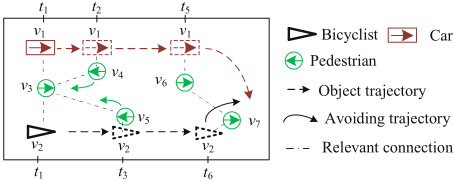
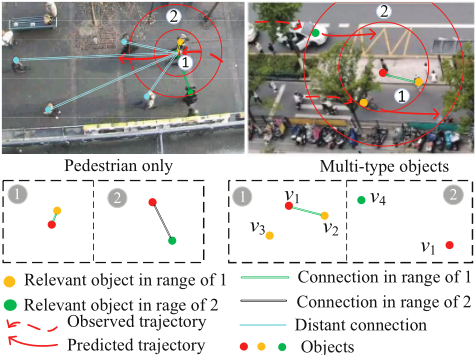
This paper take more types of objects into account, which gives a rise to intricate interactions, encompassing different types and diverse trajectories of objects, as vividly depicted in Figure 1. The challenging nature of these object trajectories goes beyond what's typically encountered, primarily due to the complex multi-relational dynamics among diverse types of objects, such as pedestrians, cars, and bicyclists, in the context of city video surveillance. Furthermore, these multi-type objects normally engage with neighboring ones in an asymmetric manner, resulting in sparse multi-relational directional connections among them. However, prior works focused on collision avoidance or motion tendency [Shi et al., 2021], which regularly considers short-term trajectories and assumes gradual changes in directions for the same object type (e.g., pedestrians). Figure 1 illustrates three specific indications, and exposes the limitations of these previous methods: (I.1) car v1 and bicyclist v2 have higher speeds than the pedestrians so v1 connects with v4 at t2 and disconnects with v3, and v2 connects with v5 at t3 and disconnects with v3. Meanwhile, the connection of pedestrians, such as v3, v4 and v5, is relatively stable; (I.2) when car v1 or bicycle v2 heads towards from the opposite direction with a pedestrian v4 or v5 at t2 or t5, the trajectory of pedestrian usually detours to avoid the collision; (I.3) cars usually have a larger radius of turning circle than bicycles, while bicycle has larger one than pedestrian so the trajectory may be quite different between different types of object. It is obvious that the precious works on sparse directed interaction methods which only consider pedestrians [Shi et al., 2021] cannot describe the interactions among multi-type objects as I.1. The traditional works for socially entangled pedestrian trajectory prediction [Bae and Jeon, 2021] cannot deal with the social interactions among various types of objects as I.1 and the asymmetric collision avoid among different types of objects as I.2. Figure 2 shows that the precious works, which divide pedestrians into several groups, are not suitable for the case of multi-type objects. Although motion tendency can facilitate the prediction with temporal information from trajectories [Shi et al., 2021], it is insufficient to describe the motion tendency of multi-type objects since the difference of them as I.3.
To address the aforementioned challenges, this paper introduces a novel approach known as Sparse Multi-Relational Graph Convolutional Network (SMGCN), depicted in Figure 3. The SMGCN is designed to capture intricate interactions in multi-type objects, encompassing both inter-type and inner-type dynamics, which describes object trajectories from the input videos by a spatial graph and a temporal graph as shown in Figure 3. Compared with previous methods, the competitiveness of our approach lies in the following five aspects. Firstly, we introduce a novel sparse multirelational spatial graph, grouping objects based on distance and relative displacement while integrating position and label information. It prunes unnecessary connections in different types of objects and models the sparse directed interactions among them, as depicted in Figure 2. Secondly, we leverage the multi-head self-attention mechanism [Vaswani et al., 2017] to learn asymmetric inter and inner-grouped directed interaction scores among multi-type objects. These scores combine distance with relative displacement fusions, and use asymmetric convolutional network to yield the fusion interaction mask matrix. Thirdly, we propose an adaptive sparsification method that computes thresholds by averaging each matrix dimension and fusing all averages, avoiding fixed thresholds. It yields sparse interaction score adjacency matrices, representing the sparse multi-relational spatial graph, which obtains by using a method similar to [Shi et al., 2021]. Fourthly, our SMGCN model introduces multi-motion tendencies, representing trajectory patterns for different types of objects. Objects with low speed tend to follow smaller turning radii when avoiding collisions, while objects with higher speeds take larger turns. For example, pedestrians tend to avoid bicyclists, whereas the latter tend to avoid cars. Finally, the object trajectories can be represented by the sparse multi-relational spatial and temporal graphs, with a series of GCNs [Kipf and Welling, 2017]. These graphs estimate biGaussian distribution parameters by the Time Convolution Network[Bai et al., 2018], and enable trajectory prediction for each object.
To our best knowledge, this paper contributes a quite novel method to model the multi-type objects interaction with the Multi-Relational Graph Convolutional Network and the Sparse Directed Interaction explicitly. Our contributions state as the following three-fold:
- Propose a new model, Sparse Multi-relational Spatial Graph, combines intricate multi-scale divisions with effective interaction sparsification, effectively pruning away unnecessary interactions among diverse types of objects.
- Design an adaptive sparsification method, which not only incorporates diverse information such as distance, relative displacement, object position and label, but also employs multi-layer GTA, leading to substantial enhancements in the accuracy of trajectory predictions.
- Propose a Sparse Multi-relational Temporal Graph to capture object trajectory temporal division and accurately model multi-type motion tendencies. This feature enables a more nuanced understanding of object behaviors in various scenarios.
Our SMGCN offers an intuitive, yet versatile solution for multi-type trajectory prediction that definitively surpasses a diverse array of architectural approaches. This study extensively engages in numerical experiments employing ETH [Pellegrini et al., 2009], UCY [Lerner et al., 2007], and SDD datasets [Robicquet et al., 2016]. Our experiments illustrate the superiority of our method compared to state-ofthe-art alternatives. Specifically, our approach showcases a reduction of ↓ 5.71% in Average Displacement Error (ADE) and ↓ 8.33% in Final Displacement Error (FDE) across the ETH and UCY datasets. Similarly, in the SDD datasets, our method achieves a substantial decrease of ↓ 26.66% in Minimum ADE and ↓ 12.49% in Minimum FDE.
2 RelatedWork
2.1 Pedestrian Trajectory Prediction
Advanced over the previous works on trajectory prediction with social forces [Mehran et al., 2009], the recent works introduce the machine learning such as CNNs and RNNs to predict the trajectory of pedestrians like Social-GAN [Gupta et al., 2018], Social-LSTM [Alahi et al., 2016], and so on. They present new social pooling schemes to compute all pedestrians' importance by attention modules. Gupta et al. presents the Social-GAN model based on a generative model to predict trajectories in a multi-modal way and accordingly a sociallyacceptable path [Gupta et al., 2018]Sadeghian et al. designs the SoPhie model to capture the interactions between human and environment respectively [Sadeghian et al., 2019]. Shi et al. describes the relationship among pedestrians by an attention module, and predicts the next coordinates for a pedestrian by Gaussian mixture model [Shi et al., 2020]. Sun et al. develops a reciprocal learning, for human forward and backward trajectory prediction with two prediction networks [Sun et al., 2020]. Bae et al. presents a disentangled multi-relational GCN, and socially entangled pedestrian trajectory prediction [Bae and Jeon, 2021]. Furthermore, Shi et al. presents a Sparse Graph Convolution Network (SGCN) for pedestrian trajectory prediction by modeling the sparse directed interaction among pedestrians and the motion tendency [Shi et al., 2021].
2.2 Multiple-Class Trajectory Prediction
Prior works mainly model sparse interactions among pedestrians, and only a few of them focus on multi-type users e.g., vehicle, cyclist, etc.. Li et al. proposes a sparse graph convolution network based approach for multi-class trajectory prediction to decide the spatial and temporal connections of agents [Li et al., 2022]. However, the generated relation graph is always overly dense with unnecessary connections between objects, without addressing sparsity to eliminate redundant interactions among them. This paper presents a sparse multi-relational directed interaction which divides objects into several spatial-temporal groups based on metrics (e.g., position, distance and relative displacement) and enables the removal of superfluous interactions within and between groups. This methodology effectively describes interactions among multi-type objects and leverages adaptive sparsification.
3 Our Method
This paper proposes an end-to-end MOTP method based on a sparse multi-relational GCN as shown in Figure 3. It contributes as follows: (1) spatial multi-relation division to eliminate the irrelevant relations and dividing the relevant relations among the multi-type objects into several groups; (2) an adaptive threshold based sparsification to optimize the sparsity of graph representation for interactions among objects; (3) multi-relational GCN to extract multi-relational spatial and temporal interactions respectively.
3.1 Sparse Multi-Relational Graph Learning
Graph input. Given a series of observations sampled from continuous video frames over time moments t ∈ {1, · · · , T}, where T is the period of observation, all objects in the video can be detected to obtain their coordinates {(xti , yt i )}Ni=1 with certain algorithms. This section describes the sequence of input frames, which contains multi-type objects, with a spatial graph denoted by Gs and a temporal graph denoted by Gt, and takes the two graphs as the input of the MSG. Let v denote object and V denote the set of objects, among which is the set E of edges denoted by ej, j = 1, · · · . This paper considers that each object vk may belong to different types, defined τk, k = 1, · · · , Y , which is represented with onehot encoded semantic labels. The spatial graph Gs(V t ,Et ) and the temporal graph Gt(Vi,Ei) composes of the object locations at time t and the trajectories corresponding to object vi respectively, where V t = {vt i , i = 1, · · · ,N} and Vi = {vt i , t = 1, · · · , T}. vt i means the attributes of object vi at time t containing its coordinates and type. The sets of edges among the two sets of objects are expressed as Et = {eti,j , i, j = 1, · · · ,N} for Gs and Ei = {el,m i , l,m= 1, · · · , T} for Gt respectively, where eti,j and el,m are set as 1 when objects vt i , vt j or vl i , vm i are connected, and 0 otherwise.
Multi-relation Spatial Division. One key contribution of ours involves a novel approach to categorize multi-type objects into group and analyze the relations within each group, as well as among different groups, to eliminate irrelevant relations. This distinguishes our work from prior approaches, which usually analyze the relation in single group and all relations are assumed to be relevant [Bae and Jeon, 2021]. For the purpose, we present a Sparse Multi-relation Spatial Graph, which contains several key procedures: multi-relation spatial division, spatial self-attention, spatial-temporal fusion and sparse, as shown in Figure 3.
Different from the previous works which learn complementary features by combining the information of distance and the relative displacement [Bae and Jeon, 2021], we utilize the object information including the Euclidean distance, the relative displacement, position and label among objects so as to increase the sparsity for the spatial graph inputs, i.e., to eliminate the irrelevant relations and select out the exact ones among objects from the input spatial graph. The information from labels indicates the type of specific object. The position is the geometric location of objects and offers extra information for determining relation besides distance and relative displacement.
Inspired by the reference [Bae and Jeon, 2021], which proposes disentangled multi-scale aggregation of social relations on a weighted graph, we use two groups of weighted subgraphs for scale metrics: distance and relative displacement. These sub-graphs are fused separately with position and label information. Each sub-graph represents an object division, with the total number of divisions set to B for both scale met- Addition :۩ Fusion :۪
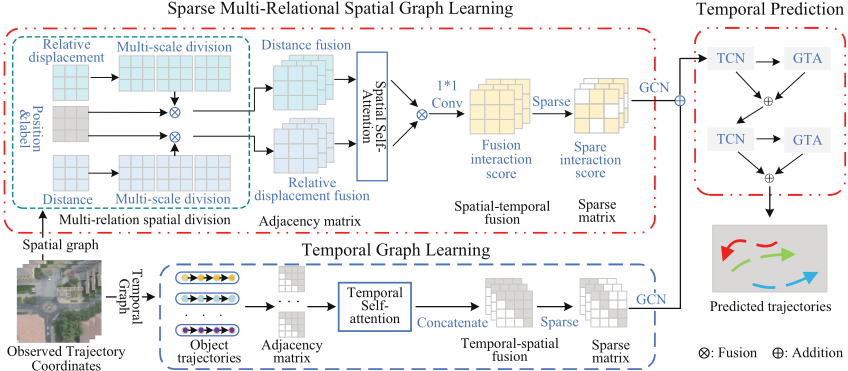
Figure 3: Sparse multi-relational graph learning. It consists of two procedures including the sparse multi-relational spatial and temporal graph learning. The multi-scale division divides the objects into several groups, and the fusion procedure generates two sequences of matrices, based on which the spatial self-attention generates the scores for the spatial interaction among objects and yields a interaction fusion matrix by 1 × 1 convolution. The temporal self-attention generates the scores for the temporal interaction among object trajectories.
rics. Let Akχ,ij denote the adjacent matrix of the sub-graph representing the kth object division. It represents relations among objects with edge weights measured by distance or displacement scales. This section defines it for each observation moment by following equation:
where aij is the distance or relative displacement relation between object vi and vj, χ={distance,relative displacement} indicates the operation in under the metric of either the distance or relative displacement. r[k] is a scale factor, k = 1, 2, · · · ,B and responses for two cases: distance scale and relative displacement. For the distance scale, aij is the Euclidean distance between object vi and vj, and r[k] ∈ {0, 0.5, 1, 2, 4}. For the relative displacement scale, aij is the relative displacement between object vi and vj, and accordingly, r[k] ∈ {0, 0.25, 0.5, 0.75, 1}. For the two cases, the equation (1) leads to two groups of matrices Akd and Akr for the distance scale and relative displacement scale respectively, where k = 1, · · · ,B.
Self-attention mechanism. Previous works primarily use the distance as the input for the relation analysis among objects, neglecting the integration of environmental geometric positions, where predicting object trajectory can benefit. Let Ht be a matrix denoting the information of position and label at moment t. To fuse Ht with the information of distance and relative displacement for each group of objects, i.e., the two matrices Atd and Atr , we obtain a distance fusion adjacent matrix ˜ Atd and relative displacement adjacent matrices ˜ Atr by the multiplication fusion, i.e., ˜ Atd = Atd · Ht and ˜ Atr = Atr · Ht .
The another information fusion is in the self-attention as shown in Figure 3, called interaction score fusion which aims to score the interaction among objects in order to obtain matrices that describe the relation weights. To calculate the weight for the relation among objects, this section introduces the attention score matrix based on the two matrices ˜ Ad = Ad · H and ˜ Ar = Ar · H by the self-attention mechanism [Vaswani et al., 2017][Bae and Jeon, 2021]. The spatial interaction for both matrices are dense and has the same space denoted by R ∈ RN×N among objects for group k at each moment, which is given by embedding one-hot encoded object type labels as following equations:
where ϕ(·, ·) is a linear transformer. M k χ is the embedding of sub-graph Akd or Akr . W χM ,W k χ,M and W χK are learnable weight matrices. Accordingly, Qkχ and Kkχ are the query and key of the self-attention mechanism for the sub-graph, respectively. W k χ,M ∈ RD×DK , where D is the dimension of spatial graph Gχ. In Equation (2), Rkχ is calculated step by step for each moment and independent across time steps for both distance and relative displacement fusion matrices.
Interaction score fusion. To capture high-level interaction features by integrating both distance and relative information, Rt,k d and Rt,k r are fused across different sub-graph with the operation of the multiplication fusion and obtain a sequence of fused spatial interaction matrix denoted by Rt,k , i.e., Rt,k = Rt,k d ⊗ Rt,k r , ∀, t = 1, · · · , T, k = 1, · · · ,B. Rt,k represents the interactions among objects at time t for the division scale r[k]. To thoroughly explore spatial multitype object interaction information across various granularity, we fuse the interaction feature across different division scale with a 1×1 convolution and obtain division-spatial-temporal interaction matrix denoted by [Rt,B ]Tt=1 . Over the entire observation duration T, we organize the spatial matrices Rt , where t = 1, · · · , T , into a unified matrix with an additional dimension, [Rt ]Tt=1 , and fuse the interactions belong to the same pair of objects along the temporal channel in [Rt ]Tt=1 by 1 × 1 convolution, which leads to a spatial-temporal interaction matrix denoted by ˆRt,B with a 1 × 1 convolution. We follow the equation (2) of the reference [Shi et al., 2021] to implement a cascade of asymmetric convolution operation on the rows and columns of ˆRt,B , and obtain the high-level interaction feature denoted by F with size T × N × N.
Sparse. Densely connected graphs suffer from superfluous spatial interactions and temporal dependencies. To address this issue, we introduce an adaptive sparse metric for multi-type relationships, which deviates from conventional approaches typically employ a fixed threshold η to eliminate implicit connections and optimize graph representation sparsity [Li et al., 2022]. Our method proposes a dynamic approach to calculate the adaptive metric from the sparse multirelational matrix denoted by M as following equation:
The matrix M in Equation (3) is fused with the high-level interaction feature by element-wise multiplication, and we can obtain the sparse multi-relational spatial adjacency matrix A as given by the following equation:
where I is a unit matrix to indicate that each object is selfconnected, and ⊙ is an element-wise multiplication operator. A is then normalized with Zero-Softmax function to keep the sparsity as the reference [Kipf and Welling, 2017]. By denoting the normalized adjacency matrix A by ˆ A, we can obtain the sparse multi-relational spatial graph G(V t , ˆ As).
Sparse multi-relational temporal graph learning. Similar to sparse multi-relational spatial graph, we delve into the interplay between distinct object types from a temporal perspective. With the temporal graph as input, the model in Figure 3 processes the sparse multi-relational temporal graph so as to learn the multi-type motion tendency, which is different from the motion tendency considering only pedestrian [Shi et al., 2021]. In departure from prior research, our study incorporates object types into consideration and introduces the position encoding tensor [Vaswani et al., 2017] to represent the Sparse Multi-relational Temporal Graph, i.e., Et = ϕ(Gt,W tE ) + ξτ , where ξτ is the position encoding tensor and τ is the object type. Mirroring the sparse multi-relational spatial graph learning paradigm, we adopt the self-attention mechanism to compute the asymmetric attention score matrices, and concatenate the matrices to the temporal-spatial fusion matrices. We also take the sparsification method, similar to that for the sparse multi-relational spatial graph learning and obtain the sparse matrices. Finally, we obtain a sparse multi-relational temporal graph denoted G(Vi, ˆ At), vi ∈ V , where ˆ At is the normalized adjacency matrix for vi.
3.2 Multi-type Trajectory Prediction
The prior subsection derives spatial-temporal features via sparse multi-relational spatial and temporal graphs utilizing multi-relational GCNs. In this section, we adopt a trajectory prediction method inspired by DMRGCN [Bae and Jeon, 2021], employing multi-layer Temporal Convolutional Network (TCN) augmented with Global Temporal Aggregation (GTA). A departure from previous approaches, we introduce the utilization of GTA after each layer of TCN to effectively extract and propagate global temporal information.
Multi-layer TCN. We employ TCN [Bai et al., 2018] to achieve spatial-temporal aggregation by integrating convolutional and recurrent architectures with long-term memory.
Multi-layer GTA. GTA is proposed to learn to compensate for the accumulated error. Different from those typical methods, we update spatio-temporal feature by GTA for every TCN layer to minimize the residual error for multi-type object interactions, which is has a more complex temporal trends compared to single-type object:
where ol,t,i,c denotes an element of the spatio-temporal feature Ol output from the l-th TCN layer at time t of object vi, and C is the total number of channels in the feature. The symbol σ represents the Sigmoid function, while w and b denote the learnable kernel weight and bias, respectively. In our SMGCN, GTA plays a pivotal role in rectifying path predictions, particularly during multi-type object interactions, with a specific emphasis on addressing long-term routes.
Learning Objective. As outlined in previous works such as Social-LSTM [Alahi et al., 2016] and SGCN [Shi et al., 2021], the trajectory coordinates (xt, yt) at time t of object vi follow a bi-variate Gaussian distribution N (µti , θt i , ρti ), where µti and θt i are the mean and standard deviation of the distribution respectively, and ρti is the correlation coefficient. Hence, our model is trained to predict the trajectory of object vi by minimizing the negative log-likelihood loss as:
where Tp is the prediction time window and (xt,i, yt,i) is the coordinates of object vi at t.
4 Experiment and Analysis
Datasets. We conduct experiments using three public datasets: ETH [Pellegrini et al., 2009], UCY [Lerner et al., 2007], and SDD [Robicquet et al., 2016]. These datasets offer diverse pedestrian trajectory data, capturing real-world interactions. The ETH dataset comprises videos from scenes ETH and HOTEL, while UCY includes scenes UNIV, ZARA1, and ZARA2. The SDD dataset covers six categories (pedestrian, cyclist, cart, car, skater, bus) within Stanford University. For evaluation, we employe the leave-one-out [Cawley and Talbot, 2003] strategy for ETH and UCY, and uniformly distribute SDD data among test, train, and validation sets. Our approach, following [Shi et al., 2021], utilizes a 0.4-second observation time interval, adopting 8 frames (i.e., 3.2 seconds) for training and predicting 12 subsequent frames (i.e., 4.8 seconds) in trajectory prediction tasks.
| Methods | Publ. | ETH | UCY | ||||
|---|---|---|---|---|---|---|---|
| ETH | HOTEL | UNIV | ZARA1 | ZARA2 | Average | ||
| Social-LSTM [Alahi et al., 2016] | CVPR | 1.09 / 2.35 | 0.79 / 1.76 | 0.67 / 1.40 | 0.47 / 1.00 | 0.56 / 1.17 | 0.72 / 1.54 |
| Vanilla-LSTM [Alahi et al., 2016] | CVPR | 1.09 / 2.41 | 0.86 / 1.91 | 0.61 / 1.31 | 0.41 / 0.88 | 0.52 / 1.11 | 0.70 / 1.52 |
| Social-GAN [Gupta et al., 2018] | CVPR | 0.87 / 1.62 | 0.67 / 1.37 | 0.76 / 1.52 | 0.35 / 0.68 | 0.42 / 0.84 | 0.61 / 1.21 |
| Sophie [Sadeghian et al., 2019] | CVPR | 0.70 / 1.43 | 0.76 / 1.67 | 0.54 / 1.24 | 0.30 / 0.63 | 0.38 / 0.78 | 0.51 / 1.15 |
| PITF [Liang et al., 2019] | CVPR | 0.73 / 1.65 | 0.30 / 0.59 | 0.60 / 1.27 | 0.38 / 0.81 | 0.31 / 0.68 | 0.46 / 1.00 |
| GAT [Kosaraju et al., 2019] | NIPS | 0.68 / 1.29 | 0.68 / 1.40 | 0.57 / 1.29 | 0.29 / 0.60 | 0.37 / 0.75 | 0.52 / 1.07 |
| Social-BiGAT [Kosaraju et al., 2019] | NIPS | 0.69 / 1.29 | 0.49 / 1.01 | 0.55 / 1.32 | 0.30 / 0.62 | 0.36 / 0.75 | 0.48 / 1.00 |
| Social-STGCNN [Mohamed et al., 2020] | CVPR | 0.64 / 1.11 | 0.49 / 0.85 | 0.44 / 0.79 | 0.34 / 0.53 | 0.30 / 0.48 | 0.44 / 0.75 |
| STAR [Yu et al., 2020] | ECCV | 0.56 / 1.11 | 0.26 / 0.50 | 0.52 / 1.15 | 0.41 / 0.90 | 0.31 / 0.71 | 0.41 / 0.87 |
| RSBGw/o context [Sun et al., 2020] | CVPR | 0.80 / 1.53 | 0.33 / 0.64 | 0.59 / 1.25 | 0.40 / 0.86 | 0.30 / 0.65 | 0.48 / 0.99 |
| SGCN [Shi et al., 2021] | CVPR | 0.63 / 1.03 | 0.32 / 0.55 | 0.37 / 0.70 | 0.29 / 0.53 | 0.25 / 0.45 | 0.37 / 0.65 |
| CSCNet [Xia et al., 2022] | PR | 0.51 / 1.05 | 0.22 / 0.42 | 0.47 / 1.02 | 0.36 / 0.81 | 0.31 / 0.68 | 0.37 / 0.79 |
| Social-SSL [Tsao et al., 2022] | ECCV | 0.69 / 1.37 | 0.24 / 0.44 | 0.51 / 0.93 | 0.42 / 0.84 | 0.34 / 0.67 | 0.44 / 0.85 |
| Social-DualCVAE [Gao et al., 2022] | ArXiv | 0.66 / 1.18 | 0.34 / 0.61 | 0.39 / 0.74 | 0.27 / 0.48 | 0.24 / 0.42 | 0.38 / 0.69 |
| SEEM [Wang et al., 2023] | TPAMI | 0.62 / 1.20 | 0.61 / 1.21 | 0.50 / 1.04 | 0.31 / 0.61 | 0.36 / 0.68 | 0.48 / 0.95 |
| SMGCN (ours) | - | 0.63 / 1.02 | 0.27 / 0.45 | 0.37 / 0.66 | 0.27 / 0.47 | 0.22 / 0.40 | 0.35 / 0.60 |
| Methods | minADE | minFDE |
|---|---|---|
| Linear [Li et al., 2022] | 37.11 | 63.51 |
| Social-LSTM [Alahi et al., 2016] | 31.19 | 56.97 |
| SF [Yamaguchi et al., 2011] | 36.48 | 58.14 |
| CAR-Net [Sadeghian et al., 2018] | 25.72 | 51.80 |
| Social-GAN [Gupta et al., 2018] | 27.25 | 41.44 |
| Social-STGCNN [Mohamed et al., 2020] | 26.46 | 42.71 |
| SMGCN (ours) | 20.89 | 36.84 |
Metrics. We evaluate prediction results using Average Displacement Error (ADE) [Raksincharoensak et al., 2016] and Final Displacement Error (FDE) [Alahi et al., 2016]. ADE is the average L-2 distance between predicted and ground-truth trajectory points, while FDE is the L-2 distance between their final destinations. For quantitative evaluation, we normalize the best prediction from 20 samples by L-2, aligning with previous work [Shi et al., 2021], ensuring comparability with typical benchmark results.
Experimental settings. In our experiments, both of the embedding dimensions for graph embeddings and the selfattention mechanism are set as 64. The feature enhancement component employs an asymmetric convolutional network with 7 convolutional layers, using a kernel size of 3. We cascade 1 layer of GCN and 2 layers of TCN. The nonlinear activation function is the PRelu [He et al., 2015]. This section trains the model for 600 epochs using the Adam optimizer with a batch size of 128. The attenuation factor set to 0.1 for every 50 rounds. During inference, 20 sample values were extracted from the double Gaussian distribution, and the sample values closest to the true values were used as metrics.
The learning rate is set as 0.001.
4.1 Comparison with State-of-The-Arts
Single-type trajectory prediction. This section evaluates the experimental performance under the ETH and UCY dataset, selecting notable methods published in the last eight years. Results in Table 1 depict our method's superior performance over selected methods and state-of-the-art ones. Specifically, our method outperforms the existing best method SGCN [Shi et al., 2021] and CSCNet [Xia et al., 2022] by ↑ 5.71% averaging on ETH and UCY datasets under the ADE metric. Our method's effectiveness lies in reducing the impact of unnecessary interactions within inner and inter groups. This is achieved through learning with our Sparse Multi-relational Spatial Graph.
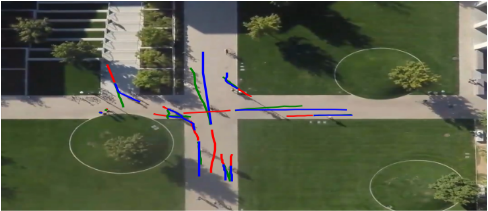
Multi-type trajectory prediction. Furthermore, we assess the influence of object types on our methods through experiments on the SDD dataset, comparing the results with typical state-of-the-art methods. Table 2 displays the comparison results of ADE and FDE metrics between those methods and ours. For example, under the minADE metric, our method outperforms the previous leading method CARNet [Sadeghian et al., 2018] by ↑ 23.12%, and surpasses the previous second-best method Social-STGCNN [Mohamed et al., 2020] by ↑ 26.66% on the SDD datasets. The reason is that our method considers the interactions among multi-type objects, i.e., dividing objects into several groups enables a more nuanced understanding of object behaviors in various scenarios, leading to substantial enhancements in the accuracy of multi-type trajectory predictions. Figure 4 displays visualization results from the SDD dataset scenario: red lines for observed, green for predicted, and blue for actual trajectories of Multi-type objects.
4.2 Ablation Study
Effect of adaptive sparse threshold η. We commence by contrasting our adaptive sparse threshold, denoted as η, with a fixed threshold (η = 0.5 or η = 0) to assess the efficacy of the proposed multi-relational sparse graph under varying sparsity levels. The outcomes are presented in Table 3. We examine two different variants of our approach: (1) MOTPV1: exploring the impact of removing the adaptive threshold η, i.e. the threshold η is not fixed and setting is as η = 0.5, which means that the sparsity among object is assumed to be fixed; (2) MOTP-V2: investigating the impact of removing the sparsification, i.e. the threshold η is set as η = 0. By comparing the results, we find that the adaptive threshold can impact the trajectory prediction performance. Specifically, in contrast to MOTP-V1, MOTP with the adaptive threshold exhibits a notable improvement, averaging ↑ 17.05% in ADE and ↑ 11.67% in FDE, respectively. Furthermore, juxtaposed with MOTP-V2, MOTP with sparsification adeptly prunes superfluous interactions stemming from multi-type objects, yielding a substantial ↑ 76.7% improvement in ADE and ↑ 73.67% in FDE, respectively. This underscores the pivotal role of sparse directed multi-type interactions in the accurate prediction of trajectories for multi-type objects.
| Datasets | Scenes | MOTP-V1 ( η = 0.5 ) | MOTP-V2 ( η = 0 ) | MOTP ( Adaptive η ) |
|---|---|---|---|---|
| ETH | ETH HOTEL | 0.72 / 1.13 0.39 / 0.55 | 0.68 / 1.19 0.86 / 1.37 | 0.63 / 1.02 0.27 / 0.45 |
| UCY | UNIV ZARA1 ZARA2 | 0.39 / 0.74 0.27 / 0.50 0.22 / 0.44 | 0.79 / 1.35 0.40 / 0.65 0.38 / 0.65 | 0.37 / 0.66 0.27 / 0.47 0.22 / 0.40 |
| Average | 0.41 / 0.67 | 0.62 / 1.04 | 0.35 / 0.60 | |
| Variants | ETH | UCY | |||
|---|---|---|---|---|---|
| ETH | HOTEL | UNIV | ZARA1 | ZARA2 | |
| w/o Relative | 0.72 | 0.33 | 0.38 | 0.28 | 0.24 |
| w/o Distance | 0.69 | 0.35 | 0.40 | 0.27 | 0.23 |
| w/o GTA | 0.69 | 0.32 | 0.39 | 0.27 | 0.26 |
| Single-layer GTA | 0.67 | 0.30 | 0.40 | 0.27 | 0.26 |
| SMGCN | 0.63 | 0.27 | 0.37 | 0.27 | 0.22 |
Effect ofmulti-relation spatial division. We delve into the significance of the multi-relational spatial division, examining their impact on the ADE metric, as depicted in Table 4 and Table 5. We analyze the effects of removing the relative and distance displacement relations from the multi-relation spatial graph and evaluate the performance of SMGCN. The results reveal a noteworthy enhancement across both the ETH and UCY datasets. For instance, on the challenging HOTEL scene of the ETH dataset, with our final SMGCN method showcases remarkable superiority over its variant lacking the relative displacement relation, boasting an impressive improvement (↑ 18.18% in ADE, ↑ 19.64% in FDE). Furthermore, it surpasses the variant without the distance displacement relation, achieving a substantial advancement (↑ 22.86% in ADE, ↑ 22.41% in FDE). This demonstrates the critical significance of both the relative and distance displacement relations.
| Variants | ETH | UCY | |||
|---|---|---|---|---|---|
| ETH | HOTEL | UNIV | ZARA1 | ZARA2 | |
| w/o Relative w/o Distance | 1.29 | 0.56 | 0.67 | 0.5 | 0.43 |
| 1.03 | 0.58 | 0.75 | 0.5 | 0.41 | |
| w/o GTA | 1.27 | 0.55 | 0.73 | 0.47 | 0.48 |
| Single-layer GTA | 1.27 | 0.49 | 0.75 | 0.47 | 0.44 |
| SMGCN | 1.02 | 0.45 | 0.66 | 0.47 | 0.40 |
Effect of multi-layer GTA. As illustrated in Table 4 and Table 5, our investigation extends to various configurations of GTA, encompassing scenarios both with and without GTA, utilizing a single-layer GTA, and deploying our comprehensive SMGCN framework with a multi-layer GTA.
The results divulge significant insights into the performance on the HOTEL scene of the ETH dataset. Notably, SMGCN with a multi-layer GTA exhibits enhanced performance compared to its counterpart without GTA, achieving a remarkable improvement (↑ 15.62% in ADE, ↑ 18.18% in FDE). Furthermore, it surpasses the single-layer GTA variant with a substantial enhancement (↑ 10.00% in ADE, ↑ 8.16% in FDE). These findings strongly indicate that, with the proposed multi-layer GTA, our SMGCN exhibits the capability to predict more accurate trajectories for multi-type objects compared to using a single GTA or none at all.
5 Conclusion
This paper studies proposes SMGCN to leverage the sparsity of multi-relation and multi-scale directed interactions and motion tendency. We conducts extensive experimental evaluations based on three public datasets, and the results show that our method can predict trajectories of multi-type objects more accurately than the typical state-of-the-art methods even under some complex scenes, such as different types of objects moving in a group and interacting with each other simultaneously. SMGCN can identify the sparse multi-relational directed interactions among multi-type objects.
Acknowledgments
This work is supported by the National Key R&D Program of China under No.2021YFC3320301.
@inproceedings{ijcai2024p188,
  title     = {Sparse Multi-Relational Graph Convolutional Network for Multi-type Object Trajectory Prediction},
  author    = {Zhang, Jianhui and Yao, Jun and Yan, Liqi and Xu, Yanhong and Wang, Zheng},
  booktitle = {Proceedings of the Thirty-Third International Joint Conference on
               Artificial Intelligence, {IJCAI-24}},
  publisher = {International Joint Conferences on Artificial Intelligence Organization},
  editor    = {Kate Larson},
  pages     = {1697--1705},
  year      = {2024},
  month     = {8},
  note      = {Main Track},
  doi       = {10.24963/ijcai.2024/188},
  url       = {https://doi.org/10.24963/ijcai.2024/188},
}
TY - CPAPER TI - Sparse Multi-Relational Graph Convolutional Network for Multi-type Object Trajectory Prediction AU - Zhang, Jianhui AU - Yao, Jun AU - Yan, Liqi AU - Xu, Yanhong AU - Wang, Zheng T2 - Proceedings of the Thirty-Third International Joint Conference on Artificial Intelligence, IJCAI-24 PB - International Joint Conferences on Artificial Intelligence Organization PY - 2024 SP - 1697 EP - 1705 DO - 10.24963/ijcai.2024/188 UR - https://doi.org/10.24963/ijcai.2024/188 ER -Copied
Machine-readable versions of this paper, for tools and AI agents:





