
Diversifying Training Pool Predictability for Zero-shot Coordination: A Theory of Mind Approach
Proceedings of the Thirty-Third International Joint Conference on Artificial Intelligence. Main Track. Pages 166-174.
https://doi.org/10.24963/ijcai.2024/19
Keywords
- Machine Learning: ML: Multiagent Reinforcement Learning
- Agent-based and Multi-agent Systems: MAS: Coordination and cooperation
- Machine Learning: ML: Reinforcement learning
Abstract
The challenge in constructing artificial social agents is to enable adaptation ability to novel agents, and is called zero-shot coordination (ZSC). A promising approach is to train the adaptive agents by interacting with a diverse pool of collaborators, assuming that the greater the diversity in other agents seen during training, the better the generalisation. In this paper, we explore an alternative procedure by considering the behavioural predictability of collaborators, i.e. whether their actions and intentions are predictable, and use it to select a diverse set of agents for the training pool. More specifically, we develop a pool of agents through self-play training during which agents' behaviour evolves and has diversity in levels of behavioural predictability (LoBP) through its evolution. We construct an observer to compute the level of behavioural predictability for each version of the collaborators. To do so, the observer is equipped with the theory of mind (ToM) capability to learn to infer the actions and intentions of others. We then use an episodic memory based on the LoBP metric to maintain agents with different levels of behavioural predictability in the pool of agents. Since behaviours that emerge at the later training phase are more complex and meaningful, the memory is updated with the latest versions of training agents. Our extensive experiments demonstrate that LoBP-based diversity training leads to better ZSC than other diversity training methods.
- [Albrecht and Stone, 2018] Stefano V Albrecht and Peter Stone. Autonomous agents modelling other agents: A comprehensive survey and open problems. Artificial In- telligence, 258:66-95, 2018.
- [Bain and Sammut, 1995] Michael Bain and Claude Sam- mut. A framework for behavioural cloning. In Machine Intelligence 15, pages 103-129, 1995.
- [Bard et al., 2020] Nolan Bard, Jakob N Foerster, Sarath Chandar, Neil Burch, Marc Lanctot, H Francis Song, Emilio Parisotto, Vincent Dumoulin, Subhodeep Moitra, Edward Hughes, et al. The hanabi challenge: A new fron- tier for ai research. Artificial Intelligence, 280:103216, 2020.
- [Baron-Cohen et al., 1985] Simon Baron-Cohen, Alan M Leslie, and Uta Frith. Does the autistic child have a "the- ory of mind"? Cognition, 21(1):37-46, 1985.
- [Boutilier, 1996] Craig Boutilier. Planning, learning and co- ordination in multiagent decision processes. In TARK, vol- ume 96, pages 195-210.
- [Bowling and McCracken, 2005] Michael Bowling and Pe- ter McCracken. Coordination and adaptation in im- promptu teams. In AAAI, volume 5, pages 53-58, 2005.
- [Brown et al., 2020] Tom Brown, Benjamin Mann, Nick Ry- der, Melanie Subbiah, Jared D Kaplan, Prafulla Dhari- wal, Arvind Neelakantan, Pranav Shyam, Girish Sastry, Amanda Askell, et al. Language models are few-shot learners. Advances in neural information processing sys- tems, 33:1877-1901, 2020.
- [Carroll et al., 2019] Micah Carroll, Rohin Shah, Mark K Ho, Tom Griffiths, Sanjit Seshia, Pieter Abbeel, and Anca Dragan. On the utility of learning about humans for human-ai coordination. Advances in Neural Information Processing Systems, 32, 2019.
- [Dafoe et al., 2021] Allan Dafoe, Yoram Bachrach, Gillian Hadfield, Eric Horvitz, Kate Larson, and Thore Grae- pel. Cooperative ai: machines must learn to find common ground. Nature, 593(7857):33-36, 2021.
- [Duan et al., 2017] Yan Duan, Marcin Andrychowicz, Bradly Stadie, OpenAI Jonathan Ho, Jonas Schneider, Ilya Sutskever, Pieter Abbeel, and Wojciech Zaremba. One-shot imitation learning. Advances in neural informa- tion processing systems, 30, 2017.
- [Eysenbach et al., 2018] Benjamin Eysenbach, Abhishek Gupta, Julian Ibarz, and Sergey Levine. Diversity is all you need: Learning skills without a reward function. In Inter- national Conference on Learning Representations, 2018. [Jaderberg et al., 2017] Max Jaderberg, Valentin Dalibard, Simon Osindero, Wojciech M Czarnecki, Jeff Donahue, Ali Razavi, Oriol Vinyals, Tim Green, Iain Dunning, Karen Simonyan, et al. Population based training of neural networks. arXiv preprint arXiv:1711.09846, 2017.
- [Jakubik et al., 2022] Johannes Jakubik, Michael Vössing, Niklas Kühl, Jannis Walk, and Gerhard Satzger. Data-centric artificial intelligence. arXiv preprint arXiv:2212.11854, 2022.
- [Jiang et al., 2023] Minqi Jiang, Tim Rocktäschel, and Ed- ward Grefenstette. General intelligence requires re- thinking exploration. Royal Society Open Science, 10(6):230539, 2023.
- [Knott et al., 2021] Paul Knott, Micah Carroll, Sam Devlin, Kamil Ciosek, Katja Hofmann, Anca Dragan, and Rohin Shah. Evaluating the robustness of collaborative agents. In Proceedings of the 20th International Conference on Autonomous Agents and MultiAgent Systems, pages 1560- 1562, 2021.
- [Lou et al., 2023] Xingzhou Lou, Jiaxian Guo, Junge Zhang, Jun Wang, Kaiqi Huang, and Yali Du. PECAN: Leverag- ing policy ensemble for context-aware zero-shot human-ai coordination. In Proceedings of the 2023 International Conference on Autonomous Agents and Multiagent Sys- tems, pages 679-688, 2023.
- [Lu et al., 2013] Xin Lu, Erik Wetter, Nita Bharti, Andrew J Tatem, and Linus Bengtsson. Approaching the limit of predictability in human mobility. Scientific reports, 3(1):2923, 2013.
- [Lupu et al., 2021] Andrei Lupu, Brandon Cui, Hengyuan Hu, and Jakob Foerster. Trajectory diversity for zero- shot coordination. In International conference on machine learning, pages 7204-7213. PMLR, 2021.
- [Mazumder et al., 2022] Mark Mazumder, Colby Banbury, Xiaozhe Yao, Bojan Karlaš, William Gaviria Rojas, Sud- nya Diamos, Greg Diamos, Lynn He, Alicia Parrish, Han- nah Rose Kirk, et al. Dataperf: Benchmarks for data- centric ai development. arXiv preprint arXiv:2207.10062, 2022.
- [Mirsky et al., 2022] Reuth Mirsky, Ignacio Carlucho, Ar- rasy Rahman, Elliot Fosong, William Macke, Mohan Srid- haran, Peter Stone, and Stefano V Albrecht. A survey of ad hoc teamwork: Definitions, methods, and open problems. In European Conference on Multiagent Systems, 2022.
- [Papoudakis et al., 2021] Georgios Papoudakis, Filippos Christianos, and Stefano Albrecht. Agent modelling under partial observability for deep reinforcement learning. Advances in Neural Information Processing Systems, 34:19210-19222, 2021.
- [Paul et al., 2021] Mansheej Paul, Surya Ganguli, and Gintare Karolina Dziugaite. Deep learning on a data diet: Finding important examples early in training. Advances in Neural Information Processing Systems, 34:20596-20607, 2021.
- [Premack and Woodruff, 1978] David Premack and Guy Woodruff. Does the chimpanzee have a theory of mind? Behavioral and brain sciences, 1(4):515-526, 1978.
- [Rabinowitz et al., 2018] Neil Rabinowitz, Frank Perbet, Francis Song, Chiyuan Zhang, SM Ali Eslami, and Matthew Botvinick. Machine theory of mind. In Interna- tional conference on machine learning, pages 4218-4227.
- PMLR, 2018.
- [Silver et al., 2018] David Silver, Thomas Hubert, Julian Schrittwieser, Ioannis Antonoglou, Matthew Lai, Arthur Guez, Marc Lanctot, Laurent Sifre, Dharshan Kumaran, Thore Graepel, et al. A general reinforcement learning algorithm that masters chess, shogi, and go through self- play. Science, 362(6419):1140-1144, 2018.
- [Song et al., 2010] Chaoming Song, Zehui Qu, Nicholas Blumm, and Albert-László Barabási. Limits of pre- dictability in human mobility. Science, 327(5968):1018- 1021, 2010.
- [Stone et al., 2010] Peter Stone, Gal Kaminka, Sarit Kraus, and Jeffrey Rosenschein. Ad hoc autonomous agent teams: Collaboration without pre-coordination. In Proceedings of the AAAI Conference on Artificial Intelligence, volume 24, pages 1504-1509, 2010.
- [Strouse et al., 2021] DJ Strouse, Kevin McKee, Matt Botvinick, Edward Hughes, and Richard Everett. Collab- orating with humans without human data. Advances in Neural Information Processing Systems, 34:14502-14515, 2021.
- [Szot et al., 2023] Andrew Szot, Unnat Jain, Dhruv Batra, Zsolt Kira, Ruta Desai, and Akshara Rai. Adaptive co- ordination in social embodied rearrangement. In Andreas Krause, Emma Brunskill, Kyunghyun Cho, Barbara En- gelhardt, Sivan Sabato, and Jonathan Scarlett, editors, Pro- ceedings of the 40th International Conference on Machine Learning, volume 202, pages 33365-33380. PMLR, 23- 29 Jul 2023.
- [Tesauro, 1994] Gerald Tesauro. Td-gammon, a self- teaching backgammon program, achieves master-level play. Neural computation, 6(2):215-219, 1994.
- [Treutlein et al., 2021] Johannes Treutlein, Michael Dennis, Caspar Oesterheld, and Jakob Foerster. A new formal- ism, method and open issues for zero-shot coordination. In International Conference on Machine Learning, pages 10413-10423. PMLR, 2021.
- [Whang et al., 2023] Steven Euijong Whang, Yuji Roh, Hwanjun Song, and Jae-Gil Lee. Data collection and qual- ity challenges in deep learning: A data-centric ai perspec- tive. The VLDB Journal, 32(4):791-813, 2023.
- [Yarats et al., 2022] Denis Yarats, David Brandfonbrener, Hao Liu, Michael Laskin, Pieter Abbeel, Alessandro Lazaric, and Lerrel Pinto. Don't change the algorithm, change the data: Exploratory data for offline reinforcement learning. arXiv preprint arXiv:2201.13425, 2022.
- [Yu et al., 2022a] Chao Yu, Jiaxuan Gao, Weilin Liu, Botian Xu, Hao Tang, Jiaqi Yang, Yu Wang, and Yi Wu. Learn- ing zero-shot cooperation with humans, assuming humans are biased. In The Eleventh International Conference on Learning Representations, 2022.
- [Yu et al., 2022b] Yu Yu, Shahram Khadivi, and Jia Xu. Can data diversity enhance learning generalization? In Pro- ceedings of the 29th international conference on computa- tional linguistics, pages 4933-4945, 2022.
- [Zha et al., 2023a] Daochen Zha, Zaid Pervaiz Bhat, Kwei- Herng Lai, Fan Yang, and Xia Hu. Data-centric ai: Per- spectives and challenges. In Proceedings of the 2023 SIAM International Conference on Data Mining (SDM), pages 945-948. SIAM, 2023.
- [Zha et al., 2023b] Daochen Zha, Zaid Pervaiz Bhat, Kwei- Herng Lai, Fan Yang, Zhimeng Jiang, Shaochen Zhong, and Xia Hu. Data-centric artificial intelligence: A survey. arXiv preprint arXiv:2303.10158, 2023.
- [Zhao et al., 2023] Rui Zhao, Jinming Song, Yufeng Yuan, Haifeng Hu, Yang Gao, Yi Wu, Zhongqian Sun, and Wei Yang. Maximum entropy population-based training for zero-shot human-ai coordination. In Proceedings of the AAAI Conference on Artificial Intelligence, volume 37, pages 6145-6153, 2023.
References were extracted automatically from the PDF and may contain errors.
Full text extracted automatically from the PDF; figures, tables and equations may differ. The PDF is the version of record.
1 Introduction
Building social agents that can coordinate with novel agents is challenging [Stone et al., 2010; Dafoe et al., 2021; Mirsky et al., 2022; Treutlein et al., 2021; Bowling and McCracken, 2005; Bard et al., 2020] because artificial social agents need to adapt to diverse partners. To overcome this challenge, recent works generate a pool of diverse artificial agents and train the adaptive agent to cooperate with agents from this pool. This kind of generative framework to create high-quality training data [Jiang et al., 2023] is actively studied in deep learning [Zha et al., 2023b;
Whang et al., 2023; Zha et al., 2023a; Jakubik et al., 2022; Mazumder et al., 2022] and benefits different sub-fields such as computer vision [Paul et al., 2021] and natural language processing [Yu et al., 2022b; Brown et al., 2020]. In the context of building adaptive agents, manipulating the process of generating the training policies provides the advantage of instilling different prior knowledge and inducing flexibility in cooperating with the partner's behaviour in the training pool. To create a pool of diverse agents, existing works have studied various schemes to generate pools that contain agents with varying trajectories [Lupu et al., 2021; Lou et al., 2023; Zhao et al., 2023], skills [Szot et al., 2023], or desires [Yu et al., 2022a].
In this paper, we explore a new diversity scheme based on the predictability of others in the team in training adaptive agents in a zero-shot coordination setting. If an agent is only trained with collaborators whose behaviours have high predictability, it will develop specific habits to cooperate with this population and not readjust to novel partners, i.e. will struggle when its new partners are less predictable. Negative effects also can happen when the adaptive agent is only trained with agents that are completely random in behaviour, i.e. low in behavioural predictability, and bring no benefit to the team since this can potentially lead the adaptive agent to learn to achieve the task individually without cooperating with others. Hence, we suggest maintaining agents with different levels of behavioural predictability (LoBP) in the population with which we train the adaptive agent. An agent or a policy is unpredictable if its behaviour cannot be predicted from a third-person point of view-the theory of mind observer-, and vice versa 1 . We continually train a theory of mind observer to predict the behaviour, including one-stepahead primitive actions and intentions, of self-play agents to assess the behavioural predictability of agents in a particular environment. Although recent research has considered machine theory of mind as a crucial component for artificial agents in cooperative multi-agent settings [Rabinowitz et al., 2018; Papoudakis et al., 2021], using this model to maintain the diversity of agents has not been studied.
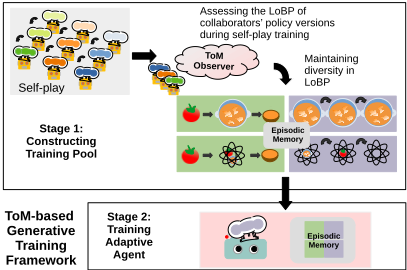
Our training framework is presented in Fig. 1. In the first stage, a training pool of diverse agents is developed via selfplay reinforcement learning (RL), and we pick the agents for a training pool for the next stage based on LoBP-based selection criteria. In the second stage, the adaptive agent is trained to cooperate with the agents in this training pool. We focus on the first stage, where the training pool is generated to have diverse LoBP. Our proposed approach includes (1) a theory of mind observer, which assigns a behavioural predictability score for agents in the pool; and (2) an episodic memory, which supports the construction of the training pool with diverse LoBP and favours agents that have meaningful behaviours that appeared in the later stage of training. We conducted experiments on the Overcooked environment [Carroll et al., 2019] and demonstrated that the LoBP-based mechanism of selecting a training pool helps the adaptive agent learn to cooperate better with unseen partners compared to other diversity-based baselines.
To summarise, our contributions are:
- A generative training framework with a theory of mind observer and episodic memory that employs the behavioural predictability to create a pool of diverse agents and is helpful to train the adaptive agent;
- Empirically showing our method produced the adaptive agents that outperform state-of-the-art methods on different cooperative tasks when paired with novel partners;
- An in-depth analysis of the pool of agents developed during the selection process.
2 RelatedWorks
Adaptability of reinforcement learning agents in social setting and zero-shot coordination. Creating a pool of agents and training an adaptive agent to best respond to this pool is emerging research to achieve zero-shot coordination. Approaches following these lines attempt to address the problem of coordinating with humans without collecting and using human data [Strouse et al., 2021]. This is opposed to traditional approaches [Carroll et al., 2019] where the adaptive agents should be trained with human proxies before cooperating with humans, which is often expensive. The automated process of generating a pool of artificial agents often benefits from approaches that encourage diversity, either by diversifying the population during training or by collecting agents. Towards enhancing the ability to generalise for artificial intelligence, this focuses on addressing the question of determining the data on which deep neural networks should undergo training to achieve effective generalisation [Yarats et al., 2022; Jiang et al., 2023], i.e. highlighting the role of training data to the adaptability of agents. In other words, if the model is exposed to diverse datasets, it can generalise and behave better in testing with situations that are unseen during training.
1 We note that in case the actual entropy of agents' behaviour can be computed, the maximum behavioural predictability which is extensively studied in human mobility research [Song et al., 2010; Lu et al., 2013] can also be used as an alternative criterion within our framework.
Maintaining diversity in the self-play pool. The first work proposed in this line is [Strouse et al., 2021], in which the pool of agents is constructed by selecting agents at three different stages of learning. This method used self-play reinforcement learning [Tesauro, 1994; Silver et al., 2018] to train independent self-play agents. After the training process, the self-play agents selected for the pool are diverse in their performance on the task. They have (a) low performance, i.e. at the beginning of training; (b) high performance, i.e. at the final stage of training; and (c) medium performance, i.e. have the rewards are the average of high and low performance. Although this is a simple approach, the adaptive agent trained on this pool surprisingly behaves well when coordinating with novel partners. Yu et al. [2022a] employed the human bias into the pool of agents via hand-crafting a reward system used in training, i.e. the desire or motivation of agents. For each self-play agent, the reward is computed by weighting pre-defined events. The weights are then randomised so that agents in the pool have different motivations during training. We note that the event-based reward system in this work is built based on human judgement of events in scenarios of Overcooked. Hence, this approach is specifically designed for the Overcooked benchmark and requires human effort to construct the diversity scores.
Maintaining diversity in the population-based training. Compared to self-play training, population-based training [Jaderberg et al., 2017] allows more control over the population of collaborators to develop the pools. Direct measurement on the output of policies such as the Jensen-Shannon divergence is employed to create a strategy that obtains the population with agents that have diverse trajectories (TrajDiv) in [Lupu et al., 2021]. In MEP [Zhao et al., 2023], the entropy rewards were derived to encourage the agents to behave not only differently from others in the population but also differently from themselves. Utilising the intrinsic rewards for conditional policy to act differently according to different discrete inputs was common used in single reinforcement learning [Eysenbach et al., 2018]. Szot et al. [2023] adopt this technique to create a pool of agents that has a specific identity and agents are trained to have different behaviours (BDP).
In [Lou et al., 2023], the adaptive agent is trained frequently with versions of the policies in the pool during the training period. This method classified agents during the training process into different sets based on their performance to evenly select agents. All the listed methods do not explore the use of behavioural predictability as a criterion to select a diverse set of agents in the training pool.
Modelling other agents and machine theory of mind. Understanding others is a crucial ability for artificial agents to engage in social interactions [Albrecht and Stone, 2018]. This ability to attribute mental states, widely known as theory of mind in psychology research [Premack and Woodruff, 1978; Baron-Cohen et al., 1985], has recently been studied in AI [Rabinowitz et al., 2018]. Based on the assumption that novel partners seen during execution also are predicting others' behaviour, in [Knott et al., 2021], the adaptive agent is trained to cooperate with a theory of mind-based policy that is cloned from human data. However, the machine theory of mind has not been used to maintain the diversity of behavioural predictability in the pool of training agents as in our work.
3 Preliminaries
3.1 Notations
Let us consider the multi-player Markov Decision Process (MDP) [Boutilier, 1996] as a tuple M = ⟨N , S, A, P, R, γ⟩ where N = {1, . . . , N} is the set of N agents that operate in the scene, S is the state space, A = A1 ∪· · ·∪Ai · · ·∪AN is the joint action space and Ai is the action space of the agent i, P : S ×A×S ↦→ [0, 1] is the transition probability function, R is the reward function and γ is the discounted factor.
In this paper, we focus on tasks that involve two agents. For simplicity, we call them the adaptive agent, which is the agent that we can train to control during execution, and the collaborator, which is its partner that the adaptive agent needs to adapt to. It is worth noting that the adaptability of AI agents can be characterised as the ability to adapt to a variety of factors, such as environmental changes or objective changes. In our work, we consider the adaptive agent in social interactions, i.e. cooperating with different collaborators. At each time step t, each agent i will observe the state st ∈ S to take action ait ∈ Ai accordingly. The joint action of agents is denoted as at ∈ A, and the trajectory of an agent at each time step t is τt = (s0, a0, . . . st, at). Here, we study teaming in cooperative tasks; hence, the team will receive the team rewards rt ∈ R, with R : S × A ↦→ R.
3.2 Zero-shot Coordination
The aim of a zero-shot coordination (ZSC) algorithm is to find a policy πadapt : S ↦→ Ai for the adaptive agent to cooperate well with unseen agents. Formally, let us consider a set C of all collaborators with their policies denoted as πcolab . This set consists of two sub-sets Ctrain which contains agents seen by the adaptive agent during training and Chold-out which is the set of agents used during evaluation. When the adaptive agent is paired with the collaborator πcolab ∼ Chold-out sampled from the hold-out set, it acts to obtain the expected return of the team, hence, the objective of the adaptive agent πadapt is
where T is the length of an episode. The adaptive policy that the zero-shot coordination algorithm seeks when trained with only collaborators sampled from Ctrain is
3.3 Tackling Zero-shot Coordination via Generative Training Framework
To tackle the zero-shot coordination problem, recent works proposed using a generative strategy in training the adaptive agent [Strouse et al., 2021; Lupu et al., 2021; Szot et al., 2023]. This training scheme has two stages as follows. In the first stage, a set (pool) of collaborators Ctrain are generated. Since this set of collaborators is only used in training the policy of the adaptive agent πadapt , we denoted it as TrainingPool. In the second stage, the policy of the adaptive agent πadapt is trained to cooperate with agents selected from this TrainingPool to achieve cooperative tasks. If the training pool is diverse, the policy of the adaptive agent πadapt found in the second stage can cooperate with novel partners in evaluation.
We follow this two-stage training framework to train the adaptive agent. One distinct advantage of this framework is controlling the training data's diversity and quality. The generative procedure in the first stage allows us to manipulate or select the set of collaborators so that the adaptive agent can meet a diverse set of partners during training.
4 Proposed Approach
4.1 Overview
Our approach focuses on the first stage, i.e. generating the pool of training agents, of the two-stage training framework described in Section 3.3. Each agent in the pool is a policy which is parameterised by the weights, denoted by ψ. Given the set of Ne initial weights {ψi0 }i=1...Ne , we aim to generate a new set of weights called TrainingPool = {ψh}h=1...H, i.e. a pool of agents, with H is the size of the pool. This pool of H agents is then used to train an adaptive agent to cooperate with different types of novel partners.
We define the TrainStep(·) as a procedure that updates weights ψk of Ne agents, i.e. {ψik+1 }i=1...Ne ← TrainStep({ψik }i=1...Ne ). Iteratively executing this training procedure will create different versions of agents. We denote the number of iterations as K. We note that the TrainStep(·) procedure can follow any tradition of updating the weights and go through multiple update steps. Here, we choose to use the RL self-play procedure [Silver et al., 2018]. However, we do not restrict our approach to select agents induced by this type of policy training; therefore, one can explore using a population-based procedure under our framework.
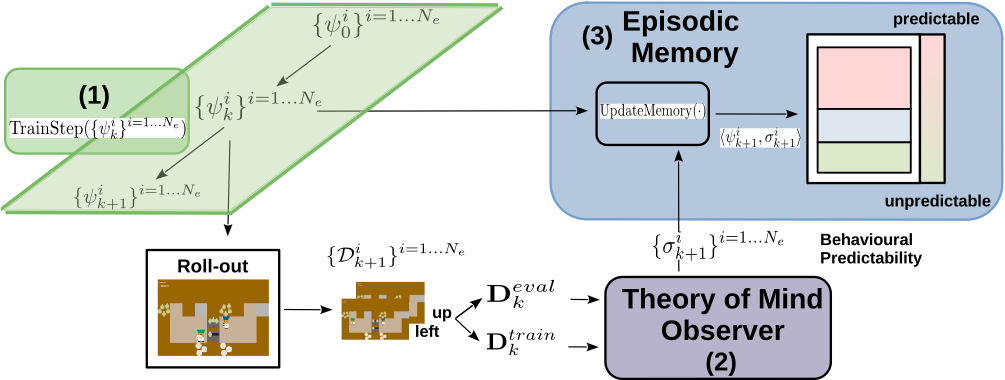
We propose an algorithm that alternates between training and selecting the training weights to construct the TrainingPool. This is done by a theory of mind model and episodic memory. Briefly, at each iteration, we update Ne weights and store them in the memory via LoBP-based updating mechanism. So, our episodic memory keeps growing until we have H agents. After this, we replace agents to keep the memory size as H. We continually train a ToM model f T oM θ (·) to predict the behaviour of policies on behavioural data collected from the population. Then, the behavioural predictability of each agent is computed based on comparing the prediction of the ToM model with the ground truth behaviour. Finally, we construct the episodic memory that uses
Algorithm 1: Constructing the Training Pool (Fig. 2)
Input : {ψi0 }i=1...Ne is the set of Ne randomly initialised weights; ToM Agent f ToM θ (·); M is the episodic memory; K is the number of iterations. Output: TrainingPool = {ψh}h=1...H with H is the number of collaborators in the training pool. 1 {Di0 }i=1...Ne ←Roll-out({ψi0 }i=1...Ne ) ; 2 Dtrain 0 ,Deval 0 ← {Di0 }i=1...Ne ; 3 {σi0 }i=1...Ne ←ToMEval(Deval 0 ) ; 4 M ← UpdateMemory(M, {⟨ψi0 , σi0 ⟩}i=1...Ne ) ; 5 for k ← 0 to K -1 do 6 Run the training procedure {ψik+1 }i=1...Ne ←TrainStep({ψik }i=1...Ne ) ; 7 // LoBP Assessment (4.2): 8 {Dik+1 }i=1...Ne ←Roll-out({ψik+1 }i=1...Ne ) ; 9 Dtrain k+1 ,Deval k+1 ← {Dik+1 }i=1...Ne ; 10 θk+1 ← ToMUpdate(f ToM θ (·), θk;Dtrain k+1 ) ; 11 {σik+1 }i=1...Ne ←ToMEval(Deval k+1 ) ; 12 // Update Episodic Memory (4.3): 13 UpdateMemory(M, {⟨ψik+1 , σik+1 ⟩}i=1...Ne ) ; 14 end 15 Collect all weights inMto the TrainingPool ; 16 return TrainingPoolthis information to collect the weights to the training pool. The proposed episodic memory stores pairs of the weight and its LoBP score.
The framework is shown in Fig. 1, and the overall algorithm is shown in Algo. 1. Details on the behavioural predictability and the ToM observer are presented in Section 4.2, and the episodic memory with its updating mechanism is introduced in Section 4.3.
4.2 Theory of Mind Observer and the Assessment of Behavioural Predictability
Behavioural Predictability
In this section, we will present how to compute the behavioural predictability of a policy, given information about the trajectories generated by this policy. This quantity is computed by a theory of mind observer, which is the model f T oM θ (·) parameterised by the weight θ. The ToM observer is trained to predict the actions and intentions of others. Given a weight ψik which represents the version k of the agent i in the pool, we collect the behavioural data Dik by rolling out the policy with respect to the weight ψik in the environment to get M trajectories, then query the prediction about the nextstep action and intention (˜at+1, ˜ gt+1) = f ToM θ (τt) from the theory of mind agent. The behavioural predictability of the policy with respect to the weight ψik is computed by
where
are the cross-entropy losses of the ToM model in predicting next-step primitive actions la and in predicting goals or intentions lg, respectively. Intuitively, if the trained observer does not predict well the behaviour generated by a policy (la or lg is high), then this policy can be considered as having a low behaviour predictability (σ is low), and vice versa.
According to our criterion, two arbitrary agents x and y with weights ψx and ψy , respectively, are considered as equal/similar in terms of LoBP if the gap between their predictability scores σx and σy is sufficiently small, i.e. |σx - σy | < δBP for a small δBP ∈ R+. We note that different approaches can be used to achieve diversity in behavioural predictability. One can build an agent model specifically for solving the task and use parameters to vary the predictability of agents in the pool. Due to simplicity, we propose to use episodic memory to promote LoBP diversity in Section 4.3.
Training the Theory of Mind Observer
In our approach, the ToM observer is continually trained along with the development of weights {ψik+1 }i=1...Ne . First, by rolling out policies with weights {ψik+1 }i=1...Ne in the environment, we collected the behavioural data {Dik+1 }i=1...Ne as shown in the 8th line of the Algo. 1. Second, this behavioural data obtained from the roll-out procedure {Dik+1 }i=1...Ne is divided into two sets Dtrain k+1 and Deval k+1 by a fixed ratio (Alg. 1, line 9th ). Finally, the ToM observer is trained on the training set Dtrain k+1 (ToMUpdate(·) in 10th of Alg. 1). It then computes the behavioural predictability σik on the evaluation set Deval k+1 (ToMEval(·) in line 11th of Alg. 1).
4.3 LoBP-based Episodic Memory
Design of LoBP-based Episodic Memory
We design the LoBP-based memory as an episodic memory M that contains H slots (equal the size of the TrainingPool) and is organised into B segments. Each slot stores a pair of weights and the behavioural predictability score ⟨ψ, σ⟩.We refer to this pair as the value of the memory slot, which can be updated, i.e. written or erased. Each segment S ∈ {S1, . . . , SB} contains several slots with a similar level of behavioural predictability as defined in Section 4.2. The number of segments B and the LoBP interval δBP are empirically chosen and fixed during the process.
Maintaining Diverse Level of Behaviour Predictability and Favouring Complex Behaviour
In this paper, we use a simple yet efficient mechanism to update the episodic memory and discard seen policies to guarantee a pool of agents with diversity in LoBP. The memory update mechanism, i.e. UpdateMemory(·) procedure, is described in Algo. 2. In detail, when a new policy with its behavioural predictability score, i.e. ⟨ψik , σik ⟩, comes to the update mechanism of the episodic memory, we will first erase the earliest memory value (making the slot empty) in the segment that has largest size (line 6th of Algo. 2), then write the weight and its predictability score ⟨ψik , σik ⟩ to the related segment. To guarantee there is no bias in the identity of the agent, we shuffle the agent set as in the 1st line of Algo. 2.
Algorithm 2: UpdateMemory
Input : {ψik }i=1...Ne is the set of Ne weights; M is the episodic memory. Output: M 1 for i in shuffle({1 . . .Ne}) do 2 ifMis not full then 3 M← ⟨ψik , σik ⟩ ; 4 else 5 Discard the earliest came value ⟨ψ, σ⟩f to the segment that has the maximum size Sm, i.e. ⟨ψ, σ⟩f ∈ Sm s.t. Sm = argmaxSj (|Sj|) where Sj ∈ {S1, . . . , SB} is the segment and |Sj| is the size of Sj; 6 M← ⟨ψik , σik ⟩ ; 7 end 8 end 9 return UpdatedMDiversity in the level of behavioural predictability. To exploit all the capacity of the memory, when the memory has not reached its limitation of size, we will write the pairs of the policy's weight and its behavioural predictability score ⟨ψik , σik ⟩ into a slot in corresponding segments without any selection. When the episodic memory is full, to maintain the diversity in the LoBP and avoid overloading, we erase one value of the slot in the segment with the maximum size and write to the corresponding segment. We recall from the previous section that each segment in the episodic memory contains weights with similar levels of behavioural predictability.
Favouring complex and meaningful behaviour. Because behaviour displayed in the late stage of training is often more complex and meaningful than in the early stage, the update mechanism will keep later samples and discard earlier samples frommemory. In other words, this mechanism results in first-in-first-out (FIFO) property for each segment.
5 Experiments
5.1 Experiment Setting
We conducted experiments on different scenarios of Overcooked which is a benchmark to assess the zero-shot coordination ability of the adaptive agents. In this game, there are two agents that need to collaborate to achieve a cooking task. The Overcooked game was first introduced to study the coordination of AI in [Carroll et al., 2019]. Each agent can take one action in the set of 6 actions A = {up, down, left, right, interact}. During one episode, agents try to deliver as many dishes as possible before the end of the episode, reaching an end after T = 400 timesteps. To make one dish, agents have to collect ingredients and put them into the pot to cook. After 20 time steps of cooking on the stove, the dish is ready and can be delivered to a counter located at a fixed place in the room. In our experiments, all scenarios (Asymmetric Advantages, Coordination Ring) have sparse rewards, i.e. the team reward is only given to agents at the delivery time (successfully achieving the task).
| FCP | TrajDiv | MEP | BDP | Our | Our (intent.) | |
|---|---|---|---|---|---|---|
| Asym. | 271.33 (23.88) | 251.714 (17.19) | 273.636 (19.92) | 278.484 (14.29) | 293.55 (10.77) | 298.824 (9.86) |
| Coord. | 103.444 (10.02) | 107.54 (9.075) | 111.9 (8.076) | 112.3 (16.537) | 120.87 (6.84) | 120.37 (4.34) |
| FCP | TrajDiv | MEP | BDP | Our | Our (intention) | |
|---|---|---|---|---|---|---|
| Onion and Delivery | 310.67 | 286.0 | 333.33 | 321.33 | 333.33 | 328.66 |
| Delivery | 307.33 | 346.0 | 216.67 | 318.00 | 346.0 | 322.0 |
| Onion Everywhere | 215.33 | 253.33 | 230.0 | 255.00 | 248.0 | 270.67 |
| avg. | 277.78 | 295.11 | 260.00 | 298.0 | 309.11 | 307.11 |
5.2 Baselines
We consider state-of-the-art baselines in two branches of approaches that employ the generative two-stage training framework. They are different in classes of training methods used in stage 1: (1) the self-play (SP) training and (2) the population-based training (PBT).
- SP training method: fictitious co-play (FCP) [Strouse et al., 2021] that used RL SP strategy to train and a rewardbased rule to select collaborators into the training pool.
- Population-based training method: (1) Trajectory Diversity (TrajDiv) [Lupu et al., 2021]; (2) Maximum entropy population-based training (MEP) [Zhao et al., 2023]; and (3) Behaviour diversity play (BDP) [Szot et al., 2023]. All three methods utilise PBT to develop the training pool but use different criteria for maintaining the diversity of the pool.
We consider two versions of our approaches where the LoBP score is only computed by action prediction, i.e. there is no lg in Eq. 1, and where both action and intention prediction are taken into account. To evaluate our approaches, we followed the literature on experimental designs. We first compare adaptive agents in cooperating with reinforcement learning agents that are developing via self-play procedure. We used different seeds to generate the pool of agents to train the agents used to evaluate the adaptive agents in the test phase. We then evaluate the coordination skill of adaptive agents with the scripted agents and the human proxies.
5.3 Cooperating with RL Agents
To evaluate the ability to cooperate with novel agents, we trained a new set of RL agents by self-play training. This set is trained with different seeds from the training process of SP agents in the FCP pool and our pool of agents. The new RL self-play agents used to evaluate the adaptive agents are randomly selected during SP training. Hence, although they shared the same training algorithm (RL self-play process), the sets of agents used in train (Ctrain) and test (Chold-out) are different. Our approach outperforms other baselines on this task. During SP training, the RL agents exhibit behaviours with diverse predictability while learning skills. Therefore, training by our approach helps social agents to adapt well to these behaviours. The performances when pairing adaptive agents with hold-out RL agents are shown in Table 1.
5.4 Cooperating with Scripted Agents
In this section, we constructed scripted agents that have high behaviour preferences. We considered interactions between the adaptive agent and three types of behaviour: (1) placing onion in pot and delivery when the soup is cooked; (2) delivery when the soup is cooked; and (3) putting onion everywhere. While the first two types of agents have meaningful behaviour, the third procedural agent's behaviour obstructs the team from achieving high performance. This type of useless predictable behaviour can appear in the RL selfplay training, however, they often in the early phase and will be discarded from the episodic memory due to the usefull predictable behaviour when the SP agents begin to learn nearoptimal behaviour. More visualisation of this phenomenon is shown in Fig. 4. The results are shown in Table 2.
5.5 Cooperating with Human Proxy Agents
General Human Proxy
We use the behaviour cloning method [Bain and Sammut, 1995] to train the policy πproxy that imitates the behaviour of humans in scenarios of Overcooked. These policies are referred to the human proxies. The human data used in our works are human interactions in experiments established in [Carroll et al., 2019]. The results are shown in Table 3 (performance of our method is higher and statistically significant different to performance of baselines with p < 0.05).
Specific Human Proxies
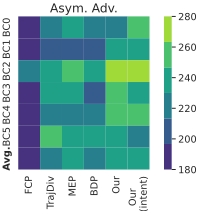
We also evaluate the adaptive agents on different human proxies. To construct different human proxies, we first metatrained a general proxy ¯πproxy on trajectories of 12 individuals. We then fine-tuned this ¯πproxy on trajectories of others 6 individuals to obtain the specific proxies for each of them {πproxy 0 , πproxy 1 , πproxy 2 , πproxy 3 , πproxy 4 , πproxy 5 }. This type of training is adopted from [Duan et al., 2017]. These policies are assumed to reflect the behaviour of individuals. The results are shown in Figure 3. Our approaches produce adaptive agents that gain higher team rewards on average when cooperating with these policies.
| FCP | TrajDiv | MEP | BDP | Our | Our (intent.) | |
|---|---|---|---|---|---|---|
| Asym. | 229.33 (24.02) | 231.862 (25.26) | 240.73 (23.66) | 254.6 (17.99) | 260.864 (14.54) | 276.796 (14.31) |
| Coord. | 88.466 (10.36) | 100.266 (11.69) | 103.934 (2.14) | 105.266 (13.33) | 102.8 (14.73) | 114.4 (15.00) |
FCP
Coord. Ring
TrajDiv MEP
BDP
Our Our
(intent)
| Low Perf. | High Perf. | |
|---|---|---|
| FCP | 12 | 12 (med) + 12 (high) |
| Our | 7 | 29 |
| Our (intent) | 5 | 31 |
Table 4: Comparison of portions in the pool of agents. Our method selects a small number of random agents than FCP.
5.6 Analysis of the Pool of Agents
Agents selected by Level of Behavioural Predictability
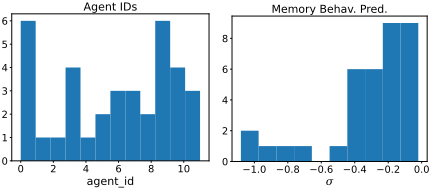
In this section, we analyse in detail the pool of agents that are generated by using the LoBP criteria. Fig. 4(a) shows that all SP agents were chosen to the training pool. Our training pool contains agents that are diverse in the level of behavioural predictability (Fig. 4(b)). To analyse the difference between the FCP pool and the LoPB-based pool, we divided the training process of the SP agents into three stages. The early stage is the period before the SP agent obtains half of the maximum training rewards. Following this stage are the middle and high stages where the SP agents obtain higher rewards. Table 4 shows that our pool mainly contains the weights of agents in the middle and high stages of training, i.e. the number of high-performance and meaningful in our pool is higher than the FCP pool. This helps the adaptive agents focus more on learning to cooperate with the agents that deliver complex behaviour instead of random behaviour often appearing in the early training phase. To further discussion, training good ToM observer can improve the efficiency of our approach, i.e. the ability of the ToM observer also affects to the settings where there are more agents or complex environment.
Pure Pools Comparison
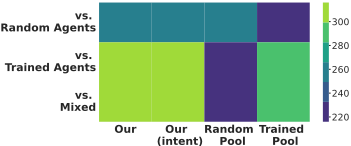
We further compared our pool with two other pools: Init Pool, in which all agents act unpredictably, and Final Pool, in which all agents are well-trained. The results are shown in Fig. 5. We evaluate adaptive agents on three sets: (1) a set of random agents (Fig. 5 (1st row)), a set of trained agents (Fig. 5 (2nd row)), and a mix of different reinforcement learning agents during self-play training (Fig. 5 (3rd row)). There is a contrast between the performance of adaptive agents trained on a random pool and the trained pool because they focus on different types of collaborators. The adaptive agent trained with only pool that have unpredictable behaviour behaves worst. Our adaptive agents obtained better results when paired with trained and mixed agents, and better performance than the adaptive agent trained on a well-trained pool when paired with random agents.
6 Conclusions
In this paper, we tackle the ZSC by the generative training framework, in which a pool of agents is auto-generated in the first stage and the adaptive agent is trained to cooperate with agents in this pool to achieve the task in the second stage. We focus on the first stage and propose to use a novel way to promote the diversity of the training pool using the levels of behavioural predictability. To realise the concept, we design a ToM observer equipped with a episodic memory to monitor the pool generation process. We demonstrated that agents trained to cooperate with this training pool can better adapt to novel partner meaning they are more robust and trustworthy compared to diversity based methods.
BC0
BC1
BC2
BC3
BC4
BC5
Avg.
100
80
60
40
Acknowledgements
This research was partially funded by the Australian Government through the Australian Research Council's Discovery Project funding scheme (project DP210102798). The views expressed herein are those of authors and are not necessarily those of the Australian Government or Australian Research Council.
@inproceedings{ijcai2024p19,
  title     = {Diversifying Training Pool Predictability for Zero-shot Coordination: A Theory of Mind Approach},
  author    = {Nguyen, Dung and Le, Hung and Do, Kien and Gupta, Sunil and Venkatesh, Svetha and Tran, Truyen},
  booktitle = {Proceedings of the Thirty-Third International Joint Conference on
               Artificial Intelligence, {IJCAI-24}},
  publisher = {International Joint Conferences on Artificial Intelligence Organization},
  editor    = {Kate Larson},
  pages     = {166--174},
  year      = {2024},
  month     = {8},
  note      = {Main Track},
  doi       = {10.24963/ijcai.2024/19},
  url       = {https://doi.org/10.24963/ijcai.2024/19},
}
TY - CPAPER TI - Diversifying Training Pool Predictability for Zero-shot Coordination: A Theory of Mind Approach AU - Nguyen, Dung AU - Le, Hung AU - Do, Kien AU - Gupta, Sunil AU - Venkatesh, Svetha AU - Tran, Truyen T2 - Proceedings of the Thirty-Third International Joint Conference on Artificial Intelligence, IJCAI-24 PB - International Joint Conferences on Artificial Intelligence Organization PY - 2024 SP - 166 EP - 174 DO - 10.24963/ijcai.2024/19 UR - https://doi.org/10.24963/ijcai.2024/19 ER -Copied
Machine-readable versions of this paper, for tools and AI agents:





