
Counterfactual User Sequence Synthesis Augmented with Continuous Time Dynamic Preference Modeling for Sequential POI Recommendation
Proceedings of the Thirty-Third International Joint Conference on Artificial Intelligence. Main Track. Pages 2306-2314.
https://doi.org/10.24963/ijcai.2024/255
Keywords
- Data Mining: DM: Recommender systems
Abstract
With the proliferation of Location-based Social Networks (LBSNs), user check-in data at Points-of-Interest (POIs) has surged, offering rich insights into user preferences. However, sequential POI recommendation systems always face two pivotal challenges. A challenge lies in the difficulty of modeling time in a discrete space, which fails to accurately capture the dynamic nature of user preferences. Another challenge is the inherent sparsity and noise in continuous POI recommendation, which hinder the recommendation process. To address these challenges, we propose counterfactual user sequence synthesis with continuous time dynamic preference modeling (CussCtpm). CussCtpm innovatively combines Gated Recurrent Unit (GRU) with neural Ordinary Differential Equations (ODEs) to model user preferences in a continuous time framework. CussCtpm captures user preferences at both the POI-level and interest-level, identifying deterministic and non-deterministic preference concepts. Particularly at the interest-level, we employ GRU and neural ODEs to model users' dynamic preferences in continuous space, aiming to capture finer-grained shifts in user preferences over time. Furthermore, CussCtpm utilizes counterfactual data augmentation to generate counterfactual positive and negative user sequences. Our extensive experiments on two widely-used public datasets demonstrate that CussCtpm outperforms several advanced baseline models.
- [Ahnert and Mulansky, 2011] Karsten Ahnert and Mario Mulansky. Odeint-solving ordinary differential equation- s in c++. In AIP Conference Proceedings, volume 1389, pages 1586-1589. American Institute of Physics, 2011.
- [Bian et al., 2023] Qingtian Bian, Jiaxing Xu, Hui Fang, and Yiping Ke. Cpmr: Context-aware incremental sequential recommendation with pseudo-multi-task learning. In Pro- ceedings of the 32nd ACM International Conference on In- formation and Knowledge Management, pages 120-130, 2023.
- [Cai et al., 2013] Yi Cai, Ho-fung Leung, Qing Li, Huaqing Min, Jie Tang, and Juanzi Li. Typicality-based collab- orative filtering recommendation. IEEE Transactions on Knowledge and Data Engineering, 26(3):766-779, 2013.
- [Chen and Wong, 2020] Tianwen Chen and Raymond Chi- Wing Wong. Handling information loss of graph neural networks for session-based recommendation. In Proceed- ings of the 26th ACM SIGKDD International Conference on Knowledge Discovery & Data Mining, pages 1172- 1180, 2020.
- [Chen et al., 2018] Ricky TQ Chen, Yulia Rubanova, Jesse Bettencourt, and David K Duvenaud. Neural ordinary d- ifferential equations. Advances in neural information pro- cessing systems, 31, 2018.
- [Chung et al., 2014] Junyoung Chung, C ¸aglar Gülc ¸ehre, KyungHyun Cho, and Yoshua Bengio. Empirical evalua- tion of gated recurrent neural networks on sequence mod- eling. CoRR, abs/1412.3555, 2014.
- [Clark et al., 2020] Kevin Clark, Minh-Thang Luong, Quoc V Le, and Christopher D Manning. Electra: Pre-training text encoders as discriminators rather than generators. ICLR, pages 26-30, 2020.
- [Devarajan et al., 2019] Malathi Devarajan, N Sabiyath Fa- tima, Subramaniyaswamy Vairavasundaram, and Logesh Ravi. Swarm intelligence clustering ensemble based point of interest recommendation for social cyber-physical sys- tems. Journal of Intelligent & Fuzzy Systems, 36(5):4349- 4360, 2019.
- [Gu et al., 2022] Shuyun Gu, Xiao Wang, Chuan Shi, and D- ing Xiao. Self-supervised graph neural networks for multi- behavior recommendation. In IJCAI, pages 2052-2058, 2022.
- [Gupta et al., 2019] Priyanka Gupta, Diksha Garg, Panka- j Malhotra, Lovekesh Vig, and Gautam M. Shroff. Nis- er: Normalized item and session representations to handle popularity bias. arXiv: Information Retrieval, 2019.
- [Hochreiter and Schmidhuber, 1997] Sepp Hochreiter and Jürgen Schmidhuber. Long short-term memory. Neural computation, 9(8):1735-1780, 1997.
- [Horozov et al., 2006] Tzvetan Horozov, Nitya Narasimhan, and Venu Vasudevan. Using location for personalized poi recommendations in mobile environments. In Interna- tional Symposium on Applications and the Internet (SAIN- T'06), pages 124-129. IEEE Computer Society, 2006.
- [Islam et al., 2022] Md Ashraful Islam, Mir Mahathir Mo- hammad, Sarkar Snigdha Sarathi Das, and Mohammed E- unus Ali. A survey on deep learning based point- of-interest (poi) recommendations. Neurocomputing, 472:306-325, 2022.
- [Kumar et al., 2024] Akshi Kumar, Deepak Kumar Jain, Ab- hishek Mallik, and Sanjay Kumar. Modified node2vec and attention based fusion framework for next poi recommen- dation. Information Fusion, 101:101998, 2024.
- [Lim et al., 2020] Nicholas Lim, Bryan Hooi, See-Kiong Ng, Xueou Wang, Yong Liang Goh, Renrong Weng, and Jagannadan Varadarajan. Stp-udgat: Spatial-temporal- preference user dimensional graph attention network for next poi recommendation. In CIKM, pages 845-854, 2020.
- [Lim et al., 2022] Nicholas Lim, Bryan Hooi, See-Kiong Ng, Yong Liang Goh, Renrong Weng, and Rui Tan. Hi- erarchical multi-task graph recurrent network for next poi recommendation. In SIGIR, pages 1133-1143, 2022.
- [Liu et al., 2020] Dugang Liu, Pengxiang Cheng, Zhenhua Dong, Xiuqiang He, Weike Pan, and Zhong Ming. A general knowledge distillation framework for counterfac- tual recommendation via uniform data. In Proceedings of the 43rd International ACM SIGIR Conference on Re- search and Development in Information Retrieval, pages 831-840, 2020.
- [Liu et al., 2021] Yuwen Liu, Aixiang Pei, Fan Wang, Y- ihong Yang, Xuyun Zhang, Hao Wang, Hongning Dai, Lianyong Qi, and Rui Ma. An attention-based category- aware gru model for the next poi recommendation. Inter- national Journal of Intelligent Systems, 36(7):3174-3189, 2021.
- [Liu et al., 2022] Yuwen Liu, Huiping Wu, Khosro Rezaee, Mohammad R Khosravi, Osamah Ibrahim Khalaf, Arif Ali Khan, Dharavath Ramesh, and Lianyong Qi. Interaction- enhanced and time-aware graph convolutional network for successive point-of-interest recommendation in traveling enterprises. IEEE Transactions on Industrial Informatics, 19(1):635-643, 2022.
- [Liu et al., 2023a] Weiming Liu, Xiaolin Zheng, Chaochao Chen, Jiajie Su, Xinting Liao, Mengling Hu, and Yanchao Tan. Joint internal multi-interest exploration and external domain alignment for cross domain sequential recommen- dation. In WWW, pages 383-394, 2023.
- [Liu et al., 2023b] Weiming Liu, Xiaolin Zheng, Jiajie Su, Longfei Zheng, Chaochao Chen, and Mengling Hu. Con- trastive proxy kernel stein path alignment for cross-domain cold-start recommendation. IEEE Transactions on Knowl- edge and Data Engineering, 35(11):11216-11230, 2023.
- [Liu et al., 2023c] Yuwen Liu, Xiaokang Zhou, Huaizhen K- ou, Yawu Zhao, Xiaolong Xu, Xuyun Zhang, and Liany- ong Qi. Privacy-preserving point-of-interest recommen- dation based on simplified graph convolutional network for geological traveling. ACM Trans. Intell. Syst. Technol., 2023.
- [Manotumruksa et al., 2018] Jarana Manotumruksa, Craig Macdonald, and Iadh Ounis. A contextual attention re- current architecture for context-aware venue recommen- dation. In The 41st international ACM SIGIR conference on research & development in information retrieval, pages 555-564, 2018.
- [Passino et al., 2021] Francesco Sanna Passino, Lucas Maystre, Dmitrii Moor, Ashton Anderson, and Mounia Lalmas. Where to next? a dynamic model of user preferences. WWW, 21:19-23, 2021.
- [Qi et al., 2022] Lianyong Qi, Yuwen Liu, Yulan Zhang, Xiaolong Xu, Muhammad Bilal, and Houbing Song. Privacy-aware point-of-interest category recommendation in internet of things. IEEE Internet of Things Journal, 9(21):21398-21408, 2022.
- [Rahmani et al., 2019] Hossein A Rahmani, Mohammad Aliannejadi, Rasoul Mirzaei Zadeh, Mitra Baratchi, Mohsen Afsharchi, and Fabio Crestani. Category-aware location embedding for point-of-interest recommendation. In SIGIR, pages 173-176, 2019.
- [Rahmani et al., 2022] Hossein A Rahmani, Mohammadme- hdi Naghiaei, Ali Tourani, and Yashar Deldjoo. Exploring the impact of temporal bias in point-of-interest recommen- dation. In RecSys, pages 598-603, 2022.
- [Rendle et al., 2009] Steffen Rendle, Christoph Freuden- thaler, Zeno Gantner, and Lars Schmidt-Thieme. Bpr: Bayesian personalized ranking from implicit feedback. In Proceedings of the Twenty-Fifth Conference on Uncertain- ty in Artificial Intelligence, page 452-461, 2009.
- [Saito and Joachims, 2021] Yuta Saito and Thorsten Joachims. Counterfactual learning and evaluation for recommender systems: Foundations, implementations, and recent advances. In Proceedings of the 15th ACM Conference on Recommender Systems, pages 828-830, 2021.
- [Singla et al., 2023] Sumedha Singla, Nihal Murali, For- ough Arabshahi, Sofia Triantafyllou, and Kayhan Bat- manghelich. Augmentation by counterfactual explanation- fixing an overconfident classifier. In Proceedings of the IEEE/CVF Winter Conference on Applications of Comput- er Vision, pages 4720-4730, 2023.
- [Tan et al., 2021] Haining Tan, Di Yao, Tao Huang, Baoli Wang, Quanliang Jing, and Jingping Bi. Meta-learning en- hanced neural ode for citywide next poi recommendation. In MDM, pages 89-98. IEEE, 2021.
- [Wang et al., 2019] Xiang Wang, Xiangnan He, Meng Wang, Fuli Feng, and Tat-Seng Chua. Neural graph col- laborative filtering. In SIGIR, pages 165-174, 2019.
- [Wang et al., 2020] Ziyang Wang, Wei Wei, Gao Cong, Xiao-Li Li, Xian-Ling Mao, and Minghui Qiu. Global context enhanced graph neural networks for session-based recommendation. In SIGIR, pages 169-178, 2020.
- [Wang et al., 2021a] Wenjie Wang, Fuli Feng, Xiangnan He, Liqiang Nie, and Tat-Seng Chua. Denoising implicit feed- back for recommendation. In Proceedings of the 14th ACM international conference on web search and data mining, pages 373-381, 2021.
- [Wang et al., 2021b] Zhenlei Wang, Jingsen Zhang, Hongteng Xu, Xu Chen, Yongfeng Zhang, Wayne Xin Zhao, and Ji-Rong Wen. Counterfactual data-augmented sequential recommendation. In Proceedings of the 44th international ACM SIGIR conference on research and development in information retrieval, pages 347-356, 2021.
- [Wu et al., 2019] Shu Wu, Yuyuan Tang, Yanqiao Zhu, Liang Wang, Xing Xie, and Tieniu Tan. Session-based recommendation with graph neural networks. In AAAI, volume 33, pages 346-353, 2019.
- [Yang et al., 2013] Dingqi Yang, Daqing Zhang, Zhiyong Yu, and Zhu Wang. A sentiment-enhanced personal- ized location recommendation system. In Proceedings of the 24th ACM conference on hypertext and social media, pages 119-128, 2013.
- [Yang et al., 2021] Mengyue Yang, Quanyu Dai, Zhenhua Dong, Xu Chen, Xiuqiang He, and Jun Wang. Top-n rec- ommendation with counterfactual user preference simula- tion. In Proceedings of the 30th ACM International Con- ference on Information & Knowledge Management, pages 2342-2351, 2021.
- [Zhang et al., 2021] Shengyu Zhang, Dong Yao, Zhou Zhao, Tat-Seng Chua, and Fei Wu. Causerec: Counterfactual us- er sequence synthesis for sequential recommendation. In Proceedings of the 44th International ACM SIGIR Con- ference on Research and Development in Information Re- trieval, pages 367-377, 2021.
- [Zhao et al., 2020] Guoshuai Zhao, Peiliang Lou, Xueming Qian, and Xingsong Hou. Personalized location rec- ommendation by fusing sentimental and spatial context. Knowledge-Based Systems, 196:105849, 2020.
References were extracted automatically from the PDF and may contain errors.
Full text extracted automatically from the PDF; figures, tables and equations may differ. The PDF is the version of record.
1 Introduction
With the widespread adoption of Location-based Social Networks (LBSNs), an increasing number of users are engaging in checking in for their favorite Points-of-Interest (POIs) on LBSNs. This trend, representing a significant shift in how individuals interact with their environment, has led to an exponential increase in user check-in data. Such data not only offers insights into users' preferences and behaviors but also provides a unique opportunity to enhance user engagement through tailored experiences [Islam et al., 2022]. While there have been many works in the field of POI recommendations, early efforts [Horozov et al., 2006; Devarajan et al., 2019] primarily focus on the interactions between users and POIs without considering the temporal effect of user check-ins. Temporal information undeniably plays a crucial role in influencing user check-ins. Recent advances [Lim et al., 2022; Lim et al., 2020] have explored sequential POI recommendations considering the impact of time. These advances have attempted to predict users' subsequent check-ins based on their historical interactions with POIs.
Despite these advancements, sequential POI recommendation still faces numerous challenges. An important challenge (C1) lies in the difficulty of modeling time in a discrete space, which fails to accurately capture the dynamic nature of user preferences. Although many studies [Rahmani et al., 2022; Kumar et al., 2024] regard time as an important factor affecting user check-in and consider time factors in their studies, these studies have all modeled time in a discrete space. However, user preferences towards certain POIs change over time. For example, a user's preference for a supermarket may decrease with increased waiting time. Time modeling in discrete space cannot reflect the fine-grained continuous preference changes of users, but modeling in continuous space can solve this problem. This represents a unique and significant issue in sequential POI recommendation, which is different from other recommendation systems. Another persistent challenge (C2) is the sparsity issue inherent in sequential POI recommendations. The vast number of users and POIs inevitably leads to sparse interactions, which is a fundamental issue that cannot be overlooked [Liu et al., 2023b]. The additional challenge (C3) is the noise in POI recommendations, arising from extrinsic factors, further complicates the scenario. Users might check in at POIs that do not genuinely reflect their preferences, influenced by external factors like restaurant promotions or social events. Some works alleviate the above challenges by using adaptive denoising techniques [Wang et al., 2021a] and contrastive learning techniques [Gu et al., 2022]. However, the sparsity and noise has been the challenge that is difficult to ignore in recommendations.
We propose an approach that augments Counterfactual User Sequence Synthesis with Continuous Time Dynamic Preference Modeling for sequential POI Recommendation, abbreviated as CussCtpm. To tackle the challenge (C1) of modeling dynamic user preferences and capture the precise user preferences in a continuous space, we utilize GRU to model the evolving nature of user preferences and then employ neural Ordinary Differential Equations (ODEs) [Chen et al., 2018] to transition the modeling of user time preferences from a discrete space to a continuous space. To mitigate the issues of sparsity (C2) and noise (C3), we use counterfactual data to enhance the learning of user sequences. Specifically, we define two concepts: the deterministic preference, which represents a user's inherent likes, and the non-deterministic preference, which depicts less favored interests. By substituting the fine-grained POI-level or abstract interest-level of these deterministic and non-deterministic preferences, we achieve counterfactual transformations. Subsequently, by using contrastive learning, we capture the representations that more accurately reflect the user's true preferences. Our primary contributions are summarized as follows:
- We propose the transition of dynamic preference modeling from a discrete to a continuous space, utilizing ODEs to capture the continuous evolution of user preferences.
- We leverage counterfactual data to alleviate the negative impacts of data sparsity and noise, refining the representation of user preferences by substituting deterministic and non-deterministic preferences.
- We conduct extensive experiments on two public POI datasets, demonstrating the superiority of CussCtpm.
2 RelatedWork
2.1 Sequential POI Recommendation
Early works use collaborative filtering method [Cai et al., 2013] to make POI recommendations based on user location information [Zhao et al., 2020] or POI category data [Rahmani et al., 2019]. However, these methods overlook the temporal aspect of user check-ins. Subsequent research begins to capture the time effects within user check-in sequences using Long Short-Term Memory (LSTM) [Hochreiter and Schmidhuber, 1997] and Gated Recurrent Unit (GRU) [Chung et al., 2014; Qi et al., 2022]. Another effort [Manotumruksa et al.,
2018] utilizes an attention mechanism combined with GRU to capture the dynamic preferences of users by leveraging feedback sequences and associated contextual information. In addition, Liu et al. [Liu et al., 2022] apply graph convolutional models to POI recommendations, thereby extracting user preference embedded within higher-order connectivity. However, despite these advances in incorporating time information into recommendation systems, a key limitation still exists: discrete spatial modeling of time effects. This limitation hinders the extraction of fine-grained changes in user preferences, which is also the challenge that our research aims to address.
The exploration of user dynamic preferences has been a key area of sequential POI recommendations. To enhance the recommendation performance, many advances [Tan et al., 2021; Liu et al., 2023a; Bian et al., 2023] have conducted extensive research on capturing user dynamic preferences. A recent effort [Passino et al., 2021] proposes a dynamic model for user preferences towards item categories. This model can estimate the probability of transitions between item categories over time, thereby predicting user preferences. Furthermore, the use of ODEs for modeling user preferences in a continuous space enables the fine-grained capture of shifts in user preferences. A study [Tan et al., 2021] leverages meta-learning enhanced neural ODEs to extract dynamic user preferences. Similarly, a work [Bian et al., 2023] defines the ODEs for the history graph and context graph to track the dynamic changes in user preferences. Therefore, we can use ODEs to model the continuous preferences of users, which can capture the authentic changes in their preferences and provide better recommendations.
2.2 Counterfactual Data Augmentation
Counterfactual data augmentation is commonly used to alleviate data scarcity issues and has been successfully applied in various fields such as computer vision [Singla et al., 2023]. However, its application in recommendation systems is underexplored. A recent study [Yang et al., 2021] applies counterfactual data augmentation in Top-N recommendation systems. Similarly, subsequent research [Saito and Joachims, 2021; Liu et al., 2020] predominantly aims to reduce bias in learning-level problems. To alleviate the impact of adverse data in the sequential recommendation, an attempt [Wang et al., 2021b] employs sampler and anchor models for heuristic intervention during model training. A work [Zhang et al., 2021] applies counterfactual data augmentation in the recommendation field, utilizing counterfactual user sequence synthesis to alleviate the noise and sparsity issues.
3 Preliminaries
3.1 ProblemDefinition
Let U = {u1, u2, ..., u|U|} denote the set of users, and P = {p1, p2, ..., p|P|} denote the set of POIs, where |U| and |P| represent the total number of users and POIs, respectively. Each user u ∈ U is associated with a sequence of interactions with POIs over time. We denote the sequence of historical interactions for user u as Su = {p1, p2, ..., pt-1}, where pt-1 ∈ P represents the POI interacted with, and t denotes the corresponding timestamp of interaction.
Given the check-in sequence of a user up to time t -1, our goal is to predict the POI that he/she probably visit at time t. Formally, the prediction target for user u at time t is denoted as gu = pt, and the prediction task is formulated in (1):
where ˆ pt is the predicted POI, Pr(p|Su, t; ϵ) is the probability of visiting POI p given the historical sequence Su and time t, parameterized by ϵ.
3.2 Counterfactual Transformation
In the counterfactual transformation process, we apply artificial interventions to change certain preferences of users to observe variations in their behavior. This process is achieved by replacing deterministic and non-deterministic preferences of users. We define the two concepts as follows:
Deterministic Preference. Deterministic preference refers to actions that are crucial to users' interest representation. These preferences reflect the core interests of the user and are not arbitrarily replaceable.
Non-Deterministic Preference. Non-deterministic preference represents actions that are irrelevant to the user's core interests and may even constitute noise. They are less important for representing users' true interests.
3.3 Neural ODE for Modeling Continuous Dynamics
Neural ODE [Chen et al., 2018] offers a principled framework for modeling the evolution of systems over continuous time. In user preference modeling, ODE enables us to capture the dynamic nature of user behavior as it unfolds through time. An ODE is a mathematical equation that describes the relationship between a function and its derivatives, representing the rate of change of the function with respect to an independent variable, typically time in our task. Formally, an ODE for a function h(t) can be expressed as:
where h(t) denotes the state of the system at time t, dh(t) dt is the derivative of h(t) with respect to time, and f is a function parameterized by Θ.
Incorporating ODE into our model necessitates the accurate integration of the user preference state over time. Given an initial state h(t0), we can derive the state at any later time T using a black-box differential equation solver defined as:
where the integral computes the accumulation of changes in preferences from the initial time t0 to any given time T .
The use of an ODE solver in our model is formalized as:
where odeint(·) denotes the black-box ODE solver [Ahnert and Mulansky, 2011], and hcontinuous(T) is the state of user preferences at time T. The solver provides a differentiable operation that is integrated with the automatic differentiation capabilities of deep learning frameworks, allowing for endto-end learning of the parameters Θ through gradient descent.
4 The ProposedMethod
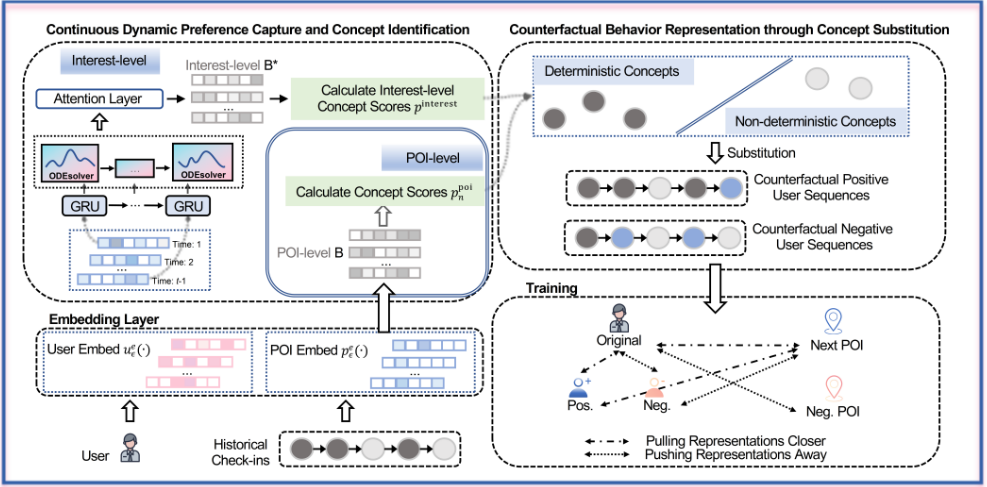
The proposed CussCtpm framework is divided into two main components: continuous dynamic preference capture and concept identification, counterfactual behavior representation. The framework is schematically shown in Figure 1.
4.1 Continuous Dynamic Preference Capture and Concept Identification
POI-level Concepts
Inspired by a recent work [Zhang et al., 2021], we consider each POI within a behavior sequence as an independent POI-level concept, with each POI possessing its unique finegrained characteristics. Next, in order to encode the user's behavioral sequence, we utilize B = peϵ (Su,1:t) as the encoded representation of the concept sequence, where S = peϵ (Su,1:t) denotes the representations of the behavior sequence and S ∈ Rt×d where d denotes the dimension of each representation. Here, peϵ (·) is the POI encoder, and (Su,1:t) represents the complete check-in sequence of the user. The concept score at the POI level, reflecting the importance of a concept in representing user interests, is computed as follows:
where bn denotes the concept vector for the n-th POI, and gu is the embedding of the target POI for user u, sim(·) is a similarity function calculated by inner product.
Interest-level Concepts
Solely utilizing POI-level representations may lead to redundancy in concepts due to the possibility of shared semantics across POIs. To overcome this, we introduce interestlevel concepts by capturing the continuous dynamic preferences of users. This process involves identifying deterministic and non-deterministic preference concepts at a more abstract level. We use GRU to capture short-term and longterm preferences containing user interests. This is mainly achieved through the gate structure in GRU, defined by ht = GRU(ht-1, pt). The details are defined as:
where rt and zt correspond to the reset and update gates, respectively, while ˜ht represents the candidate activation, and ht represents the final state of GRU. pt is the embedding of a POI at the present timestep t, and ht-1 is the hidden state of the preceding timestep t - 1. The parameters {Wr, Ur, Wz, Uz, Wh, Uh} are the trainable matrices, {br, bz, bh} are biases. The sigmoid activation function is symbolized by σ, and the Hadamard product is denoted by ⊙.
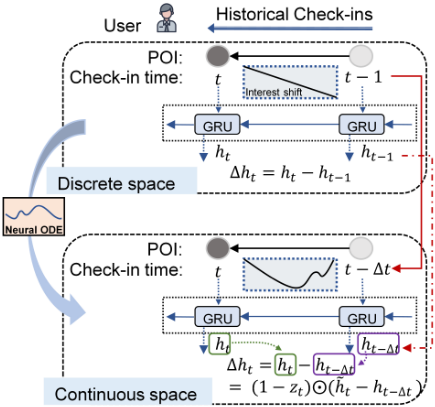
Other works [Manotumruksa et al., 2018; Liu et al., 2021] utilize GRU and combine attention mechanisms when capturing users' dynamic preferences. Although such methods can capture user preferences, they still model user preferences in a discrete space. Modeling in discrete space is unable to capture fine-grained user preferences. Here, we use neural ODEs to map users' dynamic preferences from discrete space to continuous space, as shown in Figure 2 for a specific example. Here, it is assumed that the user's preference for POIs is relatively constant in discrete space, whereas the user's preference for POIs alternates between decreasing/increasing in continuous space. Our goal is to model user preferences within a continuous domain, hence we evolve from the discrete time step at t - 1 in our original domain, projecting it onto a continuous span represented by t -∆t within our destination domain. Through this transition, the difference of the GRU's outputs, denoted by ∆ht, are utilized to formulate a differential equation as follows:
This difference equation naturally leads to the following ODE for h(t) when ∆t → 0:
Through GRU and the subsequent transformation into continuous time representations via ODE, our model employs an attention mechanism to further refine user interest representations. The interest-level concepts are then extracted to weigh the importance of different points in the sequence as follows:
where H is the vectorial representations of the behavior sequence containing dynamic preferences, W1 and W2 are trainable parameters, α is the attention score by an additive model, and tanh(·) represents hyperbolic tangent function. Then we can obtain the concept sequence as follows:
Given that the interest-level concepts and target POI are not naturally embedded in the same space, we calculate the concept score using a weighted sum at the POI-level.
Finally, we obtain the POI-level concepts and the interestlevel concepts, respectively. Subsequently, it is necessary to distinguish the importance of these concepts. Consistent with the approach in [Zhang et al., 2021], we categorize the top 50% of the scores from the POI-level ratings ppoi n and interestlevel ratings pinterest as deterministic preferences, while the rest are classified as non-deterministic preferences. This selection ensures a balanced proportion between deterministic and non-deterministic preferences in our analysis.
4.2 Counterfactual Behavior Representation
If we replace the deterministic preferences in the user sequence, the core interests and preferred POIs of the user will be changed by which the sequence becomes a counterfactual negative user sequence. On the contrary, if the non-deterministic preferences in the user sequence are replaced, the new sequence will still be semantically similar to the original sequence, and the new sequence will become a counterfactual positive user sequence. Here, we set a fixed replacement ratio γ as the proportion of deterministic and non-deterministic concepts that are substituted to create these counterfactual sequences. To facilitate the concept substitution process, we employ a First-In-First-Out (FIFO) queue as a concept memory bank at each level. This queue serves as a repository for concepts extracted from the current mini-batch, which are enqueued for subsequent use. By employing this FIFO queue mechanism, we effectively maintain the overall sequence length and the relative positions of the remaining concepts, which is critical for preserving the structural integrity of the user sequence.
Inspired by [Zhang et al., 2021; Clark et al., 2020], we consider the contrast between counterfactual sequences and observation. A robust user representation should exhibit minimal sensitivity to non-deterministic preference concepts, while an accurate representation should rely more on deterministic preference concepts. To achieve this, we use triplet margin loss to measure the relative similarity between the representations derived from the original and counterfactual sequences. The loss function for this contrast is given by:
where u, u+y , u-x represent the true representation of the user, counterfactual positive user representation, and counterfactual negative user representation from counterfactual POI-level concept sequences, respectively. Additionally, x and y denote the number of generated counterfactual negative users and counterfactual positive users, respectively. We choose the L2 distance as the distance function d(·), and empirically set the margin ∆c1 = 1.
The aforementioned goal focuses exclusively on user representation. We also incorporate the target POI which contributes to refining user representation learning.
Here, ˆp denote the target POI, the margin ∆c2 is set to 0.5.
4.3 Optimization
To enhance the accuracy and robustness of user representations, our model employs contrastive learning. This approach is pivotal for training the model, as it emphasizes the relationships between different types of users. We first define the primary loss function for our model training:
Here, ψθ(·) denotes cosine similarity, p′t denotes all possible POIs that may be accessed, V = {(Sum , gum )|um ∈ U} denotes the user's historical interaction behaviors, and θ denotes the corresponding trainable parameters.
Combining the above components, the overall loss function for our model is given by:
where λ and η are weighting parameters that balance the contributions of contrastive objectives to total loss.
5 Experiments
In this section, we have conducted extensive experiments on real-world datasets, and analyzed the performance of the proposed CussCtpm by addressing the following questions:
- RQ1: Can our proposed CussCtpm outperform the baselines for sequential POI recommendation?
- RQ2: How does the continuous time dynamic preference modeling in CussCtpm affect model performance?
- RQ3: How to demonstrate the effectiveness of synthesizing counterfactual user sequences?
- RQ4: How is the performance of CussCtpm affected by different parameter settings?
5.1 Experimental Settings
Datasets and Metrics. We utilize real-world check-in datasets: NYC and TKY collected from Foursquare. These datasets [Yang et al., 2013] encompass user check-in details. We consider POIs with less than 5 check-ins as outliers and delete them. For evaluation metrics, we employ Mean Reciprocal Rank (MRR) and Hit Rate (HIT). MRR can quantify the accuracy of the top-ranked recommendations and emphasize the importance of placing truly relevant POIs at the forefront. HIT can evaluate the overall effectiveness of our POI recommendation system, reflecting how frequently our proposed POIs align with users' genuine preferences. Recommendation number Top-K candidates are 5, 10, 20.
Baselines. Our experimental study compares CussCtpm with a series of methods, including traditional methods like BPR [Rendle et al., 2009], contemporary GNN-based methods such as LESSR [Chen and Wong, 2020], SR-GNN [Wu et al., 2019], GCE-GNN [Wang et al., 2020], NISER [Gupta et al., 2019], simplified GCN-based methods such as NGCF [Wang et al., 2019], PriGCN [Liu et al., 2023c], and the time-aware method such as ITGCN [Liu et al., 2022].
5.2 Results and Discussion (RQ1)
Our experiment compares CussCtpm with a series of methods. The comparison results are summarized in Table 1. From Table 1, we can observe that our method is overall superior to other methods and achieves good performance improvement. The traditional method BPR is greatly affected by the dataset and performs poorly on the NYC dataset, but ensures good performance on the TKY dataset. This may be because BPR does have personalized sorting capabilities, but its universality needs to be improved. The GNN-based methods, capable of capturing high-order user-POI connectivity, are yet hindered by data sparsity and noise, as evidenced by GCE-GNN's performance on NYC. Compared with simplified GCN-based methods, these models omit some unnecessary structures in the graph, such as activation functions and transformation matrices. These methods have improved training speed, but have not overcome the effects of sparsity and noise. Considering the influence of time, ITGCNmodels can capture the dynamic preferences of users in discrete space. However, user preferences are constantly changing over time, while ITGCN can not consider this influencing factor. In contrast, CussCtpm excels in addressing these challenges by integrating continuous-time dynamic preference modeling and counterfactual user sequence synthesis. This approach not only captures the evolving nature of user preferences in a more granular manner but also effectively mitigates issues arising from sparse data and extrinsic noise.
5.3 Impact of Capturing User Preferences Dynamically (RQ2)
We evaluate the impact of continuous time dynamic preference modeling on the performance of CussCtpm. We create a variant of our model, CussCtpm-t, which omits the integration of GRU with Neural ODE for capturing the dynamic preferences of users, relying solely on attention mechanisms for preference capture. The comparative analysis of CussCtpm and its variant CussCtpm-t is summarized in Table 2. The results indicate a noticeable decline in recommendation performance when the dynamic preference capture component is excluded. Specifically, CussCtpm-t exhibits lower MRR and HIT scores compared to the complete CussCtpm model. These findings underscore the significance of capturing user preferences dynamically, leveraging the synergy between GRU and neural ODE.
5.4 Impact of Aggregation Strategy (RQ3)
We experiment with three variations of our model: CussCtpm-n (without counterfactual negative sequences), CussCtpm-p (without counterfactual positive sequences), and CussCtpm-np (without any counterfactual sequences). Table 2 summarizes the performance of these variants compared to the complete CussCtpm model. The experimental results highlight a significant decline in model performance with the omission of both counterfactual positive and negative user sequences in CussCtpm-np. CussCtpm-n, which maintains counterfactual positive user sequences, marginally outperforms CussCtpm-p, indicating a slightly greater impact of counterfactual positive sequences on the model's performance.
5.5 Parameter Sensitivity Analyses (RQ4)
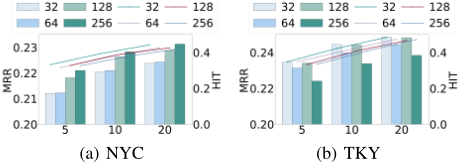
Embedding Dimension. We explore various options for the embedding dimension e, specifically: 32, 64, 128, and 256. The results are summarized in Figure 3. The model's MRR shows an increase on NYC but a decrease on TKY. This phenomenon could be attributed to the fact that an embedding dimension of 32 already offers sufficient expressive power for this scenario. Hence, merely increasing the embedding dimension may lead to more computational cost and potentially cause the feature representation overly dispersed.
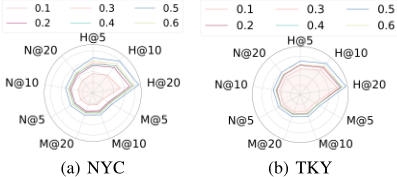
Replacement Ratio. Our method generates counterfactual negative/positive users by replacing deterministic/nondeterministic preferences in user sequences. Consequently, the choice of replacement ratio γ is a crucial factor affecting model performance. We have tested several values of γ: 0.1, 0.2, 0.3, 0.4, 0.5, 0.6, and then conducted extensive experiments. The results are summarized in Figure 4. Through observation, it is evident that both in the NYC and TKY datasets, the model's performance gradually improves as the γ value increases. However, there is a noticeable decline in performance when γ shifts from 0.5 to 0.6. This indicates that the model achieves optimal performance at a replacement ratio of 0.5. A higher γ introduces excessive noise, while a lower value leads to suboptimal counterfactual learning capabilities.
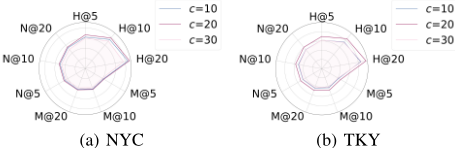
The Number of Interest-level Concepts. We capture the dynamic preferences of users and generate interest-level concepts. We evaluated three different quantities: 10, 20, and 30, and summarized the results in Figure 5. Our observations indicate that with a lower number of interest-level concepts, the granularity of these concepts is coarser. As the number increases, the concepts become more fine-grained. However, an excess of concepts can lead to increased noise. Therefore, the optimal number of concepts we have determined is 20.
| Datasets | NYC | TKY | ||||||||||
|---|---|---|---|---|---|---|---|---|---|---|---|---|
| Metric | M@5 | M@10 | M@20 | H@5 | H@10 | H@20 | M@5 | M@10 | M@20 | H@5 | H@10 | H@20 |
| BPR | 0.0869 | 0.0949 | 0.0983 | 0.1493 | 0.2090 | 0.2637 | 0.2243 | 0.2316 | 0.2360 | 0.3179 | 0.3744 | 0.4385 |
| LESSR | 0.0686 | 0.0701 | 0.0712 | 0.0862 | 0.0981 | 0.1190 | 0.1547 | 0.1620 | 0.1659 | 0.2305 | 0.2850 | 0.3408 |
| SR-GNN | 0.0380 | 0.0385 | 0.0388 | 0.0599 | 0.0645 | 0.0737 | 0.0754 | 0.0773 | 0.0789 | 0.1068 | 0.1198 | 0.1438 |
| GCE-GNN | 0.1612 | 0.1642 | 0.1692 | 0.2672 | 0.2903 | 0.3594 | 0.1551 | 0.1608 | 0.1641 | 0.2265 | 0.2723 | 0.3159 |
| NISER | 0.0357 | 0.0364 | 0.0364 | 0.0506 | 0.0553 | 0.0691 | 0.0505 | 0.0522 | 0.0531 | 0.0740 | 0.0980 | 0.1067 |
| NGCF | 0.0539 | 0.0587 | 0.0615 | 0.0995 | 0.1293 | 0.1741 | 0.1788 | 0.1819 | 0.1850 | 0.2538 | 0.2769 | 0.3205 |
| PriGCN | 0.2027 | 0.2031 | 0.2103 | 0.3521 | 0.3777 | 0.3893 | 0.2122 | 0.2200 | 0.2236 | 0.3336 | 0.3847 | 0.3951 |
| ITGCN | 0.1934 | 0.1989 | 0.2024 | 0.3634 | 0.3689 | 0.3705 | 0.2288 | 0.2301 | 0.2358 | 0.3354 | 0.3937 | 0.4029 |
| CussCtpm-t | 0.2134 | 0.2159 | 0.2188 | 0.3721 | 0.4105 | 0.4377 | 0.2153 | 0.2204 | 0.2298 | 0.3024 | 0.3561 | 0.3961 |
| CussCtpm-n | 0.2095 | 0.2132 | 0.2165 | 0.3694 | 0.4051 | 0.4247 | 0.2147 | 0.2159 | 0.2246 | 0.2988 | 0.3530 | 0.3897 |
| CussCtpm-p | 0.2088 | 0.2124 | 0.2134 | 0.3691 | 0.4012 | 0.4233 | 0.2139 | 0.2160 | 0.2229 | 0.2967 | 0.3529 | 0.3876 |
| CussCtpm-np | 0.1937 | 0.2031 | 0.2059 | 0.3588 | 0.3982 | 0.4200 | 0.2123 | 0.2087 | 0.2149 | 0.2900 | 0.3504 | 0.3834 |
| CussCtpm | 0.2204 | 0.2238 | 0.2253 | 0.3934 | 0.4432 | 0.4931 | 0.2345 | 0.2445 | 0.2486 | 0.3480 | 0.4230 | 0.4850 |
| Improv. | 8.73% | 10.19% | 7.13% | 8.26% | 17.34% | 26.66% | 2.49% | 5.57% | 5.34% | 3.76% | 7.44% | 10.60% |
The Number of Negative/Positive User Representations. We investigate the impact of varying the number of counterfactual negative and positive users on our model's performance. The results are summarized in Table 2. Initially, we set the count for both negative and positive users to 1. Then, we incrementally increase the number of counterfactual negative users (i.e., x) and counterfactual positive users (i.e., y), to observe their respective impacts. From Table 2, moderately increasing the quantity of negative users is beneficial. However, an excessive number of positive users can introduce unwanted noise. Therefore, we have determined the optimal configuration for our model to be x = 4 and y = 1.
| x/y | Metric | NYC | TKY | NYC | TKY | x/y |
|---|---|---|---|---|---|---|
| 1/1 | H@5 H@10 H@20 M@5 M@10 M@20 | 0.2825 0.3101 0.3333 0.3890 0.3915 0.4509 0.1834 0.2073 0.1902 0.2178 0.1942 0.2220 | 0.2825 0.3333 0.3915 0.1834 0.1902 0.1942 | 0.3101 0.3890 0.4509 0.2073 0.2178 0.2220 | 1/1 | |
| 1/2 H@5 H@10 H@20 M@5 M@10 M@20 | 0.2918 0.3509 0.3980 0.1972 0.2048 0.2081 | 0.3188 0.3851 0.4466 0.2133 0.2221 0.2264 | 0.2798 0.3416 0.3869 0.1779 0.1865 0.1896 | 0.3083 0.3764 0.4392 0.2098 0.2191 0.2236 | 2/1 | |
| 1/4 | H@5 H@10 H@20 M@5 M@10 M@20 | 0.2724 0.3343 0.3869 0.1886 0.1970 0.2007 | 0.3210 0.3956 0.4514 0.2180 0.2282 0.2321 | 0.3324 0.3934 0.4432 0.2121 0.2204 0.2238 | 0.3480 0.4230 0.4850 0.2345 0.2445 0.2486 | 4/1 |
6 Conclusion
In conclusion, our work presents CussCtpm, a novel approach for continuous POI recommendation in LBSNs. CussCtpm effectively addresses the critical challenges of modeling user preferences in a continuous temporal space and mitigating data sparsity. By integrating GRU with neural ODEs, our model captures nuanced, evolving user preferences at both POI and interest levels. The use of counterfactual data augmentation for generating positive and negative user sequences, combined with contrastive learning, significantly enhances the accuracy of user representations and overall recommendation performance.
Acknowledgments
This work is partially supported by the National Natural Science Foundation of China under Grant (No. 92267104, No. 62372242, No. 62272405), Natural Science Foundation of Shandong Province (No. ZR2023MF007), Foundation of Yunnan Key Laboratory of Service Computing (No. YNSC23103), Dou Wanchun Expert Workstation of Yunnan Province (No.202105AF150013). Dr Xuyun Zhang is the recipient of an ARC DECRA (project No. DE210101458) funded by the Australian Government.
@inproceedings{ijcai2024p255,
  title     = {Counterfactual User Sequence Synthesis Augmented with Continuous Time Dynamic Preference Modeling for Sequential POI Recommendation},
  author    = {Qi, Lianyong and Liu, Yuwen and Liu, Weiming and Pei, Shichao and Xu, Xiaolong and Zhang, Xuyun and Wang, Yingjie and Dou, Wanchun},
  booktitle = {Proceedings of the Thirty-Third International Joint Conference on
               Artificial Intelligence, {IJCAI-24}},
  publisher = {International Joint Conferences on Artificial Intelligence Organization},
  editor    = {Kate Larson},
  pages     = {2306--2314},
  year      = {2024},
  month     = {8},
  note      = {Main Track},
  doi       = {10.24963/ijcai.2024/255},
  url       = {https://doi.org/10.24963/ijcai.2024/255},
}
TY - CPAPER TI - Counterfactual User Sequence Synthesis Augmented with Continuous Time Dynamic Preference Modeling for Sequential POI Recommendation AU - Qi, Lianyong AU - Liu, Yuwen AU - Liu, Weiming AU - Pei, Shichao AU - Xu, Xiaolong AU - Zhang, Xuyun AU - Wang, Yingjie AU - Dou, Wanchun T2 - Proceedings of the Thirty-Third International Joint Conference on Artificial Intelligence, IJCAI-24 PB - International Joint Conferences on Artificial Intelligence Organization PY - 2024 SP - 2306 EP - 2314 DO - 10.24963/ijcai.2024/255 UR - https://doi.org/10.24963/ijcai.2024/255 ER -Copied
Machine-readable versions of this paper, for tools and AI agents:





