
Spatial-Temporal Perceiving: Deciphering User Hierarchical Intent in Session-Based Recommendation
Proceedings of the Thirty-Third International Joint Conference on Artificial Intelligence. Main Track. Pages 2415-2423.
https://doi.org/10.24963/ijcai.2024/267
Keywords
- Data Mining: DM: Recommender systems
Abstract
Session-based recommendation (SBR) aims to predict the next-interacted item based on anonymous users' behavior sequences. The main challenge is how to recognize the user intent with limited interactions to achieve a more accurate inference of user behavior. Existing works usually regard several consecutive items in the current session as intent. However, we argue such intent generation based on temporal transition ignores the fact that each item also has its semantically connected items in the feature space, which can be regarded as spatial intent. The limited consideration of intent fails to capture complex behavioral patterns in real-world scenarios, leading to sub-optimal solutions. To address this issue, we propose the Hierarchical Intent Perceiving Contrastive Learning Framework (HearInt) for SBR, which proposes a hierarchical consideration of intents from both temporal and spatial perspective. Specifically, we first propose that the user's temporal intents are mutually exclusive while the spatial intents are mutually compatible. Following these analyses, we design a Temporal Intent Decoupling module to mitigate the mutual influence of long-term and short-term intents, and a Cross-scale Contrastive Learning task to enhance the consistency of intents across different spatial scales. Experimental results on three real-world datasets exhibit that HearInt achieves state-of-the-art performance.
- Datasets
- Diginetica Metrics P@10 MRR@10 P@20 MRR@20 P@10 MRR@10 P@20 MRR@20 P@10 MRR@10 P@20 MRR@20 NARM 42.07 24.88 50.22 24.59 19.17 10.42 23.30 10.70 35.44 15.13 49.70 16.17 STAMP 42.95 24.61 50.96 25.17 22.63 13.12 26.47 13.36 33.98 14.26 45.64 14.32 SR-GNN 43.21 26.07 50.32 26.57 23.41 13.45 27.57 13.72 36.86 15.52 50.73 17.59 GCE-GNN 46.05 27.48 53.63 28.01 29.19 15.55 33.42 15.42 41.54 18.29 54.22 19.04 S 2 -DHCN 46.15 26.85 53.66 27.30 26.22 14.60 31.42 15.05 39.87 17.53 53.18 18.44 COTREC 48.61 29.46 56.17 29.97 30.62 17.65 36.35 18.04 41.88 18.16 54.18 19.07 HIDE 43.95 25.70 51.25 26.20 31.10 16.77 37.12 17.19 40.39 17.45 53.72 18.37 Atten-Mixer 48.63 28.05 56.01 28.57 31.62 18.23 37.24 18.62 40.24 17.32 53.86 18.27 HearInt 49.62 30.02 57.39 30.54 33.87 18.85 39.92 19.27 41.47 18.60 55.02 19.52 Table 2: Performances of comparison approaches on three datasets. The boldface is the best result, and the underline is the second best result.
- [Chung et al., 2014] Junyoung Chung, Caglar Gulcehre, KyungHyun Cho, and Yoshua Bengio. Empirical evalua- tion of gated recurrent neural networks on sequence mod- eling. In NeurIPS Workshop on Deep Learning, Quebec, Canada, 2014.
- [Gao et al., 2022] Chen Gao, Xiang Wang, Xiangnan He, and Yong Li. Graph neural networks for recommender system. In WSDM, pages 1623-1625, AZ, USA, 2022. ACM.
- [Guo et al., 2022] Jiayan Guo, Yaming Yang, Xiangchen Song, Yuan Zhang, Yujing Wang, Jing Bai, and Yan Zhang. Learning multi-granularity consecutive user intent unit for session-based recommendation. In WSDM, pages 343-352, AZ, USA, 2022. ACM.
- [Hidasi et al., 2016] Balázs Hidasi, Alexandros Karat- zoglou, Linas Baltrunas, and Domonkos Tikk. Session- based recommendations with recurrent neural networks. In ICLR, San Juan, Puerto Rico, 2016.
- [Kang and McAuley, 2018] Wang-Cheng Kang and Julian McAuley. Self-attentive sequential recommendation. In ICDM, pages 197-206, Singapore, 2018. IEEE.
- [Kipf and Welling, 2017] TN Kipf and M Welling. Semi- supervised classification with graph convolutional net- works. In ICLR, Toulon, France, 2017. ICLR.
- [Lai et al., 2022] Siqi Lai, Erli Meng, Fan Zhang, Chenliang Li, Bin Wang, and Aixin Sun. An attribute-driven mir- ror graph network for session-based recommendation. In SIGIR, pages 1674-1683, Madrid, Spain, 2022. ACM.
- [Latifi et al., 2021] Sara Latifi, Noemi Mauro, and Jannach. Session-aware recommendation: A surprising quest for the state-of-the-art. Information Sciences, 573:291-315, 2021.
- [Li et al., 2017] Jing Li, Pengjie Ren, Zhumin Chen, Zhaochun Ren, Tao Lian, and Jun Ma. Neural at- tentive session-based recommendation. In CIKM, page 1419-1428, Singapore, 2017. ACM.
- [Li et al., 2022] Yinfeng Li, Chen Gao, Hengliang Luo, De- peng Jin, and Yong Li. Enhancing hypergraph neural networks with intent disentanglement for session-based recommendation. In SIGIR, pages 1997-2002, Madrid, Spain, 2022. ACM.
- [Liu et al., 2018] Qiao Liu, Yifu Zeng, Refuoe Mokhosi, and Haibin Zhang. Stamp: short-term attention/memory prior- ity model for session-based recommendation. In SIGKDD, pages 1831-1839, London,United Kingdom, 2018. ACM.
- [Liu et al., 2024] Huafeng Liu, Mingjie Zhou, Mingyang Song, Deqiang Ouyang, Yawen Li, Liping Jing, Jian Yu, and Michael K Ng. Learning hierarchical preferences for recommendation with mixture intention neural stochastic processes. IEEE Transactions on Knowledge and Data Engineering, pages 1-14, 2024.
- [Oord et al., 2018] Aaron van den Oord, Yazhe Li, and Oriol Vinyals. Representation learning with contrastive predic- tive coding. arXiv preprint arXiv:1807.03748, 2018.
- [Pan et al., 2020] Zhiqiang Pan, Fei Cai, Wanyu Chen, Honghui Chen, and Maarten De Rijke. Star graph neural networks for session-based recommendation. In CIKM, pages 1195-1204, Virtual Event, 2020. ACM.
- [Qiu et al., 2019] Ruihong Qiu, Jingjing Li, Zi Huang, and Hongzhi Yin. Rethinking the item order in session-based recommendation with graph neural networks. In CIKM, pages 579-588, Beijing, China, 2019. ACM.
- [Qiu et al., 2022] Ruihong Qiu, Zi Huang, Hongzhi Yin, and Zijian Wang. Contrastive learning for representation de- generation problem in sequential recommendation. In WSDM, pages 813-823, Virtual Event, 2022. ACM.
- [Rendle et al., 2010] Steffen Rendle, Christoph Freuden- thaler, and Lars Schmidt-Thieme. Factorizing personal- ized markov chains for next-basket recommendation. In WWW, pages 811-820, Raleigh North Carolina, USA, 2010. ACM. Scarselli et al., 2008]
- Franco Scarselli, Marco Gori, Ah Chung Tsoi, Markus Hagenbuchner, and Gabriele Monfardini. The graph neural network model. IEEE Transactions on Neural Networks, 20(1):61-80, 2008.
- [Shani et al., 2005] Guy Shani, David Heckerman, Ronen I Brafman, and Craig Boutilier. An mdp-based recom- mender system. Journal of Machine Learning Research, 6(9):1265-1295, 2005.
- [Sun et al., 2023] Zhu Sun, Hui Fang, Jie Yang, Xinghua Qu, Hongyang Liu, Di Yu, Yew-Soon Ong, and Jie Zhang. Daisyrec 2.0: Benchmarking recommendation for rigor- ous evaluation. IEEE Transactions on Pattern Analysis and Machine Intelligence, 45(7):8206-8226, 2023.
- [Wang et al., 2020] Ziyang Wang, Wei Wei, Gao Cong, Xiao-Li Li, Xian-Ling Mao, and Minghui Qiu. Global context enhanced graph neural networks for session-based recommendation. In SIGIR, pages 169-178, Virtual Event, 2020. ACM.
- [Wu et al., 2019] Shu Wu, Yuyuan Tang, Yanqiao Zhu, Liang Wang, Xing Xie, and Tieniu Tan. Session-based rec- ommendation with graph neural networks. In AAAI, pages 346-353, Hawaii, USA, 2019.
- [Xia et al., 2021a] Xin Xia, Hongzhi Yin, Junliang Yu, Yingxia Shao, and Lizhen Cui. Self-supervised graph co-training for session-based recommendation. In CIKM, pages 2180-2190, GA, USA, 2021. ACM.
- [Xia et al., 2021b] Xin Xia, Hongzhi Yin, Junliang Yu, Qinyong Wang, Lizhen Cui, and Xiangliang Zhang. Self-supervised hypergraph convolutional networks for session-based recommendation. In AAAI, pages 4503- 4511, Virtual Event, 2021.
- [Xie et al., 2022] Yueqi Xie, Peilin Zhou, and Sunghun Kim. Decoupled side information fusion for sequential recom- mendation. In SIGIR, pages 1611-1621, Madrid, Spain, 2022. ACM.
- [Zhang et al., 2023] Peiyan Zhang, Jiayan Guo, Chaozhuo Li, Yueqi Xie, Jaeboum Kim, Yan Zhang, Xing Xie, Hao- han Wang, and Sunghun Kim. Efficiently leveraging multi-level user intent for session-based recommendation via atten-mixer network. In WSDM, pages 168-176, Sin- gapore, 2023. ACM.
- [Zheng et al., 2022] Yu Zheng, Chen Gao, Jianxin Chang, Yanan Niu, Yang Song, Depeng Jin, and Yong Li. Dis- entangling long and short-term interests for recommenda- tion. In WWW, pages 2256-2267, Lyon, France, 2022. ACM.
References were extracted automatically from the PDF and may contain errors.
Full text extracted automatically from the PDF; figures, tables and equations may differ. The PDF is the version of record.
1 Introduction
Recommender systems are pivotal in managing information overload by effectively understanding user profiles and longterm behavior [Xie et al., 2022; Sun et al., 2023]. Unfortunately, such information may be unavailable in realworld scenarios due to privacy concerns [Hidasi et al., 2016; Gao et al., 2022]. In response, SBR emerges, and its goal is to predict the next item based on the anonymous user's interaction sequence (denoted as a session) [Latifi et al., 2021].
∗Corresponding author.
In the past decade, many approaches have emerged in SBR and have demonstrated superiority in capturing the dependency between items within the session. For example, Recurrent neural networks (RNNs) based models [Hidasi et al., 2016; Li et al., 2017; Liu et al., 2018; Qiu et al., 2022] are devoted to learning sequential dependency of consecutive items, while graph neural networks (GNNs) based models [Wu et al., 2019; Qiu et al., 2019; Wang et al., 2020; Pan et al., 2020; Xia et al., 2021b; Xia et al., 2021a; Lai et al., 2022] convert the current session into a graph and capture complex dependency between adjacent items. However, these approaches only take individual items as basic units to extract user preference, neglecting to dive deeply into the user intent arising from the combination of items.
The user intent is the driving force for generating interaction sequences, which can be generally represented by a collection of items that exhibit some shared characteristics. Recently, some studies [Guo et al., 2022; Li et al., 2022; Zhang et al., 2023] extract segments that contain different consecutive items to represent various intents for better inferring user preferences. However, the generation of these intents only considers the temporal dependencies of items, which is insufficient to fully express the user's complex intents in real-world scenarios. For instance, consider a session: Mouse - Computer - Headphone - Smartphone - Smartphone - Smartphone. If a model extracts intents solely based on a segment of consecutive items, it may classify the user as a smartphone enthusiast, neglecting the possibility that the user is actually an electronics aficionado. This limitation may constrain the scope of related recommendations. In contrast, if we consider semantically related items as intents in the feature space, we can observe that all items in this session belong to the category of electronic products. Therefore, it is crucial to extract intent by integrating distant items in the session that are semantically related or even related items from other sessions, which is neglected by existing works.
To address this limitation, we propose a hierarchical consideration of user intent. As illustrated in Figure 1, the session consists of different intents from different hierarchical levels:
(1) From the temporal perspective, the user's behavior can be represented by long-term and short-term intents. Generally, since short-term intents can evolve rapidly according to some external factors, long-term and short-term intents tend to be mutually exclusive [Liu et al., 2018; Zheng et al., 2022].
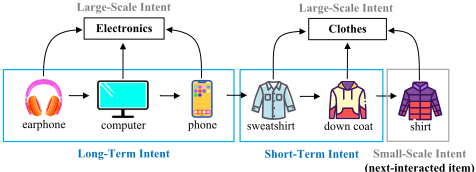
For example, in Figure1, the long-term intent of this session is Electronics, and its short-term intent has shifted to Clothes due to recent temperature changes. Therefore, simply conflating these intents during the training process cannot avoid their mutual interference, resulting in sub-optimal session representations learned by the model.
(2) From the spatial perspective, we consider the set of semantically similar items in the feature space as user intents. Based on the number of items included, we refine them into two categories, including the small-scale intent (e.g., the nextinteracted item in Figure 1) and the large-scale intent (e.g., the next-interacted category in Figure 1). The large-scale intent is composed of many small-scale intents and can be regarded as a representative of their shared properties. Therefore, largescale and small-scale intents are compatible with each other.
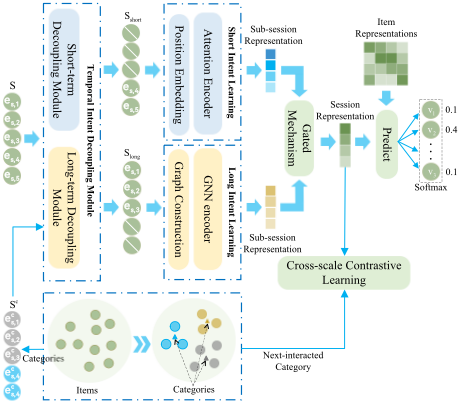
To the end, we propose a novel Hierarchical Intent Perceiving Contrastive Learning Framework (HearInt), which incorporates the hierarchical intent from the temporal and spatial level to comprehensively extract the behavioral patterns. For temporal intent, we design a Temporal Intent Decoupling (TID) module to disentangle long-term and shortterm intents from the session, aiming to eliminate their mutual interference during the training process. Subsequently, each intent is fed into encoders to obtain its sub-session representation. Following this, we employ a gated mechanism that adaptively combines the above representations to generate session representation for predicting the next item. For spatial intent, we first apply a clustering algorithm to all items in the feature space to learn the semantic relevance between items and obtain the item's centroids (i.e., categories). Then, we consider item categories as large-scale intents and items as small-scale intents. Based on it, we introduce a Cross-scale Contrastive Learning task (CCL), whose positive signals are session representation and the next-interacted category. Through this task, semantic relevance between session representation and potentially interacting items is enhanced, promoting the recommendation of more relevant items. The source code and datasets are publicly available on GitHub 1 .
In summary, the main contributions of this work include:
- We propose a novel HearInt model with spatial and temporal perspectives, which takes full advantage of the hierarchical intent hidden in user behaviors session, promoting recommendation performance.
1 https://github.com/jarviswww/Code4HearInt
- We design a TID module to separately learn the representations of long-term and short-term intents, avoiding their mutual interference.
- We propose a cross-scale contrastive learning task, which learns the correlation between the session representation and the large-scale intent to generate more relevant recommendations.
- Experiments on three benchmark datasets show the effectiveness and superiority of HearInt compared with the state-of-the-art approaches.
2 RelatedWork
2.1 Session-based Recommendation
Initial approaches in session-based recommendation make simplistic assumptions and employ Markov chains to extract short-term interest representations of users [Shani et al., 2005; Rendle et al., 2010]. Then, as deep learning demonstrates advantages in modeling complex information, researchers have introduced RNNs [Chung et al., 2014] to learn the temporal relation among items. STAMP [Liu et al., 2018] introduces a short-term memory priority module to emphasize the last click in the session. After that, with the great success of Transformer in other fields, the self-attention mechanism has been introduced to the SBR. For example, SASRec [Kang and McAuley, 2018] firstly leverages the selfattention mechanism to extract the context dependency within sessions. Besides, the significant superiority exhibited by GNNs [Scarselli et al., 2008; Kipf and Welling, 2017] in modeling complex relations, GNNs-based approaches have also gained much attention from researchers in SBR. For example, SRGNN [Wu et al., 2019] innovatively leverages a gated graph neural network to model sessions as graphs. GCE-GNN [Wang et al., 2020] introduces a global graph to capture item transitions across all sessions, acknowledging that a graph based solely on a single session is inadequate for comprehensive modeling of that session. Following this idea, many models are proposed with contrastive learning[Xia et al., 2021b][Xia et al., 2021a]. However, these approaches only take individual items as basic units to extract user preference, neglecting to dive deeply into the user intent arising from the combination of items.
2.2 Intent Perceiving in Session-based Recommendation
In recent years, there has been an emergence of research in session-based recommendation focusing on user intents. The intent is considered to be the engine that drives the generation of the session. Thus, a comprehensive analysis of it is beneficial for modeling the behavioral patterns hidden in sessions. MIHSG [Guo et al., 2022] constructs multi-granular intent graphs by considering different segments of sessions as different user intents, thereby capturing the interactions between intent units of different granularity. HIDE [Li et al., 2022] disentangles the intents under each item click in micro and macro manners to capture the dynamic intents of users and avoid noisy signals. Atten-Mixer [Zhang et al., 2023] leverages different combinations of recent interactions to represent multiple user intents, and exploits them to augment the readout module of GNNs. However, although these methods have paved the way for considering user intents in session-based recommendation, they have the limitation of not considering the collaborative effect of intents from different levels. Besides, they do not take into account the mutual interference between different intents, which can affect the accuracy of the recommendations.
3 Method
In this section, we formulate the problem and elaborate on our proposed HearInt, whose basic structure is given in Figure 2. First, we introduce the Temporal Intent Decoupling (TID) that acquires two sub-sessions from the session. Then, we separately introduce the learning process of each sub-session. After introducing the basic components, we will introduce the two learning tasks, which are the next-item prediction task and the Cross-scale Contrastive Learning (CCL) task.
3.1 Problem Statement
Let V = {v1, v2, .., vN} denote a set of unique items, where N is the total number of items. For each session, we represent it as S = {vs,1, vs,2, ..., vs,t} where vs,i ∈ V (1 ≤ i ≤ t) represents the interacted item at time step i. We embed each item into the same feature space and denote ej ∈ Rd as the vector representation of item vj ∈ V . The embedded session is denoted as S = {es,1, es,2, ..., es,t}. The session-based recommendation aims to predict the next-interacted item, namely vs,t+1, for a given session S.
The categories (i.e., clustering centroids) of items are acquired through clustering. Let each category be denoted as ck ∈ C (1 ≤ k ≤ K), where C is the category set and K is the number of categories, and its vector representations are denoted as eck . For a given embedded session S, we denote its category version as Sc = {ecs,1 , ecs,2 , ..., ecs,t }, where item embeddings are replaced by their category embeddings.
3.2 Temporal Intent DecouplingModule
To alleviate the mutual interference between long-term and short-term intents in the current session, we conduct a decoupling operation under the guidance of item categories. Given a session S = {es,1, es,2, ..., es,t} and its category version Sc = {ecs,1 , ecs,2 , ..., ecs,t }. For the short-term intent, previous studies [Zheng et al., 2022; Li et al., 2022; Liu et al., 2024] typically focus only on the recently clicked items, overlooking that this intent might have appeared earlier in the session. This leads to a loss of potentially valuable information. Therefore, we innovatively consider the category of the last-interacted item as the short-term intent, allowing us to explore more informative intent representation.
Besides, we define the long-term intent as the category that appears most frequently in the session, different from the previous approach [Zheng et al., 2022] of considering the mean of all item representations as the long-term intent, which also includes irrelevant short-term information. We formulate the definition of long-term and short-term intents as follows:
For each intent, we compute its cosine similarity with all item categories in Sc , obtaining similarity scores for all items. Subsequently, under the constraints of a threshold α ∈ (0, 1) and a mask probability β ∈ (0, 1), items with the cosine similarity higher than α are retained, while those with a cosine similarity lower than α are set to 0 with a probability β. This decoupling operation is performed twice, thereby obtaining the decoupled results for both long-term and short-term intents. This process can be formulated as (Using long-term intent as an example):
where ˆ βi is the randomly generated probability for item ecs,i , and M is the mask sequence. These operations enable the decoupling of the input session into two sub-sessions Slong and Sshort related to long and short-term intents, respectively.
3.3 Representation Learning of Decoupled Session
We next present how to learn sub-session representations through two different networks. Here, we first describe the learning of short-term intent-oriented sub-session representation for Sshort, whose core is neural attention, and then introduce the learning of long-term intent-oriented sub-session representation for Slong, whose core is GNN.
Short-term Intent-oriented Sub-session Representation
Traditional methods merely model the last click and ignore other semantically similar items in the session, resulting in incomplete and inaccurate short-term user preferences. To alleviate the problem, based on the generated sub-session Sshort, which contains semantically similar items with the last click, we generate the transformed information of each item in the sub-session using the self-attention mechanism.
Given the sub-session Sshort, we initialize a learnable position embedding P and perform an item-wise addition between P and Sshort, which is formulated as Sshort = [Sshort + P]. After that, we employ a scaled dot-product attention network to extract the semantic and sequential dependency between items within the session, and incorporate a positionwise feed-forward network after it to introduce more nonlinearity. This process can be formulated as:
where Q is the query, K is the key matrix, V is the value matrix, W1, W2 ∈ Rd×d are weight matrices, b1, b2 ∈ Rd are bias vectors, K = V = Sshort, and Q = SELU(W0Sshort +b0) where W0 ∈ Rd×d and b0 ∈ Rd refer to weight matrix and bias vector, respectively. After aggregating the information of semantically related neighbors of the last-interacted item, we consider its representation es,t ∈ Rd as the sub-session representation, and denote it as Rshort.
Long-term Intent-oriented Sub-session Representation
Graph Construction. To better aggregate information of the long-term intent-oriented sub-session, we first reconstruct Slong into two edge-aware graphs to explore more intricate edge transition relationships. The proposed two edge-aware graphs are defined as:
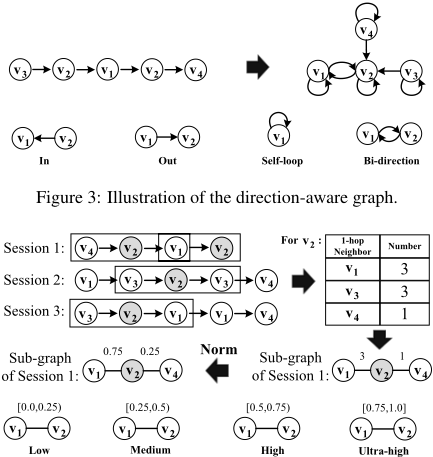
(i) Direction-aware Graph, which constructs four types of edges according to different item transition patterns, including in, out, bidirection, and self-loop, as shown in Figure 3. Given a session S = {vs,1, vs,2, ..., vs,t}, we form a directed edge-aware graph Gs = (Vs, Es), where Vs ⊆ V refers to the set of items in S, Es = {eij} is the set of edge which indicates the item-transition pattern between vs,i and vs,j .
(ii) Frequency-aware Graph, whose construction process is shown in Figure 4. For a specific item in a session, we initially construct a local undirected graph based on the connections between items in the sub-session. To determine the edge weights in this graph, we calculate the co-occurrence times of each item with its neighbors across all sessions in datasets and then normalize them within the local undirected graph to ascertain the weights. Four types of edges are assigned to this graph according to the normalized weights. This approach enables the utilization of global information to guide the aggregation of information in the local undirected graph, thereby complementing the directed graph that relies solely on item transitions in the local session. Given a session S = {vs,1, vs,2, ..., vs,t}, we form a frequency-aware graph Gf = (Vf , Ef ), where Vf ⊆ V refers to the set of items in S, Ef = {efij } is the set of frequency edges from vs,i to vs,j.
GNN Encoder. After constructing edge-aware graphs, we employ the GNN to refine the information aggregation process by assigning different learnable parameters to different types of edges. Considering the different importance of neighboring items, we employ attention mechanisms to learn the weights between adjacent item pairs. The attention score can be calculated as:
where aij estimates the importance weight from item j to item i, rij is the type of edge from item i to item j, aTrij is the learnable parameter assigned to edge rij, Ni is the 1-order neighbors around item i in sub-session Slong, and es,i,es,j ∈ Slong. Then, we update the representation of item i by performing a linear combination of neighbors associated with the attention scores:
For both edge-aware graphs, we employ the same transformation process as illustrated in Equ. (7) and (8), and denote the obtained sub-sessions as ˆ S1 long and ˆ S2 long . A gate mechanism is then employed to aggregate information from both graphs as follows, where W3 are trainable parameters.
To distinguish and aggregate the contribution made by each item to the current sub-session, we adopt the soft attention mechanism to learn the sub-session representation.
where ˆ ss,i ∈ ˆ Slong, ˆ s′s,i represents average representation in ˆ Slong , and ˆ s′′ s,i = tanh (W4 [ˆ ss,i||pi] + b3) where pi ∈ P. W4 ∈ Rd×2d ,W5,W6 ∈ Rd×d , b3, b4 ∈ Rd are trainable parameters, and γi represents the attention weight.
After acquiring sub-session representations Rshort and Rlong, we employ a gate mechanism to adaptively aggregate them to generate the final session representation:
where W7 ∈ Rd×2d is the learnable parameter and R denotes the final session representation.
3.4 Next-itemPrediction Task
Given session representation R, we multiply it with candidate item embeddings and apply a softmax to calculate the probabilities of each item being the next one:
where ej is the vector representation of vj ∈ V . Then, we adopt a cross-entropy loss function as the learning objective, which is defined as:
where yi is the one-hot encoding vector of the ground truth.
3.5 Cross-scale Contrastive Learning Task
To enhance the compatibility within the spatial intents, we employ a cross-scale contrastive learning task. Different from the typical same-scale contrastive learning, here we employ two samples with different scales, which are the nextinteracted category ecs,t+1 and the session representation R, as contrastive signals. It is worth noting that since the session representation gradually converges with the representation of the next-interacted item (i.e., small-scale intent) in the next-item prediction task, we also consider it a kind of smallscale signal. Then, we adopt InfoNCE [Oord et al., 2018] to maximize the similarity between R and ecs,t+1 (positive), while minimizing the similarity between R and other categories (negative). This process can be formulated as:
where τ is the temperature parameter that controls the discrimination towards negative samples.
To incorporate the cross-scale contrastive learning task into the next-item prediction task, we introduce a multi-task learning strategy. Specifically, a hyper-parameter λ is introduced to control the magnitude of cross-scale contrastive loss. The total learning loss for session S can be expressed as:
4 Experiments
In this section, we first illustrate experiment setups, including datasets, baselines, evaluation metrics, and hyper-parameters. Then, we analyze comparison experimental results.
| Dataset | Tmall | RetailRocket | Diginetica |
|---|---|---|---|
| training sessions | 351,268 | 433,643 | 719,470 |
| test sessions | 25,898 | 15,132 | 60,858 |
| # of items | 40,728 | 36,968 | 43,097 |
| average lengths | 6.69 | 5.43 | 5.12 |
4.1 Experiment Setups
Datasets
We evaluate the proposed model on three benchmark datasets, namely Tmall 2 , RetailRocket 3 ,Diginetica 4 . Tmall is from the IJCAI-15 competition and consists of shopping logs of unnamed users on Tmall online shopping platform. RetailRocket is released by an e-commerce corporation for the Kaggle competition and contains users' browsing activity. Diginetica comes from CIKM Cup 2016 and describes the music listening behavior of users. Following [Xia et al., 2021a], we conduct preprocessing over each dataset. Specifically, sessions with a length of 1 and items that appeared fewer than 5 times are excluded. Then, the latest data (such as the data from last week) is set to be a test set, and previous data is used as the training set. Additionally, we use a sequence splitting preprocess method to augment session S = s1, s2, ..., sn in these datasets, and generate multiple sessions with corresponding labels ([s1]; s2), ([s1, s2]; s3), ..., ([s1, s2, ..., sn-1]; sn). The statistics of the datasets are presented in Table 1.
Metrics
Following [Li et al., 2017], we adopt P@K (Precision) and MRR@K (Mean Reciprocal Rank) to evaluate the recommendation results, where K is 10 or 20.
Hyper-parameters Setup
For the general setting, the embedding size is 100, the batch size is 100. For HearInt, the initial learning rate is 0.001, which will decay by 0.6 after every 1 epoch. We employ the k-means as the clustering algorithm and set the number of clusters to 100. The threshold α of cosine similarity is 0 in three datasets. Mask probability β is 0.4 for Tmall , while 0.1 is for Diginetica and Retailrocket. The θ The best number of layers in both attention and GNN encoders is 1,2,2 for Tmall, Retailrocket, and Diginetica, respectively. For the baseline models, we refer to their best parameter setups reported in the original papers and directly report their results if in line with general settings, evaluation metrics, and datasets. Otherwise, we record the reproduced results under the public code.
4.2 Baselines
We compare HearInt with the following approaches. :
- NARM [Li et al., 2017] adopts RNNs and the attention mechanism to extract the general interest of users.
- STAMP [Liu et al., 2018] emphasizes the short-term memory through leveraging the attention mechanism.
2 https://tianchi.aliyun.com/dataset/dataDetail?dataId=42
3 https://www.kaggle.com/retailrocket/ecommerce-dataset
4 https://competitions.codalab.org/competitions/11161
| Datasets Metrics | RetailRocket | Tmall | Diginetica | |||||||||
|---|---|---|---|---|---|---|---|---|---|---|---|---|
| P@10 | MRR@10 | P@20 | MRR@20 | P@10 | MRR@10 | P@20 | MRR@20 | P@10 | MRR@10 | P@20 | MRR@20 | |
| NARM | 42.07 | 24.88 | 50.22 | 24.59 | 19.17 | 10.42 | 23.30 | 10.70 | 35.44 | 15.13 | 49.70 | 16.17 |
| STAMP | 42.95 | 24.61 | 50.96 | 25.17 | 22.63 | 13.12 | 26.47 | 13.36 | 33.98 | 14.26 | 45.64 | 14.32 |
| SR-GNN | 43.21 | 26.07 | 50.32 | 26.57 | 23.41 | 13.45 | 27.57 | 13.72 | 36.86 | 15.52 | 50.73 | 17.59 |
| GCE-GNN | 46.05 | 27.48 | 53.63 | 28.01 | 29.19 | 15.55 | 33.42 | 15.42 | 41.54 | 18.29 | 54.22 | 19.04 |
| S2 -DHCN | 46.15 | 26.85 | 53.66 | 27.30 | 26.22 | 14.60 | 31.42 | 15.05 | 39.87 | 17.53 | 53.18 | 18.44 |
| COTREC | 48.61 | 29.46 | 56.17 | 29.97 | 30.62 | 17.65 | 36.35 | 18.04 | 41.88 | 18.16 | 54.18 | 19.07 |
| HIDE | 43.95 | 25.70 | 51.25 | 26.20 | 31.10 | 16.77 | 37.12 | 17.19 | 40.39 | 17.45 | 53.72 | 18.37 |
| Atten-Mixer | 48.63 | 28.05 | 56.01 | 28.57 | 31.62 | 18.23 | 37.24 | 18.62 | 40.24 | 17.32 | 53.86 | 18.27 |
| HearInt | 49.62 | 30.02 | 57.39 | 30.54 | 33.87 | 18.85 | 39.92 | 19.27 | 41.47 | 18.60 | 55.02 | 19.52 |
- SR-GNN [Wu et al., 2019] employs GNNs to learn item embeddings and learn the session representation through a soft-attention layer.
- GCE-GNN [Wang et al., 2020] consider the extraction of spatial information from global and local views.
- S2 -DHCN [Xia et al., 2021b] generates two different views from the original session using the hypergraph, regarding them as self-supervised signals to enhance the session representation.
- COTREC [Xia et al., 2021a] forms two independent session representations and adopts co-training to generate positive and negative samples pertaining to the last click from the candidate items.
- HIDE [Li et al., 2022] disentangles the intents under each item click in micro and macro manners to capture the dynamic intents of users and avoid noisy signals.
- Atten-Mixer [Zhang et al., 2023] considers compositions of the last few items in a session as different intents to employ a multi-level reasoning component for GNNs.
4.3 Overall Performance
To evaluate the effectiveness of HearInt, we report the comparison results with the state-of-the-art baselines. From Table 2, we draw the following observations:
- Among the sequential baseline models, STAMP outperforms NARM on Tmall and RetailRocket but lags on Diginetica. As shown in Table 1, the average session length is longer in Tmall and RetailRocket compared to Diginetica. This phenomenon shows that STAMP explicitly emphasizes short-term intents to alleviate the interference of long-range items, leading to better performance in modeling user interests within longer sessions. It further validates our previous view that long-term and short-term intents can mutually influence each other.
- In general, GNN-based models outperform the sequential models, which reveals that leveraging the captured complex instead of single sequential transitions between items is more beneficial in learning the session representation. Compared with SR-GNN, models that like
GCE-GNN, S2 -DHCN, and COTREC exhibit more effectiveness. It indicates that integrating item-transitions information from other sessions into the current session improves the infer of user behavior patterns.
- Our proposed HearInt almost surpasses the overall baselines on these three datasets, demonstrating the usefulness of the proposed hierarchical intent. Compared to existing models, the hierarchical intent benefits the model in two main aspects: (i) devised the TID module allows HearInt to avoid introducing irrelevant information in long-term intent and increase related information(such as semantically similar items) in short-term intent, making learned session representation superior. (ii) incorporating CCL task, whose positive signals are session representation and category of the next click, makes semantic relevance between session representation and the next click closer during the training process. The above modules enable HearInt to acquire session representations containing more relevant information, which enhances the relevance of recommendations results.
4.4 Model Analysis and Discussion
In this subsection, we take an in-depth model analysis study, aiming to further understand the framework of HearInt. Due to the space limit, we only show the analysis results with K=20 in the partial datasets. We have obtained similar experimental results in terms of other metrics and datasets.
Ablation Study
To profoundly comprehend the contribution of the hierarchical intent component in HearInt, we designed five variants: HearInt-base, HearInt-S, HearInt-L, HearInt-NT, and HearInt-NC. HearInt-base removes the TID module and CCL. HearInt-NT removes the TID module but contains the CCL module. HearInt-NC includes the TID module but drops the CCL module. HearInt-S discards the entire longterm intent channel (i.e., GNN encoder), while HearInt-L discards the entire short-term intent channel (i.e., attention encoder). Table 3 illustrates the comparison results. From Table 3, we have the following observation: (i) HearInt with the best results while HearInt-base with the worst performance, demonstrating that introducing semantic-related information in both spatial and temporal perspectives is effective in enhancing recommendation relevance through TID and CCL. (ii) Compared to HearInt, HearInt-S with short-term intent and HearInt-L with long-term intent make more contributions in Tmall and Dignetica, respectively. However, the average length of sessions in Tmall is longer than in Dignetica, as shown in Table 1. This further demonstrates that simultaneously incorporating decoupled intent is positive in learning better session representation. (iii) HearInt outperforms HearInt-NT. It reveals that utilizing contrastive learning with maximum consistency between session representation and the category of the next click improves the recommendation's relevance.
| Datasets | Tmall | Diginetica | ||
|---|---|---|---|---|
| Metrics | P@20 | MRR@20 | P@20 | MRR@20 |
| HearInt | 39.92 | 19.37 | 55.02 | 19.52 |
| HearInt-base | 37.59 | 17.82 | 54.58 | 18.97 |
| HearInt-S | 38.60 | 19.27 | 53.80 | 18.86 |
| HearInt-L | 38.04 | 18.58 | 54.51 | 19.24 |
| HearInt-NT | 39.68 | 18.98 | 54.70 | 19.33 |
| HearInt-NC | 37.83 | 18.07 | 54.60 | 19.20 |
Influence of Clustering Centriods
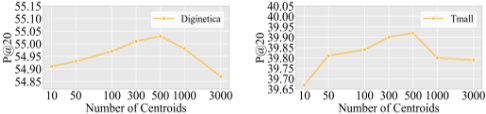
To explore the impact of clustering centroids, we range the numbers of clustering centroids within {10, 50, 100, 300, 500 , 1000, 3000}. Figure 5 illustrates that as the number of clustering centroids increases, the performance of P@20 on two datasets exhibits a hump-shaped trend. This is because, as the number of clustering centroids increases, the negative samples in contrastive learning gradually increase, causing the constraint in the denominator to shift from 'reducing irrelevant samples' to 'reducing relevant samples'.
Influence of the Cross-scale Contrastive Learning
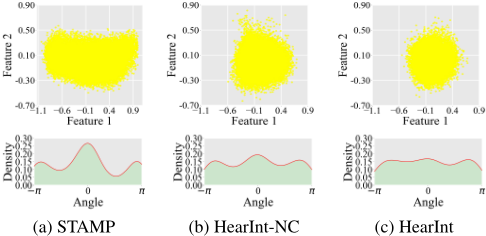
To evaluate how dose cross-scale contrastive learning enhances the recommendation performance, we visualize the ablation model's item embeddings and their distribution in the feature space. Specifically, we employ the singular value decomposition (SVD) to project the high-dimensional embeddings into a 2-D space and conduct the Gaussian kernel density estimation (KDE) on angles to depict the density of embedding distribution across different orientations. Results are reported in Figure 6. For models like STAMP without contrastive learning, the item embeddings are notably uneven, concentrating around three specific angles. When it comes to HearInt-NC, although its distribution of items is more uniform than STAMP, it still shows a steeper distribution curve than HearInt. It indicates that learning the correlation between the session representation and the large-scale intent enhances the uniformity of items, resulting in a more uniform distribution of item embeddings. The uniform distribution maintains the differences between different items since nonuniformity implies that some items are gathered in feature space. Besides, it can prevent the model from focusing excessively on items gathered in specific regions during training and ignoring items scattered elsewhere in feature space.
| SessionID Range | No.14 | No.15 | ||
|---|---|---|---|---|
| Top-50 | Top-100 | Top-50 | Top-100 | |
| HearInt | 15 | 23 | 12 | 21 |
| HearInt-base | 11 | 16 | 8 | 15 |
Case Study
To straightforwardly perceive that HearInt introduces more semantically relevant items in recommendation lists, we randomly pick the No.14 and No.15 sessions from the test set as cases to explain. The results are shown in Table 4. Compared with HearInt-base, it can be observed that the Top-K recommendation results of HearInt include more items whose categories are the same as the next-interacted category. This proves that our proposed model indeed benefits in recommending more relevant items.
5 Conclusion
In this paper, we propose a novel session-based recommendation framework based on the leveraging of the hierarchical intent. First, we explore the relation between intentions at temporal and spatial hierarchical levels, proposing that the longterm and short-term intents exhibit mutual exclusivity while the large-scale and small-scale intents are mutually compatible. Then, we present a temporal intent decoupling module to mitigate mutual interference among temporal intents and implement a cross-scale contrastive learning task to enhance consistency among spatial intents. Extensive experiments conducted on three datasets confirm that our proposed framework, HearInt, outperforms state-of-the-art methods.
Ethical Statement
We affirm that our manuscript is original, unpublished, and not under consideration elsewhere. No part of our study, including data, has been fabricated or manipulated.
Acknowledgements
We would like to thank the anonymous reviewers for their valuable discussions and constructive feedback. This work was supported by the National Key R&D Program of China(2022YFB4300603), the National Natural Science Foundation of China (U22B2061), the Sichuan Science and Technology Program (2023YFG0151), and the Development of a Big Data-based Platform for Analyzing the Coupling Relationship of Strip Production Processes Project (211129).
@inproceedings{ijcai2024p267,
  title     = {Spatial-Temporal Perceiving: Deciphering User Hierarchical Intent in Session-Based Recommendation},
  author    = {Wang, Xiao and Dai, Tingting and Liu, Qiao and Liang, Shuang},
  booktitle = {Proceedings of the Thirty-Third International Joint Conference on
               Artificial Intelligence, {IJCAI-24}},
  publisher = {International Joint Conferences on Artificial Intelligence Organization},
  editor    = {Kate Larson},
  pages     = {2415--2423},
  year      = {2024},
  month     = {8},
  note      = {Main Track},
  doi       = {10.24963/ijcai.2024/267},
  url       = {https://doi.org/10.24963/ijcai.2024/267},
}
TY - CPAPER TI - Spatial-Temporal Perceiving: Deciphering User Hierarchical Intent in Session-Based Recommendation AU - Wang, Xiao AU - Dai, Tingting AU - Liu, Qiao AU - Liang, Shuang T2 - Proceedings of the Thirty-Third International Joint Conference on Artificial Intelligence, IJCAI-24 PB - International Joint Conferences on Artificial Intelligence Organization PY - 2024 SP - 2415 EP - 2423 DO - 10.24963/ijcai.2024/267 UR - https://doi.org/10.24963/ijcai.2024/267 ER -Copied
Machine-readable versions of this paper, for tools and AI agents:





