
Modeling Personalized Retweeting Behaviors for Multi-Stage Cascade Popularity Prediction
Proceedings of the Thirty-Third International Joint Conference on Artificial Intelligence. Main Track. Pages 2598-2606.
https://doi.org/10.24963/ijcai.2024/287
Keywords
- Data Mining: DM: Recommender systems
- Machine Learning: ML: Applications
- Data Mining: DM: Mining text, web, social media
Abstract
Predicting the size of message cascades is critical in various applications, such as online advertising and early detection of rumors. However, most existing deep learning approaches rely on cascade observation, which hinders accurate cascade prediction before message posting. Besides, these approaches overlook personalized retweeting behaviors that reflect users' inclination to retweeting specific types of information. In this study, we propose a universal cascade prediction framework, namely Cascade prediction regarding Multiple Stage (CasMS), that effectively predicts cascade popularity across message generation stage as well as short-term and long-term stages. Unlike previous methods, our approach not only captures users' personalized retweeting behaviors but also incorporates temporal cascade features. We perform the experiments in datasets collected ourselves as well as public datasets. The results show that our method significantly surpasses existing approaches in predicting the cascade during the message generation stage and different time periods in the cascade dynamics.
- [Bian et al., 2020] Tian Bian, Xi Xiao, Tingyang Xu, Peilin Zhao, Wenbing Huang, Yu Rong, and Junzhou Huang. Ru- mor detection on social media with bi-directional graph convolutional networks. In Proceedings of the AAAI con- ference on artificial intelligence, volume 34, pages 549- 556, 2020.
- [Brown et al., 2020] Tom Brown, Benjamin Mann, Nick Ry- der, Melanie Subbiah, Jared D Kaplan, Prafulla Dhari- wal, Arvind Neelakantan, Pranav Shyam, Girish Sastry, Amanda Askell, et al. Language models are few-shot learners. Advances in neural information processing sys- tems, 33:1877-1901, 2020.
- [Cao et al., 2017] Qi Cao, Huawei Shen, Keting Cen, Wen- tao Ouyang, and Xueqi Cheng. Deephawkes: Bridging the gap between prediction and understanding of information cascades. In Proceedings of the 2017 ACM on Confer- ence on Information and Knowledge Management, pages 1149-1158, 2017.
- [Chamberlain et al., 2021] Ben Chamberlain, James Row- bottom, Maria I Gorinova, Michael Bronstein, Stefan Webb, and Emanuele Rossi. Grand: Graph neural diffu- sion. In International Conference on Machine Learning, pages 1407-1418. PMLR, 2021.
- [Chen et al., 2019] Xueqin Chen, Fan Zhou, Kunpeng Zhang, Goce Trajcevski, Ting Zhong, and Fengli Zhang. Information diffusion prediction via recurrent cascades convolution. In 2019 IEEE 35th international conference on data engineering (ICDE), pages 770-781. IEEE, 2019.
- [Chen et al., 2022] Wei Chen, Carlos Castillo, and Laks VS Lakshmanan. Information and influence propagation in social networks. Springer Nature, 2022.
- [Cheng et al., 2014] Justin Cheng, Lada Adamic, P Alex Dow, Jon Michael Kleinberg, and Jure Leskovec. Can cascades be predicted? In Proceedings of the 23rd inter- national conference on World wide web, pages 925-936, 2014.
- [Chowdhery et al., 2023] Aakanksha Chowdhery, Sharan Narang, Jacob Devlin, Maarten Bosma, Gaurav Mishra, Adam Roberts, Paul Barham, Hyung Won Chung, Charles Sutton, Sebastian Gehrmann, et al. Palm: Scaling lan- guage modeling with pathways. Journal of Machine Learning Research, 24(240):1-113, 2023.
- [Devlin et al., 2018] Jacob Devlin, Ming-Wei Chang, Ken- ton Lee, and Kristina Toutanova. Bert: Pre-training of deep bidirectional transformers for language understand- ing. arXiv preprint arXiv:1810.04805, 2018.
- [Dong et al., 2019] Li Dong, Nan Yang, Wenhui Wang, Furu Wei, Xiaodong Liu, Yu Wang, Jianfeng Gao, Ming Zhou, and Hsiao-Wuen Hon. Unified language model pre- training for natural language understanding and genera- tion. Advances in neural information processing systems, 32, 2019.
- [Gao et al., 2019] Xiaofeng Gao, Zhenhao Cao, Sha Li, Bin Yao, Guihai Chen, and Shaojie Tang. Taxonomy and eval- uation for microblog popularity prediction. ACM Trans- actions on Knowledge Discovery from Data (TKDD), 13(2):1-40, 2019.
- [Grover and Leskovec, 2016] Aditya Grover and Jure Leskovec. node2vec: Scalable feature learning for networks. In Proceedings of the 22nd ACM SIGKDD international conference on Knowledge discovery and data mining, pages 855-864, 2016.
- [Hochreiter and Schmidhuber, 1997] Sepp Hochreiter and Jürgen Schmidhuber. Long short-term memory. Neural computation, 9(8):1735-1780, 1997.
- [Kipf and Welling, 2016] Thomas N Kipf and Max Welling. Semi-supervised classification with graph convolutional networks. arXiv preprint arXiv:1609.02907, 2016.
- [Ko et al., 2020] Jihoon Ko, Kyuhan Lee, Kijung Shin, and Noseong Park. Monstor: an inductive approach for es- timating and maximizing influence over unseen networks. In 2020 IEEE/ACM International Conference on Advances in Social Networks Analysis and Mining (ASONAM), pages 204-211. IEEE, 2020.
- [Lea et al., 2017] Colin Lea, Michael D Flynn, Rene Vidal, Austin Reiter, and Gregory D Hager. Temporal convolu- tional networks for action segmentation and detection. In proceedings of the IEEE Conference on Computer Vision and Pattern Recognition, pages 156-165, 2017.
- [Leskovec et al., 2007] Jure Leskovec, Lada A Adamic, and Bernardo A Huberman. The dynamics of viral marketing. ACM Transactions on the Web (TWEB), 1(1):5-es, 2007.
- [Li et al., 2017] Cheng Li, Jiaqi Ma, Xiaoxiao Guo, and Qiaozhu Mei. Deepcas: An end-to-end predictor of infor- mation cascades. In Proceedings of the 26th international conference on World Wide Web, pages 577-586, 2017.
- [Ling et al., 2022a] Chen Ling, Tanmoy Chowdhury, Junji Jiang, Junxiang Wang, Xuchao Zhang, Haifeng Chen, and Liang Zhao. Deepgar: Deep graph learning for analogi- cal reasoning. In 2022 IEEE International Conference on Data Mining (ICDM), pages 1065-1070. IEEE, 2022.
- [Ling et al., 2022b] Chen Ling, Junji Jiang, Junxiang Wang, and Zhao Liang. Source localization of graph diffusion via variational autoencoders for graph inverse problems. In Proceedings of the 28th ACM SIGKDD conference on knowledge discovery and data mining, pages 1010-1020, 2022.
- [Lu et al., 2023] Xiaodong Lu, Shuo Ji, Le Yu, Leilei Sun, Bowen Du, and Tongyu Zhu. Continuous-time graph learning for cascade popularity prediction. In Edith Elkind, editor, Proceedings of the Thirty-Second Interna- tional Joint Conference on Artificial Intelligence, IJCAI- 23, pages 2224-2232. International Joint Conferences on Artificial Intelligence Organization, 8 2023. Main Track. IJCAI
- [Mikolov et al., 2013] Tomas Mikolov, Kai Chen, Greg Corrado, and Jeffrey Dean. Efficient estimation of word representations in vector space. arXiv preprint arXiv:1301.3781, 2013.
- [Mishra et al., 2016] Swapnil Mishra, Marian-Andrei Ri- zoiu, and Lexing Xie. Feature driven and point process approaches for popularity prediction. In Proceedings of the 25th ACM international on conference on information and knowledge management, pages 1069-1078, 2016.
- [Perozzi et al., 2014] Bryan Perozzi, Rami Al-Rfou, and Steven Skiena. Deepwalk: Online learning of social repre- sentations. In Proceedings of the 20th ACM SIGKDD in- ternational conference on Knowledge discovery and data mining, pages 701-710, 2014.
- [Pinto et al., 2013] Henrique Pinto, Jussara M Almeida, and Marcos A Gonc ¸alves. Using early view patterns to pre- dict the popularity of youtube videos. In Proceedings of the sixth ACM international conference on Web search and data mining, pages 365-374, 2013.
- [Robles et al., 2020] Juan Francisco Robles, Manuel Chica, and Oscar Cordon. Evolutionary multiobjective optimiza- tion to target social network influentials in viral marketing. Expert systems with applications, 147:113183, 2020.
- [Shen et al., 2014] Huawei Shen, Dashun Wang, Chaoming Song, and Albert-László Barabási. Modeling and predict- ing popularity dynamics via reinforced poisson processes. In Proceedings of the AAAI Conference on Artificial Intel- ligence, volume 28, 2014.
- [Shulman et al., 2016] Benjamin Shulman, Amit Sharma, and Dan Cosley. Predictability of popularity: Gaps be- tween prediction and understanding. In Proceedings of the international AAAI conference on web and social media, volume 10, pages 348-357, 2016.
- [Sun et al., 2023a] Xigang Sun, Jingya Zhou, Ling Liu, and Wenqi Wei. Explicit time embedding based cascade atten- tion network for information popularity prediction. Infor- mation Processing & Management, 60(3):103278, 2023.
- [Sun et al., 2023b] Xigang Sun, Jingya Zhou, Ling Liu, and Zhen Wu. Castformer: A novel cascade transformer to- wards predicting information diffusion. Information Sci- ences, 648:119531, 2023.
- [Szabo and Huberman, 2010] Gabor Szabo and Bernardo A Huberman. Predicting the popularity of online content. Communications of the ACM, 53(8):80-88, 2010.
- [Tang et al., 2021] Xiangyun Tang, Dongliang Liao, Weijie Huang, Jin Xu, Liehuang Zhu, and Meng Shen. Fully ex- ploiting cascade graphs for real-time forwarding predic- tion. In Proceedings of the AAAI Conference on Artificial Intelligence, volume 35, pages 582-590, 2021.
- [Touvron et al., 2023] Hugo Touvron, Thibaut Lavril, Gau- tier Izacard, Xavier Martinet, Marie-Anne Lachaux, Tim- othée Lacroix, Baptiste Rozière, Naman Goyal, Eric Ham- bro, Faisal Azhar, et al. Llama: Open and efficient founda- tion language models. arXiv preprint arXiv:2302.13971, 2023.
- [Tsur and Rappoport, 2012] Oren Tsur and Ari Rappoport. What's in a hashtag? content based prediction of the spread of ideas in microblogging communities. In Pro- ceedings of the fifth ACM international conference on Web search and data mining, pages 643-652, 2012.
- [Wang et al., 2022] Junxiang Wang, Junji Jiang, and Liang Zhao. An invertible graph diffusion neural network for source localization. In Proceedings of the ACM Web Con- ference 2022, pages 1058-1069, 2022.
- [Weng et al., 2013] Lilian Weng, Filippo Menczer, and Yong-Yeol Ahn. Virality prediction and community struc- ture in social networks. Scientific reports, 3(1):1-6, 2013.
- [Wu et al., 2019] Qitian Wu, Yirui Gao, Xiaofeng Gao, Paul Weng, and Guihai Chen. Dual sequential prediction mod- els linking sequential recommendation and information dissemination. In Proceedings of the 25th ACM SIGKDD international conference on knowledge discovery & data mining, pages 447-457, 2019.
- [Wu et al., 2020] Zhiang Wu, Changsheng Li, Jie Cao, and Yong Ge. On scalability of association-rule-based recom- mendation: A unified distributed-computing framework. ACM Transactions on the Web (TWEB), 14(3):1-21, 2020.
- [Xia et al., 2021] Wenwen Xia, Yuchen Li, Jun Wu, and Shenghong Li. Deepis: Susceptibility estimation on so- cial networks. In Proceedings of the 14th ACM Interna- tional Conference on Web Search and Data Mining, pages 761-769, 2021.
- [Xu et al., 2021] Xovee Xu, Fan Zhou, Kunpeng Zhang, Siyuan Liu, and Goce Trajcevski. Casflow: Exploring hi- erarchical structures and propagation uncertainty for cas- cade prediction. IEEE Transactions on Knowledge and Data Engineering, 2021.
- [Yang et al., 2019] Zhilin Yang, Zihang Dai, Yiming Yang, Jaime Carbonell, Russ R Salakhutdinov, and Quoc V Le. Xlnet: Generalized autoregressive pretraining for lan- guage understanding. Advances in neural information pro- cessing systems, 32, 2019.
- [Zhao et al., 2015] Qingyuan Zhao, Murat A Erdogdu, Hera Y He, Anand Rajaraman, and Jure Leskovec. Seis- mic: A self-exciting point process model for predict- ing tweet popularity. In Proceedings of the 21th ACM SIGKDD international conference on knowledge discov- ery and data mining, pages 1513-1522, 2015.
References were extracted automatically from the PDF and may contain errors.
Full text extracted automatically from the PDF; figures, tables and equations may differ. The PDF is the version of record.
1 Introduction
In the realm of online social platforms such as Twitter, Sina Weibo, and Facebook, users generate and share various types of information with their friends/fans. Certain information messages have the potential to follow social connections and spread rapidly to a large number of users. This cascade phenomenon has been extensively utilized in viral marketing [Leskovec et al., 2007; Robles et al., 2020], recommendations [Wu et al., 2019; Wu et al., 2020] and rumor detection [Bian et al., 2020]. Predicting the cascade popularity is a key problem in these applications. Although deep learning-based methods have been employed to address this challenge, existing approaches primarily focus on analyzing the temporal cascade paths while disregarding personalized retweeting behaviors [Li et al., 2017; Cao et al., 2017; Chen et al., 2019]. In reality, different users possess distinct preferences when retweeting or sharing different messages, which significantly impacts the accuracy of information cascade prediction. Besides, in the message generation stage, users also want to evaluate the potential popularity and optimize the message contents based on the evaluation feedback. Hence, how to effectively predict the popularity in the message generation stage and the cascade dynamics is a permanent problem in social network analysis.
∗Corresponding author.
The cascade process relies on both the diffusion model of messages and social connections, making diffusion modelbased approaches a natural choice. To enhance diffusion model-based approaches, some studies utilize the Hawkes point process to model message cascades [Zhao et al., 2015; Mishra et al., 2016]. Inspired by traditional machine learning techniques, feature regression is employed to forecast the message cascades, where the features can be extracted from message contents, social connections, and even the prior domain knowledge [Cheng et al., 2014; Shulman et al., 2016; Gao et al., 2019]. In recent years, deep learning-based methods have been introduced to identify complex features in social graphs and temporal cascade snapshots [Cao et al., 2017; Chen et al., 2019; Lu et al., 2023]. However, most existing deep learning-based methods overlook the significance of personalized retweeting behaviors regarding some specific kinds of messages, which are crucial for accurate cascade prediction [Xu et al., 2021; Sun et al., 2023a].
The challenges associated with cascade prediction can be categorized into three classes: (1) Extracting complex features from multimodal data poses a significant challenge. Users generate and share diverse types of data such as social graphs, tweet text, images and videos. Effectively extracting features from this multimodal data is a challenge.(2) Accurately characterizing the diffusion model is a problem in cascade prediction. Recent deep learning-based methods overlook the underlying model of the diffusion process and have small prediction accuracy when the observed data is insufficient. (3) Extracting the temporal features of cascades is a challenge. The dynamics of cascades are influenced by both the static graph structure and the temporal cascade. How to combine different features is a problem.
In this paper, we present a universal framework, called Cascade regarding Multiple Stage (CasMS), to forecast the size of message cascades. Our proposed CasMS first leverages the retweeting history of users to extract their behavioral patterns. By incorporating a Graph Convolutional Network (GCN) module [Kipf and Welling, 2016], our approach effectively captures both static graph features and temporal cascade features, enabling simultaneous cascade prediction in the message generation stage and in long-term time period. The primary contributions of CasMS are as follows:
- Characterizing personalized retweeting behavior: We explicitly capture users' preferences in retweeting specific types of messages, in contrast to existing methods that overlook the importance of personalization.
- Cascade-driven graph convolutional network: We introduce a graph convolutional network that combines the diffusion model and personalized retweeting behaviors. This integration facilitates the joint description of the diffusion model and the users' personalization.
- Real-world dataset experiments: To validate our framework, we conduct extensive experiments using datasets collected ourselves as well as publicly available datasets. The results unequivocally demonstrate that CasMS outperforms state-of-the-art baselines.
2 RelatedWork
The task touches on the diffusion model of cascade, feature engineering, and deep learning-based cascade prediction.
Cascade model & prediction: Typical cascade models, such as the independent cascade model and the linear threshold model, are commonly used to describe the process of information propagation [Chen et al., 2022; Ling et al., 2022b; Ling et al., 2022a]. These models rely on prior knowledge and involve calculating parameters based on cascade snapshots. By evaluating these parameters, it becomes possible to predict based on the diffusion model. However, it is worth noting that the current models primarily focus on predicting the outbreaks of information that are characterized by the thresholds of graphs [Shulman et al., 2016; Xia et al., 2021].
Feature-based prediction: This type of approach utilizes various features for cascade size prediction, including information content, user characteristics, social graphs, and temporal cascade features [Cheng et al., 2014; Szabo and Huberman, 2010]. These features are then fed into a discriminative machine learning algorithm to facilitate prediction. Therefore, the extraction and integration of features play a pivotal role in the cascade prediction. Tsur et al. [Tsur and Rappoport, 2012] demonstrated the informativeness of user features from early adopters as predictors, while Pinto et al. [Pinto et al., 2013] emphasized the substantial impact of temporal features. It is important to note that the marginal gain diminishes as more diverse features are combined. Inspired by this, the models of Poisson process and Hawkes process have been incorporated into cascade prediction [Shen et al., 2014], where only a limited set of features are utilized. In the Hawkes process, content features are used to evaluate the content virality, temporal cascade features are used to evaluate the memory decay, and the social graph features are used to evaluate user influence. Later on, various methods have been proposed to extract and combine different features [Gao et al., 2019].
Deep learning-based prediction: Deep learning methods have demonstrated remarkable achievements in natural language processing and computer vision. Leveraging their ability to automatically extract and fuse diverse features, as well as perform end-to-end tasks, deep learning has also been applied to cascade prediction. One notable instance is DeepCas [Li et al., 2017] that is the pioneering use of deep learning as a cascade predictor. Subsequently, several traditional methods have been adapted to achieve end-to-end prediction through the integration of deep learning techniques. For instance, Deephawkes [Cao et al., 2017] utilizes deep learning to extract features from the node sequences of the cascade and determine the decay parameters of the Hawkes process. Chen et al. [Chen et al., 2019] employ graph convolutional neural networks to extract temporal features from the cascade. Sun et al. [Sun et al., 2023b] introduce Transformer to capture both the spatio-temporal features and users' characteristics.
Our work shares similarities with the cascade prediction approach proposed in references [Chen et al., 2019; Lu et al., 2023]. In these studies, the authors employ GCN to capture temporal characteristics within the cascade snapshots. In contrast, our approach first learns the retweeting patterns of users. We incorporate users' retweeting features, along with the users' states throughout the cascade process, into our graph convolutional network. Unlike previous works that roughly extract temporal features, our novel GCN aims to describe personalized behavior in the implicit diffusion models, implying better interpretation. More importantly, our method could predict the popularity not only in the short-term and long-term periods but also in the message generation stage.
3 Preliminaries
3.1 Motivation
Existing popularity prediction approaches in the field of social media suffer from the following problems:
- How to predict the popularity during the message generation stage? While large language models(LLMs), such as GPT [Brown et al., 2020], PaLM [Chowdhery et al., 2023] and LLaMA [Touvron et al., 2023], and multimodal software assist in generating high-quality messages, they do not guarantee popularity. To address this issue, the prediction of popularity during the message generation stage necessitates consideration of users' social position, personalized preferences, and the spreading model. However, existing methods mostly rely on the early cascade paths, which are not applicable during the message generation stage.
- How to perform long-term prediction of the message cascade? Most existing works either employ Hawkes processes or graph neural networks that are suitable for smoothly spreading processes. However, these methods do not explicitly account for the underlying cascade models, resulting in poor performance in predicting burst cascades for popular messages.
- How to incorporate users' personalized retweeting preferences and cascade models in the popularity prediction models? In social networks, each user possesses
a personalized preference for retweeting specific types of messages(depending on message content), which in turn affects cascade models and popularity prediction. While personalized behaviors in social networks have been extensively studied, incorporating them into popularity prediction remains an open question.
To tackle the above problems, we put forward an innovative framework for predicting popularity that effectively integrates users' personalized behaviors with cascade models. By bridging the gap between micro-level user behaviors and macro-level cascade processes, our approach enables accurate popularity prediction across message generation, shortterm, and long-term periods.
3.2 ProblemFormulation
Let G = (V,E) be a static social network, where V denotes the the set of users and E ⊆ V × V denotes the set of edges. Suppose we have M messages, denoted by M = {mi , i ∈ [1,M]}. For each message mi , we use a cascade C i = {(uij , vij , tij )} to record the diffusion process of message mi , where the triple (uij , vij , tij ) corresponds to the j-th retweet, meaning that user vij retweets message mi from user uij , and the time elapsed between the original post and the j-th retweet is tij . The popularity Rit of the message mi up to time t is defined as the number of retweets, i.e., Rit = |{(uij , vij , tij )|tij ≤ t}|. The problem of popularity prediction in this paper is then formulated as follows:
Problem definition(Popularity prediction): Given a message mi , the observation time window [0, t] and the prediction time ∆t, the objective is to predict the increment of the size of cascade C i until time t + ∆t, which is denoted as ∆Rit = Rit+∆t - Rit .
Prediction task in message generation stage: In the message generation stage, the corresponding cascade set C i is empty. Therefore, our approach relies solely on the content of a message, the static social graph, and the cascade model to make predictions, in contrast to previous works that are based on early cascade paths. Hence, it is essential to carefully extract and fuse the features into the prediction model.
Prediction task in short-term and long-term periods: In the problem definition, the parameter t determines the earliness of the prediction, while ∆t represents the time period for the prediction. Specifically, when ∆t is small, we focus on short-term popularity prediction. Conversely, when ∆t is larger, we shift our attention to long-term prediction.
In the prediction task, we only consider the popularity in static social networks. But in reality, the social network evolves over time. This exclusion of network structure evolution helps to avoid any undesired effects that may arise from new edges influencing the information cascades.
3.3 Challenges
The cascade prediction is actually to find a function f that maps (G,mi ,C i ) to ∆Rit , f : (G,mi ,C i ) → ∆Rit . There are three challenges to calculate the function f: (1) In the message generation stage, most computer-aided software uses the network buzzwords as the prompt of large language
(or multimodal) models to generate potential popular messages. However, predicting the popularity based solely on the network buzzwords fails to consider the message content and users' social influence. Additionally, we recognize that different types of messages may require different approaches to measure social influence. For instance, a sportsrelated tweet from a famous athlete may have a higher impact compared to a traffic-related tweet from the same user. Integrating these features effectively remains a challenge. (2) In the long-term prediction, though existing frameworks apply deep node/network embedding and temporal feature extraction methods to predict the popularity, they fail to consider the diversity of diffusion models for different message types, hindering the accuracy of long-term prediction. Furthermore, traditional prediction models may experience a significant performance decline when the topic of the message changes on the Internet (concept drift). (3) The retweeting behavior of users heavily relies on the content of the messages in the cascade model. Extracting behavior preference features from sparse data and incorporating them into the corresponding prediction framework remain significant challenges.
4 Proposed CasMS Framework
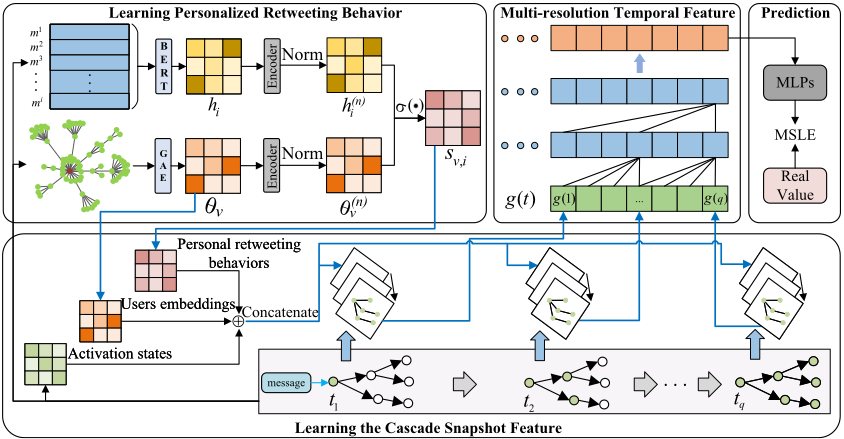
In this section, we propose a novel and comprehensive framework CasMS to predict popularity, which tackles the aforementioned challenges simultaneously. The CasMS framework, as depicted in Figure 1, consists of four essential components: (1) Modeling Personalized Retweeting Behaviors: We dedicate this component to extracting the feature of personalized retweeting behaviors. (2) Learning Cascade Snapshot Feature: This component integrates the personalized retweeting behaviors with message diffusion models to extract the cascade snapshot feature. (3) Learning MultiResolution Temporal Feature: Leveraging a temporal convolutional network, this component facilitates the learning of the temporal feature of the message cascade. (4) Joint PredictionModule: This component takes the temporal cascade features as input and uses multi-layer perceptrons (MLPs) to predict popularity. In the subsequent sections, we provide detailed explanations of each component.
4.1 Learning Personalized Retweeting Behavior
To extract the personalized retweeting behavior feature, we need the features of messages and the users' social influence. Message feature extraction: The potential popularity of a message is determined by its contents. Additionally, users tend to retweet messages that revolve around specific topics reflecting his/her interests. To extract the features of message contents, we have employed Bidirectional Encoder Representations from Transformers (BERT) [Devlin et al., 2018], an esteemed semantic model in the natural language processing field. While alternative more complex pre-trained models like XLNet [Yang et al., 2019] and UniLM [Dong et al., 2019] also exist for extracting message features, their marginal gains in our specific task are minor. Therefore, BERT is sufficient for the feature extraction task. In our experiments, we utilized the RoBERTa-wwm-ext-large 1 (an open enhanced version of BERT) as the input module, from which we extracted the feature hi of message mi as
1 https://github.com/ymcui/Chinese-BERT-wwm
User feature extraction: Users' characteristics can be derived from profile tags, such as age, gender, and interests, as well as the social network structure. In our dataset, we only have access to the network structure. Therefore, we utilize this structural feature alone to represent users' characteristics.
To obtain the node embeddings, we adopt the Skip-grambased model [Mikolov et al., 2013]. Let us consider a network G = (V, E), where V represents the set of nodes and E represents the set of edges. The objective function [Perozzi et al., 2014; Grover and Leskovec, 2016] optimized by the Skip-gram model with negative sampling is as follows:
where σ(x) = 1/(1 + exp(-x)) denotes the sigmoid function, k signifies the negative sampling rate and P indicates the negative sampling distribution (We use the uniform distribution in the experiments). The objective of the above equation is to learn a d-dimensional representation θv ∈ Rd for each user v. We employ a |V | × d matrix Θ to represent the social influence representations of all users.
In our framework, the social representation is initially computed based on Eq. 2 and serves as input for the next module. Characterizing personalized retweeting behavior: The retweeting behavior of users is influenced by both textual features of messages and user features derived from network structures. In order to quantify the likelihood of a user retweeting a message, we employ the dot product between the message feature and the user feature. However, since the dimensions of the message feature and user feature differ, it is necessary to align the two dimensions. We employ a neural network module to first compress each feature to the same dimension - namely, hi for the message feature and θv for the user feature. This compression is achieved using multilayer perceptron modules in Eq. 3, parameterized by ϕ and ψ, both of which yield an output dimension of 64. After compressing, the normalized features undergo dot product computation in Eq. 4, followed by a sigmoid function σ(·) to ensure similarity values in the range of (0, 1). The resulting output sv,i signifies the probability that user v will retweet message i.
The parameters in the module of users' personalized retweeting behavior are trained together with the popularity prediction task.
4.2 Learning the Cascade Snapshot Feature
The cascade snapshot of a message mi records the cascade sequence of activated nodes until time t, i.e., {(uij , vij , tij )|tij ≤ t}. In the cascade model, each user has personalized retweeting behavior and is influenced by his/her neighbors.
In this module, the GCN [Kipf and Welling, 2016] is utilized to describe the cascade model and extract snapshot features. Let av = 1(0) represents whether node v is activated(inactivated). The input attribute of a node v is the concatenation of node (user) embedding feature, activation state av, personalized retweeting behavior sv,i, and other hidden parameters (denoted by η ∈ Rr×1 ),
where xv,0 has dimension (d + r + 2) × 1. The feature matrix X0 of all nodes is constructed, where each row represents a user's attribute. In the GCN, the features are aggregated from the local neighborhood and combined as,
where Xl represents features in different layers and we set Xl(l ̸= 0) the same dimension with X0, A(l) (·) and C (l) (·) are the aggregation function and combine function parameterized by Wl and bl respectively, K = 5 in the experiment. The elements sv,i denote the likelihood of a user towards a message, while η encodes the unknown features in the snapshot. GCN has been widely applied in various tasks, including information diffusion estimation [Chamberlain et al., 2021; Xia et al., 2021; Ko et al., 2020], graph source localization [Wang et al., 2022; Ling et al., 2022b], and graph analogical reasoning [Ling et al., 2022a]. In the module, GCN is leveraged to characterize the underlying diffusion model and extract the snapshot features.
Notably, the element av in Xl represents the probability of user v being activated. Let Xl(av) represent the element av in Xl. To consider the activation probability increment caused by neighbors, an additional variable av,l is introduced for each node v and each layer l. The activation probability av,l is calculated as the sum of av,l-1 and Xl(av), constrained to be no greater than 1,
In fact, Xl(av) represents the probability increment of user v. Theorem 1 (Monotonicity of activation probability elements av,l). For any GCN-based diffusion model, the activation probability elements av,l are monotonic and nondecreasing for all nodes and all layers, assuming that C(l) (·) in Eq. 8 is a non-negative function.
Proof: The graph convolutional network can be represented as the iterationA(1) ◦(C (1) ◦A(2) ◦C (2) ...◦A(K) ◦C (K) ). Since C (l) (·)∀l = 1, 2, .., k are non-negative, Xl = C (l) (ol; bl) ≥ 0 and Xl(av) ≥ 0. Given that y = min{x, 1} is a nondecreasing function, we can conclude that av,l is monotonic and non-decreasing.□
It is worth noting that many neural units, such as sigmoid, ReLU, satisfy the non-decreasing and non-negative properties of C(l) (·) in Theorem 1. The cascade snapshot feature module takes cascade snapshots, users' features, and personalized retweeting behavior as inputs, and extracts the snapshot features using the stacked GCN. The output of the module is the concatenation of nodes' feature in the last layer Xl of GCN and the potential activation probability vector of the last layer al = [a1,l, ..., av,l, ..., a|V |,l].
Remark: The cascade snapshot feature module differs from the classical GCN in three perspectives: (1) Users' personalized retweeting behavior is explicitly included in the input. (2) The input user features are pretrained from the network embedding module, as opposed to being optimized by the final task in prior works. (3) The activation probability av,l is ensured to be monotonic and non-decreasing by utilizing non-negative neural units.
4.3 LearningMulti-resolution Temporal Feature
The temporal feature of the cascade dynamics is crucial for predicting popularity. In this module, we employ a Temporal Convolutional Network (TCN) [Lea et al., 2017] to extract multi-resolution temporal features. Unlike previous researches that mainly used LSTM [Hochreiter and Schmidhuber, 1997] for processing time series data, recent studies have demonstrated that TCN outperforms LSTM. This is because TCN, based on the traditional convolutional neural network, possesses a longer effective memory than LSTM. As a result, TCN is capable of capturing more distant and comprehensive information in time series data.
To handle the temporal cascade data, we first split the cascade records into q time-interval uniform snapshots. For each snapshot, denoted by g(t) = [F latten(Xl), al], we calculate the snapshot feature. Here, g(t) represents the concatenation of the last layer of Graph Convolutional Network (GCN) and the activation probability vector al. The resulting number q of snapshot features construct the time series input of the TCN, namely, g(1), g(2), ..., g(t), ..., g(q).
Next, we use the classical dilated causal TCN on the time series input. Let f = (f1, f2, ..., fz) be the convolution kernel, and d be the expansion factor of the dilation convolution. The dilated causal convolution is given by the equation
4.4 Joint PredictionModule
Joint feature extraction: The proposed framework incorporates three key components: message content features, users' social influence, and a multi-resolution temporal cascade. Firstly, the users' social influence feature is computed based on social network embedding using Eq. 2. Importantly, this social influence feature is shared among all cascades and is only calculated once within the framework. Secondly, given a set of temporal cascade records, we extract the content feature using the message feature module. Additionally, we leverage Eqs. 3-5 to determine users' personalized retweeting behavior in relation to the message. Thirdly, we split the cascade records into uniform snapshots and extract the multiresolution temporal feature jointly using the cascade snapshot module and the multi-resolution temporal module. The output of the multi-resolution temporal module is fed into the final prediction module to predict the popularity.
Prediction module: We employ the multi-layer perceptrons (MLPs) as our prediction module. The MLPs take the output from the multi-resolution temporal module as input and consists of two hidden layers. Its output has only one neural unit activated by ReLU function and corresponds to the predicted popularity increment, denoted as ̂ ∆Rit . We adopt the Mean Squared Logarithmic Error (MSLE) as the loss function, which is defined as follows:
where Lreg is the regularization term for the parameters.
Regarding prediction in message generation stage: In the message generation stage, we assume that a user v generates a message mi and aims to evaluate the popularity prior to posting it. Within our framework, we set that the cascade record consists of only one element, denoted as C i , specifically as C i = {(vi0 , vi0 , ti0 = 0)}. To ensure consistency in our analysis, we divide the cascade records into q time-interval uniform snapshots. In this process, we designate the first q - 1 snapshots as empty, while allowing the last snapshot to contain one element from C i . By implementing these precise settings, our framework is capable of predicting the potential popularity during the message generation stage.
Regarding prediction in short-term and long-term periods: To predict the popularity across different time periods, distinct sets of model parameters are trained under different ∆t. The experiment involves training three categories of model parameters specifically for short-term, medium-term, and long-term time predictions, respectively.
5 Experiment
5.1 Datasets
We use four real-world datasets in the experiments, including three public datasets and a private dataset collected by ourselves: (1) Twitter [Weng et al., 2013] contains the tweets published between Mar 24 and Apr 25, 2012 on Twitter and their retweets during this period. (2) Weibo2016 [Cao et al., 2017] was collected on Sina Weibo in China on July 1, 2016. Every cascade in this dataset represents the cascade process of a post. (3) APS 2 is the citation relationships before 2017 on American Physical Society (APS). The cascade in this dataset represents citation behavior. (4) Weibo2022 is a Sina Weibo dataset we collected ourselves between December 1, 2022 and June 1, 2023. For all datasets, we randomly sample 70% as training data, 15% for validation, and the rest for testing. Table 1 shows the statistics of the datasets.
5.2 Baselines
We compare our approach with 10 baseline methods: (1) Feature-Linear is a feature-based approach that takes the features of users and messages as input and uses the linear classifier to predict the popularity. (2) Feature-Deep is also a feature-based approach. It uses the multilayer perceptron to predict the popularity, with neural layers 64-16-1. (3) DeepCas [Li et al., 2017] is the first end-to-end model for the problem. (4) DeepHawkes [Cao et al., 2017] integrates deep learning and point processes to predict cascades. (5) CasCN [Chen et al., 2019] treats each cascade as a graph sequence and uses the GCN and LSTM to learn cascade representations. (6) TempCas [Tang et al., 2021] designs a sequence model to learn macroscopic temporal patterns on the cascade graph. (7) CasFlow [Xu et al., 2021] combines the users' representations and cascade features based on GRU and VAE to get representations of cascades. (8) TCAN [Sun et al., 2023a] integrates the explicit time embedding and attention mechanism to fully learn the representation of cascade graphs and cascade sequences. (9) CasTformer [Sun et al., 2023b] utilizes the transformer mechanism to capture diverse cascade prediction. (10) CTCP [Lu et al., 2023] uses a continuoustime graph learning method for cascade prediction.
2 https://journals.aps.org/datasets
| #Datasets | #Users | #Cascades | #Retweets |
|---|---|---|---|
| 578,913 | 88,440 | 7,998,380 | |
| Weibo2016 | 6,738,040 | 119,313 | 15,311,973 |
| APS | 616,316 | 207,685 | 3,304,400 |
| Weibo2022 | 2,171,833 | 746,826 | 8,435,052 |
5.3 EvaluationMetrics
We choose three widely used evaluation metrics: Mean Squared Logarithmic Error (MSLE), Mean Absolute Percentage Error (MAPE) and R-Squared (R2 ) [Sun et al., 2023b].
5.4 Experimental Settings
In the temporal feature module, we utilize two convolutional layers with expansion factors d = {2, 3} respectively to extract multi-resolution temporal features. In the prediction module, we utilize the traditional l2 norm as the regularization function Lreg and set λ = 0.001. In short-term prediction, the time ∆t are 4 days for Twitter, 3 hours for Weibo2016, and 3 years for APS. As for long-term prediction, the time ∆t are 32 days for Twitter, 24 hours for Weibo2016, and 20 years for APS. The code is available on https://anonymous.4open.science/r/CasMS-B8F7.
5.5 Performance Comparison
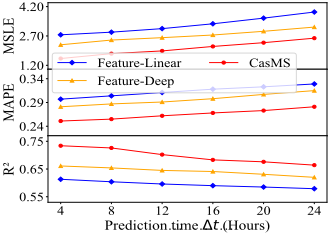
Prediction in the message generation stage: In the stage of message generation, the observation cascade is empty, hence the prediction can only rely on the message content feature and social graph feature. Among the baseline methods, only Feature-Linear and Feature-Deep are applicable in this scenario. Figure 2 shows the predictive performance of our proposed approach, compared with Feature-Linear and Feature-Deep methods, in the dataset Weibo2022. In fig. 2, our method demonstrates a significant improvement over the baseline methods in the message generation stage. By capturing users' personalized retweeting behavior, our approach excels at predicting the popularity of different messages during the message generation stage.
| Dataset | Weibo2016 | APS | ||||||||||||||||
|---|---|---|---|---|---|---|---|---|---|---|---|---|---|---|---|---|---|---|
| Time t | 1 Day | 2 Days | 0.5 Hour | 1 Hour | 3 Years | 5 Years | ||||||||||||
| Metrics | MSLE | MAPE | R2 | MSLE | MAPE | R2 | MSLE | MAPE | R2 | MSLE | MAPE | R2 | MSLE | MAPE | R2 | MSLE | MAPE | R2 |
| Feature-Linear | 7.615 | 0.672 | 0.376 | 5.778 | 0.641 | 0.405 | 3.517 | 0.297 | 0.372 | 3.325 | 0.283 | 0.402 | 1.583 | 0.254 | 0.356 | 1.496 | 0.223 | 0.381 |
| Feature-Deep | 6.983 | 0.632 | 0.397 | 5.366 | 0.613 | 0.426 | 2.928 | 0.289 | 0.411 | 2.746 | 0.277 | 0.438 | 1.511 | 0.231 | 0.387 | 1.466 | 0.209 | 0.406 |
| DeepCas2017 | 11.587 | 0.691 | 0.081 | 9.283 | 0.665 | 0.095 | 4.142 | 0.301 | 0.242 | 3.829 | 0.288 | 0.261 | 1.966 | 0.289 | 0.072 | 1.785 | 0.256 | 0.089 |
| DeepHawkes2017 | 6.045 | 0.605 | 0.529 | 4.295 | 0.581 | 0.574 | 2.819 | 0.295 | 0.482 | 2.632 | 0.279 | 0.512 | 1.388 | 0.246 | 0.405 | 1.213 | 0.211 | 0.421 |
| CasCN2019 | 6.520 | 0.661 | 0.418 | 5.187 | 0.631 | 0.450 | 2.635 | 0.306 | 0.426 | 2.522 | 0.295 | 0.453 | 1.684 | 0.257 | 0.348 | 1.421 | 0.219 | 0.373 |
| TempCas2021 | 4.071 | 0.606 | 0.579 | 3.977 | 0.577 | 0.610 | 2.583 | 0.312 | 0.541 | 2.497 | 0.289 | 0.575 | 1.534 | 0.262 | 0.327 | 1.396 | 0.223 | 0.353 |
| CasFlow2021 | 3.956 | 0.589 | 0.586 | 3.794 | 0.559 | 0.627 | 2.232 | 0.297 | 0.567 | 2.160 | 0.282 | 0.598 | 1.483 | 0.255 | 0.375 | 1.253 | 0.217 | 0.401 |
| TCAN2023 | 3.671 | 0.574 | 0.607 | 3.529 | 0.537 | 0.638 | 2.152 | 0.289 | 0.584 | 2.007 | 0.276 | 0.603 | 1.365 | 0.244 | 0.412 | 1.121 | 0.206 | 0.427 |
| CasTformer2023 | 3.517 | 0.536 | 0.616 | 3.401 | 0.515 | 0.649 | 2.115 | 0.276 | 0.613 | 1.956 | 0.264 | 0.641 | 1.434 | 0.254 | 0.423 | 1.227 | 0.218 | 0.451 |
| CTCP2023 | 3.474 | 0.529 | 0.621 | 3.387 | 0.506 | 0.655 | 2.009 | 0.285 | 0.639 | 1.800 | 0.269 | 0.664 | 1.313 | 0.247 | 0.429 | 1.112 | 0.211 | 0.469 |
| CasMS (ours) Improvement | 3.171 8.7%↑ | 0.512 3.2%↑ | 0.655 5.4%↑ | 3.044 10.1%↑ | 0.484 4.4%↑ | 0.683 4.2%↑ | 1.821 9.4%↑ | 0.264 4.3%↑ | 0.684 7.1%↑ | 1.606 10.8%↑ | 0.246 6.9%↑ | 0.734 10.5%↑ | 1.159 11.8%↑ | 0.235 3.9%↑ | 0.477 11.1%↑ | 0.971 12.7%↑ | 0.197 4.6%↑ | 0.502 7.1%↑ |
Prediction in the short-term and long-term periods: Table 2 presents the prediction comparison of our method against 10 baseline methods. Table 2 clearly indicate that our method consistently outperforms the existing approaches with error bars less than 1%. Our method achieves an average improvement of over 10% for the MSLE metric. This notable improvement can be attributed to the characterization of personalized retweeting behavior and the incorporation of multiresolution temporal feature extraction in our model. Notably, our method outperforms all other methods across various observation time windows and prediction time periods. Considering the consistent agreement of the results for other prediction time periods ∆t with those presented in Table 2, we omit them due to space limitations.
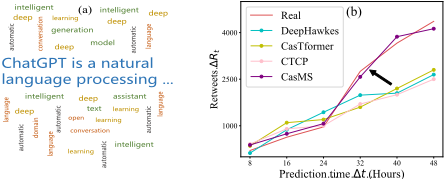
A case study: We chose one popular message from Weibo2022 with burst cascades and predicted its popularity at different prediction time periods in fig. 3. In fig. 3, the number of real retweets (colored red line) experiences a sharp surge during the time interval [24, 32]. Traditional approaches, which predict a smooth increase in popularity, fail to capture this sudden burst. In contrast, our method intriguingly anticipates such a burst during the aforementioned period, which indicates the effectiveness of our model.
Ablation study: We examine the predictive performance of CasMS by comparing it with various modifications on Twitter, Weibo2016, and APS. Here, we explore the impact of submodules on the overall prediction performance: (1) CasMS-UF removes user feature extraction. (2) CasMSPR removes personalized retweeting behavior module. (3) CasMS-LT replaces the TCN of CasMS with LSTM.
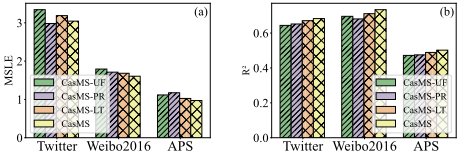
From fig. 4, we observe that: (1) Based on CasMS-UF, the user feature module provides a comprehensive depiction of users, thereby improving predictive performance. (2) Based on CasMS-PR, users' personalized retweeting behaviors allow us to decipher their preferences for different kinds of messages. (3) Based on CasMS-LT, TCNdemonstrates a substantial advantage over LSTM in effectively capturing cascade temporal features.
6 Conclusion
In this study, we studied the problem of cascade prediction in the message generation phase, as well as predictions for different time periods. Our methodology initially captures users' personalized retweeting behavior. We combine GCN and TCN to generate the multi-resolution features. Specifically, GCN extracts cascade features in social graphs, while TCN captures temporal features. The proposed method's effectiveness is demonstrated through extensive experiments conducted on four real-world datasets.
Our present model primarily accommodates static graphs and purely textual communications. We plan to generalize the model to dynamic, evolving graphs, as well as messages enriched with images and a broader spectrum of multimedia content. and future research.
Ethical Statement
There are no ethical issues.
Acknowledgments
The authors acknowledge financial support from the Shenzhen Fundamental Research-General Project (Grant Nos. 20220811155803001, JCYJ20190808162601658), National Natural Science Foundation of China (Grant Nos. 62276171, 62002233, 61972145), Guangdong Basic and Applied Basic Research Foundation (Grant Nos. 2024A1515011938 and 2020B1515120028), Guangdong Peral River Recruitment Program of Talents (Grant Nos. 2019ZT08X603), and Swiftlet Fund Fintech funding, Gang Liu is the corresponding author.
@inproceedings{ijcai2024p287,
  title     = {Modeling Personalized Retweeting Behaviors for Multi-Stage Cascade Popularity Prediction},
  author    = {Zhou, Mingyang and Lin, Yanjie and Liu, Gang and Li, Zuwen and Liao, Hao and Mao, Rui},
  booktitle = {Proceedings of the Thirty-Third International Joint Conference on
               Artificial Intelligence, {IJCAI-24}},
  publisher = {International Joint Conferences on Artificial Intelligence Organization},
  editor    = {Kate Larson},
  pages     = {2598--2606},
  year      = {2024},
  month     = {8},
  note      = {Main Track},
  doi       = {10.24963/ijcai.2024/287},
  url       = {https://doi.org/10.24963/ijcai.2024/287},
}
TY - CPAPER TI - Modeling Personalized Retweeting Behaviors for Multi-Stage Cascade Popularity Prediction AU - Zhou, Mingyang AU - Lin, Yanjie AU - Liu, Gang AU - Li, Zuwen AU - Liao, Hao AU - Mao, Rui T2 - Proceedings of the Thirty-Third International Joint Conference on Artificial Intelligence, IJCAI-24 PB - International Joint Conferences on Artificial Intelligence Organization PY - 2024 SP - 2598 EP - 2606 DO - 10.24963/ijcai.2024/287 UR - https://doi.org/10.24963/ijcai.2024/287 ER -Copied
Machine-readable versions of this paper, for tools and AI agents:





