
Optimizing Viscous Democracy
Proceedings of the Thirty-Third International Joint Conference on Artificial Intelligence. Main Track. Pages 2643-2650.
https://doi.org/10.24963/ijcai.2024/292
Keywords
- Game Theory and Economic Paradigms: GTEP: Computational social choice
- Agent-based and Multi-agent Systems: MAS: Agent-based simulation and emergence
- Multidisciplinary Topics and Applications: MTA: Web and social networks
Abstract
Viscous democracy is a generalization of liquid democracy, a social choice framework in which voters may transitively delegate their votes. In viscous democracy, a "viscosity" factor decreases the weight of a delegation the further it travels, reducing the chance of excessive weight flowing between ideologically misaligned voters.
We demonstrate that viscous democracy often significantly improves the quality of group decision-making over liquid democracy. We first show that finding optimal delegations within a viscous setting is NP-hard. However, simulations allow us to explore the practical effects of viscosity. Across social network structures, competence distributions, and delegation mechanisms we find high viscosity reduces the chance of ``super-voters'' attaining large amounts of weight and increases the number of voters that are able to affect the outcome of elections. This, in turn, improves group accuracy as a whole. As a result, we argue that viscosity should be considered a core component of liquid democracy.
- [Albert and Barabási, 2002] Réka Albert and Albert-László Barabási. Statistical mechanics of complex networks. Re- views of modern physics, 74(1):47, 2002.
- [Alouf-Heffetz et al., 2022] Shiri Alouf-Heffetz, Ben Arm- strong, Kate Larson, and Nimrod Talmon. How should we vote? a comparison of voting systems within social net- works. In Proceedings of IJCAI '22, pages 31-38, 2022. IJCAI
- [Armstrong et al., 2024] Ben Armstrong, Shiri Alouf- Heffetz, and Nimrod Talmon. Optimizing vis- cous democracy. https://benarmstrong.ca/assets/pdf/ IJCAI2024-Optimizing-Viscous-Democracy.pdf, 2024. Preprint. Link
- [Battiston et al., 2020] Federico Battiston, Giulia Cencetti, Iacopo Iacopini, Vito Latora, Maxime Lucas, Alice Pata- nia, Jean-Gabriel Young, and Giovanni Petri. Networks beyond pairwise interactions: Structure and dynamics. Physics Reports, 874:1-92, 2020.
- [Becker et al., 2021] Ruben Becker, Gianlorenzo D'Angelo, Esmaeil Delfaraz, and Hugo Gilbert. When can liquid democracy unveil the truth? CoRR, abs/2104.01828, 2021.
- [Berkhin, 2005] Pavel Berkhin. A survey on pagerank com- puting. Internet mathematics, 2(1):73-120, 2005.
- [Bloembergen et al., 2019] Daan Bloembergen, Davide Grossi, and Martin Lackner. On rational delegations in liquid democracy. In Proceedings of AAAI '19', volume 33, pages 1796-1803, 2019.
- [Blum and Zuber, 2016] Christian Blum and Christina Isabel Zuber. Liquid democracy: Potentials, problems, and per- spectives. Journal of Political Philosophy, 24(2):162-182, 2016.
- [Boldi et al., 2011] Paolo Boldi, Francesco Bonchi, Carlos Castillo, and Sebastiano Vigna. Viscous democracy for social networks. Communications of the ACM, 54(6):129- 137, 2011.
- [Boldi et al., 2015] Paolo Boldi, Corrado Monti, Massimo Santini, and Sebastiano Vigna. Liquid fm: recommend- ing music through viscous democracy. arXiv preprint arXiv:1503.08604, 2015.
- [Brill and Talmon, 2018] Markus Brill and Nimrod Talmon. Pairwise liquid democracy. In Proceedings of IJCAI '18, volume 18, pages 137-143, 2018.
- [Burkardt, 2014] John Burkardt. The truncated normal dis- tribution. Department of Scientific Computing Website, Florida State University, pages 1-35, 2014.
- [Caragiannis and Micha, 2019] Ioannis Caragiannis and Evi Micha. A contribution to the critique of liquid democracy. In IJCAI, pages 116-122, 2019.
- [Dey et al., 2021] Palash Dey, Arnab Maiti, and Amatya Sharma. On parameterized complexity of liquid democ- racy. In Proceedings of CALDAM '21, pages 83-94, 2021.
- [Erdos et al., 1960] Paul Erdos, Alfréd Rényi, et al. On the evolution of random graphs. Publ. Math. Inst. Hung. Acad. Sci, 5(1):17-60, 1960.
- [Escoffier et al., 2019] Bruno Escoffier, Hugo Gilbert, and Adèle Pass-Lanneau. The convergence of iterative dele- gations in liquid democracy in a social network. In Pro- ceedings of SAGT '19, pages 284-297, 2019.
- [Gonzalez, 1985] Teofilo F. Gonzalez. Clustering to mini- mize the maximum intercluster distance. Theoretical Com- puter Science, 38:293-306, 1985.
- [Green-Armytage, 2015] James Green-Armytage. Direct voting and proxy voting. Constitutional Political Econ- omy, 26:190-220, 2015.
- [Grofman et al., 1983] Bernard Grofman, Guillermo Owen, and Scott L Feld. Thirteen theorems in search of the truth. Theory and decision, 15(3):261-278, 1983.
- [Halpern et al., 2021] Daniel Halpern, Joseph Y Halpern, Ali Jadbabaie, Elchanan Mossel, Ariel D Procaccia, and Manon Revel. In defense of liquid democracy. arXiv preprint arXiv:2107.11868, 2021.
- [Hassan and De Filippi, 2021] Samer Hassan and Primavera De Filippi. Decentralized autonomous organization. Inter- net Policy Review, 10(2):1-10, 2021.
- [Jain et al., 2022] Pallavi Jain, Krzysztof Sornat, and Nim- rod Talmon. Preserving consistency for liquid knapsack voting. In Proceedings of ECAI '22, pages 221-238, 2022.
- [Kahng et al., 2021] Anson Kahng, Simon Mackenzie, and Ariel Procaccia. Liquid democracy: An algorithmic perspective. Journal of Artificial Intelligence Research, 70:1223-1252, 2021.
- [Kleinberg, 2010] Jon Kleinberg. Ect volume 26 issue 5 cover and back matter. Econometric Theory, 26(5):b1-b4, 2010.
- Kenneth O May. A set of independent neces- sary and sufficient conditions for simple majority decision. Econometrica: Journal of the Econometric Society, pages 680-684, 1952.
- [Paulin, 2020] Alois Paulin. An overview of ten years of liq- uid democracy research. In DG.O '20, pages 116-121, 2020.
- [Shapiro, 2018] Ehud Shapiro. Point: foundations of e- democracy. Communications of the ACM, 61(8):31-34, 2018.
- [Zhang and Grossi, 2021] Yuzhe Zhang and Davide Grossi. Power in liquid democracy. In Proceedings AAAI '21, vol- ume 35, pages 5822-5830, 2021.
References were extracted automatically from the PDF and may contain errors.
Full text extracted automatically from the PDF; figures, tables and equations may differ. The PDF is the version of record.
1 Introduction
Liquid democracy [Blum and Zuber, 2016], an evolving concept in democratic theory, seeks to address the limitations of traditional direct and representative democracy by enabling flexible delegation of voting power. To do so, in liquid democracy, individuals choose between casting their votes directly or delegating their voting power to another voter of their choice. In contrast to simple proxy voting [GreenArmytage, 2015], delegations are transitive and a delegation may "flow" through many voters. By merging the strengths of direct democracy and representative decision-making, liquid democracy enhances epistemic decision-making by incorporating diverse perspectives and informed opinions.
We study a generalization of liquid democracy - viscous democracy [Boldi et al., 2011] - which effectively limits the maximum weight voters can attain. In this variant, vote weights decrease exponentially the further a delegation travels. This "viscosity" in the computation of the vote weights has its roots in random walks and the PageRank algorithm [Berkhin, 2005]. Viscous democracy offers a compromise between the advantages of delegation and direct voting, potentially curbing excessive concentration of power while maintaining the flexibility core to liquid democracy.
Here, we are interested in quantifying the potential benefit of adding viscosity to liquid democracy. A pivotal factor in this assessment is the dampening factor or "viscosity" - denoted by α throughout the paper - which governs the rate of weight decay as delegation chains lengthen. As we show, the influence of α extends beyond decision quality, affecting the overall structure of those delegation graphs that achieve a high quality of decision making. We are interested in identifying suitable values of α generally and for specific settings. Specifically, we seek to unravel the relationship between the value of α and the quality of decision making, as well as exploring how α shapes the topology of optimal delegations.
In this paper we adopt a dual approach, employing analytical and theoretical methodologies, as well as computer-based simulations. Theoretical analyses provide insights into the fundamental dynamics and properties of viscous democracy; simulations, on the other hand, offer a tangible platform for observing the empirical behavior of viscous democracy under varied conditions, facilitating a more realistic assessment of its outcomes and interactions. The combination of these approaches enriches our understanding of the complex interactions within the system of viscous democracy.
We view our work as fundamental to the better understanding of viscous democracy; as such, it paves the way to tools that can optimally parameterize viscous democracy in different settings, setting the dampening parameter α based on the specific properties of the setting at hand. As we show, the improvement to the quality of decision making from viscosity is frequently significant.
Remark 1. The introduction of viscosity to liquid democracy is a deviation from the principle of "one person, one vote" which, therefore, may render it inappropriate for democratic contexts in which equality in voting is essential [Shapiro, 2018]. We show, however, that it does prove advantageous in other applications; in particular, in those that prioritize prediction accuracy (e.g., a group prediction regarding the price of some stock), group recommendation (the application discussed alongside the introduction of viscous democracy [Boldi et al., 2011]), and other, general collaborative settings (e.g., a collaborative venture capital such as The DAO [Hassan and De Filippi, 2021]). In these scenarios due to varying levels of competence in the population around different topics of discussion - the nuanced decision-making facilitated by viscosity enhances collective intelligence, allowing for better decision making.
2 RelatedWork
By now, there is a relatively large corpus of literature on liquid democracy. This includes works that study liquid democracy from a political science perspective [Blum and Zuber, 2016; Paulin, 2020]; from an algorithmic point of view [Kahng et al., 2021; Dey et al., 2021; Caragiannis and Micha, 2019]; from a game-theoretic point of view [Zhang and Grossi, 2021; Bloembergen et al., 2019; Escoffier et al., 2019]; and from an agenda aiming to increase the expressive power that is granted to voters [Brill and Talmon, 2018; Jain et al., 2022].
This work concentrates on the epistemic approach to social choice; we assume some ground truth of the decision to be made and evaluate the accuracy of the voting system at revealing ground truth using a common model for epistemic liquid democracy [Alouf-Heffetz et al., 2022; Kahng et al., 2021; Caragiannis and Micha, 2019; Halpern et al., 2021].
Viscous democracy is relatively under-studied within liquid democracy. The original paper on the topic [Boldi et al., 2011] establishes some intuition and a relation to the PageRank algorithm [Berkhin, 2005]; but there is no analysis regarding the effect of one specific value of the dampening factor compared to another, nor is there analysis discussing how to choose the factor. Viscous democracy was also applied as a setting for group recommendation system [Boldi et al., 2015].
3 Model
Our formal model describes how voters are embedded in an underlying social network, how they may delegate, and how group decisions are ultimately made.
3.1 Delegation Graphs
We adopt a basic epistemic social choice setting with n voters, V = {v1, . . . , vn}, and two alternatives A = {a+, a-}. We assume that a+ is an objectively correct outcome that all voters collectively aim to elect. Each voter vi ∈ V has a competency level qi ∈ Q in the range [0, 1] that corresponds to the probability that vi would vote "correctly" (i.e., would vote for a+). Voters are connected via an underlying social network G = (V, E) with a set of undirected edges E representing the connections between voters (where delegations can occur as direct arcs only along these connections).
Our model generalizes liquid democracy - a system enabling transitive delegations. Each voter vi is able to perform one of two actions: They may vote directly, as above, supporting a+ with probability qi, or they may delegate their vote to a voter in their set of neighbours, NG(i) = {j ∈ V |(i, j) ∈ E}. If a voter votes directly, then we refer to them as a guru and model them as delegating to themselves.
A delegation function d : V → V outputs the delegation of each voter. d(vi) = vj indicates that vi delegates to vj. Delegation applies transitively so that a delegation might "travel"
several hops before reaching a guru. d∗ (vi) refers to the repeated application of d(vi) until a self-delegation (i.e. a guru) is reached. The guru of vi is d∗ (vi) and denote the set of all gurus as G(V ). We disallow any delegation from vi to vj that would result in a cycle.This is done to prevent loss of votes within the voting process. In our experiments we choose a fixed proportion of voters to delegate while the remainder vote directly.
Note that a delegation function induces a directed subgraph of G containing (directed versions of the) edges in E only when a delegation flows between the two nodes of an edge. We call this a delegation graph of G, denoted D = (V, {(i, j) ∈ E|d(i) = j}). A delegation graph can be conceived of as a forest of directed trees, where all edges in each tree flow towards the singular guru in that tree.
3.2 VoteWeights
In "traditional" liquid democracy, the weight of each guru is equal to the number of delegations it receives, either directly or indirectly. This paper builds upon a model introduced by Boldi et al. referred to as viscous democracy [Boldi et al., 2011]. Each edge that a delegation travels reduces its weight by a constant dampening factor α ∈ [0, 1], also referred to as the viscosity. Thus, the weight of each voter vi is,
where Path (-, i) denotes all paths of delegations that reach vi. Note the following:
- When α = 1, viscous democracy reduces to the standard liquid democracy setting.
- At lower values of α, guru weights change based upon the structure of the delegation graph. Weights of voters that are further away from their guru decrease more than the weights of voters close to the guru.
- As there are no cycles, there is at most one path between any two voters.
3.3 Group Accuracy
As there are only two alternatives, we use weighted plurality voting (following May's theorem [May, 1952]) to determine the winner of an election. Specifically, each guru selects one alternative, based upon their competence, and commits all of their weight to supporting that alternative. The alternative receiving the most total weight is the winner. The probability that a+ will be selected as the winner is referred to as group accuracy, or, simply accuracy.
Accuracy is a function of the delegations and the voter competencies but, crucially, it is also affected by α. We denote the accuracy of given viscosity, competencies, and delegations as Acc(α, Q, D). We refer to the value of α that maximizes group accuracy as α∗ . The existence of 0 < α∗ < 1 and the dynamics of α∗ are a major focus of this paper.
We can now formally specify an election by either of two forms (we use these interchangeably, as the first form implies the second):
- E = (Q,G, d): Here, an election is a combination of voter competencies, an underlying social network, and a delegation function which may be used to determine a delegation graph D; or
- E = (Q,D): Here, an election consists of voter competencies and an already existing delegation graph.
4 Families of Delegation Graphs
Throughout this paper we explore several different families of delegation graphs of two varieties: We first describe delegation graphs that are induced by the application of a delegation function to voters on a social network. Second, we introduce two simple delegation graph models that are constructed directly, without a specific delegation function, to serve as illustrative examples.
4.1 Social Networks
Our experiments explore two types of underlying social networks G that voters exist upon: both empirical and artificially-generated networks. The empirical networks we consider are collected from a variety of sources and detailed in [Armstrong et al., 2024].
To generate artificial networks we use two well-studied probabilistic models that are often used to replicate properties of real-world social networks [Kleinberg, 2010]: Erd˝os-R´enyi (ER) and Barab´asi-Albert (BA) networks. Both of these models are parameterized by the number of nodes and a parameter controlling their edge density [Erdos et al., 1960; Albert and Barab´asi, 2002]. Unless stated otherwise, voters are placed on social networks uniformly at random.
4.2 Delegation Functions
Delegation functions use a social network and the competence of each voter to determine, for each delegating voter, to whom they delegate. We define delegation probability functions p(vi, vj) as giving the probability that vi will delegate to vj. A delegation function d specifies a delegate for each voter based upon p(vi, vj). Our experiments consider several concrete delegation probability functions, defined formally in [Armstrong et al., 2024]:
- Max: Each delegating voter delegates to their most competent neighbour.
- Random Better: Each delegating voter delegates to a neighbour more competent than themselves chosen with uniformly random probability.
- Proportional Better: Each delegating voter delegates to a neighbour more competent than themselves chosen
Algorithm 1 Competence-Based Attachment (CBA)
Input: V, Q, G
- 1: S ←G
- 2: E ← ∅
- 3: D← (V,E)
- 4: while S ̸= V do
- 5: Select one voter vi ∈ V \ S uniformly at random.
- 6: Select one voter vj ∈ S with probability proportional to its relative competence; P(vj) ∝ qj ∑ vk∈Sqk
- 7: Attach: E ←E ∪ (vi, vj).
- 8: Update: S ←S ∪ {vi}.
- 9: end while
- with probability proportional to the competence of each potential guru.
- Proportional Weighted: Each delegating voter delegates to a neighbour more competent than themselves with probability proportional to the competence and weight of each potential guru, such that gurus with higher weight are less likely to receive delegations.
4.3 Delegation GraphModels
We also explore two directly-constructed graph families which we use to demonstrate the possible effects of changing viscosity. The first model is a natural adaptation of the model of preferential attachment while the second model generates very simple graphs that highlight some basic topological properties that affect the optimal viscosity.
- Competence-Based Attachment (CBA): This model creates a delegation graph by applying the idea of preferential attachment to voter competencies [Battiston et al., 2020]. Given voter competencies and some set of gurus the remaining voters select a delegate based upon the relative competence of each potential delegate. For completeness, Algorithm 1 outlines the procedure in more detail.
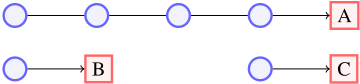
- Stars and Chains (SC): A basic structure parameterized by (s, scomp, ns, c, ccomp, nc). This model constructs a delegation graph consisting of s small star components each with ns - 1 delegators and 1 guru, and c large chains with nc - 1 delegators. Gurus are thus located at the center of the stars and at one end of the chains. Gurus in star and chain components have competence ccomp and scomp, respectively. Each chain component should have more voters than are in all star components combined, that is nc > sns (typically we have considered settings where nc = sns + 1 but that is not required). Figure 1 visualizes a simple SC delegation graph.
5 Optimal Delegation Graphs
Here we provide bounds on the complexity of finding delegations within a viscous setting that maximizes group accuracy. Informally, given a social network and some value of α, we are interested in the combinatorial problem of picking for each voter whether she will vote directly or whether she will delegate to some other voter, and, if so, to whom.
Definition 1. In the OPTIMAL DELEGATION GRAPH (ODG) problem we are given a network of voters G = (V, E) and the task is to find a subgraph D = (V, ED ⊆ E) that is a viable delegation graph of G (i.e. there are no cycles in D) and which maximizes the accuracy.
Next we analyze the computational complexity of ODG. First, note that, for the case of α, we can solve ODG in polynomial time.
Theorem 1. For α = 0, ODG is in P.
Proof. Observe that, for α = 0, setting a voter to delegate to some other voter effectively removes that voter, as no weight is transferred through delegation. Thus, to solve ODG we can iterate over k ∈ [n] ∪ {0}, which is the number of voters to remove. In particular, for each k ∈ [n] ∪ {0}, look for the k voters with the lowest accuracy and remove them (i.e. have them make arbitrary delegations). Now, compute the accuracy (this can be done in polynomial time using dynamic programming [Becker et al., 2021]). Finally, select the k for which the accuracy is the highest.
As all voters are equally weighted, it is always strictly better to include a more competent voter in place of a less competent voter and removing some number of least competent voters will solve ODG.
For α = 1, however, Caragiannis and Micha (2019) have shown that ODG is NP-hard.
Corollary 1. For α = 1, ODG is NP-hard. Furthermore, for this case, it is also NP-hard to approximate ODG to within a factor of 1/16 [Caragiannis and Micha, 2019].
Below, we provide the first results on the complexity of ODG for 0 < α < 1.
Theorem 2. For α = 1m ,m ∈ N, ODG is NP-Hard.
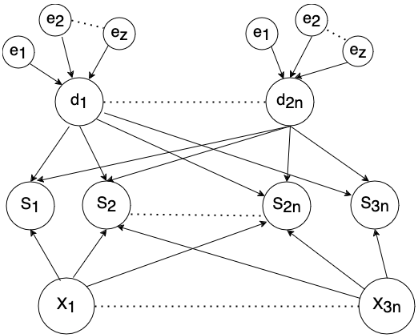
Proof. The proof follows a reduction from the NP-hard problem Restricted Exact Cover by 3-Sets (X3C) [Gonzalez, 1985] to ODG. An instance of X3C consists of a set X = {x1, .., x3n}, a family F = {S1, .., S3n} where each set Si has 3 elements fromX, and each element fromX appears in exactly 3 sets from F. The task is to decide whether a subfamily F ′ ⊂ F such that X = ⋃ Sj Sj ∈F ′ and Sj ∩ Si = ∅ exists.
We will construct the following instance for the ODG problem (see Figure 2):
- For each set S1, .., S3n we will have a voter Si with competence qSi > 0.5.
- For each element xi ∈ X we have 3 sets Si1 , Si2 , Si3 that xi appears in. We connect an outgoing edge to each Si from xi. The competence of xi is set to qxi = 0, ∀i ∈ 1, .., 3n.
- Lastly, we have a set of dummy voters d1, .., d2n with competence qd = 0 that are connected to all the the set voters S1, .., S3n with outgoing edges. Each dummy voter has peripherally a set of dummy voters ei1 , .., eiz that are connected to it. Each has competence of qe = 0, designed to incentivize the dummy voters to delegate otherwise they contribute negatively to the outcome of an election.
This completes the description of the reduction. Below we prove the two directions for correctness.
=⇒ Given a solution for the Restricted 3-Set Exact Cover F ′ = {Sj1 , Sj2 .., Sjn }, we shall delegate each xi to its corresponding Sj it appears in F ′ . There is only one such set Sjℓ because F ′ is an exact cover. Each of these Sj in layer 2 (see figure 2) voters now has a weight of 1 + 3α: weight from the node itself plus weight from three delegators, xj1 , xj2 , xj3 , that are each one hop away (and thus have their weight reduced by the viscosity factor). For the remaining 2n sets in layer 2 we shall delegate one dummy voter from d1, .., d2n to each set in layer 2 that is Sr ∈ F\F ′ , the matching is arbitrarily. Since each set Sr receives one dummy d voter delegation and further delegations from z peripheral e voters that travel an extra hop. Sr has a total weight of 1+α+z ·α2 . Thus, we set z = 2α then all the Si voters in the central layer have the same weight, w∗ = 1+3α. We know that this corresponds to the optimal weight distribution due to a direct application of Condorcet's Jury Theorem [Grofman et al., 1983]: Each Si has qSi > 0.5 so more active Si will monotonically increase group accuracy, and optimal weighted voting for when all Si have the same competence is equal weight distribution.
⇐= Next, we show that optimal delegation indeed leads to an exact cover. First we have to consider that the only voters that would be active are the {Si}, since they are solely the ones with positive competence. They all have the same competence, that is larger then 0.5, so an optimal outcome would take place when they all have equal weight, again (see [Grofman et al., 1983]). Distributing the total weight equally would mean each set voter Si would get one dummy voter dj with its associated voters ei1 , .., eiz or three delegations from x1, .., x3n voters. Since any other combination of voter delegations would mean some voters would receive excess weight and at least one voter would end up with less weight, thus causing a deviation from the optimal weight of w∗ = 1 + 3α. Note that we could achieve lower weight for di if any of the peripheral eij did not delegate, but since their competence is zero they must not be active voters in the optimal delegation graph as that would reduce group accuracy. Next we look at the sets Si that have incoming delegations from the first layer of xi and select those Si's to be our cover F ′ , we know that it satisfies all the condition to be a restricted exact 3 set cover for X.
Remark 2. Theorem 2 could be extended to any rational α = km by reducing from the X (k + 1) C problem (i.e., restricted exact cover with sets containing k + 1 elements, where each element x appear in exactly k + 1 sets). The construction follows similar steps; we then set z = m, which causes the optimal weight to be w∗ = 1 + (k + 1) · α for each set.
6 Some Pathological Cases Regarding α∗
We now concentrate on whether viscosity provides actual benefits to accuracy over liquid democracy. The standard model of liquid democracy used in most prior work only explores the situation where α = 1. In contrast, recall that α = 0 is a form of direct democracy where delegated votes become irrelevant as their weight is 0 and all gurus have equal weight. Viscous democracy lies in the middle between these two settings with 0 < α < 1. In this section we show that there exist many parameterizations of delegation graphs for which a different one of direct, liquid, and viscous democracy are strictly beneficial.
Note that accuracy is a piecewise function with respect to α: i.e., accuracy changes only when α causes a change in the sets of gurus that make up a majority of weight. This means that, typically, α∗ is not a unique value but rather a range of values. However, for simplicity we typically refer to it as a single value.
6.1 Liquid Democracy: α∗ = 1
We first show that there exist settings in which liquid democracy (i.e., where α∗ = 1) leads to optimal accuracy. Below we present an example where increasing α always weakly increases accuracy.
Example 1. Consider the delegation graph in Figure 1 with 3 chains of voters. Let qA = 0.9 and qB = qC = 0.4. When α = 1, wA = 5 and the outcome depends entirely on A's vote and, thus, group accuracy is 0.9. When α < 0.848, wA < wB +wC and accuracy drops to approximately 0.772.
6.2 Direct Democracy: α∗ = 0
We now show, for the topology of the delegation graph, a setting of competencies where lower values of α are weakly superior to higher values.
Example 2. Consider again the SC delegation graph of Figure 1. Let qA = 0.9 and qB = qC = 0.8. As before, when α = 1, group accuracy depends solely on A and is 0.9. In this case, however, decreasing α to the pivotal α = 0.848 causes accuracy to increase due to the relative strength of voters B and C. When α < 0.848, accuracy increases to approximately 0.928.
6.3 Viscous Democracy: 0 < α∗ < 1
In contrast to the previous examples we now present a simple example where accuracy is maximized when 0 < α < 1.
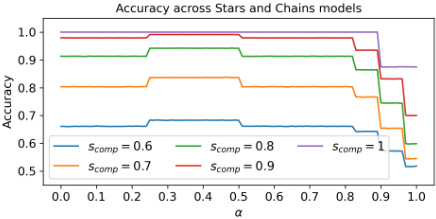
Example 3. Consider a SC delegation graph with s = 6, scomp = 0.8, ns = 5, c = 3, ccomp = 0.5, nc = 30. That is, 6 star components each with size 5 and 3 chain components each with size 30.
When 0 ≤ α < 0.25, the group accuracy is roughly 0.91. However, the weight of star components increases more quickly than that of chain components as α increases. For 0.25 ≤ α ≤ 0.5, accuracy becomes approximately 0.94. For higher values of α, the larger chain components begin to dominate and accuracy decreases. Here, α∗ ∈ [0.25, 0.5]. Figure 3 showcases a family in which non-extreme alpha (i.e., 0 < α∗ < 1) is optimal.
6.4 Intuition Regarding α∗
Here we have demonstrated, for the first time, the existence of settings where 0 < α∗ < 1; using the Stars and Chains delegation graph model. Intuitively, this graph structure leads to interesting dynamics as α changes due to the non-linearity in the corresponding changes in the weights of the gurus.
It is worthwhile to delve a little deeper into these graphs: Observe that the weight of a guru vs in a star component increases linearly with α: ws = 1 + nsα. On the other hand, the weight of a guru vc in a chain component increases based on the polynomial wc = 1 + α + α2 + α3 + ... with degree equal to the length of the chain. While this particular delegation structure is somewhat contrived, we believe similar structures may often occur in more realistic settings. In any setting where gurus receive the majority of their delegations at different distances from each other, there is the possibility that α < 1 may be weakly, if not strongly, optimal.
7 Experimental Analysis
We have shown by example that there exist delegation graphs with α∗ < 1. In this section we concentrate on the frequency with which α∗ is below 1. We examine first the CBA topology defined in subsection 4.3 and then consider how often delegation mechanisms on other randomly-generated and real-world social networks benefit from viscosity.
In order to understand α∗ under a wide range of settings, each of our experiments consider voters with competencies drawn from one of 3 distributions. These are often explored as 9 parameterizations of each distribution:
- (i) Uniform - Intervals of width 0.2 from U (0, 0.2) shifted up to U (0.8, 1) in equal steps of 0.1.
- (ii) Gaussian - µ ∈ {0.1, 0.2, ..., 0.9}, σ = 0.051
- (iii) Exponential - µ ∈ {0.1, 0.2, ..., 0.9}2
7.1 Calculating Accuracy and α∗
Before we can describe the results of our experiments, we discuss how we compute accuracy and α∗ .
Monte Carlo Simulations for Group Accuracy
As discussed by [Alouf-Heffetz et al., 2022], computing accuracy exactly for some liquid democracy settings is computationally impractical. Furthermore, the dynamic algorithm for computing accuracy described previously [Becker et al., 2021] does not work with α < 1. We use Monte Carlo simulation to estimate accuracy by running many elections with the same parameters. Each reported accuracy result is the proportion of 1000 elections in which a+ was successfully elected, following the same procedure as Alouf-Heffetz et al..
Estimating the Value of α∗
Additional complexity that arises from the fact that group accuracy is a piecewise function in terms of α. Therefore the optimal α∗ is actually an interval, in terms of notation we often refer to the upper bound of that interval. We are primarily interested in identifying settings where α∗ is strictly below 1 so we take a simple, cautious approach to estimation, described formally in [Armstrong et al., 2024]. In short, we calculate accuracy several times at 21 evenly spaced values of α in [0, 1] (chosen to test at every interval of 0.05). Given two values of α: αs and αt, the mean, and st. dev. of accuracy estimates at αs and αt we say that αt is better than αs if µt - σt > µs + σs.
The best value emerging from this procedure is α∗ . If no value is strictly better than α = 1 we say that α∗ = 1. As each experiment is run for many trials, we end up with one value of α∗ for each trial. Thus, we typically report the mode value of α∗ across all trials.
7.2 CBADelegation Graphs
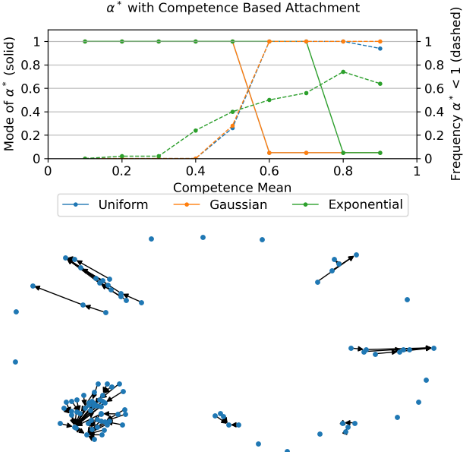
Figure 4 shows how α∗ changes as the average voter competence increases when voter delegations use a CBA topology. Each point represents 50 trials with 100 voters each.
As CBA graphs are dominated by a small number of powerful gurus, Figure 4 shows a phase shift when mean competence reaches roughly 0.5 At µ < 0.5 most trials find α∗ = 1, corresponding to dominance from the large components in the graph. At µ > 0.5, it becomes beneficial to have more gurus affecting the outcome (due to Jury Theorem effects; more voters is beneficial when average competence is above 0.5) so α∗ approaches 0.
1 We use the SciPy implementation of the truncated normal distribution [Burkardt, 2014].
2 Since the exponential distribution does not provide an upper bound on sampled values whenever we sample a competency value greater than 1 we map the value to 1. This leads to a mean value slightly lower than the original distribution, i.e µ′ = 1λ - e-λ λ .
7.3 Viscosity in RandomNetworks
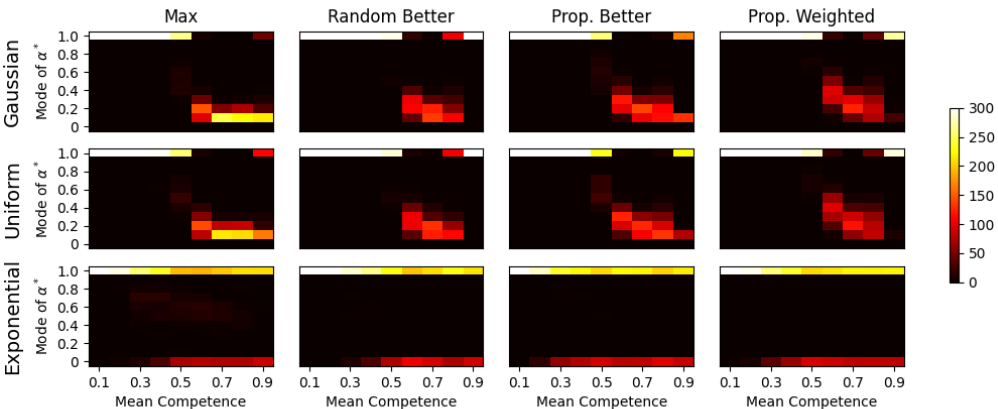
For each delegation mechanism and competence distribution, we ran 300 trials on randomly generated ER and BA social networks. Figure 5 shows how often each value of α is optimal for ER networks with p = 0.1.
The heatmap immediately makes clear that α∗ takes on a wide range of values. It is often 1, but is often below 1 as well. In particular, we see a shift similar to the CBA topology in subsection 7.2: when mean competence is below 0.5, α∗ is usually 1. When voters become more competent, α∗ takes on a wider range of values between 0 and 0.5.
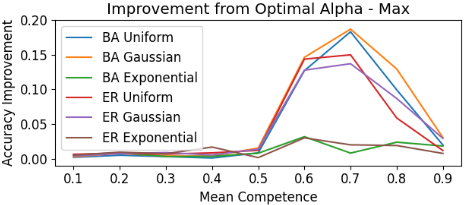
Moreover, Figure 6 shows the amount by which accuracy can be improved simply by setting α optimally. Figure 6 displays the difference between accuracy when α is set to 1 and when it is set to the approximate optimal value. When evaluating Uniform and Gaussian competence distributions, mean competence over 0.5 show significant benefit from optimal values of alpha while only mild improvement is seen with Exponential competencies. This effect holds across network type and delegation mechanism, as seen in [Armstrong et al., 2024].
7.4 Delegation Graph Structure
We examined several properties of the delegation graph structure to see their impact on the value of optimal alpha. From the delegation graphs of the same experiments discussed in subsection 7.3 we computed the values of several features. On this dataset, with α∗ as a target variable, we ran a RandomForest regression. This found no single feature was extremely predictive of α∗ but mean competence was the most predictive. Specifically, higher competence values were related with lower values of α∗ . A list of features we explored, and their importances is included in [Armstrong et al., 2024].
7.5 Empirical Data
To strengthen the results we show in subsection 7.3 we have run delegation experiments over several real-world networks. The networks are described in detail in [Armstrong et al., 2024] and cover a wide range of sizes and topologies. These experiments show very similar distributions of α∗ , suggesting that these results are highly robust to network structure.
8 Discussion
This paper shows that viscous democracy significantly improves upon liquid democracy in many realistic scenarios. On simulated and empirical networks, when voters tend to have moderate competence, a low value for α is likely to improve the chance of retrieving the ground truth. Intuitively, viscosity increase the number of gurus that can affect the election by making it harder for voters to amass large amounts of power. In contexts where there is a joint decision making objective and voter delegation, the use of viscosity should be strongly considered - it may provide up to 10%-20% improvement in accuracy over standard liquid democracy.
9 Outlook
Our results show that viscosity improves decision-making ability which opens up several avenues for future research on why viscosity is useful and how to use this knowledge.
- Evaluating viscous democracy in other settings: Here we concentrated on a simple epistemic model of elections in which the decision to be made is binary. Evaluating the improvement from viscous democracy in more involved settings is important. Many settings remain open for exploration, such as multi-winner elections and more subjective settings where there is no ground truth.
- Developing practical tools for viscous democracy: We have shown that viscosity typically improves delegation performance. Practically, developing tools that can efficiently predict the values of α∗ across different settings is important. Various machine learning and optimization techniques may prove valuable for this task.
@inproceedings{ijcai2024p292,
  title     = {Optimizing Viscous Democracy},
  author    = {Armstrong, Ben and Alouf-Heffetz, Shiri and Talmon, Nimrod},
  booktitle = {Proceedings of the Thirty-Third International Joint Conference on
               Artificial Intelligence, {IJCAI-24}},
  publisher = {International Joint Conferences on Artificial Intelligence Organization},
  editor    = {Kate Larson},
  pages     = {2643--2650},
  year      = {2024},
  month     = {8},
  note      = {Main Track},
  doi       = {10.24963/ijcai.2024/292},
  url       = {https://doi.org/10.24963/ijcai.2024/292},
}
TY - CPAPER TI - Optimizing Viscous Democracy AU - Armstrong, Ben AU - Alouf-Heffetz, Shiri AU - Talmon, Nimrod T2 - Proceedings of the Thirty-Third International Joint Conference on Artificial Intelligence, IJCAI-24 PB - International Joint Conferences on Artificial Intelligence Organization PY - 2024 SP - 2643 EP - 2650 DO - 10.24963/ijcai.2024/292 UR - https://doi.org/10.24963/ijcai.2024/292 ER -Copied
Machine-readable versions of this paper, for tools and AI agents:





