
CoCoG: Controllable Visual Stimuli Generation Based on Human Concept Representations
Proceedings of the Thirty-Third International Joint Conference on Artificial Intelligence. Main Track. Pages 3178-3186.
https://doi.org/10.24963/ijcai.2024/352
Keywords
- Humans and AI: HAI: Cognitive modeling
- Humans and AI: HAI: Human-computer interaction
- Humans and AI: HAI: Cognitive systems
Abstract
A central question for cognitive science is to understand how humans process visual scenes, i.e, to uncover human low-dimensional concept representation space from high-dimensional visual stimuli. Generating visual stimuli with controlling concepts is the key. However, there are currently no generative models in AI to solve this problem. Here, we present the Concept based Controllable Generation (CoCoG) framework. CoCoG consists of two components, a simple yet efficient AI agent for extracting interpretable concept and predicting human decision-making in visual similarity judgment tasks, and a conditional generation model for generating visual stimuli given the concepts. We quantify the performance of CoCoG from two aspects, the human behavior prediction accuracy and the controllable generation ability. The experiments with CoCoG indicate that 1) the reliable concept embeddings in CoCoG allows to predict human behavior with 64.07% accuracy in the THINGS-similarity dataset; 2) CoCoG can generate diverse stimuli through the control of concepts; 3) CoCoG can manipulate human similarity judgment behavior by intervening key concepts.
CoCoG offers visual objects with controlling concepts to advance our understanding of causality in human cognition. The code of CoCoG framework is available at https://github.com/ncclab-sustech/CoCoG.
- [Bansal et al., 2023] Arpit Bansal, Hong-Min Chu, Avi Schwarzschild, Soumyadip Sengupta, Micah Goldblum, Jonas Geiping, and Tom Goldstein. Universal guidance for diffusion models. In Proceedings of the IEEE/CVF Conference on Computer Vision and Pattern Recognition, pages 843-852, 2023.
- [Chung et al., 2022] Hyungjin Chung, Byeongsu Sim, Do- hoon Ryu, and Jong Chul Ye. Improving diffusion models for inverse problems using manifold constraints. Advances in Neural Information Processing Systems, 35:25683- 25696, 2022.
- [Fan et al., 2023] Ying Fan, Olivia Watkins, Yuqing Du, Hao Liu, Moonkyung Ryu, Craig Boutilier, Pieter Abbeel, Mohammad Ghavamzadeh, Kangwook Lee, and Kimin Lee. Dpok: Reinforcement learning for fine-tuning text-to- image diffusion models. arXiv preprint arXiv:2305.16381, 2023.
- [Fu et al., 2023] Stephanie Fu, Netanel Tamir, Shobhita Sun- daram, Lucy Chai, Richard Zhang, Tali Dekel, and Phillip Isola. Dreamsim: Learning new dimensions of human visual similarity using synthetic data. arXiv preprint arXiv:2306.09344, 2023.
- [Goodfellow et al., 2020] Ian Goodfellow, Jean Pouget- Abadie, Mehdi Mirza, Bing Xu, David Warde-Farley, Sherjil Ozair, Aaron Courville, and Yoshua Bengio. Gen- erative adversarial networks. Communications of the ACM, 63(11):139-144, 2020.
- [Hebart et al., 2020] Martin N Hebart, Charles Y Zheng, Francisco Pereira, and Chris I Baker. Revealing the multi- dimensional mental representations of natural objects un- derlying human similarity judgements. Nature human be- haviour, 4(11):1173-1185, 2020.
- [Hebart et al., 2023] Martin N Hebart, Oliver Contier, Lina Teichmann, Adam H Rockter, Charles Y Zheng, Alexis Kidder, Anna Corriveau, Maryam Vaziri-Pashkam, and Chris I Baker. Things-data, a multimodal collection of large-scale datasets for investigating object representations in human brain and behavior. Elife, 12:e82580, 2023.
- [Ho and Salimans, 2022] Jonathan Ho and Tim Salimans. Classifier-free diffusion guidance. arXiv preprint arXiv:2207.12598, 2022.
- [Ho et al., 2020] Jonathan Ho, Ajay Jain, and Pieter Abbeel. Denoising diffusion probabilistic models. Advances in neural information processing systems, 33:6840-6851, 2020.
- [Jha et al., 2023] Aditi Jha, Joshua C Peterson, and Thomas L Griffiths. Extracting low-dimensional psy- chological representations from convolutional neural networks. Cognitive science, 47(1):e13226, 2023.
- [Kawar et al., 2022] Bahjat Kawar, Michael Elad, Stefano Ermon, and Jiaming Song. Denoising diffusion restora- tion models. Advances in Neural Information Processing Systems, 35:23593-23606, 2022.
- [Kirstain et al., 2023] Yuval Kirstain, Adam Polyak, Uriel Singer, Shahbuland Matiana, Joe Penna, and Omer Levy. Pick-a-pic: An open dataset of user preferences for text-to- image generation. arXiv preprint arXiv:2305.01569, 2023.
- [Marjieh et al., 2022a] Raja Marjieh, Ilia Sucholutsky, Theodore R Sumers, Nori Jacoby, and Thomas L Grif- fiths. Predicting human similarity judgments using large language models. arXiv preprint arXiv:2202.04728, 2022.
- [Marjieh et al., 2022b] Raja Marjieh, Pol Van Rijn, Ilia Su- cholutsky, Theodore Sumers, Harin Lee, Thomas L Grif- fiths, and Nori Jacoby. Words are all you need? language as an approximation for human similarity judgments. In The Eleventh International Conference on Learning Rep- resentations, 2022.
- [Medin et al., 1993] Douglas L Medin, Robert L Goldstone, and Dedre Gentner. Respects for similarity. Psychological review, 100(2):254, 1993.
- [Meng et al., 2021] Chenlin Meng, Yutong He, Yang Song, Jiaming Song, Jiajun Wu, Jun-Yan Zhu, and Stefano Er- mon. Sdedit: Guided image synthesis and editing with stochastic differential equations. In International Confer- ence on Learning Representations, 2021.
- [Murphy and Medin, 1985] Gregory L Murphy and Dou- glas L Medin. The role of theories in conceptual coher- ence. Psychological review, 92(3):289, 1985.
- [Muttenthaler et al., 2022a] Lukas Muttenthaler, Jonas Dip- pel, Lorenz Linhardt, Robert A Vandermeulen, and Simon Kornblith. Human alignment of neural network repre- sentations. In The Eleventh International Conference on Learning Representations, 2022.
- [Muttenthaler et al., 2022b] Lukas Muttenthaler, Charles Y Zheng, Patrick McClure, Robert A Vandermeulen, Mar- tin N Hebart, and Francisco Pereira. Vice: Variational in- terpretable concept embeddings. Advances in Neural In- formation Processing Systems, 35:33661-33675, 2022.
- [Muttenthaler et al., 2023] Lukas Muttenthaler, Lorenz Lin- hardt, Jonas Dippel, Robert A Vandermeulen, Katherine Hermann, Andrew K Lampinen, and Simon Kornblith. Im- proving neural network representations using human simi- larity judgments. arXiv preprint arXiv:2306.04507, 2023.
- [Özbey et al., 2023] Muzaffer Özbey, Onat Dalmaz, Salman UH Dar, Hasan A Bedel, S ¸aban Özturk, Alper Güngör, and Tolga C ¸ukur. Unsupervised medical image translation with adversarial diffusion models. IEEE Transactions on Medical Imaging, 2023.
- [Peterson et al., 2018] Joshua C Peterson, Joshua T Abbott, and Thomas L Griffiths. Evaluating (and improving) the correspondence between deep neural networks and hu- man representations. Cognitive science, 42(8):2648-2669, 2018.
- [Podell et al., 2023] Dustin Podell, Zion English, Kyle Lacey, Andreas Blattmann, Tim Dockhorn, Jonas Müller, Joe Penna, and Robin Rombach. Sdxl: Improving la- tent diffusion models for high-resolution image synthesis. arXiv preprint arXiv:2307.01952, 2023.
- [Rainforth et al., 2023] Tom Rainforth, Adam Foster, Desi R Ivanova, and Freddie Bickford Smith. Modern bayesian experimental design. arXiv preprint arXiv:2302.14545, 2023.
- Ramesh et al., ] Aditya Ramesh, Prafulla Dhariwal, Alex Nichol, Casey Chu, and Mark Chen. Hierarchical text- conditional image generation with clip latents. [Roads and Love, 2021]
- Brett D Roads and Bradley C Love. Enriching imagenet with human similarity judgments and psychological embeddings. In Proceedings of the ieee/cvf conference on computer vision and pattern recognition, pages 3547-3557, 2021.
- [Roads and Love, 2023] Brett D Roads and Bradley C Love. Modeling similarity and psychological space. Annual Re- view of Psychology, 75, 2023.
- [Rombach et al., 2022] Robin Rombach, Andreas Blattmann, Dominik Lorenz, Patrick Esser, and Björn Ommer. High-resolution image synthesis with latent diffusion models. In Proceedings of the IEEE/CVF conference on computer vision and pattern recognition, pages 10684-10695, 2022.
- [Sauer et al., 2023] Axel Sauer, Dominik Lorenz, Andreas Blattmann, and Robin Rombach. Adversarial diffusion distillation. arXiv preprint arXiv:2311.17042, 2023.
- [Song et al., 2020] Yang Song, Jascha Sohl-Dickstein, Diederik P Kingma, Abhishek Kumar, Stefano Ermon, and Ben Poole. Score-based generative modeling through stochastic differential equations. In International Conference on Learning Representations, 2020.
- [Song et al., 2021] Yang Song, Liyue Shen, Lei Xing, and Stefano Ermon. Solving inverse problems in medical imaging with score-based generative models. In Interna- tional Conference on Learning Representations, 2021.
- [Tang et al., 2023] Zhiwei Tang, Dmitry Rybin, and Tsung- Hui Chang. Zeroth-order optimization meets human feedback: Provable learning via ranking oracles. arXiv preprint arXiv:2303.03751, 2023.
- [Tao et al., 2022] Ming Tao, Hao Tang, Fei Wu, Xiao-Yuan Jing, Bing-Kun Bao, and Changsheng Xu. Df-gan: A simple and effective baseline for text-to-image synthe- sis. In Proceedings of the IEEE/CVF Conference on Computer Vision and Pattern Recognition, pages 16515- 16525, 2022.
- [von Rütte et al., 2023] Dimitri von Rütte, Elisabetta Fedele, Jonathan Thomm, and Lukas Wolf. Fabric: Personalizing diffusion models with iterative feedback. arXiv preprint arXiv:2307.10159, 2023.
- [Wu et al., 2023] Xiaoshi Wu, Keqiang Sun, Feng Zhu, Rui Zhao, and Hongsheng Li. Human preference score: Bet- ter aligning text-to-image models with human preference. In Proceedings of the IEEE/CVF International Conference on Computer Vision, pages 2096-2105, 2023.
- [Ye et al., 2023] Hu Ye, Jun Zhang, Sibo Liu, Xiao Han, and Wei Yang. Ip-adapter: Text compatible image prompt adapter for text-to-image diffusion models. arXiv preprint arXiv:2308.06721, 2023.
- [Yu et al., 2023] Jiwen Yu, Yinhuai Wang, Chen Zhao, Bernard Ghanem, and Jian Zhang. Freedom: Training-free energy-guided conditional diffusion model. arXiv preprint arXiv:2303.09833, 2023.
- [Zhang et al., 2023] Lvmin Zhang, Anyi Rao, and Maneesh Agrawala. Adding conditional control to text-to-image dif- fusion models. In Proceedings of the IEEE/CVF Interna- tional Conference on Computer Vision, pages 3836-3847, 2023.
- [Zheng et al., 2018] Charles Y Zheng, Francisco Pereira, Chris I Baker, and Martin N Hebart. Revealing inter- pretable object representations from human behavior. In International Conference on Learning Representations, 2018.
References were extracted automatically from the PDF and may contain errors.
Full text extracted automatically from the PDF; figures, tables and equations may differ. The PDF is the version of record.
1 Introduction
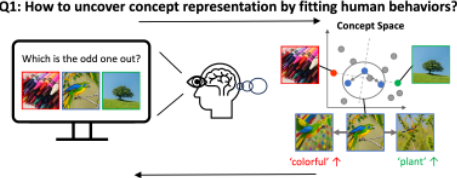
Humans receive abundant visual stimulation from the natural world. Unlike computer vision models that aim at object recognition tasks, humans aim to survive in complex nature, which requires understanding abstract concepts of these visual objects, such as functionality, toxicity, and danger. To explore such concept representation in humans, scientists have proposed a series of visual stimuli-based decisionmaking tasks [Murphy and Medin, 1985; Medin et al., 1993; Hebart et al., 2020; Roads and Love, 2023], such as the similarity judgment task, in which visual stimuli of specific concepts are presented to the participants and then their decisionmaking behaviors are recorded. However, understanding human concept representation through these cognitive tasks has two main difficulties. On the one hand, training an AI agent to uncover interpretable concept representations by predicting human decision-making behavior requires substantial human decision-making data under massive visual objects. On the other hand, to understand the causal relationship between concept representation and behavior, it is necessary to manipulate the concepts, preserving all other low-level features, to generate visual objects. This is unexplored territory for AI. It poses a new technical challenge for image generation, namely controllable visual object generation based on concept representation.
The appendix is available at https://arxiv.org/abs/2404.16482.
Controllable generation models have made great progress in AI community, for example, conditional generation models based on GAN [Goodfellow et al., 2020; Tao et al., 2022] and diffusion [Song et al., 2020; Ho et al., 2020; Ho and Salimans, 2022]. These conditional generation models have been applied in many fields, including text-to-image/video generation [Rombach et al., 2022; Ramesh et al., ], image inverse problem [Kawar et al., 2022; Chung et al., 2022; Meng et al., 2021] and biomedical imaging[Song et al., 2021; ¨Ozbey et al., 2023]. The conditions for controllable image generation can come from multiple aspects, such as text, sketches, edge maps, segmentation maps, depth maps [Rombach et al., 2022; Ramesh et al., ; Meng et al., 2021; Zhang et al., 2023; Yu et al., 2023; Bansal et al., 2023]. However, these conditions do not include human subjective feelings nor human feedback, resulting in generated images misaligned with human needs. For instance, generated images by recommendation system may not meet human preference. To align the generated images with human needs, some pioneer works brought human feedback (e.g., the human visual preference score obtained offline [Wu et al., 2023; Kirstain et al., 2023], the human-in-the-loop visual comparison decision [von R¨utte et al., 2023; Fan et al., 2023; Tang et al., 2023]) into conditional generative models. Nevertheless, these works have not consider prior knowledge of cognitive science, such as the factors that have the greatest impact on human decision-making, that is, concepts, as control variables for image generation.
A large number of human research suggest that similarity judgment tasks are an effective experimental paradigm for revealing human concept representations [Roads and Love, 2023; Hebart et al., 2020]. In these tasks, human subjects are asked to compare different visual stimuli and make decisions based on their similarity. AI models, such as [Peterson et al., 2018; Marjieh et al., 2022b; Marjieh et al., 2022a; Muttenthaler et al., 2022a; Jha et al., 2023; Fu et al., 2023], are proposed to predict the subjects' decisions, under an assumption that human perception of visual objects can be encoded into a low-dimensional mental representation, namely concept embedding. The distance between visual objects in this concept space reflects the distance of visual objects in the human's mind. Human decision-making behavior can be explained by different dimensions of concept representation. Thus, aligning AI models with humans in terms of concept representation would naturally align their outputs as well. Also, compared with existing controllable image generation methods, a controllable generation model based on concept representation would control human decision-making behavior more effectively.
In this study, we propose a Concept based Controllable Generation (CoCoG) framework. CoCoG utilize concept embeddings as conditions for the image generation model, bridging cognitive science and AI. CoCoG comprises two parts: a concept encoder for learning concept embedding via predicting human behaviors and a concept decoder which employs a conditional diffusion model for mapping concept embedding to visual stimuli through a two-stage generation strategy.
CoCoG has three main contributions:
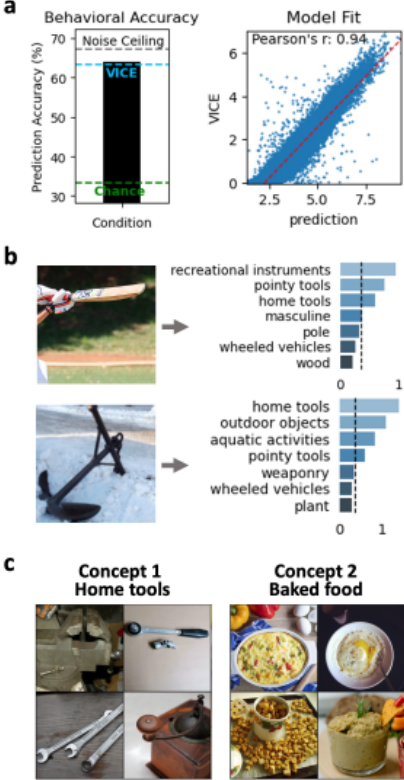
- CoCoG's concept encoder can predict human visual similarity decision-making behaviors with higher accuracy than the state-of-the-art (SOTA) model (i.e., VICE [Muttenthaler et al., 2022b]), uncovering a reliable, interpretable concept space of humans (Figure 3).
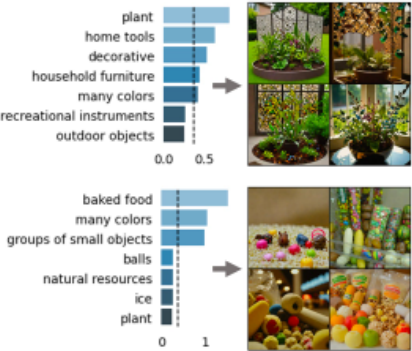
- CoCoG's concept decoder can generate visual stimuli by controlling the concept embedding. The generated visual stimuli have diversity and high consistency with the target concept embeddings (Figure 4&5). The generation can be guided with text prompts (Figure 6&7).
- CoCoG can manipulate the human similarity decisionmaking behavior in a highly controllable way by controlling the concepts of generated visual stimuli (Figure 8).
2 Method
The CoCoG method comprises two parts: a concept encoder and a two-stage concept decoder, as shown in Figure 2.
2.1 Concept Encoder for Embedding Low-Dimensional Concepts
The first step in CoCcoG is to train a concept encoder to learn the concept embeddings of visual objects (Figure 2a). Given a dataset of visual objects X, for each visual object x in the dataset, we first input it into the CLIP image encoder f to extract the CLIP embedding h ∈ RD . Then, the CLIP embedding is input into a learnable concept projector g, thereby generating the concept embedding of the visual object c ∈ Rd :
where the each dimension in concept embedding c represents aninterpretable concept, and the corresponding activation of this dimension indicates the activation strength of the concept in the visual object. In short, we have c = g(f(x)).
To train this model, we used the triplet odd-one-out similarity judgment task in the THINGS dataset [Hebart et al., 2023]. In this task, participants are asked to view three visual objects and consider the similarity between each pair of visual objects to determine the similar pair and select the remaining one as the odd-one-out.
Similar to previous works [Zheng et al., 2018; Hebart et al., 2020; Muttenthaler et al., 2022b], we use the dot product similarity as the similarity measurement function between concept embeddings (i.e., Sij =< ci, cj >) and use crossentropy based on pairwise similarities to predict human decisions. Therefore, for the concept embeddings ci, cj, ck of three visual objects xi, xj , xk, we have
where p(y) is the probability distribution of the triplet visual stimuli (xi, xj , xk) being the odd-one-out, with the highest probability choice being the model's predicted behavioral outcome. By comparing the model's predicted behavioral outcomes with the recorded behavioral outcomes from human participants, we calculate the loss and perform backpropagation to train the concept projector g. In the specific process, we added an L1 regularization to c to ensure the sparseness of low-dimensional concept embedding. We verified different training strategies (see Appendix).
2.2 Two-Stage Concept Decoder for Controllable Visual Stimuli Generation
After training the concept encoder, we can obtain the data triplet (xi, hi, ci) for each image in the dataset. Based on these data, we then train a concept decoder to generate visual objects by controlling human conceptual representations.
In our model, the concept embedding c completely determines the distribution of the human decision y, and the h completely determines the distribution of c. Therefore, the joint distribution of the human decisions p(x, h, c, y) can be formulated as:
Next, we present each step of p(c|y), p(h|c), p(x|h) respectively. p(c|y) means finding the appropriate concept embedding c given the behavioral outcome y. This step is determined according to specific control objectives, which we will discuss in chapter 4.2. For p(c|y) and p(x|h), we decompose the concept decoder into two stages, the Prior Diffusion and the CLIP guided generation, respectively, which execute the processes of generating CLIP embedding h from the concept embedding c and generating visual object x from the CLIP embedding h.
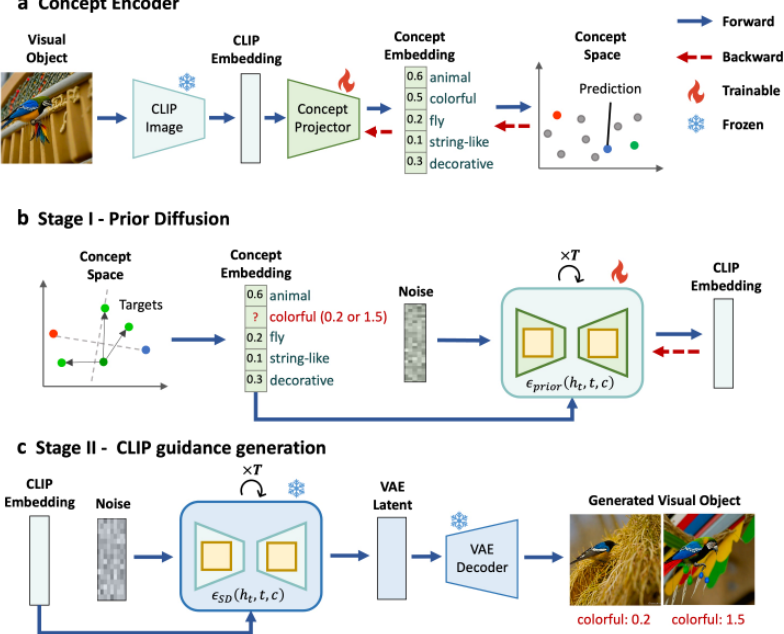
Stage I - Prior diffusion. Inspired by DALL-E 2 [Ramesh et al., ], we train a diffusion model conditioned on the concept embedding c to learn the distribution of CLIP embeddings p(h|c) (Figure 2b). The CLIP embedding h obtained in this stage serves as the prior for the next stage. We construct a lightweight U-Net: ϵprior(ht, t, c), where ht represents the noisy CLIP embedding in the diffusion time step t. We extract the CLIP embeddings and the concept embeddings from ImageNet and use the obtained training pairs (hi, ci) to train the Prior Diffusion model. We employ the classifier-free guidance method to train this conditional generative diffusion model. The specific formulas can be found in the Appendix.
Stage II - CLIP guidance generation. After obtaining the CLIP embedding h in Stage I, we model a generator p(x|h) to sample the visual object x conditional to h (Figure 2c). In this study, we use the pre-trained SDXL and IP-Adapter models[Podell et al., 2023; Sauer et al., 2023; Ye et al., 2023]. Speicfically, SDXL serves as the backbone of the image diffusion generation model. Through the dual cross-attention modules of the IP-Adapter, we input the CLIP embedding h as a condition, thereby guiding the denoising process of the U-Net. Similar to Stage I, we have the model ϵSD(zt, t, h), where zt are the noisy latents of SDXL's VAE. Details can be found in the Appendix. Since we freeze the pre-trained models without any modification, we can simply use the existing functionalities of the pre-trained models and combine them with concept embedding guidance.
CLIP embedding as an intermediate variable. In both processes from visual objects to concept embeddings and from concept embeddings back to visual objects, we use CLIP embeddings as an intermediate variable. This is for two purposes: 1) For the concept encoder, CLIP embeddings are sufficiently low-dimensional and contain key information of images. Previous study has shown that using CLIP embeddings along with simple linear probing can well predict human behavior in similarity judgment tasks [Muttenthaler et al., 2022a]. 2) For the concept decoder, using CLIP embeddings helps us better utilize existing pre-trained conditional generative models. Existing models can already use CLIP embeddings as a conditional input for the generative model, allowing us to simply adopt a two-stage generation strategy.
We only need to train a Prior Diffusion model, which significantly reduces the computational cost of training and inference.
3 Model Validation
3.1 Concept Encoder Can Predict and Explain Human Behaviors
We first validated the concept encoder from two aspects: the prediction accuracy of human behaviors (Figure 3a) and the interpretability of the learned lwo-dimensional concepts (Figure 3b&c). We used the THINGS Odd-one-out dataset as the similarity judgment behavior dataset to train our concept encoding model. We tested various configurations of the concept encoding model (which will be detailed in the Appendix). Figure 3a shows the results of the optimal model configuration. We used 42-dimensional concept embeddings for comparison with previous SOTA model (VICE) and our experiments have found that more than 42 dimensions only bring small improvements. In terms of behavioral prediction, our best-performing model achieved an accuracy of 64.07% on the THINGS Odd-one-out dataset, surpassing the previous best model VICE's accuracy of 63.27%. We also compared the similarity predictions of visual objects between our model and VICE, and the Pearson correlation coefficient of their predictions reached 0.94. This indicates that our model can accurately predict human similarity judgment behaviors.
One major merit of our concept embedding is its good interpretability. Figure 3b shows the low-dimensional concept embeddings for the two example visual objects. It is obvious that the concept embeddings encoded by CoCoG well describe the visual objects, and the activation of concepts in a visual object exhibits a favorable property of sparsity, which is in line with human intuition (see Appendix). We used the CLIP-Dissect model to automatically choose words from the lexicon to describe the concepts in each of the 42 dimensions. Note that the relationship between these words and the concepts is not absolute and is only for examples. Figure 3 shows the visual objects with the highest activation in the first two conceptual dimensions (i.e., home tools and baked food). Importantly, we find that the visual objects that significantly activate these dimensions are highly consistent with these two concepts. This indicates that our model can effectively encode the conceptual embeddings of visual objects, and the encoded concepts have good interpretability.
3.2 Concept Decoder Can Generate Visual Objects Consistent With Concept Embedding
In this section, we validate the generative effectiveness of the concept decoder. Specific training parameters are shown in the Appendix. Figure 4 shows visual objects generated under the guidance of concept embeddings. These visual objects generated from the same concept embedding are well-aligned with the concept embedding and have good diversity, demonstrating that our diffusion model can conditionally generate visual objects consistent with the concept embeddings.
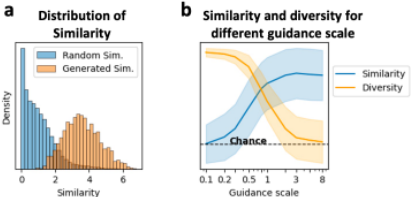
We quantify the similarity between the concept embeddings of the generated visual objects and the target concept embeddings according to Eq.2. The similarity between generated visual objects and target concept embeddings is significantly higher than that between two random visual objects (Figure 5a). Additionally, by adjusting the guidance scale, we can control the guiding strength of the target concept embeddings, thereby controlling the similarity and diversity of the generated visual objects (specific metrics calculation can be found in the Appendix). As the guidance scale increases, the similarity between the visual objects and the target concept embeddings increases while the diversity decreases (Figure 5b).
4 CoCoG for Studying Counterfactual Explanations of Human Behaviors
According to the role of concept embedding, manipulating the concept embedding can directly influence human similarity judgment behavior. Conversely, does the change in visual objects that do not affect the concept embedding have no impact on human behavior? CoCoG is an excellent tool to explore this counterfactual question.
4.1 Flexible Controlling of Generated Objects With Text Prompts
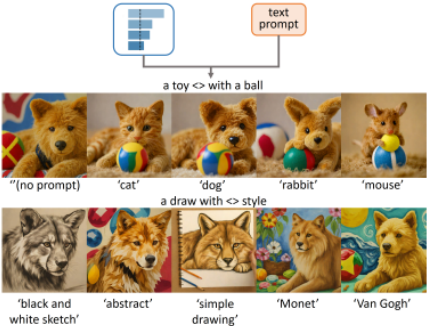
As shown in 6, we used the same concept embedding combined with different text prompts to generate visual objects. Regardless of the changes in the category and style of the visual objects, the images consistently retained the characteristics of the concept embedding. Note that we fixed the random seed to highlight the differences in text prompts. In theory, these completely different visual objects would lead to similar judgment behaviors in similarity judgment experiments.
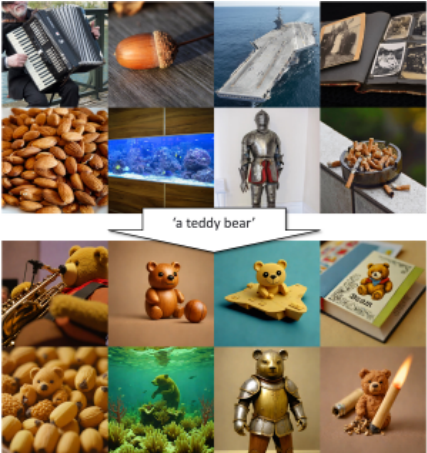
Further, we show visual objects generated using the same text prompt combined with different concept embeddings (Figure 7). The images in the upper half were used to extract concept embeddings, which were then combined with text prompts to generate the new images in the lower half. The generated images reflect the property "teddy bear" after adding the text prompt, with preserving the concept embeddings. Therefore, contrary to the concept-editing experiment, modifying text prompts do not lead to changes in judgment behavior because the concept embedding is preserved.
4.2 Manipulating the Similarity Judgment Decisions by Intervening the Key Concepts
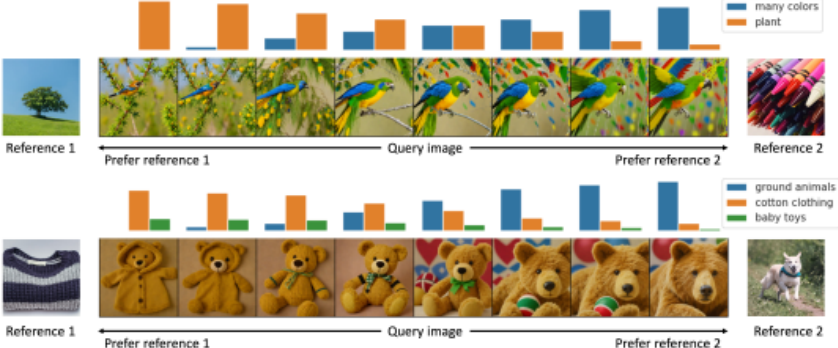
In this experiment, we designed a simple scenario to show how CoCoG can manipulate similarity judgment behavior. Suppose participants need to perform a Two alternative forced choice experiment, i.e., they need to choose from Reference 1 & 2 which is more similar to the Query. In this scenario, we can directly increase or decrease certain concepts to make the Query more similar to one of the references. Considering that we use dot product similarity, we can simply choose the concept that is significant in the Reference but not in the Query as the key concept. The results in Figure 8, show that the preference of the Query for Reference 1 & 2 is manipulated by modifying two and three concepts, with the concepts shifting to two different directions. It is evident that the generated visual objects by CoCoG can change smoothly but significantly with the manipulation of concepts.
This method provides us with an effective tool for analyzing the causal mechanisms of concepts in similarity judgment tasks. For example, in the experiment, we can directly manipulate the concepts of interest and observe subsequent behavior. Researchers can actively choose to explore the impact of certain concepts on behavior and analyze the causal relationship between changes in concepts and judgment behavior. By focusing on informative concepts and precisely controlling the activation values of concepts, this method is expected to improve the efficiency of data collection and significantly reduce the number of experimental trials needed (rather than using millions of trials [Hebart et al., 2023]).
5 RelatedWorks
5.1 Concept Embeddings
Numerous computational models have been developed to model embeddings encoding in similarity judgment tasks [Roads and Love, 2023; Hebart et al., 2020]. These methods aim to study concept embeddings through similarity judgment tasks, either by optimizing concept embeddings for each object [Zheng et al., 2018; Roads and Love, 2021; Hebart et al., 2020; Muttenthaler et al., 2022b] or by using DNNs to predict human similarity judgment behavior [Peterson et al., 2018; Marjieh et al., 2022b; Marjieh et al., 2022a;
Muttenthaler et al., 2022a; Jha et al., 2023; Fu et al., 2023]. Previous methods, assuming sparsity, continuity, and positivity of concept embeddings, learn low-dimensional concept embeddings for each object through probabilistic models. These embeddings have good interpretability but cannot generalize to new objects. On the other hand, DNNbased methods construct concept embeddings from neural activations by reducing the dimensionality of high-dimensional DNN latent representations [Jha et al., 2023], aligning DNNbased similarity judgments with human judgments [Muttenthaler et al., 2023], or using multimodal inputs to improve similarity judgment predictions [Marjieh et al., 2022b; Marjieh et al., 2022a]. This approach can utilize state-of-theart DNN models to form embeddings that naturally generalize to new objects. To enhance behavioral experiments, Roads et al. utilized active learning coupled with a trial selection strategy for efficient concept embedding inference [Roads and Love, 2021]. Similarly, DreamSim leveraging Stable Diffusion, generates synthetic data within specified categories to create a Perceptual dataset, aimed at studying Human perceptual judgments [Fu et al., 2023].
5.2 Conditional DiffusionModels
Recently, conditional generative models based on diffusion models have seen significant development. The classifierfree guidance method has demonstrated strong controllable generative capabilities through supervised learning [Ho and Salimans, 2022]. These methods dominate the tasks of textto-image generation. From the widely used Stable Diffusion [Rombach et al., 2022; Podell et al., 2023; Sauer et al., 2023] to subsequent methods like ControlNet [Zhang et al., 2023] and IP-Adapter [Ye et al., 2023], they have added more controllable conditions to conditional generation, such as edge maps, segmentation maps, depth maps [Rombach et al., 2022; Ramesh et al., ; Meng et al., 2021; Zhang et al., 2023; Yu et al., 2023; Bansal et al., 2023]. Additionally, conditional generative models based on human feedback and preferences have also shown potential. Works like FABRIC and DPOK use real-time similarity tasks to guide models to generate images meeting human needs, proving that human feedback can provide more nuanced control over conditional generative models [von R¨utte et al., 2023; Fan et al., 2023; Tang et al., 2023]. Methods like Pick-a-pic and Human Preference Score generate images aligned with human aesthetics [Kirstain et al., 2023; Wu et al., 2023]. These advancements demonstrate that, in comparison to standard textto-image frameworks, conditional generative models possess significant potential for more closely meeting human needs and preferences.
6 Discussion
We proposed the CoCoG model, capable of predicting human visual similarity judgment behavior and learning human conceptual embeddings for visual objects. It can also efficiently and controllably generate visual objects in line with human cognition (Fig 3), manipulating human similarity judgment behavior and studying causal mechanisms in human cognition (Fig 8).
Contributions to AI. Our approach bridges generative models and human visual cognition. Through the concept encoding model, we align DNNs with human visual concept representations, simulating human processing and responses to visual objects more precisely, with potential to enhance AI's visual understanding capabilities; through controllable diffusion generation based on concept embeddings, we make conditional generative models more closely linked to human cognition and can manipulate human behavior through generated stimuli, promising to improve control and safety in AIhuman interactions.
Contributions to cognitive science. Our approach significantly expands research on human visual cognition in cognitive science. With the concept encoding model, we achieved interpretable concept encoding for visual objects (Figure 3b); with controllable diffusion generation based on concept embeddings, we can generate a rich variety of natural stimuli to control human similarity judgment behaviors (Figure [Roads and Love, 2021; Fu et al., 2023]). By combining advanced AI models with cognitive science research methods, we greatly enhance the efficiency and breadth of visual cognition research. Additionally, this method may reveal causal mechanisms in human visual cognition, offering new perspectives for understanding human cognitive processes.
Future directions. In the future, we will extend the paradigm of human visual cognition research to the study of AI representational spaces, which would help align AI with humans and provide new insights for understanding AI's cognition. Also, we recommend to bring optimal experimental design [Rainforth et al., 2023; Roads and Love, 2021] into human experiments. It will largely improve the efficiency of human behavioral data collection, facilitate model learning, optimizing experimental paradigms with broader applications in cognitive science and AI.
Ethical Statement
The human behavioral data in this study is from THINGS public dataset. No animal or human experiments are involved.
Acknowledgments
This work is supported by the National Key R&D Program of China (2021YFF1200804), Shenzhen Science and Technology Innovation Committee (20200925155957004, KCXFZ20201221173400001, SGDX2020110309280100), Guangdong Provincial Climbing Plan (pdjh2024c21310).
Contribution Statement
Chen Wei and Jiachen Zou contribute equally to this work. Quanying Liu is the corresponding author.
@inproceedings{ijcai2024p352,
  title     = {CoCoG: Controllable Visual Stimuli Generation Based on Human Concept Representations},
  author    = {Wei, Chen and Zou, Jiachen and Heinke, Dietmar and Liu, Quanying},
  booktitle = {Proceedings of the Thirty-Third International Joint Conference on
               Artificial Intelligence, {IJCAI-24}},
  publisher = {International Joint Conferences on Artificial Intelligence Organization},
  editor    = {Kate Larson},
  pages     = {3178--3186},
  year      = {2024},
  month     = {8},
  note      = {Main Track},
  doi       = {10.24963/ijcai.2024/352},
  url       = {https://doi.org/10.24963/ijcai.2024/352},
}
TY - CPAPER TI - CoCoG: Controllable Visual Stimuli Generation Based on Human Concept Representations AU - Wei, Chen AU - Zou, Jiachen AU - Heinke, Dietmar AU - Liu, Quanying T2 - Proceedings of the Thirty-Third International Joint Conference on Artificial Intelligence, IJCAI-24 PB - International Joint Conferences on Artificial Intelligence Organization PY - 2024 SP - 3178 EP - 3186 DO - 10.24963/ijcai.2024/352 UR - https://doi.org/10.24963/ijcai.2024/352 ER -Copied
Machine-readable versions of this paper, for tools and AI agents:





