
NELLIE: A Neuro-Symbolic Inference Engine for Grounded, Compositional, and Explainable Reasoning
Proceedings of the Thirty-Third International Joint Conference on Artificial Intelligence. Main Track. Pages 3602-3612.
https://doi.org/10.24963/ijcai.2024/399
Keywords
- Natural Language Processing: NLP: Question answering
- Knowledge Representation and Reasoning: KRR: Reasoning about knowledge and belief
- Knowledge Representation and Reasoning: KRR: Automated reasoning and theorem proving
- Search: S: Other
Abstract
Our goal is to develop a modern approach to answering questions via systematic reasoning where answers are supported by human interpretable proof trees grounded in an NL corpus of facts. Such a system would help alleviate the challenges of interpretability and hallucination with modern LMs, and the lack of grounding of current explanation methods (e.g., Chain-of-Thought). This paper proposes a new take on Prolog-based inference engines, where we replace handcrafted rules with a combination of neural language modeling, guided generation, and semiparametric dense retrieval. Our implementation, NELLIE, is the first system to demonstrate fully interpretable, end-to-end grounded QA as entailment tree proof search, going beyond earlier work explaining known-to-be-true facts from text. In experiments, NELLIE outperforms a similar-sized state-of-the-art reasoner while producing knowledge-grounded explanations. We also find NELLIE can exploit both semi-structured and NL text corpora to guide reasoning. Together these suggest a new way to jointly reap the benefits of both modern neural methods and traditional symbolic reasoning.
- [Andreas et al., 2016] Jacob Andreas, Marcus Rohrbach, Trevor Darrell, and Dan Klein. Neural module networks. In Proceedings of the IEEE conference on computer vision and pattern recognition, 2016.
- [Arabshahi et al., 2021a] Forough Arabshahi, Jennifer Lee, Antoine Bosselut, Yejin Choi, and Tom Mitchell. Con- versational multi-hop reasoning with neural commonsense knowledge and symbolic logic rules. In Proceedings of EMNLP, 2021.
- [Arabshahi et al., 2021b] Forough Arabshahi, Jennifer Lee, Mikayla Gawarecki, Kathryn Mazaitis, Amos Azaria, and Tom Mitchell. Conversational neuro-symbolic common- sense reasoning. In Proceedings of AAAI, 2021.
- [Bos and Markert, 2005] Johan Bos and Katja Markert. Recognising textual entailment with logical inference. In Proceedings of HLT and EMNLP, 2005.
- [Bosselut et al., 2021] Antoine Bosselut, Ronan Le Bras, and Yejin Choi. Dynamic neuro-symbolic knowledge graph construction for zero-shot commonsense question answer- ing. AAAI, 2021.
- [Bostrom et al., 2022] Kaj Bostrom, Zayne Sprague, Swarat Chaudhuri, and Greg Durrett. Natural language deduction through search over statement compositions. In Findings of ACL: EMNLP 2022, 2022.
- [Clark et al., 2018] Peter Clark, Isaac Cowhey, Oren Etzioni, Tushar Khot, Ashish Sabharwal, Carissa Schoenick, and Oyvind Tafjord. Think you have solved question answer- ing? try arc, the ai2 reasoning challenge. arXiv:1803.05457, 2018.
- [Clark et al., 2021] Peter Clark, Oyvind Tafjord, and Kyle Richardson. Transformers as soft reasoners over language. In Proceedings of IJCAI, 2021. IJCAI
- [Creswell and Shanahan, 2022] Antonia Creswell and Mur- ray Shanahan. Faithful reasoning using large language models. arXiv preprint arXiv:2208.14271, 2022.
- [Dalvi et al., 2021] Bhavana Dalvi, Peter Jansen, Oyvind Tafjord, Zhengnan Xie, Hannah Smith, Leighanna Pi- patanangkura, and Peter Clark. Explaining answers with entailment trees. In Proceedings of EMNLP, 2021.
- [Dalvi Mishra et al., 2022] Bhavana Dalvi Mishra, Oyvind Tafjord, and Peter Clark. Towards teachable reasoning systems: Using a dynamic memory of user feedback for continual system improvement. In Proceedings of EMNLP, 2022.
- [Das et al., 2021] Rajarshi Das, Manzil Zaheer, Dung Thai, Ameya Godbole, Ethan Perez, Jay Yoon Lee, Lizhen Tan, Lazaros Polymenakos, and Andrew McCallum. Case-based reasoning for natural language queries over knowledge bases. In Proceedings of EMNLP, 2021.
- [Demszky et al., 2018] Dorottya Demszky, Kelvin Guu, and Percy Liang. Transforming question answering datasets into natural language inference datasets. arXiv:1809.02922, 2018.
- [Green et al., 1961] Bert F. Green, Alice K. Wolf, Carol Chomsky, and Kenneth Laughery. Baseball: An automatic question-answerer. 1961.
- [Gupta et al., 2020] Nitish Gupta, Kevin Lin, Dan Roth, Sameer Singh, and Matt Gardner. Neural module networks for reasoning over text. In International Conference on Learning Representations, 2020.
- [He et al., 2022] Hangfeng He, Hongming Zhang, and Dan Roth. Rethinking with retrieval: Faithful large language model inference. arXiv preprint arXiv:2301.00303, 2022.
- [Holtzman et al., 2019] Ari Holtzman, Jan Buys, Li Du, Maxwell Forbes, and Yejin Choi. The curious case of neural text degeneration. In ICLR, 2019.
- [Hong et al., 2022] Ruixin Hong, Hongming Zhang, Xintong Yu, and Changshui Zhang. METGEN: A module-based en- tailment tree generation framework for answer explanation. In Findings of ACL: NAACL 2022, 2022.
- [Jackson, 1986] P Jackson. Introduction to expert systems. 1986.
- [Jansen and Ustalov, 2019] Peter Jansen and Dmitry Ustalov. TextGraphs 2019 shared task on multi-hop inference for explanation regeneration. In Proceedings of the Thirteenth Workshop on Graph-Based Methods for Natural Language Processing (TextGraphs-13), 2019.
- [Jhamtani and Clark, 2020] Harsh Jhamtani and Peter Clark. Learning to explain: Datasets and models for identifying valid reasoning chains in multihop question-answering. In Proceedings of EMNLP (EMNLP), 2020.
- [Ji et al., 2022] Ziwei Ji, Nayeon Lee, Rita Frieske, Tiezheng Yu, Dan Su, Yan Xu, Etsuko Ishii, Yejin Bang, Andrea Madotto, and Pascale Fung. Survey of hallucination in natural language generation. ACM Computing Surveys, 2022.
- [Johnson et al., 2019] Jeff Johnson, Matthijs Douze, and Hervé Jégou. Billion-scale similarity search with GPUs. IEEE Transactions on Big Data, 2019.
- [Jones et al., 2000] Karen Sparck Jones, Steve Walker, and Stephen E. Robertson. A probabilistic model of information retrieval: development and comparative experiments -part 1. Inf. Process. Manag., 2000.
- [Jung et al., 2022] Jaehun Jung, Lianhui Qin, Sean Welleck, Faeze Brahman, Chandra Bhagavatula, Ronan Le Bras, and Yejin Choi. Maieutic prompting: Logically consistent reasoning with recursive explanations. In Proceedings of EMNLP, 2022.
- [Kalyanpur et al., 2021] Aditya Kalyanpur, Tom Breloff, David Ferrucci, Adam Lally, and John Jantos. Braid: Weav- ing symbolic and neural knowledge into coherent logical explanations. AAAI, 2021.
- [Kautz and Selman, 1999] Henry Kautz and Bart Selman. Unifying sat-based and graph-based planning. In IJCAI, 1999. IJCAI
- [Kautz et al., 1992] Henry A Kautz, Bart Selman, et al. Plan- ning as satisfiability. In ECAI, 1992.
- [Kazemi et al., 2023] Mehran Kazemi, Najoung Kim, Deepti Bhatia, Xin Xu, and Deepak Ramachandran. LAMBADA: Backward chaining for automated reasoning in natural lan- guage. In Proceedings of the 61st Annual Meeting of the Association for Computational Linguistics (Volume 1: Long Papers), 2023.
- [Khashabi et al., 2019] Daniel Khashabi, Erfan Sadeqi Azer, Tushar Khot, Ashish Sabharwal, and Dan Roth. On the possibilities and limitations of multi-hop reasoning under linguistic imperfections. arXiv:1901.02522, 2019.
- [Khot et al., 2017] Tushar Khot, Ashish Sabharwal, and Peter Clark. Answering complex questions using open informa- tion extraction. In Proceedings of the 55th Annual Meeting of the Association for Computational Linguistics (Volume 2: Short Papers), 2017.
- [Khot et al., 2020] Tushar Khot, Peter Clark, Michal Guerquin, Peter Jansen, and Ashish Sabharwal. Qasc: A dataset for question answering via sentence composition. In Proceedings of AAAI, 2020.
- [Khot et al., 2021] Tushar Khot, Daniel Khashabi, Kyle Richardson, Peter Clark, and Ashish Sabharwal. Text mod- ular networks: Learning to decompose tasks in the language of existing models. In Proceedings of the 2021 Conference of the North American Chapter of the Association for Com- putational Linguistics: Human Language Technologies, 2021.
- [Khot et al., 2022] Tushar Khot, Harsh Trivedi, Matthew Fin- layson, Yao Fu, Kyle Richardson, Peter Clark, and Ashish Sabharwal. Decomposed prompting: A modular approach for solving complex tasks. In The Eleventh International Conference on Learning Representations, 2022.
- [Kojima et al., 2022] Takeshi Kojima, Shixiang Shane Gu, Machel Reid, Yutaka Matsuo, and Yusuke Iwa- sawa. Large language models are zero-shot reasoners. arXiv:2205.11916, 2022.
- [Kundu et al., 2019] Souvik Kundu, Tushar Khot, Ashish Sabharwal, and Peter Clark. Exploiting explicit paths for multi-hop reading comprehension. In Proceedings of the 57th Annual Meeting of the Association for Computational Linguistics, 2019.
- [Lewis et al., 2019] Mike Lewis, Yinhan Liu, Naman Goyal, Marjan Ghazvininejad, Abdelrahman Mohamed, Omer Levy, Veselin Stoyanov, and Luke Zettlemoyer. Bart: Denoising sequence-to-sequence pre-training for natu- ral language generation, translation, and comprehension. arXiv:1910.13461, 2019.
- [Lyu et al., 2023] Qing Lyu, Shreya Havaldar, Adam Stein, Li Zhang, Delip Rao, Eric Wong, Marianna Apidianaki, and Chris Callison-Burch. Faithful chain-of-thought reasoning. In ACL. Association for Computational Linguistics, 2023.
- [Lyu et al., 2024] Qing Lyu, Marianna Apidianaki, and Chris Callison-Burch. Towards Faithful Model Explanation in NLP: A Survey. Computational Linguistics, 2024.
- [Madaan et al., 2021] Aman Madaan, Niket Tandon, Dheeraj Rajagopal, Peter Clark, Yiming Yang, and Eduard Hovy. Think about it! improving defeasible reasoning by first modeling the question scenario. In Proceedings of EMNLP, 2021.
- [Manhaeve et al., 2018] Robin Manhaeve, Sebastijan Duman- cic, Angelika Kimmig, Thomas Demeester, and Luc De Raedt. Deepproblog: Neural probabilistic logic pro- gramming. NIPS, 2018.
- [McCarthy, 1959] John McCarthy. Programs with common sense, 1959.
- [Metaxiotis et al., 2002] Kostas S Metaxiotis, Dimitris Ask- ounis, and John Psarras. Expert systems in production planning and scheduling: A state-of-the-art survey. Journal of Intelligent Manufacturing, 2002.
- [Mihaylov et al., 2018] Todor Mihaylov, Peter Clark, Tushar Khot, and Ashish Sabharwal. Can a suit of armor conduct electricity? a new dataset for open book question answer- ing. In Proceedings of the 2018 Conference on Empirical Methods in Natural Language Processing, 2018.
- [Musen and Van der Lei, 1988] Mark A Musen and Johan Van der Lei. Of brittleness and bottlenecks: Challenges in the creation of pattern-recognition and expert-system models. In Machine Intelligence and Pattern Recognition. 1988.
- [Olausson et al., 2023] Theo Olausson, Alex Gu, Ben Lipkin, Cedegao Zhang, Armando Solar-Lezama, Joshua Tenen- baum, and Roger Levy. LINC: A neurosymbolic approach for logical reasoning by combining language models with first-order logic provers. In Proceedings of the 2023 Con- ference on Empirical Methods in Natural Language Pro- cessing, 2023.
- [Pan et al., 2019] Zhufeng Pan, Kun Bai, Yan Wang, Lian- qiang Zhou, and Xiaojiang Liu. Improving open-domain di- alogue systems via multi-turn incomplete utterance restora- tion. In Proceedings of EMNLP-IJCNLP, 2019.
- [Pan et al., 2023] Liangming Pan, Alon Albalak, Xinyi Wang, and William Wang. Logic-LM: Empowering large language models with symbolic solvers for faithful logical reasoning. In Findings of ACL: EMNLP 2023, 2023.
- [Picco et al., 2021] Gabriele Picco, Thanh Lam Hoang, Marco Luca Sbodio, and Vanessa Lopez. Neural unification for logic reasoning over natural language. In Findings of ACL: EMNLP 2021, 2021.
- [Polu and Sutskever, 2020] Stanislas Polu and Ilya Sutskever. Generative language modeling for automated theorem prov- ing. ArXiv, 2020.
- [Raffel et al., 2020] Colin Raffel, Noam Shazeer, Adam Roberts, Katherine Lee, Sharan Narang, Michael Matena, Yanqi Zhou, Wei Li, and Peter J Liu. Exploring the limits of transfer learning with a unified text-to-text transformer. JMLR, 2020.
- [Riazanov and Voronkov, 2002] Alexandre Riazanov and An- drei Voronkov. The design and implementation of vampire. AI communications, 2002.
- [Ribeiro et al., 2022] Danilo Neves Ribeiro, Shen Wang, Xi- aofei Ma, Rui Dong, Xiaokai Wei, Henry Zhu, Xinchi Chen, Zhiheng Huang, Peng Xu, Andrew O. Arnold, and Dan Roth. Entailment tree explanations via iterative retrieval- generation reasoner. In NAACL-HLT, 2022.
- [Rocktäschel and Riedel, 2017] Tim Rocktäschel and Sebas- tian Riedel. End-to-end differentiable proving. Advances in neural information processing systems, 2017.
- [Russell and Norvig, 2010] Stuart Russell and Peter Norvig. Artificial intelligence: a modern approach. 2010.
- [Saha et al., 2023a] Swarnadeep Saha, Omer Levy, Asli Ce- likyilmaz, Mohit Bansal, Jason Weston, and Xian Li. Branch-solve-merge improves large language model evalu- ation and generation, 2023.
- [Saha et al., 2023b] Swarnadeep Saha, Xinyan Yu, Mohit Bansal, Ramakanth Pasunuru, and Asli Celikyilmaz. MUR- MUR: Modular multi-step reasoning for semi-structured data-to-text generation. In Findings of ACL: ACL 2023, 2023.
- [Schank, 1983] Roger C Schank. Dynamic memory: A theory of reminding and learning in computers and people. 1983.
- [Schubert, 2015] Lenhart Schubert. Semantic representation. Proceedings of AAAI, 29(1), Mar. 2015.
- [Sessa, 2002] Maria I Sessa. Approximate reasoning by similarity-based sld resolution. Theoretical computer sci- ence, 2002.
- [Sprague et al., 2022] Zayne Sprague, Kaj Bostrom, Swarat Chaudhuri, and Greg Durrett. Natural language deduction with incomplete information. In Proceedings of EMNLP, 2022.
- [Stern et al., 2010] Roni Stern, Tamar Kulberis, Ariel Felner, and Robert Holte. Using lookaheads with optimal best-first search. In Proceedings of AAAI, 2010.
- [Tafjord et al., 2021] Oyvind Tafjord, Bhavana Dalvi, and Pe- ter Clark. ProofWriter: Generating implications, proofs, and abductive statements over natural language. In Findings of ACL: ACL-IJCNLP 2021, 2021.
- [Tafjord et al., 2022] Oyvind Tafjord, Bhavana Dalvi Mishra, and Peter Clark. Entailer: Answering questions with faith- ful and truthful chains of reasoning. In Proceedings of EMNLP, 2022.
- [Thayaparan et al., 2021] Mokanarangan Thayaparan, Marco Valentino, and André Freitas. Explainable inference over grounding-abstract chains for science questions. In Find- ings of ACL: ACL-IJCNLP 2021, 2021.
- [Thayaparan et al., 2022] Mokanarangan Thayaparan, Marco Valentino, Deborah Ferreira, Julia Rozanova, and André Freitas. Diff-explainer: Differentiable convex optimization for explainable multi-hop inference. TACL, 2022.
- [Valentino et al., 2022] Marco Valentino, Mokanarangan Thayaparan, and André Freitas. Case-based abductive natural language inference. In Proceedings of the 29th International Conference on Computational Linguistics, 2022.
- [Weber et al., 2019] Leon Weber, Pasquale Minervini, Jannes Münchmeyer, Ulf Leser, and Tim Rocktäschel. NLProlog: Reasoning with weak unification for question answering in natural language. In Proceedings of the 57th Annual Meeting of the Association for Computational Linguistics, 2019.
- [Wei et al., 2022] Jason Wei, Xuezhi Wang, Dale Schuur- mans, Maarten Bosma, Ed Chi, Quoc Le, and Denny Zhou. Chain of thought prompting elicits reasoning in large lan- guage models. arXiv:2201.11903, 2022.
- [Welleck et al., 2022] Sean Welleck, Jiacheng Liu, Ximing Lu, Hannaneh Hajishirzi, and Yejin Choi. Naturalprover: Grounded mathematical proof generation with language models. arXiv:2205.12910, 2022.
- [Wong et al., 2023] Lionel Wong, Gabriel Grand, Alexan- der K. Lew, Noah D. Goodman, Vikash K. Mansinghka, Jacob Andreas, and Joshua B. Tenenbaum. From word models to world models: Translating from natural language to the probabilistic language of thought, 2023.
- [Xia et al., 2024] Yu Xia, Rui Wang, Xu Liu, Mingyan Li, Tong Yu, Xiang Chen, Julian McAuley, and Shuai Li. Be- yond chain-of-thought: A survey of chain-of-x paradigms for llms, 2024.
- [Xie et al., 2020] Zhengnan Xie, Sebastian Thiem, Jaycie Martin, Elizabeth Wainwright, Steven Marmorstein, and Peter Jansen. WorldTree v2: A corpus of science-domain structured explanations and inference patterns supporting multi-hop inference. In Proceedings of the Twelfth Lan- guage Resources and Evaluation Conference, 2020.
- [Yadav et al., 2019] Vikas Yadav, Steven Bethard, and Mihai Surdeanu. Quick and (not so) dirty: Unsupervised selection of justification sentences for multi-hop question answering. In Proceedings of EMNLP-IJCNLP, 2019.
- [Yang et al., 2022] Kaiyu Yang, Jia Deng, and Danqi Chen. Generating natural language proofs with verifier-guided search. In Proceedings of EMNLP, 2022.
- [Ye et al., 2023] Xi Ye, Qiaochu Chen, Isil Dillig, and Greg Durrett. SatLM: Satisfiability-aided language models using declarative prompting. In Thirty-seventh Conference on Neural Information Processing Systems, 2023.
- [Zelle and Mooney, 1996] John M. Zelle and Raymond J. Mooney. Learning to parse database queries using inductive logic programming. In Proceedings of AAAI, 1996.
References were extracted automatically from the PDF and may contain errors.
Full text extracted automatically from the PDF; figures, tables and equations may differ. The PDF is the version of record.
1 Introduction
Large language models (LLMs) are impressive at questionanswering (QA), but it remains challenging to understand how answers systematically follow from authoritative information. This general opacity is a growing impediment to widespread use of LLMs, e.g., in critical applications such as medicine, law, and hiring decisions, where interpretability and trust are paramount. While there has been rapid progress in having LLMs generate systematic explanations for their answers, e.g., Chain-of-Thought [Wei et al., 2022], Entailer [Tafjord et al., 2022], or Maieutic Prompting [Jung et al., 2022], such explanations are not grounded in external facts and may include hallucinations [Ji et al., 2022]. Rather, what would be desirable - and what this work pursues - is a system that systematically reasons over authoritative text: to support answers with human interpretable proof trees grounded in the text, while not requiring translation to an entirely symbolic formalism.
Our approach is to revisit the behavior of expert systems [Jackson, 1986; Metaxiotis et al., 2002]. Expert systems are appealing for their explainable behavior: decisions are made by constructing a well-formed symbolic proof from explicit, formally represented knowledge authored by a knowledge engineer in consultation with a domain expert. However, as expert systems are known to be both expensive and brittle [Musen and Van der Lei, 1988], the AI community has turned to neuro-symbolic mechanisms that use large language models to reason over natural language (NL). Reasoning over NL does not require a symbolic formalism and allows the use of inferentially powerful LLMs, but also loses the systematic, verifiable proofs that expert systems produced. This motivates our pursuit of a new way to jointly reap the benefits of both modern neural methods and traditional reasoning.
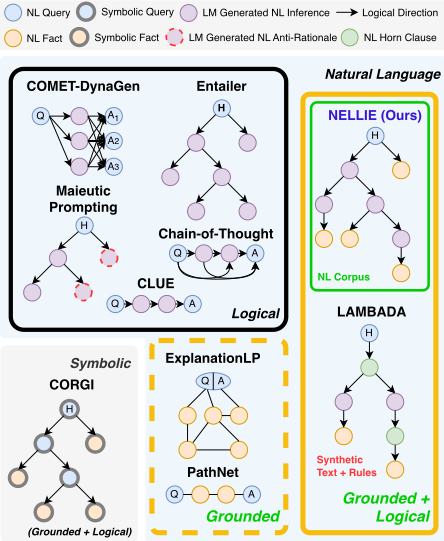
We desire the following expert system-inspired desiderata:
- Grounding inferences fully and scalably in a corpus of knowledge from an authoritative human source.
- Logical direction, showing how a given hypothesis (and all intermediate inferences leading up to it) follows as the logical consequence of the underlying knowledge source
- Competitive end-to-end QA performance in a complex domain requiring diverse forms of reasoning.
As illustrated in Figure 2, various eXplainable QA (XQA) methods accomplish 2 of these criteria, but not all 3. Some methods, like Chain-of-Thought, generate inference chains or logically structured graphs from an LLM without grounding in verified knowledge. Others, like ExplanationLP [Thayaparan et al., 2021], compose graphs of grounded facts, but do not show logical direction. LAMBADA [Kazemi et al., 2023] achieves both direction and grounding but is limited to simple domains with provided NL Horn rules and sets of 1-2 dozen facts. In contrast, we desire a system that handles a larger corpus (10K statements) and doesn't need handcrafted rules.
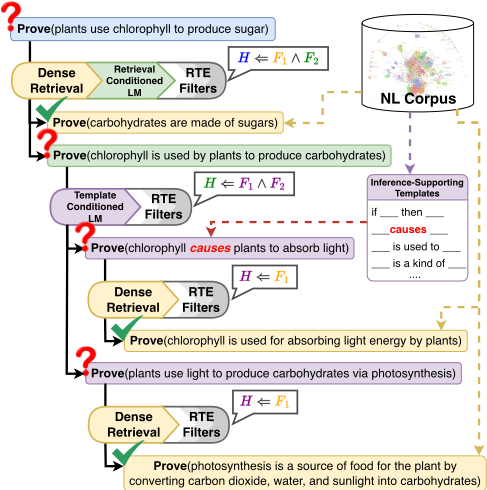
To achieve all three desiderata, we reuse the general inference framework of an expert system, but replace handcrafted rules with a combination of neural language modeling, guided generation, and semiparametric dense retrieval. We demonstrate this in a system called NELLIE, the Neuro-Symbolic Large LM Inference Engine. NELLIE leverages LLMs as proposal functions in the search of proof trees showing how a conclusion follows via entailment from an external corpus of NL statements. The "symbols" that our neuro-symbolic engine reasons over are free-form NL sentences. Rather than require a knowledge engineer to carefully write hundreds of inference rules as in the classical setting, NELLIE employs an LLM as a dynamic rule generator [DRG; Kalyanpur et al., 2021] to generate (rather than retrieve) candidate rules that decompose a hypothesis into subqueries that, if themselves proved recursively, will prove that hypothesis via composition (Figure 1). In this way, NELLIE can answer the question posed by the classical expert system: "Does this statement systematically follow from my knowledge, or not?".
NELLIE is built upon a backward chaining symbolic theorem prover written in Prolog, implemented using a few metarules specifying how inference should proceed. These include checking for entailment of a hypothesis against a retrieved fact or decomposing it into a conjunction of subqueries to recursively prove. To treat NL sentences as if they were symbols in a purely symbolic search algorithm, we use a natural language inference-based form of weak unification [Sessa, 2002; Weber et al., 2019] between the hypothesis and a corpus fact. This produces interpretable proofs similar to the compositional entailment trees of prior work (e.g., EntailmentBank [Dalvi et al., 2021]) while tackling the additional challenge of QA.
NELLIE is designed to search across hundreds of trees whose leaves come from one of two types of knowledge: (a) a corpus of semi-structured text statements, such as NL renditions of database entries, or (b) a corpus of free-form NL sentences. Many correct proofs might exist for a given hypothesis, but much fewer will be fully groundable in the provided corpus, making the search harder than for ungrounded alternatives like Entailer [Tafjord et al., 2022] or COMET-Dynagen [Bosselut et al., 2021]. To improve grounding, we introduce two guiding methods to boost the likelihood of generating rules whose conditions match against the available text: (1) For applications where a semi-structured corpus is available, NELLIE leverages this structure via templates to help steer rule generation towards syntax that is more likely to match corpus entries. (2) For both free-form and semi-structured corpora, NELLIE retrieves and conditions on statements to help steer generation towards trees grounded in them. Ablation experiments show these together and individually improve NELLIE's reasoning.
NELLIE expands upon methods that ground known-to-betrue hypotheses to provided facts [SCSEARCH; Bostrom et al., 2022], extending the paradigm to perform QA. This involves searching for and comparing trees for conflicting answer options. Experiments find NELLIE outperforms a similar-sized state-of-the-art reasoner, Entailer, while producing compositional trees showing how decisions are grounded in corpus facts. Our contributions are thus:
- An architecture for systematic reasoning from a corpus of textual knowledge to answer questions. This can be viewed as a modern approach to expert system inference, but without requiring a formal knowledge representation.
- An implementation, NELLIE, 1 that outperforms a similarsized SOTA reasoner (Entailer-3B) while producing
1 Code and appendix at https://github.com/JHU-CLSP/NELLIE.
grounded trees. To our knowledge, this is the first system to perform grounded XQA as NL entailment tree search.
2 RelatedWork
Theorem Proving over Language A long-standing approach to reasoning over NL is to project it into a symbolic form, such as for QA [Green et al., 1961; Zelle and Mooney, 1996] or entailment [Bos and Markert, 2005]. Provided the translation from NL to symbolic representation is accurate, one can leverage fast and scalable solutions for discrete symbolic inference [Riazanov and Voronkov, 2002; Kautz et al., 1992; Kautz and Selman, 1999]. However, reliably translating broad-domain NL into an adequately expressive formalism for reasoning is a challenge [Schubert, 2015], though some have found success using LLMs to perform this semantic parsing task [Wong et al., 2023; Lyu et al., 2023; Olausson et al., 2023; Pan et al., 2023; Ye et al., 2023].
Recent work explores methods of handling NL without parsing it to another formalism. Some use LMs to generate proof steps in mathematical theorem proving [Polu and Sutskever, 2020; Welleck et al., 2022]. Variants of neural theorem provers [NTPs; Rockt¨aschel and Riedel, 2017] such as NLProlog [Weber et al., 2019] reconcile NL facts with symbolic reasoning by learning embeddings for the facts and symbols in a theory, then using weak unification to backward chain. Kalyanpur et al., 2021 inject neural reasoning into a Boxer/Prolog-based symbolic reasoner via a special LM-calling predicate. Arabshahi et al., 2021b combine handwritten symbolic rules with neural symbol embeddings to classify conversational intents. Other work explores using LMs to emulate stepwise [Tafjord et al., 2021; Kazemi et al., 2023] or end-to-end [Clark et al., 2021; Picco et al., 2021] logical reasoning over small rulebases converted to NL. These approaches require both user-provided if/then rules to operate, while NELLIE requires only facts and is thus applicable to domains in which rules are not available.
Modular Reasoning over NL NELLIE's systematic reasoning is related to approaches that decompose problems into sequences of modular operations. Gupta et al., 2020 introduce a neural module network [NMN; Andreas et al., 2016] for QA with modules for span extraction and arithmetic operations. Khot et al., 2021 introduce another NMN that decomposes questions into simpler ones answerable by existing models. These are part of a broader class of work decomposing multistep reasoning using reasoning modules [Khot et al., 2022; Saha et al., 2023a; Saha et al., 2023b].
Systematic Explanation Generation Recent works have used LMs to generate NL reasoning graphs in support of an answer. "Chain-of-Thought" prompting [Wei et al., 2022; Kojima et al., 2022], elicits free-form inference hops from the LM before it generates an answer. Other text graph generation methods connect model-generated statements via common sense relations [Bosselut et al., 2021; Arabshahi et al., 2021a] or for/against influence [Madaan et al., 2021; Jung et al., 2022], though these are not knowledge-grounded and don't address entailment (see Figure 2).
The EntailmentBank dataset [Dalvi et al., 2021] has driven research towards the construction of explanation trees, challenging models to produce stepwise entailment proofs of a statement using a set of provided support facts. This direction builds upon works on explainable reasoning that build graphs from KB-retrieved sets of support statements, but stop short of showing their role in logical entailment [Pan et al., 2019; Jansen and Ustalov, 2019; Yadav et al., 2019; Valentino et al., 2022]. Components of our framework are related to concurrent approaches for entailment tree construction [Bostrom et al., 2022; Hong et al., 2022; Sprague et al., 2022]. Ribeiro et al., 2022 also use iterative retrieval-conditioned generation, and Yang et al., 2022 also use entailment classifiers to filter proof steps. None of the above tree generation approaches consider this harder scenario of multiple-choice QA, opting instead to focus on the reconstruction task from support facts. Tafjord et al., 2022 do consider the harder task. They propose a backward chaining QA system, Entailer, that generates entailment trees (not grounded in human-verified facts) using a search grounded to the model's internal beliefs, complementary to NELLIE's use of guided and retrieval-conditioned generation to obtain knowledge grounding. As with NELLIE (§5.2), Entailer benefits from humans adding more useful statements to its available knowledge [Dalvi Mishra et al., 2022]. The difference between systems is highlighted by the number of generations (i.e. search nodes) considered by the two algorithms: while Entailer considers at most a couple dozen hypothesis decompositions, NELLIE must consider hundreds or thousands to find one that is fully grounded.
Faithful Complex LLMReasoning Of the growing body of work on LLM-based "Chain-of-X" reasoning methods [Xia et al., 2024], a portion considers ways to improve faithfulness to underlying knowledge and reduce LLM hallucinations (see Lyu et al., 2024 for an overview of faithful explanation methods). NELLIE contributes to this space by providing a faithfulby-design algorithm that reasons based on logical hypothesis grounding. Other recent methods include Rethinking with Retrieval [He et al., 2022], which reranks reasoning chains using a faithfulness score based on retrieved knowledge, and the forward-chaining Faithful Reasoning algorithm [Creswell and Shanahan, 2022], which follows "a beam search over reasoning traces" to answer a question by iteratively adding deductive inferences to a context of starting facts. Theirs is a different style search to our backward-chaining NELLIE, not relying upon NLI for verifying logical connectedness and not scaling to larger knowledge bases.
3 Background
A logical expert system proves a propositional query against a theory comprised of facts and inference rules, generally given in the form of Horn clauses. Upon finding a rule whose head can unify with the query, a depth-first backward chaining algorithm such as those used in Prolog solvers will perform variable substitution and then recursively attempt to prove the terms in the rule's body. For example, a disease classification system might prove query CONTAGIOUS(flu) via facts CONTAGIOUS(influenza) and OTHERNAME(flu↪ influenza), and conjunctive rule CONTAGIOUS(X) ( OTHERNAME(X↪ Y )^
CONTAGIOUS(Y ). It does so by unifying CONTAGIOUS(flu) with CONTAGIOUS(X) and then recursively unifying the terms in the rule body with their matching facts. Here, flu is an object symbol, CONTAGIOUS is a predicate symbol, and X is a variable. See Russell and Norvig, 2010 for further details.
Neural Predicates While most declarative predicates have meaning only in the context of user-defined inference axioms, others can call external neural modules that produce values for their arguments or determine the truth value of the predicate. A popular implementation of this paradigm is DeepProbLog [Manhaeve et al., 2018], which we use to define LMinvoking predicates. In the above example, we might train a sequence-to-sequence (seq2seq) model to produce other names for a disease Y , turning OTHERNAME(Y +↪X-)2 into a neural predicate. This mechanism creates the ability to introduce externally defined object symbols, e.g. seq2seq-generated NL, into the engine's vocabulary.
Weak Unification In classical backward chaining, a unification operator assigns equivalence to two logical atoms; this requires atoms to have the same arity and have no unequal ground literals in the same argument position. Issues arise when literals are NL sentences, which can be syntactically distinct but semantically equivalent. To handle this, Weber et al., 2019 propose a weak unification operator, which allows for the unification of any same-arity atoms regardless of conflicting symbols. 3 They estimate a unification score as the aggregation of pairwise similarity scores using a similarity function ✓(s1↪ s2) 2 [0↪ 1]. The score of the full proof is taken as the minimum of scores across all steps. In this work, we apply a similar aggregation; we say that a query fact s1 "weakly unifies" with provenance fact s2 with a unification score equal to the confidence of an NLI model taking s2 as the premise and s1 as the hypothesis.
4 Overview of Approach
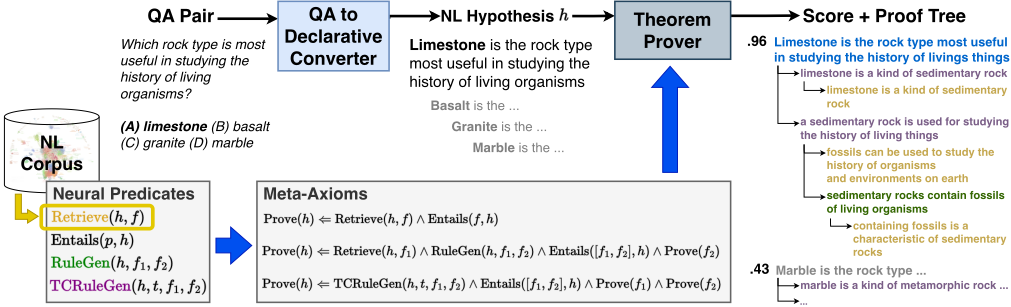
Depicted in Figure 3, our framework is comprised of: an external corpus of facts (some ¶f1↪ ▷ ▷ ▷ fn♦); a module that converts a QA pair to a hypothesis; an off-the-shelf theorem prover; and a suite of meta-axioms that use neural fact retrieval and dynamic rule generation modules to propose, verify, and score inferences. In our experiments, we consider one implementation of this framework that uses the corpus WorldTree [Xie et al., 2020], a set of 9K NL science facts that can interchangeably be considered as rows in 81 n-ary relational tables.
Question Conversion Given a multiple-choice question, the system converts each candidate answer into a hypothesis h using a Question to Declarative Sentence model [QA2D; Demszky et al., 2018] (See §C). It then searches for a proof of h against its knowledge base. For each alternative, we enumerate p proofs using a time-capped backward chaining search and then take as the system's answer the candidate with the overall highest-scoring proof.
2 In Prolog syntax, '+' denotes inputs, '-' outputs.
3 Introducing weak unification greatly increases the search runtime, as one might try to unify any two symbols in the vocabulary at every recursive step. This poses a substantial challenge when applying the query grounding algorithm to a search space over NL.
4.1 Inference Rule Structure
Our approach uses LMs to dynamically generate inference rules given a hypothesis. The rule structure is strikingly simple, instantiating one of the following meta-level templates:
Via template I, the system proves the hypothesis by finding a provenance Fact stored in its knowledge store that entails the hypothesis. Via template II, it enumerates a pair, Fact1 and Fact2, both either stored in the knowledge store or themselves recursively proved, such that the pair in conjunction entails the hypothesis. 4 Template I is given higher search precedence than II, yielding an intuitive high-level procedure: we first look up the hypothesis against the factbase, searching for an entailing fact. If we do not find one, we decomposes the hypothesis into a pair of statements to be proved. Concretely, for an input hypothesis h, we define the predicate PROVE(h) that serves as the primary goal term. We define the following core meta-rules, which use the neural predicates RETRIEVE, ENTAILS, and RULEGEN. At each step in the backward-chaining search, NELLIE's Prolog engine attempts to unify a query with the head of one of these three rules:
- Fact Unification PROVE(h) ( RETRIEVE(h+↪ f -) ^ ENTAILS(f↪ h)
- Two Premise Rule Generation PROVE(h) ( RULEGEN(h+↪ f - 1 ↪ f - 2 ) ^ENTAILS([f1↪ f2]↪ h)
^ PROVE(f1) ^ PROVE(f2)
- Retrieved First Premise Rule Generation PROVE(h) ( RETRIEVE(h+↪ f - 1 ) ^ RULEGEN(h+↪ f + 1 ↪ f -
2 ) ^ENTAILS([f1↪ f2]↪ h) ^ PROVE(f2)
4.2 Unification with Retrieved Facts
For factbase fact f, PROVE(f) is vacuously true. Rule 1 shows how we prove PROVE(h) using retrieval. The predicate RETRIEVE proposes candidate fi's given h using a FAISS [Johnson et al., 2019]-based nearest neighbor dense retrieval index. We train the retrieval encoder via ranking loss such that the embedding for a hypothesis is maximally similar to its supporting facts. To promote logical coherence and improve the precision of the system, we apply a set of neural models for recognizing textual entailment (RTE) as filters ENTAILSj(·) that iteratively rule out fi candidates that are not classified as entailing h.
Implicit in rule 1 is that PROVE(h) weakly unifies with some PROVE(fi); we assign the unification score ✓(h↪ fi) equal to the confidence of one RTE model.
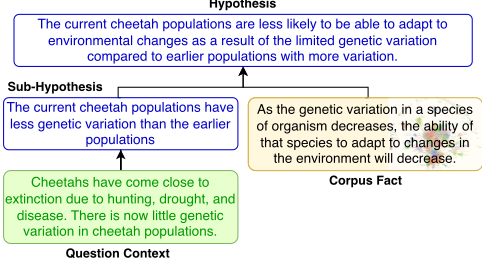
For some questions such as the one depicted in Figure 4, it is necessary to ground a subquery in evidence from the problem. To handle this, we add the question setup (defined as all but its last sentence) as a "fact" always proposed by RETRIEVE.
4 We find that two-premise decomposition is sufficiently powerful and expressive for our purposes. For example, to prove a hypothesis such as those in EntailmentBank [Dalvi et al., 2021] that requires a three-premise conjunction h ( f1 ^ f2 ^ f3, NELLIE produces instead a recursive set of decompositions H ( f1^fi; fi ( f2^f3.
Cheetahs have come close to extinction due to hunting, drought, and
disease. There is now little genetic variation in cheetah populations. Which of the following is a result of the limited genetic variation in the current cheetah populations compared to earlier populations with more variation? (A) ...
(D) The current cheetah populations are less likely to be able to adapt to environmental changes.
4.3 Dynamic Rule Generator (DRG)
If we do not find an entailing fact for hypothesis h, we decompose h into a pair of entailing premises; we propose candidates using nucleus sampling [Holtzman et al., 2019] from a seq2seq model. The predicate RULEGEN(h↪ f1↪ f2) prompts a model trained to generate h ! f1↪ f2 pairs. The space of potential decompositions is very large; there are many deductively valid ways to prove a hypothesis in natural language, though only a fraction of them are ultimately groundable in the provided factbase. To bias the proof search towards those more likely to be grounded in the corpus, we adopt a two-pronged approach, illustrated in inference rules 2 and 3, that proposes a heterogeneous search frontier using different biasing strategies in addition to straightforward LM sampling.
Template Conditioned Generation (TCG) One way in which we improve our LM-based proposal function is to leverage the high-level structure that supports reasoning in a given domain: we propose template-guided generation to bias search towards the semi-structure of WorldTree. 5 WorldTree tables correspond to types of facts with similar syntax and semantics that support scientific reasoning. WorldTree questions are annotated with the fact rows that support their answers. Each table can be viewed as an n-ary relation of columns whose values are text spans. E.g., the Taxonomic relation has columns <A>, [HYPONYM], <is a / a kind of>, <SCOPE1>, [HYPERNYM], <for>, [PURPOSE]. Rows include 'a bird is an animal' and 'a seed is a kind of food for birds.'
Thus, for the RULEGEN predicate in rule 2, half of the f1↪ f2 candidates are sampled from the DRG conditioned on h plus a template that cues the model to reflect the syntax of a WorldTree table. We train the DRG to accept any masked infilling template (e.g. <mask>is a kind of <mask>, akin to those used to pretrain LMs [Lewis et al., 2019; Raffel et al., 2020]), and propose decompositions whose first fact reflects the template's syntax. We thus create a h↪ t1 ! f1↪ f2 model. We feed the model templates drawn fromWorldTree's tables, guiding it towards proof steps more likely to be grounded in the factbase. A sample of the 150 templates can be found in Figure 5 (a larger list is shown in §D). We reuse the same model for non-template-conditioned generation by feeding it an empty template. In practice, we make two generation calls: one samples m free-generated candidates, and a second samples n candidates for each of nt templates.
Template Selection WorldTree is a diverse corpus, containing tables that are specific to a particular subset of science problems (e.g. the "Predator-Prey" table). As conditioning on dozens of templates can be computationally expensive, we introduce a case-based reasoning [Schank, 1983; Das et al., 2021] approach that selects relevant templates for a given hypothesis. We construct an Okapi-BM25 [Jones et al., 2000] retrieval index over questions from the WorldTree QA training set to obtain the most lexically similar items to a query. At inference time, we select the top-k most similar questions to the query and take as our template subset the tables of the questions' annotated facts.
5 While our approach is applicable to a wide array of reasoning problems, the use of WorldTree-specific templates illustrates one way by which we can infuse domain-specific structure into the neural search algorithm. This is a strict departure from the burdensome process of symbolic knowledge engineering. As our experiments show, this guidance method improves NELLIE's QA accuracy by a few points, though ablating it yields a similarly strong performance.
| WorldTree Relation | Template |
|---|---|
| KINDOF IFTHEN PROP-THINGS CAUSE MADEOF REQUIRES ACTION USEDFOR PARTOF CHANGE USEDFOR AFFECT PROP-ANIMAL-ATTRIB SOURCEOF COMPARISON EXAMPLES COUPLEDRELATIONSHIP PROP-CONDUCTIVITY PROP-GENERIC HABITAT MEASUREMENTS | <mask>is a kind of <mask> if <mask>then <mask> <mask>has <mask> <mask>causes <mask> <mask>made of <mask> <mask>requires <mask> <mask>is when <mask> <mask>used to <mask> <mask>a part of <mask> <mask>changes <mask> <mask>used for <mask> <mask>has <mask>impact on <mask> <mask>is a <mask>animal <mask>is a source of <mask> <mask>than <mask> an example of <mask>is <mask> as <mask>decreases <mask>will <mask> <mask>is <mask>conductor <mask>is a property of <mask> <mask>live in <mask> <mask>is a measure of <mask> |
Retrieval Conditioned Generation (RCG) In rule 3, rather than generate a pair of subqueries, we immediately ground half of the antecedent by choosing as f1 a fact retrieved directly from the corpus. We have the DRG force decode f1 before generating f2 as normal, then recur only on f2.
Filters As stochastic sampling from LMs can be noisy, some fraction of the generated candidate set may be invalid: premises may be incoherent, or the decomposition might not properly entail h. Accordingly, we introduce a set of compositional entailment verifiers [Khot et al., 2020; Jhamtani and Clark, 2020] trained on two-premise compositional entailment. We also add a "self-ask" filter, which following Tafjord et al., 2022 is an LM fine-tuned to assign a statement a truth value. If the confidence is below 0.5 for either an entailment judgment or the 'self-ask' belief in f1 or f2, then we filter the pair. All filters condition on the question text as context. When NELLIE uses these rules, the unification score equals the lowest of the scores for PROVE(f1), for PROVE(f2), and the confidence of entailment filters se([f1↪ f2] ) H).
4.4 Proof Search
Given a query, NELLIE searches for t seconds to find up to p proofs of depth d or less. We followWeber et al., 2019 in pruning search branches whose unification score is guaranteed to fall below the current best, given our monotonic aggregation function min(·). Found proofs that score under the current best do not count towards p. Full pseudocode for the algorithm, which follows a depth-first search with a breadth-first lookahead [Stern et al., 2010] to check for the unification of generated subgoals, can be found in §E. It is parameterized by
- A maximum number of proofs m at which to cut off searching. In experiments, we set this to 10 for top-level queries and 2 for recursive subqueries.
- A number of support facts nf to retrieve at each call to RETRIEVEK, which we set to 15.
- Candidate generation rates nv for vanilla nucleussampled decompositions, nt for template-conditioned decompositions, and nr for retrieval-conditioned generations. We set these each to 40. 6 Upon removing exact match duplicates, a call to RULEGEN produces about 100 candidates.
- Entailment scoring module SCOREe(·), which is a separate RTE cross-encoder model for single- and doublepremise entailments.
5 Experiments
We train the components of NELLIE to be able to answer questions in the Science QA domain. The different neural modules are trained on reformulations of existing datasets for scientific reasoning. Further information can be found in §A.
Our experiments illustrate how the approach exemplified by NELLIE provides grounded and logical explanations, performing comparably or better than approaches that do not satisfy these properties. We evaluate models on two multiple-choice QA datasets constructed so that correct answers are supported by facts in the WorldTree corpus:
EntailmentBank [Dalvi et al., 2021] is a dataset of entailment trees for declarativized answers to the AI2 Reasoning Challenge (ARC) dataset [Clark et al., 2018], showing how the hypothesis can be derived via compositional entailment hops from WorldTree facts. We recast the test set, initially designed to test tree reconstruction, into QA by retrieving the corresponding multiple-choice ARC questions from which the hypotheses were constructed.
WorldTree [Xie et al., 2020] is a subset of the ARC dataset annotated with undirected explanation graphs whose nodes are facts from the WorldTree tablestore. We note that WorldTree explanations do not show how facts should combine. There is no guarantee that fully grounded trees exist for these questions using the WorldTree corpus alone. The difficulty of this task is akin to that of a course exam: the teacher (us) provides the student (the model) with a very large study guide of facts, but expects the student to use these facts by composing them to reason coherently about a problem.
Our task metric is accuracy: whether a generated proof of the correct option outscores any other. 7
Baselines We evaluate NELLIE against Entailer [Tafjord et al., 2022], another system that produces entailment tree proofs via backward chaining. Entailer stops recurring not when it finds entailing facts from a corpus, but rather when the model believes that a subquery is true with high confidence. Its trees are thus not grounded in verified facts. We reimplemented their algorithm using their T5-11B-based model, reporting their configuration of a max tree depth (D) of 3 and minimum of 1 (i.e. ≥ 1 decomposition). We also evaluate their ablated setting which recurs exactly once (D=1). This is a baseline that is neither grounded nor particularly interpretable, generating just a pair of statements. To isolate the impact of model size, we also evaluate an Entailer-3B model based on the same T5-3B model as NELLIE's DRG. 8 We also compare against grounded xQA methods without logical structure (see Fig 2): PathNet [Kundu et al., 2019], which constructs 2-hop chains by linking entities between facts, and three approaches that build graphs from facts using linear programming: TupleILP [Khot et al., 2017], ExplanationLP [Thayaparan et al., 2021], and Diff -Explainer [Thayaparan et al., 2022]. 9
6 Due to batching, these correspond to 3 total calls to the HuggingFace library's generate function for the T5-3B model.
7 If it produces no proofs, it gives no answer and is wrong. NELLIE searches for up to p=10 proofs of max depth d=5 with a timeout of t=180 seconds per option.
| Explanations | QAAccuracy (%) | ||||
|---|---|---|---|---|---|
| Grounded | Logical | Ovr | Easy | Chal | |
| EntailmentBank QA | |||||
| NELLIE (3B) | Yes | Yes | 71.4 | 76.4 | 60.4 |
| Entailer-3B | |||||
| (D = 3) | No | Yes | 48.7 | 52.8 | 39.6 |
| (D = 1) | No | No | 64.9 | 71.2 | 50.9 |
| Entailer-11B | |||||
| (D = 3) | No | Yes | 73.2 | 77.3 | 64.2 |
| (D = 1) | No | No | 71.1 | 76.4 | 59.4 |
| WorldTree QA | |||||
| NELLIE (3B) | Yes | Yes | 71.4 | 75.7 | 60.9 |
| Entailer-3B | |||||
| (D = 3) | No | Yes | 45.2 | 50.1 | 33.3 |
| (D = 1) | No | No | 47.7 | 51.6 | 38.5 |
| Entailer-11B | |||||
| (D = 3) | No | Yes | 73.2 | 76.7 | 64.6 |
| (D = 1) | No | No | 74.1 | 78.7 | 63.0 |
| PathNet | Yes | No | 43.4 | ||
| TupleILP | Yes | No | 49.8 | ||
| ExplanationLP | Yes | No | 62.6 | ||
| Diff-Explainer | Yes | No | 71.5 | ||
5.1 Results
Table 1 shows QA performance. NELLIE's overall (Ovr) accuracy of over 70% matches that of the best-performing grounded baseline, Diff -Explainer, on WorldTree, and is within 2 points of the best logically directed baseline, Entailer11B. This is notable given Entailer-11B is a much larger model and has no requirement to provide grounded proofs. NELLIE outperforms the same-sized Entailer-3B baseline by a margin of 22% on EntailmentBank and 26% on WorldTree under its default max D = 3 configuration, and even outperforms the less explainable D = 1 variant.
8 We obtained the training data from Tafjord et al., 2022 and trained our model in consultation with the authors.
9 We show results from [Thayaparan et al., 2021 & 2022].
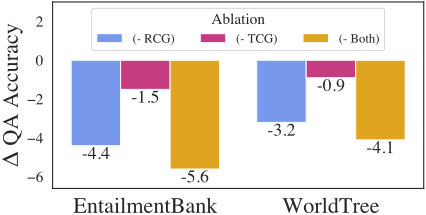
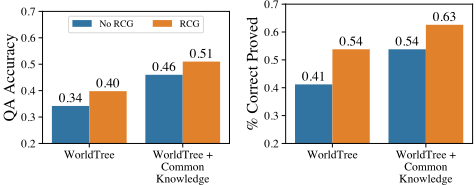
Figure 6 shows the results of ablating NELLIE's two conditional generation modules and replacing them with vanilla generation. Removing both template- and retrieval-conditioned generation lowers NELLIE's performance in all circumstances, highlighting the empirical benefit of structured guidance. Ablating TCG ((- TCG), and the drop from (- RCG) to (- Both)) reduces performance by 1-1.5 points. Ablating RCG (NELLIE vs (- RCG)) drops it by 3-4.
5.2 Domain Generalization and Knowledge Scaling
While NELLIE was trained on datasets centered around WorldTree, we show that it can perform in another domain by altering the knowledge over which it reasons. We consider OpenBookQA [Mihaylov et al., 2018], a dataset that requires reasoning over facts not included in WorldTree; each question is associated with one WorldTree science fact ("metals conduct electricity"), but also one fact from a separate pool of common knowledge ("a suit of armor is made of metal").
As with a classical expert system, we have designed NELLIE to be "improvable merely by making statements to it" [McCarthy, 1959]. This suggests that as we increase the provided knowledge store, we should expect NELLIE to reason more effectively. Because WorldTree does not cover all the knowledge required to answer OBQA questions, we test whether NELLIE performs better on them when we add the common knowledge to its retrieval index. As the common knowledge annotations are one fact per question and are not designed specifically for entailment, it is unlikely a priori that a fully grounded entailment tree can be created using the available knowledge alone, making this a challenging task.
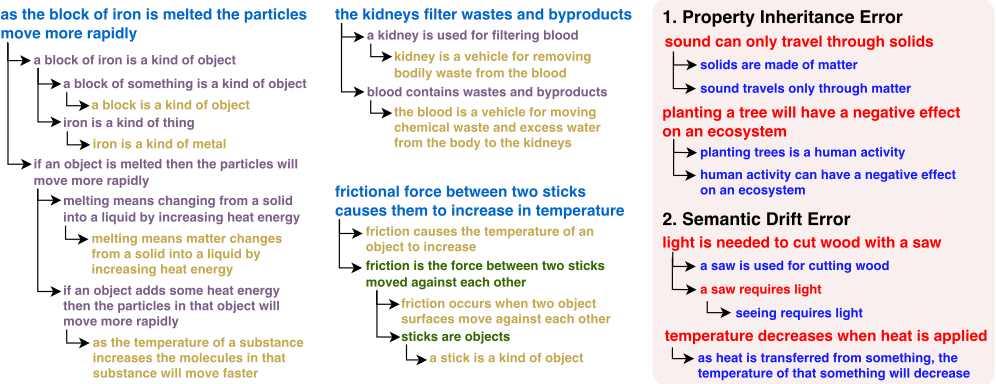
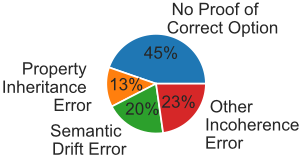
Figure 7 shows NELLIE's accuracy with and without RCG. We do not use TCG, as the targeted common knowledge is freeform. We find that QA accuracy increases 11-12% with the common knowledge added. The percent of correct statement proved also increases 9-12%. These results also highlight the importance of RCG, as it provides a 5% QA boost and 13% on correct proof rate. These results show that NELLIE can be applied out-of-the-box to a dataset requiring reasoning over a different source of free-form NL knowledge.
5.3 Tree Error Analysis
We find that NELLIE can produce high quality proofs of correct hypotheses; examples are shown in Figure 8 (left) and §F. However, the system can also generate proofs for incorrect answers that bypass its entailment filters. We can diagnose (and perhaps annotate) error patterns to address in future work. We list a few categories, depicted in Figure 8 (right). A common pattern of error is Hypernym Property Inheritance Errors (also known as the "fallacy of the undistributed middle"), in which the model assumes that a member of a taxonomic class has a property of their hypernym, but the property is not universal. A colloquial example is inferring penguins can fly from penguins are birds & birds can fly. We also observe an amount of Errors from Semantic Drift [Khashabi et al.,
2019] between inference hops, culminating in RTE model false positives. E.g., in block 2 of Fig 8 (right), which object loses temperature during heat transfer changes between hops. Figure 9 shows the distribution of these errors on a set of 136 incorrect answers from EntailmentBank. The predominant error case is a failure to find any proof of the correct option.
Correct Answer TreeAnalysis To investigatewhether NELLIE reaches a right solution with right vs wrong reasoning, we manually inspected for reasoning errors in 50 correct answer trees produced by NELLIE. We found that 39/50 (78%) of trees were perfectly acceptable. Most of the 11 unacceptable trees were due to incompleteness at one decomposition step.
6 Conclusion
We propose a reimagined version of a classical expert system that relies on the inferential power of LLMs rather than handcrafted rules. NELLIE has the skeleton of a symbolic theorem prover, but the provided rules invoke neural predicates that allow for systematic reasoning over NL statements. To dynamically generate inferences, we introduce two mechanisms for knowledge-guided generation: conditioning decompositions on retrieval or model-selected inference templates. Our search algorithm undergirds NELLIE, an explainable reasoning system that performs end-to-end QA by searching for grounded entailment trees. We find that NELLIE equals or exceeds the performance of comparable XQA systems, while providing explanations with the simultaneous guarantees of logical directionality and groundedness in human-provided text. This work thus suggests a new way to jointly reap the benefits of both modern neural methods and traditional reasoning.
Acknowledgements
Thanks to Nils Holzenberger, Kyle Richardson, Elias StengelEskin, Marc Marone, Kate Sanders, Rachel Wicks, and Andrew Blair-Stanek for comments on earlier drafts. Thank you to Abbey Coogan for feedback on figure design.
@inproceedings{ijcai2024p399,
  title     = {NELLIE: A Neuro-Symbolic Inference Engine for Grounded, Compositional, and Explainable Reasoning},
  author    = {Weir, Nathaniel and Clark, Peter and Van Durme, Benjamin},
  booktitle = {Proceedings of the Thirty-Third International Joint Conference on
               Artificial Intelligence, {IJCAI-24}},
  publisher = {International Joint Conferences on Artificial Intelligence Organization},
  editor    = {Kate Larson},
  pages     = {3602--3612},
  year      = {2024},
  month     = {8},
  note      = {Main Track},
  doi       = {10.24963/ijcai.2024/399},
  url       = {https://doi.org/10.24963/ijcai.2024/399},
}
TY - CPAPER TI - NELLIE: A Neuro-Symbolic Inference Engine for Grounded, Compositional, and Explainable Reasoning AU - Weir, Nathaniel AU - Clark, Peter AU - Van Durme, Benjamin T2 - Proceedings of the Thirty-Third International Joint Conference on Artificial Intelligence, IJCAI-24 PB - International Joint Conferences on Artificial Intelligence Organization PY - 2024 SP - 3602 EP - 3612 DO - 10.24963/ijcai.2024/399 UR - https://doi.org/10.24963/ijcai.2024/399 ER -Copied
Machine-readable versions of this paper, for tools and AI agents:





