
Breaking Barriers of System Heterogeneity: Straggler-Tolerant Multimodal Federated Learning via Knowledge Distillation
Proceedings of the Thirty-Third International Joint Conference on Artificial Intelligence. Main Track. Pages 3789-3797.
https://doi.org/10.24963/ijcai.2024/419
Keywords
- Machine Learning: ML: Multi-modal learning
Abstract
Internet of Things (IoT) devices possess valuable yet private multimodal data, calling for a decentralized machine learning scheme. Though several multimodal federated learning (MFL) methods have been proposed, most of them merely overlook the system heterogeneity across IoT devices, resulting in the inadaptability to real world applications. Aiming at this, we conduct theoretical analysis and exploration experiments on straggler impacts and uncover the fact that stragglers caused by system heterogeneity are fatal to MFL, resulting in catastrophic time overhead. Motivated by this, we propose a novel Multimodal Federated Learning with Accelerated Knowledge Distillation (MFL-AKD) framework, which is the first attempt to integrate knowledge distillation to combat stragglers in complex multimodal federated scenarios. Concretely, given the pretrained large-scale vision-language models deployed in the central server, we apply a fast knowledge transfer mechanism to conduct early training of local models with part of the local data. The early-trained model is then enhanced through the distillation of the pretrained large model and further trained on the remaining data. Extensive experiments on two datasets for video moment retrieval and two datasets for image-text retrieval demonstrate that our method achieves superior results with high straggler robustness.
- [Ahn et al., 2020] Sungyong Ahn, Seunghyun Yoo, and Ki- jung Shin. Fedkd: Collaborative learning with weight- sharing and knowledge distillation. In Proceedings of the AAAI Conference on Artificial Intelligence, volume 34, pages 4598-4605, 2020.
- [Bonawitz et al., 2017] Keith Bonawitz, Vladimir Ivanov, Ben Kreuter, Antonio Marcedone, H Brendan McMahan, Sarvar Patel, Daniel Ramage, Alec Segal, Karn Seth, Vin- cent Vanhoucke, et al. Practical secure aggregation for privacy-preserving machine learning. In Proceedings of the 2017 ACM SIGSAC Conference on Computer and Communications Security, pages 1175-1191, 2017.
- [Cheng et al., 2021] Sijie Cheng, Jingwen Wu, Yanghua Xiao, and Yang Liu. Fedgems: Federated learning of larger server models via selective knowledge fusion. CoRR, abs/2110.11027, 2021.
- [Gao et al., 2017] Jiyang Gao, Chen Sun, Zhenheng Yang, and Ram Nevatia. Tall: Temporal activity localization via language query. In 2017 IEEE International Conference on Computer Vision (ICCV), pages 5277-5285, 2017.
- [Han et al., 2020] Pengchao Han, Shiqiang Wang, and Kin K Leung. Adaptive gradient sparsification for efficient fed- erated learning: An online learning approach. In 2020 IEEE 40th international conference on distributed com- puting systems (ICDCS), pages 300-310. IEEE, 2020.
- [Hinton et al., 2015] Geoffrey Hinton, Oriol Vinyals, and Jeff Dean. Distilling the knowledge in a neural network, 2015.
- [Hu et al., 2023] Yupeng Hu, Kun Wang, Meng Liu, Haoyu Tang, and Liqiang Nie. Semantic collaborative learning for cross-modal moment localization. ACM Transactions on Information Systems, 42(2):1-26, 2023.
- [Huang et al., 2022] Jie Huang, Zheng Liu, Dong Yang, and Yang Li. Multimodal federated learning via contrastive representation ensemble. In AAAI, 2022.
- [Kairouz et al., 2021] Peter Kairouz, H. Brendan McMahan, Brendan Avent, Aurélien Bellet, Mehdi Bennis, Arjun Nitin Bhagoji, Kallista Bonawitz, Zachary Charles, Gra- ham Cormode, Rachel Cummings, and et al. Advances and open problems in federated learning. Found. Trends Mach. Learn., 14(1-2):1-210, jun 2021.
- [Komodakis and Pesquet, 2017] Nikos Komodakis and Jean- Christophe Pesquet. Paying more attention to attention: Improving the performance of convolutional neural net- works via attention transfer. In Proceedings of the IEEE Conference on Computer Vision and Pattern Recognition, pages 5294-5303, 2017.
- [Krishna et al., 2017] Ranjay Krishna, Kenji Hata, Fred- eric Ren, Li Fei-Fei, and Juan Carlos Niebles. Dense- captioning events in videos. In 2017 IEEE International Conference on Computer Vision (ICCV). IEEE, October 2017.
- [Li et al., 2020a] Mingsheng Li, Haoqiang Fan, Haoyi Xiong, Wei Zhu, Jianfei Hu, and Ling Li. Federated learn- ing: Challenges, methods, and future directions. IEEE Sig- nal Processing Magazine, 37(3):50-60, 2020.
- [Li et al., 2020b] Tian Li, Anit Kumar Sahu, Manzil Zaheer, Maziar Sanjabi, Ameet Talwalkar, and Virginia Smith. Federated optimization in heterogeneous networks. Pro- ceedings of Machine learning and systems, 2:429-450, 2020.
- [Li et al., 2020c] Xiang Li, Yifeng Wang, and Xiaoming M. Wu. Fedmd: Heterogenous federated learning via model distillation. In Proceedings of the 26th ACM SIGKDD In- ternational Conference on Knowledge Discovery & Data Mining, pages 2423-2433, 2020.
- [Lin et al., 2014] Tsung-Yi Lin, Michael Maire, Serge Be- longie, James Hays, Pietro Perona, Deva Ramanan, Piotr Dollár, and C Lawrence Zitnick. Microsoft coco: Com- mon objects in context. In Computer Vision-ECCV 2014: 13th European Conference, Zurich, Switzerland, Septem- ber 6-12, 2014, Proceedings, Part V 13, pages 740-755. Springer, 2014.
- [Liu et al., 2019] Ronghang Liu, Joel Lehman, Piero Molino, Felipe Petroski Such, Elnaz Frank, Alexander Sergeev, and Kellen Yocum. Federated learning for vision- and-language grounding problems. In EMNLP-IJCNLP 2019, 2019.
- [Liu et al., 2021] Jianchun Liu, Hongli Xu, Lun Wang, Yang Xu, Chen Qian, Jinyang Huang, and He Huang. Adaptive asynchronous federated learning in resource-constrained edge computing. IEEE Transactions on Mobile Comput- ing, 2021.
- [McMahan et al., 2017] Brendan McMahan, Eider Moore, Daniel Ramage, Seth Hampson, and Blaise Aguera y Ar- cas. Communication-Efficient Learning of Deep Networks from Decentralized Data. In Aarti Singh and Jerry Zhu, editors, Proceedings of the 20th International Conference on Artificial Intelligence and Statistics, volume 54 of Pro- ceedings of Machine Learning Research, pages 1273- 1282. PMLR, 20-22 Apr 2017.
- [Qu et al., 2021] Leigang Qu, Meng Liu, Jianlong Wu, Zan Gao, and Liqiang Nie. Dynamic modality interaction mod- eling for image-text retrieval. In Proceedings of the 44th International ACM SIGIR Conference on Research and Development in Information Retrieval, pages 1104-1113, 2021.
- [Radford et al., 2021] Alec Radford, Jong Wook Kim, Chris Hallacy, Aditya Ramesh, Gabriel Goh, Sandhini Agar- wal, Girish Sastry, Amanda Askell, Pamela Mishkin, Jack Clark, et al. Learning transferable visual models from nat- ural language supervision. In International conference on machine learning, pages 8748-8763. PMLR, 2021.
- [Reisizadeh et al., 2022] Amirhossein Reisizadeh, Isidoros Tziotis, Hamed Hassani, Aryan Mokhtari, and Ramtin Pedarsani. Straggler-resilient federated learning: Leverag- ing the interplay between statistical accuracy and system heterogeneity. IEEE Journal on Selected Areas in Infor- mation Theory, 3(2):197-205, 2022.
- [Romero et al., 2015] Adriana Romero, Nicolas Ballas, Samira Ebrahimi Kahou, Antoine Chassang, Carlo Gatta, and Yoshua Bengio. Fitnets: Hints for thin deep nets, 2015.
- [Smith et al., 2017] Virginia Smith, Chao-Kai Chiang, Maziar Sanjabi, and Ameet S Talwalkar. Federated multi-task learning. Advances in neural information processing systems, 30, 2017.
- [Tang et al., 2021a] Haoyu Tang, Jihua Zhu, Meng Liu, Zan Gao, and Zhiyong Cheng. Frame-wise cross-modal match- ing for video moment retrieval. IEEE Transactions on Multimedia, 24:1338-1349, 2021.
- [Tang et al., 2021b] Haoyu Tang, Jihua Zhu, Lin Wang, Qinghai Zheng, and Tianwei Zhang. Multi-level query interaction for temporal language grounding. IEEE Transactions on Intelligent Transportation Systems, 23(12):25479-25488, 2021.
- [Vaswani et al., 2017] Ashish Vaswani, Noam Shazeer, Niki Parmar, Jakob Uszkoreit, Llion Jones, Aidan N Gomez, Łukasz Kaiser, and Illia Polosukhin. Attention is all you need. Advances in neural information processing systems, 30, 2017.
- [Wang et al., 2021] Yuzhou Wang, Wenjie Jiang, Jingkuan Song, and Xiangyang Xue. Fedvmr: A new federated learning method for video moment retrieval. IEEE Trans- actions on Multimedia, 2021.
- [Wu et al., 2020] Wentai Wu, Ligang He, Weiwei Lin, Rui Mao, Carsten Maple, and Stephen Jarvis. Safa: A semi- asynchronous protocol for fast federated learning with low overhead. IEEE Transactions on Computers, 70(5):655- 668, 2020.
- [Wu et al., 2022] Yuezhou Wu, Yan Kang, Jiahuan Luo, Yuanqin He, Lixin Fan, Rong Pan, and Qiang Yang. Fedcg: Leverage conditional gan for protecting privacy and maintaining competitive performance in federated learning. In Lud De Raedt, editor, Proceedings of the Thirty-First International Joint Conference on Artificial Intelligence, IJCAI-22, pages 2334-2340. International Joint Conferences on Artificial Intelligence Organization, 7 2022. Main Track. IJCAI
- [Yang et al., 2020] Qiang Yang, Yang Liu, Tianjian Chen, and Yuan Tong. Federated Learning, volume 14 of Synthe- sis Lectures on Artificial Intelligence and Machine Learn- ing. Morgan & Claypool Publishers, 2020.
- [Young et al., 2014] Peter Young, Alice Lai, Micah Hodosh, and Julia Hockenmaier. From image descriptions to visual denotations: New similarity metrics for semantic inference over event descriptions. Transactions of the Association for Computational Linguistics, 2:67-78, 2014.
- [Zhao et al., 2021] Liang Zhao, Junlin Wang, Zhigang Chen, Qiang Wu, and Jie Chen. Multimodal federated learning on iot data. IEEE Internet of Things Journal, 2021.
References were extracted automatically from the PDF and may contain errors.
Full text extracted automatically from the PDF; figures, tables and equations may differ. The PDF is the version of record.
1 Introduction
Nowadays, with the increase of multimedia data (e.g., images, videos, and texts) in daily life, the imperative to harness the wealth of multimedia data has become a hot topic, which has raised increasing research interests in many multimodal tasks such as text-image retrieval [Qu et al., 2021] and video moment retrieval [Gao et al., 2017; Wang et al., 2021]. The integration and storage of these data modalities across mobile and IoT systems present a significant challenge in training models with data from diverse devices.
∗Corresponding Author: Haoyu Tang
Multimodal Federated Learning (MFL) [McMahan et al., 2017; Yang et al., 2020] has emerged as a promising approach to leverage multimodal data from various sources such as enormous IoT devices without privacy disclosure. These IoT devices always vary in computation capacity, communication bandwidth, energy power, and operation systems [Han et al., 2020]. All these factors lead to so-called system heterogeneity. However, existing MFL methods have overlooked this intrinsic property with a naive assumption: uniform capacities and the same model structures across all clients [Cheng et al., 2021; Wang et al., 2021]. Such an ideal assumption eliminates the heterogeneous nature of MFL, neglecting the severe time overhead and performance degradation caused by the stragglers.
Stragglers, or less efficient participants, have been recognized as a fundamental challenge in FL since its inception [Wu et al., 2020]. The huge extra time overhead with the performance degradation [Kairouz et al., 2021] caused by stragglers have led to the development of various mitigation methods, which can be broadly categorized into two groups: (1) employing relaxed synchronization, (2) improved scheduling and aggregation schemes. What's worse, almost all these methods cannot be applied to MFL directly. For synchronization-based methods, the outdated models and dropped knowledge parts are deadly to multimodal scenarios. Additionally, aggregation-based methods face difficulties due to the expected diversity in model structures among clients, a result of the inherent system variability in MFL. This variation makes it challenging to directly combine local gradients, rendering the aggregation approach impractical in MFL.
Focusing on the issue, we carefully investigate the practical impact of stragglers in MFL under the real-world scenarios. Instead of simulation, we conduct all the explored experiments using real decentralized machines with different controlled computation capacities and communication bandwidth. As shown in Fig. 1, our findings reveal that the impact of stragglers in MFL is more severe than in horizontal single-modal FL, leading to significant delays and even training failure, and this problem is exacerbated as the number
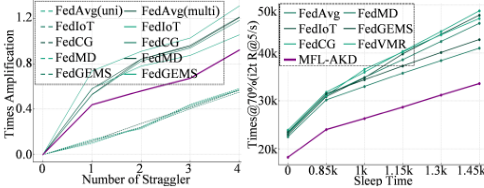
- (a) Time increase v.s stragglers. (b) Times@70% v.s sleep time
Figure 1: Illustrations of Straggler issues. In left figure, a straggler is set to 50% reduced speed compared to a standard client. 'Uni' and 'multi' represent unimodal and multimodal FL, respectively. The right figure shows the results fromMSCOCO for i2t retrieval.
and latency of stragglers increase. All these findings suggest a significant implication: incomprehensive aggregation of cross-modal information is fatal to multimodal decentralized learning, which calls for the development of a stragglerrobust MFL framework under practical system heterogeneity.
Motivated by these observations, we decompose the challenge and reorganize them into two requirements: (1) Efficiency and lightness for locally deployed models, ensuring minimal computation and communication demands, paired with a powerful, large-scale global model for in-depth crossmodal understanding. (2) An effective, adaptable aggregation strategy, not only enabling knowledge obtainment from different model structures, but also allowing partial aggregation to avoid total falls while maintaining the possibility of full aggregation. To this end, we propose a multimodal federated learning framework with accelerated knowledge distillation (MFL-AKD). To alleviate the local budget while keeping the powerful representative ability of the central server, we deploy a lightweight encoder to each client while maintaining the powerful CLIP in the central server. For flexible aggregation and potential stragglers, we incorporate principles of knowledge distillation for efficient knowledge transfer from the central model to local models, and designed a fast knowledge transfer mechanism before the regular updating in each round, accelerating the convergence of the federated models. We validate the proposed MFL-AKD on two crucial vision-language tasks, text-image retrieval [Qu et al., 2021] and video moment retrieval [Tang et al., 2021a; Tang et al., 2021b; Hu et al., 2023], on four popular datasets. Experimental results validate the superior performance and the remarkable straggler-tolerant ability of our proposed MFLAKD. The main contributions of this paper are summarized as follows:
- We take the first attempt to identify and address the straggler problem in multimodal federated learning. Through analysis and exploration experiments with real decentralized machines, we discovered that stragglers affect MFL more severely than single-modal FL, significantly impacting the central model's effectiveness.
- We decompose the straggler challenge in MFL and propose Multimodal Federated Learning with Accelerated Knowledge Distillation. To mitigate potential straggler
- issues, MFL-AKD introduces a Fast Knowledge Transfer Mechanism to circumvent potential setbacks caused by large-scale data and provide guidance for subsequent full-batch training, effectively combating the stragglers with its fast convergence and early-training strategy.
- We demonstrate the effectiveness of our approach on two crucial vision-language tasks: text-image retrieval and video moment retrieval. Extensive experiments confirm that our method outperforms existing MFL approaches, demonstrating superior performance and remarkable tolerance to straggler-related delays.
2 RelatedWork
2.1 Stragglers in Federated Learning
In recent years, federated learning has gained increasing attention for its ability to train deep models using decentralized data on the client side, without sharing raw local data [Li et al., 2020a; Kairouz et al., 2021]. However, system heterogeneity leads to stragglers that can significantly slow down the convergence rate of synchronous FL algorithms, posing a serious issue for real-time applications. To address this, researchers have proposed asynchronous FL algorithms to mitigate straggler lag by relaxing client synchronization requirements [Wu et al., 2020; Liu et al., 2021]. However, these methods face challenges with communication bottlenecks and outdated local model updates during aggregation. Therefore, current research efforts primarily focus on straggler issues in synchronous FL. Common strategies involve setting fixed deadlines for all clients to update and share their local models, allowing clients to process data samples at varying speeds based on computational capacity [Smith et al., 2017; Li et al., 2020b; Han et al., 2020]. Additionally, [Reisizadeh et al., 2022] proposed to first train with faster clients and then gradually include stragglers towards the end of training. However, these approaches have not investigated the MFL scenario, which is more severely impacted by stragglers. They also lack a real-time update strategy in federated learning knowledge distillation environments, which is crucial for maintaining efficiency and effectiveness in MFL with multiple stragglers and extended delays.
2.2 Knowledge Distillation
Knowledge distillation (KD) aims to transfer the knowledge of a large and complex model (i.e., the teacher model) to a smaller and simpler model (i.e., the student model) so that a lightweight student with comparable performance to the teacher can be obtained [Hinton et al., 2015; Romero et al., 2015]. This technique often minimizes the discrepancy in probability distributions of teacher and student models between their final logical outputs [Hinton et al., 2015] or intermediate features [Komodakis and Pesquet, 2017].
Recently, knowledge distillation has demonstrated encouraging outcomes in compressing the client model size of unimodal FL [Huang et al., 2022]. For example, [Ahn et al., 2020] presented to transfer the knowledge from a global model to local models with a weighted loss function to balance the knowledge distillation and the federated learning objectives. [Li et al., 2020c] proposed a FedMD framework that integrates transfer learning and knowledge distillation to facilitate federated learning in scenarios where individual clients possess their distinctive model designs.
Despite the progress they have made, directly extending those unimodal knowledge distillation methods into the multimodal FL scenarios will be highly inappropriate due to the heterogeneity of cross-modal data. More importantly, the straggler problem not addressed by these federated knowledge distillation methods will lead to more severe performance degradation and cost increases [Bonawitz et al., 2017].
2.3 Multimodal Federated Learning
Multimodal federated learning is an emerging area that involves using various data sources (e.g., text, image, and audio) from multiple clients to develop a multimodal model, ensuring data privacy across different clients. To address this issue, several methods have been proposed in recent years [Cheng et al., 2021; Wu et al., 2022; Li et al., 2020c; Zhao et al., 2021]. For example, [Liu et al., 2019] introduced FL to the vision-and-language grounding tasks and proposed to collaboratively extract diverse image representations derived from different tasks. Inspired by the idea of contrastive learning, [Huang et al., 2022] presented a CreamFL framework that regularizes local client training by incorporating both inter-modal and intra-modal contrasts to enhance the multimodal FL. Besides, [Wang et al., 2021] aimed at the video moment retrieval and proposed to attentively aggregate the model of grouped clients that are trained sequentially.
However, as these methods do not involve knowledge distillation and specialized acceleration strategy design, all of them will face severe performance degradation and communication delays when facing stragglers. In contrast, our MFLAKD ensures its robustness to stragglers through the designed quick knowledge transfer strategy in KD process.
3 Revisiting Stragglers in Synchronized FL
To investigate the difference in the impact of stragglers in unimodal FL and multimodal FL, we here theoretically revisit and further conduct exploration experiments.
3.1 Problem Setup
Consider a multimodal federated learning scenarios with K clients with up to N modals data. Each client ci possesses ni samples, constituting the local dataset Di = {xji , yj i }ni j=1 . The goal of multimodal federated learning is to collaboratively train a global model f(·; θg) parameterized by θg by utilizing the decentralized datasets {Di}Ki in T communication rounds. At the beginning of each round, the server will decide the participated clients set P. Let It = {i|ci ∈ P}. The participant number in the t-th round is denoted as τ t = |Pt | = |It |. Each client ci ∈ P is then required to conduct the training task on its local data Di. Considering the system heterogeneity across Pt , there may exist M t stragglers in the t-th communication round, and M t ≤ τ t . Unimodal FL is the special case when N = 1 under this definition.
3.2 The Impact of Stragglers
System heterogeneity is an inevitable issue that occurs in the practical application of FL. Due to the difference in hardware, e.g. computing chips, battery power, and communication bandwidth, the ability to execute training tasks varies across different clients, which causes the well-known stragglers problem. Though numerous methods have been elaborated to deal with such an issue, the theoretical analysis of straggler impact in FL is yet to be established.
Definition 1 (Time Consumption of Synchronized FL) Consider a synchronized federated framework with K clients {ci}Ki=1 for R communication rounds, the server requires each participated client ci ∈ Pr to conduct the training task on its local dataset Di. Let ϵri denote the total floating point operation number of client ci in the r-th round, γ r i denote the comprehensive computation capacity measured by floating point operations per second (FLOPS). The time consumption of FL is defined as:
where max() is a function to extract the max element in a set and ζ r i is the communication time cost of client ci in the r-th round.
To further facilitate the numerical analysis, we introduce the sum of the averaged wasted time across all clients during a full federated training procedure as a metric to measure the absolute impact of stragglers in FL defined as below:
Definition 2 (Averaged Wasted Time of Stragglers) Given a federated framework with its relevant variables as introduced before, the averaged wasted time of stragglers is defined as:
where υ = max ({( ϵri γ r i + ζ r i ) |i ∈ Ir }) is the time consumption of the lowest client in r-th round.
We now claim our analysis of straggler impacts as indicated in Proposition 1.
Proposition 1 The impact of stragglers is correlated with: (1) Task Difficulty Φ; (2) Balance of dataload on unit computation capacity; (3) Communication consumption.
Analysis (1) Task difficulty Φ closely relates to the required communication rounds R for desired model performance. The convergence speed within a federated algorithm is influenced by the convexity and smoothness of the objective functions. Therefore, simpler tasks that satisfy the conditions of convexity and smoothness, tend to converge more rapidly. (2) Workload on unit computation capacity is decided by the data amount and the model capacity. The more imbalance the dataload on unit computation, the more gap exists in the time consumption across all clients.
Discussion (1) The common trick to mitigate severe stragglers involves setting a response threshold, effectively reducing υ to lessen the time consumption gap ∣∣∣ ϵri γ r i + ζ r i - v∣∣∣. (2)
The communication budget is generally constant, as the uploaded content consistently includes the gradient or parameters of the current local model. Therefore, communication consumption ζi mainly depends on the communication bandwidth, which is hard to manually optimize in federated algorithm design.
Comparison of multimodal FL with unimodal FL: (1) Tasks in multimodal FL are often more difficult than those in unimodal FL, as they involve the joint relationships between different modalities. (2) Workload is more imbalanced across clients in multimodal FL than in unimodal FL, as data in different modalities possesses different data structures with different storage requirements. Those differences magnify the impact of stragglers in multimodal FL, calling for the establishment of a straggler-robust multimodal FL framework.
4 The ProposedMethod
In this section, we introduce our proposed straggler-robust multimodal federated framework MFL-AKD. We choose the vision-language tasks as representative multimodal tasks. Specifically, we consider text-to-image and video moment retrieval tasks, which aim to match a given sentence x with its most relevant image or video moment y.
4.1 Motivation


We now briefly revisit our motivation for the proposal of MFL-AKD. As described before, system heterogeneity is an inevitable issue in the practical application of multimodal federated learning, causing stragglers in each communication round. However, such an issue has been largely overlooked with a naive conjecture that the impact of stragglers in MFL is similar to that in the unimodal FL. With the analysis proposed in Section 3.2, the impact of stragglers in multimodal FL is much more severe than that in unimodal FL, which calls for the establishment of a straggler-robust multimodal federated framework. To develop such a framework, the following requirements should be satisfied: From the system perspective: (1) Lightweight but effective client-deployed model to alleviate the workload of clients. (2) Powerful and large serverdeployed model to sufficiently handle the difficult multimodal tasks. From the scheduling perspective: (1) Balanced workload decided by computation capacities across all clients; (2) Efficient aggregation schema to accelerate the convergence.
4.2 Framework Overview


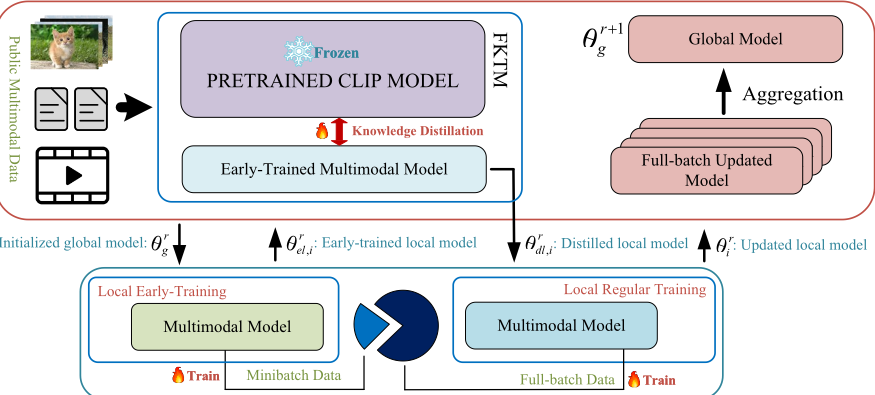
In response to these requirements, we develop a straggler robust multimodal federated method named MFL-AKD. To handle the challenge brought by multimodal tasks, MFLAKD deploys a powerful pretrained vision-language model CLIP F(·; θC) on the server and allows clients to use its desired model fi(·; θi) in arbitrary structures. To facilitate the convergence of the federated algorithm and allow the dynamic workload to prevent straggling, we have designed a novel Fast Knowledge Transfer Mechanism (FKTM) in MFLAKD. FKTM requires all clients to extract part of its local data to conduct workload-balanced early training before the ordinary training. Such a partial extraction ensures the balance of workload on computation capacity, largely reducing the wasted time of stragglers. The early-trained models are then uploaded to the server to conduct a warm-up utilizing the CLIP model through knowledge distillation. By doing this, FKTM not only mitigates the time consumption gap between clients but also accelerates the convergence of the federated framework. The application of KD also allows the deployment of models in different structures on clients. Note that we here mainly introduce MFL-AKD with the same model architectures deployed in clients to facilitate the comparison with other MFL methods. The overall framework of MFL- AKD is illustrated in Figure 2.
Commencing the r-th round, the central server first identifies the participated client set Pr . For each client ci ∈ Pr , the server distributes current global model parameter θr g to initialize its local model. Concerning the possible imbalance workload on computation capacity ϵri γ r i among clients set Pr , MFL-AKD requires each client ci ∈ Pr to randomly extract a mini-batch of local data Di according to its computation capacity ϵri in current round and further conduct early-training to get the local model parameter θr el,i , which is further asynchronously uploaded to the server. Receiving the uploaded early-trained parameter θr el,i of client ci, the FKTM in the server then utilizes the CLIP model to conduct knowledge distillation to warm up the early-trained local model, accelerating the convergence of the federated frameworks. The distilled early-trained local model θr dl,i is then distributed to its corresponding client ci and further conduct model training on the rest data to get updated local model θr i . All the updated local model {θr i }i∈Ir is then uploaded to the server to get global model θr+1 g for next round training.
4.3 Multimodal Local Training
Without loss of generality, we introduce the local training of MFL-AKD under the multimodal retrieval tasks. The input instance {xi, yi} in the local dataset Di denotes a sentence xi and its related image or video moment yi, and the training goal is to obtain a local multimodal encoder fi(·; θr i ) that characterizes the visual language well. Considering the excellence of transformer in cross-modal embedding, we adopted a transformer-structured encoder [Vaswani et al., 2017].
Specifically, fi encodes xi and yi into their respective embeddings hxi and hyi . The local loss function that minimizes the distance between hxi and hyi is defined as:
where ni denotes the size of Di, and L denotes the mean square error.
4.4 Fast Knowledge Transfer Mechanism (FKTM) via Centralized Knowledge Distillation
We here specifically introduce the designed FKTM with a centralized knowledge distillation process in MFL-AKD. As analyzed before, the impact of stragglers on a particular federated framework is highly correlated with its convergence speed and balance of workload on unit computation capacity across clients. To effectively handle the straggler problem and prevent entirely dropped clients, FKTM requires the clients ci ∈ Pr to early-train the initialized local model θr g on a small fraction of its local data while remaining the workload balance. After receiving the local early-trained model θr el,i , FKTM further enhances the ability of the model by distilling knowledge from the powerful teacher model. Specifically, a large pretrained CLIP model F(·; θC) is adopted as the teacher. For the input pair (xji , yj i ), the CLIP teacher and the student encoder θr el,i embed them into their corresponding representations and further conduct knowledge distillation through:
The distilled local model θr dl,i of client ci is then redistributed to the client to continue the training on the rest of its local data. FKTM sufficiently utilizes the prior knowledge in pretrained large multimodal models to help the earlytrained model rapidly adapt to its local multimodal data and get experience from the prior knowledge. Such a mechanism significantly accelerates the convergence of the MFLAKD, making the framework tolerant to stragglers and leaving readiness models for each client to combat the potential drop-offs during the subsequent training.
5 Experiments
We evaluated our framework on two fundamental visionlanguage tasks: image-text retrieval on the Flickr30k andMS COCO datasets, and video moment retrieval on the CharadesSTA and ActivityNet Captions datasets.
5.1 Experimental Setup
Datasets We use four popular multimodal datasets in textimage and text-video retrieval tasks. Details are given below:
- Flickr30k [Young et al., 2014]: This image-text retrieval dataset consists of 31,784 images, each of which is manually annotated with five different sentence descriptions. As in [Qu et al., 2021], 29,784, 1,000, and 1,000 images with paired sentences are adopted for training, validation, and testing, respectively.
- MSCOCO [Lin et al., 2014]: This image-text retrieval dataset contains 123,287 images, each of which is paired with five annotated sentences. For fair comparisons, the public dataset split is adopted [Qu et al., 2021], i.e., 113,287, 5000, and 5000 images for training, validation, and testing, respectively. Besides, the MSCOCO 5Fold 1K setting is adopted for evaluation, where the average results are over 5-fold of 1,000 testing images.
- Charades-STA [Gao et al., 2017]: This dataset video moment retrieval is manually annotated by [Gao et al., 2017], which contains 6,672 videos with 29.76 seconds long on average. The number of sentence-video pairs is 16,127 in total. Following the common settings [Gao et al., 2017], we divide those pairs into two parts, i.e., 12408 pairs for training and 3720 pairs for testing, respectively.
- ActivityNet Captions (Anet) [Krishna et al., 2017]: This video moment retrieval dataset contains 14926 videos with an average duration of 120 seconds. The sentence-video pairs are 71,957 in total, where the corresponding sentences are longer with more complicated semantics. Following [Gao et al., 2017], we adopt 37,417, 17,505, and 17,031 sentence-video pairs for training, validation, and testing, respectively.
Evaluation metrics. The standard Recall@K (R@K for short) and R@n, IoU=m are adopted as the evaluation metrics for the image-text retrieval and video moment retrieval task, respectively. R@K denotes the percentage of ground truth at the top-K retrieved results, and R@n, IoU=mmeans the percentage of the samples that contain at least one out of top-n retrieval results with Intersection over Union (IoU) larger than m. Besides, we also evaluate the efficiency of our framework by measuring its relative time gain [Wu et al., 2022] compared to a predefined baseline.
| Flickr30k | MSCOCO 5Fold 1K | |||||||
|---|---|---|---|---|---|---|---|---|
| Method | Text Retrieval | Image Retrieval | Text Retrieval | Image Retrieval | ||||
| R@1 | R@5 | R@1 | R@5 | R@1 | R@5 | R@1 | R@5 | |
| FedAvg[McMahan et al., 2017] | 67.9 | 89.0 | 47.8 | 73.1 | 64.8 | 89.8 | 46.6 | 79.6 |
| FedIoT[Zhao et al., 2021] | 67.2 | 88.7 | 45.4 | 71.9 | 64.0 | 89.6 | 43.7 | 79.1 |
| FedCG[Wu et al., 2022] | 66.5 | 87.8 | 44.9 | 70.4 | 63.8 | 88.5 | 45.8 | 78.7 |
| FedMD[Li et al., 2020c] | 67.4 | 89.1 | 47.9 | 73.8 | 64.9 | 90.7 | 46.4 | 80.3 |
| FedGEMS[Cheng et al., 2021] | 69.4 | 90.7 | 50.9 | 74.5 | 66.0 | 94.2 | 54.0 | 82.3 |
| FedVMR[Wang et al., 2021] | 69.3 | 91.3 | 51.2 | 75.2 | 66.3 | 94.1 | 54.2 | 82.8 |
| MFL-AKD (w/o. KD) | 66.8 | 88.4 | 46.9 | 72.3 | 64.8 | 92.9 | 53.3 | 81.5 |
| MFL-AKD (w/o. FKTM) | 68.3 | 89.6 | 49.2 | 72.1 | 66.0 | 92.7 | 53.4 | 81.7 |
| MFL-AKD | 69.0 | 91.5 | 51.3 | 75.8 | 66.1 | 94.2 | 54.4 | 83.1 |
| Charades-STA | Anet | |||||||
|---|---|---|---|---|---|---|---|---|
| Models | R@1 | R@5 | R@1 | R@5 | ||||
| n=0.5 | n=0.7 | n=0.5 | n=0.7 | n=0.5 | n=0.7 | n=0.5 | n=0.7 | |
| FedAvg[McMahan et al., 2017] | 50.5 | 25.5 | 82.4 | 58.3 | 36.9 | 17.6 | 78.9 | 63.7 |
| FedIoT[Zhao et al., 2021] | 47.9 | 23.6 | 80.4 | 57.2 | 37.8 | 18.6 | 79.3 | 64.1 |
| FedCG[Wu et al., 2022] | 39.4 | 19.7 | 78.9 | 53.5 | 20.0 | 4.2 | 71.4 | 58.3 |
| FedMD[Li et al., 2020c] | 51.7 | 26.4 | 82.9 | 59.1 | 39.4 | 19.8 | 80.4 | 64.3 |
| FedGEMS[Cheng et al., 2021] | 52.9 | 31.7 | 83.6 | 64.4 | 41.7 | 22.5 | 81.2 | 65.3 |
| FedVMR[Wang et al., 2021] | 53.0 | 31.6 | 84.7 | 64.7 | 42.3 | 22.7 | 82.6 | 66.2 |
| MFL-AKD (w/o. KD) | 49.3 | 25.4 | 79.2 | 53.6 | 34.8 | 16.5 | 79.0 | 61.2 |
| MFL-AKD (w/o. FKTM) | 49.2 | 24.9 | 80.1 | 53.4 | 36.9 | 20.1 | 80.6 | 64.1 |
| MFL-AKD | 53.1 | 32.2 | 84.6 | 65.0 | 42.4 | 23.4 | 82.4 | 66.1 |
Compared methods. We compare the MFL-AKD with various state-of-the-art (SOTA) multimodal FL methods to validate its superior performance and straggler robustness, including FedAvg [McMahan et al., 2017], FedIoT [Zhao et al., 2021], FedCG [Wu et al., 2022], FedMD [Li et al., 2020c], FedGEMS [Cheng et al., 2021], and FedVMR [Wang et al., 2021]. Among those methods, FedIoT, FedCG, and FedGEMS are multimodal FL frameworks, where we conduct experiments on four datasets and report the corresponding results. and FedMD is an unimodal method with knowledge distillation, where we extend this method to accommodate the multimodal settings.
Implementation details. Based on our MFL-AKD framework, we conducted experiments with 40 to 60 communication rounds for the federated learning process. All experiments were performed on a cluster of 4 heterogeneous devices with different configurations. We implemented our framework using PyTorch 1.7.1. For the server side, we used a high-performance computing node equipped with four Intel Xeon processors and 128GB memory. For the visionlanguage knowledge distillation, the ViT-B/32 version CLIP [Radford et al., 2021] is adopted as the teacher model. Each client device was equipped with a GPU of a different model and memory size. We randomly partitioned the datasets among the clients. For the text-image retrieval task, the model on each client is trained locally for 10 rounds and 30 rounds on the Flicker30k and MSCOCO datasets, respectively. For the video moment retrieval task, the model on each client is trained for 40 rounds and 60 rounds on the Charades-STA and Anet datasets, respectively. The stochastic gradient descent (SGD) optimizer with a learning rate of 0.001 is adopted. During the federated learning process, we applied knowledge distillation with a temperature of 5 and a weight of 0.5 to encourage model convergence.
5.2 Performance Comparison
We first compare the performance of MFL-AKD with SOTA multimodal FL methods on four multimodal datasets. Table 1 and Table 2 display the retrieval performance of MFL-AKD and other baselines for video moment retrieval and text-image retrieval tasks, respectively. Note that the best results are highlighted and the second ones are underlined.
From those results, the following observations stand out.
| Times@70% (i2t R@5/s) | υ = 1500 | 1750 | 2000 | 2250 | 2500 |
|---|---|---|---|---|---|
| FedAvg | 20.2k | 22.8k | 25.3k | 28.8k | 31.3k |
| FedIoT | 20.1k | 22.0k | 24.2k | 26.3k | 28.6k |
| FedCG | 20.0k | 22.4k | 24.9k | 27.3k | 29.8k |
| FedMD | 19.9k | 22.3k | 24.8k | 27.1k | 29.5k |
| FedGEMS | 19.1k | 20.8k | 22.6k | 24.5k | 26.3k |
| FedVMR | 19.8k | 22.0k | 24.3k | 26.6k | 28.9k |
| MFL-AKD (w/o. KD) | 19.6k | 21.7k | 23.8k | 26.0k | 28.2k |
| MFL-AKD (w/o. FKTM) | 17.4k | 19.2k | 21.0k | 22.7k | 24.2k |
| MFL-AKD | 15.6k | 16.8k | 17.9k | 19.1k | 20.3k |
| Times@50% (R@5 IoU=0.7/s) | υ = 750 | 900 | 1050 | 1200 | 1350 |
|---|---|---|---|---|---|
| FedAvg | 37.4k | 42.2k | 47.0k | 51.7k | 56.3k |
| FedIoT | 37.0k | 41.7k | 46.2k | 50.6k | 54.8k |
| FedCG | 38.1k | 42.8k | 48.5k | 52.8k | 57.9k |
| FedMD | 36.9k | 41.0k | 45.2k | 49.2k | 53.3k |
| FedGEMS | 36.1k | 40.0k | 43.8k | 47.5k | 51.2k |
| FedVMR | 35.5k | 39.1k | 42.7k | 46.3k | 49.8k |
| MFL-AKD (w/o. KD) | 33.6k | 37.0k | 40.5k | 43.9k | 47.4k |
| MFL-AKD (w/o. FKTM) | 32.9k | 36.5k | 50.0k | 43.2k | 46.8k |
| MFL-AKD | 30.1k | 33.0k | 35.5k | 37.9k | 40.2k |
For the text-image retrieval task, the proposed MFL-AKD model consistently surpasses all baselines over most metrics. As for "R@1" metric on both datasets, we also achieve a competing performance (69.0 vs 69.4). Furthermore, our MFL-AKD model also achieves the best retrieval performance in terms of all metrics except for "R@5, IoU=0.5" on both datasets. Compared to the strongest FedVMR baseline which targets this task, our method achieves substantial improvements on most metrics.
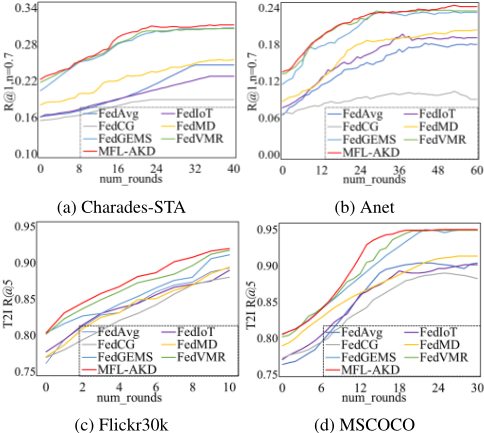
We further compare the convergence speed of all federated methods on various multimodal benchmarks. Results in Fig. 3 demonstrate that MFL-AKD converges fast on all benchmarks, significantly surpassing all compared methods.
5.3 Robustness on Stragglers
We further conduct experiments to validate the effectiveness of MFL-AKD in combating the stragglers in MFL scenarios. To measure the severity of the straggler problems, we adopt the same implementation strategy with the performance comparison experiments, while manually changing the straggling time. We use the time consumption Υ to compare the robustness of stragglers among various methods. Table 3 and Table 4 report the experimental results on Flickr30k for imagetext retrieval tasks and Anet for video moment retrieval tasks respectively. As demonstrated in the table, MFL-AKD exhibits the shortest time consumption under different straggling times, and when the straggling time varies from the lowest to the highest, the time consumption only increases by around 5k for text-image retrieval and 10k for video moment retrieval, which is far lower than that of other baselines.
5.4 Ablation Studies
To evaluate the contribution of different components in our proposed MFL-AKD framework, we further conduct ablation experiments to validate the effectiveness of the design of MFL-AKD. Specifically, we gradually remove key components of our framework and obtained the following model variants.
- MFL-AKD (w/o. FKTM): We discard the FKTM from MFL-AKD which disables the early training and adopt the common communication strategy as FedAvg. The knowledge distillation of pretrained model is now conducted on the global updated model after the aggregation of the clients' model.
- MFL-AKD (w/o. KD): We remove the knowledge distillation mechanism from MFL-AKD, which directly returns the aggregated model of early-trained models without learning from pretrained large model.
The results are illustrated in the corresponding Table 1, 2, 3, and 4 respectively. From the results, missing of KD or FKTM will lead to a significant loss of performance and robustness to stragglers, which validates the effectiveness of key components of MFL-AKD.
6 Conclusion
In this paper, we make the first attempt to analyze and combat stragglers in multimodal FL by integrating knowledge distillation, especially for vision-language scenarios. We propose a novel straggler-robust multimodal FL method named MFLAKD. With the knowledge distilled from the vision-language pretrained model, the cross-modal semantic representations of the local model are greatly and rapidly enhanced, resulting in a remarkable improvement in convergence speed. Moreover, we also design the Fast Knowledge Transfer Mechanism to allow the balance of workload and enable early training of local models to handle the stragglers. Through experiments on video moment retrieval and text-image retrieval datasets, we have verified that our method can significantly alleviate the impact of stragglers while achieving remarkable retrieval accuracy.
Acknowledgments
This work was supported in part by the Alibaba Group through Alibaba Innovative Research Program, No.21169774; in part by the National Natural Science Foundation (NSF) of China, No.62206156, No.62276155, No.72004127, and No.62206157; in part by the NSF of Shandong Province, No.ZR2021MF040 and No.ZR2022QF047; in part by the Key R&D Program of Shandong Province, China (Major Scientific and Technological Innovation Projects), No.2022CXGC020107.
@inproceedings{ijcai2024p419,
  title     = {Breaking Barriers of System Heterogeneity: Straggler-Tolerant Multimodal Federated Learning via Knowledge Distillation},
  author    = {Chen, Jinqian and Tang, Haoyu and Cheng, Junhao and Yan, Ming and Zhang, Ji and Xu, Mingzhu and Hu, Yupeng and Nie, Liqiang},
  booktitle = {Proceedings of the Thirty-Third International Joint Conference on
               Artificial Intelligence, {IJCAI-24}},
  publisher = {International Joint Conferences on Artificial Intelligence Organization},
  editor    = {Kate Larson},
  pages     = {3789--3797},
  year      = {2024},
  month     = {8},
  note      = {Main Track},
  doi       = {10.24963/ijcai.2024/419},
  url       = {https://doi.org/10.24963/ijcai.2024/419},
}
TY - CPAPER TI - Breaking Barriers of System Heterogeneity: Straggler-Tolerant Multimodal Federated Learning via Knowledge Distillation AU - Chen, Jinqian AU - Tang, Haoyu AU - Cheng, Junhao AU - Yan, Ming AU - Zhang, Ji AU - Xu, Mingzhu AU - Hu, Yupeng AU - Nie, Liqiang T2 - Proceedings of the Thirty-Third International Joint Conference on Artificial Intelligence, IJCAI-24 PB - International Joint Conferences on Artificial Intelligence Organization PY - 2024 SP - 3789 EP - 3797 DO - 10.24963/ijcai.2024/419 UR - https://doi.org/10.24963/ijcai.2024/419 ER -Copied
Machine-readable versions of this paper, for tools and AI agents:





