
Look-ahead Search on Top of Policy Networks in Imperfect Information Games
Proceedings of the Thirty-Third International Joint Conference on Artificial Intelligence. Main Track. Pages 4344-4352.
https://doi.org/10.24963/ijcai.2024/480
Keywords
- Machine Learning: ML: Multiagent Reinforcement Learning
- Agent-based and Multi-agent Systems: MAS: Multi-agent learning
- Search: S: Game playing
- Search: S: Local search
Abstract
Search in test time is often used to improve the performance of reinforcement learning algorithms. Performing theoretically sound search in fully adversarial two-player games with imperfect information is notoriously difficult and requires a complicated training process. We present a method for adding test-time search to an arbitrary policy-gradient algorithm that learns from sampled trajectories. Besides the policy network, the algorithm trains an additional critic network, which estimates the expected values of players following various transformations of the policies given by the policy network. These values are then used for depth-limited search. We show how the values from this critic can create a value function for imperfect information games. Moreover, they can be used to compute the summary statistics necessary to start the search from an arbitrary decision point in the game. The presented algorithm is scalable to very large games since it does not require any search during train time. We evaluate the algorithm's performance when trained along Regularized Nash Dynamics, and we evaluate the benefit of using the search in the standard benchmark game of Leduc hold'em, multiple variants of imperfect information Goofspiel, and Battleships.
- [Bard et al., 2014] Nolan Bard, Michael Johanson, and Michael Bowling. Asymmetric abstractions for adversar- ial settings. In Proceedings of the 2014 international con- ference on Autonomous agents and multi-agent systems, pages 501-508, 2014.
- [Bowling et al., 2009] Michael Bowling, Nicholas Risk, Nolan Bard, Darse Billings, Neil Burch, Joshua Davidson, John Hawkin, Robert Holte, Michael Johanson, Morgan Kan, Bryce Paradis, Jonathan Schaeffer, David Schnizlein, Duane Szafron, Kevin Waugh, and Martin Zinkevich. A demonstration of the polaris poker system. In Adaptive Agents and Multi-Agent Systems, pages 1391-1392, 01 2009.
- [Brown and Sandholm, 2017] Noam Brown and Tuomas Sandholm. Safe and nested subgame solving for imperfect-information games. In I. Guyon, U. Von Luxburg, S. Bengio, H. Wallach, R. Fergus, S. Vish- wanathan, and R. Garnett, editors, Advances in Neural In- formation Processing Systems, volume 30.
- [Brown and Sandholm, 2018] Noam Brown and Tuomas Sandholm. Superhuman ai for heads-up no-limit poker: Libratus beats top professionals. Science, 359(6374):418- 424, 2018.
- [Brown and Sandholm, 2019] Noam Brown and Tuomas Sandholm. Superhuman ai for multiplayer poker. Science, 365(6456):885-890, 2019.
- [Brown et al., 2018] Noam Brown, Tuomas Sandholm, and Brandon Amos. Depth-limited solving for imperfect- information games.
- In S. Bengio, H. Wallach, H. Larochelle, K. Grauman, N. Cesa-Bianchi, and R. Gar- nett, editors, Advances in Neural Information Processing Systems, volume 31.
- Curran Associates, Inc., 2018.
- [Brown et al., 2020] Noam Brown, Anton Bakhtin, Adam Lerer, and Qucheng Gong. Combining deep reinforcement learning and search for imperfect-information games. In
- H. Larochelle, M. Ranzato, R. Hadsell, M.F. Balcan, and H. Lin, editors, Advances in Neural Information Process- ing Systems, volume 33, pages 17057-17069.
- [Burch et al., 2014] Neil Burch, Michael Johanson, and Michael Bowling. Solving imperfect information games using decomposition. Proceedings of the AAAI Confer- ence on Artificial Intelligence, 28(1), Jun. 2014.
- [Espeholt et al., 2018] Lasse Espeholt, Hubert Soyer, Remi Munos, Karen Simonyan, Vlad Mnih, Tom Ward, Yotam Doron, Vlad Firoiu, Tim Harley, Iain Dunning, Shane Legg, and Koray Kavukcuoglu. IMPALA: Scalable dis- tributed deep-RL with importance weighted actor-learner architectures. In Jennifer Dy and Andreas Krause, edi- tors, Proceedings of the 35th International Conference on Machine Learning, volume 80 of Proceedings of Machine Learning Research, pages 1407-1416. PMLR, 10-15 Jul 2018.
- [Gruslys et al., 2020] Audrunas Gruslys, Marc Lanctot, Rémi Munos, Finbarr Timbers, Martin Schmid, Julien Pérolat, Dustin Morrill, Vinícius Flores Zambaldi, Jean- Baptiste Lespiau, John Schultz, Mohammad Gheshlaghi Azar, Michael Bowling, and Karl Tuyls. The advan- tage regret-matching actor-critic. CoRR, abs/2008.12234, 2020.
- [Hennes et al., 2020] Daniel Hennes, Dustin Morrill, Shayegan Omidshafiei, Rémi Munos, Julien Perolat, Marc Lanctot, Audrunas Gruslys, Jean-Baptiste Lespiau, Paavo Parmas, Edgar Duèñez Guzmán, and Karl Tuyls. Neural replicator dynamics: Multiagent learning via hedging policy gradients. In Proceedings of the 19th International Conference on Autonomous Agents and MultiAgent Systems, AAMAS '20, page 492-501, Richland, SC, 2020. International Foundation for Autonomous Agents and Multiagent Systems.
- [Kovařík et al., 2022] Vojtěch Kovařík, Martin Schmid, Neil Burch, Michael Bowling, and Viliam Lisý. Rethinking formal models of partially observable multiagent decision making. Artificial Intelligence, 303:103645, 2022.
- [Kovařík et al., 2023] Vojtěch Kovařík, Dominik Seitz, Vil- iam Lisý, Jan Rudolf, Shuo Sun, and Karel Ha. Value functions for depth-limited solving in zero-sum imperfect- information games. Artificial Intelligence, 314:103805, 2023.
- [Lanctot et al., 2017] Marc Lanctot, Vinicius Zambaldi, Au- drunas Gruslys, Angeliki Lazaridou, Karl Tuyls, Julien Perolat, David Silver, and Thore Graepel. A unified game- theoretic approach to multiagent reinforcement learning. In I. Guyon, U. Von Luxburg, S. Bengio, H. Wallach, R. Fergus, S. Vishwanathan, and R. Garnett, editors, Ad- vances in Neural Information Processing Systems, vol- ume 30.
- Curran Associates, Inc., 2017.
- [Lanctot et al., 2019] Marc Lanctot, Edward Lockhart, Jean- Baptiste Lespiau, Vinicius Zambaldi, Satyaki Upadhyay, Julien Pérolat, Sriram Srinivasan, Finbarr Timbers, Karl Tuyls, Shayegan Omidshafiei, Daniel Hennes, Dustin Morrill, Paul Muller, Timo Ewalds, Ryan Faulkner, János Kramár, Bart De Vylder, Brennan Saeta, James Brad- bury, David Ding, Sebastian Borgeaud, Matthew Lai, Julian Schrittwieser, Thomas Anthony, Edward Hughes, Ivo Danihelka, and Jonah Ryan-Davis. OpenSpiel: A framework for reinforcement learning in games. CoRR, abs/1908.09453, 2019.
- [McAleer et al., 2023] Stephen Marcus McAleer, Gabriele Farina, Marc Lanctot, and Tuomas Sandholm. ESCHER: Eschewing importance sampling in games by comput- ing a history value function to estimate regret. In The Eleventh International Conference on Learning Represen- tations, 2023.
- [McMahan, 2011] Brendan McMahan. Follow-the- regularized-leader and mirror descent: Equivalence theorems and l1 regularization. In Geoffrey Gordon, David Dunson, and Miroslav Dudík, editors, Proceedings of the Fourteenth International Conference on Artificial Intelligence and Statistics, volume 15 of Proceedings of Machine Learning Research, pages 525-533, Fort Lauderdale, FL, USA, 11-13 Apr 2011. PMLR. Moravcik et al., 2016]
- Matej Moravcik, Martin Schmid, Karel Ha, Milan Hladik, and Stephen Gaukrodger. Refin- ing subgames in large imperfect information games. Pro- ceedings of the AAAI Conference on Artificial Intelligence, 30(1), Feb. 2016.
- [Moravčík et al., 2017] Matej Moravčík, Martin Schmid, Neil Burch, Viliam Lisý, Dustin Morrill, Nolan Bard, Trevor Davis, Kevin Waugh, Michael Johanson, and Michael Bowling. Deepstack: Expert-level artifi- cial intelligence in heads-up no-limit poker. Science, 356(6337):508-513, 2017.
- [Perolat et al., 2021] Julien Perolat, Remi Munos, Jean- Baptiste Lespiau, Shayegan Omidshafiei, Mark Rowland, Pedro Ortega, Neil Burch, Thomas Anthony, David Bal- duzzi, Bart De Vylder, Georgios Piliouras, Marc Lanctot, and Karl Tuyls. From poincaré recurrence to convergence in imperfect information games: Finding equilibrium via regularization. In Marina Meila and Tong Zhang, editors, Proceedings of the 38th International Conference on Ma- chine Learning, volume 139 of Proceedings of Machine Learning Research, pages 8525-8535. PMLR, 18-24 Jul 2021.
- [Perolat et al., 2022] Julien Perolat, Bart De Vylder, Daniel Hennes, Eugene Tarassov, Florian Strub, Vincent de Boer, Paul Muller, Jerome T Connor, Neil Burch, Thomas Anthony, et al. Mastering the game of stratego with model-free multiagent reinforcement learning. Science, 378(6623):990-996, 2022.
- [Russell and Norvig, 2009] Stuart Russell and Peter Norvig. Artificial Intelligence: A Modern Approach. Prentice Hall Press, USA, 3rd edition, 2009.
- [Schmid et al., 2023] Martin Schmid, Matej Moravčík, Neil Burch, Rudolf Kadlec, Josh Davidson, Kevin Waugh, Nolan Bard, Finbarr Timbers, Marc Lanctot, G. Zacharias Holland, Elnaz Davoodi, Alden Christianson, and Michael Bowling. Student of games: A unified learning algorithm for both perfect and imperfect information games. Science Advances, 9(46):eadg3256, 2023.
- [Seitz et al., 2021] Dominik Seitz, Nikita Milyukov, and Vil- iam Lisý. Learning to guess opponent's information in large partially observable games. In Proc. AAAI Workshop Reinforcement Learning in Games, 2021.
- [Silver et al., 2018] David Silver, Thomas Hubert, Julian Schrittwieser, Ioannis Antonoglou, Matthew Lai, Arthur Guez, Marc Lanctot, Laurent Sifre, Dharshan Kumaran, Thore Graepel, Timothy Lillicrap, Karen Simonyan, and Demis Hassabis. A general reinforcement learning algo- rithm that masters chess, shogi, and go through self-play. Science, 362(6419):1140-1144, 2018.
- [Sokota et al., 2023] Samuel Sokota, Ryan D'Orazio, J. Zico Kolter, Nicolas Loizou, Marc Lanctot, Ioannis Mitliagkas, Noam Brown, and Christian Kroer. A unified approach to reinforcement learning, quantal response equilibria, and two-player zero-sum games, 2023.
- [Steinberger et al., 2020] Eric Steinberger, Adam Lerer, and Noam Brown. DREAM: deep regret minimization with advantage baselines and model-free learning. CoRR, abs/2006.10410, 2020.
- [Tammelin et al., 2015] Oskari Tammelin, Neil Burch, Michael Johanson, and Michael Bowling. Solving heads- up limit texas hold'em. In Qiang Yang and Michael J. Wooldridge, editors, Proceedings of the Twenty-Fourth International Joint Conference on Artificial Intelligence, IJCAI 2015, Buenos Aires, Argentina, July 25-31, 2015, pages 645-652. AAAI Press, 2015.
- [Šustr et al., 2021] Michal Šustr, Martin Schmid, Matej Moravčík, Neil Burch, Marc Lanctot, and Michael Bowl- ing. Sound algorithms in imperfect information games. In Proceedings of the 20th International Conference on Au- tonomous Agents and MultiAgent Systems, AAMAS '21, page 1674-1676, Richland, SC, 2021. International Foun- dation for Autonomous Agents and Multiagent Systems.
- [Wang et al., 2023] Tony Tong Wang, Adam Gleave, Nora Belrose, Tom Tseng, Michael D Dennis, Yawen Duan, Viktor Pogrebniak, Sergey Levine, and Stuart Russell. Ad- versarial policies beat professional-level go AIs, 2023.
- [Zhang and Sandholm, 2021] Brian Zhang and Tuomas Sandholm. Subgame solving without common knowl- edge. In M. Ranzato, A. Beygelzimer, Y. Dauphin, P.S. Liang, and J. Wortman Vaughan, editors, Advances in Neural Information Processing Systems, volume 34, pages 23993-24004.
- Curran Associates, Inc., 2021.
- [Zinkevich et al., 2007] Martin Zinkevich, Michael Johan- son, Michael Bowling, and Carmelo Piccione. Regret minimization in games with incomplete information. In J. Platt, D. Koller, Y. Singer, and S. Roweis, editors, Ad- vances in Neural Information Processing Systems, vol- ume 20.
- Curran Associates, Inc., 2007.
References were extracted automatically from the PDF and may contain errors.
Full text extracted automatically from the PDF; figures, tables and equations may differ. The PDF is the version of record.
1 Introduction
The field of multi-agent deep reinforcement learning has achieved remarkable success in training strong agents for two-player adversarial games through selfplay. Many of these agents develop strategies represented by neural networks, which subsequently provide probability distributions for actions based on current observations during gameplay.
Despite their success, the neural networks can occasionally lead the agent to make suboptimal decisions that an adversarial opponent may exploit. AlphaZero-style algorithms in Go are susceptible to exploitation, as evidenced by winning against the trained policy network 97% of the time [Wang et al., 2023]. Similarly, policy-gradient algorithms display evident gameplay errors, necessitating the application of multiple heuristics to rectify these errors [Perolat et al., 2022].
However, there are principled ways of using search to avoid these mistakes, as evidenced by AlphaZero [Silver et al., 2018], DeepStack [Moravˇc´ık et al., 2017], and Student of Games [Schmid et al., 2023].
Algorithms that use policy-gradient methods in imperfect information games like Regularized Nash Dynamics (RNaD) [Perolat et al., 2022; Perolat et al., 2021] rely on directly applying the neural network's policy during gameplay. Adding search to these methods could improve the strategy and mitigate some mistakes. However, this enhancement comes at the expense of turning model-free algorithms into modeldependent ones during gameplay.
Adding search to policy-gradient methods in imperfect information games presents multiple challenges that are not present in a perfect information case, which makes algorithms like AlphaZero unusable in this setting. First, the imperfect information search must be performed not only from the current unobserved state of the game, but from all possible states that share the same public information amongst all players. Second, the state values depend on beliefs players have about the current information of their opponents. Thirdly, the opponent's strategy is unknown, and the optimal strategies are not unique. Hence, we need to optimize over all possible strategies the opponent may deploy both in the remainder of the game as well as unobserved past actions.
In this paper, we introduce the algorithm Multi-Agent Search With Policy Transformations (SePoT), which builds upon the concept of multi-valued states [Brown et al., 2018]. SePoT trains a policy transformation critic network that estimates the expected value of policies derived from the policy network. This critic is trained alongside a policy network with a policy-gradient technique without requiring any additional trajectories beyond those sampled by the original policy-gradient algorithm. The critic network is trained with an off-policy V-trace that estimates expected values against a multitude of potential opponent strategies derived from the policy represented by the policy network. We show that this critic provides sufficient information to perform a safe search [ˇSustr et al., 2021] in imperfect information games.
Furthermore, our approach enables safe search at any point within a game, utilizing the information provided by the introduced critic network. This eliminates the need for conducting search in all decision points from the root until the current decision point, which is often intractable in games with little public knowledge, but at the cost of requiring a domainspecific function that reconstructs current game segment. It is in strict contrast to prior methods [Brown et al., 2018; Moravˇc´ık et al., 2017; Schmid et al., 2023]. This flexibility allows us to perform search only in game segments sufficiently simple for available compute power, while employing the neural network policy in other parts of the game.
Finally, we establish a connection between value functions and multi-valued states within imperfect information games that enables training previously used imperfect information value functions [Moravˇc´ık et al., 2017; Schmid et al., 2023] without the expensive search in the training time.
In our experiments, we evaluate SePoT with RNaD [Perolat et al., 2022]. We show that using search in head-to-head play in imperfect-information Goofspiel and Battleships improves the performance over the network trained with RNaD. Furthermore, we demonstrate that the exploitability of policy derived from the search is the same or lower than that of the policy network from RNaD in a small version of imperfect information Goofspiel and the standard benchmark game Leduc hold'em.
Our main contributions are: (1) Adding safe search on top of the policy-gradient method without requiring training time search or additional training trajectories. (2) Introducing search technique that may be performed anywhere in the game without performing search in previous parts of the game. (3) Establishing a practical connection between the multi-valued states and the value functions. (4) Showing that the additional search improves the performance of RNaD.
2 Issues With Imperfect Information Search
| State | P1 ship | P2 ship |
|---|---|---|
| w1 | A1-A2 | A1-A3 |
| w2 | A1-A2 | A3-C3 |
| w3 | A2-B2 | A1-A3 |
| w4 | A2-B2 | A3-C3 |
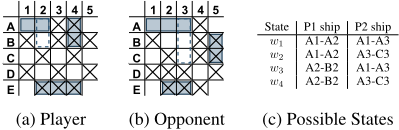
Consider a smaller version of Battleships, in which two players have three ships of sizes 3, 2, and 2 on a square grid of size 5. Players take turns shooting on a tile of the opponent's board after all ships are secretly placed. The player that first hits all tiles occupied by the opponent's ships wins. Suppose we are in the middle of the game, and the current boards are shown in Figure 1. Each player knows their remaining ship's position, but does not know the opponent's. Based on the public shooting actions up until this point, we know that there are only two possible positions for the player and the opponent. The player may have either placed the ship at A1-A2 or A2-B2. Similarly, the opponent may have placed the ship at A1-A3 or A3-C3. Possible positions are shown on each board with the dashed rectangle. There are four possible states, that is, all possible combinations between the positions across both players, as shown in Figure 1c. The first player cannot distinguish between states w1 and w2, neither between w3,w4. Similarly, the opponent cannot distinguish between w1,w3 and between w2,w4. Shooting anywhere else than A1, A2, A3, B3, and C3 does not make sense for a rational player. However, training RNaD for three days results in a policy that shoots to these tiles with a probability less than 45%.
Employing additional search should improve this policy, but doing so naively in imperfect information games introduces multiple issues. The first issue is that starting search only from states that are possible from the player's point of view, which are w1 and w2, would search only in those parts of the game where the player placed the ship at A1-A2. This means that the player incorrectly assumes the opponent knows the ship's position during this search. The outcome of the search would be that the game always ends in 2 turns because the opponent would shoot at the ship. Since the player requires at least three turns to win, it could never win against this informed opponent, and its strategy would be to play randomly. However, in the real gameplay scenario, the opponent lacks knowledge of the player's ship's location, providing the player, who is moving first, with a genuine opportunity to win. Nevertheless, this issue can be fixed by starting the search from all four possible states.
The second issue is more profound. In practice, for many different reasons, the player may incorrectly assume that the opponent is slightly more likely to place his ship at position A1 instead of C3. In such a case, the player would always shoot at either tile A1, A2, or A3 since it provides more reward in expectation from its point of view. This leads to a strategy that could be exploited by an adversarial opponent who would never put the ship there in the first place. This is a well-studied problem in imperfect information games. One possible solution during search is to assume that the opponent can play any strategy in earlier parts of the game. This assumption then allows computing a more robust strategy against possible play from the game's previous and subsequent parts [Burch et al., 2014; Moravcik et al., 2016; Brown and Sandholm, 2017].
The third issue for applying search in the situation in Figure 1 are sizes of required game structures. The full end-game cannot be solved online in reasonable time since it has over 109 terminal histories. Also, it is impossible to safely search in earlier decision points, since after the first move there are more than 108 possible ship configurations and branching factor of 50, which means that even a depth-limited game with look-ahead of one move has more than 1010 histories. Using a depth-limited search with a value function at the depth limit only later in the game enables search even with much less computational resources [Kovaˇr´ık et al., 2023].
3 Background
Factored-observation stochastic game (FOSG) [Kovaˇr´ık et al., 2022] is a tuple G = (N,W, p,w0 ,A, T ,R,O), where N = {1, . . . , N} is a player set, W is the set of states and w0 is an initial state, p : W → 2N is a player function, which for given state w ∈ W assigns currently acting players from N, A = Πi∈NAi is the space of joint actions. We denote Ai(w) legal actions for player i in the world state w. T :
W × A → W is the transition function, R : W × A → RN is the reward function and O : W × A ×W → O is the observation function. O is factored as O = (O0,O1, . . .ON), where O0 are a public observations given to all players and Oi are a private observations of player i. In this work, we focus on two-player zero-sum games, where N = {1, 2, c} and R1(w, a) = -R2(w, a) ∀(w, a) ∈ W × A. c denotes a chance player who has publicly announced a non-changeable policy throughout the game. Moreover, we study only games with perfect recall, where neither player forgets any information.
Trajectory τ = w0a0w1a1 . . .wt ∈ (WA)∗W for which al ∈ A(wl ) and wl+1 = T (wl , al ) is a finite sequence of states and actions in the game. Trajectory utility for player i is a cumulative reward ui(τ) = ∑l-1 t=0 Ri(wt , at ). We use H to denote histories, which are trajectories that start in the initial state w0 . Z = {z ∈ H|z is terminal} are histories in which neither player has an action to play, effectively ending the game. h ⊑ h′ means that h′ extends h and h0 is an initial history, that corresponds to the initial state w0 , before any player played any action. Each history ends with some world state wl . Therefore, we denote Ri(h, a) = Ri(wl , a) as a reward given to player i, if in history h ∈ H the players play joint action a. Since player i does not observe the state of the game directly, but only observes its actions Ai, private observations Oi and public observations O0, it cannot distinguish between multiple different histories. We say that these indistinguishable histories are in the same infoset si ∈ Si. If two histories h, h′ ∈ H belong to the same infoset si, then player i has to have the same actions in these histories and si(h) denotes an infoset of player i in history h. We will use Ai(si) to denote these available actions in infoset si. Furthermore, we will use a notion of public-states s0 ∈ S0, which may be viewed as an information set for an external player which does not act in the game. Two histories belong to the same public state if and only if they have the same sequence of public observations from the initial state. Each public state is made from multiple information sets for a given player i. We will use Si(s0) to denote all infosets that are in public state s0 and H(s) to denote all histories in an infoset s.
Policy of player i is a mapping πi : Si → ∆Ai s.t. πi(si) ∈ ∆Ai(si). Πi is a set of all policies of player i. We will use πi(si, ai) to denote the probability of playing action ai in si, while following the policy πi. A strategy profile is defined as π = (π1, . . . , πN), and π-i is used to denote a strategy profile without the policy of player i.
Expected utility, if all players play according to strategy profile π from history h onward is defined as uπi (h) = Eτ∼π|hui(τ). P π (h) = ∏h′ aw⊑h ∏j∈N πj(sj(h′ ), aj) is a probability of reaching history h if all players play according to strategy profile π. This may be separated into P π (h) = P π i (h)P π-i (h), where P π i (h) is only a players i contribution to reaching history h, similarly P π-i (h) is a contribution of all the other players except i, which is called counterfactual reach probability. Counterfactual values for infoset si is a sum of expected utilities of each history h within the same infoset, weighted by the counterfactual reach probability of this history vπ i (si) = ∑h∈H(si) P π-i (h)uπi (h)
Best response against policy πi of a player i is a policy πBR -i ∈ BRi(πi), where u(πi,πBR -i ) i (h0 ) ≥ u(πi,π′-i ) i (h0 ) for all π′-i . If all players play a best response to each other, then the resulting policy profile πNE is called Nash equilibrium. The usual metric to compare strategies in two-player zerosum games is an exploitability E(πi) = u(πi,πBR -i ) -i (h0 ) - uπNE -i (h0 ), that is how much utility can opponent get if it plays best response to the player's strategy, compared to the utility of Nash equilibrium. From definition, if player i plays Nash equilibrium, then the exploitability is 0.
3.1 Depth-Limited Solving
Range ri ∈ ∆Si(s0) for player i in public state s0 is a probability distribution over infosets si ∈ Si(s0) in public state s0, which corresponds to player's contribution to the probability of reaching this infoset. Furthermore range for public state s0 is defined as r = (r1, . . . , rN) ∈ ∆S1(s0) × · · · × ∆SN(s0). A public belief state is a public state with associated range β = (s0, r). Optimal value function is a function v∗ (β) ∈ R|S1(s0)|...|SN(s0)| , that for given public belief state β returns counterfactual values vπ i (si) for each player i and infoset si ∈ Si(s0) associated with public belief state β if both players played optimally from that point based on associated ranges r. Value function v(β) is then defined similarly, but it's output could be noisy. For any public belief state, we can construct subgame G(β), which is the same FOSG as G, but it starts in s0 with initial ranges r instead of the initial state. Depth-limited subgame is defined as G DL (β). However, after some depth limit, the value function v is called and returned counterfactual values are used as a terminal values.
Resolving some subgame to improve blueprint policy π naively would involve fixing policy π for all players in previous parts of the game and using single wA, where players act with corresponding ranges. However, this may result in a much more exploitable strategy [Burch et al., 2014] than the original blueprint π. Multiple techniques were developed to deal with this issue in two-player zero-sum games [Burch et al., 2014; Moravcik et al., 2016; Brown and Sandholm, 2017; Brown et al., 2020]. In this work we will focus on the one proposed in [Burch et al., 2014]. When resolving from the perspective of player i, it constructs a slightly modified subgame called a gadget game GG i (β, vπ o ), where vπ o are counterfactual values for each infoset so ∈ So(s0) of opponent o in a current public state s0, when players play according to policy π. This subgame has the artificial state wA as an initial state, but instead of using full ranges r, it uses only ranges ri and rc. Directly after this artificial state, |H(s0)| opponent's decision nodes are separated into multiple infosets based on the information player has in a given history. The opponent o has a choice to either terminate the game and receive the counterfactual value vπ o (so) or continue the game as in the original subgame.
Suppose that after the depth limit, the optimal value function is used and that the counterfactual values vπNE o (so) used in the gadget game are computed for Nash equilibrium policy πNE . Then the solution of gadget game GG i (β, vπ o ) is part of a Nash equilibrium in the entire game [Burch et al., 2014;
Kovaˇr´ık et al., 2023].
In this work, we focus on an alternative to the value function called multi-valued states [Brown et al., 2018], which, after the depth limit, gives the opponent the choice to fix its strategy until the end of the game. Then, the game terminates with the reward corresponding to the reward if player i follows some blueprint policy πi, while the opponent follows the fixed strategy. Authors of [Kovaˇr´ık et al., 2023] pointed out that multi-valued states could be viewed as a form of a value function. We further discuss this in Section 4.2
3.2 Regularized Nash Dynamics
Using usual reinforcement learning techniques to find an optimal policy with self-play does not guarantee convergence to Nash equilibrium and can be exploited [Lanctot et al., 2017]. However, regularizing the reward leads to establishing this guarantee [Perolat et al., 2022; Sokota et al., 2023].
Reward regularization with KL-Divergence is
where πR is a regularization policy and η is a hyperparameter for adjusting the regularization effect. Games with such a regularized reward have a single unique fixed point πfix for any regularization policy πR [Perolat et al., 2021]. Follow the Regularized Leader [McMahan, 2011] may be used to converge to πfix. Setting πR = πfix will change the unique fixed point. If this is done repetitively, the fixed point will gradually converge to the Nash equilibrium.
In order to converge to a Nash equilibrium in large games with reward regularization, the authors in [Perolat et al., 2022] propose using two-player V-trace with Neural Replicator Dynamics [Hennes et al., 2020] as a loss function for policy head and usual L2 loss for value head. With this method, it is possible to achieve human-level performance in Stratego.
4 Multi-Agent SearchWith Policy Transformations
In this section, we present an algorithm Multi-Agent Search With Policy Transformations (SePoT) that trains an additional critic alongside a policy network with some policygradient algorithm for imperfect information games, like RNaD [Perolat et al., 2022]. During gameplay, this critic is used to construct a depth-limited gadget game that is then solved with some search algorithm, in our case CFR+ [Tammelin et al., 2015].
4.1 Network Training
Performing a depth-limited search in imperfect information games requires a value function that, after the depth limit, assigns value to each infoset based on ranges [Kovaˇr´ık et al., 2023]. To use a value function based on multi-valued states, it is necessary for each history h to learn multiple values that correspond to the expected values if the opponent plays some fixed policies against the player's blueprint policy. Training such value function presents two difficulties to overcome.
The first is the selection of the opponent policies to be used as a basis to compute the expected values. In large games, simply using some predefined policy is not viable due to the sheer size of full policies. The second is estimating the expected value of these policies.
To find different opponent policies, we decided to use a similar method to the "bias approach" in [Brown et al., 2018]. The main idea is to use a single policy, which in our case is the policy from the policy network, and then apply some mapping that maps the network policy to a different policy. We call this mapping a policy transformation.
Definition 1. Policy transformation f T : Πi →Πi for player i is a function that maps policy to a different one.
In poker, an example of a transformation is folding more frequently [Bowling et al., 2009; Bard et al., 2014]. Similarly, in Goofspiel, certain transformations increase the probability of playing cards with lower value if the player is winning or decrease the probability of playing even-valued cards. These transformations do not have to be game-domain specific. However, the effectiveness of different transformations varies across different games. These transformations aim to cover the strategy space as much as possible. Constant transformations that transform any policy into each pure strategy cover this space fully [Brown et al., 2018].
In our experiments, we use transformations that move the actor policy π in some direction with a fixed step size k ∈ R. These transformations are encoded within a neural network, which undergoes concurrent training with the actor network. At each training step, for each trajectory, we compute the direction in which the actor policy for that trajectory has shifted. Subsequently, we update only the transformation associated with the minimum Euclidean distance across the trajectory. Since each update should improve the actor policy against the current opponent's policy, this direction should aim into the important regions of strategy space, but the quality of these transformations is not guaranteed.
To estimate the expected value of these transformed policies against the player's blueprint, we propose to train an additional critic network ui(h)[f T ], that takes history h as an input and outputs the player's i expected value for each policy transformation f T . To avoid sampling additional trajectories, which may be impossible in continuing tasks, we would like to use already sampled trajectories by the original policygradient algorithm more effectively. This may be achieved by using some off-policy training algorithm. In this work, we have used a V-trace estimator.
We define the V-trace operator V for histories, while following some sampling policy µ as
where ht is history at timestep t in trajectory τ with initial history being h0 . ρt = min(ρ, π(si(ht ),ati ) µ(si(ht ),ati ) ) and ct = min(c, π(si(ht ),ati ) µ(si(ht ),ati ) ) are truncated importance sampling weights. If player does not act in timestep t, or if the t ≥ l, we say that vi(ht ) = 0.
Theorem 1. (Inspired by [Espeholt et al., 2018]): Let ρt = min (ρ, π(si(ht ),ati ) µ(si(ht ),ati ) ), ct = min (c, π(si(ht ),ati ) µ(si(ht ),ati ) ), ρ ≥ c ≥ 1 and µ(s, a) > 0 ∀s, a. Let us assume there exists κ ∈ (0, 1], such that Eµρl( ∏0≤q<l cq ) ≥ κ, where l is a length of the trajectory. Then the V-trace operator V has a unique fixed point vπρ , which is the expected value of following policy
Using ρ → ∞ will result in convergence to the vπ , that is, the expected value of the policy π in given history. The proof of Theorem 1 is in Appendix A. For training the history network, we use standard L2 loss.
4.2 Constructing Public Belief State
After the training phase, the original policy-gradient algorithm ends up with a trained policy network, which is then used at each decision point to retrieve policy. Based on this policy, the action is sampled, and the game proceeds. SePoT finishes the training with the additional history value network.
As discussed in the Section 2, naively employing search in the game could lead to highly exploitable strategies. Using resolving gadget [Burch et al., 2014], which limits the opponent's counterfactual value in root infosets, bounds the error after performing search in a subgame. Constructing a gadget game requires the opponent's counterfactual values vπ o in each root infoset and public belief state β = (s0, r). Most previous methods stored counterfactual values vπ o , public state s0 and ranges r from previous searches [Moravˇc´ık et al., 2017; Schmid et al., 2023]. SePoT could leverage the same idea. Still, we propose a novel approach of using the trained history network to compute counterfactual values, the trained policy network to retrieve ranges for searching player i, and a function that reconstructs the public state. This allows running the search from an arbitrary public state without the need to search in all parent public states.
Safe search in imperfect information games has to be performed from all possible histories based on public information. This requires all histories H(s0) from current public state s0 to construct the gadget game GG i . Let us assume a function that generates all histories in the public state s0 from the publicly available information to all players. While the details of reconstructing the public state s0 are not explored in detail here, for games like Goofspiel or Battleships, the public state can be reconstructed by Constraint Satisfaction Problem (CSP) [Russell and Norvig, 2009; Seitz et al., 2021].
Gadget game GG i requires ranges for the player i and the chance player. Chance player ranges rc can easily be stored during gameplay like older methods [Moravˇc´ık et al., 2017; Schmid et al., 2023; Brown and Sandholm, 2018]. Suppose the player i played only by using the policy from the neural network during current gameplay and decides to perform a search at some public state s0. In that case, it has to recompute the ranges ri for each infoset si ∈ Si(s0). This requires backtracking from all of these infosets to all previous decision points and acquiring the policy from the policy network for each of them. Because we are in a perfect recall setting, each infoset cannot have more parenting infosets than the maximal trajectory length lmax to this infoset from the initial state w0 , so this backtracking involves at most |Si(s0)|lmax queries to the policy network.
In order to compute the counterfactual values in root infosets for the opponent, let us assume that one of the transformations we used in training is identity transformation, meaning that the critic network output corresponds to the expected value if both players follow the policy from the network, which serves as an approximation of a Nash equilibrium. The opponent's counterfactual values are the expected values multiplied by the reaches of both chance and resolving players. As discussed, these ranges are always available, so the counterfactual values can always be computed from the definition. Thanks to this, we have both counterfactual values vπ o and β available in each decision point to construct a gadget game and perform a safe search.
We compare previously used continual resolving for constructing public belief state with our approach in Appendix C.1
4.3 Value Function
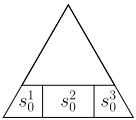
(a) Subgame
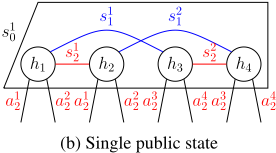
Multi-valued states [Brown et al., 2018] are a modification of the original game, where after the depth limit, the opponent has one more decision point, in which it chooses its strategy for the remainder of the game against some fixed blueprint policy. This modified game is a standard game and can be solved by any game solving algorithm unaware of value functions. Authors of [Moravˇc´ık et al., 2017] trained value function for Poker, which served as a generalization of the value function from perfect information games. This value function returns counterfactual values based on ranges at the depth limit. These were then specially adapted for Counterfactual Regret Minimization (CFR) [Zinkevich et al., 2007].
These two approaches to the depth-limited search may not seem connected, but the authors of [Kovaˇr´ık et al., 2023] show this connection by explaining that the multi-valued states could be viewed as a value function, which is not trained for all possible strategies in the game, but only for some subset. However, their explanation does not explicitly clarify how this connection could be leveraged.
Let us assume a depth-limited subgame, as in Figure 2, with three leaf public states s10 , s20 , s30 . Further examining public state s10 in Figure 2b, there are four possible states in this public state, which are separated into different infosets. First player has infoset s11 , that contains histories h1, h3 and s21 containing histories h2, h4. Similarly second player has infosets s12 , s22 , that contains histories h1, h2 and h3, h4 respectively. The value function would return counterfactual values for each infoset, namely vπ 1 (s11 ), vπ 1 (s21 ), vπ 2 (s12 ), vπ 2 (s22 ).
In the same example, using multi-valued states as proposed in [Brown et al., 2018] gives the opponent, player 2, another choice to pick between two strategies in each infoset, as shown in Figure 2b.
Using CFR requires storing multiple statistics in each infoset, like regret and average strategy. These statistics must be stored even for these artificial infosets created by the multivalued states. In such a scenario, themulti-valued states could be viewed as a stateful value function where these statistics determine the value function state. Each CFR iteration, this value function updates its state and returns counterfactual values based on the current state and input ranges r. Let us assume that instead of performing regret matching and storing these necessary statistics, the opponent always picks a best response based on input ranges. In such a case, we can use multi-valued states as a usual value function with just additional computation step, without keeping the state inside the value function. Let us rephrase the value function in terms of using a history network with policy transformations for player i.
where F T is a set of all used policy transformations and P π-i are directly taken from ranges r-i in β. Since we are in a two-player zero-sum setting and the network returns an expected value for the player i, choosing a best response by the opponent is taking such transformation that minimizes the counterfactual value of the player i.
This presents a new way to train value functions without using search in the training time at all by first training multi-valued states and then using them with different possible ranges to generate counterfactual values for training the value function.
With the constructed gadget game and a corresponding value function, any previously developed search algorithm for imperfect information games may conduct the subsequent search. During our experiments, we used CFR+ [Tammelin et al., 2015] exclusively. When using CFR+, a subclass of Growing tree-CFR (GT-CFR) introduced in [Schmid et al., 2023], the bounds already established by the GT-CFR authors in Theorem 3 also apply to our approach. However, the quality of this value function ξ, which is the distance between values returned by the optimal value function and the trained value function, is affected by additional errors, even if the value function is trained perfectly. The first of these errors is that the blueprint strategy of resolving player i is not Nash equilibrium but just some approximation. Second is that the opponent's strategies used for multi-valued states may not be best responses to any strategy.
The multi-valued states could be expanded by giving both players a choice to pick frommultiple strategies for the rest of the game [Brown and Sandholm, 2019; Kovaˇr´ık et al., 2023]. This would increase the number of values that must be trained quadratically because each pair of strategies between players yields different values. SePoT is compatible with this approach, and the only required change is to compute a Nash equilibrium of the underlying normal-form game at the depth limit during search instead of a best response.
We have already shown how the history critic trained for multi-valued states can be used as a value function. However, we could go one step further and train the usual value function out of this history critic. The value function may be trained before the gameplay phase by randomly sampling possible ranges, computing the counterfactual values from multi-valued states, and then training the value function on these counterfactual values. Such trained value function can then be used in already developed algorithms [Moravˇc´ık et al., 2017; Schmid et al., 2023] without any changes.
We provide pseudocode for training and gameplay in Appendix E
5 Experiments
We have conducted two experiments to validate SePoT's performance. Our experiments have used the framework OpenSpiel [Lanctot et al., 2019]. The depth-limited search was conducted with CPU Intel Xeon Scalable Gold 6146, operating at a frequency of 3.2 GHz, while the network training additionally used a single GPU Tesla V100. The hyperparameter setting is described in Appendix D. Appendix B provides a detailed description of the game rules.
5.1 Head-To-Head Play in Large Games
The first experiment shows the effectiveness of SePoT in large games. We trained RNaD and RNaD with SePoT separately, each three times, with the same hyperparameter setting. These were then used in head-to-head play against each other, where RNaD directly followed the policy network and SePoT applied search in those subgames that contained less than 25000 or 100000 unique histories. The evaluation encompassed these games: Goofspiel with eight cards and randomized point order, and with thirteen cards both with descending and randomized point order and Battleships on square grids of size 3x3, 5x5, and 7x7 with ships of size (2, 2), (3, 2, 2), (4, 3, 3, 2) respectively.
For each game, we have trained 3 RNaD policy networks and 3 different RNaD policy networks along with SePoT's history critic. Each network was trained for 3 days. We have run over one hundred thousand game simulations of RNaD against SePoT for each game. In half of them, the SePoT was a first player; in half, it was a second player. The average rewards multiplied by 100 from these simulations are presented in Table 1 along with a 95% confidence interval. Employing search outperformed the RNaDs policy network with statistical significance in all the games tested.
The usage of search improves the performance in Battleships more than in Goofspiel. This is because, in Goofspiel, most of the subgames are quite large, so the search is used sparingly. However, Battleships have a lot of smaller subgames where the search is used.
| Max subgame size | Goofspiel 8 randomized | Goofspiel 13 descending | Goofspiel 13 randomized | Battleships 3x3 | Battleships 5x5 | Battleships 7x7 |
|---|---|---|---|---|---|---|
| 25000 | 2.70±0.05 | 3.44±0.05 | 1.12±0.05 | 6.2±0.06 | 81.9±0.3 | 24.1±0.7 |
| 100000 | 3.10±0.19 | 3.51±0.1 | 1.43±0.3 | 6.5±0.07 | 83.5±0.5 | 42.1±0.9 |
5.2 Exploitability in Smaller Games
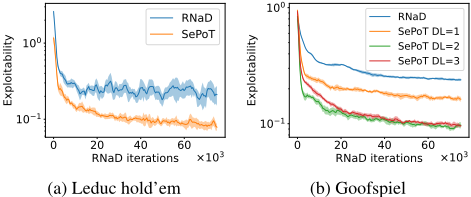
In the second experiment, we aim to evaluate the effect of depth-limited search with multi-valued states on the quality of the policy compared to the policy network. In the experiments, we compare the exploitability of SePoT and the policy network from RNaD. We use Leduc hold'em and Goofspiel with 5 cards and randomized order of point cards for evaluation. We trained ten networks with different random seeds while computing exploitability every 500 iterations up to iteration 75,000. The results in Figure 3 show the mean and 95% confidence interval of the exploitability throughout these runs. In Leduc hold'em, we separately solve part before dealing a public card. In Goofspiel, we use different depth limits for search, where DL=n means that both players play n actions before the value function is called.
The plots in Figure 3b show how the exploitability changes with additional iterations. Using the depth limit 2 or 3 yields similar results, showing that both outperform depth limit 1 and the policy network. This experiment shows that with additional training, the search still improves over the network policy. Furthermore, it confirms the intuition that having a longer look-ahead increases the quality of the search solution.
6 RelatedWork
Previous search algorithms require using safe search both in train and test time [Brown et al., 2020; Brown and Sandholm, 2018; Moravˇc´ık et al., 2017; Schmid et al., 2023]. Using those algorithms in larger games requires some subgame reduction techniques like abstracting the game [Brown and Sandholm, 2018] or revealing part of the private information [Zhang and Sandholm, 2021]. SePoT uses a policy-gradient training algorithm that trains in arbitrarily sized games. Furthermore, SePoT chooses whether the search should be used at each point independently during gameplay. This enables safe search in larger games than previously possible without using any subgame reduction techniques. However, SePoT is flexible enough to be used with these subgame reduction techniques to increase the number of subgames that the search may be applied in even further.
Imagine a game of Battleships as an example. After placing the ships, there are more than 1020 possible states in a public state, which makes training of search algorithms infeasible. After several more rounds, the information is steadily being revealed to both players, and eventually, the size of the public state becomes small enough. SePoT can perform search in such a game, which was previously not possible.
Our method is heavily based on the [Brown et al., 2018], with the notable differences being a more principled way to train the blueprint policy with policy-gradient algorithms and choosing the policy transformations. Moreover, we show how to use multi-valued states as a value function practically. We present a way to leverage an already trained critic network to construct a gadget game anywhere in the game without the need to perform a search in previous parts.
Model-free deep reinforcement learning methods based on regret minimization [Steinberger et al., 2020; Gruslys et al., 2020; McAleer et al., 2023] use search in the gameplay and still can be scaled to very large games. The main limitation of these methods is the need to compute the average strategy, which either requires storing all the trajectories used in learning or approximating this average, which is prone to error. In games like Battleships, the training may consist of billions of trajectories to train properly. Storing all of these trajectories and computing averages is both memory and computationally demanding. SePoT uses a policy-gradient algorithm that approximates the optimal strategy in immediate strategies, so it does not compute the average strategy.
7 Conclusion
Policy-gradient algorithms proved to be powerful for solving huge problems in various settings. Recently, these algorithms were successfully applied to two-player zero-sum imperfect information games and outperformed human professionals in Stratego. However, these algorithms could not incorporate search to improve mistakes caused by network inaccuracies. We have presented an algorithm SePoT that can be used alongside any trajectory sampling policy-gradient algorithm in two-player zero-sum imperfect information games to train additional critic network without any search during training. We have shown that this network is sufficient to enable safe search during test time. The search we use differs from previous approaches since it is independent of the application of search in previous parts of the game, with the only limitation being the local size of the subgame and reconstruction of the public states. Thanks to this, SePoT can employ search even in larger games while still having a choice to follow policy from the policy network. Our experimental results demonstrate that SePoT is able to outperform RNaD in most of the tested scenarios.
Acknowledgments
This research is supported by Czech Science Foundation (GA22-26655S) and Grant Agency of the CTU in Prague (SGS22/168/OHK3/3T/13), and the Canadian Institute for Advanced Research. Computational resources were supplied by (e-INFRA CZ LM2018140) supported by the Ministry of Education, Youth and Sports of the Czech Republic and also (CZ.02.1.01/0.0/0.0/16 019/0000765).
@inproceedings{ijcai2024p480,
  title     = {Look-ahead Search on Top of Policy Networks in Imperfect Information Games},
  author    = {Kubíček, Ondřej and Burch, Neil and Lisý, Viliam},
  booktitle = {Proceedings of the Thirty-Third International Joint Conference on
               Artificial Intelligence, {IJCAI-24}},
  publisher = {International Joint Conferences on Artificial Intelligence Organization},
  editor    = {Kate Larson},
  pages     = {4344--4352},
  year      = {2024},
  month     = {8},
  note      = {Main Track},
  doi       = {10.24963/ijcai.2024/480},
  url       = {https://doi.org/10.24963/ijcai.2024/480},
}
TY - CPAPER TI - Look-ahead Search on Top of Policy Networks in Imperfect Information Games AU - Kubíček, Ondřej AU - Burch, Neil AU - Lisý, Viliam T2 - Proceedings of the Thirty-Third International Joint Conference on Artificial Intelligence, IJCAI-24 PB - International Joint Conferences on Artificial Intelligence Organization PY - 2024 SP - 4344 EP - 4352 DO - 10.24963/ijcai.2024/480 UR - https://doi.org/10.24963/ijcai.2024/480 ER -Copied
Machine-readable versions of this paper, for tools and AI agents:





