
Unbiased Active Semi-supervised Binary Classification Models
Proceedings of the Thirty-Third International Joint Conference on Artificial Intelligence. Main Track. Pages 4389-4397.
https://doi.org/10.24963/ijcai.2024/485
Keywords
- Machine Learning: ML: Semi-supervised learning
- Machine Learning: ML: Regression
- Machine Learning: ML: Active learning
Abstract
Active learning is known to be a well-motivated algorithm that aims to maximize model performance with relatively small data, but it introduces sampling bias due to active selection. To adjust the bias, current literature utilizes corrective weights in a supervised learning approach. However, those methods consider only a small amount of actively sampled data and thus estimation efficiency can be improved using unsampled data together. In this paper, we develop an actively improved augmented estimation equation (AI-AEE) based on corrective weights as well as imputation models that allow us to leverage unlabeled data. The asymptotic distribution of the proposed estimator as the solution to the AI-AEE is derived, and an optimal sampling scheme to minimize the asymptotic mean squared error of the estimator is proposed. We then propose a general practical algorithm for training prediction models in the active and semi-supervised learning framework. The superiority of our method is demonstrated on synthetic and real data examples.
- [Ai et al., 2018] Mingyao Ai, Jun Yu, Huiming Zhang, and HaiYing Wang. Optimal subsampling algorithms for big data regressions. arXiv preprint arXiv:1806.06761, 2018.
- [Cai et al., 2022] Tianxi Cai, Mengyan Li, and Molei Liu. Semi-supervised triply robust inductive transfer learning. arXiv preprint arXiv:2209.04977, 2022.
- [Cao et al., 2009] Weihua Cao, Anastasios A Tsiatis, and Marie Davidian. Improving efficiency and robustness of the doubly robust estimator for a population mean with in- complete data. Biometrika, 96(3):723-734, 2009.
- [Carpenter et al., 2006] James R Carpenter, Michael G Ken- ward, and Stijn Vansteelandt. A comparison of multiple imputation and doubly robust estimation for analyses with missing data. Journal of the Royal Statistical Society: Se- ries A (Statistics in Society), 169(3):571-584, 2006.
- [Chakrabortty and Cai, 2018] Abhishek Chakrabortty and Tianxi Cai. Efficient and adaptive linear regression in semi-supervised settings. The Annals of Statistics, 46(4):1541-1572, 2018.
- [Chakrabortty et al., 2019] Abhishek Chakrabortty, Jiarui Lu, T Tony Cai, and Hongzhe Li. High dimensional m-estimation with missing outcomes: A semi-parametric framework. arXiv preprint arXiv:1911.11345, 2019.
- [Deng et al., 2020] Siyi Deng, Yang Ning, Jiwei Zhao, and Heping Zhang. Optimal semi-supervised estimation and inference for high-dimensional linear regression. arXiv preprint arXiv:2011.14185, 2020.
- [Farquhar et al., 2021] Sebastian Farquhar, Yarin Gal, and Tom Rainforth. On statistical bias in active learning: How and when to fix it. arXiv preprint arXiv:2101.11665, 2021.
- [Gal et al., 2017] Yarin Gal, Riashat Islam, and Zoubin Ghahramani. Deep bayesian active learning with image data. In International Conference on Machine Learning, pages 1183-1192. PMLR, 2017.
- [Ganti and Gray, 2012] Ravi Ganti and Alexander Gray. Upal: Unbiased pool based active learning. In Artificial Intelligence and Statistics, pages 422-431. PMLR, 2012.
- [Gronsbell and Cai, 2018] Jessica L Gronsbell and Tianxi Cai. Semi-supervised approaches to efficient evaluation of model prediction performance. Journal of the Royal Statistical Society: Series B (Statistical Methodology), 80(3):579-594, 2018.
- [Gronsbell et al., 2022] Jessica Gronsbell, Molei Liu, Lu Tian, and Tianxi Cai. Efficient evaluation of prediction rules in semi-supervised settings under stratified sam- pling. Journal of the Royal Statistical Society. Series B, Statistical Methodology, 84(4):1353-1391, 2022.
- [Horvitz and Thompson, 1952] Daniel G Horvitz and Dono- van J Thompson. A generalization of sampling without replacement from a finite universe. Journal of the Ameri- can statistical Association, 47(260):663-685, 1952.
- [Hou et al., 2021] Jue Hou, Zijian Guo, and Tianxi Cai. Sur- rogate assisted semi-supervised inference for high dimen- sional risk prediction. arXiv preprint arXiv:2105.01264, 2021.
- [Imberg et al., 2020] Henrik Imberg, Johan Jonasson, and Marina Axelson-Fisk. Optimal sampling in unbiased ac- tive learning. In International Conference on Artificial In- telligence and Statistics, pages 559-569. PMLR, 2020.
- [Imberg et al., 2022] Henrik Imberg, Xiaomi Yang, Carol Flannagan, and Jonas Bärgman. Active sampling: A machine-learning-assisted framework for finite popula- tion inference with optimal subsamples. arXiv preprint arXiv:2212.10024, 2022.
- [Kiefer, 1959] Jack Kiefer. Optimum experimental designs. Journal of the Royal Statistical Society: Series B (Method- ological), 21(2):272-304, 1959.
- [Kossen et al., 2021] Jannik Kossen, Sebastian Farquhar, Yarin Gal, and Tom Rainforth. Active testing: Sample- efficient model evaluation. In International Conference on Machine Learning, pages 5753-5763. PMLR, 2021.
- [Kossen et al., 2022] Jannik Kossen, Sebastian Farquhar, Yarin Gal, and Tom Rainforth. Active surrogate estima- tors: An active learning approach to label-efficient model evaluation. arXiv preprint arXiv:2202.06881, 2022.
- [Krijthe and Loog, 2017] Jesse H Krijthe and Marco Loog. Projected estimators for robust semi-supervised classifica- tion. Machine Learning, 106(7):993-1008, 2017.
- [Lee et al., 2021] JooChul Lee, Elizabeth D Schifano, and HaiYing Wang. Fast optimal subsampling probability ap- proximation for generalized linear models. Econometrics and Statistics, 2021.
- [Lee et al., 2022] JooChul Lee, Elizabeth D Schifano, and HaiYing Wang. Sampling-based gaussian mixture regres- sion for big data. Journal of Data Science, pages 1-15, 2022.
- [Liu et al., 2022] Xiaokang Liu, Jessica Chubak, Rebecca A Hubbard, and Yong Chen. Sat: a surrogate-assisted two- wave case boosting sampling method, with application to ehr-based association studies. Journal of the American Medical Informatics Association, 29(5):918-927, 2022.
- [McCullagh, 1983] Peter McCullagh. Quasi-likelihood functions. The Annals of Statistics, 11(1):59-67, 1983.
- [Robins et al., 1994] James M Robins, Andrea Rotnitzky, and Lue Ping Zhao. Estimation of regression coefficients when some regressors are not always observed. Journal of the American statistical Association, 89(427):846-866, 1994.
- [Settles et al., 2008] Burr Settles, Mark Craven, and Lewis Friedland. Active learning with real annotation costs. In Proceedings of the NIPS workshop on cost-sensitive learn- ing, volume 1. Vancouver, CA:, 2008.
- [Tan and Heagerty, 2020] W Katherine Tan and Patrick J Heagerty. Predictive case control designs for modification learning. arXiv preprint arXiv:2011.14529, 2020.
- [Wang and Kim, 2022] HaiYing Wang and Jae Kwang Kim. Maximum sampled conditional likelihood for informative subsampling. Journal of Machine Learning Research, 23:1-50, 2022.
- [Wang et al., 2018] HaiYing Wang, Rong Zhu, and Ping Ma. Optimal subsampling for large sample logistic regres- sion. Journal of the American Statistical Association, 113(522):829-844, 2018.
- [Wang et al., 2021] HaiYing Wang, Aonan Zhang, and Chong Wang. Nonuniform negative sampling and log odds correction with rare events data. Advances in Neural In- formation Processing Systems, 34:19847-19859, 2021.
- [Wang et al., 2022a] Jing Wang, HaiYing Wang, and Shifeng Xiong. Unweighted estimation based on optimal sam- ple under measurement constraints. Canadian Journal of Statistics, 2022.
- [Wang et al., 2022b] Linshanshan Wang, Xuan Wang, Katherine P Liao, and Tianxi Cai. Semi-supervised transfer learning for evaluation of model classification performance. arXiv preprint arXiv:2208.07927, 2022.
- [Yao and Wang, 2019] Yaqiong Yao and HaiYing Wang. Op- timal subsampling for softmax regression. Statistical Pa- pers, 60(2):585-599, 2019.
- [Yilmaz et al., 2021] Emine Yilmaz, Peter Hayes, Raza Habib, Jordan Burgess, and David Barber. Sample effi- cient model evaluation. arXiv preprint arXiv:2109.12043, 2021.
- [Yoo and Kweon, 2019] Donggeun Yoo and In So Kweon. Learning loss for active learning. In Proceedings of the IEEE/CVF conference on computer vision and pattern recognition, pages 93-102, 2019.
- [Zhang et al., 2021] Tao Zhang, Yang Ning, and David Rup- pert. Optimal sampling for generalized linear models un- der measurement constraints. Journal of Computational and Graphical Statistics, 30(1):106-114, 2021.
- [Zhou et al., 2022] Doudou Zhou, Molei Liu, Mengyan Li, and Tianxi Cai. Doubly robust augmented model accuracy transfer inference with high dimensional features. arXiv preprint arXiv:2208.05134, 2022.
- [Zhu, 2005] Xiaojin Zhu. Semi-supervised learning with graphs. Carnegie Mellon University, 2005.
References were extracted automatically from the PDF and may contain errors.
Full text extracted automatically from the PDF; figures, tables and equations may differ. The PDF is the version of record.
1 Introduction
With the advancement of technology, big data has improved the performance of modern machine learning and statistical models. However, dealing with a huge amount of unlabeled data is a key challenge in many fields, such as electronic health records [Gronsbell et al., 2022], speech recognition [Zhu, 2005], and text extraction [Settles et al., 2008]. Since labeling massive data is time-consuming, expensive, and labor-intensive, it is important to acquire a subset of reliable data points from domain experts. Active learning (AL) is an algorithm aiming for maximizing model performance with sampled data. By selecting potentially more informative data points, models can be trained more efficiently in AL setting. AL has a close connection with sampling designs in that subsamples are drawn from a pool dataset (it is known as subsampling). In many cases, sampling designs necessitate prior information that we aim to estimate. Regarding subsampling, we can implement the sampling designs using knowledge obtained from actively labeled data within the AL setting.
∗Corresponding Author
Although AL could be a promising sample-efficient learning algorithm, a major limitation is the sampling bias caused by active selection where data points are selected from a pool dataset in sequence. Since the actively sampled data points are not drawn from a common population distribution, they may lead to biased training models for the target population unless the sampling bias is appropriately adjusted. Inverse probability weighting [Horvitz and Thompson, 1952; Ganti and Gray, 2012] is a standard method for removing sampling bias under importance sampling, but this cannot be applied directly to actively sampled data. To adjust the bias introduced by active selection, Farquhar et al.[2021] corrected sampling weights in a manner where modified weights are assigned to the data points selected at earlier steps. By applying corrective weighting, they proposed an unbiased estimator for a general loss function. However, they utilized only a small amount of actively sampled data for model training in the manner of supervised learning and therefore, there is room for improvement in estimation efficiency by leveraging unsampled data.
Relevant work on semi-supervised learning (SSL) has demonstrated that SSL algorithms yields better performance than supervised learning in many cases by constructing imputation models using labeled data, which are then employed to impute outcomes for unlabeled data.[Krijthe and Loog, 2017; Chakrabortty and Cai, 2018]. Subsequently, prediction models are built using the labeled data and the imputed data. Motivated by these results, we focus on leveraging unlabeled data under the AL setting in this work. We propose an actively improved augmented estimating equation (AIAEE) based on corrective weights and imputation models. The main idea behind AI-AEE is to automatically annotate unsampled data by using an imputation model constructed from actively sampled data. Moreover, we propose sampling schemes to actively select informative data points. Several recent works have investigated optimal sampling probability under binary classifiers aiming to minimize the asymptotic variance of the resultant estimator [Wang et al., 2018; Zhang et al., 2021]. Adopting this idea, we derive the asymptotic distribution of our proposed estimator and an optimal sampling scheme by minimizing the asymptotic mean square error of the estimator. The major contributions are as follows.
- We propose the AI-AEE constructed from actively labeled data and unlabeled data. To leverage the unlabeled data, an actively improved imputation model is considered. The AI-AEE is an unbiased estimator for true target population risk, and is robust even when the imputation model deviates from for the true model.
- We derive asymptotic distributions of the proposed estimator obtained from AI-AEE and an existing estimator and compare the efficiency of the estimators.
- We propose an optimal sampling scheme to minimize the asymptotic mean squared error of the proposed estimator.
- Based on the proposed estimator and sampling scheme, we propose a practical batch-mode algorithm for training prediction models in the active and semi-supervised learning setting. By applying the algorithm to synthetic and real data examples, we demonstrate the superiority of our methods compared to others.
The paper is organized as follows. Section 2 describes the problem setup in this work and examines theoretical results of the estimator based on the existing method. Section 3 proposes the estimator as the solution to AI-AEE and provides its theoretical properties and insights. Also, we propose an optimal sampling scheme for the proposed estimator and develop the practical algorithm in the active semi-supervised learning setting. In Section 4, we investigate previous works relevant to AL, SSL, and optimal subsampling schemes. Section 5 presents results of numerical studies. Section 6 concludes the paper and discusses future works.
2 RelatedWorks
2.1 Unbiased Active Learning and Testing
In machine learning fields, AL has been a powerful tool for developing sample-efficient algorithms in a manner that informative data points are labeled throughout multiple steps using the information from earlier steps. However, many related works with active learning algorithms did not address bias due to active selection [Gal et al., 2017; Yoo and Kweon, 2019]. To overcome this problem, unbiased AL algorithms were proposed for training models under sampling with replacement [Ganti and Gray, 2012] and active selection [Farquhar et al., 2021]. A few recent works developed unbiased model evaluation methods in the AL setting (it is also known as active testing). Yilmaz et al. proposed an unbiased estimator of test metrics under Poisson sampling. Kossen et al.[2021] developed an estimator for a model test risk and Kossen et al.[2022] improved the efficiency of model evaluation using a surrogate model under active selection.
2.2 Semi-Supervised Learning (SSL)
SSL can lead to efficiency gains in training models by using labeled and unlabeled data together. Recent relevant works have investigated the classification model training with high dimensional covariates [Chakrabortty et al., 2019], data shift [Cai et al., 2022], and surrogate variables [Hou et al., 2021], as well as model validation with classification accuracy metrics [Gronsbell and Cai, 2018] and data shift [Wang et al., 2022b; Zhou et al., 2022] under the SSL setting. Those works considered imputation models to replace unlabeled data with imputed values. However, they have studied under the simple sampling setting where the labeled data were derived from a random sampling. Gronsbell et al.[2022] selected a small subset of data under the stratified sampling and improved estimation efficiency of Brier score and overall misclassification rate leveraging unlabelled data together.
2.3 Optimal Subsampling
Subsampling strategy is important to improve estimation efficiency by labeling informative subsets of the pool data. In recent works faced with massive data, optimal subsampling strategies have been developed for machine learning and statistical models, such as classification models [Wang et al., 2018; Yao and Wang, 2019; Wang et al., 2021], generalized linear models [Ai et al., 2018; Lee et al., 2021], and mixture models [Lee et al., 2022]. Those papers and our work have different goals. Assuming fully labeled data are available, the above-mentioned work selects subsample with the goal of mitigating computational burden. Also, the proposed subsampling probabilities in those papers depend on outcomes which cannot be used in our paper. Imberg et al.[2020] and Zhang et al.[2021] constructed optimal subsampling designs for generalized linear models under sampling with replacement when outcomes are not available. However, since we considered sampling design under the active learning setting and an extension of generalized linear models, we cannot directly apply their sampling design to our setting. Farquhar et al.[2021] introduced an optimal subsampling distribution which is proportional to the expectation of a one dimensional loss function. Imberg et al.[2022] developed optimal active sampling schemes for finite population characteristics based on machine learning tools. However, since both designs were derived based on models different from our target model, we cannot directly apply them to our specific setting.
3 Problem Setup
Let y be the binary outcome variable and x be the p dimensional vector of covariates including the intercept term. We consider a possibly misspecified working model P(y = 1|x) = g(xTβ) where g(·) is a known smooth function of β and β is the unknown parameter. That is, the working model might deviate from the conditional density of y given x due to the invalid model assumptions.
Let βt be the unknown parameter satisfying the following estimating equation,
The equation is commonly used to obtain quasi-likelihood estimators for generalized linear models. Although this model may not be correctly specified for the true model, the working model is commonly used for the purpose of interpretability to examine the association between the outcome and covariates in the statistical field. Under the AL setting, we start with a dataset including only fully labeled covariates. Let DN = {xi}Ni=1 be the dataset of size N with labeled covariates where xi's are independent and identically distributed. If data for y is fully observed, we can obtain ˆβf for βt as the solution to the full data based estimating equation,
However, since we cannot acquire all labeled outcomes in practice, we sample a subset of data for labeling. Let Dn = {(y1, x1), ..., (yn, xn)} denote as labeled outcomes, covariates selected from DN . For 1 ≤ s ≤ n, let Ds be the selected data from the first to the sth sampling step from DN, and D-s be the remaining data excepting Ds. Let Rs = {i : xi /∈ D-s, 1 ≤ i ≤ N} and R-s = {i : xi ∈ D-s, 1 ≤ i ≤ N} be the index sets indicating the sampled data and the unsampled data from the first to the sth sampling step, respectively. Let π(xk,R(s-1)) be the sampling probability used for the sth sampling step for k ∈ R-(s-1). If we select data points randomly, we can consider the sampled data based estimating equation to obtain an estimator,
Since the non-uniform sampling probability is considered in the AL setting, the application of the estimating equation in (3) with the actively sampled data can lead to a biased estimator. If the model g(xTβ) is correctly specified, then we can obtain (asymptotically) an unbiased estimator from (3) for βt since the sampling probability depends on only covariates [Wang and Kim, 2022; Wang et al., 2022a]. However, when the prediction models are misspecified, the unbiased estimator from (3) is not guaranteed. In this work, we wish to unbiasedly estimate ˆβf with the actively selected subdata accommodating the model misspecification.
4 Estimation
4.1 CorrectiveWeighting Estimator
Under the AL framework, Farquhar et al.[2021] adjusted the sampling bias based on corrective weights. Adopting the approach, we can obtain the corrective weighting (CW) estimator ˜βcw from the following estimating equation,
where wi = 1 + [{(N - i + 1)π(xi, R(i-1))}-1 - 1](N - n)/(N - i). The corrective weight wi is readjusted at each step in an iterative manner to remove the bias. When the sample size n increases, n → N, the corrective weights goes to 1 and Qcw (β) is closer to the full data based estimating equation in (2). In addition, if the sampling probability is uniform, wi's are equal to one and Qcw (β) is the same as the estimating equation in (3). The following result shows that Qcw (β) is unbiased.
Proposition 1. The estimating equation QCW (β) is an unbiased estimator of E[x{y - g(xTβ)}].
To further investigate the asymptotic distribution of ˜βcw , we need the following assumptions.
Assumption 1. The matrix ∑Ni=1 ˙g(xTi ˆβf)xixTi /N goes to a positive-definite matrix in probability where ˙g(η) = ∂g(η)/∂η.
Assumption 3. Assume that ˙g(xTi β) is Lipschitz continuous in β. There exists ϕ(xi) with E(ϕ(xi)2 ) < ∞ such that | ˙g(xTi β1) - ˙g(xTi β2)| ≤ ϕ(xi)‖β1 - β2‖ for every β1 and β2.
Assumption 1 is a mild condition to ensure that the target function has an unique maximum solution. However, this assumption may not hold in the high-dimensional setting where the number of covariates is much larger than the total data size and subdata size. Assumption 2 is a condition on sampling probabilities and the distribution of covariates. It imposes moment constraints. For example, Assumption 2 holds if E(x4 ) < ∞ for equal sampling probabilities. Assumption 3 restrict the gradient of the function g(·) to ensure that we can use a martingale central limit theorem to establish the asymptotic normality of the estimator.
Theorem 1. Under Assumptions (1)- (3), if N, n→∞
in distribution, where Vcw = Σ-1 N ΛcwΣ-1 N , Λcw = Λcw 1 - Λcw 2 ,
and A⊗ = AAT for any vector A.
In Theorem 1, the matrix Λcw can be viewed as the variation due to subsampling and Λcw 1 depends on the sampling probabilities.
Remark 1. We note that under some regularity conditions, ˆβf -βt = Op(1/√N) [McCullagh, 1983]. Then, if n/N → 0, we have √n(˜βcw - ˆβf ) converges in distribution to a normal distribution with mean 0 and variance-covariance matrix Vcw.
4.2 Proposed Estimator
Although the estimating equation in (4) yields the unbiased estimator, it ignores the unsampled data. In the SSL literature, improved estimation efficiency was gained by augmenting imputed outcomes [Robins et al., 1994; Carpenter et al.,
2006; Cao et al., 2009]. Inspired by these results, we leverage the unlabeled data through an imputation approach. Let m(x) be the imputation model used for labeling unsampled outcomes. Let {δ1:n i }Ni=1 be the indicator function where δ1:n i = 1 if ith data point is selected in the first through the nth sampling and δ1:n i = 0 otherwise. We consider the augmented estimating equation (AEE),
We show that the Qaee (β) is unbiased.
Proposition 2. The AEE, Qaee (β) is an unbiased estimator of E[x{y - g(xTβ)}].
From Proposition 2, we observe that the proposed AEE is unbiased although the imputation model m(x) is misspecified for the true model. We can consider the imputation models using all covariates without loosing information of covariates such as addictive models, nonparametric models, random forest, and gradient boosting to deal with more complex structures between outcome and covariates. With ˆmn(·) the imputation model developed by the actively sampled data Dn, we propose the actively improved (AI) estimator ˜βai as the solution to actively improved AEE (AI-AEE),
We present an additional assumption to investigate the asymptotic distribution of ˜βai .
Assumption 4 imposes the condition on the imputation model m(x) to ensure that the difference between ˆmn(x) and the limiting of m(x) is small when the subdata size is large enough.
Theorem 2. Under Assumptions 1, 2 and 4, if N, n →∞
in distribution, where Vai = Σ-1 N ΛaiΣ-1 N , Λai = Λai 1 -Λai 2 ,
As discussed in the previous section, the matrix Λai can be viewed as the variation due to subsampling and Λai 1 depends on the sampling probabilities. Also, if n/N → 0, we have √n(˜βai -βt) converges in distribution to a normal distribution with mean 0 and variance-covariance matrix Vai under some regularity conditions. From the asymptotic results, we compare the proposed estimator ˜βai with ˜βcw .
Theorem 3. Under Assumption 2, if m(x) = E(y|x), Vcw+ op(1) ≥ Vai, where B1 ≥ B2 if and only if B1 - B2 is positive semi-definite for two positive semi-definite matrices B1 and B2.
From Theorem 3, when the imputation model is correctly specified, the estimation efficiency of ˜βai is asymptotically higher, compared to ˜βcw .
5 Subsampling Probability and Algorithm
5.1 Self-Learning Based Subsampling Probability
A key challenge in the AL setting is to select informative data points. Theorem 2 shows that the asymptotic variance of the proposed estimator depends on the sampling probability. Thus, we aim to minimize Vai for achieving higher estimation efficiency with less data. To the this end, we consider the A-optimality criterion minimizing the trace of asymptotic variance matrix [Kiefer, 1959; Wang et al., 2018].
Theorem 4. The optimal subsampling probabilities at sth sampling step given R(s-1) that minimize tr(Vai) are
for k ∈ R-(s-1). In (4), we give preferences to data points with larger quantities of |yi -m(xi)|. The closer data points are to classification boundary, the more they are likely to be sampled. However, we cannot directly calculate the sampling probability since it depends on unobserved outcome yi. Thus, we propose surrogate sampling probabilities. By replacing yi by g(xTi β), we can consider the following self-learning based sampling (SBS) probabilities at the sth sampling step given R(s-1) ,
for k ∈ R-(s-1). The SBS probability is proportional to the quantity |g(xTk β) - m(xk)| = |{yk - g(xTk β)} - {yk - m(xk)}|. Either the data points are close to the boundary from the model g(·) but are not close to the boundary from the model m(·) or visa versa, they are selected with high probability.
Remark 2. We note that tr(Vai) ≤ tr(Vcw) + tr(Vu) where Vu = Σ-1 N ΛuΣ-1 N and
The SBS probability can be obtained by minimizing tr(Vu). Thus, we can view that SBS probability aims for minimizing the upper bound of the asymptotic variance Vai.
Algorithm 1 Unbiased Active Semi-supervised Learning Algorithm
- Select a pilot subsample of size n0 randomly from DN for the initial step. Using the subsample, build the imputation model ˆm0(·), and calculate ˜βai 0 from the equation (3) and Σ˜βai 0 ,N .
- For b = 1, 2, ..., repeat until cost of labelling is regulated
- Calculate the sampling probability based on ˜βai b-1 , Σ˜βAI b-1 ,N , and ˆmb-1(·),
for k ∈ Rbat -(b-1) . According to ˜πsbs k,b , select data points without replacement and label the outcomes, Bb = {(ybi, xbi) : i = 1, ..., nb}
- With the combined sub-data B1:b of size Nb, update the imputation model ˆmb(·)
- Obtain the estimate ˜βai b from the AI-AEE Qai (β) with ˆmb(·)
5.2 Practical Algorithm
To specify the proposed sampling probability in (8) under the AL framework, quantities to replace β,m(·) and ΣN are required in practice. To deal with this, we propose a general practical algorithm based on batch-mode active selection. For b = 1, 2, ..., we denote Bb = {(ybi, xbi) : i = 1, ..., nb} as a sub-data selected from BN/Nb-1 at bth batch where BN/Nb-1 is the remaining data with the covariates excepting the data selected at 1,..., b - 1 batch. Denote B1:b = {B1, ..., Bb} as a cumulative sub-data collected from 1st to bth batch. Rbat -b = {i : xi ∈ BN/Nb , 1 ≤ i ≤ N} be the index sets. Nb = ∑bi=1 ni is the cumulative sub-data size.
The basic idea of the algorithm is that we construct the quantities using the sampled data acquired at previous steps and update the sampling probability to select additional data points. Let ˆmb-1(·) and ˜βai b-1 be the imputation model and the coefficient estimator constructed by B1:(b-1). To select bth sub-data, we replace β,m(·) and ΣN by ˜βai b-1 , ˆmb-1(·) and Σ˜βai b-1 ,N in (8) where Σ˜βai b-1 ,N = ∑Ni=1 ˙g(xTi ˜βai b-1 )xixTi /N. Then, we obtain the updated estimator ˜βai b based on the cumulative sampled data B1:b. The summary of the algorithm is presented in Algorithm 1.
6 Numerical Studies
In this section, we conduct numerical studies to assess the performance of the proposed estimator with synthetic data and four real data examples. The codes used for the numerical studies are available on a Github repository https: //github.com/IJCAI-24/ActiveSemiPrediction.
6.1 Synthetic Data
We generate synthetic data to evaluate the performance of the proposed algorithm. We consider 7 dimensional covariates xi = (x1,i, ..., x7,i). The covariates (x1,i, ..., x5,i) are generated from a multivariate normal distribution N(0,Σ) and x6,i and x7,i are generated from a uniform distribution Unif(0, 0.5) where Σjk = 2 ∗ 0.4I(j̸=k) for j, k = 1, . . . , 5 and I() is the indicator function. With β1 = ... = β7 = 0.7, we consider three different models to generate the outcome yi;
Case 2. yi ∼ Bern(θi) with logit(θi) = -3+xTi β+h1(x), where h1(x) = 0.5 ∗ sin(0.5 ∗ x1,i) - 0.5 ∗ sin(0.5 ∗ x2,i) + 0.2 ∗ sin(0.2 ∗ x7,i).
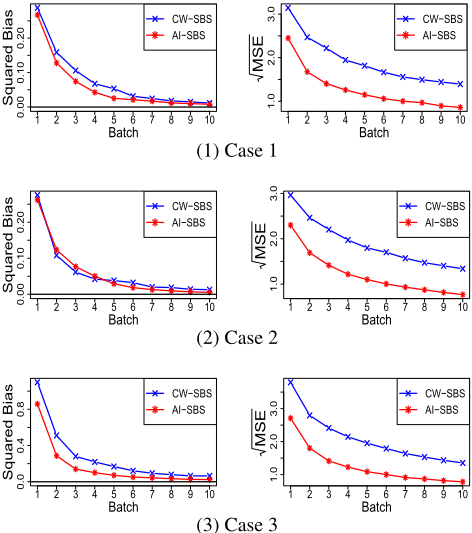
For all cases, about 25% of outcomes is y = 1. We generate full training data of size N = 105 and consider 10 batches. In each batch, we select the subdata of size 100. For the initial values in the proposed algorithm, uniform samples of size 150 are used. Natural spline models with 2 degree of freedom is considered for the imputation model in each repetition, and the models estimate non-linear effects for all continuous covariates. The repetition is 300 times and calculate empirical MSEs and the sum of squared bias for coefficients based on ∑Ss=1 ‖˜β(s) b -ˆβf‖2 /S and ‖ ∑Ss=1 ˜β(s) b /S-ˆβf‖2 , respectively where S is the number of replications, ˜β(s) b is the estimate provided from the bth batch at the sth repetition, and
ˆβf is the full data estimate.
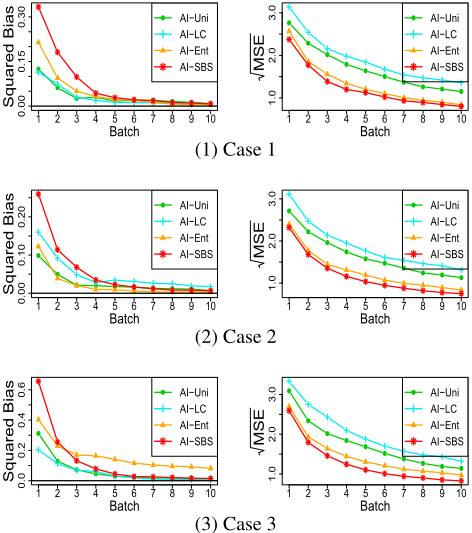
We compare the proposed AI estimator with the CW estimator. In addition, we investigate the efficiency of sampling schemes considering four different sampling probabilities; uniform sampling probability (Uni), least confidence (LC), entropy sampling probability (Ent), proposed selflearning based sampling probability, ˜πsbs (SBS). We used sampling probabilities proportional to 1-g(xTi β) for LC and g(xTi β) log {g(xTi β)} for Ent.
Comparison of estimators We first compare the proposed AI estimator with the CW estimator under the SBS scheme. The results are shown in Figure 1. As the cumulative batch size increases, the MSEs of all methods become smaller and the biases are reduced. The AI method leveraging unlabeled data outperforms the CW estimator using only labeled data for both of the sampling schemes in all cases.
Comparison of sampling schemes As shown in Figure 2, the SBS scheme is always preferred for the AI estimator for all cases in terms of the MSE. When combining different estimators and sampling schemes, it is clear that the AI estimator with the SBS performs best in terms of the MSE. As we expected, the statistical bias decreases for all sampling schemes as the cumulative labeled size increases.
Smaller subsample size We conduct additional numerical studies using synthetic data from Case 1 , 2 and 3 with 120 pilot sample size and 80 subdata size. Figure S.1 and S.2 in Section 7 of Supplementary Material show the results. Overall, the results are similar to those in Figure 1 and 2. Across all cases, the proposed AI method produces better results for MSE than the CWmethod. Moreover, the AI method under the proposed SBS sampling scheme tends to have better performance than the others in terms of MSE. In general, the results also indicate that the larger the pilot sample size and subdata size are, the smaller the MSE tends to be over the batches.
Effect of imputation models To investigate the impact of imputation models, we use a simple natural spline model considering a non-linear effect of only x4 and linear effects of the remaining covariates (OnlyX4). We compared the simple imputation model with the natural spline models considering non-linear effects of all continuous covariates (AllXs). Figure S.3 in Section 7 of Supplementary Material presents the results of the bias and MSE over batches for the CW and AI method under the SBS sampling. Regardless imputation models, the proposed AI methods shows better MSE performance than the CW method. Also we observe that OnlyX4 and AllXs imputation models with the AI method show similar performance for Case 1 and 2, while allXs yields lower MSEs than onlyX4 for Case 3.
6.2 Real Data Examples
We apply the proposed algorithm to four real datasets; 1) Bank Marketing data, 2) SUSY data, 3) Credit Card Clients data and 4) Purchasing Intention data. The datasets are available on the UCI Machine Learning repository:
- https://archive.ics.uci.edu/ml/datasets/bank+marketing,
- https://archive.ics.uci.edu/ml/datasets/SUSY,
- https://archive.ics.uci.edu/ml/datasets/default+of+credit+ card+clients, and
- https://archive.ics.uci.edu/ml/datasets/Online+Shoppers+ Purchasing+Intention+Dataset.
For Bank Marketing dataset, 14 covariates with client information is considered to predict whether the client will agree to a term deposit. The data size is 41,188 and about 11.27% of the responses is y = 1. SUSY dataset includes 18 features to classify a signal process which produces supersymmetric particles. We consider the last 200,000 examples in the dataset. The percent of the response y = 1 is about 45.93%. We use Credit Card Clients dataset with 30,000 customers to classify default payment (yes = 1, no = 0) using 23 predictors such as demographics, history of past payment, amount of bill statement and previous payment. The percent of the response y = 1 is 22.12%. Purchasing Intention dataset has 12,330 observations with about 15.47% of the response y = 1 (y = 1; ending with shopping, y = 0; not end with shopping). The dataset contains 17 covariates related to users information in e-commerce market. We build a natural spline model with 2 or 3 degree of freedom for the imputation models. For initial values and the subdata size, we consider 150 and100 for the first two examples, and 200 and 200 for the other examples, respectively. The total number of batches is 10 and the repetition is 300 times.
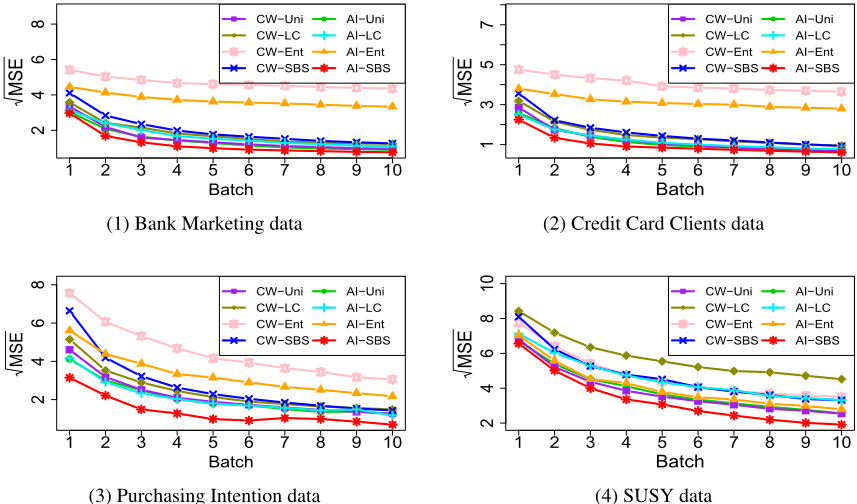
Figure 3 shows the performance of the CW and AI estimators with four different sampling schemes. In general, the results are similar to those in the experiments with the synthetic data. The AI method outperforms the CW method over the batches under the identical non-uniform sampling scheme. It is worth noting that the performance of the AI estimator with the SBS scheme achieves the lowest MSE for all real data examples. As shown in Figure S.4 in Section 7 of Supplementary Material, the biases tend to decrease as the labeled data is larger.
7 Conclusion and Limitations
In the AL setting, we proposed the AI-AEE to estimate the unknown parameters in the target prediction models using labelled and unlabelled data based on an imputation model. We found that even when the imputation models are misspecified, AI-AEE is unbiased and robust. We derived the asymptotic results for the CW estimator and the proposed AI estimator and showed that the AI estimator has a higher efficiency gain than the CW estimator. Furthermore, by minimizing the asymptotic mean squared errors of the AI estimator, we derived the optimal sampling probability for each sampling step. However, since the sampling probability depends on the unlabelled outcomes and the full data-based estimator, we proposed the surrogate SBS probability that is actively updated with sampled data. We demonstrated that our methods provide better performance than other methods in the numerical studies.
There are some interesting topics that need to be further investigated. In this paper, we found that the AI estimator is more efficient than the CW estimator when the imputation model is correctly specified. Under misspecification of the imputation model, however, this is not guaranteed. In a recent paper, Deng et al. developed a 'safe' estimator in the linear regression problem under the SSL setting. They showed that it is no worse than the supervised estimators even when the imputation model is not correctly specified. Using this idea, we can build more robust prediction models in the AL setting even when the imputation model is misspecified. Also, it is challenging to train prediction models on rare event data in practice. The scarcity of rare event data can lead to poor performance. Also, the low prevalence of the rare event cases may require tedious annotation work to collect data points in the minor class under the AL setting. Therefore, it would be important to collect the rare events for labelling. One possible solution is to use surrogate variables that are highly correlated with the rare cases [Liu et al., 2022]. The other solution is to label data points with high risk prediction based on the trained models to enrich the rare cases [Tan and Heagerty, 2020].
8 SupplementaryMaterial
Supplementary Material includes all proofs of propositions and theorems in the main manuscript, additional numerical experiments and codes used for numerical studies.
@inproceedings{ijcai2024p485,
  title     = {Unbiased Active Semi-supervised Binary Classification Models},
  author    = {Lee, JooChul and Ma, Weidong and Wang, Ziyang},
  booktitle = {Proceedings of the Thirty-Third International Joint Conference on
               Artificial Intelligence, {IJCAI-24}},
  publisher = {International Joint Conferences on Artificial Intelligence Organization},
  editor    = {Kate Larson},
  pages     = {4389--4397},
  year      = {2024},
  month     = {8},
  note      = {Main Track},
  doi       = {10.24963/ijcai.2024/485},
  url       = {https://doi.org/10.24963/ijcai.2024/485},
}
TY - CPAPER TI - Unbiased Active Semi-supervised Binary Classification Models AU - Lee, JooChul AU - Ma, Weidong AU - Wang, Ziyang T2 - Proceedings of the Thirty-Third International Joint Conference on Artificial Intelligence, IJCAI-24 PB - International Joint Conferences on Artificial Intelligence Organization PY - 2024 SP - 4389 EP - 4397 DO - 10.24963/ijcai.2024/485 UR - https://doi.org/10.24963/ijcai.2024/485 ER -Copied
Machine-readable versions of this paper, for tools and AI agents:





