
DWLR: Domain Adaptation under Label Shift for Wearable Sensor
Proceedings of the Thirty-Third International Joint Conference on Artificial Intelligence. Main Track. Pages 4425-4433.
https://doi.org/10.24963/ijcai.2024/489
Keywords
- Machine Learning: ML: Time series and data streams
- Machine Learning: ML: Adversarial machine learning
- Machine Learning: ML: Classification
- Machine Learning: ML: Deep learning architectures
Abstract
Wearable sensors play a crucial role in real-world scenarios, such as human activity recognition, sleep monitoring and electrocardiogram monitoring. However, deploying classifiers on them is challenged by distribution shifts across users and devices. Unsupervised domain adaptation (UDA) is proposed to address this, yet existing methods mostly focus on feature distribution shift, neglecting the potential misclassification due to label shift. In this paper, we propose Domain adaptation under label shift for Wearable sensor with Learnable Reweighting (DWLR) to handle both feature and label shifts. Specifically, DWLR employs learnable reweighting to align label distributions between source and target domains. It incorporates elements of information gain during the reweighting process to counter potential distribution shift that could emerge from over-reliance on data with high-confidence pseudo labels. Importantly, since wearable sensor data is time-series data, and can be subjected to distribution shifts originating from either the time domain, the frequency domain, or both, DWLR performs reweighting and alignment separately in these two domains to more robustly handle potential feature distribution shifts. Extensive experiments on three distinct wearable sensor datasets demonstrate the effectiveness of DWLR, yielding a remarkable average performance improvement of 5.85%.
- [Anguita et al., 2013] Davide Anguita, Alessandro Ghio, Luca Oneto, Xavier Parra Perez, and Jorge Luis Reyes Or- tiz. A public domain dataset for human activity recogni- tion using smartphones. In Proceedings of the 21th in- ternational European symposium on artificial neural net- works, computational intelligence and machine learning, pages 437-442, 2013.
- [Bai et al., 2018] Shaojie Bai, J Zico Kolter, and Vladlen Koltun. An empirical evaluation of generic convolutional and recurrent networks for sequence modeling. arXiv preprint arXiv:1803.01271, 2018.
- [Bousmalis et al., 2017] Konstantinos Bousmalis, Nathan Silberman, David Dohan, Dumitru Erhan, and Dilip Kr- ishnan. Unsupervised pixel-level domain adaptation with generative adversarial networks. In Proceedings of the IEEE conference on computer vision and pattern recog- nition, pages 3722-3731, 2017.
- [Bousmalis et al., 2018] Konstantinos Bousmalis, Alex Ir- pan, Paul Wohlhart, Yunfei Bai, Matthew Kelcey, Mri- nal Kalakrishnan, Laura Downs, Julian Ibarz, Peter Pastor, Kurt Konolige, et al. Using simulation and domain adap- tation to improve efficiency of deep robotic grasping. In 2018 IEEE international conference on robotics and au- tomation (ICRA), pages 4243-4250. IEEE, 2018.
- [Cai et al., 2021] Ruichu Cai, Jiawei Chen, Zijian Li, Wei Chen, Keli Zhang, Junjian Ye, Zhuozhang Li, Xiaoyan Yang, and Zhenjie Zhang. Time series domain adapta- tion via sparse associative structure alignment. In Pro- ceedings of the AAAI Conference on Artificial Intelligence, volume 35, pages 6859-6867, 2021.
- [Chung et al., 2015] Junyoung Chung, Kyle Kastner, Lau- rent Dinh, Kratarth Goel, Aaron C Courville, and Yoshua Bengio. A recurrent latent variable model for sequential data. Advances in neural information processing systems, 28, 2015.
- [Cohen, 1995] Leon Cohen. Time-frequency analysis, vol- ume 778. Prentice hall New Jersey, 1995.
- Thomas M Cover. Elements of information theory. John Wiley & Sons, 1999.
- [Gal et al., 2017] Yarin Gal, Riashat Islam, and Zoubin Ghahramani. Deep bayesian active learning with image data. In International Conference on Machine Learning, pages 1183-1192. PMLR, 2017.
- [Ganin et al., 2015] Yaroslav Ganin, E. Ustinova, Hana Ajakan, Pascal Germain, H. Larochelle, Franc ¸ois Lavi- olette, Mario Marchand, and Victor S. Lempitsky. Domain-adversarial training of neural networks. ArXiv, abs/1505.07818, 2015.
- [Ghifary et al., 2016] Muhammad Ghifary, W Bastiaan Kleijn, Mengjie Zhang, David Balduzzi, and Wen Li. Deep reconstruction-classification networks for unsuper- vised domain adaptation. In Computer Vision-ECCV 2016: 14th European Conference, Amsterdam, The Netherlands, October 11-14, 2016, Proceedings, Part IV 14, pages 597-613. Springer, 2016.
- [Goldberger et al., 2000] Ary L Goldberger, Luis AN Ama- ral, Leon Glass, Jeffrey M Hausdorff, Plamen Ch Ivanov, Roger G Mark, Joseph E Mietus, George B Moody, Chung-Kang Peng, and H Eugene Stanley. Physiobank, physiotoolkit, and physionet: components of a new re- search resource for complex physiologic signals. circu- lation, 101(23):e215-e220, 2000.
- [Goodfellow et al., 2014] Ian Goodfellow, Jean Pouget- Abadie, Mehdi Mirza, Bing Xu, David Warde-Farley, Sherjil Ozair, Aaron Courville, and Y. Bengio. Genera- tive adversarial nets. In Neural Information Processing Systems, 2014.
- [He et al., 2023] Huan He, Owen Queen, Teddy Koker, Con- suelo Cuevas, Theodoros Tsiligkaridis, and Marinka Zit- nik. Domain adaptation for time series under feature and label shifts. In International Conference on Machine Learning, 2023.
- [Hu et al., 2023] Rong Hu, Ling Chen, Shenghuan Miao, and Xing Tang. Swl-adapt: An unsupervised domain adap- tation model with sample weight learning for cross-user wearable human activity recognition. In Proceedings of the AAAI Conference on artificial intelligence, volume 37, pages 6012-6020, 2023.
- [Jiang et al., 2020] Xiang Jiang, Qicheng Lao, Stan Matwin, and Mohammad Havaei. Implicit class-conditioned do- main alignment for unsupervised domain adaptation. In International Conference on Machine Learning, pages 4816-4827. PMLR, 2020.
- [Kang et al., 2019] Guoliang Kang, Lu Jiang, Yi Yang, and Alexander G Hauptmann. Contrastive adaptation network for unsupervised domain adaptation. In Proceedings of the IEEE/CVF conference on computer vision and pattern recognition, pages 4893-4902, 2019.
- [Kwapisz et al., 2011] Jennifer R Kwapisz, Gary M Weiss, and Samuel A Moore. Activity recognition using cell phone accelerometers. ACM SigKDD Explorations Newsletter, 12(2):74-82, 2011.
- [Kwon et al., 2021] Shinjae Kwon, Hojoong Kim, and Woon-Hong Yeo. Recent advances in wearable sensors and portable electronics for sleep monitoring. Iscience, 24(5), 2021.
- [Lee and Raginsky, 2018] Jaeho Lee and Maxim Raginsky. Minimax statistical learning with wasserstein distances. Advances in Neural Information Processing Systems, 31, 2018.
- [Liu and Tuzel, 2016] Ming-Yu Liu and Oncel Tuzel. Cou- pled generative adversarial networks. Advances in neural information processing systems, 29, 2016.
- [Liu and Xue, 2021] Qiao Liu and Hui Xue. Adversarial spectral kernel matching for unsupervised time series do- main adaptation. In IJCAI, pages 2744-2750, 2021. IJCAI
- [Liu et al., 2022] Hongrui Liu, Binbin Hu, Xiao Wang, Chuan Shi, Zhiqiang Zhang, and Jun Zhou. Confidence may cheat: Self-training on graph neural networks under distribution shift. In Proceedings of the ACM Web Confer- ence 2022, pages 1248-1258, 2022.
- [Long et al., 2015] Mingsheng Long, Yue Cao, Jianmin Wang, and Michael Jordan. Learning transferable features with deep adaptation networks. In International confer- ence on machine learning, pages 97-105. PMLR, 2015.
- [Longoni et al., 2018] Marco Longoni, Diego Carrera, Beat- rice Rossi, Pasqualina Fragneto, Marco Pessione, Gia- como Boracchi, et al. A wearable device for online and long-term ecg monitoring. In IJCAI, pages 5838-5840, 2018. IJCAI
- [McClure et al., 2020] Kristin McClure, Brett Erdreich, Ja- son HT Bates, Ryan S McGinnis, Axel Masquelin, and Safwan Wshah. Classification and detection of breathing patterns with wearable sensors and deep learning. Sensors, 20(22):6481, 2020.
- [Mukherjee and Awadallah, 2020] Subhabrata Mukherjee and Ahmed Awadallah. Uncertainty-aware self-training for few-shot text classification. Advances in Neural Information Processing Systems, 33:21199-21212, 2020.
- [Ozyurt et al., 2023] Yilmazcan Ozyurt, Stefan Feuerriegel, and Ce Zhang. Contrastive learning for unsupervised do- main adaptation of time series. ICLR, 2023.
- [Patel et al., 2015] Vishal M Patel, Raghuraman Gopalan, Ruonan Li, and Rama Chellappa. Visual domain adapta- tion: A survey of recent advances. IEEE signal processing magazine, 32(3):53-69, 2015.
- [Purushotham et al., 2017] Sanjay Purushotham, Wilka Car- valho, Tanachat Nilanon, and Yan Liu. Variational recur- rent adversarial deep domain adaptation. In International Conference on Learning Representations, 2017.
- [Qian et al., 2019] Hangwei Qian, Sinno Jialin Pan, Bing- shui Da, and Chunyan Miao. A novel distribution- embedded neural network for sensor-based activity recog- nition. In IJCAI, volume 2019, pages 5614-5620, 2019.
- [Ragab et al., 2022] Mohamed Ragab, Emadeldeen Eldele, Zhenghua Chen, Min Wu, Chee-Keong Kwoh, and Xiaoli Li. Self-supervised autoregressive domain adaptation for time series data. IEEE Transactions on Neural Networks and Learning Systems, 2022.
- [Saito et al., 2017] Kuniaki Saito, Yoshitaka Ushiku, and Tatsuya Harada. Asymmetric tri-training for unsupervised domain adaptation. In International Conference on Ma- chine Learning, pages 2988-2997. PMLR, 2017.
- [Shen et al., 2018] Jian Shen, Yanru Qu, Weinan Zhang, and Yong Yu. Wasserstein distance guided representation learning for domain adaptation. In Proceedings of the AAAI Conference on Artificial Intelligence, volume 32, 2018.
- [Shi et al., 2022] Weili Shi, Ronghang Zhu, and Sheng Li. Pairwise adversarial training for unsupervised class- imbalanced domain adaptation. Proceedings of the 28th ACM SIGKDD Conference on Knowledge Discovery and Data Mining, 2022.
- [Stisen et al., 2015] Allan Stisen, Henrik Blunck, Sourav Bhattacharya, Thor Siiger Prentow, Mikkel Baun Kjær- gaard, Anind Dey, Tobias Sonne, and Mads Møller Jensen. Smart devices are different: Assessing and mitigatingmo- bile sensing heterogeneities for activity recognition. In Proceedings of the 13th ACM conference on embedded networked sensor systems, pages 127-140, 2015.
- [Sun et al., 2016] Baochen Sun, Jiashi Feng, and Kate Saenko. Return of frustratingly easy domain adaptation. In Proceedings of the AAAI Conference on Artificial Intel- ligence, volume 30, 2016.
- [Tan et al., 2020] Shuhan Tan, Xingchao Peng, and Kate Saenko. Class-imbalanced domain adaptation: An empiri- cal odyssey. In European Conference on Computer Vision, pages 585-602. Springer, 2020.
- [Tang et al., 2021] Shixiang Tang, Peng Su, Dapeng Chen, and Wanli Ouyang. Gradient regularized contrastive learn- ing for continual domain adaptation. In Proceedings of the AAAI Conference on Artificial Intelligence, volume 35, pages 2665-2673, 2021.
- [Tonutti et al., 2019] Michele Tonutti, Emanuele Ruffaldi, Alessandro Cattaneo, and Carlo Alberto Avizzano. Ro- bust and subject-independent driving manoeuvre antici- pation through domain-adversarial recurrent neural net- works. Robotics and Autonomous Systems, 115:162-173, 2019.
- [Tzeng et al., 2017] Eric Tzeng, Judy Hoffman, Kate Saenko, and Trevor Darrell. Adversarial discriminative domain adaptation. In Proceedings of the IEEE confer- ence on computer vision and pattern recognition, pages 7167-7176, 2017.
- [Wilson et al., 2020] Garrett Wilson, Janardhan Rao Doppa, and Diane J Cook. Multi-source deep domain adaptation with weak supervision for time-series sensor data. In Pro- ceedings of the 26th ACM SIGKDD International Con- ference on Knowledge Discovery & Data Mining, pages 1768-1778, 2020.
- [Winograd, 1978] Shmuel Winograd. On computing the dis- crete fourier transform. Mathematics of computation, 32(141):175-199, 1978.
- [Zhao et al., 2019] Han Zhao, Remi Tachet Des Combes, Kun Zhang, and Geoffrey Gordon. On learning invari- ant representations for domain adaptation. In Interna- tional Conference on Machine Learning, pages 7523- 7532. PMLR, 2019.
References were extracted automatically from the PDF and may contain errors.
Full text extracted automatically from the PDF; figures, tables and equations may differ. The PDF is the version of record.
1 Introduction
Wearable sensors play a crucial role in various real-world scenarios, such as human activity recognition [Qian et al., 2019; Hu et al., 2023], sleep monitoring [Kwon et al., 2021], electrocardiogram monitoring [Longoni et al., 2018], etc. It is always challenging to obtain high performance for modeling wearable sensors in real applications. Recently, deep learning-based models designed for wearable sensor data have show promising achievements [Qian et al., 2019; McClure et al., 2020]. Additionally, since most wearable sensor data are time series, some time series approaches can also be used to model wearable sensor data [Bai et al., 2018; Chung et al., 2015]. Most deep learning-based works typically require a large amount of labeled data to train their models and achieve satisfactory performance. However, labeled data are scarce in real-world applications due to the laborious labeling process. Furthermore, deep learning-based methods often assume that the training data (i.e., source domain) comes from the same distribution as the test data (i.e., target domain). Nevertheless, this assumption usually does not hold due to variations in the physical environment and behavior patterns of users, which is also known as domain shift.
∗Corresponding author.
In order to address the substantial cost of labeling and the inherent domain shift problem, previous works have trained their models on labeled source domains and subsequently transferred them to unlabeled target domains, a method commonly referred to as Unsupervised Domain Adaptation (UDA) [Patel et al., 2015]. Numerous UDA works have demonstrated remarkable success across various applications [Bousmalis et al., 2018; Bousmalis et al., 2017; Saito et al., 2017]. Some discrepancy-based approaches align the feature distributions of target and source domain by minimizing a divergence that measures the distance between the two distributions [Shen et al., 2018; Lee and Raginsky, 2018; Sun et al., 2016; Kang et al., 2019]. Recently, drawing inspiration from Generative Adversarial Aetworks (GANs), several works have employed adversarial learning methods to acquire domain-invariant features for effective knowledge transfer [Long et al., 2015; Tzeng et al., 2017; Liu and Tuzel, 2016]. Moreover, UDA methods for modeling cross-user wearable sensors have exhibited substantial success [Hu et al., 2023; Qian et al., 2019]. Given that the majority of wearable sensor data comprises time series data, UDA methods tailored for such data have made significant progress [Purushotham et al., 2017; Tonutti et al., 2019; Wilson et al., 2020; Ragab et al., 2022; Ozyurt et al., 2023; Liu and Xue, 2021].
While most existing works are based on the assumption that the source and target domains have the same label distribution, this assumption is usually inapplicable in real-world applications, leading to an inevitable problem in application scenarios, namely label shift. For instance, as depicted in Figure 1 (a), in human activity recognition tasks where different users are treated as different domains, significant differences in the proportions of certain categories, such as running and sitting for different individuals like sports enthusiasts and avid readers. Despite this, most existing works solely focus on aligning the feature distributions, ignoring label shift, which may degrade the performance of models on the target domain [Zhao et al., 2019]. Figure 1 (b) provides an example where there are numerous circular samples but relatively few triangular samples in the source domain (orange). Conversely, in the target domain (blue), there are relatively few circular samples but many triangular samples. As a result, some triangular samples in the target domain may be incorrectly classified as belonging to the circular category due to the label shift problem. Recently, there are methods aligning feature distributions and label distributions using pseudo labels with high confidence [Tan et al., 2020; Shi et al., 2022]. Nevertheless, as shown in Figure 1 (b), exclusively selecting examples with high-confidence pseudo labels may overlook samples (depicted with dashed borders) at the classification boundary, resulting in a distribution shift problem. Existing studies indicate that data at the classification boundary may contribute more to the model, as they provide more information to the model, a concept referred to as information gain [Mukherjee and Awadallah, 2020].
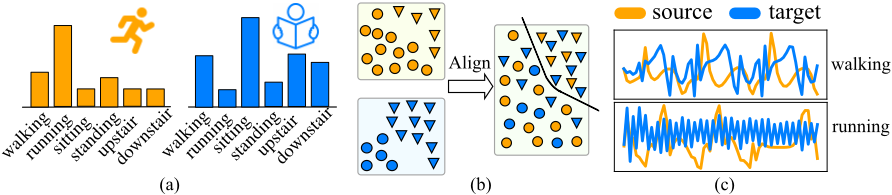
Furthermore, most of these models handle wearable sensor data, which can be viewed as time series data, primarily focusing on the time domain. This focus may potentially overlook valuable information from the frequency domain, which can offer an alternative perspective for modeling time series [Cohen, 1995; He et al., 2023]. In addition, the domain shift may occur in either the time domain or the frequency domain. As shown in Figure 1 (c), the frequency of patterns of source and target data in the walking category is consistent (three similar patterns are repeated in both source and target domains), and domain shift mainly occurs in the time domain. While for the running category, domain shift obviously also occurs in the frequency domain.
To address the above challenges, we propose Domain adaptation under label shift for Wearable sensor with Learnable Reweighting (DWLR). DWLR adopts a learnable reweighting method to address the problem of UDA with both feature shift and label shift for wearable sensor. Specifically, DWLR aligns the label distributions through learnable reweighting combined with maximization of not only confidence but information gain, which select data that contribute more to the model training [Mukherjee and Awadallah, 2020] and avoids the distribution shift problem caused by only select data with high-confidence pseudo labels. Then, DWLR uses adversarial learning to extract domain-invariant features to align source and target domain. Furthermore, considering that the time and frequency domains can provide different perspectives and that domain shift may occur in either domain, DWLR performs reweighting and alignment from the time and frequency domains, respectively. We summarize our contributions as follows:
- We propose a learnable reweighting method DWLR to align label distributions, which adress the problem of label shift that reduces the performance of UDAmethod.
- We utilize information gain to constrain the process of learnable reweighting, avoiding the distribution shift problem caused by only selecting data with highconfidence pseudo labels.
- We consider the different information and domain shift from the time and frequency domains, and perform reweighting and alignment from each domain respectively.
- Extensive experiments demonstrate the effectiveness of DWLR with an average improvement of 5.85%. 1
2 RelatedWork
Unsupervised Domain Adaptation (UDA) can be viewed as a special instance of transfer learning [Patel et al., 2015]. In UDA, the data distributions of the source and target domains are different, while the target task remains the same as that of the source domain, and only the source data is labeled [Bousmalis et al., 2018; Bousmalis et al., 2017]. Some discrepancy-based approaches aim to align the distributions by minimizing a divergence that measures the distance between two feature distributions [Long et al., 2015; Shen et al., 2018; Lee and Raginsky, 2018]. In recent years, Generative Adversarial Networks (GANs) [Goodfellow et al., 2014] have been developed rapidly. Inspired by GANs, some approaches incorporate adversarial training [Long et al., 2015; Tzeng et al., 2017; Liu and Tuzel, 2016], which use a domain discriminator to confuse the features of different domains through adversarial objectives. Some UDA methods use auxiliary self-supervised tasks, such as contrastive learning and reconstruction, to capture the common semantic information of source and target domains [Kang et al., 2019; Tang et al., 2021; Ghifary et al., 2016].
1 Supplementary material is available at https://github.com/ JuRenGithub/DWLR.
Some UDA methods designed for cross-user wearable sensors modeling has achieved great success. [Hu et al., 2023] proposes SWL-Adapt, which considers the difference among samples by calculating sample weights of each sample. Considering the wearable sensor data are almost time series data, Variational Recurrent Adversarial Deep Domain Adaptation (VRADA) [Purushotham et al., 2017] and Recurrent Domain Adversarial Neural Network (R-DANN) [Tonutti et al., 2019] leverage recurrent neural network as the feature extractor. [Wilson et al., 2020] proposes Convolutional deep Domain Adaptation model for time series sensor data (CoDATS). [Ragab et al., 2022] proposes a SeLf-supervised AutoregRessive Domain Adaptation (SLARDA) framework, which designs an auxiliary task to capture the transferable feature of source domain data. [Cai et al., 2021] proposes Sparse Associative Structure Alignment (SASA) to align the sparse associative structure of the sequential sensor data. Adversarial Spectral KernelMatching (AdvSKM) [Liu andXue, 2021] incorporates a hybrid sepectral kernel network to improve domain matching performance. Contrastive Learning for Unsupervised Domain Adaptation (CLUDA) [Ozyurt et al., 2023] introduces contrastive learning for UDA.
Recently, several works [Tan et al., 2020; Jiang et al., 2020; Shi et al., 2022] have emerged focusing on UDA under label shift, a more practical domain adaptation setting, where feature shift and label shift both exist. [Tan et al., 2020] proposes COAL to achieve collaborative alignment of feature and label distributions through pseudo labels. [Jiang et al., 2020] adopts a sampling-based approach to implicitly align feature distributions to deal with UDA under label shift. [Shi et al., 2022] propose a data-augmentation method which can be integrated into existing UDA models to tackle with the label shift problem. [He et al., 2023] proposes alignment and correction strategy to address feature and label shift problem in universal domain adaptation.
3 Method
Problem definition. In the setting of cross-user wearable sensor UDA under label shift, two different data distributions exist, where P is from the source domain (source user) and Q is from the target domain (target user). We are given a source domain P = {(xsi , ys i )}N s i=1 with N s labeled data, where ys i ∈ {1, . . . , k} represents the label of data xsi , and a target domain Q = {xti }N t i=1 with N t unlabeled data. For brevity, we omit the subscript i hereafter. And x ∈ RL×M contains L time points of sensor data with M channels. Our goal is to build an end-to-end deep network that transfers the knowledge learned from P to Q and predict the label ˆ yt of each data xt ∈ Q.
3.1 Model Overview
The framework of the proposed DWLR is shown in Figure 2. The cornerstone of DWLR is learnable reweighting , which aims to reweight the target data to align label distributions. Subsequently, DWLR aligns the feature distributions through adversarial training. Specifically, DWLR first trains the encoder and task classifier with labeled source data. Considering that the wearable sensor data are primarily time series data, DWLR incorporates information from both the time and frequency domains to effectively model the wearable sensor data. Then, a learnable reweighting network WNet(·) conducts a reweighting process on the target data based on the features extracted by the shared encoder from both the time and frequency domains, with the aim of aligning the label distributions. Furthermore, to address the issue of distribution shift resulting from selecting only data with highconfidence pseudo labels, WNet(·) utilizes information gain to constrain the learnable reweighting process. Finally, based on the reweighting result, DWLR utilizes the discriminator to align the feature distributions.
3.2 Backbone and Task Learning
As mentioned in Section 1, the time domain and frequency domain can provide different perspectives on wearable sensor data modeling [Cohen, 1995]. Additionally, domain shift may occur in either the time domain, the frequency domain, or both. Therefore, we have developed two encoders, Ft(·) and Ff(·), which take into account the time domain and frequency domain, respectively.
As Eq 1 shows, the representation ft in the time domain and the representation ff in the frequency domain are obtained from the time-domain encoder Ft(·) and the frequencydomain encoder Ff(·). In this work, Ft(·) is implemented using convolutional neural networks (CNNs) To capture features from the frequency domain, we apply the Discrete Fourier Transform (DFT) [Winograd, 1978] to each channel of x with a length of L:
where j is the frequency index, m is the channel index, and v is a complex vector Then we extract the amplitude a and the phase p from v:
where Re(·) and Im(·) are the imagery and real part. After that we employ CNNs on a and p:
where ⊕ is concatenate operation.
To ensure the relevance of the extracted features f to downstream tasks, we guide Ft(·) and Ff (·) using two task classifiers, Ct(·) and Cf (·). The task classifier outputs probability scores for each class, h = C(f), where h ∈ Rk . Consequently, we predict the label ˆ y as the class with the highest probability score, i.e., ˆ y = argmax i∈{1,··· ,k}hi. We use the source
̂
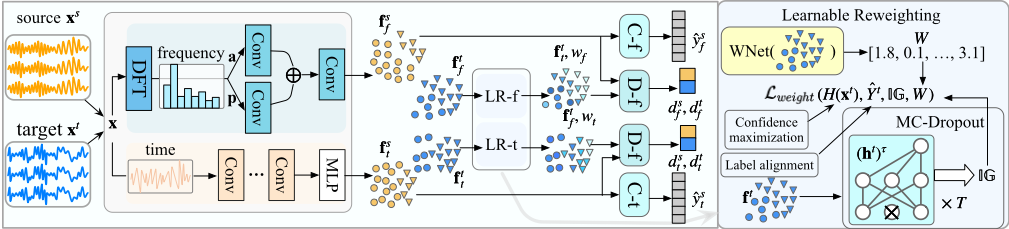
data to train the classifier and encoder from both the time and frequency domains with a cross-entropy loss function:
Note that we omit the subscripts t and f here because this process is the same for the time and frequency domains, and this convention will continue to be followed.
3.3 Learnable Reweighting
In our scenario, both feature shift and label shift exist. As illustrated in Figure 1 (b), if we directly align the feature distributions, ignoring the problem of label shift, some data from the target domain will be misclassified. To address this problem, DWLR chooses to first align the label distributions by reweighting data from the target domain. It is intuitive to assign more weight to the target data with a smaller class proportion compared to the source data and assign less weight to the target data with a larger class proportion than the source data. Since labels are unavailable in the target domain, DWLR addresses this challenge by using pseudo labels ˆ yt obtained from the shared classifier C(·).
To ensure the reliability of pseudo labels, many studies have opted to select data with high-confidence pseudo labels [Tan et al., 2020; Ragab et al., 2022], where the predicted probability hti indicates the confidence level for the i-th class. Previous research has demonstrated that highconfidence data tend to cluster around the class centers in the feature space [Liu et al., 2022] However, if we only select data with high-confidence pseudo labels, there is a risk of neglecting the target data that exhibit low confidence and reside near the classification boundary. This ignored data still has feature-shift problem with the source data, which can hinder the classifier's ability to effectively distinguish them. Furthermore, existing studies have shown that data at the classification boundary may contribute more to the model [Mukherjee and Awadallah, 2020]. This data can provide more information to the model and is referred to as information gain, which can measure the reduction of uncertainty of the model when given a random variable [Cover, 1999].
To select appropriate data, we introduce a learnable reweighting network, WNet(·). It assigns a weight w to each target data based on its corresponding feature f t :
where WNet(·) is implemented by MLP and Batch(·) means to reweight the data one miniBatch containing N t data at a time, as we need to normalize the weights. Also, ∑N t i=1 wi = N t , which means the total weight of the data remains unchanged after reweighting. Based on the reweighted results W = [w1,w2, · · · ,wN t ] and pseudo labels ˆ Y t = [ˆ yt1 , ˆ yt2 , · · · , ˆ ytN t ], we can obtain the reweighted label distribution of the target domain as ˆQ′y = {(wi, ˆ yt i )}N t i=1 . Since the label distribution of the source domain Py is known to us, we opt to minimize the KL-divergence between the distributions:
In addition to aligning the label distributions, it is also important to give larger weight to data that provides substantial information gain. However, it is difficult to compute the information gain directly for a given f . [Gal et al., 2017] proposes a method to compute the information gain approximately using Monte-Carlo Dropout (MC-Dropout), which leverages dropout, a regularization technique in deep learning models, to provide an estimation of the information gain:
where hτi is the τ-th predicted probability of representation f for the i-th class out of a total of T predictions. We use the classifier C(·) with dropout to implement MC-Dropout. Therefore, our objective is to maximize the information gain of reweighted data.
As the data with large information gain tend to have lower confidence, their pseudo labels could be wrong. To address this problem, we give more weight to data with highconfidence pseudo labels by maximizing confidence.
̂
Where we use the predicted probability ˆhti ·wi to quantify the confidence of f t i . The overall loss function for WNet(·) is
3.4 Adversarial Training
We use a discriminator D(·) to align feature distributions by adversarial training, which is commonly used in some existing works [Long et al., 2015; Tzeng et al., 2017; Liu and Tuzel, 2016]. Specifically, the goal of the discriminator is to distinguish whether the feature f is extracted from the source or target domain. We use cross entropy loss to train the discriminator. For the data xs from the source domain, the crossentropy can be calculated by logds , where ds is the output of D(f s ). While for the target domain, we need to multiply log (1 - dt ) by the obtained weight w. Therefore, the objective function of the discriminator is
Meanwhile, it is desirable for the representation f extracted by the encoder to be as domain-invariant as possible. Therefore, we can employ the opposite objective to Ldis to guide the encoder training, which is called adversarial training:
Ldis and Ladv can be implemented by a gradient reversal layer[Ganin et al., 2015].
3.5 Model Learning
Given wearable sensor data from the source and target domains, we first pretrain the encoder and classifier by Ltask with the labeled source data. Then, WNet(·), F(·), C(·), and D(·) are trained iteratively through two stages. In the first stage, the WNet(·), F(·) and C(·) are trained by Lnet.
During learnable reweighting, C(·) is used for obtaining pseudo-labels and calculating information gain, but the gradient of Lweight will not be propagated to C(·). In the second stage, the D(·) is trained by Ldis. Note that the above two stages are carried out separately in time and frequency domain, and F(·), C(·), WNet(·), D(·) are not shared in time and frequency domain. Additionally, when making predictions on the target domain, we combine prediction scores from the time and frequency domain by adding them together for the final prediction.
4 Experiment
In this section, we conduct extensive experiments to verify the effectiveness of our proposed model.
4.1 Experiment Setup
Dataset. In our experiments, we use three real-world wearable sensor datasets (i.e., WISDM [Kwapisz et al., 2011], UCIHAR [Anguita et al., 2013] and HHAR [Stisen et al., 2015]). And we also conduct experiment on a human sensor dataset, SleepEDF [Goldberger et al., 2000]. For each dataset, we treat different users as different domains. In addition, we randomly select multiple pairs of users as the source domain and the target domain. More details and category distribution can be found in the supplementary material.
Baseline. In this experiment, we compare our method with three types of baseline methods. The first type of approach is a method designed for wearable sensor modeling without domain adaptation, Distribution-Embedded Deep Neural Network (DDNN) [Qian et al., 2019]. The second type of approach is UDA method suitable for wearable sensor data, including SWL-Adapt [Hu et al., 2023], RDANN [Tonutti et al., 2019], CoDATS [Wilson et al., 2020], VRADA [Purushotham et al., 2017], SLARDA [Ragab et al., 2022], SASA [Cai et al., 2021], AdvSKM [Liu and Xue, 2021] and CLUDA [Ozyurt et al., 2023]. The third type of approach is designed for UDA under label shift including COAL [Tan et al., 2020], PAT [Shi et al., 2022], RAINCOAT [He et al., 2023], and Implicit Class-Conditioned Domain Alignment [Jiang et al., 2020], which is abbreviated as ImMMD as it uses MMD as discrepancy measure.
Implement detail. Considering that the datasets we use are not balanced, we adopt the macro AUC-ROC score to measure the model performance, since it does not take label imbalance into account. For each baseline and our model, we repeat the experiment 10 times and take the average value as the final result. For our model, the α is set to 0.5 and β is set to 2.0. For WISDM, HHAR and UCIHAR the feature extractor and classifier are pretrained for 10 epochs. For SleepEDF, the pretrain epoch is set to 50, and we also adjust the baseline pretrain epoch if pretrain is required. The batch size is set to 256. We employ the AdamW optimizer with a learning rate of 1e-3 and a weight decay of 1e-3.
4.2 Performance Comparison
Table 1 provides a summary of the performance of DWLR with other baseline models on three wearable sensor datasets, WISDM, UCIHAR, and HHAR, and a human sensor dataset, SleepEDF. One of the core aspects of the SASA method is to capture the relationships between variables. Since SleepEDF is a univariate dataset, SASA has not been tested on SleepEDF. Overall, our proposed DWLR outperforms the other baseline models by an average improvement of 5.85% across the four datasets. It is important to note that DDNN, designed for wearable sensors without domain adaptation, serves as a lower bound for positive transfer. And DDNN performs the worst on most of the experimental results. We attribute this to the possibility of DDNN overfitting the source data, resulting in worse performance in the target domain. This highlights the presence of a domain shift between the source and target domains. However, SLARDA and SASA without considering label shift problem, perform worse than the source-only baseline in some experiments. Additionally, these two baselines are both newer methods and are inferior to some other older baselines in our experiment. We think this is because these newer methods can align the feature distributions better, which yet leads to worse performance when the label shift cannot be ignored. The performance of baseline PAT and ImMMD, designed for UDA under label shift, is relatively poor. This could be attributed to their design for computer vision tasks, while wearable sensor datasets consist of sequential data with temporal dependencies and other characteristics. The RAINCOAT primarily focuses on addressing the label shift problem in universal domain adaptation, albeit our experimental setup differs. Therefore, its performance is not as good. For the experimental results where DWLR does not perform well, particularly on users 3 to 10 in UCIHAR and users 3 to 12 in SleepEDF, we observed inadequate accuracy in pseudo-labeling. The accuracy of pseudolabeling directly impacts the alignment of label distribution, leading to suboptimal performance, with an AUC-ROC score of only 79%. For the human sensor dataset SleepEDF, despite some declines in the performance of certain baselines such as CLUDA, PAT, and RAINCOAT, the performance of DWLR still remains optimal.
| s→t | DDNN | RDANNVRADACoDATs | SLARDASASA | AdvSKMSWL-Adapt | CLUDACOAL | PAT | ImMMDRAINCOATDWLR | |||||||
|---|---|---|---|---|---|---|---|---|---|---|---|---|---|---|
| WISDM | ||||||||||||||
| 20→6 | 83.02 | 87.37 | 95.05 | 94.29 | 84.70 | 84.81 | 82.31 | 90.10 | 86.37 | 91.11 | 86.89 | 83.56 | 90.55 | 95.57 |
| 20→12 | 73.76 | 68.52 | 76.43 | 86.71 | 79.42 | 71.95 | 90.95 | 87.57 | 76.13 | 85.45 | 59.15 | 92.17 | 95.61 | 97.09 |
| 24→21 | 53.06 | 83.63 | 85.55 | 91.40 | 86.79 | 63.05 | 69.80 | 90.70 | 83.16 | 88.99 | 68.08 | 88.75 | 72.47 | 94.36 |
| 5→18 | 68.00 | 87.30 | 86.70 | 83.03 | 72.20 | 85.29 | 78.11 | 82.95 | 79.75 | 88.69 | 63.70 | 79.75 | 89.36 | 96.07 |
| 8→24 | 74.43 | 77.87 | 77.82 | 78.12 | 68.32 | 72.04 | 65.54 | 83.94 | 75.31 | 82.89 | 63.64 | 69.74 | 84.27 | 93.83 |
| 13→6 | 71.34 | 87.80 | 92.51 | 87.78 | 82.20 | 60.73 | 72.54 | 81.11 | 81.18 | 91.79 | 79.28 | 79.17 | 87.80 | 95.52 |
| UCIHAR | ||||||||||||||
| 3→10 | 57.17 | 60.94 | 68.82 | 72.06 | 52.67 | 57.58 | 67.07 | 52.15 | 61.58 | 72.09 | 59.60 | 65.46 | 71.81 | 79.06 |
| 28→12 | 63.02 | 76.04 | 75.40 | 83.10 | 71.33 | 65.86 | 83.96 | 89.26 | 81.91 | 79.11 | 67.41 | 66.93 | 76.72 | 92.16 |
| 8→20 | 66.86 | 70.96 | 81.73 | 80.41 | 71.00 | 70.71 | 79.99 | 87.73 | 83.78 | 83.94 | 75.82 | 81.96 | 82.91 | 94.28 |
| 4→19 | 68.03 | 85.08 | 87.79 | 89.96 | 89.45 | 69.77 | 89.32 | 68.85 | 88.39 | 90.67 | 76.69 | 86.09 | 88.25 | 82.68 |
| 27→7 | 63.95 | 98.04 | 98.49 | 93.69 | 96.30 | 89.32 | 82.43 | 97.54 | 97.75 | 99.19 | 80.71 | 99.49 | 83.55 | 99.92 |
| 25→16 | 61.84 | 79.69 | 74.48 | 83.12 | 65.70 | 69.86 | 83.26 | 80.27 | 84.92 | 86.34 | 61.12 | 82.01 | 75.58 | 93.20 |
| 16→10 | 61.52 | 68.90 | 77.21 | 77.17 | 75.35 | 59.75 | 86.72 | 64.64 | 76.49 | 66.19 | 63.60 | 71.41 | 92.50 | 87.15 |
| HHAR | ||||||||||||||
| a→c | 58.85 | 69.09 | 70.60 | 83.26 | 61.78 | 70.39 | 68.36 | 68.37 | 86.06 | 77.95 | 66.20 | 66.48 | 70.00 | 89.29 |
| e→b | 55.89 | 82.21 | 71.38 | 68.06 | 66.04 | 54.27 | 73.72 | 80.44 | 91.33 | 86.81 | 74.19 | 75.88 | 74.02 | 90.02 |
| d→g | 76.96 | 74.25 | 74.24 | 75.57 | 88.76 | 69.61 | 89.03 | 93.76 | 90.97 | 87.94 | 79.83 | 88.91 | 80.90 | 94.33 |
| e→d | 70.47 | 88.93 | 85.44 | 93.01 | 91.58 | 57.77 | 79.19 | 93.73 | 95.81 | 96.16 | 78.66 | 89.58 | 77.76 | 97.86 |
| h→f | 83.12 | 87.30 | 85.05 | 94.58 | 65.57 | 65.73 | 75.46 | 84.10 | 85.56 | 86.48 | 68.97 | 88.49 | 83.16 | 87.15 |
| i→g | 59.09 | 71.29 | 66.80 | 73.95 | 87.28 | 66.64 | 89.24 | 88.66 | 89.69 | 87.38 | 78.48 | 73.87 | 73.69 | 94.19 |
| h→i | 63.99 | 71.25 | 64.56 | 60.86 | 66.15 | 71.98 | 71.44 | 78.60 | 80.91 | 82.67 | 65.48 | 70.56 | 76.63 | 89.60 |
| SleepEDF | ||||||||||||||
| 4→8 | 70.86 | 65.73 | 52.74 | 78.94 | 50.85 | - | 68.02 | 79.50 | 58.84 | 79.50 | 55.58 | 73.44 | 62.28 | 81.19 |
| 10→17 | 67.72 | 70.30 | 50.75 | 77.07 | 48.73 | - | 60.19 | 70.87 | 53.29 | 74.17 | 57.50 | 66.85 | 62.43 | 82.75 |
| 7→13 | 75.89 | 87.26 | 77.09 | 90.50 | 52.82 | - | 83.97 | 81.48 | 64.63 | 86.40 | 61.36 | 82.72 | 68.88 | 89.64 |
| 3→12 | 69.06 | 53.96 | 50.83 | 77.67 | 51.48 | - | 65.65 | 74.03 | 57.05 | 78.02 | 56.54 | 73.83 | 60.79 | 79.36 |
| 15→1 | 75.21 | 82.42 | 67.77 | 86.38 | 47.29 | - | 75.97 | 77.32 | 60.64 | 81.58 | 54.44 | 77.18 | 62.86 | 82.73 |
| 19→0 | 71.92 | 85.14 | 62.92 | 87.30 | 56.86 | - | 75.14 | 79.62 | 61.24 | 84.23 | 60.46 | 81.71 | 61.42 | 88.84 |
| Average67.88 | 77.74 | 75.31 | 82.60 | 70.41 | 68.85 | 77.21 | 81.05 | 78.18 | 84.45 | 67.86 | 79.00 | 77.16 | 90.30 | |
4.3 Ablation Study
| Method | WISDM | UCIHAR | HHAR |
| w/o freq | 90.31 | 87.31 | 86.73 |
|---|---|---|---|
| w/o time | 92.14 | 87.76 | 86.24 |
| merge | 94.49 | 88.96 | 87.31 |
| DWLR | 95.41 | 89.78 | 91.78 |
DWLR performs learnable reweighting and alignment separately in the time domain and frequency domain. To investigate the impact of the time and frequency domain on the performance of DWLR, we removed the time domain part (w/o time) and the frequency domain part (w/o freq). Additionally, we merged the representations of the time domain ft frequency domain ff , and applied learnable reweighting and alignment to the merged representation, exploring the effects of not separating the time and frequency domain. As shown in Table 2, the performance decreases the most when the frequency domain component is removed. Merging the frequency domain and the time domain leads to a certain degree of performance degradation. This indicates that the frequency domain information is crucial for the UDA of wearable sensors. Modeling the time and frequency domain separately enables the capture of information from different perspectives, enhancing the overall understanding of the sensor data.
| Dataset | w/o Llabel | w/o LIG | w/o Lconf | DWLR |
|---|---|---|---|---|
| 20→6 | 91.94 | 92.36 | 92.49 | 95.57 |
| W 5→18 | 89.37 | 93.45 | 92.47 | 96.07 |
| 20→12 | 92.31 | 93.08 | 94.12 | 97.09 |
| 16→10 | 79.92 | 83.34 | 84.01 | 87.15 |
| U 3→10 | 71.12 | 73.87 | 72.33 | 79.06 |
| 28→12 | 82.59 | 85.16 | 84.76 | 92.16 |
| e→b | 86.37 | 87.43 | 88.01 | 90.02 |
| H i→g | 89.98 | 91.81 | 90.45 | 94.19 |
| h→i | 81.31 | 84.64 | 86.83 | 89.06 |
As mentioned in the Method section, the cornerstone of DWLR is learnable reweighting, of which the objective function Lweight consists of three parts: Llabel, LIG, and Lconf . Thus, we conducted an ablation study to demonstrate the effectiveness of each part on three wearable sensor datasets, where W represents the WISDM dataset, U represents the UCIHAR dataset, and H represents the HHAR dataset. The results in Table 3 show that the alignment of label distribution plays the most important role in DWLR, which is also consistent with our motivation for designing the model. Moreover, maximizing information gain and confidence also indeed help DWLR achieving better performance.
4.4 Analysis of Learnable Reweighting
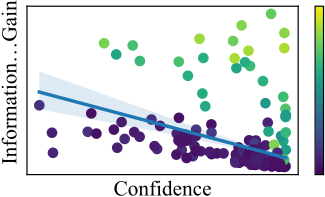
In the learnable reweighting component, we constrain the reweighting process with information gain and confidence. To investigate the validity of these constraints, we examine the relationship between the weight and information gain as well as confidence on target data. In the Figure 3, the horizontal axis represents confidence, the vertical axis represents information gain, the color depth indicates the weight on the target data, where lighter colors indicate larger weights. It shows that data with higher information gain and confidence have higher weights, supporting the description in the Method section. Moreover, a negative correlation between information gain and confidence suggests that only considering data with high-confidence pseudo labels may lead to the neglect of informative data.
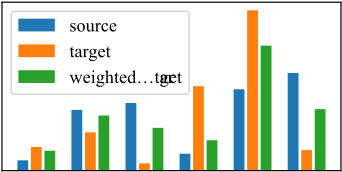
Furthermore, to verify the effective alignment of learnable reweighting on label distributions, we present in Figure 4 the label distributions of the source domain and the target domain before and after reweighting. These distributions are based on a randomly selected pair of users from the UCIHAR dataset. Figure 4 illustrates that after reweighting, while the label distribution of the target domain does not perfectly match that of the source domain, it is much more similar to the source domain label distribution compared to the original distribution.
4.5 Model Efficiency
| Method | WISDM | UCIHAR | HHAR | Avg |
| w/o WNet(·) | 4.90 | 4.51 | 10.57 | 6.66 |
|---|---|---|---|---|
| DWLR | 6.14 | 5.37 | 13.22 | 8.24 |
We use MC-Dropout to compute the information gain approximately in our learnable reweighting component, which may increase the time complexity of DWLR. To evaluate this, we conduct experiments on three wearable datasets with and without WNet(·), and compare their time costs. As Table 4 shows, without WNet(·), each epoch costs an average of 6.66s. And with WNet(·), the time cost is 8.24s, which just adds 23.8% extra time. This means the learnable sampling module does not significantly increase the training time. More details are in the supplementary material.
5 Conclusion
Our paper proposes a learnable reweighting-based approach DWLR for wearable sensor UDA under label shift. DWLR aligns label distributions and gives large weight to data with high information gain and confidence. Considering that wearable sensor data carries distinct perspectives in both the time and frequency domains, as well as the possibility of domain shifts occurring in either domain, the DWLR conducts reweighting and alignment separately in the time and frequency domains.
Acknowledgments
This work is supported by National Natural Science Foundation of China (No. 62322606, No. 62441605).
We want to thank Jingbo Shang from the University of California, San Diego for his invaluable guidance.
@inproceedings{ijcai2024p489,
  title     = {DWLR: Domain Adaptation under Label Shift for Wearable Sensor},
  author    = {Li, Juren and Yang, Yang and Chen, Youmin and Zhang, Jianfeng and Lai, Zeyu and Pan, Lujia},
  booktitle = {Proceedings of the Thirty-Third International Joint Conference on
               Artificial Intelligence, {IJCAI-24}},
  publisher = {International Joint Conferences on Artificial Intelligence Organization},
  editor    = {Kate Larson},
  pages     = {4425--4433},
  year      = {2024},
  month     = {8},
  note      = {Main Track},
  doi       = {10.24963/ijcai.2024/489},
  url       = {https://doi.org/10.24963/ijcai.2024/489},
}
TY - CPAPER TI - DWLR: Domain Adaptation under Label Shift for Wearable Sensor AU - Li, Juren AU - Yang, Yang AU - Chen, Youmin AU - Zhang, Jianfeng AU - Lai, Zeyu AU - Pan, Lujia T2 - Proceedings of the Thirty-Third International Joint Conference on Artificial Intelligence, IJCAI-24 PB - International Joint Conferences on Artificial Intelligence Organization PY - 2024 SP - 4425 EP - 4433 DO - 10.24963/ijcai.2024/489 UR - https://doi.org/10.24963/ijcai.2024/489 ER -Copied
Machine-readable versions of this paper, for tools and AI agents:





