
Alleviating Imbalanced Pseudo-label Distribution: Self-Supervised Multi-Source Domain Adaptation with Label-specific Confidence
Proceedings of the Thirty-Third International Joint Conference on Artificial Intelligence. Main Track. Pages 4669-4677.
https://doi.org/10.24963/ijcai.2024/516
Keywords
- Machine Learning: ML: Classification
- Machine Learning: ML: Self-supervised Learning
- Machine Learning: ML: Multi-task and transfer learning
Abstract
The existing self-supervised Multi-Source Domain Adaptation (MSDA) methods often suffer an imbalanced characteristic among the distribution of pseudo-labels. Such imbalanced characteristic results in many labels with too many or too few pseudo-labeled samples on the target domain, referred to as easy-to-learn label and hard-to-learn label, respectively. Both of these labels hurt the generalization performance on the target domain. To alleviate this problem, in this paper we propose a novel multi-source domain adaptation method, namely Self-Supervised multi-Source Domain Adaptation with Label-specific Confidence (S3DA-LC). Specifically, we estimate the label-specific confidences, i.e., the learning difficulties of labels, and adopt them to generate the pseudo-labels for target samples, enabling to simultaneously constrain and enrich the pseudo supervised signals for easy-to-learn and hard-to-learn labels. We evaluate S3DA-LC on several benchmark datasets, indicating its superior performance compared with the existing MSDA baselines.
- [Ahmed et al., 2021] Sk Miraj Ahmed, Dripta S. Raychaud- huri, Sujoy Paul, Samet Oymak, and Amit K. Roy- Chowdhury. Unsupervised multi-source domain adapta- tion without access to source data. In Proceedings of the IEEE Conference on Computer Vision and Pattern Recog- nition (CVPR 2021), pages 10103-10112, 2021.
- [Berthelot et al., 2020] David Berthelot, Nicholas Carlini, Ekin D. Cubuk, Alex Kurakin, Kihyuk Sohn, Han Zhang, and Colin Raffel. ReMixMatch: Semi-supervised learning with distribution alignment and augmentation anchoring. In Proceedings of the International Conference on Learn- ing Representations (ICLR 2020), 2020.
- [Dong et al., 2021] Jiahua Dong, Zhen Fang, Anjin Liu, Gan Sun, and Tongliang Liu. Confident anchor-induced multi- source free domain adaptation. In Proceedings of the An- nual Conference on Neural Information Processing Sys- tems (NeurIPS 2021), pages 2848-2860, 2021.
- [Feng et al., 2021] Haozhe Feng, Zhaoyang You, Minghao Chen, Tianye Zhang, Minfeng Zhu, Fei Wu, Chao Wu, and Wei Chen. KD3A: Unsupervised multi-source decen- tralized domain adaptation via knowledge distillation. In Proceedings of the International Conference on Machine Learning (ICML 2021), pages 3274-3283, 2021.
- [Ganin and Lempitsky, 2015] Yaroslav Ganin and Victor S. Lempitsky. Unsupervised domain adaptation by backprop- agation. In Proceedings of the International Conference on Machine Learning (ICML 2015), pages 1180-1189, 2015.
- [Guo et al., 2020] Han Guo, Ramakanth Pasunuru, and Mo- hit Bansal. Multi-source domain adaptation for text clas- sification via distancenet-bandits. In Proceedings of the AAAI Conference on Artificial Intelligence (AAAI 2020), pages 7830-7838, 2020.
- [He et al., 2016] Kaiming He, Xiangyu Zhang, Shaoqing Ren, and Jian Sun. Deep residual learning for image recog- nition. In Proceedings of the IEEE Conference on Com- puter Vision and Pattern Recognition (CVPR 2016), pages 770-778, 2016.
- [Kang et al., 2019] Guoliang Kang, Lu Jiang, Yi Yang, and Alexander G. Hauptmann. Contrastive adaptation network for unsupervised domain adaptation. In Proceedings of the IEEE Conference on Computer Vision and Pattern Recog- nition (CVPR 2019), pages 4893-4902, 2019.
- [Kang et al., 2022] Guoliang Kang, Lu Jiang, Yunchao Wei, Yi Yang, and Alexander Hauptmann. Contrastive adapta- tion network for single-and multi-source domain adapta- tion. IEEE Transactions on Pattern Analysis and Machine Intelligence, 44(4):1793-1804, 2022.
- [Kundu et al., 2020] Jogendra Nath Kundu, Naveen Venkat, Ambareesh Revanur, Rahul M. V., and R. Venkatesh Babu. Towards inheritable models for open-set domain adapta- tion. In Proceedings of the IEEE Conference on Com- puter Vision and Pattern Recognition (CVPR 2020), pages 12373-12382, 2020.
- [Li and Wang, 2020] Ximing Li and Yang Wang. Recover- ing accurate labeling information from partially valid data for effective multi-label learning. In Proceedings of the International Joint Conference on Artificial Intelligence, (IJCAI 2020), pages 1373-1380, 2020. IJCAI
- [Li et al., 2020] Changchun Li, Ximing Li, and Jihong Ouyang. Learning with noisy partial labels by simulta- neously leveraging global and local consistencies. In Pro- ceedings of the ACM International Conference on Infor- mation and Knowledge Management (CIKM 2020), pages 725-734, 2020.
- [Liang et al., 2020] Jian Liang, Dapeng Hu, and Jiashi Feng. Do we really need to access the source data? Source hy- pothesis transfer for unsupervised domain adaptation. In Proceedings of the International Conference on Machine Learning (ICML 2020), pages 6028-6039, 2020.
- [Long et al., 2015] Mingsheng Long, Yue Cao, Jianmin Wang, and Michael I. Jordan. Learning transferable fea- tures with deep adaptation networks. In Proceedings of the International Conference on Machine Learning (ICML 2015), pages 97-105, 2015.
- [Long et al., 2017] Mingsheng Long, Han Zhu, Jianmin Wang, and Michael I. Jordan. Deep transfer learning with joint adaptation networks. In Proceedings of the Inter- national Conference on Machine Learning (ICML 2017), pages 2208-2217, 2017.
- [Nguyen et al., 2021] Van-Anh Nguyen, Tuan Nguyen, Trung Le, Quan Hung Tran, and Dinh Phung. STEM: An approach to multi-source domain adaptation with guaran- tees. In Proceedings of the IEEE International Confer- ence on Computer Vision (ICCV 2021), pages 9332-9343, 2021.
- [Peng et al., 2019] Xingchao Peng, Qinxun Bai, Xide Xia, Zijun Huang, Kate Saenko, and Bo Wang. Moment match- ing for multi-source domain adaptation. In Proceedings of the IEEE International Conference on Computer Vision (ICCV 2019), pages 1406-1415, 2019.
- [Saenko et al., 2010] Kate Saenko, Brian Kulis, Mario Fritz, and Trevor Darrell. Adapting visual category models to new domains. In European Conference on Computer Vi- sion (ECCV 2010), volume 6314, pages 213-226, 2010.
- [Saito et al., 2018] Kuniaki Saito, Kohei Watanabe, Yoshi- taka Ushiku, and Tatsuya Harada. Maximum classifier dis- crepancy for unsupervised domain adaptation. In Proceed- ings of the IEEE Conference on Computer Vision and Pat- tern Recognition (CVPR 2018), pages 3723-3732, 2018.
- [Saito et al., 2020] Kuniaki Saito, Donghyun Kim, Stan Sclaroff, and Kate Saenko. Universal domain adapta- tion through self supervision. In Proceedings of the An- nual Conference on Neural Information Processing Sys- tems (NeurIPS 2020), 2020.
- [Sohn et al., 2020] Kihyuk Sohn, David Berthelot, Nicholas Carlini, Zizhao Zhang, Han Zhang, Colin Raffel, Ekin Do- gus Cubuk, Alexey Kurakin, and Chun-Liang Li. Fix- Match: Simplifying semi-supervised learning with con- sistency and confidence. In Proceedings of the Annual Conference on Neural Information Processing Systems (NeurIPS 2020), 2020.
- [Sun and Saenko, 2016] Baochen Sun and Kate Saenko. Deep CORAL: Correlation alignment for deep domain adaptation. In Computer Vision -ECCV 2016 Workshops, pages 443-450, 2016.
- [Tan et al., 2018] Chuanqi Tan, Fuchun Sun, Tao Kong, Wenchang Zhang, Chao Yang, and Chunfang Liu. A survey on deep transfer learning. In Artificial Neural Networks and Machine Learning (ICANN 2018), volume 11141, pages 270-279, 2018.
- [Tukey, 1977] John W. Tukey. Exploratory Data Analysis. Addison-Wesley, 1977.
- [Venkat et al., 2020] Naveen Venkat, Jogendra Nath Kundu, Durgesh Kumar Singh, Ambareesh Revanur, and Venkatesh Babu R. Your classifier can secretly suffice multi-source domain adaptation. In Proceedings of the Annual Conference on Neural Information Processing Systems (NeurIPS 2020), 2020.
- [Venkateswara et al., 2017] Hemanth Venkateswara, Jose Eusebio, Shayok Chakraborty, and Sethuraman Pan- chanathan. Deep hashing network for unsupervised do- main adaptation. In Proceedings of the IEEE Confer- ence on Computer Vision and Pattern Recognition (CVPR 2017), pages 5385-5394, 2017.
- [Wang and Deng, 2018] Mei Wang and Weihong Deng. Deep visual domain adaptation: A survey. Neurocomput- ing, 312:135-153, 2018.
- [Wang et al., 2022] Zengmao Wang, Chaoyang Zhou, Bo Du, and Fengxiang He. Self-paced supervision for multi-source domain adaptation. In Proceedings of the International Joint Conference on Artificial Intelligence (IJCAI 2022), pages 3551-3557, 2022. IJCAI
- [Wen et al., 2020] Junfeng Wen, Russell Greiner, and Dale Schuurmans. Domain aggregation networks for multi- source domain adaptation. In Proceedings of the Inter- national Conference on Machine Learning (ICML 2020), pages 10214-10224, 2020.
- [Xie et al., 2020] Qizhe Xie, Zihang Dai, Eduard H. Hovy, Thang Luong, and Quoc Le. Unsupervised data augmen- tation for consistency training. In Proceedings of the An- nual Conference on Neural Information Processing Sys- tems (NeurIPS 2020), 2020.
- [Xu et al., 2018] Ruijia Xu, Ziliang Chen, Wangmeng Zuo, Junjie Yan, and Liang Lin. Deep Cocktail Network: Multi-source unsupervised domain adaptation with cate- gory shift. In Proceedings of the IEEE Conference on Computer Vision and Pattern Recognition (CVPR 2018), pages 3964-3973, 2018.
- [Zhang et al., 2021] Bowen Zhang, Yidong Wang, Wenxin Hou, Hao Wu, Jindong Wang, Manabu Okumura, and Takahiro Shinozaki. FlexMatch: Boosting semi- supervised learning with curriculum pseudo labeling. In Proceedings of the Annual Conference on Neural Infor- mation Processing Systems (NeurIPS 2021), 2021.
- [Zhao et al., 2018] Han Zhao, Shanghang Zhang, Guanhang Wu, José M. F. Moura, João Paulo Costeira, and Geof- frey J. Gordon. Adversarial multiple source domain adap- tation. In Proceedings of the Annual Conference on Neural Information Processing Systems (NeurIPS 2018), pages 8568-8579, 2018.
- [Zhao et al., 2020a] Sicheng Zhao, Bo Li, Colorado Reed, Pengfei Xu, and Kurt Keutzer. Multi-source domain adap- tation in the deep learning era: A systematic survey. arXiv, abs/2002.12169, 2020.
- [Zhao et al., 2020b] Sicheng Zhao, Guangzhi Wang, Shang- hang Zhang, Yang Gu, Yaxian Li, Zhichao Song, Pengfei Xu, Runbo Hu, Hua Chai, and Kurt Keutzer. Multi-source distilling domain adaptation. In Proceedings of the AAAI Conference on Artificial Intelligence (AAAI 2020), pages 12975-12983, 2020.
- [Zhao et al., 2020c] Sicheng Zhao, Xiangyu Yue, Shang- hang Zhang, Bo Li, Han Zhao, Bichen Wu, Ravi Krishna, Joseph E. Gonzalez, Alberto L. Sangiovanni-Vincentelli, Sanjit A. Seshia, and Kurt Keutzer. A review of single- source deep unsupervised visual domain adaptation. IEEE Transactions on Neural Networks and Learning Systems, 33(2):473-493, 2020.
References were extracted automatically from the PDF and may contain errors.
Full text extracted automatically from the PDF; figures, tables and equations may differ. The PDF is the version of record.
1 Introduction
Unsupervised Domain Adaptation (UDA) refers to the goal of transferring the task knowledge from the labeled source data to the unlabeled target data under a domain-shift, enabling to reduce the demand for costly labeled samples in the target domain [Tan et al., 2018; Wang and Deng, 2018]. Commonly, the previous studies mainly focus on the SingleSource Domain Adaptation (SSDA), which consists of only one source domain and one target domain [Zhao et al., 2020c]. However, the situation is often violated in realworld scenarios, since the available labeled samples are often from different domains. Accordingly, only applying one specific source domain may result in sub-optimal solutions [Zhao et al., 2018]. Motivated by handling the problem, increasingly more attention has been recently paid to the topic of Multi-Source Domain Adaptation (MSDA) within the machine learning community [Zhao et al., 2020a].
∗Corresponding author.
To our knowledge, the common framework of the existing MSDA methods consists of two key components: learning the models on the source domains and incorporating target samples to fine-tune the models with various alignment strategies. Generally speaking, the alignment strategies are key to improving the generalization performance of the MSDA methods, and nowadays the representatives mainly include minimizing the statistical discrepancy between source and target domains [Wen et al., 2020; Guo et al., 2020; Feng et al., 2021], adversarial learning with a domain discriminator [Zhao et al., 2018; Xu et al., 2018; Zhao et al., 2020b], and incorporating auxiliary self-supervised learning tasks [Venkat et al., 2020; Kang et al., 2022; Ahmed et al., 2021]. Among them, the self-supervised methods are flexible, straightforward, and easy-to-implement, thus receiving increasing concern. For instance, a common way is to generate pseudo-labels for target samples by using ensemble classification confidences, e.g., Deep CockTail Network (DCTN) [Xu et al., 2018] or nearest neighbor assignments, e.g., Data frEe multi-sourCe unsupervISed domain adaptatION (DECISION) [Ahmed et al., 2021] and Muti-Source Contrastive Adaptation Network (MSCAN) [Kang et al., 2022]; and Selfsupervised Implicit Alignment (SImpAl) [Venkat et al., 2020] generates pseudo-labels of target samples by the agreements of a set of shared classifiers.
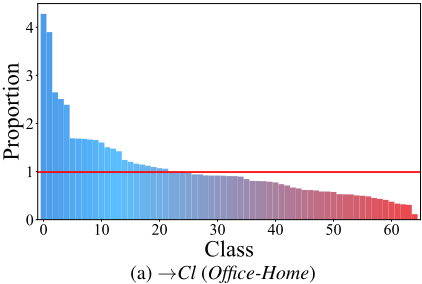
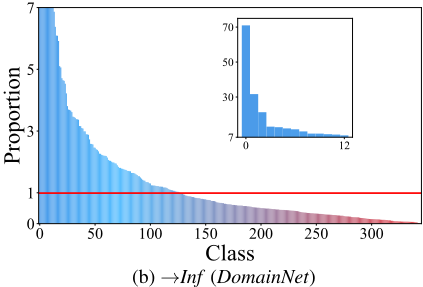
Unfortunately for self-supervised MSDA methods, the distribution of pseudo-labels often has an imbalanced characteristic, where, specifically, on the target domain there are many labels with too many or too few pseudo-labeled samples, formally referred to as easy-to-learn labels and hard-to-learn labels. As depicted in Fig.1, we illustrate several examples of pseudo-label distributions learned by SImpAl [Venkat et al., 2020]. Technically, the label whose proportion is above one can be considered as an easy-to-learn label, while the label whose proportion is below one can be considered as a hardto-learn label. Both of these labels hurt the generalization performance on the target domain, especially the leftmost and rightmost labels.
In this paper, we aim to alleviate the aforementioned problem of self-supervised MSDA methods, and then develop a novel straightforward-yet-effective MSDA method, namely Self-Supervised multi-Source Domain Adaptation with Label-specific Confidence (S3DA-LC). The basic idea of S3DA-LC is to consider the learning difficulty of each label on the target domain when generating pseudo-labels of target samples, so as to simultaneously constrain and enrich the pseudo supervised signals for easy-to-learn labels and hard-to-learn labels. To be specific, our S3DA-LC consists of two training stages, i.e., warm-up stage and adaptation stage. In the warm-up stage, we mainly train domainspecific classifiers for each source domain. In the adaptation stage, we employ the pre-trained classifiers to compute the ensemble predictions for target samples. We then compute the label-specific confidences, i.e., learning difficulty of each label on the target domain, by measuring the difference between the ensemble prediction distribution and the label distributions of all source domains. With them, we can determine pseudo-labeled target samples and then formulate a self-supervised objective to further fine-tune the classifiers in a unified framework, where we alternatively update labelspecific confidences and fine-tune the classifiers. To empirically examine S3DA-LC, we compare it against the existing MSDA methods on several benchmark datasets.
To sum up, we list the main contributions below:
- We propose a novel straightforward-yet-effective MSDA method named S3DA-LC.
- We propose label-specific confidences to alleviate the imbalanced characteristic of pseudo-label distribution.
- Empirical results indicate that S3DA-LC can outperform the existing MSDA methods and achieves the state-ofthe-art results.
2 RelatedWork
Unsupervised domain adaptation. UDA methods aim at learning a domain-agnostic model from the labeled source domain and apply it to the unlabeled target domain. A common way is to minimize a distance measure in a domaininvariant feature space [Long et al., 2015; Long et al., 2017], and other existing methods learn a latent shared feature space across domains by adversarial learning [Ganin and Lempitsky, 2015]. Recent studies jointly learn with the source domain and target domain with pseudo supervised signals in a self-supervised manner to reduce the domain shift [Saito et al., 2020; Liang et al., 2020]. However, the aforementioned methods mainly handle the single-source-single-target adaptation, which may result in sub-optimal solutions [Zhao et al., 2018].
Multi-source domain adaptation. Beyond the typical UDA, MSDA aims to incorporate task knowledge from multiple source domains. To our knowledge, the self-supervised MSDA methods with pseudo-labeling are the representatives in the community [Xu et al., 2018; Venkat et al., 2020; Ahmed et al., 2021]. For example, DCTN [Xu et al., 2018] assigns pseudo-labels to target samples with high confidence with a fixed threshold, and combines multi-way adversarial learning to train the model. SImpAl [Venkat et al., 2020] trains a set of shared classifiers on source domains and generates pseudo-labels of target samples by the prediction agreements of shared classifiers, then alternately trains the model on source domains and the target domain to align the distributions. DECISION [Ahmed et al., 2021] adopts selfsupervised clustering with the combinations of features and predictions, and generates pseudo-labels by measuring the distances between target samples and clustering prototypes. However, those self-supervised MSDA methods take no account of the learning difficulties of different labels when generating pseudo-labels. In contrast, our S3DA-LC alleviates this problem by estimating the label-specific confidences to generate more precise self-supervised signals.
Pseudo-labeling with confidence threshold. The pseudolabeling is one prevalent methodology to solve learning tasks with limited supervision [Xu et al., 2018; Li et al., 2020; Li and Wang, 2020; Ahmed et al., 2021]. Kundu et al. [Kundu et al., 2020] select top-k percentile target instances based on classifier confidence, and enforce the target predictions to match the pseudo-labels for these instances using cross-entropy. Confident-Anchor-induced multisourcefree Domain Adaptation (CAiDA) [Dong et al., 2021] develops a confident-anchor-induced pseudo-label generator to mine pseudo-labels for the unlabeled target data, by incorporating with the quantified source transferability contributions. Besides DA, applying a fixed threshold to select unlabeled samples with high confidence has been also studied in semi-supervised learning [Sohn et al., 2020; Xie et al., 2020]. Beyond applying a fixed threshold for all labels, a recent work of [Zhang et al., 2021] proposes to use different thresholds for different labels. For each label, its threshold describes the learning difficulty, and it is estimated by the number of predicted samples. To some extent, it is built on a balanced assumption of labels, which may be violated in many real applications. Our S3DA-LC also estimates different thresholds for labels, i.e., label-specific confidences. But, inspired by ReMixMatch [Berthelot et al., 2020] where it adjusts predict label distributions according to the ratio between the average model predictions on unlabeled data and the empirical ground-truth label distribution, S3DA-LC employs the label distributions of all source domains, which are exactly known, potentially leading to more precise estimations of label-specific thresholds.
3 S3DA-LC
In this section, we introduce the proposed MSDA method named S3DA-LC in more details.
Formulation. Generally, let X and Y = {1, ...,C} denote the sample and label spaces, respectively. We are given by K source domains {DkS }Kk=1 and one target domain DT , where each source domain DkS contains Nk labeled samples denoted by DkS = {(xki , yk i ) ∈ X × Y}Nk i=1 , and the target domain includes NT unlabeled samples denoted by DT = {xti ∈ X}NT i=1 . The target domain shares a same label set Y with the source domains. The objective of MSDA is to learn a predictive model on the target domain by transferring the knowledge from source domains.
Overview. The main idea of S3DA-LC is to estimate labelspecific confidences to describe the learning difficulty of each label on the target domain, and then use them as adaptive thresholds to generate more precise pseudo-labels for target samples. Specifically, S3DA-LC consists of two training stages, i.e., warm-up stage and adaptation stage. In the warm-up stage, we jointly train a shared feature extractor g(x;Θ) : X → Rd and K domain-specific classifiers {hk (g(x);Wk ) : Rd → RC }Kk=1 on source domains. We then initialize the transferability weights {wk }Kk=1 of domain-specific classifiers on the target domain and the weighted ensemble predictions {p(xti ) ∈ ∆C-1 }NT i=1 for target samples. In the adaptation stage, we estimate the labelspecific confidences {δc}Cc=1 on the target domain. We generate pseudo-labels {ˆyt i }NT i=1 for target samples by using {p(xti )}NT i=1 and {δc}Cc=1 , and then continue to train the feature extractor g(x;Θ) and domain-specific classifiers {hk (g(x);Wk )}Kk=1 in a self-supervised paradigm. For each test sample, we predict it by using the ensemble prediction of those classifiers.
3.1 Warm-up
In the warm-up stage, we first train a feature extractor g(x; Θ) shared by all source domains and K domain-specific classifiers {hk (g(x);Wk )}Kk=1 simultaneously. For each domain DkS , its classifier objective is formulated below:
where ℓ(·) is the cross-entropy loss and σ(·) denotes the softmax function.
Combining with the classifiers of all source domains, the overall training objective of the warm-up stage is:
Initialization of {wk }Kk=1 and {p(xti )}NT i=1 . After a warmup learning with Eq.(2), we are given by pre-trained g(x; Θ) and {hk (g(x);Wk )}Kk=1 . With them, we can predict target samples and further use the ensemble predictions to generate pseudo-labels.
To achieve more precise ensemble predictions, we first estimate the transferability weights {wk }Kk=1 of domain-specific classifiers, which describe the transfer difficulty of each source-target pair. We take inspiration from the information theory, where, for each domain-specific classifier, its transferability weight can be measured by the entropy of its predictions on the target domain, specifically formulated below:
where H(·) is the Shannon entropy. Shannon entropy can reflect the confidence of a classifier on the target samples where the more certain the classifier is, the lower the entropy. When the classifier of a source domain is more certain about the target samples, this source domain can be seen as more similar to the target domain, and vice versa. Its final transferability weight can be measured by the inverse of Shannon entropy which is as follows:
Given those transferability weights, we can compute a weighted ensemble prediction for each target sample xt as follows:
3.2 Adaptation with Pseudo-labeled Samples
In the adaptation stage, we generate pseudo-labels for target samples by using label-specific confidences, and then update the model with them in a self-supervised manner.
Label-specific confidences. The existing self-supervised MSDA methods generate pseudo-labeled target samples by measuring whether their ensemble predictions are greater than a fixed confidence threshold, so as to maintain target samples with high confidences [Xu et al., 2018; Sohn et al., 2020; Xie et al., 2020]. However, such way neglects the learning difficulties of different labels, resulting in many easy-to-learn and hard-to-learn labels as illustrated in Fig.1.
To alleviate this problem, we propose label-specific confidences used as an adaptive pseudo-labeled confidence threshold for each label on the target domain.
During the warm-up stage, we train a unified feature extractor across multiple source domains. This stage aligns the features from the source domains, enabling the extractor to capture domain-invariant feature, which alleviates the distribution shift between the source and target domains. And, since in the scenario of MSDA the source domains and target domain share a same label set Y, the label distribution of all source domains can serve as a guide for generating pseudolabels in target domain.
The mean of label distributions of source domains G is:
where nkc denotes the number of samples belonging to label c in the source domain DkS .
In parallel, we can estimate the distribution of ensemble prediction over the target domain as follows:
where 1(·) is the indicator function.
Accordingly, we can measure the learning difficulty of each label, i.e., label-specific confidence, by the difference between G and V, specifically formulated below:
where τ is a scaling parameter used to adjust the confidence; and Φ = Q3 + λ · (Q3 - Q1) is the upper range of Tukey's fences [Tukey, 1977] 1 . We use Φ to normalize V/G to avoid the potential negative effect of outliers, where Q1 and Q3 represent the lower and upper quartile of V/G respectively and λ is a coefficient.
From the label-specific confidence δc, the labels with lower (or higher) values of Vc/Gc correspond to lower (or higher) thresholds, so as to generate pseudo-labeled target samples with high-confidences.
Self-supervised training. Given the label-specific confidences {δc}Cc=1 , we determine whether a target sample xt is associated with a pseudo-label with the following formula:
where ˆyt = argmax (p(xt )) is treated as the pseudo-label and A(xt ) denotes the corresponding pseudo-label indicator.
We then formulate a self-supervised objective with pseudolabeled target samples as follows:
By combining Eq.(10) and the cross-entropy losses on source domains, the overall objective of the adaptation stage is given by:
1 Tukey's fences is a statistical method for pinpointing outliers by setting up thresholds, or "fences".
Algorithm 1 The full training process of S3DA-LC
Input: K source domains {DkS }Kk=1 and target domain DT ; scaling parameter τ .
Output: feature extractor g(x;Θ) and domain-specific classifiers {hk (g(x);Wk )}Kk=1 .
- // Warm-up stage
- 1: while not converge do
- 2: Update Θ and {Wk }Kk=1 by optimizing Eq.(2).
- 3: end while
- 4: Initialize {wk }Kk=1 by using Eqs.(3) and (4), and {p(xti )}NT i=1 by using Eq.(5).
- // Adaptation stage
- 5: Initialize {δc}Cc=1 by using Eq.(8).
- 6: while not converge do
- 7: Update Θ and {Wk }Kk=1 by optimizing Eq.(11).
- 8: Update {wk }Kk=1 and {δc}Cc=1 by using Eq.(12) every epoch.
- 9: end while
Training summary. We now review and summarize the full training process of S3DA-LC where the full training process of S3DA-LC is outlined in Algorithm 1. In the warmup stage, we train the shared feature extractor g(x;Θ) and K domain-specific classifiers {hk (g(x);Wk )}Kk=1 on the source domains by optimizing Eq.(2) until convergence (lines 1-3), and then initialize the transferability weight {wk }Kk=1 by using Eqs.(3) and (4) and the weighted ensemble predictions {p(xti )}NT i=1 by using Eq.(5) (line 4). In the adaptation stage, we initialize the label-specific confidences {δc}Cc=1 by using Eq.(8) (line 5). With them, we generate the pseudo-labels of target samples and fine-tune g(x;Θ) and {hk (g(x);Wk )}Kk=1 in a self-supervised manner by optimizing Eq.(11) (line 7). At each epoch, we update {wk }Kk=1 and {δc}Cc=1 using a moving average formula (line 8):
where α = NP/NT is a scaling parameter, and NP = ∑xt∈DT A(xt ).
4 Experiments
Datasets. In the experiments, we evaluate S3DA-LC on 3 benchmark datasets: (1) Office-31 [Saenko et al., 2010] contains 31 classes and 4,652 images unevenly spreading in three visual domains Amazon (A), DSLR (D), Webcam (W); (2) Office-Home [Venkateswara et al., 2017] contains 65 classes and about 15,500 images from 4 domains: Art (Ar), Clipart (Cl), Product (Pr) and Real-World (Rw); (3) DomainNet [Peng et al., 2019] contains 345 classes and over 600K images from 6 domains: Clipart (Clp), Infograph (Inf ), Painting (Pnt), Quickdraw (Qdr), Real (Rel) and Sketch (Skt).
Implementation details. We adopt ResNet-50 [He et al., 2016] as the backbone network for Office-31 and Office- Home, and adopt ResNet-101 [He et al., 2016] as the backbone network for DomainNet. We employ a single fully connected layer as the classifier, i.e., domain specific classifier, for each source domain. We use the Adam optimizer with the learning rate 10-5 and weight decay 5 × 10⁻⁴ . For S3DA-LC, we set τ to 0.9 for all datasets and the sensitivity analysis of parameters will be discussed later. We follow the common setting for Tukey's fences [Tukey, 1977] and set λ to 1.5 for all datasets. The implementation is available at https://github.com/MengKang98/S3DA-LC.
| Standard | Method | Office-31 | Office-Home | |||||||
|---|---|---|---|---|---|---|---|---|---|---|
| →A | →W | →D | Avg | →Ar | →Cl | →Pr | →Rw | Avg | ||
| Single DAN [Long et al., 2015] D-CORAL [Sun and Saenko, | 66.7 65.3 | 96.8 | 99.5 | 87.7 | 68.2 | 56.5 | 80.3 | 75.9 | 70.2 | |
| 2016] | 98.0 | 99.7 | 87.7 | 67.0 | 53.6 | 80.3 | 76.3 | 69.3 | ||
| Best MCD [Saito et al., 2018] | 69.7 | 98.5 | 100.0 | 89.4 | 69.1 | 52.2 | 79.6 | 75.1 | 69.0 | |
| Single Combine | DAN [Long et al., 2015] | 67.6 | 97.8 | 99.6 | 88.3 | 68.5 | 59.4 | 79.0 | 82.5 | 72.4 |
| D-CORAL [Sun and Saenko, 2016] | 67.1 | 98.0 | 99.3 | 88.1 | 68.1 | 58.6 | 79.5 | 82.7 | 72.2 | |
| MCD [Saito et al., 2018] | 68.5 | 99.3 | 99.4 | 89.0 | 67.8 | 59.9 | 79.2 | 80.9 | 71.9 | |
| SImpAl [Venkat et al., 2020] | 70.6 | 97.4 | 99.2 | 89.0 | 70.8 | 56.3 | 80.2 | 81.5 | 72.2 | |
| CAiDA [Dong et al., 2021] | 75.8 | 98.9 | 99.8 | 91.6 | 75.2 | 60.5 | 84.7 | 84.2 | 76.2 | |
| Multi- DECISION [Ahmed et al., 2021] | 75.4 | 98.4 | 99.6 | 91.1 | 74.5 | 59.4 | 84.4 | 83.6 | 75.5 | |
| Source SPS [Wang et al., 2022] | 73.8 | 99.3 | 100.0 | 91.0 | 75.1 | 66.0 | 84.4 | 84.2 | 77.4 | |
| S3DA-LC | 78.1 | 99.0 | 100.0 | 92.4 | 78.1 | 70.0 | 87.4 | 87.2 | 80.7 | |
| Standard Method | →Clp | →Inf | →Pnt | →Qdr | →Rel | →Skt | Avg |
|---|---|---|---|---|---|---|---|
| DAN [Long et al., 2015] | 39.1 | 11.4 | 33.3 | 16.2 | 42.1 | 29.7 | 28.6 |
| MCD [Saito et al., 2018] | 42.6 | 19.6 | 42.6 | 3.8 | 50.5 | 33.8 | 32.2 |
| Single Best CAN [Kang et al., 2019] | 63.8 | 24.0 | 55.7 | 27.1 | 67.7 | 51.9 | 48.4 |
| DAN [Long et al., 2015] | 45.4 | 12.8 | 36.2 | 15.3 | 48.6 | 34.0 | 32.1 |
| MCD [Saito et al., 2018] | 54.3 | 22.1 | 45.7 | 7.6 | 58.4 | 43.5 | 38.5 |
| Single Combine CAN [Kang et al., 2019] | 67.4 | 25.3 | 56.2 | 26.3 | 72.5 | 56.2 | 50.7 |
| DCTN [Xu et al., 2018] | 48.6 | 23.5 | 48.8 | 7.2 | 53.5 | 47.3 | 38.2 |
| SImpAl [Venkat et al., 2020] | 66.4 | 26.5 | 56.6 | 18.9 | 68.0 | 55.5 | 48.6 |
| MSCAN [Kang et al., 2022] | 69.3 | 28.0 | 58.6 | 30.3 | 73.3 | 59.5 | 53.2 |
| Multi-Source KD3A [Feng et al., 2021] | 72.5 | 23.4 | 60.9 | 16.4 | 72.7 | 60.6 | 51.1 |
| STEM [Nguyen et al., 2021] | 72.0 | 28.2 | 61.5 | 25.7 | 72.6 | 60.2 | 53.4 |
| SPS [Wang et al., 2022] | 70.8 | 24.6 | 55.2 | 19.4 | 67.5 | 57.6 | 49.2 |
| S3DA-LC | 71.9 | 31.3 | 61.3 | 27.8 | 75.7 | 61.2 | 54.8 |
4.1 Comparing against Existing Baselines
We verify the effectiveness of S3DA-LC by comparing it with existing MSDA methods. The results are shown in Tables 1 and 2, where we take the averages of 3 independent runs as the final results.
For fair comparisons, we adopt 3 evaluation standards defined in [Venkat et al., 2020]: (1) Single Best: the best performance of SSDA methods among all source domains; (2) Source Combine: all source domains are combined into a single source domain to perform SSDA; (3) Multi-source: adaptation from all source domains to the target domain. For the first two settings, we compare S3DA-LC with previous SSDA methods, e.g., DAN [Long et al., 2015], D-CORAL [Sun and Saenko, 2016], MCD [Saito et al., 2018] and CAN [Kang et al., 2019]. For the Multi-source setting, we select 9 existing MSDA methods for comparison, including DCTN [Xu et al., 2018], SImpAl [Venkat et al., 2020], KD3A [Feng et al., 2021], MSCAN [Kang et al., 2022], CAiDA [Dong et al., 2021], STEM [Nguyen et al., 2021], DECISION [Ahmed et al., 2021] and SPS [Wang et al., 2022]. The results of baselines under Single Combine setting are cited from STEM [Nguyen et al., 2021] and SPS [Wang et al., 2022] and the results under Single Best and Multi-Source settings are cited from corresponding papers.
As shown in Tables 1 and 2, S3DA-LC achieves competitive results on all datasets averagely. On Office-31, S3DA-LC exceeds former SOTA methods CAiDA [Dong et al., 2021] on all tasks. On Office-Home, S3DA-LC exceeds former SOTA methods SPS [Wang et al., 2022] on all tasks, with huge improvements of 4.0% on →Cl, 3.0% on →Ar, →Pr and →Rw. On DomainNet, S3DA-LC exceeds former SOTA
| Models | Office-Home | DomainNet | ||
|---|---|---|---|---|
| →Ar | →Cl | →Inf | →Skt | |
| Warm-up Only | 72.3 | 56.1 | 26.2 | 56.2 |
| w/o δc | 73.3 | 57.5 | 27.6 | 59.1 |
| w/o wk | 77.6 | 69.9 | 30.8 | 60.8 |
| S3DA-LC | 78.1 | 70.0 | 31.3 | 61.2 |
| with Φ =max(·) | 77.7 | 65.1 | 28.8 | 60.8 |
| with λ = 3.0 | 77.8 | 69.2 | 31.1 | 61.2 |
methods STEM [Nguyen et al., 2021] on 4 out of 6 transfer tasks, with huge improvements of 3.1% on →Inf and →Rel.
4.2 Ablation Study
To evaluate contribution of each part of S3DA-LC, we decompose S3DA-LC to reveal their functions. Table 3 shows the results of ablation study.
We first set τ = 0.0 to verify the label-specific confidences, i.e., w/o δc. The performance degrades huge on all tasks. This is because all target domain samples are assigned pseudo-labels and participate in self-supervised training when τ equals 0.0. And the pseudo-labels selected in this setting have a very low accuracy rate and are very unbalanced.
We also evaluate the function of transferability weights by setting wk = 1 for k = 1, ..., K, i.e., w/o wk . In this case, we treat all source domains equally. S3DA-LC outperforms w/o wk on all tasks. This suggests the effectiveness of transferability weights {wk }Kk=1 .
4.3 Negative Effects of Outliers
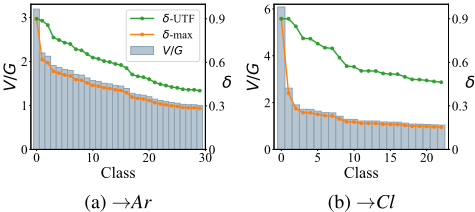
In Eq.(8), we use the upper range of Tukey's fences (UTF), i.e., Φ = Q3 + λ · (Q3 - Q1), to avoid the negative effects of potential outliers in V/G. To evaluate the function of UTF, we set Φ = max(V/G), i.e., with Φ = max(·) and test it on several tasks. As shown in Table 3, performance dropped on all tasks. Notably, performance degrades more on tasks →Cl (-4.9%) and →Inf (-2.5%) than on →Ar (-0.4%) and →Skt (-0.4%). This is because the outliers are relatively larger on the former tasks.
As shown in Fig.2, we illustrate the difference between G and V labels with V/G > 1.0. These labels are commonly easy-to-learn labels. The green and orange lines represent the label-specific confidences δ normalized by UTF (δ-UTF) and max(·) (δ-max) respectively. Comparing Fig.2 (a) and (b), the largest and second largest values of V/G are significantly more different on →Cl than on →Ar. Therefore, for the rest labels with V/G > 1.0, δ-max is much lower than δ-UTF on →Cl, which will weaken the constraining ability on easyto-learn labels. While on →Ar, the gap of δ between δ-max and δ-UTF is smaller. This explains why the performance of with Φ = max(·) degrades less on →Ar. Above all, the experiments show negative effects of outliers and also verify the effectiveness of UTF.
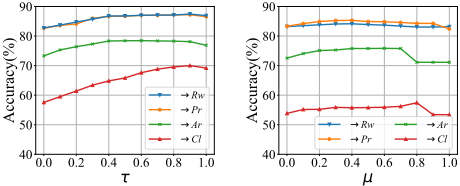
Figure 4: Sensitivity of µ.
4.4 Sensitivity of Parameters
To study the sensitivity of τ, we investigate 11 different τ values (from 0.0 to 1.0) on Office-Home. As shown in Fig.3, the performance decay on all four tasks occurs when τ approaches 0.0. This suggests that a too small τ will introduces too much noise into the pseudo-labels, which will deteriorate the adaptation. And with increasing of τ, the performance on tasks →Rw, →Pr and →Ar remains stable when τ ∈ [0.4, 0.9]. The performance on task →Cl achieves best results at τ = 0.9. In summary, we set τ as 0.9 for practice.
Notably, even performances on multiple tasks decrease when τ = 1.0, S3DA-LC still achieves good results even when τ =1.0. This is because Eq.(12) will gradually update the labels with initial δc =1.0 to less than 1.0. Thus the labels abandoned at the beginning will rejoin the training eventually.
S3DA-LC use the "regular" setting in [Tukey, 1977] where
λ = 1.5. We also test the "far" setting where λ = 3.0, i.e., with λ = 3.0. As shown in Table 3, the performances of with λ = 3.0 are closer to the S3DA-LC comparing with with Φ = max(·). And S3DA-LC still achieves best performances.
4.5 Fix Threshold Strategy
We adopt idea of fix threshold strategy where we replace the label-specific confidences δc with a fixed confidence µ in Eq.(9). We evaluate different µ values (from 0.0 to 1.0) on Office-Home.
Comparing Fig.3 and Fig.4, it is evident that label-specific confidences strategy vastly outperforms fix threshold strategy in almost every setting. Notably, there are huge drops on →Cl when µ >0.8 and →Ar when µ >0.7. This is because the confidence level of the model on the target domain cannot exceed µ when µ is too large, so almost no sample is assigned pseudo-labels, which results in training failure. And fix threshold strategy is also sensitive to µ since the optimal values on different tasks are also different. Notably, fix threshold strategy degrades to warm-up when τ =1.0. This is because no sample will be assigned pseudo-label and the adaptation stage cannot proceed. The results validate the superiority of label-specific confidences.
| Task | Method | Hard-to-learn | Easy-to-learn | All | ||||
|---|---|---|---|---|---|---|---|---|
| Num↓ | Avg↑ | Num↓ | Avg↓ | Var↓ | Acc↑ | |||
| →Cl | SImpAl S3DA-LC | 43 31 | 0.68 0.79 | 22 34 | 1.78 1.32 | 0.55 0.12 | 56.85 73.84 | |
| →Inf | SImpAl S3DA-LC | 218 128 | 0.41 0.58 | 127 217 | 3.88 2.72 | 21.67 3.59 | 27.14 34.09 | |
4.6 Distribution of Pseudo-labels
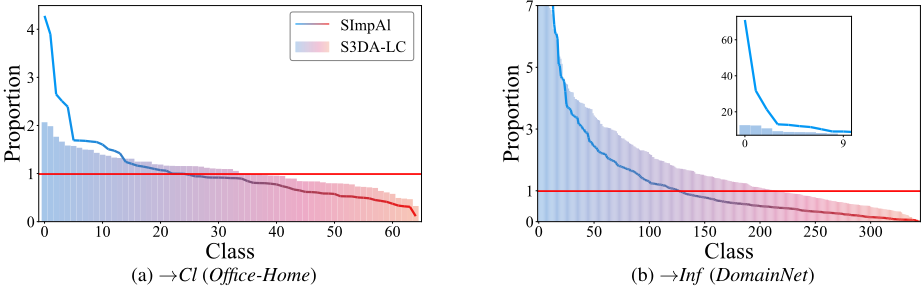
To verify the effectiveness of S3DA-LC in alleviating the imbalanced pseudo-label distribution, we compare the pseudolabel distributions generated by S3DA-LC and SImpAl [Venkat et al., 2020]. Fig.5 shows the visualized distributions. The deep gradient blue-red line represents the distribution generated by SImpAl which is the simplified version of Fig.1, and the light gradient blue-red bars represent the distribution generated by S3DA-LC. For a fair comparison, we visualize the distributions of the final update of pseudo-labels for both methods.
We expect the pseudo-label distribution to be close to the true label distribution, i.e., the proportions between pseudolabel distribution and true label distribution on the target domain (the vertical axis in Fig.5) should be close to 1.0. As shown in Fig.5, the proportions of S3DA-LC are flatter than SImpAl, and the proportions of leftmost labels are also milder. Apparently, the pseudo-label distributions generated by S3DA-LC are closer to the true label distribution.
We further analyze the pseudo-label distribution generated by S3DA-LC and SImpAl statistically, as shown in Table 4. For hard-to-learn labels, S3DA-LC largely reduces the number (Num) of them and increases the average (Avg) of proportions. This verifies the enriching ability of S3DA-LC on hard-to-learn labels. S3DA-LC greatly enriches the sample number of hard-to-learn labels, which increases the number of easy-to-learn labels. However, even with more easy-tolearn labels, S3DA-LC still achieves lower average of proportions. This verifies the constraining ability of S3DA-LC on easy-to-learn labels.
For all pseudo-labels, we use the variance of the proportions (Var) to measure the difference between the pseudolabel distribution and true label distribution. The smaller the variance, the closer the distribution of pseudo-labels and true labels. If the variance of the proportions equals to 0, the pseudo-labels distribution and true label distribution will be identical. As shown in Table 4, S3DA-LC achieves much lower Var than SImpAl on both tasks, which represents S3DA-LC generates more balanced pseudo-labels. Meanwhile, S3DA-LC also generates more accurate pseudo-labels. All together verifies that S3DA-LC can alleviate the imbalanced pseudo-label distribution.
5 Conclusion
In this paper, we focus on the imbalanced characteristic of pseudo-label distribution in target domain, where both easyto-learn and hard-to-learn labels extremely hurt the generalization performance. We propose a self-supervised MSDA method named S3DA-LC to alleviate such problem. S3DALC estimates label-specific confidences by measuring the differences between the prior distribution of all domains and the distribution of ensemble prediction over the target domain, then uses them as dynamic thresholds to generate more precise pseudo-labels for target domain. Along with selfsupervised training, S3DA-LC achieves state-of-the-art performance comparing against the existing MSDA baselines.
Acknowledgments
We sincerely thank the anonymous reviewers for their careful work and thoughtful suggestions, which have greatly improved this article. This work was supported by the Natural Science Research Foundation of Jilin Province of China under Grant Nos. 20220101106JC and YDZJ202201ZYTS423, the National Natural Science Foundation of China under Grant No. 62276113, the China Postdoctoral Science Foundation under Grant No. 2022M721321, and the Fundamental Research Funds for the Central Universities of China under Grant Nos. 2412022ZD018, 2412022QD040 and 93K172022K10.
@inproceedings{ijcai2024p516,
  title     = {Alleviating Imbalanced Pseudo-label Distribution: Self-Supervised Multi-Source Domain Adaptation with Label-specific Confidence},
  author    = {Lu, Shuai and Kang, Meng and Li, Ximing},
  booktitle = {Proceedings of the Thirty-Third International Joint Conference on
               Artificial Intelligence, {IJCAI-24}},
  publisher = {International Joint Conferences on Artificial Intelligence Organization},
  editor    = {Kate Larson},
  pages     = {4669--4677},
  year      = {2024},
  month     = {8},
  note      = {Main Track},
  doi       = {10.24963/ijcai.2024/516},
  url       = {https://doi.org/10.24963/ijcai.2024/516},
}
TY - CPAPER TI - Alleviating Imbalanced Pseudo-label Distribution: Self-Supervised Multi-Source Domain Adaptation with Label-specific Confidence AU - Lu, Shuai AU - Kang, Meng AU - Li, Ximing T2 - Proceedings of the Thirty-Third International Joint Conference on Artificial Intelligence, IJCAI-24 PB - International Joint Conferences on Artificial Intelligence Organization PY - 2024 SP - 4669 EP - 4677 DO - 10.24963/ijcai.2024/516 UR - https://doi.org/10.24963/ijcai.2024/516 ER -Copied
Machine-readable versions of this paper, for tools and AI agents:





