
Towards Sharper Generalization Bounds for Adversarial Contrastive Learning
Proceedings of the Thirty-Third International Joint Conference on Artificial Intelligence. Main Track. Pages 5190-5198.
https://doi.org/10.24963/ijcai.2024/574
Keywords
- Machine Learning: ML: Adversarial machine learning
- Machine Learning: ML: Self-supervised Learning
- Machine Learning: ML: Learning theory
Abstract
Recently, the enhancement on the adversarial robustness of machine learning algorithms has gained significant attention across various application domains. Given the widespread label scarcity issue in real-world data, adversarial contrastive learning (ACL) has been proposed to adversarially train robust models using unlabeled data. Despite the empirical success, its generalization behavior remains poorly understood and far from being well-characterized. This paper aims to address this issue from a learning theory perspective. We establish novel high-probability generalization bounds for the general Lipschitz loss functions. The derived bounds scale O(log(k)) with respect to the number of negative samples k, which improves the existing linear dependency bounds. Our results are generally applicable to many prediction models, including linear models and deep neural networks. In particular, we obtain an optimistic generalization bound O(1/n) under the smoothness assumption of the loss function on the sample size n. To the best of our knowledge, this is the first fast-rate bound valid for ACL. Empirical evaluations on real-world datasets verify our theoretical findings.
- [Anthony et al., 1999] Martin Anthony, Peter L Bartlett, Pe- ter L Bartlett, et al. Neural network learning: Theoretical foundations, volume 9. cambridge university press Cam- bridge, 1999.
- [Arora et al., 2019] Sanjeev Arora, Hrishikesh Khande- parkar, Mikhail Khodak, Orestis Plevrakis, and Nikunj Saunshi. A theoretical analysis of contrastive unsuper- vised representation learning. In International Conference on Machine Learning, pages 9904-9923, 2019.
- [Awasthi et al., 2019] Pranjal Awasthi, Abhratanu Dutta, and Aravindan Vijayaraghavan. On robustness to adversarial examples and polynomial optimization. Advances in Neu- ral Information Processing Systems, 32, 2019.
- [Awasthi et al., 2020] Pranjal Awasthi, Natalie Frank, and Mehryar Mohri. Adversarial learning guarantees for linear hypotheses and neural networks. In International Confer- ence on Machine Learning, pages 431-441, 2020.
- [Bartlett and Mendelson, 2002] Peter L Bartlett and Shahar Mendelson. Rademacher and gaussian complexities: Risk bounds and structural results. Journal of Machine Learn- ing Research, 3(Nov):463-482, 2002.
- [Bartlett et al., 2005] Peter L Bartlett, Olivier Bousquet, and Shahar Mendelson. Local rademacher complexities. The Annals of Statistics, 33(4):1497-1537, 2005.
- [Chen et al., 2020] Ting Chen, Simon Kornblith, Moham- mad Norouzi, and Geoffrey Hinton. A simple framework for contrastive learning of visual representations. In Inter- national Conference on Machine Learning, pages 1597- 1607. PMLR, 2020.
- [Fan et al., 2021] Lijie Fan, Sijia Liu, Pin-Yu Chen, Gaoyuan Zhang, and Chuang Gan. When does contrastive learning preserve adversarial robustness from pretraining to finetuning? Advances in Neural Information Process- ing Systems, 34:21480-21492, 2021.
- [Golowich et al., 2018] Noah Golowich, Alexander Rakhlin, and Ohad Shamir. Size-independent sample complexity of neural networks. In Conference on Learning Theory, pages 297-299. PMLR, 2018.
- [Gowal et al., 2020] Sven Gowal, Po-Sen Huang, Aaron van den Oord, Timothy Mann, and Pushmeet Kohli. Self- supervised adversarial robustness for the low-label, high- data regime. In International Conference on Learning Representations, 2020.
- [Grill et al., 2020] Jean-Bastien Grill, Florian Strub, Flo- rent Altché, Corentin Tallec, Pierre Richemond, Elena Buchatskaya, Carl Doersch, Bernardo Avila Pires, Zhao- han Guo, Mohammad Gheshlaghi Azar, et al. Bootstrap your own latent-a new approach to self-supervised learn- ing. Advances in Neural Information Processing Systems, 33:21271-21284, 2020.
- [Hahnloser et al., 2000] Richard HR Hahnloser, Rahul Sarpeshkar, Misha A Mahowald, Rodney J Douglas, and H Sebastian Seung. Digital selection and analogue amplification coexist in a cortex-inspired silicon circuit. Nature, 405(6789):947-951, 2000.
- [He et al., 2020] Kaiming He, Haoqi Fan, Yuxin Wu, Sain- ing Xie, and Ross Girshick. Momentum contrast for un- supervised visual representation learning. In Proceedings of the IEEE/CVF Conference on Computer Vision and Pat- tern Recognition, pages 9729-9738, 2020.
- [Hendrycks and Dietterich, 2019] Dan Hendrycks and Thomas Dietterich. Benchmarking neural network robustness to common corruptions and perturbations. In International Conference on Learning Representations, 2019.
- [Ho and Nvasconcelos, 2020] Chih-Hui Ho and Nuno Nvas- concelos. Contrastive learning with adversarial exam- ples. Advances in Neural Information Processing Systems, 33:17081-17093, 2020.
- [Jiang et al., 2020] Ziyu Jiang, Tianlong Chen, Ting Chen, and Zhangyang Wang. Robust pre-training by adversar- ial contrastive learning. Advances in Neural Information Processing Systems, 33:16199-16210, 2020.
- [Khim and Loh, 2018] Justin Khim and Po-Ling Loh. Ad- versarial risk bounds via function transformation. ArXiv Preprint ArXiv:1810.09519, 2018.
- [Khosla et al., 2020] Prannay Khosla, Piotr Teterwak, Chen Wang, Aaron Sarna, Yonglong Tian, Phillip Isola, Aaron Maschinot, Ce Liu, and Dilip Krishnan. Supervised con- trastive learning. Advances in Neural Information Process- ing Systems, 33:18661-18673, 2020.
- [Kim et al., 2020] Minseon Kim, Jihoon Tack, and Sung Ju Hwang. Adversarial self-supervised contrastive learn- ing. Advances in Neural Information Processing Systems, 33:2983-2994, 2020.
- [Kingma and Ba, 2015] Diederik P Kingma and Jimmy Ba. Adam: A method for stochastic optimization. In Interna- tional Conference on Learning Representations, 2015.
- [Lee et al., 2021] Seanie Lee, Dong Bok Lee, and Sung Ju Hwang. Contrastive learning with adversarial perturba- tions for conditional text generation. In International Con- ference on Learning Representations, 2021.
- [Lei et al., 2023] Yunwen Lei, Tianbao Yang, Yiming Ying, and Ding-Xuan Zhou. Generalization analysis for contrastive representation learning. ArXiv Preprint ArXiv:2302.12383, 2023.
- [Lin et al., 2019] Ji Lin, Chuang Gan, and Song Han. De- fensive quantization: When efficiency meets robustness. In International Conference on Learning Representations, 2019.
- [Ling et al., 2003] Charles X Ling, Jin Huang, and Harry Zhang. Auc: a better measure than accuracy in com- paring learning algorithms. In Advances in Artificial In- telligence: 16th Conference of the Canadian Society for Computational Studies of Intelligence, AI 2003, Halifax, Canada, June 11-13, 2003, Proceedings 16, pages 329- 341. Springer, 2003.
- [Liu et al., 2022] Ye Liu, Yaya Cheng, Lianli Gao, Xiang- long Liu, Qilong Zhang, and Jingkuan Song. Practical evaluation of adversarial robustness via adaptive auto at- tack. In Proceedings of the IEEE/CVF Conference on Computer Vision and Pattern Recognition, pages 15105- 15114, 2022.
- [Ma et al., 2021] Xingjun Ma, Yuhao Niu, Lin Gu, Yisen Wang, Yitian Zhao, James Bailey, and Feng Lu. Un- derstanding adversarial attacks on deep learning based medical image analysis systems. Pattern Recognition, 110:107332, 2021.
- [Madry et al., 2018] Aleksander Madry, Aleksandar Makelov, Ludwig Schmidt, Dimitris Tsipras, and Adrian Vladu. Towards deep learning models resistant to adversarial attacks. In International Conference on Learning Representations, 2018.
- [Maurer, 2016] Andreas Maurer. A vector-contraction in- equality for rademacher complexities. In Algorithmic Learning Theory: 27th International Conference, ALT 2016, Bari, Italy, October 19-21, 2016, Proceedings 27, pages 3-17. Springer, 2016.
- [Misra and Maaten, 2020] Ishan Misra and Laurens van der Maaten. Self-supervised learning of pretext-invariant rep- resentations. In Proceedings of the IEEE/CVF Conference on Computer Vision and Pattern Recognition, pages 6707- 6717, 2020.
- [Mustafa et al., 2022] Waleed Mustafa, Yunwen Lei, and Marius Kloft. On the generalization analysis of adversarial learning. In International Conference on Machine Learn- ing, pages 16174-16196, 2022.
- [Neyshabur et al., 2015] Behnam Neyshabur, Ryota Tomioka, and Nathan Srebro. Norm-based capacity control in neural networks. In Conference on Learning Theory, pages 1376-1401. PMLR, 2015.
- [Reeve and Kaban, 2020] Henry Reeve and Ata Kaban. Op- timistic bounds for multi-output learning. In Interna- tional Conference on Machine Learning, pages 8030- 8040, 2020.
- [Srebro et al., 2010] Nathan Srebro, Karthik Sridharan, and Ambuj Tewari. Smoothness, low noise and fast rates. Advances in Neural Information Processing Systems, 23, 2010.
- [Szegedy et al., 2014] Christian Szegedy, Wojciech Zaremba, Ilya Sutskever, Joan Bruna, Dumitru Erhan, Ian Goodfellow, and Rob Fergus. Intriguing properties of neural networks. In International Conference on Learning Representations, 2014.
- [Wu et al., 2018] Zhirong Wu, Yuanjun Xiong, Stella X Yu, and Dahua Lin. Unsupervised feature learning via non- parametric instance discrimination. In Proceedings of the IEEE/CVF Conference on Computer Vision and Pattern Recognition, pages 3733-3742, 2018.
- [Xiao et al., 2022] Jiancong Xiao, Yanbo Fan, Ruoyu Sun, Jue Wang, and Zhi-Quan Luo. Stability analysis and gen- eralization bounds of adversarial training. In Advances in Neural Information Processing Systems, 2022.
- [Xing et al., 2021] Yue Xing, Qifan Song, and Guang Cheng. On the algorithmic stability of adversarial train- ing. Advances in Neural Information Processing Systems, 34:26523-26535, 2021.
- [Xu et al., 2019] Kaidi Xu, Sijia Liu, Pu Zhao, Pin-Yu Chen, Huan Zhang, Quanfu Fan, Deniz Erdogmus, Yanzhi Wang, and Xue Lin. Structured adversarial attack: Towards gen- eral implementation and better interpretability. In Interna- tional Conference on Learning Representations, 2019.
- [Yin et al., 2019] Dong Yin, Ramchandran Kannan, and Pe- ter Bartlett. Rademacher complexity for adversarially ro- bust generalization. In International Conference on Ma- chine Learning, pages 7085-7094, 2019.
- [Zhang et al., 2023] Yanghao Zhang, Wenjie Ruan, Fu Wang, and Xiaowei Huang. Generalizing univer- sal adversarial perturbations for deep neural networks. Machine Learning, 112(5):1597-1626, 2023.
- [Zheng et al., 2020] Haizhong Zheng, Ziqi Zhang, Juncheng Gu, Honglak Lee, and Atul Prakash. Efficient adversarial training with transferable adversarial examples. In Pro- ceedings of the IEEE/CVF Conference on Computer Vision and Pattern Recognition, pages 1181-1190, 2020.
- [Zhou, 2002] Ding-Xuan Zhou. The covering number in learning theory. Journal of Complexity, 18(3):739-767, 2002.
- [Zou and Liu, 2023] Xin Zou and Weiwei Liu. Generaliza- tion bounds for adversarial contrastive learning. Machine Learning Research, 24:1-54, 2023.
References were extracted automatically from the PDF and may contain errors.
Full text extracted automatically from the PDF; figures, tables and equations may differ. The PDF is the version of record.
1 Introduction
Contrastive learning (CL), which learns generalizable feature representations from unlabeled data [Grill et al., 2020; Chen et al., 2020; Khosla et al., 2020], has demonstrated superior abilities in self-supervised learning [Wu et al., 2018; Misra and Maaten, 2020]. Despite the state-of-the-art performance, the vulnerability of learning models to small input perturbations [Hendrycks and Dietterich, 2019] has raised safety concerns when implementing them to high-risk applications [Lin et al., 2019; Ma et al., 2021]. These perturbations are capable of completely altering the models' decisions, commonly referred to as adversarial perturbations [Xu et al., 2019; Zhang et al., 2023].
Adversarial contrastive learning (ACL) has emerged as a prominent approach to improve the model's robustness against adversarial perturbations. Its fundamental concept involves addressing a min-max optimization problem by injecting adversarial samples into the CL objective [Gowal et al., 2020; Jiang et al., 2020]. The remarkable empirical effectiveness of ACL motivates the need for a theoretical understanding of the adversarially robust generalization of learned representations.
∗Corresponding author.
Theoretical analysis of ACL presents more challenges as compared to its non-adversarial counterpart [Arora et al., 2019; Lei et al., 2023]. The maximization operator over perturbations of adversarial learning [Xing et al., 2021; Xiao et al., 2022] introduces difficulties in measuring the generalization capability of the hypothesis class. Several previous work on this problem considers an approximate smoothness [Xiao et al., 2022] or surrogate adversarial loss [Yin et al., 2019; Khim and Loh, 2018], and then provides generalization guarantees. However, these classical results is invalid for ACL due to the inconsistency of analytical framework. They assume that inputs and true labels are known as prior knowledge, while the input label is not available to the learner of ACL, which makes the complexity estimation of hypothesis space more difficult than [Xiao et al., 2022; Yin et al., 2019; Awasthi et al., 2020; Mustafa et al., 2022]. Moreover, the interplay of instance-level perturbations, learned representations, and multi-component loss function renders standard analysis techniques of CL [Arora et al., 2019; Lei et al., 2023] inapplicable in adversarial scenarios.
To tackle these challenges, a recent study [Zou and Liu, 2023] considers the surrogate upper bound on the original adversarial risk, which reduces the analysis problem of the adversarial risk of ACL to that of the general risk using standard learning-theoretic techniques. In particular, they develop generalization bounds scale O(k) for ACL in terms of the number of negative samples k. However, the bound linearly dependent on the number of negative samples k will not be valid for large values of k [Chen et al., 2020; Lei et al., 2023]. Furthermore, the surrogate bound derived from the average supervised loss in [Zou and Liu, 2023] may overestimate the original adversarial loss, and not yield meaningful generalization guarantees [Awasthi et al., 2020].
This paper provides a comprehensive study of the generalization properties of ACL. In summary, this work makes three key contributions:
- We develop a unified generalization analysis framework
| Learning Type | Reference | Attack Type | Analysis Tool | Convergence Rate |
|---|---|---|---|---|
| SL | Yin et al. (2019) Khim and Loh (2018) Awasthi et al. (2020) Xing et al. (2021) Xiao et al. (2022) | ℓ∞-norm additive ℓr-norm additive ℓr-norm additive | Rademacher complexity Rademacher complexity Algorithmic stability | O(K/√n) O(K/√n) ♯O(1/n) |
| ACL | Mustafa et al. (2022) Zou and Liu (2023) Section 4.1 (Ours) Section 4.2 (Ours) | ℓr-norm additive Spatial transformation ℓr-norm additive ℓr-norm additive | Covering number Local Rademacher complexity Rademacher complexity Covering number Local Rademacher complexity | O(log(K)/√n) ⋆O(1/n) O(k/√n) O(log(k)/√n) ⋆O(1/n) |
for ACL that spans both linear models and deep neural networks in its applicability, which sheds a new light on understanding the generalization properties in the self-supervised setup [Jiang et al., 2020; Fan et al., 2021]. Unlike prior work on optimizing a surrogate upper bound, we work directly with the original adversarial unsupervised risk, yielding a tighter generalization gap compared to [Zou and Liu, 2023].
- We establish generalization bounds scale O(log(k)) in the number of negative samples k, by leveraging ℓ∞- covering number and a novel vector concentration estimation technique. Our results hold for a broad range of negative samples, and exhibit a substantial advancement in the current Rademacher complexity-based bounds O(k) [Yin et al., 2019; Zou and Liu, 2023; Awasthi et al., 2019].
- We provide optimistic generalization bounds O(n-1 ) for the smooth loss by introducing robust self-bounding property [Reeve and Kaban, 2020] and using the local Rademacher complexity [Bartlett et al., 2005]. To the best of our knowledge, this is the first fast-decaying generalization bounds for ACL. Experimental observations on real-world datasets validate our theoretical findings.
2 RelatedWork
Adversarial Contrastive Learning. Recently, adversarial robustness has become a crucial requirement when designing learning algorithms. Conventional adversarial learning methods commonly use labeled data to adversarially train robust models [Madry et al., 2018; Zheng et al., 2020]. Due to the difficulty and high cost of acquiring large-scale labeled data, recent work has proposed ACL methods to achieve superior model robustness on unlabeled data, by incorporating the adversarial learning strategy with CL [Jiang et al., 2020; Lee et al., 2021; Kim et al., 2020]. A summary of relevant empirical work is provided in Supplementary Material B. Although these work show impressive performance, there is a lack of theoretical guarantees of the generalization of ACL.
Adversarial Robustness. Szegedy et al. (2014) have found that machine learning models are highly susceptible to imperceptible perturbations added to input samples. A recent work focuses on designing models robust to adversarial perturbations [Jiang et al., 2020; Liu et al., 2022; Kim et al., 2020], and investigating adversarially robust generalization from a theoretical perspective [Xing et al., 2021; Xiao et al., 2022; Zou and Liu, 2023].
Yin et al. (2019) study the adversarial generalization under ℓ∞ attacks by employing Rademacher complexity. They consider a surrogate adversarial loss based on the SDP relaxation. However, the relaxation is quite weak, causing the risk bound to be greatly overestimated. Awasthi et al. (2020) extend the prior work of [Yin et al., 2019] and provide a general analysis of ℓr attacks (r ≥ 1). The studies of Awasthi et al. (2020) and Yin et al. (2019) are both limited to simple models and architectures (e.g., one-hidden-layer neural networks). Khim and Loh (2018) establish the adversarial risk bounds for multi-layer neural networks by introducing the tree-transform, which can be vacuous since they assume that the perturbations propagate through each path in the network independently. Mustafa et al. (2022) obtain the generalization bounds for deep neural networks by leveraging the notion of coverage. Their bounds apply to the original network and grow as O(log(K)) in the number of label classes K, while the existing bounds mostly grow as O(K) [Yin et al., 2019; Awasthi et al., 2020; Khim and Loh, 2018].
The aforementioned work is confined to supervised learning paradigms. Theoretical understanding of self-supervised learning under adversarial scenarios remains underdeveloped. A recent work [Zou and Liu, 2023] studies the generalization properties of ACL based on the supervised surrogate risk. Specifically, they derive a surrogate upper bound on the original adversarial unsupervised loss by exploiting the monotonicity of the function and introducing the notion of average supervised risk. By analyzing the Rademacher complexity of the surrogate, they establish the generalization bounds scale O(k) in the number of negative samples k. In contrast, we consider a general class and a novel adversarial sample set with cardinality nk to approximate the adversarial unsupervised loss class. With these in mind, we develop the bounds scale O(log(k)) by quantifying the covering number of the general class over adversarial samples. The relevant work is summarized in Table 1.
3 Adversarial Contrastive Learning
Let the vectors are denoted by boldface lowercase letters (e.g., w), and the elements in the vector be denoted by italics letters with subscripts (e.g., wi). The matrices are denoted by uppercase letter (e.g., W). For a matrix W = (w1, . . . ,wd′ ) ∈ Rd×d′ , the (p, q) matrix norm of W is defined as ‖W‖p,q = ‖(‖w1‖p, . . . , ‖wd′‖p)‖q. The Frobenius norm of matrices is denoted by ‖ · ‖F . Let p∗ be the number satisfying 1/p + 1/p∗ = 1.
Let X ⊆ Rd denote the space of all possible sample points, and C denote the set of all latent classes. Suppose there exists a probability distribution Dc over X that quantifies the relevance of sample x to the class c, where c is randomly drawn according to the distribution ρ on the classes C. The probability of similar samples x and x+ drawn from the same class c is expressed as
and the probability of drawing the negative sample x- unrelated to x is expressed as
Let (xi, x+i ) ∼ Dsim and (x-i1 , . . . , x-ij , . . . , x-ik ) ∼ Dneg, where k denotes the number of negative samples. Given a training set S = {(xi, x+i , x-i1 , . . . , x-ik )}ni=1 of size n, the target of CL is to learn a representation function f : X ↦→ Rd′ on unlabeled samples such that pulls together similar pairs (xi, x+i ) and pushes apart dissimilar pairs (xi, x-ij ) [Chen et al., 2020; Arora et al., 2019; He et al., 2020]. Let F be a family of functions mapping from X to Rd′ . A popular approach for seeking a good representation f ∈ F is to minimize the following empirical risk on S
where f(xi)T denotes the transpose of f(xi), and ℓ : Rk ↦→ R+ is an unsupervised loss function, such as the hinge loss ℓ(τ) = max{0, 1 +maxj∈[k] {-τj}}, and the logistic loss ℓ(τ) = log(1 + ∑j∈[k] exp(-τj)) for τ = (τ1, . . . , τk) ∈ Rk .
In ACL, an adversary carefully designs adversarial samples to fool the learned model, resulting in performance deterioration [Kim et al., 2020; Fan et al., 2021]. From a representation perspective [Ho and Nvasconcelos, 2020; Kim et al., 2020; Zou and Liu, 2023], one can perturb x in a manner that its feature representation is as far away from f(x+) as possible and as close as possible to f(x-). Let Br(ε) be the perturbation space and defined as {θ : ‖θ‖r ≤
ε}. Given a sample (x, x+, x-1 , . . . , x-k ), a learned representation function f, the adversary selects the perturbation parameter by
where gf(x + θ, x+, x-) := f(x + θ)T (f(x+) - f(x-)) and its corresponding hypothesis class is defined by
A common strategy [Madry et al., 2018] for obtaining a robust representation f is to minimize the following adversarial empirical risk
The risk ˜ En(f) measures the empirical performance of f on training samples subjected to adversarial perturbation. The generalization performance of f in adversarial scenarios is measured by the adversarial population risk, defined by
In this paper, we are interested in the uniform deviation between adversarial population risk and adversarial empirical risk, denoted as ˜ E(f) - ˜ En(f ).
Results in learning theory [Bartlett and Mendelson, 2002] show that we can bound ˜ E(f) - ˜ En(f) by quantifying the complexity of the adversarial loss class ˜ Ladv, where
One of the main tools used in this paper to measure complexity of hypothesis classes is the ℓ∞-covering number [Zhou, 2002], as defined below.
Definition 1 (ℓ∞-covering number). Let S = {z1, z2, . . . , zn} ∈ Z n , and H be a function class defined over the space Z. For any µ > 0, the ℓ∞-covering number of H w.r.t. S, denote as N∞(H, µ, S), is defined as the smallest cardinality m of a collection of vectors v1, . . . , vm ∈ {(h(z1), . . . , h(zn)) : h ∈ H} such that
where vji is the i-th component of vector vj.
As pointed out by Mustafa et al. (2022), quantifying ℓ∞- covering number of class ˜ Ladv (i.e., N∞( ˜ Ladv, µ, S)) is difficult since it takes values in an infinite space. We utilize the following general class to approximate the adversarial loss class, i.e., ˜ Ladv :
which incorporates perturbations into the argument to remove the maximum over Br(ε). We further approximate k components of functions in Ladv by employing an adversarial set of cardinality nk.
To this end, we introduce some necessary Lipschitzness assumptions.
Assumption 1. Let functions ℓ : Rk ↦→ R+ and gf : X 3 ↦→ R be Lipschitz continuous:
- The function ℓ is ξ-Lipschitz w.r.t. the ‖ · ‖∞-norm if, for ∀τ1, τ2 ∈ Rk and ξ > 0
- The function gf is η-Lipschitz w.r.t. the ‖ · ‖r-norm if, for ∀x, x+, x-, θ1, θ2 ∈ Rd , and η > 0
It is worth noting that the Lipschitz property of ℓ is a fairly standard assumption, encompassing commonly used loss functions such as the hinge loss and the logistic loss [Arora et al., 2019]. Moreover, the Lipschitz condition on θ ↦→ gf (x+θ, x+, x-) plays a key role in our analysis and is readily satisfied by a wide range of attacks [Madry et al., 2018; Awasthi et al., 2020; Fan et al., 2021].
4 Theoretical Analysis for ACL
In this section, we present the high probability bound of generalization gap in Section 4.1. We further derive the optimistic generalization bound for the specific case in Section 4.2. Please refer to the Supplementary Material for complete proofs.
4.1 The Generalization Error Bound for ACL
We first derive an upper bound on the ℓ∞-covering number of the adversarial class ˜ Ladv .
Lemma 1. With definitions of (1), (2), (3), and Assumption 1. Let the set CB(µ/2ξη) be a µ/2ξη-cover of Br(ε) and define the adversarial sample set
Then, we have
Remark 1. The first inequality above allows us to control the ℓ∞-covering number of ˜ Ladv by the ℓ∞-covering number of Ladv, which extends previous work of [Mustafa et al., 2022] for supervised adversarial learning to unsupervised ACL. By exploiting the Lipschitz continuity of ℓ and covering the perturbation space Br(ε), we reduce the complexity analysis of the loss class Ladv w.r.t. k components to that of the function class G on ˜ S of cardinality nk.
Motivated by previous work [Srebro et al., 2010; Anthony et al., 1999; Lei et al., 2023], we derive the relationship between the ℓ∞-covering number and the worst-case Rademacher complexity, which serves as the key step in developing the generalization bounds.
Definition 2 (The worst-case Rademacher complexity). Let H be a real-valued function class. Given a sample S = {zi}ni=1 , the worst-case Rademacher complexity is defined as Rn(H) = sup|S|≤n RS(H), where |S| is the cardinality of S and RS(H) is the empirical Rademacher complexity of H on S defined as RS(H) = Eϵ[suph∈H 1n ∑i∈[n] ϵih(zi)], where ϵ = (ϵ1, . . . , ϵn) ∼ {±1}n are i.i.d. Rademacher random variables.
Theorem 1. With the same conditions in Lemma 1. Assume that ‖f(x)‖2 ≤ Λ for any f ∈ F and x ∈ X. Let the cardinality of cover set be defined as Mµ := |CB(µ/2ξη)|. Then
where C1 = 256, C2 = 128e, and R˜ S,nkMµ (G) is
and denotes the worst-case Rademacher complexity of G defined on the set ˜ S.
We then obtain the following high-probability generalization bound.
Theorem 2. With the same conditions in Theorem 1. Assume that the function ℓ is bounded by B. Then for all f ∈ F and gf ∈ G, with probability at least 1 - δ, we have
Remark 2. As we can see, the worst-case Rademacher complexity R ˜ S,nkMµ (G) is the key quantity for the generalization of ACL. In a typical case, R˜ S,nkMµ (G) = O((nkMµ)- 1 2 ), where Mµ is the cardinality of the set covering perturbation space Br(ε) and is heavily associated with the feature dimension. In this case, the generalization error bound has the order O(log(nkMµ)n- 1 2 ), similar to the bounds in [Lei et al., 2023; Mustafa et al., 2022]. This result is more favorable for downstream k-category classification tasks with larger k compared to existing bounds scale O(k) [Zou and Liu, 2023; Awasthi et al., 2020; Yin et al., 2019].
Remark 3. Despite Zou and Liu (2023) develop generalization bounds for ACL, they take the label into consideration for analyzing the adversarial risk. In contrast, our result derived from Theorem 1 directly applies to the original adversarial unsupervised risk, which provides a tighter generalization guarantee for ACL in a self-supervised manner [Fan et al., 2021; Lee et al., 2021].
4.2 The Optimistic Generalization Bound for ACL
We further refine the result of Theorem 2, and then develop the fast-rate bound for the generalization of ACL by using the smooth assumption of the loss function [Srebro et al., 2010; Reeve and Kaban, 2020]. Our analysis is based on the local Rademacher complexity [Bartlett et al., 2005] over adversarial samples.
Let the local adversarial loss class ˜Ladv|γ be defined as ˜Ladv|γ := {(x, x+, x-1 , . . . , x-k ) ↦→ maxθ∈Br(ε) ℓ({gf(x + θ, x+, x-j )}kj=1 ) : f ∈ F, ˜ En(f) ≤ γ}, which is the set of adversarial losses with empirical adversarial training errors at most γ, for f ∈ F. We consider the smooth loss function with the following robust self-bounding Lipschitz property [Reeve and Kaban, 2020; Mustafa et al., 2022].
Assumption 2. A loss function ℓ : Rk ↦→R+ is said to be λrobust-self-bounding Lipschitz continuous w.r.t. a set Br(ε) if, for any measurable functions φ, ψ : Br(ε) → Rk , we have
Based on Assumption 2, we show that the covering number of the local adversarial class ˜Ladv|γ can be bounded by the covering number of the function class G.
Lemma 2. Let G be defined in (1). Assume Assumption 2 holds. Further let the set CB(µ/2√2γλη) be a µ/2√2γληcover of Br(ε) and the adversarial set be defined as
Then, we have the upper bound
Then, we have the following structural result on the ℓ∞- covering number of the local adversarial class. It serves as a key step in developing the fast-rate bound by a sub-root bound on the local Rademacher complexity [Bartlett et al., 2005].
Theorem 3. With the same conditions in Lemma 2. Assume that ‖f(x)‖2 ≤ Λ for any f ∈ F and x ∈ X. Let the cardinality of cover set be defined as ˆMµ := |CB(µ/2√2γλη)|. Then
where C3 = 512, C4 = 256e, and Rˆ S,nk ˆMµ (G) is
and denotes the worst-case Rademacher complexity of G defined on the set ˆ S.
In the following theorem, we provide the optimistic generalization bound for the adversarial loss function under the smooth assumption.
Theorem 4. With the same conditions in Theorem 3. Suppose that the function ℓ is bounded by B. With probability at least 1 - δ, for all f ∈ F and gf ∈ G, we have
where the logarithmic factors are hidden in ˜ O.
Remark 4. Theorem 4 provides a fast-rate generalization bound, in the sense that the bound depends on adversarial training errors. Typically, we have Rˆ S,nk ˆMµ (G) = O((nk ˆMµ)- 1 2 ) [Yin et al., 2019; Lei et al., 2023]. Then, the first term grows as O(n-1 ), while the second term grows at the usual O(n- 1 2 ). However, if ˜ En(f) = 0, Theorem 4 implies generalization bounds
This achieves faster rates of convergence than existing generalization bounds [Zou and Liu, 2023; Awasthi et al., 2020; Yin et al., 2019].
5 Explicit Bounds for Hypothesis Classes
Theoretical results in Section 4 indicate that the generalization can be guaranteed in terms of the worst-case Rademacher complexity of hypothesis classes. In this section, we provide clear characterizations of the Rademacher complexity for linear hypotheses and deep neural networks, and establish corresponding generalization error bounds. Please refer to the Supplementary Material for complete proofs.
5.1 Linear Hypothesis Class
Let F be a class of linear functions from X to Rd′ , defined by
We derive the following upper bound for linear hypothesis classes.
Theorem 5. Let the class G be defined in (1), and the hypothesis class F be defined in (4). Suppose that the loss ℓ : R+ ↦→ R+ is ξ-Lipschitz and bounded by B. Let the perturbation be chosen in ℓr norm ball of radius ε. Assume ‖f(x)‖ ≤ Λ, δ ∈ (0, 1). Then, we have
and with probability at least 1 - δ for all f ∈ F
where Mµ = (12nξR2BxBε)d , Bε = max(1, d1- 1p - 1 r )ε, Bx = max{‖xi‖2, ‖x+i ‖2, ‖x-ij ‖2 : i ∈ [n], j ∈ [k]}, and Bp x = max(√p∗ -1, 1)max{‖xi‖2, ‖x+i ‖2, ‖x-ij ‖2 : i ∈ [n], j ∈ [k]}.
Remark 5. The generalization bound has additional dimension dependent terms associated with the adversarial perturbation, i.e., Bε and Mµ. The dependence d1- 1p - 1 r in Bε arises from the norm mismatch between the input dimension and the weight, which is consistent with Lemma 1 in [Awasthi et al., 2020]. In particular, if p ∈ [1, r∗ ], one can avoid a polynomial dimension dependence in Bε. As discussed in Remark 2, the dependence d in Mµ is due to the complexity of the perturbation space Br(ε). Therefore, we can narrow the generalization gap by reducing the effective dimensionality of the adversarial perturbation through a low-dimensional feature projection (d′ < d). In this case, the dependence on d is reduced to O(d′ ).
Remark 6. It is worth noting that the bound in [Zou and Liu, 2023] has as an extra polynomial dimension dependence dmax{ 1p - 1 p∗ , 1 p∗ - 1p } , and grows as O(k) in the number of negative samples k. In contrast, our result avoids such dependence and only grows as O(log(k)), which benefits from the application of the vector-concentration inequality [Maurer, 2016] and the covering number [Zhou, 2002], enabling us to obtain an optimistic generalization bound of order 1n by plugging an upper bound of ℜ ˆMµ and ˆMµ back into Theorem 4.
5.2 Multi-layer Neural Network
We consider L-layer feed-forward networks with the following hypothesis class
where σ(·) is an elementwise 1-Lipschitz activation function with σ(0) = 0, e.g., the ReLU activation, and Wl ∈ Rhl×hl-1 , where hL = d′ , h0 = d.
By applying the "peeling" argument [Neyshabur et al., 2015; Golowich et al., 2018] and the vector-contraction inequality [Maurer, 2016], we derive the upper bound on the generalization error of deep neural networks. The theoretical results are summarized in the theorem below.
Theorem 6. Let G be defined in (1), and F be a class of neural networks defined in (5). Suppose that the loss ℓ : R+ ↦→ R+ be ξ-Lipschitz and bounded by B. Let the perturbation be selected in ℓr ball with radius ε. Assume ‖f(x)‖ ≤ Λ, ‖W1‖2,p ≤ B1, and δ ∈ (0, 1). Then, we have
and with probability at least 1 - δ for all f ∈ F
where Bx = max{‖xi‖2, ‖x+i ‖2, ‖x-ij ‖2 : i ∈ [n], j ∈ [k]}, Bp x = max(√p∗ -1, 1)max{‖xi‖2, ‖x+i ‖2, ‖x-ij ‖2 : i ∈ [n], j ∈ [k]}, Bε = max(1, d1- 1p - 1 r )ε, and Mµ = (12nξ ∏Ll=1 B2 l BxBε)d .
Remark 7. The generalization bound above suffers from additional dimension dependent terms compared to its nonadversarial counterpart. As discussed in the linear case, one can indeed avoid d1- 1p - 1 r dependence in Bε by choosing an appropriate p-norm regularizer on the weight matrix (W1) of the first layer, where p ∈ [1, r∗ ]. A projection on a low-dimensional representation space can help alleviate d dependence in Mµ caused by the complexity of the perturbation. While the bound in Theorem 6 of order O(n- 12 ) is similar to the generalization bound in [Zou and Liu, 2023], our result scale O(log(k)) holds for a large k in the number of negative samples. By applying Theorem 4, we have a faster convergence rate O(n-1 ), which improves existing results [Zou and Liu, 2023; Yin et al., 2019; Awasthi et al., 2019].
| Dataset | Size (n) | Dimension (d) |
|---|---|---|
| Wine | 178 | 13 |
| A9a | 48,842 | 123 |
| Spambase | 4,601 | 58 |
| Waveform | 5,000 | 21 |
| MNIST | 70,000 | 28x28 |
| CIFAR-10 | 60,000 | 32x32x3 |
6 Experimental Evaluation
In this section, we conduct several experiments to validate our theoretical results in Theorem 5&6.
6.1 Experimental Setup
Datasets. We use real-world datasets from UCI Machine Learning Repository 1 for experiments: theWine, A9a, Spambase, Waveform, CIFAR-10, and MNIST datasets. Statistics of datasets are provided in Table 2.
Model Settings. We adopt a one-layer network architecture without activation function as the linear model. A fivelayer feedforward neural network with ReLU [Hahnloser et al., 2000] activation is used as the non-linear model, where the number of units is (1024, 512, 256, 128, 64). All models trained by the Adam [Kingma and Ba, 2015] optimizer with the learning rate 1e - 3. Inspired by theoretical analysis of Theorem 5&6, we train an adversarial robust model by minimizing the objective
where ℓ(·) is contrastive loss defined in [Chen et al., 2020], W1 denotes the weight matrix of the first layer, and λ ≥ 0 denotes the regularization parameter. The ℓ∞ PGD algorithm [Madry et al., 2018] with step size ε/5 is used to generate adversarial perturbations, where ε denotes the maximum allowable perturbation.
Evaluation Metric. After adversarial training, we run a PGD attack to check the adversarial test AUC [Ling et al., 2003] for downstream classification tasks. Similar to [Yin et al., 2019], we evaluate the generalization performance of ACL models by calculating the generalization error:
Each experiment is independently repeated 10 times, with the mean value and standard deviation of the results across the 10 trials presented in Figure 1 and 2.
6.2 Experiments for Theoretical Observations
Effect of Feature Dimension. We first investigate the effect of feature dimension on the generalization behavior of ACL models. Specifically, we compare the generalization error (7) with different feature dimensions (i.e., d). As shown in Figure 1, the generalization error decreases as the number of features d decreases. This empirical observation implies that low-dimensional input can mitigate the impact of perturbations and improve the generalization ability.
1 https://archive.ics.uci.edu
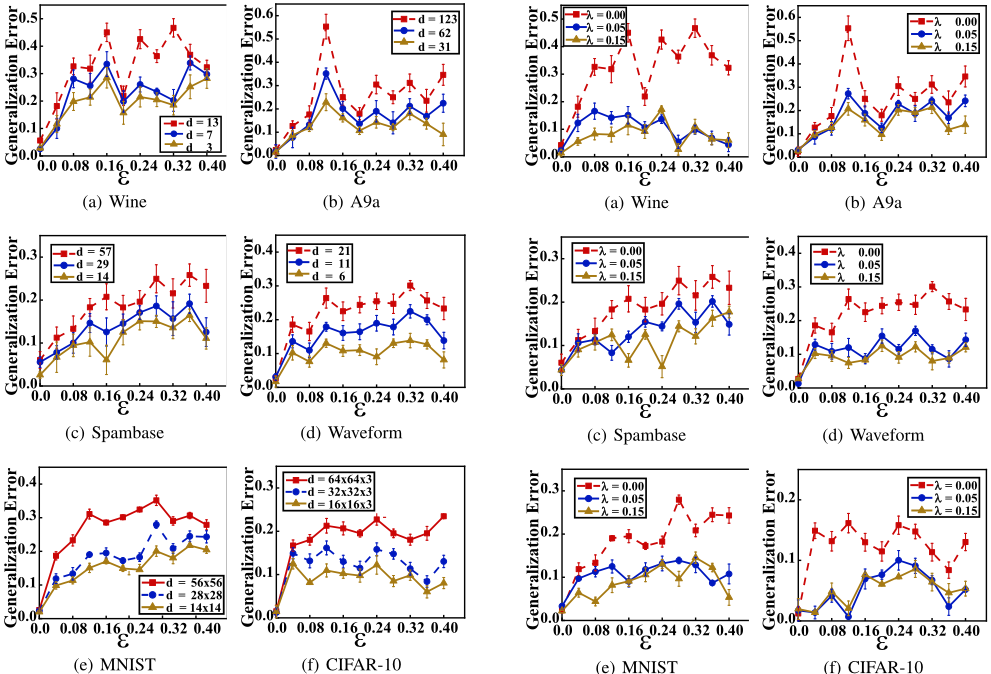
Effect of Regularization. We evaluate the effect of the regularization on the generalization ability of ACL models. Here, we consider the objective with ℓ1 regularization (6), and observe the generalization error (7) of models trained with different regularization parameters λ. As shown in Figure 2, models trained without regularization (i.e., λ = 0) have larger generalization errors, which suggests that regularization is beneficial for enhancing the robustness of the model.
7 Conclusions
This paper provides a systematic analysis of the generalization properties for ACL. We significantly improve the existing generalization bounds O(k) to a logical factor O(log k) by developing the concentration estimation technique associated with the ℓ∞-covering number. Under robust selfbounding Lipschitz condition, we further provide the optimistic bound with the fast convergence rate, when adversarial empirical error is zero. Our analysis is easily applicable to various models: it requires simply quantifying the worst-case Rademacher complexity of the hypothesis class. We present the general results for linear models and multi-layer neural networks with ℓr additive perturbations. Our results show that the generalization error bounds have additional perturbation terms associated with the feature dimension and the weight matrix, as compared to their non-adversarial counterparts. One can alleviate dimension dependence in the perturbation term by imposing a p-norm regularization on the weight matrix, where 1 ≤ p ≤ r∗ , and thus reduce the generalization gap. Moreover, projecting the input into the low-dimensional feature space help reduce the effective dimension of adversarial perturbations and improve adversarially robust generalization. Experimental observations on real-world datasets validate these theoretical findings. In future work, we will investigate the generalization behavior of ACL under various adversarial attacks (possibly non-additive).
Figure 2: The generalization performance (mean value and standard deviation) under different regularization (λ). The dashed and solid lines represent the results of models trained without and with regularization, respectively. The first four subfigures and the last two subfigures show the results of linear and non-linear models, respectively. ε denotes the maximum allowable perturbation.
1
1
1
Acknowledgments
This work was supported by the National Natural Science Foundation of China (Nos. 62376104, 62106191, 12071166, and 11801201), the Fundamental Research Funds for the Central Universities of China (No. 2662023LXPY005), and HZAU-AGIS Cooperation Fund (No. SZYJY2023010).
@inproceedings{ijcai2024p574,
  title     = {Towards Sharper Generalization Bounds for Adversarial Contrastive Learning},
  author    = {Wen, Wen and Li, Han and Gong, Tieliang and Chen, Hong},
  booktitle = {Proceedings of the Thirty-Third International Joint Conference on
               Artificial Intelligence, {IJCAI-24}},
  publisher = {International Joint Conferences on Artificial Intelligence Organization},
  editor    = {Kate Larson},
  pages     = {5190--5198},
  year      = {2024},
  month     = {8},
  note      = {Main Track},
  doi       = {10.24963/ijcai.2024/574},
  url       = {https://doi.org/10.24963/ijcai.2024/574},
}
TY - CPAPER TI - Towards Sharper Generalization Bounds for Adversarial Contrastive Learning AU - Wen, Wen AU - Li, Han AU - Gong, Tieliang AU - Chen, Hong T2 - Proceedings of the Thirty-Third International Joint Conference on Artificial Intelligence, IJCAI-24 PB - International Joint Conferences on Artificial Intelligence Organization PY - 2024 SP - 5190 EP - 5198 DO - 10.24963/ijcai.2024/574 UR - https://doi.org/10.24963/ijcai.2024/574 ER -Copied
Machine-readable versions of this paper, for tools and AI agents:





