
Improving Multi-agent Reinforcement Learning with Stable Prefix Policy
Proceedings of the Thirty-Third International Joint Conference on Artificial Intelligence. Main Track. Pages 49-57.
https://doi.org/10.24963/ijcai.2024/6
Keywords
- Agent-based and Multi-agent Systems: MAS: Multi-agent learning
- Agent-based and Multi-agent Systems: MAS: Coordination and cooperation
Abstract
In multi-agent reinforcement learning (MARL), the epsilon-greedy method plays an important role in balancing exploration and exploitation during the decision-making process in value-based algorithms. However, the epsilon-greedy exploration process will introduce conservativeness when calculating the expected state value when the agents are more in need of exploitation during the approximate policy convergence, which may result in a suboptimal policy convergence. Besides, eliminating the epsilon-greedy algorithm leaves no exploration and may lead to unacceptable local optimal policies. To address this dilemma, we use the previously collected trajectories to construct a Monte-Carlo Trajectory Tree, so that an existing optimal template, a sequence of state prototypes, can be planned out. The agents start by following the planned template and act according to the policy without exploration, Stable Prefix Policy. The agents will adaptively dropout and begin to explore by following the epsilon-greedy method when the policy still needs exploration. We scale our approach to various value-based MARL methods and empirically verify our method in a cooperative MARL task, SMAC benchmarks. Experimental results demonstrate that our method achieves not only better performance but also faster convergence speed than baseline algorithms within early time steps.
- [Agarwal et al., 2021] Alekh Agarwal, Sham M Kakade, Ja- son D Lee, and Gaurav Mahajan. On the theory of policy gradient methods: Optimality, approximation, and distri- bution shift. The Journal of Machine Learning Research, 22(1):4431-4506, 2021.
- [Bu et al., 2020] Yuxuan Bu, Xuechen Chen, T. D. Kulka- rni, Amir Saeedi, and Joshua B. Tenenbaum. Individual- global-maximum: A new framework for multi-agent re- inforcement learning. arXiv preprint arXiv:2006.07689, 2020.
- [Cao et al., 2012] Yongcan Cao, Wenwu Yu, Wei Ren, and Guanrong Chen. An overview of recent progress in the study of distributed multi-agent coordination. IEEE Trans- actions on Industrial informatics, 9(1):427-438, 2012.
- [Foerster et al., 2017] Jakob Foerster, Guillaume Assael, Michael White, Timothy P. Lillicrap, and John D. Schul- man. Learning to communicate with deep multi-agent re- inforcement learning. arXiv preprint arXiv:1706.03762, 2017.
- [Foerster et al., 2018] Jakob Foerster, Guillaume Assael, Michael White, Timothy P. Lillicrap, and John D. Schul- man. Counterfactual multi-agent policy gradients. arXiv preprint arXiv:1802.01561, 2018.
- [Hu et al., 2021] Jian Hu, Siyang Jiang, Seth Austin Hard- ing, Haibin Wu, and Shih wei Liao. Rethinking the imple- mentation tricks and monotonicity constraint in coopera- tive multi-agent reinforcement learning. 2021.
- [Jin et al., 2018] Chi Jin, Zeyuan Allen-Zhu, Sebastien Bubeck, and Michael I Jordan. Is q-learning provably effi- cient? Advances in neural information processing systems, 31, 2018.
- [Koenig and Simmons, 1993] Sven Koenig and Reid G Sim- mons. Complexity analysis of real-time reinforcement learning. In AAAI, volume 93, pages 99-105, 1993.
- [Lowe et al., 2017] Ryan Lowe, Yi I Wu, Aviv Tamar, Jean Harb, OpenAI Pieter Abbeel, and Igor Mordatch. Multi- agent actor-critic for mixed cooperative-competitive envi- ronments. Advances in neural information processing sys- tems, 30, 2017.
- [Mahajan et al., 2019] Anuj Mahajan, Tabish Rashid, Mikayel Samvelyan, and Shimon Whiteson. Maven: Multi-agent variational exploration. Advances in Neural Information Processing Systems, 32, 2019.
- [Oliehoek et al., 2016] Frans A Oliehoek, Christopher Am- ato, et al. A concise introduction to decentralized POMDPs, volume 1. Springer, 2016.
- [Ouyang et al., 2017] Yi Ouyang, Mukul Gagrani, Ashutosh Nayyar, and Rahul Jain. Learning unknown markov deci- sion processes: A thompson sampling approach. Advances in neural information processing systems, 30, 2017.
- [Rashid et al., 2018] Tabish Rashid, Mikayel Samvelyan, Christian Schroeder Witt, Gregory Farquhar, Jakob Fo- erster, and Shimon Whiteson. Qmix: Monotonic value function factorisation for deep multi-agent reinforcement learning. In International Conference on Machine Learn- ing, pages 4292-4301, 2018.
- [Rashid et al., 2020] Tabish Rashid, Gregory Farquhar, Bei Peng, and Shimon Whiteson. Weighted qmix: Expand- ing monotonic value function factorisation for deep multi- agent reinforcement learning. Advances in neural infor- mation processing systems, 33:10199-10210, 2020.
- [Samvelyan et al., 2019] Mikayel Samvelyan, Tabish Rashid, Christian Schroeder de Witt, Gregory Farquhar, Nantas Nardelli, Tim G. J. Rudner, Chia-Man Hung, Philiph H. S. Torr, Jakob Foerster, and Shimon White- son. The StarCraft Multi-Agent Challenge. CoRR, abs/1902.04043, 2019.
- [Son et al., 2019] Kyunghwan Son, Daewoo Kim, Wan Ju Kang, David Earl Hostallero, and Yung Yi. Qtran: Learn- ing to factorize with transformation for cooperative multi- agent reinforcement learning. In International Conference on Machine Learning, pages 5887-5896. PMLR, 2019.
- [Sunehag et al., 2017] Peter Sunehag, Guy Lever, Audrunas Gruslys, Wojciech Marian Czarnecki, Vinicius Zambaldi, Max Jaderberg, Marc Lanctot, Nicolas Sonnerat, Joel Z Leibo, Karl Tuyls, et al. Value-decomposition networks for cooperative multi-agent learning. arXiv preprint arXiv:1706.05296, 2017.
- [Sutton and Barto, 1998] R. S. Sutton and A. G. Barto. Re- inforcement learning: An introduction. MIT press, 1998.
- [Uchendu et al., 2023] Ikechukwu Uchendu, Ted Xiao, Yao Lu, Banghua Zhu, Mengyuan Yan, Joséphine Simon, Matthew Bennice, Chuyuan Fu, Cong Ma, Jiantao Jiao, et al. Jump-start reinforcement learning. In International Conference on Machine Learning, pages 34556-34583.
- PMLR, 2023.
- [Wang et al., 2019a] Tonghan Wang, Jianhao Wang, Yi Wu, and Chongjie Zhang. Influence-based multi-agent explo- ration. arXiv preprint arXiv:1910.05512, 2019.
- [Wang et al., 2019b] Tonghan Wang, Jianhao Wang, Chongyi Zheng, and Chongjie Zhang. Learning nearly decomposable value functions via communication minimization. arXiv preprint arXiv:1910.05366, 2019.
- [Wang et al., 2020a] Jianhao Wang, Zhizhou Ren, Terry Liu, Yang Yu, and Chongjie Zhang. Qplex: Duplex dueling multi-agent q-learning. arXiv preprint arXiv:2008.01062, 2020.
- [Wang et al., 2020b] Tonghan Wang, Heng Dong, Victor Lesser, and Chongjie Zhang. Roma: Multi-agent rein- forcement learning with emergent roles. arXiv preprint arXiv:2003.08039, 2020.
- [Wang et al., 2023] Jiangxing Wang, Deheng Ye, and Zongqing Lu. More centralized training, still decentral- ized execution: Multi-agent conditional policy factoriza- tion. In International Conference on Learning Represen- tations (ICLR), 2023.
- [Xie et al., 2022] Tengyang Xie, Dylan J Foster, Yu Bai, Nan Jiang, and Sham M Kakade. The role of coverage in online reinforcement learning. arXiv preprint arXiv:2210.04157, 2022.
- [Yang et al., 2020] Yaodong Yang, Ying Wen, Jun Wang, Li- heng Chen, Kun Shao, David Mguni, and Weinan Zhang. Multi-agent determinantal q-learning. In International Conference on Machine Learning, pages 10757-10766.
- PMLR, 2020.
- [Ye et al., 2021] Weirui Ye, Shaohuai Liu, Thanard Kuru- tach, Pieter Abbeel, and Yang Gao. Mastering atari games with limited data. Advances in Neural Information Pro- cessing Systems, 34:25476-25488, 2021.
- [Yu et al., 2022] Chao Yu, Akash Velu, Eugene Vinitsky, Ji- axuan Gao, Yu Wang, Alexandre Bayen, and Yi Wu. The surprising effectiveness of ppo in cooperative multi-agent games. Advances in Neural Information Processing Sys- tems, 35:24611-24624, 2022.
- [Zhang and Lesser, 2011] Chongjie Zhang and Victor Lesser. Coordinated multi-agent reinforcement learning in networked distributed pomdps. In Twenty-Fifth AAAI Conference on Artificial Intelligence, 2011.
- [Zhang et al., 2021] Tianhao Zhang, Yueheng Li, Chen Wang, Guangming Xie, and Zongqing Lu. Fop: Factoriz- ing optimal joint policy of maximum-entropy multi-agent reinforcement learning. In International Conference on Machine Learning, pages 12491-12500. PMLR, 2021.
References were extracted automatically from the PDF and may contain errors.
Full text extracted automatically from the PDF; figures, tables and equations may differ. The PDF is the version of record.
1 Introduction
Recent research on multi-agent reinforcement learning (MARL) has a very wide range of applications in the real world such as autonomous vehicle teams [Cao et al., 2012] and sensor networks [Zhang and Lesser, 2011]. A number of MARL methods have been proposed to improve either value decomposition [Sunehag et al., 2017; Rashid et al., 2018; Rashid et al., 2020; Wang et al., 2020a] or cooperative exploration [Yang et al., 2020; Mahajan et al., 2019; Wang et al., 2020b], among which value-based MARL methods [Sunehag et al., 2017; Son et al., 2019; Wang et al., 2019b] have shown outstanding performance on challenging tasks. e.g. StarCraft II [Samvelyan et al., 2019].
∗Corresponding Author: Yin Zhang.
Moreover, most of the value-based MARL algorithms use ϵ-greedy [Sutton and Barto, 1998] method to balance exploration and exploitation by choosing the greedy action with a probability 1 - ϵ or a random choice action otherwise. To explain the sub-optimal policy selection, we show a typical matrix game as described in Figure 1 where (B, R) is the global-optimal solution. However, if player 1 applies ϵgreedy method with ϵ = 0.2, choosing action L by 0.1 and action R by 0.9, the expectation for player 2 to choose T and B are 1.81 and 1.8. Therefore, player 2 will always choose T when player 1 makes decisions with exploration, and player 2 always chooses L for the same reason. In this case, the solution will fall into (T, L), a suboptimal solution. Therefore, the calculation of Qtot, mixed by each agent's Q, is inaccurate and the errors are cumulated and propagated through the transitions among a trajectory.
Figure 2 also shows the dilemma between the benefit of exploration and the sub-optimal solutions ϵ-greedy method brings. Agents are trapped in local optima when greedy selections are applied only. When using ϵ-greedy method, agents explore through the whole trajectories which makes them difficult to reach the goal. In contrast, if agents start with a stable policy for a few steps and apply ϵ-greedy method afterward, the agents achieve a higher number of successful cases. Based on this, we propose Stable Prefix Policy (SPP) to encourage agents to follow the existing optimal trajectory planned from previously collected trajectory data. Specifically, we implement Monte-Carlo Trajectory Tree (MCT2 ) to preserve the structure of previous trajectories. The existing optimal trajectory template planned from MCT2 is used for guiding the agents on whether to follow the template during rollouts and assemble target values in the training process.
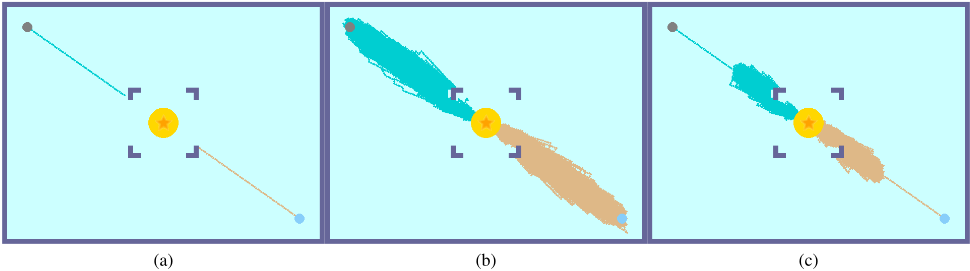
When the agents dropout from the template, ϵ-greedy method is activated afterwards.
The main contributions of this work are as follows: 1) We propose the SPP method to rebalance the exploration and exploitation process when the policy of agents is close to the optimal policy during the training process. 2) Our proposed method can be adapted to other value-based MARL algorithms with mixing networks with minor changes to existing MARL code-bases. 3) We validate our methods empirically by extensive experiments on SMAC benchmarks. Experimental Results indicate that existing MARL methods equipped with our method can compete with or outperform original MARL methods in terms of the winning rates or cumulated rewards respectively within 2M time steps.
2 RelatedWork
Multi-agent reinforcement learning. In multi-agent value-based algorithms, the centralized value function, usually a joint Q-function, is decomposed into local utility functions. Many methods have been proposed to meet the Individual-Global-Maximum (IGM) [Bu et al., 2020] assumption, which indicates the consistency between the local optimal actions and the optimal global joint action. VDN [Lowe et al., 2017] and QMIX [Rashid et al., 2018] introduce additivity and monotonicity to Q-functions. QTRAN [Son et al., 2019] transforms IGM into optimization constraints. QPLEX [Wang et al., 2020a] uses duplex dueling network architecture to guarantee IGM assumption. Instead of focusing on value decomposition, multi-agent policy gradient algorithms provide a centralized value function to evaluate current joint policy and guide the update of each local utility network. Most policy-based MARL methods extend RL ideas, including MADDPG [Lowe et al., 2017], MATRPO [Foerster et al., 2017], MAPPO [Yu et al., 2022]. FOP [Zhang et al., 2021] algorithm factorizes optimal joint policy by maximum entropy and MACPF [Wang et al., 2023] is the latest algorithm that mixes critic values of each agent.
Exploration in Multi-agent Reinforcement Learning. Extended from single-agent reinforcement learning, the ϵgreedy method is widely applicable in value-based MARL algorithms. In this paper, our approach is based on the ϵ-greedy exploration method and QMIX algorithm for reward credit allocation. In policy-based algorithms, such as MAPPO and COMA [Foerster et al., 2018], for exploration, multi-agent approaches rely on classical noise-based exploration in which agents explore local regions that are close to their individual actor policy. Another line of coordinated exploration algorithms has been proposed. Multi-agent variational exploration (MAVEN) [Mahajan et al., 2019] introduces a latent space for hierarchical control. Agents condition their behavior on the latent variable to perform committed exploration. Influence-based exploration [Wang et al., 2019a] captures the influence of one agent's behavior on others. Agents are encouraged to visit 'interaction points' that will change other agents' behavior.
3 Backgrounds
A fully cooperative multi-agent task is described as a DecPOMDP [Oliehoek et al., 2016] task which consists of a tuple G = ⟨S, A, P, r, Z, O, N, γ⟩ in which s ∈ S is the true state of the environment and N is the number of agents. At each time step, each agent i ∈ N ≡ {1, . . . , n} chooses an action ai ∈ A which forms the joint action a ∈ A ≡ AN . The transition on the environment is according to the state transition function that P(·|s, a) : S ×A× S → [0, 1]. The reward, r(s, a) : S × A → R, is shared among all the agents, and γ ∈ [0, 1) is the discount factor for future reward penalty.
Partially observable scenarios are considered in this paper that each agent draws individual observations z ∈ Z of the environment according to the observation functions O(s, i) : S × N → Z. Meanwhile, the action-observation history, τi ∈ T ≡ (Z ×A)∗ , is preserved for each agent and conditions the stochastic policy πi(ai|τi) : T ×A → [0, 1]. The policy π for each agent is determined by a joint actionvalue function: Qπ (st , at ) = Est+1:∞,at+1:∞[Rt |st , at ], in which the accumulated reward is considered as a discounted return and formulated as Rt = ∑∞i=0 γ i rt+i . After the rollout process, the whole trajectory from the initial transition to terminated transition are stored in the replay buffer.
Deep q-learning algorithm aims to find the optimal joint action-value function Q∗ (s, a; θ) = r(s, a) + γEs′ [maxa′ Q∗ (s′ , a′ ; θ)]. Due to partial observability, Q(τ, a; θ) is used in place of Q(s, a; θ) and parameters θ are learnt by minimizing the expected TD error. Centralized training and decentralized execution (CTDE) enables agents to acquire global states during the training and only individual observations during the testing execution. In multi-agent settings, VDN learns a joint action-value function Qtot(τ, a) as the sum of individual value functions: QVDN tot (τ, a) = ∑ni=1 Qi(τi, ai). QMIX introduces a monotonic restriction ∀i ∈ N, ∂QQMIX tot (τ,a) ∂Qi(τi,ai) > 0 to the mixing network to meet the IGM assumption. IGM asserts the consistency between joint and local greedy action selections in the joint action-value Qtot(τ, a) and individual action-values [Qi(τi, ai)]ni=1 .
4 Method
In this section, we introduce the overall architecture of our method and describe the generation of the stable prefix policy. Our method divides the decision-making of the existing MARL methods into two phases: our Stable Prefix Policy and vanilla policy. SPP balances the exploration and exploitation during the trajectory planning process with UCT, with Dirichlet noise during the planning phase. For planning, we establish a trajectory tree from data in the replay buffer in the Monte-Carlo Tree structure, which we call Monte-Carlo Trajectory Tree (MCT2 ), to plan out the existing optimal trajectory. Instead of selecting one action fromMCT planning, our work uses MCT to preserve trajectories across episodes to provide trajectory templates for utility network training. Additionally, we describe the rollout process, the target value assembling method, and the training pipeline in this section. The pseudo-code is provided in Appendix A.
4.1 Architecture
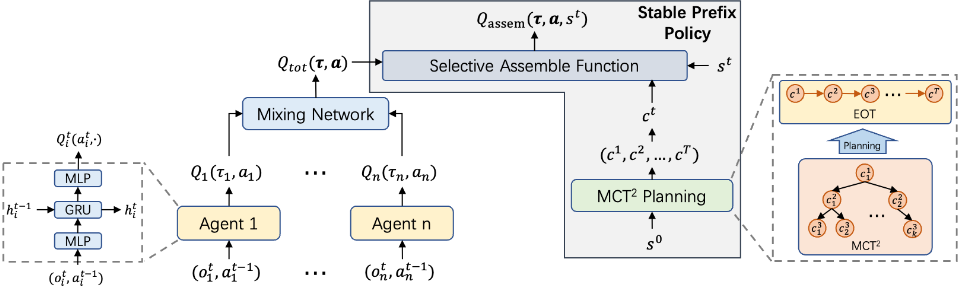
The training process of value-based MARL algorithms is the Q value Temporal Difference (TD) updating of each agent's utility network. In QMIX and the algorithms derived from QMIX, TD updates are applied to the mixed Qtot value. The utility network is composed of multi-layer perceptron (MLP) layers and Gate Recurrent Unit (GRU) cells in which hti is the historical hidden state. Similar to QMIX algorithm, the utility network at time step t of agent i takes the observation oti and its chosen action ati as an input and outputs the Qi(τi, ai) of each agent according to the encoded history state τi. Then, these Q values are fed into the mixing network which guarantees the monotonic constraints by hyper-networks and the Qtot(τ, a) is used for TD learning.
As shown in Figure 3, our stable prefix policy is dependent on the time step t. To summarize the states into a few categories, we train a KMeans classifier ϕ(c|s) periodically by the data sampled from the replay buffer. To plan a potential optimal trajectory fromMCT2 , the state s0 (the initial state) is classified into a cluster c0 . Then the existing optimal trajectory is selected from the root node c0 according to the probabilistic upper confidence bound (PUCB) value of each node and the sequence of cluster IDs is generated. At time step t, ct is used to be compared with the true state cluster and control the Q assembling process.
Based on the trained classifier ϕ(c|s) and the sequence of transitions from the replay buffer during the training process, our classifier predicts the cluster ID of each state in each time step t. Whether the agents are following the trajectory template can be determined by the comparison between the predicted cluster IDs ˆ ct (from ϕ(st )) and the cluster from our stable prefix policy ct . Once confirming the agents are following the template, the target value calculated by Qtot(τn, an) is assembled with other target values with the same cluster ID to calculate TD error. According to the CTDE settings, during the testing execution phase, the actions are conditioned only on the utility networks without SPP and without ϵ-greedy exploration.
4.2 Stable Prefix Policy
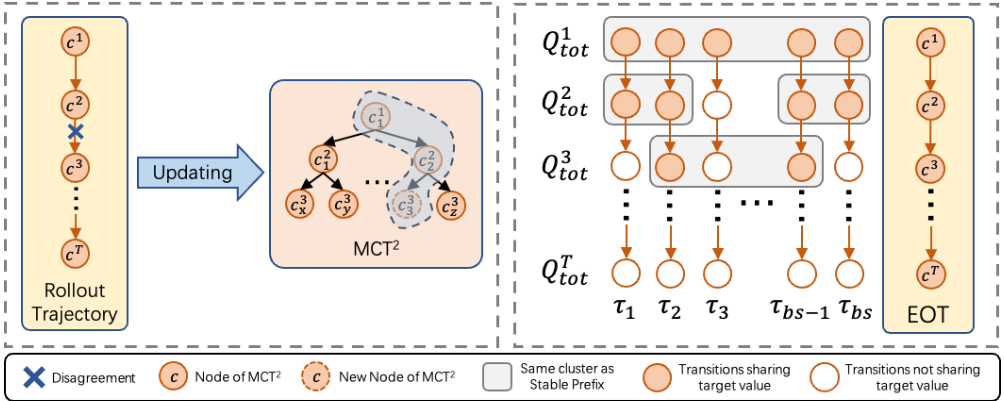
As shown in Figure 4, to plan out an existing optimal trajectory as a template from previously collected interactive data, our method generates trajectory trees by the data sampled from the replay buffer in Monte-Carlo Tree structure. We randomly select tinter trajectories and apply clustering methods to assign states s into a cluster c such that similar states can be assigned to the same cluster. A transition (st , at , st+1 , rt+1 ) can be regarded as a visit from a node with cluster ID ϕ(st ) to its child node with ϕ(st+1 ). Meanwhile, the expectation rewards from one cluster of states to its subsequent clusters are stored in the tree. Apart from the IDs of clusters, the value of a node v(n) is also stored in the node and is calculated by the following formula:
In the formula above, v(n) is the value of the node n and cn are the children nodes of the node n. π(cn|n) is the probability of visiting a child node cn from it parent node n and is usually calculated by counting numbers. Rn→cn is the expectation of the historical rewards from node n to node cn. γ is the discount factor and v(cn) is the value of child node cn. λ is dynamically changed with the visit number of cluster Γn and empirically defined as 1/Γn.
During the establishment of the MCT2 , we follow the procedure in Efficient Zero [Ye et al., 2021]. A newly selected node will be expanded with the average reward and policy as its prior. Additionally, when the root node is to expand, we apply the Dirichlet noise to the policy prior to give more explorations.
where ND(ξ) is the Dirichlet noise distribution, ρ and ξ is set to 0.25 and 0.3. However, we do not use any noise and set ρ to 0 for the non-root node or during evaluations.
Based on the MCT2 implementation described above, we greedily select routes, a sequence of cluster IDs, from the root node to a leaf according to the PUCB values from each parent node n to its child node cn. Inside the formula below, cucb is the hyper-parameter for balancing exploration and exploitation.
After the selection, an optimal path of clusters is selected from the root node to a leaf node, (c0 , c1 , ...cT ) within time steps T , which will be used for training and rollout process.
During the rollout process, agents start by following the template trajectory generated by MCT2 . When the agents are following the template, the actions are selected greedily according to their Q values for full exploitation. However, once the agents dropout from the template trajectory in a time step t (ct ̸= ϕ(st )), actions are generated by ϵ-greedy for exploration in the latter rollout steps.
After the rollout processes, the trajectories from the environment interactions will be used to update the MCT2 . The states s are classified into clusters c which instead form the transition sequences (c0 , a0 , c1 , a1 ...cT ). The values of the node before the dropout time step will be updated or created in the MCT2 . It is worth noting that MCT2 only concentrates on the cluster transitions without actions. In such a way, our stable prefix policy only focuses on the optimal subsequent states no matter what actions the agents take.
4.3 Training Pipeline
The existing template trajectories are also used in the training process. A mini-batch of trajectories is sampled from the replay buffer to train the utility network. Our MCT2 generates a template for each sampled trajectory to find the time step that the agents dropout from the template. As shown in Figure 3, the Qtot(τ, a) are calculated from the mixing network and the cluster ID ct is the output of our stable prefix policy. The target values y are calculated by:
While calculating the target y, we also assemble the target values of the same cluster node among the sampled batch of sequences such that the target values are close to the expectation of true discounted returns from that state.
Inside the formula above, bs is the batch size of sampled data, Qtot(τi, ai) is calculated by adding the rewards to the value of the subsequent node in the template, and the ct is the cluster node from the trajectory. Because our method takes Qtot and trajectory tree into consideration, our method can be adapted to other value-based MARL algorithms with mixing networks.
4.4 Sample Complexity Analysis
In this section, We linked our SPP method to the framework in [Koenig and Simmons, 1993], verifying that our SPP method can achieve a polynomial sample complexity. As we need to calculate the sample complexity of SPP method. Before that, since our SPP method uses the clustering method for feature extraction, we also need to give a reasonable assumption for the feature extraction module in our algorithm.
Assumption 1. Assume that the state is parametrized by some feature mapping (clustering mapping) such that for any policy π, Qassem and π(s) depend only on ϕ(s), the stable prefix policy πspp cover the states visited by the optimal policy:
where π∗ is the optimal policy, dπt is the state visit distribution under a policy π in time step t, ϕ(·) is a feature extractor of the policy, and the constant C denotes an upper bound on the coverage ratio[Xie et al., 2022] between πspp and optimal policy π∗ .
Assumption 1 indicates that the distributions of states being visited by each of the feature extractors corresponding to SPP πspp and utility policy π should not be too different from each other. The ratio is sometimes called the distribution mismatch coefficient in the literature of policy gradient methods [Agarwal et al., 2021]. We can show that given Assumption 1 our method explores the current time step without dropout of any state which gives good performance guarantees for MDP with general function approximation.
Theorem 1 ([Uchendu et al., 2023] theorem 4.3). With an appropriate choice of training and evaluation process, our approach (pseudocode in Appendix A) guarantees a nearoptimal bound up to a factor of C × poly(H) for MDP with general function approximation.
At this point, we have obtained all the results we need, showing that our SPP method achieves a polynomial sample complexity, providing a reasonable assumption 1 holds. Although polynomial or near optimal-bound can be achieved by many optimism-based methods [Jin et al., 2018; Ouyang et al., 2017], our approach further constructs a bonus for uncertainty, which improves the empirical performance of our SPP method.
5 Experiments
We evaluate the performance of our method via the fully cooperative StarCraftII micro-management challenges by the mean winning rate in each scenario. In this environment, we mainly present 6 scenarios with 2 levels of difficulty. Meanwhile, ablation studies are also presented to show the adaptability of our approach to other algorithms and the influence of effective horizons. The details of other SMAC tasks are shown in Appendix B.
5.1 Experiment Settings
SMAC: We verify our proposed stable prefix policy methods on 6 subtasks of two difficulties, a) hard 1c3s5z, 3s_vs_5z, and 5m_vs_6m, and b) super-hard scenarios 3s5z_vs_3s6z, MMM2, and 6h_vs_8z. The difficulty is set as 7 by default. The winning rates of battles are calculated by the mean of 5 different seeds and smoothed by 0.6 for better visualization within 2M time steps.
Baselines: We adapt our method to QMIX and W-QMIX algorithms and compare our methods to the value-based QPLEX algorithm, popular policy-based algorithm MAPPO, and currently the latest actor-critic algorithmMACPF. In the ablation study, we also adapt our method to QPLEX algorithm. The QMIX, QPLEX, and W-QMIX in this paper are from pymarl codebase [Hu et al., 2021]. MACPF is from the codebase [Zhang et al., 2021; Wang et al., 2023] and MAPPO is provided by [Yu et al., 2022]
5.2 Experiment Results
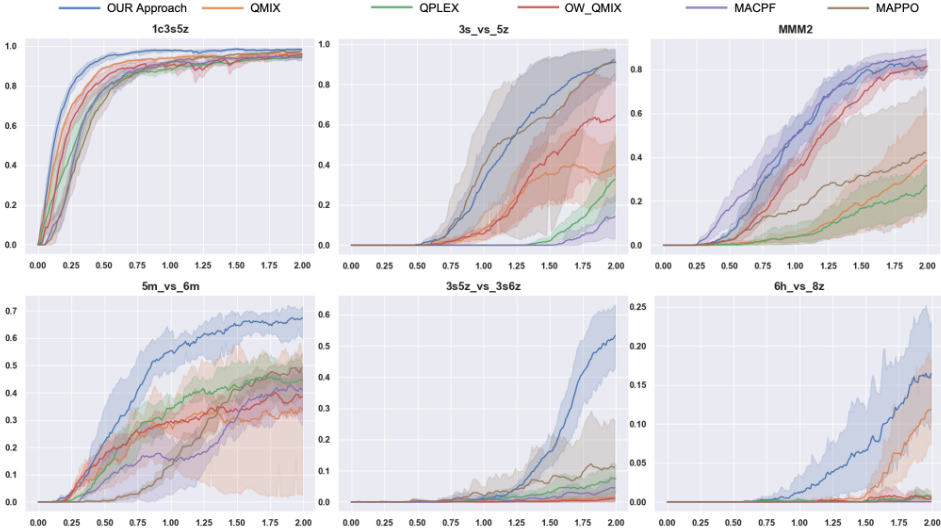
We mainly evaluate our proposed stable prefix policy method on QMIX algorithm on 6 benchmarks of SMAC, which is composed of three hard tasks and three super-hard tasks. To demonstrate the overall performance of each algorithm, Figure 5 plots the average test winning rate across the 6 scenarios. In hard tasks, including 5m_vs_6m and 1c3s5z, our proposed method can compete with or outperform baseline algorithms. In the 3s_vs_5z scenario, our method has lower variance within 2M training steps. In the MMM2 task, our method can compete with policy-based methods, however, our proposed stable prefix policy still augments QMIX algorithm and outperforms other value-based methods. In the 6h_vs_8z and 3s5z_vs_3s6z tasks, not all the baselines show the winning rate and our method can achieve acceptable results. It is worth noting that we adjust the parameter size of the mixing network of QMIX and also apply both the original setting and the adjustment setting to other baselines. The better results of the two settings are shown in the graph. Other hyper-parameters are in Appendix C.
5.3 Ablation Studies
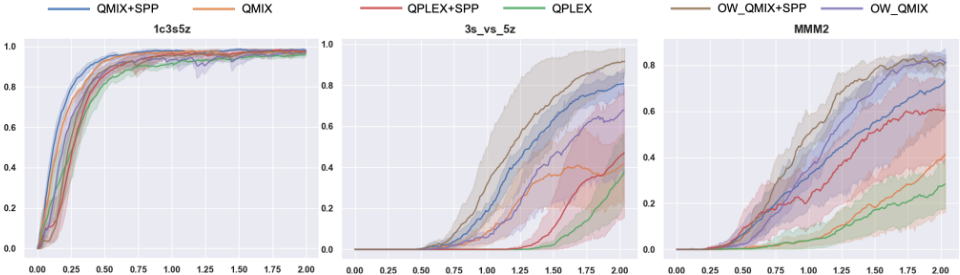
Compatibility: We implement a trajectory tree to provide current existing optimal trajectories for training and rollout and our stable prefix policy module is entirely based on mixing networks, our method can be regarded as a plugin that can be adapted to other value-based MARL methods with minor changes. To test the compatibility of our work, we apply our method on QPLEX, and OW_QMIX algorithms in 1c3s5z, 3s_vs_5z, and MMM2 scenarios correspondingly.
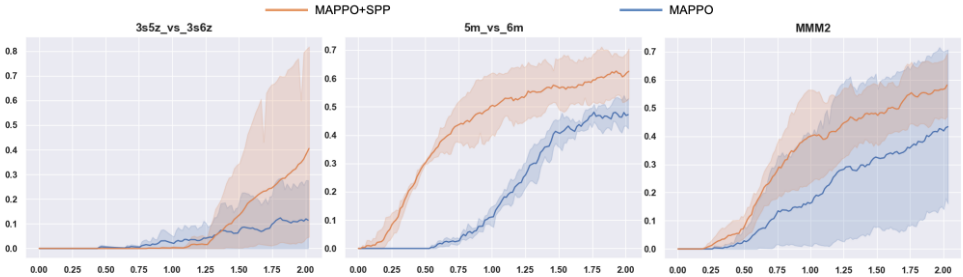
According to Figure 6, in the 1c3s5z scenario and MMM2 task, both the QMIX with stable prefix and QPLEX with stable prefix outperform their original algorithms and OW_QMIX with stable prefix can compete with its origin. In the 3s_vs_5z scenario, all of the algorithms with our proposed stable prefix policy outperform the algorithms without prefix policy. By adding a large replay buffer and assembling the target critic value, we also apply the idea of our approach to the MAPPO algorithm to restrict early exploration. Figure 7 shows that our method can also improve the policy-based MARL algorithms with critic networks.
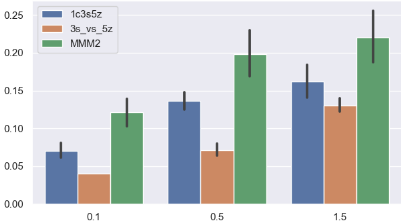
Effectiveness: During the rollout process, our proposed MCT2 provides a potential optimal trajectory for agents to follow. Agents select actions according to their utility network and might encounter disagreements with the template in some time steps. Therefore, we record the portion of time steps that agents drop out from the template with the average length of an episode and analyze the influence of the dropout time step on the performance in three scenarios.
According to Figure 8 and the task specifications, 1c3s5z is an easy task for agents to focus fire on correct enemies, so agents have more probability to agree with the stable prefix trajectories. In the 3s_vs_5z task, agents should walk and attack, which is difficult for stable prefix policy to predict when to walk and attack. The important way to win MMM2 task is the control of Medivac and the ally to sacrifice, so the ratio of dropout length is high. According to the trend from the graph, as the policy network converges and the value of each node in our MCT2 becomes accurate, the dropout ratio becomes higher in later training time steps.
6 Discussion
Performance Enhancement: According to the main experiment result in Figure 5, our method can compete with or outperform other baseline algorithms in most tasks. Our method can also outperform other value-based algorithms in environments where policy-based algorithms are dominant. The existing optimal template trajectories provide agents currently the best route with the highest return. The Q value assembling mechanism within a batch of trajectories reduces the error between the assembled Qtot and its true value.
Adaptability: We adapt our method on value-basedMARL algorithms with mixing networks and assemble the Qtot for training. The essence of our work is providing a potential trajectory to agents and assembling a more accurate Q value.
Therefore, value-based MARL algorithms without centralized training, such as IQL, should also be suitable for our method. As for Actor-Critic MARL algorithms, the training of the critic modules is a value-based process, so our proposed method should be suitable for the critic training.
Effectiveness: We aim to find the optimal value without trembling hands when a sub-optimal policy can be obtained from historical interactions. Therefore, the stability of the prefix policy influences the dropout time step, the time step agents encounter disagreements with the provided template. According to Figure 8, the dropout time step is lower in the task where agents need to explore more during the early time steps. When the task is easy enough or the policy is near convergence, the dropout time step will rise during the rollout process. In summary, the dropout time step is empirically positively correlated to training time steps and negatively correlated to the task difficulty.
7 Conclusion and FutureWork
In this work, we consider the dilemma between the need for exploration and sub-optimal decision-making exploitation. To solve the problem, we propose a plugin that consists of a stable prefix trajectory provider, the Monte-Carlo Trajectory Tree, and a selective assemble function. We show that the usage of our stable prefix policy can improve MARL algorithms' performance when their utility network is close to optimal and offer exploration budget to later time steps by restricting early exploration according to the templates. SMAC experimental results indicate that our method can be adapted to value-based MARL methods in terms of implementation and offers significant improvements to value-based MARL methods. In the future, we might focus on the prescription that early exploration is vital and update a solution without early dropout in this paper.
Acknowledgements
This work was supported by the Zhejiang Provincial Natural Science Foundation of China under Grant No. LZ23F020009, the NSFC project (No. 62072399), MoE Engineering Research Center of Digital Library, China Research Centre on Data and Knowledge for Engineering Sciences and Technology, the Fundamental Research Funds for the Central Universities, and the Ministry of Education Industry-Academia Cooperation and Collaborative Education for Tencent Project Sponsorship-Tencent AI Arena. We also express our sincere gratitude to anonymous reviewers for their invaluable feedback and constructive comments.
@inproceedings{ijcai2024p6,
  title     = {Improving Multi-agent Reinforcement Learning with Stable Prefix Policy},
  author    = {Deng, Yue and Wang, Zirui and Zhang, Yin},
  booktitle = {Proceedings of the Thirty-Third International Joint Conference on
               Artificial Intelligence, {IJCAI-24}},
  publisher = {International Joint Conferences on Artificial Intelligence Organization},
  editor    = {Kate Larson},
  pages     = {49--57},
  year      = {2024},
  month     = {8},
  note      = {Main Track},
  doi       = {10.24963/ijcai.2024/6},
  url       = {https://doi.org/10.24963/ijcai.2024/6},
}
TY - CPAPER TI - Improving Multi-agent Reinforcement Learning with Stable Prefix Policy AU - Deng, Yue AU - Wang, Zirui AU - Zhang, Yin T2 - Proceedings of the Thirty-Third International Joint Conference on Artificial Intelligence, IJCAI-24 PB - International Joint Conferences on Artificial Intelligence Organization PY - 2024 SP - 49 EP - 57 DO - 10.24963/ijcai.2024/6 UR - https://doi.org/10.24963/ijcai.2024/6 ER -Copied
Machine-readable versions of this paper, for tools and AI agents:





