
InstructME: An Instruction Guided Music Edit Framework with Latent Diffusion Models
Proceedings of the Thirty-Third International Joint Conference on Artificial Intelligence. Main Track. Pages 5835-5843.
https://doi.org/10.24963/ijcai.2024/645
Keywords
- Multidisciplinary Topics and Applications: MTA: Arts and creativity
- Multidisciplinary Topics and Applications: MTA: Other
Abstract
Music editing primarily entails the modification of instrument tracks or remixing in the whole, which offers a novel reinterpretation of the original piece through a series of operations. These music processing methods hold immense potential across various applications but demand substantial expertise. Prior methodologies, although effective for image and audio modifications, falter when directly applied to music. This is attributed to music's distinctive data nature, where such methods can inadvertently compromise the intrinsic harmony and coherence of music. In this paper, we develop InstructME, an Instruction guided Music Editing and remixing framework based on latent diffusion models. Our framework fortifies the U-Net with multi-scale aggregation in order to maintain consistency before and after editing. In addition, we introduce chord progression matrix as condition information and incorporate it in the semantic space to improve melodic harmony while editing. For accommodating extended musical pieces, InstructME employs a chunk transformer, enabling it to discern long-term temporal dependencies within music sequences. We tested InstructME in instrument-editing, remixing, and multi-round editing. Both subjective and objective evaluations indicate that our proposed method significantly surpasses preceding systems in music quality, text relevance and harmony.
Demo samples are available at https://musicedit.github.io
- [Agostinelli et al., 2023] Andrea Agostinelli, Timo I Denk, Zalán Borsos, Jesse Engel, Mauro Verzetti, Antoine Cail- lon, Qingqing Huang, Aren Jansen, Adam Roberts, Marco Tagliasacchi, et al. Musiclm: Generating music from text. arXiv preprint arXiv:2301.11325, 2023.
- [Cheuk et al., 2022] Kin Wai Cheuk, Keunwoo Choi, Qi- uqiang Kong, Bochen Li, Minz Won, Amy Hung, Ju- Chiang Wang, and Dorien Herremans. Jointist: Joint learn- ing for multi-instrument transcription and its applications. arXiv preprint arXiv:2206.10805, 2022.
- [Copet et al., 2023] Jade Copet, Felix Kreuk, Itai Gat, Tal Remez, David Kant, Gabriel Synnaeve, Yossi Adi, and Alexandre Défossez. Simple and controllable music gen- eration. arXiv preprint arXiv:2306.05284, 2023.
- [Dhariwal and Nichol, 2021] Prafulla Dhariwal and Alexan- der Nichol. Diffusion models beat gans on image synthe- sis. Advances in neural information processing systems, 34:8780-8794, 2021.
- [Donahue et al., 2023] Chris Donahue, Antoine Caillon, Adam Roberts, Ethan Manilow, Philippe Esling, An- drea Agostinelli, Mauro Verzetti, Ian Simon, Olivier Pietquin, Neil Zeghidour, et al. Singsong: Generating musical accompaniments from singing. arXiv preprint arXiv:2301.12662, 2023.
- [Fagerjord, 2010] Anders Fagerjord. After convergence: Youtube and remix culture. International handbook of in- ternet research, pages 187-200, 2010.
- [Hershey et al., 2017] Shawn Hershey, Sourish Chaudhuri, Daniel PW Ellis, Jort F Gemmeke, Aren Jansen, R Chan- ning Moore, Manoj Plakal, Devin Platt, Rif A Saurous, Bryan Seybold, et al. Cnn architectures for large-scale au- dio classification. In 2017 ieee international conference on acoustics, speech and signal processing (icassp), pages 131-135. IEEE, 2017.
- [Hertz et al., 2022] Amir Hertz, Ron Mokady, Jay Tenen- baum, Kfir Aberman, Yael Pritch, and Daniel Cohen-Or. Prompt-to-prompt image editing with cross attention con- trol. arXiv preprint arXiv:2208.01626, 2022.
- [Ho and Salimans, 2022] Jonathan Ho and Tim Salimans. Classifier-free diffusion guidance. arXiv preprint arXiv:2207.12598, 2022.
- [Ho et al., 2020] Jonathan Ho, Ajay Jain, and Pieter Abbeel. Denoising diffusion probabilistic models. Advances in neural information processing systems, 33:6840-6851, 2020.
- [Holz, 2023] David Holz. Midjourney. artificial intelligence platform. accessible at https://www.midjourney.com. https://www.midjourney.com/, 2023. Accessed: 2023-07- 31. Link
- [Huang et al., 2022] Qingqing Huang, Aren Jansen, Joon- seok Lee, Ravi Ganti, Judith Yue Li, and Daniel PW El- lis. Mulan: A joint embedding of music audio and natural language. arXiv preprint arXiv:2208.12415, 2022.
- [Huang et al., 2023a] Qingqing Huang, Daniel S Park, Tao Wang, Timo I Denk, Andy Ly, Nanxin Chen, Zhengdong Zhang, Zhishuai Zhang, Jiahui Yu, Christian Frank, et al. Noise2music: Text-conditioned music generation with dif- fusion models. arXiv preprint arXiv:2302.03917, 2023.
- [Huang et al., 2023b] Rongjie Huang, Jiawei Huang, Dongchao Yang, Yi Ren, Luping Liu, Mingze Li, Zhenhui Ye, Jinglin Liu, Xiang Yin, and Zhou Zhao. Make-an- audio: Text-to-audio generation with prompt-enhanced diffusion models. arXiv preprint arXiv:2301.12661, 2023.
- [Jeong et al., 2023] Jaeseok Jeong, Mingi Kwon, and Youngjung Uh. Training-free style transfer emerges from h-space in diffusion models. arXiv preprint arXiv:2303.15403, 2023.
- [Karras et al., 2020] Tero Karras, Samuli Laine, Miika Ait- tala, Janne Hellsten, Jaakko Lehtinen, and Timo Aila. An- alyzing and improving the image quality of stylegan. In Proceedings of the IEEE/CVF conference on computer vi- sion and pattern recognition, pages 8110-8119, 2020.
- [Kilgour et al., 2019] Kevin Kilgour, Mauricio Zuluaga, Do- minik Roblek, and Matthew Sharifi. Fréchet audio dis- tance: A reference-free metric for evaluating music en- hancement algorithms. In INTERSPEECH, pages 2350- 2354, 2019.
- [Kwon et al., 2022] Mingi Kwon, Jaeseok Jeong, and Youngjung Uh. Diffusion models already have a semantic latent space. arXiv preprint arXiv:2210.10960, 2022.
- [Lam et al., 2023] Max WY Lam, Qiao Tian, Tang Li, Zongyu Yin, Siyuan Feng, Ming Tu, Yuliang Ji, Rui Xia, Mingbo Ma, Xuchen Song, et al. Efficient neural music generation. arXiv preprint arXiv:2305.15719, 2023.
- [Liu et al., 2023a] Haohe Liu, Zehua Chen, Yi Yuan, Xin- hao Mei, Xubo Liu, Danilo Mandic, Wenwu Wang, and Mark D Plumbley. Audioldm: Text-to-audio gen- eration with latent diffusion models. arXiv preprint arXiv:2301.12503, 2023.
- [Liu et al., 2023b] Xihui Liu, Dong Huk Park, Samaneh Azadi, Gong Zhang, Arman Chopikyan, Yuxiao Hu, Humphrey Shi, Anna Rohrbach, and Trevor Darrell. More control for free! image synthesis with semantic diffusion guidance. In Proceedings of the IEEE/CVF Winter Confer- ence on Applications of Computer Vision, pages 289-299, 2023.
- [Lu et al., 2021] Wei-Tsung Lu, Ju-Chiang Wang, Minz Won, Keunwoo Choi, and Xuchen Song. Spectnt: A time- frequency transformer for music audio. arXiv preprint arXiv:2110.09127, 2021.
- [Lugmayr et al., 2022] Andreas Lugmayr, Martin Danell- jan, Andres Romero, Fisher Yu, Radu Timofte, and Luc Van Gool. Repaint: Inpainting using denoising diffusion probabilistic models. In Proceedings of the IEEE/CVF Conference on Computer Vision and Pattern Recognition, pages 11461-11471, 2022.
- [Lv et al., 2023] Ang Lv, Xu Tan, Peiling Lu, Wei Ye, Shikun Zhang, Jiang Bian, and Rui Yan. Getmusic: Gen- erating any music tracks with a unified representation and diffusion framework. arXiv preprint arXiv:2305.10841, 2023.
- [Manilow et al., 2019] Ethan Manilow, Gordon Wichern, Prem Seetharaman, and Jonathan Le Roux. Cutting mu- sic source separation some slakh: A dataset to study the impact of training data quality and quantity. In 2019 IEEE WASPAA, pages 45-49. IEEE, 2019.
- [Meng et al., 2021] Chenlin Meng, Yutong He, Yang Song, Jiaming Song, Jiajun Wu, Jun-Yan Zhu, and Stefano Ermon. Sdedit: Guided image synthesis and editing with stochastic differential equations. arXiv preprint arXiv:2108.01073, 2021.
- [Nichol et al., 2021] Alex Nichol, Prafulla Dhariwal, Aditya Ramesh, Pranav Shyam, Pamela Mishkin, Bob McGrew, Ilya Sutskever, and Mark Chen. Glide: Towards photore- alistic image generation and editing with text-guided dif- fusion models. arXiv preprint arXiv:2112.10741, 2021.
- [Raffel et al., 2020] Colin Raffel, Noam Shazeer, Adam Roberts, Katherine Lee, Sharan Narang, Michael Matena, Yanqi Zhou, Wei Li, and Peter J Liu. Exploring the limits of transfer learning with a unified text-to-text transformer. The Journal of Machine Learning Research, 21(1):5485- 5551, 2020.
- [Ramesh et al., 2022] Aditya Ramesh, Prafulla Dhariwal, Alex Nichol, Casey Chu, and Mark Chen. Hierarchical text-conditional image generation with clip latents. arXiv preprint arXiv:2204.06125, 2022.
- [Ren et al., 2020] Yi Ren, Jinzheng He, Xu Tan, Tao Qin, Zhou Zhao, and Tie-Yan Liu. Popmag: Pop music accom- paniment generation. In Proceedings of the 28th ACM in- ternational conference on multimedia, pages 1198-1206, 2020.
- [Rombach et al., 2022] Robin Rombach, Andreas Blattmann, Dominik Lorenz, Patrick Esser, and Bj "orn Ommer. High-resolution image synthesis with latent diffusion models. In Proceedings of the IEEE/CVF conference on computer vision and pattern recognition, pages 10684-10695, 2022.
- [Ronneberger et al., 2015] Olaf Ronneberger, Philipp Fis- cher, and Thomas Brox. U-net: Convolutional networks for biomedical image segmentation. In Medical Image Computing and Computer-Assisted Intervention-MICCAI 2015: 18th International Conference, Munich, Germany, October 5-9, 2015, Proceedings, Part III 18, pages 234- 241. Springer, 2015.
- [Saharia et al., 2022] Chitwan
- Saharia, William Chan, Saurabh Saxena, Lala Li, Jay Whang, Emily L Denton, Kamyar Ghasemipour, Raphael Gontijo Lopes, Burcu Karagol Ayan, Tim Salimans, et al. Photorealistic text-to-image diffusion models with deep language un- derstanding. Advances in Neural Information Processing Systems, 35:36479-36494, 2022.
- [Schneider et al., 2023] Flavio Schneider, Zhijing Jin, and Bernhard Schölkopf. Mo\ˆusai: Text-to-music gener- ation with long-context latent diffusion. arXiv preprint arXiv:2301.11757, 2023.
- [Song et al., 2020] Yang Song, Jascha Sohl-Dickstein, Diederik P Kingma, Abhishek Kumar, Stefano Ermon, and Ben Poole. Score-based generative modeling through stochastic differential equations. arXiv preprint arXiv:2011.13456, 2020.
- [Vaswani et al., 2017] Ashish Vaswani, Noam Shazeer, Niki Parmar, Jakob Uszkoreit, Llion Jones, Aidan N Gomez, Łukasz Kaiser, and Illia Polosukhin. Attention is all you need. Advances in neural information processing systems, 30, 2017.
- [Wang et al., 2024] Yuancheng Wang, Zeqian Ju, Xu Tan, Lei He, Zhizheng Wu, Jiang Bian, et al. Audit: Audio edit- ing by following instructions with latent diffusion models. Advances in Neural Information Processing Systems, 36, 2024.
- [Waysdorf, 2021] Abby S Waysdorf. Remix in the age of ubiquitous remix. Convergence, 27(4):1129-1144, 2021.
- [Wierstorf et al., 2017] Hagen Wierstorf, Dominic Ward, Russell Mason, Emad M Grais, Chris Hummersone, and Mark D Plumbley. Perceptual evaluation of source sepa- ration for remixing music. In Audio Engineering Society Convention 143. Audio Engineering Society, 2017.
- [Yang and Lerch, 2020a] Li-Chia Yang and Alexander Lerch. On the evaluation of generative models in music. Neural Computing and Applications, 32(9):4773-4784, 2020.
- [Yang and Lerch, 2020b] Li-Chia Yang and Alexander Lerch. Remixing music with visual conditioning. In 2020 IEEE International Symposium on Multimedia (ISM), pages 181-188. IEEE, 2020.
- [Yang et al., 2022] Haici Yang, Shivani Firodiya, Nicholas J Bryan, and Minje Kim. Don't separate, learn to remix: End-to-end neural remixing with joint optimization. In ICASSP 2022-2022 IEEE International Conference on Acoustics, Speech and Signal Processing (ICASSP), pages 116-120. IEEE, 2022.
- [Zha et al., 2021] Xuefan Zha, Wentao Zhu, Lv Xun, Sen Yang, and Ji Liu. Shifted chunk transformer for spatio- temporal representational learning. Advances in Neural Information Processing Systems, 34:11384-11396, 2021.
References were extracted automatically from the PDF and may contain errors.
Full text extracted automatically from the PDF; figures, tables and equations may differ. The PDF is the version of record.
1 Introduction
Music editing involves performing basic manipulations on musical compositions, including such atomic operations as the inclusion or exclusion of instrumental tracks and the adjustment of pitches in specific segments. On top of these atomic operations, remixing can be understood as an advanced version of music editing that mixes various atomic operations with style and genre considered [Fagerjord, 2010]. Both atomic operations and remix can be handled by using a text-based generative model. In music editing, the text would be natural language-based editing instructions, such as "adding a guitar track", "replacing a piano track with a violin", etc. Models from the text-generated image domain seem to be adaptable to the music editing scenario. However, unlike image generation, models need to pay attention to the music harmony in addition to understanding the text and generating it. For example, when introducing a guitar track, care is taken to harmonize its rhythm, chord progression, and melodic motifs with the original audio framework, thus ensuring that overall consistency and coherence are maintained. Therefore, for successful music editing, the model should be able to: (i) understand editing instructions and generate music stems; (ii) ensure the compatibility of the part being processed with the original music source.
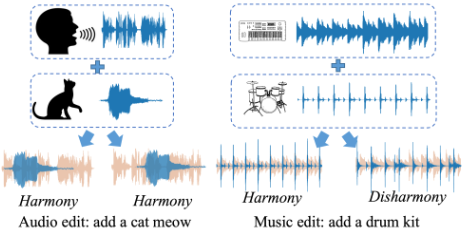
Lately, a multitude of endeavours pertaining to text-based image or audio manipulation [Hertz et al., 2022; Lugmayr et al., 2022; Meng et al., 2021; Wang et al., 2024] have attracted considerable attention due to their noteworthy performance within their respective domains. However, the distinct data properties and generative prerequisites inherent to the domain of music preclude the direct applicability of these methods to the sphere of music editing. In image editing, it is feasible to maintain consistency over the residual regions by employing masking techniques, thereby confining attention solely to the objects to be generated. However, this underlying principle proves inapplicable to the domain of musical data, as shown in Figure 1 the interwoven nature of individual tracks across both temporal and frequency domains prevents the straightforward implementation of such an approach. Perhaps the most similar method to ours is [Wang et al., 2024] for audio editing. However, the method is mainly applied to the editing of sound effects. Unlike music tracks, the individual sound effects are independent of each other, so there is no need to consider whether the sound effects are in harmony or not.
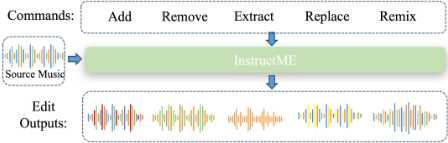
In order to bridge the gap between text-based generative models and music editing tasks, we propose InstructME, an instruction-guided music editing framework based on latent diffusion models. For simplicity, we limit music editing operations to adding, removing, extracting, replacing, and remixing. As shown in Figure 2, InstructME takes text instructions and source music as input, and outputs the target music accordingly. To maintain the consistency of the music before and after editing, we utilize the multiscale aggregation strategy and incorporate the chord progression matrix into the semantic space [Kwon et al., 2022; Jeong et al., 2023] during the source music encoding process to ensure harmony. During training, we employ the chunk transformer to model long-term temporal dependencies of music data in a segmented chunk-wise manner and train the model on collected 417 hours of music data. For testing, we evaluate the model in terms of three aspects: music quality, text relevance and harmony. Experimental results of public and private datasets demonstrate that InstructME outperforms the previous system.
Our key contributions can be summarized as:
- To the best of our knowledge, we propose the first instruction guided music editing framework applicable for both atomic and advanced operations.
- We point out the special problem of consistency and harmony in music editing domain and develop multi-scale aggregation and chord condition via chunk transformer to solve it.
- We propose quantitative evaluation metrics for music editing tasks in terms of quality, relevance and harmony.
- Our proposed method InstructME surpasses previous systems through thorough subjective and objective tests.
2 RelatedWork
2.1 Text Guided Generation
Generating a new version of accompaniment for a track directly with targeted properties (e.g. genre, mood, instruments) adhering is a viable approach to accomplish the objectives of editing or remixing. Recent studies [Huang et al., 2023b; Liu et al., 2023a; Agostinelli et al., 2023; Schneider et al., 2023; Huang et al., 2023a; Lam et al., 2023; Copet et al., 2023] have already succeeded in generating plausible music that reflects key music properties(e.g. genre, mood, etc) that are depicted in a given text. However, there is no guarantee for them to generate tracks that are harmonious with a given track while keeping the given one or specified part of it unchanged. Another work [Donahue et al., 2023] proposed a generative model, which trained over instrumentals given vocals, generating coherent instrumental music to accompany input vocals. But it has no way for users to control the generation process, not to mention interactive editing, which is important for an intelligent editing tool as it applies feedback from users to make a more preferable output as in [Holz, 2023].
2.2 Audio Editing andMusic Remixing
[Huang et al., 2023b; Liu et al., 2023a] propose zero-shot audio editing by utilizing pre-trained text-to-audio latent diffusion models, which seem flexible but not accurate enough for the editing process. Moreover, there is no guarantee for those audio generation models that are trained with general purposes to achieve a good editing effect in the editing specialized usage scenario. Due to this, AUDIT [Wang et al., 2024] proposed a general audio editing model based on a latent diffusion and denoising process guided by instructions. Certainly, as previously stated in the introduction section, this framework necessitates certain enhancements to effectively cater to music-related tasks.
For remixing, although the text-guided generative systems mentioned above can also perform generation conditions on a given recording [Liu et al., 2023a; Lam et al., 2023], or more specifically, melodies [Agostinelli et al., 2023; Copet et al., 2023], the generated music can only preserve the tune of the conditional melodies, the original tracks, such as vocal, will not directly feature in the output music. This kind of conditional-generated music is traditionally known as music covers, not remixes. Likewise, past studies [Yang et al., 2022; Yang and Lerch, 2020b; Wierstorf et al., 2017] have attempted to apply neural networks to the task of music remixing. These methods, which are often incorporated with source separation models, primarily viewed music remixing as a task of adjusting the gain of individual instrument sources of an audio mixture. But music remixing is not just limited to manipulating the gain of different sources of the recording itself, it can also involve incorporating other materials to create something new [Waysdorf, 2021].
3 Methodology
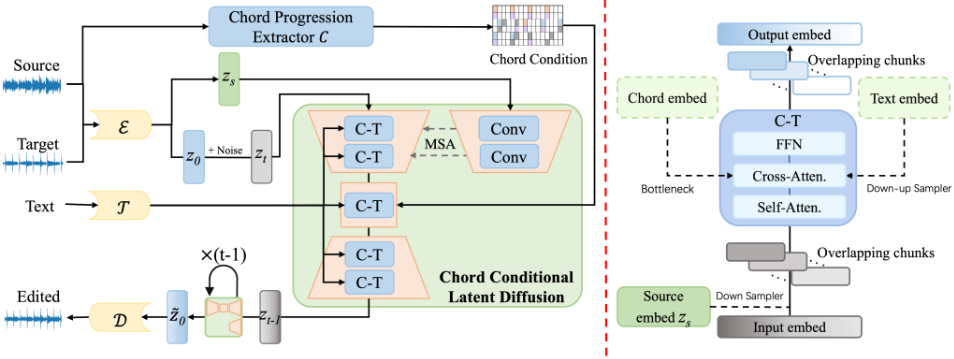
In this section, we will provide an overview of the InstructME architecture and the process of instruction-based music editing, as illustrated in Figure 3. Additionally, we will explain strategies aimed at improving editing consistency and harmony, as well as approaches to achieving more sophisticated music editing operations.
3.1 Instruction toMusic Editing
InstructME accepts music audio xs and editing instructions y as input, and produces new audio x that adheres to the given instructions. We utilize text and audio encoders to transform the data into a latent representation. For each text instruction y, a pretrained T5 [Raffel et al., 2020] converts it into sequence of embeddings T (y) ∈ RL×D , similar to [Wang et al., 2024]. For each audio segment xs ∈ RT×1 , a variational auto-encoder (VAE) transforms the waveform into a 2D latent embedding zs ∈ R Tr ×C . Using text and audio embeddings as conditions, a diffusion process [Song et al., 2020; Ho et al., 2020] produces embeddings of new audio samples, which the VAE decoder then converts to audio waveforms.
The VAE used by InstructME consists of an encoder E, a decoder D and a discriminator with stacked convolutional blocks. The decoder reconstructs the waveform ˆx from the latent space z and there is no vocoder like [Wang et al., 2024; Liu et al., 2023a]. The discriminator was used to enhance the sound quality of generated audio through adversarial training. We provide the model and training details in the Appendix.
Diffusion Model
Diffusion model contains two processes. The forward process is a standard Gaussian noise injection process. At time step t,
where αt = 1 - βt and ¯αt = ∏Tt=1 αt are scheduling hyperparameters. In the reverse process, we employ a time-conditional U-Net ϵθ [Ronneberger et al., 2015; Rombach et al., 2022] as the denoise model backbone. At time step t, conditioning on embeddings of text T (y) and source music zs, this denoise model attempts to restore the original latent z0 of target music from noisy zt. For model optimization, we use reweighted bound [Ho et al., 2020;
Rombach et al., 2022] as objective function:
with t uniformly sampled from [1, T] during the training. In the end, we pass z0 through the decoder D to obtain the waveform music.
The U-Net layers utilize transformers with self and cross attention as building blocks. In the down sampler layers, source audio embeddings and generated embeddings merge into the input of the self-attention layer. Cross attention is employed for text conditions in each down-up sampler layer, and for chord conditions in the bottleneck layer.
Efficient Diffusion
The self-attention of lengthy music sequences is computationally expensive. To alleviate this problem, we employ the chunk transformer to model long-term temporal dependencies in a chunk-wise manner, which is different from [Zha et al., 2021] in both architecture and motivation. Outlined in Figure 3 (Right), the process involves three steps: segmentation of T -frame embeddings into K-frame chunks with 50% overlap, individual chunk processing through a transformer layer, and fusion to merge overlapping output chunks into T frames by addition.
At each layer of the chunk transformer, a token from a Kframe chunk can observe 3K 2 neighboring frames. By stacking multiple layers of chunk transformer, the U-Net acquires an expansive receptive field, enabling effective modeling of long-term dependencies. Compared with oracle transformer's complexity O(T 2 ), chunk transformer has lower computational cost O(2 ∗ ⌈ TK ⌉ ∗ K2 ) = O(TK). In addition to faster inference and lower memory consumption, the chunkwise modeling approach decreases the model's reliance on sequence length, learning invariant representations. This minimizes performance degradation caused by duration differences in training and sampling.
3.2 Improving Consistency and Harmony
To make the diffusion model more suitable for music editing tasks, we propose an enhanced U-Net with several modifications including multi-scale aggregation and chord condition.
Multi-Scale Aggregation
Contrary to the music generation tasks [Huang et al., 2023a], music editing tasks require the preservation of certain content and properties from the original music. In order to maintain coherence between the original and edited music, AUDIT [Wang et al., 2024] directly concatenates the source music channel zt with the target music channel zs at the U-Net's input. It leans heavily on the invariance of some low-level and local music features, which might pose challenges or limitations when applied to more complex music manipulation tasks. To more effectively capture the high-level characteristics of the source music, we introduce a multi-scale aggregation (MSA) strategy as depicted in Figure 3 (Left). The source music embeddings zs are input to a multi-layer convolution encoder, yielding feature maps with varying resolutions for the corresponding U-Net layers. This strategy has been proven effective in high-resolution image generation [Karras et al., 2020].
Chord-Conditional
The Chord progression is a key element in defining a piece's musical harmony. We adopt a chord progression recognition model C [Cheuk et al., 2022] to extract the chord probability embedding p of the source music and then emphasize it explicitly during the denoise process. [Kwon et al., 2022; Jeong et al., 2023] discover the semantic latent space in the bottleneck of diffusion has nice properties to accommodate semantic image manipulation. Inspired by them, we incorporate the chord progression representation p ∈ Rdp×Tp in the bottleneck feature map h ∈ Rdh×Th of U-Net with crossattention mechanism [Vaswani et al., 2017]. With chord progression condition extracted by C, in the bottleneck layer of U-Net, the objective function in Equation 2 can be rewritten:
where ps denotes chord progression matrix of source music xs, encoded by extractor C.
3.3 Towards AdvancedMusic Editing - Remix
For diffusion models, there exist two primary strategies for achieving controllable generation. One of these is classifier guidance (CG) [Dhariwal and Nichol, 2021; Liu et al., 2023b], which utilizes a classifier during the sampling process and mixes its input gradient of the log probability with the score estimate of diffusion model. It is flexible and controllable, but tends to suffer a performance degradation [Ho and Salimans, 2022]. Another approach, named classifierfree guidance (CFG) [Ho and Salimans, 2022; Nichol et al., 2021; Ramesh et al., 2022; Saharia et al., 2022], achieves the same effect through training a conditional diffusion model directly without a guidance classifier. This method performs better but requires a large amount of data with diverse text descriptions, which is difficult for our InstructME trained with source-target paired data. In this work, to attain a tradeoff between quality and controllability, we adopt both classifier and classifier-free guidance to achieve the controllable editing of Remix operations.
We specify instrument and genre tags with CFG by incorporating these tags into text commands to train the conditional diffusion models. During the training, we discard our text condition y randomly with a certain probability pCFG following [Liu et al., 2023a; Wang et al., 2024]. Then, in the sampling, we can estimate the noise ˆ ϵθ(t, T (y), ps, zs, zt) with a linear combination of the conditional and unconditional score estimates:
where w can determine the strength of guidance.
To achieve finer-grained semantic control with weaklyassociated, free-form text annotations, we apply classifier guidance during sampling with a pre-trained MuLan [Huang et al., 2022], which can project the music audio and its corresponding text description into the same embedding space. The guidance function we use is:
where EL(·) and EM(·) denote the language and music encoders respectively. Then, by adding the gradient on estimated xt, we can guide the generation
with factor s to control the guidance scale.
4 Experiments Setup
4.1 Dataset
We collected 417 hours of music audio. Each audio file consists of multiple instrumental tracks. We resampled audios to 24khz sample rate and divided them into non-overlapping 10-second clips. For each audio clip, we select pairs of versions with varying instrument compositions and generate a text instruction based on the instrument differences. We use the clips generated before to prepare the triplet data <text instruction, source music, target music> including remixing (1 Million), adding (0.3M) and replacement (0.3M), extracting (0.2M) and removing (0.2M) respectively. These music triplet data are referred to as the 'in-house data'. We show our detailed data processing methods in Appendix.
Evaluation Data
We evaluate the models on both in-domain data and outdomain data. (1) In-domain data: We split the in-house data randomly into two parts and use one subset to generate triplet data for evaluating the models. (2) Out-domain data: To demonstrate the robustness of the system, we also evaluate the models on the Synthesized Lakh (Slakh) Dataset [Manilow et al., 2019] which is a dataset of multitrack audio and has no overlap with the training data.
4.2 EvaluationMetric
Music is sounds that are artificially organized in relation to the sensational moments, with complex interplay and multilayered perceptual impact between pitch, intensity, rhythm and timbre. Defining a single suitable metric to fully evaluate music is challenging, [Agostinelli et al., 2023; Huang et al., 2023a] focus evaluation on signal quality and semantics, whereas [Lv et al., 2023; Ren et al., 2020; Yang and Lerch, 2020a] propose more direct evaluation approach based on musicality indicators, in order to achieve a more comprehensive evaluation of music, we proposed the following metrics to objectively evaluate the performance of edited music in three aspects:
| Dataset | Model | Task | FADVGG(↓) | Instruction Acc. (↑) | Chord Rec. Acc. (↑) | Pitch His. (↑) | IO Interval (↑) |
|---|---|---|---|---|---|---|---|
| In-house | AUDIT | Extract | 1.67 | 0.39 | 0.82 | 0.62 | 0.54 |
| Remove | 1.73 | 0.65 | 0.86 | 0.64 | 0.53 | ||
| Add | 1.25 | 0.73 | 0.72 | 0.64 | 0.54 | ||
| Replace | 1.50 | 0.62 | 0.83 | 0.63 | 0.51 | ||
| Avg. | 1.54 | 0.60 | 0.81 | 0.63 | 0.53 | ||
| InstructME | Extract | 1.54 | 0.56 | 0.86 | 0.69 | 0.68 | |
| Remove | 1.68 | 0.80 | 0.88 | 0.72 | 0.66 | ||
| Add | 1.22 | 0.73 | 0.75 | 0.72 | 0.66 | ||
| Replace | 1.39 | 0.62 | 0.86 | 0.71 | 0.67 | ||
| Avg. | 1.45 | 0.68 | 0.84 | 0.71 | 0.67 | ||
| Slakh | AUDIT | Extract | 4.91 | 0.52 | 0.66 | 0.62 | 0.52 |
| Remove | 1.92 | 0.57 | 0.57 | 0.61 | 0.51 | ||
| Add | 3.11 | 0.87 | 0.58 | 0.63 | 0.47 | ||
| Replace | 4.08 | 0.78 | 0.55 | 0.62 | 0.47 | ||
| Avg. | 3.50 | 0.68 | 0.59 | 0.62 | 0.49 | ||
| InstructME | Extract | 5.04 | 0.66 | 0.71 | 0.70 | 0.71 | |
| Remove | 1.87 | 0.79 | 0.65 | 0.70 | 0.69 | ||
| Add | 3.15 | 0.87 | 0.66 | 0.74 | 0.67 | ||
| Replace | 3.97 | 0.83 | 0.65 | 0.74 | 0.69 | ||
| Avg. | 3.50 | 0.79 | 0.67 | 0.72 | 0.69 |
Music Quality : We use the fr´echet audio distance (FAD) 1 [Kilgour et al., 2019] to measure the quality between edited music and target music, the audio classification model is implemented with VGGish [Hershey et al., 2017].
Text Relevance : We define the instruction accuracy (IA) metric to indicate the relevance of the text-music pair, the proposed editing tasks are all related to music tags such as instrument, mood and genre, so we calculate instruction accuracy according to the edited music tags and input command while tags are recognized with tagging models which implemented with [Lu et al., 2021].
Harmony : We use three metrics for harmony evaluation,
- Chord Recognition Accuracy (CRA). Chord Recognition Accuracy measures the harmony coherence between edited music and target music. We acquire the chord progression sequences of both source and target music in the initial step, while the chord progression recognition model is implemented by [Cheuk et al., 2022]. Then the alignment of these sequences is computed to determine the chord recognition accuracy.
- Pitch Class Histogram (PCH) 2 : The pitch class his-
1 https://github.com/gudgud96/frechet-audio-distance
2 https://github.com/RichardYang40148/mgeval
togram is a pitch content representation that is octaveindependent. We calculate the distribution of pitches classes according to this histogram.
- Inter-Onset Interval (IOI) 2 : Inter-onset interval refers to the time between two note onsets within a bar. In our case, regarding PCH and IOI, we further compute the averaging overlapped area of their distributions to quantize the musical harmony in terms of pitch and onset aspects.
For objective evaluation, we generate 800 triplet data randomly for each music editing task and evaluate them with these objective metrics.
As for subjective evaluation, same as baseline AUDIT [Wang et al., 2024], we conduct overall testing following the standard Mean Opinion Score (MOS) evaluation procedure, which is widely used in measuring audio generation tasks [Huang et al., 2023b; Schneider et al., 2023].
5 Results and Analysis
5.1 Objective Evaluation Results
We compare against AUDIT [Wang et al., 2024] trained on the same data and in the same VAE latent space, as our baseline system in all experiments. As shown in Table 1, InstructME outperforms AUDIT in terms of music quality, text relevance and harmony. Specifically, operations such as extract and remove are tasks with definite answers, and these tasks emphasize the precision of generation. Alternatively, operations such as add, replace, and remix are tasks with indeterminate answers, and these tasks are more creatively oriented. These two types of tasks require the model to achieve stable and diverse output based on an accurate understanding of textual instructions. From Table 1, it is observed that InstructME improves musical quality by 5.84%, text relevance by 13.33% and harmony up to 26.42% compared to AUDIT on In-house dataset. These results demonstrate that our approach provides rich generated content in addition to capturing the difference between textual instructions.
| Model | FAD | IA | CRA | PCH | IOI |
| AUDIT | 0.49 | 0.69 | 0.59 | 0.60 | 0.46 |
|---|---|---|---|---|---|
| InstructME | 0.45 | 0.73 | 0.70 | 0.72 | 0.64 |
To study the generalization ability of InstructME, we also test it on the public available dataset Slakh [Manilow et al., 2019] which is more challenging in maintaining harmony by including unseen chord progressions. Table 1 shows that InstructME achieves comparable performance with AUDIT on musical quality but better results on text relevance and harmony. Particularly for chord recognition accuracy, our method surpasses the previous method by 13.56%.
As a novel and unique task proposed in this paper, we also evaluated the performance of InstructME and AUDIT on remix task. As Table 2 indicates, compared to AUDIT, InstructME achieves a significant improvement in harmony related metrics(CRA by 18.6%, PCH by 20% and IOI by 39%), and also achieves better results in quality and text relevance.
5.2 Subjective Evaluation Results
| Model | Duration | Quality | Relevance | Harmony |
|---|---|---|---|---|
| AUDIT | 10s 30s | 2.79±0.15 2.33±0.19 | 2.94±0.08 2.23±0.13 | 3.01±0.17 2.19±0.21 |
| 60s | 2.24±0.22 | 2.09±0.15 | 2.05±0.20 | |
| InstructME | 10s 30s | 3.35±0.13 2.62±0.20 | 3.59±0.10 3.05±0.16 2.93±0.17 | 3.54±0.14 2.63±0.23 2.48±0.21 |
| 60s | 2.62±0.24 |
We also conduct a subjective evaluation by outsourcing 10 testing samples(10s clip) per editing task for each labor. Mean Opinion Score(MOS) of scale 5 is used to compare the music quality, text relevance and harmony of two methods. To be more representative of real-world application scenarios, we also respectively generate 30-second and 60-second audio results, leveraging the chunk transformer's insensitivity to output length. A subjective evaluation of these generated long-duration music was also performed. We wrap all results in Table 3 and the MOS scores show the superiority of our method over the baseline.
5.3 Case Study
Chord Condition and Multi-Scale Aggregation
We perform ablation experiments to study the impact of the chord condition and multi-scale aggregation. The objective evaluation results of training InstructME without chord condition and multi-scale aggregation are listed in Table 4 respectively. The absence of chord conditioning is demonstrated to lead to a deterioration in harmony-related metrics such as CRA, PCH, and IOI. This observation underscores the critical role of the chord conditioning mechanism in holding the harmonicity of music editing. Moreover, the notable decline in FAD, subsequent to the deactivation of Multi-Scale Aggregation within the U-Net architecture, indicates its significant contribution to preserving the audio quality of music during the editing process.
| Metric | InstructME | w/o Chord Condition | w/o MSA |
|---|---|---|---|
| FAD(↓) | 1.45 | 1.46(↑ 0.01) | 1.53(↑ 0.08) |
| IA (↑) | 0.68 | 0.63(↓ 0.05) | 0.66(↓ 0.02) |
| CRA(↑) | 0.84 | 0.81(↓ 0.03) | 0.83(↓ 0.01) |
| PCH(↑) | 0.71 | 0.64(↓ 0.07) | 0.72(↑ 0.01) |
| IOI (↑) | 0.67 | 0.53(↓ 0.14) | 0.67(↓ 0.00) |
Consistency and Harmony
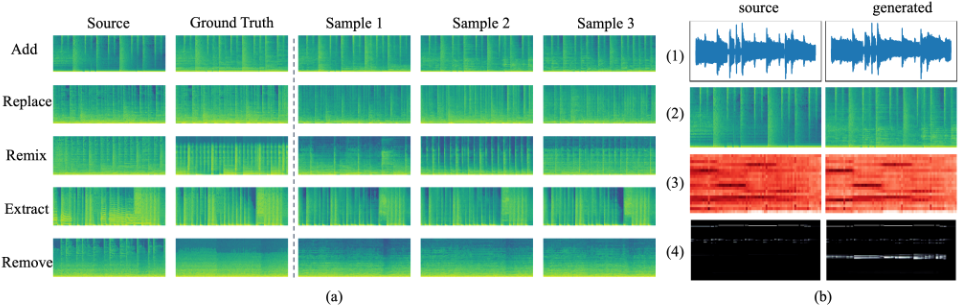
In Figure 4(b), we present an illustrative study to elucidate aspects of consistency and harmony. For example, we take "Add acoustic guitar" as the textual instruction. The waveforms in Figure 4(b)(1) indicate that the beat timings before and after editing are meticulously synchronized, which demonstrates InstructME's capacity to maintain temporal consistency through the editing process. The temporal consistency is also observed in the corresponding spectrograms in Figure 4(b)(2), which exhibit energy spikes at identical times. Subsequently, we proceed to extract and compare the chord progression matrices from the source and generated musical segments as portrayed in Figure 4(b)(3). The intensity of the color is indicative of the predicted chord probability. Upon scrutinizing the probability patterns between the source and generated music, it is concluded that our method is able to preserve the musical harmony of the source. The last row in Figure 4(b) is the pitch matrix. In this representation, the uppermost pair of white stripes corresponds to the pitch pertaining to the piano and drum, respectively. Remarkably, the mere variations of these two lines between source and generated music are evidence of the consistency maintenance. The third stripe corresponds to the guitar's pitch information. Furthermore, the absence of other instruments from the generated music validates our model's precise and controlled behavior.
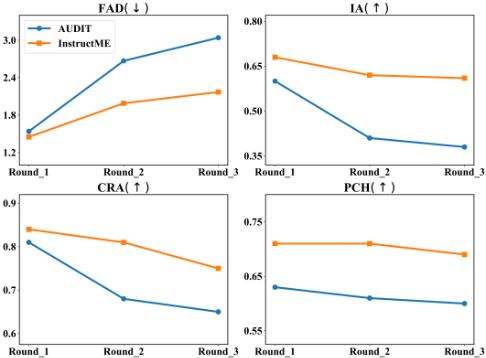
In pursuit of a more comprehensive understanding of our model's persistence in consistency and harmony, we undertake a series of multi-round editing experiments, which use different instructions to continuously edit music several times. Results are listed in Figure 5. Notably, both our method and the baseline approaches suffer a gradual diminishment in performance as the iterative editing processes unfold. However, InstructME exhibits relatively slight degradation, especially in CRA and PCH, which can reflect the harmony of music. Importantly, the remaining metrics remain well within an acceptable range, attesting to the robustness of the model's performance.
As mentioned in Section 5.1, different editing operations require different modeling capabilities. For example, the remix demands diversity because of different creative interpretations of the same sound source. However, the removal operation requires stability as the model should generate accurate and unique results. We also conducted visualization explorations for different tasks, as depicted in Figure 4(a). Each row contains the source music, the ground truth and three samples generated by InstructME. For tasks requiring precision, our model consistently generates results congruent with the ground truth. For creativity-oriented tasks, the visual representation illustrates the diversity present in the spectrogram of the sampled music segments. The subjective results of diversity and stability are listed in Table 5, which underscore the capacity of InstructME to conceive and construe novel compositions derived from existing audio sources.
We strongly encourage readers to learn about the performance of our model through demos at https://musicedit.
| Model | Diversity | Stability |
|---|---|---|
| Tasks | Add,Replace,Remix | Extract,Remove |
| AUDIT | 3.12 ± 0.18 | 3.77 ± 0.09 |
| InstructME | 3.37 ± 0.14 | 4.02 ± 0.08 |
6 Conclusion
In this work, we introduce InstructME, a music editing and remixing framework based on latent diffusion models. For InstructME, we enhance the U-Net with multi-scale aggregation and chord condition to improve the harmony and consistency of edited music, and introduce chunk transformer to extend the long-term music generation capabilities. To evaluate the efficacy of music editing results, we establish several quantitative metrics and conduct experimental trials to validate them. Our findings indicate that the proposed InstructME outperforms the baselines in both subjective and objective experiments, which shows that our InstructME can effectively edit source music based on simple editing instructions, while preserving certain musical components and generating harmonious results that align with the semantic information conveyed in the instructions.
Acknowledgements
Work was done during Bing Han's internship at ByteDance. All authors conceive the paper's methodology and experiments. Bing Han and Junyu Dai contributed equally to this work. Yanmin Qian is the corresponding author. Bing Han and Yanmin Qian were supported in part by China NSFC projects under Grants 62122050 and 62071288, in part by Shanghai Municipal Science and Technology Commission Project under Grant 2021SHZDZX0102.
@inproceedings{ijcai2024p645,
  title     = {InstructME: An Instruction Guided Music Edit Framework with Latent Diffusion Models},
  author    = {Han, Bing and Dai, Junyu and Hao, Weituo and He, Xinyan and Guo, Dong and Chen, Jitong and Wang, Yuxuan and Qian, Yanmin and Song, Xuchen},
  booktitle = {Proceedings of the Thirty-Third International Joint Conference on
               Artificial Intelligence, {IJCAI-24}},
  publisher = {International Joint Conferences on Artificial Intelligence Organization},
  editor    = {Kate Larson},
  pages     = {5835--5843},
  year      = {2024},
  month     = {8},
  note      = {Main Track},
  doi       = {10.24963/ijcai.2024/645},
  url       = {https://doi.org/10.24963/ijcai.2024/645},
}
TY - CPAPER TI - InstructME: An Instruction Guided Music Edit Framework with Latent Diffusion Models AU - Han, Bing AU - Dai, Junyu AU - Hao, Weituo AU - He, Xinyan AU - Guo, Dong AU - Chen, Jitong AU - Wang, Yuxuan AU - Qian, Yanmin AU - Song, Xuchen T2 - Proceedings of the Thirty-Third International Joint Conference on Artificial Intelligence, IJCAI-24 PB - International Joint Conferences on Artificial Intelligence Organization PY - 2024 SP - 5835 EP - 5843 DO - 10.24963/ijcai.2024/645 UR - https://doi.org/10.24963/ijcai.2024/645 ER -Copied
Machine-readable versions of this paper, for tools and AI agents:





