
TaD: A Plug-and-Play Task-Aware Decoding Method to Better Adapt LLMs on Downstream Tasks
Proceedings of the Thirty-Third International Joint Conference on Artificial Intelligence. Main Track. Pages 6587-6596.
https://doi.org/10.24963/ijcai.2024/728
Keywords
- Natural Language Processing: NLP: Language generation
- Natural Language Processing: NLP: Applications
- Natural Language Processing: NLP: Language models
Abstract
Fine-tuning pre-trained models on downstream tasks is a common practice in leveraging large language models (LLMs) today. A critical issue is how to adapt pre-trained models to downstream tasks better, thereby enhancing their performance. This paper introduces Task-aware Decoding (TaD), a plug-and-play method that exploits the difference in probability distributions before and after fine-tuning to boost the performance of LLMs on downstream tasks. The proposed TaD argues that the difference between the pre-finetuning probability distribution and the post-finetuning one represents the direction from common knowledge towards specific downstream-task knowledge. Aligning the final output probability distribution to that direction can probably result in superior downstream task performance, compared to the original fine-tuned model. Experiments on various datasets across four different task categories well demonstrate TaD's effectiveness on different LLMs, i.e., GPT, BLOOM, and LLaMA, with different fine-tuning methods. Moreover, further experiments reveal that TaD better enhances model performance in data-scarce scenarios.
- [Bisk et al., 2020] Yonatan Bisk, Rowan Zellers, Ronan Le Bras, Jianfeng Gao, and Yejin Choi. Piqa: Reason- ing about physical commonsense in natural language. In Thirty-Fourth AAAI Conference on Artificial Intelligence, 2020.
- [Brown et al., 2020] Tom Brown, Benjamin Mann, Nick Ry- der, Melanie Subbiah, Jared D Kaplan, Prafulla Dhari- wal, Arvind Neelakantan, Pranav Shyam, Girish Sastry, Amanda Askell, et al. Language models are few-shot learners. Advances in neural information processing sys- tems, 33:1877-1901, 2020.
- [Chen et al., 2020] Hui Chen, Guiguang Ding, Xudong Liu, Zijia Lin, Ji Liu, and Jungong Han. Imram: Iterative matching with recurrent attention memory for cross-modal image-text retrieval. In Proceedings of the IEEE/CVF con- ference on computer vision and pattern recognition, pages 12655-12663, 2020.
- [Christiano et al., 2017] Paul F Christiano, Jan Leike, Tom Brown, Miljan Martic, Shane Legg, and Dario Amodei. Deep reinforcement learning from human preferences. Advances in neural information processing systems, 30, 2017.
- [Chuang et al., 2023] Yung-Sung Chuang, Yujia Xie, Hongyin Luo, Yoon Kim, James Glass, and Pengcheng He. Dola: Decoding by contrasting layers improves factuality in large language models. arXiv preprint arXiv:2309.03883, 2023.
- [Clark et al., 2019] Christopher Clark, Kenton Lee, Ming- Wei Chang, Tom Kwiatkowski, Michael Collins, and Kristina Toutanova. BoolQ: Exploring the surprising dif- ficulty of natural yes/no questions. In Proceedings of the 2019 Conference of the North American Chapter of the Association for Computational Linguistics: Human Lan- guage Technologies, Volume 1 (Long and Short Papers), pages 2924-2936, Minneapolis, Minnesota, June 2019. Association for Computational Linguistics.
- [Cobbe et al., 2021] Karl Cobbe, Vineet Kosaraju, Moham- mad Bavarian, Jacob Hilton, Reiichiro Nakano, Christo- pher Hesse, and John Schulman. Training verifiers to solve math word problems. arXiv preprint arXiv:2110.14168, 2021.
- [Ding et al., 2021] Xiaohan Ding, Xiangyu Zhang, Ningning Ma, Jungong Han, Guiguang Ding, and Jian Sun. Repvgg: Making vgg-style convnets great again. In Proceedings of the IEEE/CVF conference on computer vision and pattern recognition, pages 13733-13742, 2021.
- [Ding et al., 2023] Ning Ding, Yujia Qin, Guang Yang, Fuchao Wei, Yang Zonghan, Yusheng Su, Shengding Hu, Yulin Chen, Chi-Min Chan, Weize Chen, Jing Yi, Weilin Zhao, Xiaozhi Wang, Zhiyuan Liu, Hai-Tao Zheng, Jianfei Chen, Yang Liu, Jie Tang, Juanzi Li, and Maosong Sun. Parameter-efficient fine-tuning of large-scale pre-trained language models. Nature Machine Intelligence, 5:1-16, 03 2023.
- [Fan et al., 2018] Angela Fan, Mike Lewis, and Yann Dauphin. Hierarchical neural story generation. In Pro- ceedings of the 56th Annual Meeting of the Association for Computational Linguistics (Volume 1: Long Papers). Association for Computational Linguistics, 2018.
- [Gera et al., 2023] Ariel Gera, Roni Friedman, Ofir Arviv, Chulaka Gunasekara, Benjamin Sznajder, Noam Slonim, and Eyal Shnarch. The benefits of bad advice: Autocon- trastive decoding across model layers. In Anna Rogers, Jordan Boyd-Graber, and Naoaki Okazaki, editors, Pro- ceedings of the 61st Annual Meeting of the Association for Computational Linguistics (Volume 1: Long Papers), pages 10406-10420, Toronto, Canada, July 2023. Associ- ation for Computational Linguistics.
- [He et al., 2022] Junxian He, Chunting Zhou, Xuezhe Ma, Taylor Berg-Kirkpatrick, and Graham Neubig. Towards a unified view of parameter-efficient transfer learning. In International Conference on Learning Representations, 2022.
- [Hernandez et al., 2023] Evan Hernandez, Belinda Z Li, and Jacob Andreas. Measuring and manipulating knowl- edge representations in language models. arXiv preprint arXiv:2304.00740, 2023.
- [Holtzman et al., 2019] Ari Holtzman, Jan Buys, Li Du, Maxwell Forbes, and Yejin Choi. The curious case of neural text degeneration. In International Conference on Learning Representations, 2019.
- [Houlsby et al., 2019] Neil Houlsby, Andrei Giurgiu, Stanis- law Jastrzebski, Bruna Morrone, Quentin de Laroussilhe, Andrea Gesmundo, Mona Attariyan, and Sylvain Gelly. Parameter-efficient transfer learning for nlp. In Interna- tional Conference on Machine Learning, 2019.
- [Hu et al., 2021] Edward J Hu, Yelong Shen, Phillip Wallis, Zeyuan Allen-Zhu, Yuanzhi Li, Shean Wang, Lu Wang, and Weizhu Chen. Lora: Low-rank adaptation of large language models. arXiv preprint arXiv:2106.09685, 2021.
- [Hu et al., 2023] Zhiqiang Hu, Lei Wang, Yihuai Lan, Wanyu Xu, Ee-Peng Lim, Lidong Bing, Xing Xu, Sou- janya Poria, and Roy Lee. LLM-adapters: An adapter fam- ily for parameter-efficient fine-tuning of large language models. In Houda Bouamor, Juan Pino, and Kalika Bali, editors, Proceedings of the 2023 Conference on Empirical Methods in Natural Language Processing, pages 5254- 5276, Singapore, December 2023. Association for Com- putational Linguistics.
- [Kadavath et al., 2022] Saurav Kadavath, Tom Conerly, Amanda Askell, Tom Henighan, Dawn Drain, Ethan Perez, Nicholas Schiefer, Zac Hatfield Dodds, Nova Das- Sarma, Eli Tran-Johnson, et al. Language models (mostly) know what they know. arXiv preprint arXiv:2207.05221, 2022.
- [Lester et al., 2021] Brian Lester, Rami Al-Rfou, and Noah Constant. The power of scale for parameter-efficient prompt tuning. In Marie-Francine Moens, Xuanjing Huang, Lucia Specia, and Scott Wen-tau Yih, editors, Pro- ceedings of the 2021 Conference on Empirical Methods in Natural Language Processing, EMNLP 2021, Virtual Event / Punta Cana, Dominican Republic, 7-11 November, 2021, pages 3045-3059. Association for Computational Linguistics, 2021.
- [Li and Liang, 2021] Xiang Lisa Li and Percy Liang. Prefix- tuning: Optimizing continuous prompts for generation. In Chengqing Zong, Fei Xia, Wenjie Li, and Roberto Navigli, editors, Proceedings of the 59th Annual Meeting of the As- sociation for Computational Linguistics and the 11th In- ternational Joint Conference on Natural Language Pro- cessing, ACL/IJCNLP 2021, (Volume 1: Long Papers), Virtual Event, August 1-6, 2021, pages 4582-4597. As- sociation for Computational Linguistics, 2021.
- [Li et al., 2022] Yuchao Li, Fuli Luo, Chuanqi Tan, Mengdi Wang, Songfang Huang, Shen Li, and Junjie Bai. Parameter-effcient sparsity for large language models fine- tuning. In Proceedings of the Thirty-First International Joint Conference on Artificial Intelligence, IJCAI 2022, Vienna, Austria, 23-29 July 2022, pages 4223-4229. ij- cai.org, 2022.
- [Li et al., 2023a] Kenneth Li, Aspen K Hopkins, David Bau, Fernanda Viégas, Hanspeter Pfister, and Martin Watten- berg. Emergent world representations: Exploring a se- quence model trained on a synthetic task. In The Eleventh International Conference on Learning Representations, 2023.
- [Li et al., 2023b] Kenneth Li, Oam Patel, Fernanda Viégas, Hanspeter Pfister, and Martin Wattenberg. Inference-time intervention: Eliciting truthful answers from a language model. arXiv preprint arXiv:2306.03341, 2023.
- [Li et al., 2023c] Xiang Lisa Li, Ari Holtzman, Daniel Fried, Percy Liang, Jason Eisner, Tatsunori Hashimoto, Luke Zettlemoyer, and Mike Lewis. Contrastive decoding: Open-ended text generation as optimization. In Anna Rogers, Jordan Boyd-Graber, and Naoaki Okazaki, edi- tors, Proceedings of the 61st Annual Meeting of the As- sociation for Computational Linguistics (Volume 1: Long Papers), pages 12286-12312, Toronto, Canada, July 2023. Association for Computational Linguistics.
- [Lin et al., 2022] Stephanie Lin, Jacob Hilton, and Owain Evans. Truthfulqa: Measuring how models mimic human falsehoods. In Proceedings of the 60th Annual Meeting of the Association for Computational Linguistics (Volume 1: Long Papers), pages 3214-3252, 2022.
- [Muennighoff et al., 2022] Niklas Muennighoff, Thomas Wang, Lintang Sutawika, Adam Roberts, Stella Bider- man, Teven Le Scao, M Saiful Bari, Sheng Shen, Zheng- Xin Yong, Hailey Schoelkopf, et al. Crosslingual gen- eralization through multitask finetuning. arXiv preprint arXiv:2211.01786, 2022. [
- [OpenAI, 2023] OpenAI. Gpt-4 technical report. arXiv preprint arXiv:2303.08774, 2023.
- [Ouyang et al., 2022] Long Ouyang, Jeff Wu, Xu Jiang, Diogo Almeida, Carroll L. Wainwright, Pamela Mishkin, Chong Zhang, Sandhini Agarwal, Katarina Slama, Alex Ray, John Schulman, Jacob Hilton, Fraser Kelton, Luke Miller, Maddie Simens, Amanda Askell, Peter Welinder, Paul F. Christiano, Jan Leike, and Ryan Lowe. Training language models to follow instructions with human feed- back. CoRR, abs/2203.02155, 2022.
- [Pfeiffer et al., 2020] Jonas Pfeiffer, Ivan Vulić, Iryna Gurevych, and Sebastian Ruder. MAD-X: An Adapter- Based Framework for Multi-Task Cross-Lingual Transfer. In Bonnie Webber, Trevor Cohn, Yulan He, and Yang Liu, editors, Proceedings of the 2020 Conference on Empiri- cal Methods in Natural Language Processing (EMNLP), pages 7654-7673, Online, November 2020. Association for Computational Linguistics.
- [Roy and Roth, 2016] Subhro Roy and Dan Roth. Solv- ing general arithmetic word problems. arXiv preprint arXiv:1608.01413, 2016.
- [Sanh et al., 2022] Victor Sanh, Albert Webson, Colin Raf- fel, Stephen Bach, Lintang Sutawika, Zaid Alyafeai, An- toine Chaffin, Arnaud Stiegler, Arun Raja, Manan Dey, et al. Multitask prompted training enables zero-shot task generalization. In International Conference on Learning Representations, 2022.
- [Subramani et al., 2022] Nishant Subramani, Nivedita Suresh, and Matthew E Peters. Extracting latent steering vectors from pretrained language models. arXiv preprint arXiv:2205.05124, 2022.
- [Sutskever et al., 2014] Ilya Sutskever, Oriol Vinyals, and Quoc V Le. Sequence to sequence learning with neural networks. Advances in neural information processing sys- tems, 27, 2014.
- [Touvron et al., 2023] Hugo Touvron, Thibaut Lavril, Gau- tier Izacard, Xavier Martinet, Marie-Anne Lachaux, Tim- othée Lacroix, Baptiste Rozière, Naman Goyal, Eric Ham- bro, Faisal Azhar, et al. Llama: Open and efficient founda- tion language models. arXiv preprint arXiv:2302.13971, 2023.
- [Turner et al., 2023] Alex Turner, Monte M, David Udell, Lisa Theirgart, and Ulisse Mini. Steering gpt-2-xl by adding an activation vector, May 2023.
- [Wang and Komatsuzaki, 2021] Ben Wang and Aran Ko- matsuzaki. GPT-J-6B: A 6 Billion Parameter Autore- gressive Language Model. https://github.com/kingoflolz/ mesh-transformer-jax, May 2021. Link
- [Wang et al., 2023] Ao Wang, Hui Chen, Zijia Lin, Hengjun Pu, and Guiguang Ding. Repvit: Revisiting mobile cnn from vit perspective. arXiv preprint arXiv:2307.09283, 2023.
- [Wei et al., 2021] Jason Wei, Maarten Bosma, Vincent Zhao, Kelvin Guu, Adams Wei Yu, Brian Lester, Nan Du, An- drew M Dai, and Quoc V Le. Finetuned language mod- els are zero-shot learners. In International Conference on Learning Representations, 2021.
- [Xiong et al., 2024] Yizhe Xiong, Hui Chen, Tianxiang Hao, Zijia Lin, Jungong Han, Yuesong Zhang, Guoxin Wang, Yongjun Bao, and Guiguang Ding. Pyra: Parallel yield- ing re-activation for training-inference efficient task adap- tation. arXiv preprint arXiv:2403.09192, 2024.
References were extracted automatically from the PDF and may contain errors.
Full text extracted automatically from the PDF; figures, tables and equations may differ. The PDF is the version of record.
1 Introduction
Large language models, including closed-source models like ChatGPT and GPT-4 [OpenAI, 2023], as well as open-source models such as LLaMA [Touvron et al., 2023], have exhibited remarkable performance in a wide range of tasks [Brown et al., 2020; Ding et al., 2021; Wang et al., 2023; Chen et al., 2020]. Such success is largely due to diverse techniques explored to enhance the pre-trained LLMs in downstream tasks. Among those methods, fine-tuning is a common strategy and has been thoroughly investigated in the literature. It mainly focuses on designing better fine-tuning methods from the algorithmic side [Ding et al., 2023; Hu et al.,
∗Corresponding author
2021], or constructing more effective datasets from the data side [Christiano et al., 2017]. For example, the ParameterEfficient Fine-Tuning (PEFT) methods [Houlsby et al., 2019; Lester et al., 2021; Li and Liang, 2021] stand out among various fine-tuning methods due to their cost-efficient nature and impressive performance. Concurrently, a multitude of highquality, manually annotated datasets have been constructed, as an increasingly focal technique aimed at aligning the outputs of LLMs with human-like responses [Ouyang et al., 2022].
Despite their remarkable success, existing fine-tuning works rarely investigate the inherent knowledge acquisition of fine-tuned LLMs. Recent works indicate that the outputs of pre-trained LLMs do not always accurately reflect the knowledge they possess. Even if a model generates an incorrect output, it may still possess correct knowledge. For example, [Li et al., 2023b] suggests that the intermediate representations in pre-trained LLMs might be correct, even if the final output is erroneous. [Kadavath et al., 2022] finds that pretained LLMs can self-assess their correctness. Therefore, we pose a question: How can we leverage such inherent knowledge in the fine-tuned LLMs to enhance their performance in downstream tasks? Intuitively, the inherent knowledge within fine-tuned LLMs should be reflected by their token-predicting behavior alterations during the fine-tuning process. We argue that such token-predicting behavior alterations indicate an adaptive shift from common knowledge gained via pretraining to specific knowledge for downstream tasks. And we can improve the adaptation of LLMs on downstream tasks by manually mining and leveraging such inherent knowledge, regardless of the fine-tuning methods.
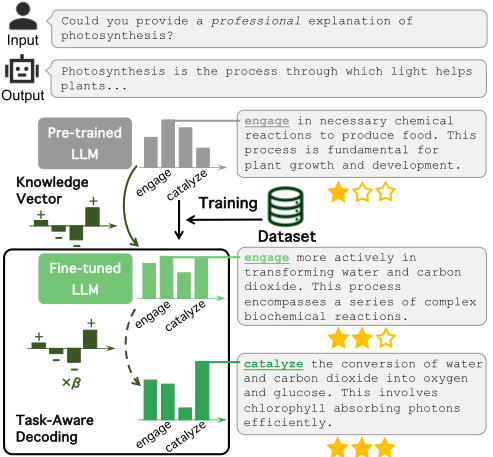
In this paper, we propose a novel Task-aware Decoding (TaD) method, which takes advantage of the differences in knowledge before and after fine-tuning to enhance the adaptation of LLMs on downstream tasks. Firstly, we formulate the knowledge difference as a knowledge vector to explicitly denote the direction of knowledge adaptation (or domain adaptation) learned by a pre-trained LLM during fine-tuning for a downstream task. As illustrated in Figure 1, though the fine-tuned LLM (i.e., after fine-tuning) outputs the same token "engage" as the pre-trained LLM (i.e., before fine-tuning) for the next token, the shift of the corresponding predicted probability distributions from the latter to the former implicitly reflects how the LLM adapts its knowledge to the downstream task during fine-tuning. Specifically, the predicted probability w.r.t the more professional token "catalyze" increases, while that w.r.t the less professional token "engage" actually decreases. Therefore, here we construct the knowledge vector based on the difference of output probability distributions w.r.t tokens from the pre-trained and the fine-tuned LLMs, which also reveals the output token preferences for downstream tasks. Given that tokens are inherently semantic, the knowledge vector naturally possesses semantic information. We then implement our proposed TaD by enhancing the fine-tuned LLM's output probability distribution with the knowledge vector, thereby reinforcing the model's knowledge adaptation to downstream tasks for better performance. Figure 1 shows that, with TaD to enhance the output probability distribution with the knowledge vector, the fine-tuned LLM can then generate a more professional next token "catalyze", instead of "engage". In that manner, the enhanced LLM can finally yield a better answer with more professional words, including "catalyze","oxygen","glucose","chlorophyll", etc. The proposed TaD is a plug-and-play decoding method, and extensive experiments well demonstrate that it can enhance the performance of various fine-tuned LLMs in many downstream tasks.
In summary, our contributions are as follows:
- To enhance the adaptation of LLMs to downstream tasks, we propose a concept of knowledge vector, which explicitly denotes the knowledge adaptation learned by LLMs during fine-tuning.
- We further develop TaD to enhance fine-tuned LLMs' output probability distribution w.r.t tokens with the knowledge vector, and enhance their performance in downstream tasks.
- We conduct extensive experiments to validate the effectiveness of TaD across various tasks, models, and finetuning methods. Experimental results well demonstrate its superiority over baselines and promising potential in data-scarce scenarios.
2 RelatedWork
2.1 Adapting LLMs for DownstreamTasks
Many efforts tackle the challenge of adapting pre-trained LLMs for downstream tasks by focusing on both fine-tuning techniques and the construction of training datasets [Ding et al., 2023; Christiano et al., 2017]. Among various fine-tuning techniques, PEFT methods [Hu et al., 2021; He et al., 2022; Ding et al., 2023; Xiong et al., 2024], due to their capability of freezing most model parameters while yielding impressive performance, have drawn much attention from the community. And thus recently PEFT methods specifically for LLMs, like [Houlsby et al., 2019; Li and Liang, 2021; Li et al., 2022], have been proposed. Concurrently, for aligning LLM's behaviors with human-like responses, fine-tuning LLMs typically requires manually labeled datasets [Ouyang et al., 2022], which incurs significant costs. In contrast, some studies construct high-quality training datasets by maximizing the utilization of existing datasets. For example, [Sanh et al., 2022] enriches the training instances by inverting inputoutput pairs of existing instances with specially crafted task descriptions. [Wei et al., 2021] augments labeled datasets with human-written task descriptions to instruct LLMs to understand the tasks.
Aside from those efforts, there are initiatives that enhance LLMs by focusing on their intrinsic features. [Li et al., 2023a; Hernandez et al., 2023] employs post-pretraining activation editing to modulate LLM behaviors. [Subramani et al., 2022; Turner et al., 2023] demonstrate that steering vectors, whether trained or manually selected, effectively facilitate style transfer in LLMs. ITI [Li et al., 2023b] enhances LLMs' performance in downstream tasks by discovering vectors for activations based on positive and negative instances. Our TaD follows a similar direction. But it opts for the differences in output probability distributions w.r.t tokens as the direction of knowledge adaptation, and derives a knowledge vector to enhance the performance of fine-tuned LLMs.
2.2 Decoding Strategies for LLMs
Decoding strategies are critical for LLMs, which significantly affect the generation quality. Basic decoding strategies include Greedy Search, Beam Search [Sutskever et al., 2014], Top-k Sampling [Fan et al., 2018], and Top-p (Nucleus) Sampling [Holtzman et al., 2019]. Greedy Search always selects the most probable next token, one by one. While efficient, it tends to yield repetitive text. In contrast, Beam Search maintains and expands multiple hypotheses for superior sequences. Top-k Sampling, choosing from highly probable tokens, injects diversity but may compromise coherence. Building on that, Top-p Sampling dynamically adjusts the selection pool based on the cumulative probability, targeting at a balance between randomness and coherence for more engaging outputs.
Additionally, there exists a range of incremental works, which can be integrated with and effectively optimize those basic strategies. Within this scope, the contrastive decoding series serves as a prime example. CD [Li et al., 2023c] utilizes the likelihood difference between a large language model and a small one to produce higher-quality texts. Furthermore, ACD [Gera et al., 2023] improves upon CD by maximizing log-probability differences across different layers in a single model. DoLa [Chuang et al., 2023] extends ACD's principles, integrating Jensen-Shannon divergence to dynamically choose layers for contrastive decoding. Those decoding strategies, however, are primarily focused on the performance of pre-trained LLMs, neglecting the changes in models after fine-tuning. Consequently, they fail to utilize the knowledge adaptation learned during fine-tuning, resulting in limited performance improvement or even performance decline in downstream tasks when applied to fine-tuned LLMs. On the contrary, our proposed TaD focuses on fine-tuned LLMs, and we define a knowledge vector to denote knowledge adaptation for downstream tasks. TaD is a plug-andplay method that can be natively integrated with those basic decoding strategies above to enhance the performance of finetuned LLMs in downstream tasks.
3 Method
In this section, we first discuss the construction of the knowledge vector, then detail the process of the proposed TaD, during which we utilize the knowledge vector to improve LLMs' outputs for a better adaptation to downstream tasks.
3.1 Constructing the Knowledge Vector
For a pre-trained language model θ, the conditional probability distribution for tokens is modeled as follows:
where V denotes the vocabulary and t represents the token's position. After applying a fine-tuning method Φ on the pretrained model θ, we get a fine-tuned model ϕ:
where Φ can be any fine-tuning method like LoRA, AdapterP, etc., and D denotes the training set for a downstream task. Similarly, for the fine-tuned model ϕ, the conditional probability distribution for tokens is formulated as Eq. 3:
Given the finite size of vocabulary V, at each position t, both pθ(xt|x<t) and pϕ(xt|x<t) can be viewed as coordinates in a |V|-dimensional space. Consequently, we can derive a |V|- dimensional vector VK on the logit scale, extending from the fine-tuning start point pS (i.e., θ) to the fine-tuning endpoint pE (i.e., ϕ):VK = pE - pS
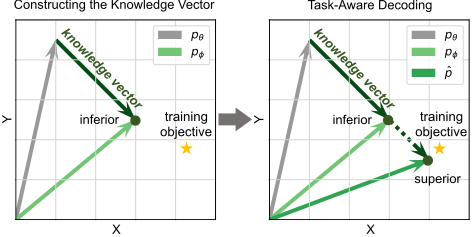
VK reflects the shift in conditional probability distributions during fine-tuning, representing a directional move from the common knowledge to the task-specific knowledge. Notably, VK directly shows the influence of fine-tuning on the model's output probability distribution, and thus also enhances the interpretability of the fine-tuning process.
It is important to note that VK may exhibit false positive cases, as mentioned in CD [Li et al., 2023c]. For example, tokens with extremely low pϕ and pθ (e.g., 10-5 and 10-10 ) might have disproportionately high VK values, misleadingly indicating an incorrect direction in the corresponding dimension (i.e., token). Therefore, we introduce a constraint function Ct to ensure the probability values of tokens output by fine-tuned model ϕ are at least α times the maximum token probability:
where α ranges from 0 to 1.
Moreover, the indicator function I(xt),
determines whether a token xt satisfies the constraint function Ct. We then introduce a penalty coefficient λ to penalize tokens that violate the constraint function, while maintaining the original values of VK for all others. This adjustment yields a revised ˆ VK, which can effectively prevent false positive cases, as follows:
Then we have the final knowledge vector ˆ VK .
| Model | Method | Multiple Choices | CBQA | ||
|---|---|---|---|---|---|
| MC1 | MC2 | MC3 | True*Info | ||
| LoRA | 30.6 | 51.3 | 25.6 | 35.7 | |
| +TaD | 33.0 | 52.5 | 27.1 | 37.0 | |
| AdapterP | 34.9 | 54.3 | 28.0 | 51.5 | |
| GPT-J-6b +TaD | 38.2 | 55.5 | 29.5 | 51.7 | |
| AdapterH | 36.4 | 55.0 | 28.5 | 53.0 | |
| +TaD | 38.3 | 55.8 | 28.7 | 55.3 | |
| Parallel | 34.3 | 54.0 | 27.7 | 47.2 | |
| +TaD | 37.5 | 55.1 | 28.9 | 47.4 | |
| LoRA | 30.8 | 51.4 | 25.7 | 17.4 | |
| +TaD | 32.8 | 52.3 | 27.2 | 17.5 | |
| AdapterP | 35.3 | 53.8 | 28.5 | 20.6 | |
| BLOOMz-7b +TaD | 35.7 | 54.8 | 28.4 | 20.7 | |
| AdapterH | 36.8 | 54.5 | 28.9 | 50.3 | |
| +TaD | 37.9 | 55.2 | 29.2 | 50.8 | |
| Parallel | 34.5 | 53.6 | 28.2 | 21.8 | |
| +TaD | 36.5 | 54.4 | 28.5 | 22.7 | |
| Model | Method | Multiple Choices | CBQA | ||
|---|---|---|---|---|---|
| MC1 | MC2 | MC3 | True*Info | ||
| LoRA | 32.9 | 55.0 | 28.5 | 49.1 | |
| +TaD | 34.2 | 55.7 | 29.0 | 51.2 | |
| AdapterP | 38.1 | 57.4 | 30.8 | 61.4 | |
| LLaMa-7b +TaD | 40.6 | 58.5 | 32.1 | 61.8 | |
| AdapterH | 37.8 | 57.6 | 30.3 | 60.3 | |
| +TaD | 39.8 | 59.0 | 32.0 | 61.0 | |
| Parallel | 37.0 | 56.3 | 29.5 | 54.3 | |
| +TaD | 39.5 | 57.0 | 30.4 | 55.2 | |
| LoRA | 33.4 | 55.7 | 29.0 | 54.1 | |
| +TaD | 35.1 | 56.7 | 29.7 | 54.7 | |
| AdapterP | 40.6 | 58.8 | 32.4 | 58.6 | |
| LLaMa-13b +TaD | 42.6 | 60.0 | 33.1 | 60.0 | |
| AdapterH | 38.2 | 57.0 | 30.4 | 61.8 | |
| +TaD | 39.5 | 57.8 | 31.2 | 63.3 | |
| Parallel | 39.8 | 58.2 | 31.7 | 60.0 | |
| +TaD | 42.0 | 60.2 | 33.8 | 61.6 | |
3.2 Task-Aware Decoding
With the constructed knowledge vector, i.e., ˆ VK in Eq. 7, we advance the probability outputs of the fine-tuned model in the direction indicated by the knowledge vector, effectively amplifying the downstream task knowledge adaptation learned during fine-tuning. It is important to note that ˆ VK is not a probability distribution. Hence, we apply the softmax function to convert it into a probability distribution:
Then we obtain the probability distribution ˆ p w.r.t xt output by TaD, via merging pϕ(xt|x<t) and pK(xt|x<t) with a weighting parameter µ.
With the improved output probability distribution w.r.t xt, i.e., ˆ p(xt|x<t), we can simply apply various basic decoding methods like Greedy Search for text generation. A simplified illustration of the proposed TaD is shown in Figure 2.
Deriving from the knowledge vector, i.e., ˆ VK, pK indicates the impact of fine-tuning on the model's output. Eq. 9 enables the modulation of this impact by adjusting µ. Therefore, we can make LLM's implicit knowledge learned during finetuning explicit by simply increasing the value of µ to amplify this impact. Additionally, we preserve pϕ in Eq. 9 to prevent false negative cases caused by using pK alone. The false negative case occurs when the next token is easily predictable. In this circumstance, both pϕ and pθ yield a probability near 1, but the value of pK is close to 0. Preserving pϕ and choosing a proper µ guarantee that the model outputs tokens with high probability in pϕ. We believe this preservation addresses the limitations of using pK alone, proving essential for preserving the baseline fine-tuned model's efficacy and ensuring the effectiveness of TaD. Moreover, it also can be seen that when µ = 0, the proposed TaD would degrade to the original finetuned model, i.e., pϕ, and thus the performance of TaD would at least match that of the original fine-tuned model.
4 Experiments
4.1 Setup
Models and Datasets
For our experiments, we select three remarkable LLMs: LLaMA (including LLaMA-7b and LLaMA-13b) [Touvron et al., 2023], GPT-J (6b) [Wang and Komatsuzaki, 2021] and BLOOMz (7b) [Muennighoff et al., 2022], and focus on two main categories of downstream tasks: multiple-choice tasks and open-ended generation tasks.
For multiple-choice tasks, we employ the commonly used TruthfulQA [Lin et al., 2022] benchmark, following previous works [Li et al., 2023b; Chuang et al., 2023]. In this benchmark, questions are concatenated with correct or incorrect answers and fed into the model. Then the model's performance is evaluated with MC (multiple-choice accuracy) based on the predicted probabilities for each question-answer pair. Specifically, TruthfulQA involves three specific MC scores, i.e., MC1, MC2, and MC3, for different experimental setups, and higher MC1/2/3 scores indicate better model performance.
For open-ended generation tasks, we focus on three subtasks: closed-book question answering, mathematical reasoning, and commonsense reasoning. For closed-book question answering, we use TruthfulQA, where the model's input and output are, respectively, given questions and generated answers. The answers are evaluated for Truthfulness and Informativeness using GPT-3 [Brown et al., 2020] fine-tuned with the official dataset. For mathematical reasoning, we utilize GSM8K [Cobbe et al., 2021] and MultiArith [Roy and Roth, 2016]. GSM8K offers a variety of high-quality, grade-school math word problems crafted by human writers. MultiArith involves math problems requiring extensive reasoning and computational steps. For commonsense reasoning, we employ BoolQ [Clark et al., 2019] and PIQA [Bisk et al., 2020]. BoolQ comprises a dataset of 15,942 yes/no questions. PIQA offers a collection of questions demanding physical commonsense reasoning.
| Model | Method | Math Reasoning | CS Reasoning | ||
|---|---|---|---|---|---|
| GSM8K | MultiArith | BoolQ | PIQA | ||
| LoRA | 21.9 | 92.5 | 61.8 | 63.4 | |
| GPT-J-6b +TaD | 22.8 | 94.2 | 62.7 | 64.6 | |
| AdapterP | 19.0 | 92.2 | 63.9 | 71.0 | |
| +TaD | 19.5 | 92.5 | 64.2 | 71.2 | |
| LoRA | 18.9 | 91.7 | 66.8 | 73.6 | |
| BLOOMz-7b +TaD | 19.3 | 94.2 | 66.9 | 73.9 | |
| AdapterP | 16.3 | 90.7 | 66.2 | 74.4 | |
| +TaD | 17.1 | 93.0 | 66.2 | 75.0 | |
| LoRA | 26.6 | 90.5 | 68.7 | 78.9 | |
| LLaMa-7b +TaD | 27.7 | 91.0 | 69.3 | 79.5 | |
| AdapterP | 31.5 | 93.5 | 65.4 | 76.3 | |
| +TaD | 32.0 | 93.7 | 66.3 | 76.3 | |
| LoRA | 35.9 | 91.5 | 70.1 | 82.5 | |
| LLaMa-13b +TaD | 38.1 | 92.0 | 70.8 | 83.1 | |
| AdapterP | 36.8 | 91.5 | 69.4 | 78.1 | |
| +TaD | 37.5 | 94.0 | 69.4 | 79.2 | |
Following previous works [Chuang et al., 2023; Hu et al., 2023], we employ the same prompt as the official one proposed in [Lin et al., 2022], and formulate specific instructions for both mathematical and commonsense reasoning tasks.
Fine-Tuning Methods and Implementation Details
PEFT methods are widely adopted for LLM fine-tuning, offering computational efficiency and comparable performance to full-parameter fine-tuning. In our experiments, we employ four PEFT methods to incorporate the proposed TaD, i.e., LoRA [Hu et al., 2021], AdapterP [Pfeiffer et al., 2020], AdapterH [Houlsby et al., 2019] and Parallel Adapter [He et al., 2022]. Specifically, our fine-tuning settings are based on LLM-Adapters [Hu et al., 2023], which provides comprehensive insights on applying PEFT to LLMs. We align our fine-tuning hyper-parameters with the study.
For TruthfulQA, we adopt a 2-fold cross-validation strategy following ITI [Li et al., 2023b], ensuring no test data leakage, and we perform fine-tuning with only <Question, Best Answer> pairs. In mathematical and commonsense reasoning, we utilize Math10K and Commonsense170K datasets from LLM-Adapters for fine-tuning, followed by evaluations on GSM8K, MultiArith, BoolQ, and PIQA.
| Model | Method | Multiple Choices | Math Reasoning | |||
|---|---|---|---|---|---|---|
| MC1 | MC2 | MC3 | GSM8K | MultiArith | ||
| LoRA | 32.9 | 55.0 | 28.5 | 26.6 | 90.5 | |
| +DoLa | 31.6 | 48.6 | 22.7 | 26.6 | 89.7 | |
| +TaD | 34.2 | 55.7 | 29.0 | 27.7 | 91.0 | |
| LLaMa-7b | AdapterP | 38.1 | 57.4 | 30.8 | 31.5 | 93.5 |
| +DoLa | 39.7 | 54.9 | 25.5 | 31.5 | 93.3 | |
| +TaD | 40.6 | 58.5 | 32.1 | 32.0 | 93.7 | |
| LoRA | 33.4 | 55.7 | 29.0 | 35.9 | 91.5 | |
| +CD | 36.2 | 55.4 | 26.5 | 19.0 | 70.3 | |
| +DoLa | 34.9 | 51.2 | 24.8 | 38.0 | 94.2 | |
| +TaD | 35.1 | 56.7 | 29.7 | 38.1 | 92.0 | |
| LLaMa-13b | AdapterP | 40.6 | 58.8 | 32.4 | 36.8 | 91.5 |
| +CD | 41.1 | 56.0 | 26.2 | 17.8 | 72.5 | |
| +DoLa | 41.3 | 56.5 | 27.5 | 35.9 | 93.5 | |
| +TaD | 42.6 | 60.0 | 33.1 | 37.5 | 94.0 | |
Moreover, we set α in Eq. 5 and λ in Eq. 7 by default to 0.1 and -∞, respectively, without additional tuning. For TruthfulQA, we set the weighting parameter µ in Eq. 9 to 0.8 empirically for all setups. For mathematical and commonsense reasoning tasks, we select the optimal µ based on the model's performance on the training sets of GSM8K and BoolQ, respectively, because we utilize Math10K and Commonsense170K rather than them for fine-tuning. Then the selected µ on GSM8K is applied to MultiArith, and similarly, the selected µ on BoolQ is applied to PIQA, so as to see the transferability of µ from one dataset to another in the same task category. Unless explicitly stated, all experiments employ Greedy Search, which is a commonly used and time-efficient decoding strategy adopted in many previous works [Li et al., 2023b; Chuang et al., 2023].
4.2 Main Results
Results on Multiple-Choice and Closed-Book Question Answering Tasks
As shown in Table 1, TaD consistently improves fine-tuned LLMs' performance across different models and PEFT methods. The experimental results well demonstrate its general applicability. Moreover, given that the metric MC1 focuses on only Best Answer while MC2/MC3 also considers other Correct Answers, we can see that, despite our training data comprising only <Question, Best Answer> pairs, the alignment to the knowledge vector introduced by TaD also improves both MC2 and MC3.
Results on Mathematical Reasoning and Commonsense Reasoning Tasks
Table 2 illustrates the performance of our method on more challenging reasoning tasks. Without loss of generality, we just present LoRA and AdapterP's results here. The results show that TaD exhibits substantial improvement across various mathematical reasoning datasets and models, and exceeds the performance of fine-tuned models in commonsense reasoning datasets.
| Model | Method | G / M | Model | Method | G / M |
|---|---|---|---|---|---|
| LLaMa-7b +TaD +TaD Top-p +TaD | Greedy 26.6/90.5 27.7/91.0 | 30.9/91.8 LLaMa-13b | Greedy +TaD +TaD | 35.9/91.5 38.1/92.0 43.7/94.3 | |
| Beam-4 | 30.5/91.3 | Beam-4 | 43.6/93.3 | ||
| 26.7/90.7 27.4/91.3 | Top-p | 36.7/91.7 | |||
| +TaD | 37.1/93.0 | ||||
| Top-k | 27.0/90.3 | Top-k | 36.8/91.7 | ||
| +TaD | 27.7/91.6 | +TaD | 37.2/93.0 |
Compared to commonsense reasoning tasks, TaD gets larger performance gains in mathematical reasoning tasks. It can be attributed to the characteristics of the latter's outputs, which are usually longer and semantically dense. That enhances TaD's benefits in iterative generation and reasoning. In contrast, the commonsense reasoning benchmarks typically require outputs formatted like "the correct answer is solution[N]", which generally have limited semantic information. And TaD's effectiveness primarily lies on the single token [N], which is limited and leads to smaller performance gains. Nonetheless, TaD still yields considerable improvements for commonsense reasoning tasks in nearly all cases, as shown in Table 2.
Comparison With Other Contrastive Decoding Strategies
We compare TaD with other baselines that do not consider the knowledge adaptation for downstream tasks during finetuning. Our experiments are conducted on TruthfulQA for multi-choice tasks and on mathematical reasoning datasets for open-ended generation tasks. Specifically, we compare TaD with CD [Li et al., 2023c] and DoLa [Chuang et al., 2023].
Following DoLa, we conduct comparisons on LLaMA7b and LLaMA-13b. And for CD, we treat the fine-tuned LLaMA-7b as an amateur and the fine-tuned LLaMA-13b as an expert. For fairness, we apply both CD and DoLa on finetuned models, and we carefully tune their hyper-parameters to yield the best results for comparisons. Specifically, for TruthfulQA, considering the training data comprises only <Question, Best Answer> pairs, we select the optimal DoLa interval and hyper-parameters based on MC1 scores using a 2-fold cross-validation strategy.
The comparison results, as shown in Table 3, indicate that TaD outperforms the baselines in most cases. Specifically, TaD exhibits a significant advantage over CD and DoLa in maintaining or improving fine-tuned LLMs' performance in various tasks. Actually, CD or DoLa can even degrade the performance of the original fine-tuned LLMs. For example, on TruthfulQA, though CD's performance surpasses that of TaD in terms of MC1 under the "LLaMA-13b + LoRA" setup, it leads to a significant decline in terms of MC2 and MC3. In contrast, TaD consistently maintains and mostly improves the fine-tuned LLMs' performance in all MC1/2/3 metrics. On GSM8K and MultiArith, the decrease in CD's performance is particularly pronounced, which well aligns with the results reported in DoLa. In contrast, TaD still gains performance improvement upon fine-tuned LLMs. Overall, TaD generates better results in various downstream tasks by considering the knowledge adaptation learned during fine-tuning and consistently maintains and improves the fine-tuned LLMs' performance.
| M | pS -→ pE | G / M | M | pS -→ pE | G / M |
| 7b | / | 10.8/37.5 | 7b* | / | 26.6/90.5 |
| 7b* | / | 26.6/90.5 | 7b -→ 7b* | 27.7/91.0 | |
| 13b | / | 16.7/53.2 | 13b* | / | 35.9/91.5 |
| 13b* | / | 35.9/91.5 | 13b -→13b* | 38.1/92.0 |
| M | pS -→ pE G / M |
| 7b* | / 26.6/90.5 7b*-→ 7b 23.7/79.0 |
| M | pS -→ pE | G / M |
| 7b | / 7b -→ 7b* 7b -→13b | 10.8/37.5 11.9/38.1 11.2/37.6 |
| M | pS -→ pE | G / M |
| 13b | / 7b -→13b | 16.7/53.2 17.2/51.8 |
| 13b* | / 7b*-→13b* | 35.9/91.5 36.2/91.8 |
| M | pS -→ pE | G / M |
| 13b* | / 7b*-→13b* 13b -→13b* | 35.9/91.5 36.2/91.8 |
| 38.1/92.0 | ||
| 7b -→13b* | 38.2/92.0 |
(f) The cumulative effect of the direction of the knowledge and model size difference.
Table 5: Ablation study results of the knowledge vector on LLaMa models. The columnMand pE -→ pS represent the models used for calculating pϕ in Eq. 5, Eq. 9 and the logarithm of the distribution in Eq. 4, respectively. A / in column pE -→ pS indicates the independent performance of model M without applying TaD. Models marked with an * signify those fine-tuned with LoRA on Math10K. G and M represent GSM8K and MultiArith, respectively. We highlight our method with a gray background.
4.3 Analysis
Integrated With Different Basic Decoding Strategies
As previously mentioned, our derived ˆ p in Eq. 9 is compatible with various basic decoding strategies. Table 4 shows the experimental results for the more challenging mathematical reasoning task, with TaD incorporated in Greedy Search, Beam Search, Top-p sampling, and Top-k sampling, respectively. It is observed that TaD consistently improves upon the fine-tuned LLMs' performance across different basic decoding strategies on both mathematical reasoning datasets.
| Model | Method | 10% | 30% | 60% | 100% |
|---|---|---|---|---|---|
| LLaMa-7b | LoRA +TaD ∆ | 58.8 62.2 +3.4 | 80.5 83.2 +2.7 | 86.2 88.0 +1.8 | 90.5 91.0 +0.5 |
| LLaMa-13b | LoRA +TaD ∆ | 70.8 79.8 +9.0 | 86.5 89.3 +3.2 | 90.2 91.5 +1.3 | 91.5 92.0 +0.5 |
Ablation Study of the Knowledge Vector
Table 5 displays the ablation study results of the knowledge vector on the more challenging mathematical reasoning task. We conduct extensive experiments by defining different directions of the knowledge vector to demonstrate the effectiveness and reasonableness of the proposed one.
Firstly, we present the pre-trained and fine-tuned LLMs' performance and showcase the effectiveness of the proposed TaD. Table 5 (a) shows that the performance of the finetuned LLaMA-7b* and LLaMA-13b* is significantly improved compared to the original pre-trained LLaMA-7b and LLaMA-13b. Table 5 (b) further shows that the proposed TaD consistently enhances the performance of the fine-tuned LLaMA-7b* and LLaMA-13b* by setting the direction of the knowledge vector as 7b-→7b* or 13b-→13b*. To validate our motivation in setting the knowledge vector's direction, we further investigate the effect of reverting the original knowledge vector, i.e., from the fine-tuned LLM to the pre-trained LLM, as shown in Table 5 (c). We can see that reverting the direction of the proposed knowledge vector significantly degrades the fine-tuned LLaMA-7b*'s performance, which is consistent with our illustration in Figure 2.
Furthermore, we find that the direction from the smaller LLMs to the larger LLMs can also improve the pre-trained or fine-tuned LLMs' performance, as can be seen in Table 5 (d). Therefore, we further conduct experiments to compare the knowledge vector derived from knowledge adaptation (i.e., from the pre-trained LLMs to the fine-tuned LLMs) and that derived frommodel size increase (i.e., from the smaller LLMs to the larger LLMs). The results are reported in Table 5 (e), and we can see that the former outperforms the latter. It suggests that the direction indicated by the knowledge adaptation learned during fine-tuning is more essential in deriving the proposed knowledge vector. Moreover, we investigate the cumulative effect of combining these two kinds of directions, by setting the direction of knowledge vector from the pre-trained LLaMA-7b to the fine-tuned LLaMA-13b*. Table 5 (f) shows that combining both directions can gain slight or even negligible further improvement over the default direction from LLaMA-13b to LLaMA-13b*, which further demonstrates the reasonableness of how we define the direction of the proposed knowledge vector.
Different Ratios of Training Datasets and the Selection of
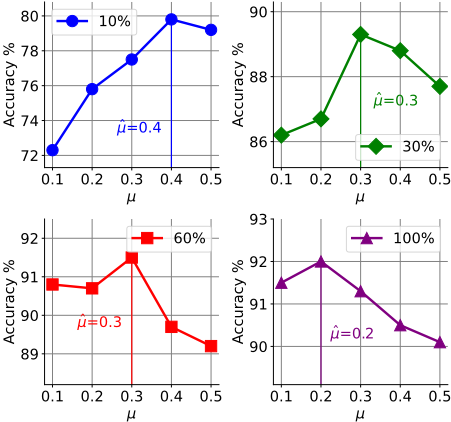
µTable 6 displays the performance of models fine-tuned with LoRA using different ratios of training data and highlights TaD's improvement over the original fine-tuned models. For each setup, we select the optimal hyper-parameters and train the LLMs for sufficient epochs to ensure convergence. As shown in Table 6, we can see that, for smaller ratios of the training data, the proposed TaD yields larger performance gains.
Furthermore, we conduct an ablation study on the selection of µ, and present the results in Figure 3. It can be observed that the optimal ˆµ incrementally increases as the ratio of training data decreases, meaning that the fine-tuned LLMs prefer stronger alignment with the knowledge vector for smaller ratios of training data.
Intuitively, with less training data, the LLMs' output probability distribution w.r.t tokens is far from reaching the final training objective in Figure 2. Therefore, starting from a more distant point, moving in the direction of the knowledge vector can strengthen the knowledge adaptation for the downstream tasks and lead to more significant improvements. Interestingly, the results above also indicate that even with limited training data, the model can be guided in the correct direction. Such a finding well highlights our method's effectiveness in data-limited scenarios.
5 Conclusion
In this paper, we introduce TaD, a plug-and-play method to enhance the performance of fine-tuned LLMs in downstream tasks. TaD leverages the differences in output probability distributions w.r.t tokens before and after fine-tuning, to construct the knowledge vector for downstream tasks. Then TaD refines the output probability distribution of the fine-tuned LLMs with the derived knowledge vector, enhancing it with knowledge adaptation learned during fine-tuning. Extensive experiments well demonstrate that TaD can consistently gain performance improvement across different LLMs, different fine-tuning methods, and different downstream tasks. And it exhibits superiority over existing approaches. Moreover, our experiments also show that TaD has a distinct advantage in data-limited scenarios.
| Model | Method | MC Average |
|---|---|---|
| LLaMa-7b | FPFT +TaD | 44.4 46.1 |
| LLaMa-13b | FPFT +TaD | 45.7 47.3 |
| Model | Method | MC Average | |
|---|---|---|---|
| 50% | 100% | ||
| LLaMa-7b | LoRA +TaD ∆ | 37.9 39.2 +1.3 | 38.8 39.6 +0.8 |
| LLaMa-13b | LoRA +TaD ∆ | 38.2 39.7 +1.5 | 39.4 40.5 +1.1 |
A Experimental Results with Full-Parameter Fine-Tuning
We conduct experiments with full-parameter fine-tuning (FPFT) on the multiple-choice tasks. As shown in Table 7, the experimental results demonstrate that TaD achieves comparable and even more significant improvement compared to being applied to PEFT models. This further demonstrates that TaD can achieve performance that cannot be obtained with the distribution of training data.
B The Difference in Improvements on the Multiple-Choice Tasks
To investigate the difference in improvements observed in Table 6 across other tasks, we conduct experiments using the LLaMa series models on the multiple-choice tasks with 50% and 100% of the training data, respectively. As shown in Table 8, we observe a consistent pattern with that in Table 6. The performance of TaD's performance is notably enhanced when the training data is reduced.
| Model | Method | Multiple Choices | CBQA | ||
|---|---|---|---|---|---|
| MC1 | MC2 | MC3 | True*Info (%) | ||
| GPT-J-6b | LoRA | 0.982 | 1.008 | 0.996 | 0.485 |
| +TaD | 0.989 | 0.987 | 0.813 | 0.401 | |
| ∆ | 0.614 | 0.493 | 0.477 | 0.274 | |
| LLaMa-7b | LoRA | 1.030 | 1.140 | 1.057 | 0.482 |
| +TaD | 0.978 | 0.986 | 0.746 | 0.388 | |
| ∆ | 0.554 | 0.385 | 0.382 | 0.283 | |
C Standard Deviations of Experiments
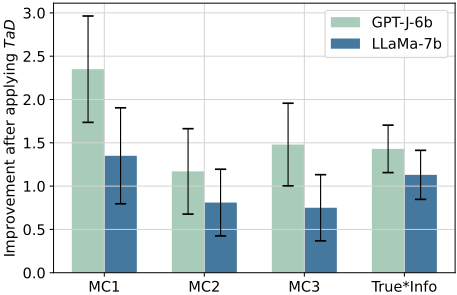
Table 9 shows the standard deviations of the performance of fine-tuned models, TaD-enhanced fine-tuned models, and the improvement after applying TaD over 5 runs, respectively. Figure 4 correspondingly displays a bar graph of the mean value of the improvement with standard deviation error bars. It is noted that the standard deviation of the improvement is smaller than that of the single model's performance. Concurrently, we observe that although the performance of finetuned models and TaD-enhanced models varies across different runs, TaD guarantees the improvement upon the finetuned models' performance. The experimental results above well demonstrate the robustness of our proposed TaD.
Acknowledgments
This work was supported by National Natural Science Foundation of China (Nos. 62271281, 61925107, 62021002). It was also sponsored by CAAI-CANN Open Fund, developed on OpenI Community.
@inproceedings{ijcai2024p728,
  title     = {TaD: A Plug-and-Play Task-Aware Decoding Method to Better Adapt LLMs on Downstream Tasks},
  author    = {Xu, Xinhao and Chen, Hui and Lin, Zijia and Han, Jungong and Gong, Lixing and Wang, Guoxin and Bao, Yongjun and Ding, Guiguang},
  booktitle = {Proceedings of the Thirty-Third International Joint Conference on
               Artificial Intelligence, {IJCAI-24}},
  publisher = {International Joint Conferences on Artificial Intelligence Organization},
  editor    = {Kate Larson},
  pages     = {6587--6596},
  year      = {2024},
  month     = {8},
  note      = {Main Track},
  doi       = {10.24963/ijcai.2024/728},
  url       = {https://doi.org/10.24963/ijcai.2024/728},
}
TY - CPAPER TI - TaD: A Plug-and-Play Task-Aware Decoding Method to Better Adapt LLMs on Downstream Tasks AU - Xu, Xinhao AU - Chen, Hui AU - Lin, Zijia AU - Han, Jungong AU - Gong, Lixing AU - Wang, Guoxin AU - Bao, Yongjun AU - Ding, Guiguang T2 - Proceedings of the Thirty-Third International Joint Conference on Artificial Intelligence, IJCAI-24 PB - International Joint Conferences on Artificial Intelligence Organization PY - 2024 SP - 6587 EP - 6596 DO - 10.24963/ijcai.2024/728 UR - https://doi.org/10.24963/ijcai.2024/728 ER -Copied
Machine-readable versions of this paper, for tools and AI agents:





