
KG-CoT: Chain-of-Thought Prompting of Large Language Models over Knowledge Graphs for Knowledge-Aware Question Answering
Proceedings of the Thirty-Third International Joint Conference on Artificial Intelligence. Main Track. Pages 6642-6650.
https://doi.org/10.24963/ijcai.2024/734
Keywords
- Natural Language Processing: NLP: Language generation
- Natural Language Processing: NLP: Question answering
Abstract
Large language models (LLMs) encounter challenges such as hallucination and factual errors in knowledge-intensive tasks. One the one hand, LLMs sometimes struggle to generate reliable answers based on the black-box parametric knowledge, due to the lack of responsible knowledge. Moreover, fragmented knowledge facts extracted by knowledge retrievers fail to provide explicit and coherent reasoning paths for improving LLM reasoning. To address these challenges, we propose KG-CoT, a novel knowledge-augmented paradigm that leverages a small-scale step-by-step graph reasoning model to reason over knowledge graphs (KGs) and utilizes a reasoning path generation method to generate chains of reasoning with high confidence for large-scale LLMs. Extensive experiments demonstrate that our KG-CoT significantly improves the performance of LLMs on knowledge-intensive question answering tasks, such as multi-hop, single-hop, and open-domain question answering benchmarks, without fine-tuning LLMs. KG-CoT outperforms the CoT prompting as well as prior retrieval-augmented and knowledge base question answering baselines. Moreover, KG-CoT can reduce the number of API calls and cost and generalize to various LLM backbones in a lightweight plug-and-play manner.
- [Baek et al., 2023] Jinheon Baek, Alham Fikri Aji, Jens Lehmann, and Sung Ju Hwang. Direct fact retrieval from knowledge graphs without entity linking. In Proceed- ings of the 61st Annual Meeting of the Association for Computational Linguistics, pages 10038-10055, Toronto, Canada, July 2023. Association for Computational Lin- guistics. [Bollacker et al., 2007]
- Kurt D. Bollacker, Robert P. Cook, and Patrick Tufts. Freebase: A shared database of structured general human knowledge. In Proceedings of the Twenty-Second AAAI Conference on Artificial Intel- ligence, pages 1962-1963, Vancouver, British Columbia, Canada, July 2007. AAAI Press.
- [Cao et al., 2021] Nicola De Cao, Wilker Aziz, and Ivan Titov. Editing factual knowledge in language models. In Proceedings of the 2021 Conference on Empirical Meth- ods in Natural Language Processing, pages 6491-6506, Punta Cana, Dominican Republic, November 2021. Asso- ciation for Computational Linguistics.
- [Chen et al., 2023] Qianglong Chen, Guohai Xu, Ming Yan, Ji Zhang, Fei Huang, Luo Si, and Yin Zhang. Distin- guish before answer: Generating contrastive explanation as knowledge for commonsense question answering. In Findings of the Association for Computational Linguistics, pages 13207-13224, Toronto, Canada, July 2023. Associ- ation for Computational Linguistics.
- [Das et al., 2021] Rajarshi Das, Manzil Zaheer, Dung Thai, Ameya Godbole, Ethan Perez, Jay Yoon Lee, Lizhen Tan, Lazaros Polymenakos, and Andrew McCallum. Case- based reasoning for natural language queries over knowl- edge bases. In Proceedings of the 2021 Conference on Em- pirical Methods in Natural Language Processing, pages 9594-9611, Punta Cana, Dominican Republic, November 2021. Association for Computational Linguistics.
- [Huang et al., 2023] Jiaxin Huang, Shixiang Gu, Le Hou, Yuexin Wu, Xuezhi Wang, Hongkun Yu, and Jiawei Han. Large language models can self-improve. In Proceedings of the 2023 Conference on Empirical Methods in Natural Language Processing, pages 1051-1068, Singapore, De- cember 2023. Association for Computational Linguistics.
- [Ji et al., 2023] Ziwei Ji, Nayeon Lee, Rita Frieske, Tiezheng Yu, Dan Su, Yan Xu, Etsuko Ishii, Yejin Bang, Andrea Madotto, and Pascale Fung. Survey of halluci- nation in natural language generation. ACM Computing Surveys, 55(12):248:1-248:38, March 2023.
- [Jiang et al., 2023] Jinhao Jiang, Kun Zhou, Xin Zhao, and Ji-Rong Wen. Unikgqa: Unified retrieval and reason- ing for solving multi-hop question answering over knowl- edge graph. In Proceedings of the Eleventh International Conference on Learning Representations, Kigali, Rwanda, May 2023. OpenReview.net.
- [Kedia et al., 2022] Akhil Kedia, Mohd Abbas Zaidi, and Haejun Lee. Fie: Building a global probability space by leveraging early fusion in encoder for open-domain ques- tion answering. In Proceedings of the 2022 Conference on Empirical Methods in Natural Language Processing, pages 4246-4260, Abu Dhabi, United Arab Emirates, De- cember 2022. Association for Computational Linguistics.
- [Kojima et al., 2022] Takeshi Kojima, Shixiang Shane Gu, Machel Reid, Yutaka Matsuo, and Yusuke Iwasawa. Large language models are zero-shot reasoners. In Advances in Neural Information Processing Systems, pages 22199- 22213, New Orleans, LA, USA, November 2022.
- Curran Associates, Inc.
- [Lewis et al., 2020] Patrick S. H. Lewis, Ethan Perez, Alek- sandra Piktus, Fabio Petroni, Vladimir Karpukhin, Na- man Goyal, Heinrich Küttler, Mike Lewis, Wen-tau Yih, Tim Rocktäschel, Sebastian Riedel, and Douwe Kiela. Retrieval-augmented generation for knowledge-intensive NLP tasks. In Advances in Neural Information Process- ing Systems, pages 9459-9474, Virtual Event, December 2020.
- [Curran Associates, Inc. Li and Ji, 2022] Mingchen Li and Jonathan Shihao Ji. Se- mantic structure based query graph prediction for ques- tion answering over knowledge graph. In Proceedings of the 29th International Conference on Computational Lin- guistics, pages 1569-1579, Gyeongju, Republic of Korea, October 2022. International Committee on Computational Linguistics.
- [Li et al., 2023] Shiyang Li, Yifan Gao, Haoming Jiang, Qingyu Yin, Zheng Li, Xifeng Yan, Chao Zhang, and Bing Yin. Graph reasoning for question answering with triplet retrieval. In Findings of the Association for Compu- tational Linguistics, pages 3366-3375, Toronto, Canada, July 2023. Association for Computational Linguistics.
- [Liang et al., 2023] Yuanyuan Liang, Jianing Wang, Hanlun Zhu, Lei Wang, Weining Qian, and Yunshi Lan. Prompt- ing large language models with chain-of-thought for few- shot knowledge base question generation. In Proceedings of the 2023 Conference on Empirical Methods in Natural Language Processing, pages 4329-4343, Singapore, De- cember 2023. Association for Computational Linguistics.
- [Ma et al., 2022] Kaixin Ma, Hao Cheng, Xiaodong Liu, Eric Nyberg, and Jianfeng Gao. Open-domain question an- swering via chain of reasoning over heterogeneous knowl- edge. In Findings of the Association for Computational Linguistics, pages 5360-5374, Abu Dhabi, United Arab Emirates, December 2022. Association for Computational Linguistics. [OpenAI, 2023] OpenAI. GPT-4 technical report. arXiv preprint, arXiv:2303.08774, March 2023.
- [Paranjape et al., 2022] Ashwin Paranjape, Omar Khattab, Christopher Potts, Matei Zaharia, and Christopher D. Manning. Hindsight: Posterior-guided training of retriev- ers for improved open-ended generation. In Proceedings of the Tenth International Conference on Learning Repre- sentations, Virtual Event, April 2022. OpenReview.net.
- [Patel et al., 2023] Ajay Patel, Bryan Li, Moham- mad Sadegh Rasooli, Noah Constant, Colin Raffel, and Chris Callison-Burch. Bidirectional language models are also few-shot learners. In Proceedings of the Eleventh International Conference on Learning Representations, Kigali, Rwanda, May 2023. OpenReview.net.
- [Petroni et al., 2019] Fabio Petroni, Tim Rocktäschel, Se- bastian Riedel, Patrick S. H. Lewis, Anton Bakhtin, Yux- iang Wu, and Alexander H. Miller. Language models as knowledge bases? In Proceedings of the 2019 Confer- ence on Empirical Methods in Natural Language Process- ing and the 9th International Joint Conference on Natu- ral Language Processing, pages 2463-2473, Hong Kong, China, November 2019. Association for Computational Linguistics.
- [Shao et al., 2023] Zhihong Shao, Yeyun Gong, Yelong Shen, Minlie Huang, Nan Duan, and Weizhu Chen. Syn- thetic prompting: Generating chain-of-thought demonstra- tions for large language models. In Proceedings of the Fortieth International Conference on Machine Learning, pages 30706-30775, Honolulu, Hawaii, USA, July 2023. Proceedings of Machine Learning Research.
- [Shi et al., 2021] Jiaxin Shi, Shulin Cao, Lei Hou, Juanzi Li, and Hanwang Zhang. Transfernet: An effective and transparent framework for multi-hop question answering over relation graph. In Proceedings of the 2021 Confer- ence on Empirical Methods in Natural Language Process- ing, pages 4149-4158, Punta Cana, Dominican Republic, November 2021. Association for Computational Linguis- tics.
- [Sun et al., 2023] Jiashuo Sun, Chengjin Xu, Lumingyuan Tang, Saizhuo Wang, Chen Lin, Yeyun Gong, Heung- Yeung Shum, and Jian Guo. Think-on-graph: Deep and re- sponsible reasoning of large language model with knowl- edge graph. arXiv preprint, arXiv:2307.07697, July 2023.
- [Wang et al., 2023a] Heng Wang, Shangbin Feng, Tianxing He, Zhaoxuan Tan, Xiaochuang Han, and Yulia Tsvetkov. Can language models solve graph problems in natural lan- guage? arXiv preprint, arXiv:2305.10037, May 2023.
- [Wang et al., 2023b] Heng Wang, Shangbin Feng, Zhaoxuan Tan, Xiaochuang Han, and Yulia Tsvetkov. Can language models solve graph problems in natural language? arXiv preprint, arXiv:2305.10037, May 2023.
- [Wang et al., 2023c] Xuezhi Wang, Jason Wei, Dale Schuur- mans, Quoc V. Le, Ed H. Chi, Sharan Narang, Aakanksha Chowdhery, and Denny Zhou. Self-consistency improves chain of thought reasoning in language models. In Pro- ceedings of the Eleventh International Conference on Learning Representations, Kigali, Rwanda, May 2023. OpenReview.net.
- [Wang et al., 2023d] Yubo Wang, Xueguang Ma, and Wenhu Chen. Augmenting black-box llms with medical text- books for clinical question answering. arXiv preprint, arXiv:2309.02233, September 2023.
- [Wei et al., 2022] Jason Wei, Xuezhi Wang, Dale Schuur- mans, Maarten Bosma, Brian Ichter, Fei Xia, Ed H. Chi, Quoc V. Le, and Denny Zhou. Chain-of-thought prompt- ing elicits reasoning in large language models. In Ad- vances in Neural Information Processing Systems, pages 24824-24837, New Orleans, LA, USA, November 2022.
- [Curran Associates, Inc. Xie et al., 2022] Minghui Xie, Chuzhan Hao, and Peng Zhang. A sequential flow control framework for multi-hop knowledge base question answering. In Proceedings of the 2022 Conference on Empirical Methods in Natural Lan- guage Processing, pages 8450-8460, Abu Dhabi, United Arab Emirates, December 2022. Association for Compu- tational Linguistics.
- [Yao et al., 2023] Shunyu Yao, Dian Yu, Jeffrey Zhao, Izhak Shafran, Thomas L. Griffiths, Yuan Cao, and Karthik Narasimhan. Tree of thoughts: Deliberate problem solving with large language models. arXiv preprint, arXiv:2305.10601, May 2023.
- [Ye et al., 2022] Xi Ye, Semih Yavuz, Kazuma Hashimoto, Yingbo Zhou, and Caiming Xiong. RNG-KBQA: gen- eration augmented iterative ranking for knowledge base question answering. In Proceedings of the 60th Annual Meeting of the Association for Computational Linguistics, pages 6032-6043, Dublin, Ireland, May 2022. Association for Computational Linguistics.
- [Ye et al., 2023] Qichen Ye, Bowen Cao, Nuo Chen, Weiyuan Xu, and Yuexian Zou. Fits: Fine-grained two- stage training for knowledge-aware question answering. arXiv preprint, arXiv:2302.11799, February 2023.
- [Zhang et al., 2023] Zhuosheng Zhang, Aston Zhang, Mu Li, and Alex Smola. Automatic chain of thought prompting in large language models. In Proceedings of the Eleventh International Conference on Learning Repre- sentations, Kigali, Rwanda, May 2023. OpenReview.net.
- [Zhao et al., 2023] Feng Zhao, Hongzhi Zou, and Cheng Yan. Structure-aware knowledge graph-to-text generation with planning selection and similarity distinction. In Pro- ceedings of the 2023 Conference on Empirical Methods in Natural Language Processing, pages 8693-8703, Singa- pore, December 2023. Association for Computational Lin- guistics.
- [Zhao et al., 2024] Ruilin Zhao, Feng Zhao, Liang Hu, and Guandong Xu. Graph reasoning transformers for knowledge-aware question answering. In Proceedings of the Thirty-Eighth AAAI Conference on Artificial Intelli- gence, pages 19652-19660, Vancouver, Canada, February 2024. AAAI Press.
- [Zhu et al., 2020] Chen Zhu, Ankit Singh Rawat, Manzil Za- heer, Srinadh Bhojanapalli, Daliang Li, Felix X. Yu, and Sanjiv Kumar. Modifying memories in transformer mod- els. arXiv preprint, arXiv:2012.00363, December 2020.
References were extracted automatically from the PDF and may contain errors.
Full text extracted automatically from the PDF; figures, tables and equations may differ. The PDF is the version of record.
1 Introduction
Recently, large language models (LLMs) [OpenAI, 2023] have achieved remarkable results in various downstream natural language understanding and generating tasks with elaborate natural language prompts [Wei et al., 2022]. Despite their significant ability to generate fluent and coherent natural language responses, LLMs suffer from hallucination and factual errors when performing knowledge-intensive tasks [Ji et al., 2023]. The essential reason for these problems lies in the black-box nature of parametric knowledge, which makes it difficult to locate and update knowledge facts stored in the parameters [Zhu et al., 2020; Cao et al., 2021]. This results in two main challenges that hinder the adaptation of LLMs in knowledge-intensive tasks.
∗Corresponding author
(a) Lack of Responsible Factual Knowledge
LLM + CoT Prompt
Q: Whence is the artist nominated for awards for "Live from Paris"? A: Let's think step by step.
As of my last knowledge update in January 2022, I don't have specific information about an artist nominated for awards …
(b) Cognition Gap with Knowledge Retrievers
LLM + Knowledge Retriever
- Q: Whence is the artist nominated for awards for "Live from Paris"?
K: (Sakira, music.artist.album, Live from Paris)
(Shakira, music.artist.album, Las de la Intuicion)
(Shakira, people.person.places_lived, Los Angeles) …
Los Angeles
(c) KG-CoT (Ours)
LLM + Chain-of-Thought Prompting over Knowledge Graphs
Q: Whence is the artist nominated for awards for "Live from Paris"? K: Path1: Live from Paris →music.artist.album_reversed→Sakira →music.artist.origin→Colombia …
Based on the reasoning paths, we can infer that Shakira, the artist behind the album "Live from Paris", hails from Colombia.
Figure 1: (a) LLMs may struggle to provide responsible answer based on the static parametric knowledge. (b) The high relevance of fragmented knowledge facts doesn't necessarily imply the usefulness for LLM reasoning. (c) Our proposed KG-CoT enables LLMs to think with KGs for knowledge-aware reasoning.
Challenge 1: Lack of Responsible Factual Knowledge. Since it is challenging to revise and expand the parametric knowledge, LLMs are hard to access the most recent updates in various domains [Wang et al., 2023d]. Therefore, when encountering questions that require up-to-date or domainspecific knowledge, LLMs may struggle to provide responsible answers based on the static parametric knowledge [Chen et al., 2023]. Although elaborate prompts [Wei et al., 2022; Yao et al., 2023] can be used to decompose complex questions into multiple steps to enhance the logical reasoning capability of LLMs, it is difficult to fully compensate for the lack of explicit factual knowledge. As a result, the benefit of elaborate prompting diminishes [Wang et al., 2023a] especially in tasks where accurate and deep understanding of subject entity is crucial for generating correct response.
Challenge 2: Cognition Gap with Knowledge Retrievers.
Augmenting LLMs with external knowledge graphs is a natural and promising solution for addressing the lack of knowledge described above [Bollacker et al., 2007]. KGs are structured, explicit, and responsible, which can provide reliable knowledge subgraphs to explicitly enhance the knowledgeaware reasoning process of LLMs [Shi et al., 2021]. However, the cognition gap in understanding and reasoning between LLMs and knowledge retrievers significantly limits the performance of LLM+KG paradigm. Knowledge retrievers prioritize knowledge facts commonly based on representation similarity [Li et al., 2023], but the relevance in this context does not necessarily guarantee usefulness for specific reasoning tasks of LLMs [Sun et al., 2023]. This cognition gap results in LLMs being compelled to continuously evaluate the usefulness of fragmented knowledge facts and recurrently invoke knowledge retrievers to provide adequate knowledge for reasoning [Sun et al., 2023]. This leads to a significant increase in the complexity and cost of the LLM+KG paradigm.
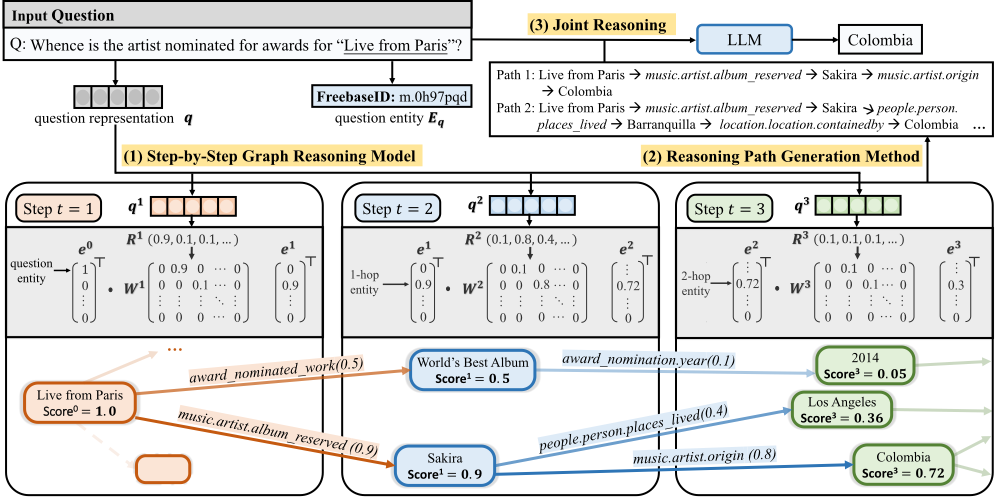
To address these challenges, we propose a Chain-ofThought prompting over Knowledge Graphs (KG-CoT), a novel knowledge-augmented framework that utilizes a stepby-step graph reasoning model to augment LLMs with responsible chains of knowledge in a plug-and-play manner. To address the lack of responsible factual knowledge (Challenge 1), we propose a step-by-step graph reasoning model to reason over KGs. Starting from the question entity, the stepby-step graph reasoning model calculates scores for relations in a KG and constructs the transition matrix for each reasoning step. By utilizing the transition matrix, the graph reasoning model can traverse various paths in the KG, hopping among relations and exploring entities with high confidence for problem solving. To address the cognition gap between LLMs and knowledge retrievers (Challenge 2), we develop a reasoning path generation method. Starting from the question entity, it retraces the step-by-step reasoning process and generates explicit reasoning paths along the transition matrix. In this way, the graph reasoning model can plug into LLMs and enable joint reasoning of LLMs over KGs.
Our main contributions are as follows:
- Large + Small: We propose a knowledge-augmentation paradigm for LLMs that combines large-scale LLMs with small-scale step-by-step graph reasoning models to augment LLMs with KGs without fine-tuning LLMs.
- Responsibility: We propose using a graph reasoning model over KGs as a enhancement of CoT prompting to generate responsible chains of knowledge for improving knowledge-aware reasoning capability of LLMs.
- Efficiency: Our proposed KG-CoT prompting significantly improves the performance of LLMs on several knowledge-intensive benchmarks without fine-tuning LLMs, and outperforms prior retrieval-augmented and knowledge base question answering baselines.
- Adaptability and Generality: Our proposed KG-CoT can be generalized to various LLM backbones (e.g., closed-source or open-source LLMs) with reduced API calls and costs in a lightweight plug-and-play manner.
2 RelatedWork
In this section, we introduce related LLM-based QA systems from two categories based on their utilization of knowledge.
2.1 LLM+ Parametric Knowledge
As the model scale increases, the emergent ability enables LLMs to comprehend natural language instructions and activate the parametric knowledge [Petroni et al., 2019] stored in their parameters for downstream NLP tasks.
Recently, Wei et al. first introduces the concept of chainof-thought prompting (CoT), in which a series of intermediate reasoning steps is generated to solve complex problems through manually constructed prompts. Kojima et al. demonstrates the ability of LLMs to generate CoT, even in zero-shot scenarios. Consequently, Zhang et al., Shao et al., and Liang et al. leverage manually constructed CoT examples to automatically generate high-quality CoT demonstrations. Huang et al. fine-tunes LLMs based on their self-generated CoT examples and demonstrates the self-improvement capability of LLMs.
However, the difficulty of modifying and updating the parametric knowledge leads to LLMs utilizing outdated or incorrect implicit parametric knowledge for response generation, which strongly limits the validity and interpretability of black-box LLMs. In this case, a natural and promising solution is to augment LLMs with external world knowledge.
2.2 LLM+ External Knowledge
Retrieval-augmented generation (RAG) is a natural way to augment LLMs with external knowledge [Lewis et al., 2020]. This approach aims to retrieve relevant knowledge from massive knowledge bases (KBs) and directly augment LLMs with external world knowledge. Paranjape et al. enhances the ability of knowledge retriever to increase the probability of relevant passages being ranked among the top-10 most relevant. In addition, Ma et al. retrieves knowledge triplets over knowledge graphs (KGs) for question answering. Zhao et al. converts KGs to text descriptions to augment LMs. KGs are structured, explicit, and interpretable, since several paths from the question entity to the answer entity can be identified.
However, recent works generally utilized representationbased multi-model pre-training for augmenting LLMs with KGs [Zhao et al., 2024; Ye et al., 2023]. In addition to limiting the adaptability to closed-source LLMs, these methods ignore the elaborate knowledge structure and explicit reasoning paths, which can serve as explicit clues for joint reasoning with LLMs. Although Wang et al. has demonstrated that LLMs have preliminary graph reasoning abilities, the overreliance on LLMs results in limited adaptability when dealing with large-scale KGs and complex multi-hop tasks.
To address these challenges, we propose the KG-CoT prompting, which includes a lightweight joint reasoning model to alleviate a portion of the reasoning burden of LLMs and perform joint reasoning over KGs. The graph reasoning model can generate explicit reasoning paths relevant to the questions, enabling LLMs to "think with KGs" for answer generation.
3 KG-CoT
KG-CoT augments LLMs with relevant knowledge by applying a small graph reasoning model to reason over KGs and generate reasoning paths with high confidence in LLM reasoning. First, we propose a graph reasoning model to perform step-by-step reasoning over the KGs and find candidate entities with high confidence. Then, we introduce the reasoning path generation method to generate the reasoning paths based on the step-by-step reasoning process. Finally, we leverage the reasoning paths to prompt LLMs for answer generation.
3.1 Step-by-Step Graph ReasoningModel
Prior semantic parsing based models [Li and Ji, 2022] have shown that the natural language question can be converted into its logical form, which is called a query graph. These findings suggest that complex questions can be decomposed into multiple meta-questions over the KGs, which is similar to chain-of-thought prompting [Wei et al., 2022]. Inspired by this, we propose a graph reasoning model to imitate the question decomposition and step-by-step reasoning over KGs.
Initialization. Let G denote the KG, n denote the number of entities in the entity set, and m denote the number of relation in the relation set. We first initialize an entity state e0 ∈ [0, 1]n , which is a one-hot vector that indicates whether the corresponding entity is mentioned in the context of questions. For example, if only the i th entity is mentioned in the question, the e0i ∈ e0 is initialized to 1 and others are set to 0. Moreover, we initialize a triplet matrix M ∈ [0, 1]n×n , which is a one-hot matrix that indicates the relation index Mij = k if it exists between the entity i < n and entity j < n.
Relation Score Calculation. Inspired by [Shi et al., 2021], we separate the graph reasoning process into T steps. At step t < T , we calculate scores for all relations in the KGs Rt ∈ [0, 1]m. The score of each relation rt i ∈ Rt indicates the probability of a "hop" occurring for the current entity based on this relation. The calculation of relation score Rt is calculated as follows:
where qt is the question representation at step t. We consider the question representation at different steps to focus on different parts of the question context. In this way, we can implicitly decompose the question and and force the graph reasoning model to focus on different relations at different steps. At step t, the question representation qt can be formulated as follows:
where q is the question embedding and (h1, . . . , h|q|) is a sequence of hidden states associated with the question.f t is used to project the question embedding q to the attention query Qt at step t. We calculate the attention weights αt and calculate the question representation at step t by taking the weighted sum of the hidden states.
Step-by-Step Reasoning. Based on the relation score Rt , we first define a transition matrix Wt ∈ [0, 1]n×n , which is used to describe the transitions from the current entity states et-1 to the next entity states et . We leverage the triplet matrix M and relation score Rt to construct the transition matrix Wt :
where k is the index of the relation between entities i and j, and Rtk is the score of relation k. Finally, we can utilize the transition matrix to perform step-by-step reasoning over the KG. The step-by-step reasoning process can be formulated as follows:
The current entities et-1 "hop" along the relations within their 1-hop neighborhood and transmit to the next entity states et based on the relation score Rt .
After T steps reasoning, we utilize the question embedding q to determine the weight distribution β for each step, and calculate the final entity scores e by taking the weighted sum of the entity scores at each step.
Training. Given the one-hot vector a ∈ [0, 1]n of the golden answer, which indicates whether the corresponding entity is the answer entity. We use the L2 Euclidean distance between e and a to optimize the step-by-step graph reasoning model:
3.2 Reasoning Path GenerationMethod
During inference, once we obtain the top-k entities EK ⊆ E through the graph reasoning model, we utilize the transition matrices W1 , W2 ... , WT to generate the reasoning paths.
Initialization. During the generation of reasoning paths, we maintain two lists Lrp and Lmid, which are used to store the candidate reasoning paths and the intermediate paths.
Extraction. Starting from the question entity Eq, we first extract the corresponding row w1 i0 , w1 i1 , . . . , w1 i(n-1) ∈ W1 , w1 ij > 0, which indicates the relation score of transitioning from the question entity at step t = 0 to the entities at step t = 1. In this way, we can extract a set of 1-hop paths P1 :
where the "key" is the extracted path and the "value" is the score of relation within it. Relij denotes the relation between the entities i and j. For each path p1ij , we first append it to the Lrp. If the object entity Ej is contained in the top-k answer entities EK , we then append the extracted path to the Lrp.
Then, we start from the object entities Ej of the 1-hop paths in the Lmid and use the W2 to extract 2-hop paths P2 :
Algorithm 1 Inference process of LLM + KG-CoT
Input: Input question q, retrieved knowledge subgraph G, and a large language model LLM.
Initialize Entity score e0 ← extract question entity Eq from G, triplet matrixM←extract triplets fromG.
Output: Output answer y
- 1: for t = 1, ..., T do
- 2: Compute the question representation qt using (2)-(5).
- 3: Compute the relation score Rt using (1).
- 4: Compute transition matrixWt using (6).
- 5: Entity score et ← step-by-step reasoning using (7).
- 6: end for
- 7: Compute final scores e using (8)-(9) and select top-k entities EK
- 8: Initialize Lmid ←p0 = ¡"Eq", [0]¿.
- 9: for t = 1, ..., T do
- 10: Extract t-hop paths Pt usingWt and paths in Lmid.
- 11: Update intermediate path list Lmid with Ptqj
- 12: if Object entity Ej ∈ EK then
- 13: Update reasoning path list Lrp with Ptqj .
- 14: end if
- 15: end for
- 16: Select N paths for each top-k entity EK from Lrp.
- 17: Serialize reasoning paths to textual sentence s
- 18: Output answer y = Call(LLM, q, s).
- 19: return Output answer y
and update the Lrp and Lmid.
By repeating the above algorithm for T steps, we can generate candidate reasoning paths from the question entities to the top-k entities.
Ranking. Each answer entity may correspond to multiple candidate paths in Lrp, and the number of hops for different paths varies. Therefore, we take the average of the scores of relations in each path as the final path score.
3.3 Joint Reasoning
For the top K candidate entity with highest confidence, we extract the path with the highest path score for each candidate entity. Thus, for each question, we utilize the stepby-step graph reasoning model (Section 3.1) and a reasoning path generation method (Section 3.2) to generate K reasoning paths with various numbers of hops and answer entities.
To maintain the chain structure, we utilize "arrows" to connect the entities and relations to construct the KG-CoT. For example, a 2-hop path p2ik :
is serialized to a textual sentence, which is formulated as:
We serialize the K reasoning paths and concatenate them with the question context as the final input sequence. We utilize elaborate instructions to prompt LLMs to leverage these reasoning paths for answer generation.
| Model | AccessKB | Multi-hopQA | Single-hop QA | Open-domain QA | |
|---|---|---|---|---|---|
| WebQSP | CompWebQ | SimpleQuestions | WebQuestions | ||
| ChatGPT + IO prompts [Patel et al., 2023] ChatGPT + CoT prompts [Wei et al., ChatGPT + SC [Wang et al., 2023c] | × × | 63.3 62.2 | 37.6 38.8 45.4 | 20.0 20.3 18.9 | 48.7 48.5 |
| 2022] | |||||
| × | 61.1 | 50.3 | |||
| Previous RA SOTA | ✓ | 65.0α | 70.4β | 85.8α | 56.3γ |
| Previous KBQA SOTA | ✓ | 76.6δ | 52.2δ | 71.1ϵ | - |
| ChatGPT + ToG-R [Sun et al., 2023] | ✓ | 75.8 | 58.9 | 45.4 | 53.2 |
| GPT-4 + ToG-R [Sun et al., 2023] | ✓ | 81.9 | 69.5 | 58.6 | 57.1 |
| ChatGPT + KG-CoT (ours) GPT-4 + KG-CoT (ours) | ✓ ✓ | 82.1 84.9 | 51.6 62.3 | 77.8 86.1 | 66.5 68.0 |
4 Experiments
4.1 Datasets
We evaluate KG-CoT based on 4 challenging knowledgeintensive question answering benchmarks that heavily rely on knowledge-aware reasoning with external world knowledge.
WebQSP. WebQSP is a knowledge-intensive multi-hop question answering benchmark. It contains 4,037 questions that are all 1-hop or 2-hop questions based on the Freebase. Based on previous works, we retrieve knowledge triplets within 2-hop neighborhoods of the question entities and produce a knowledge subgraph with 1,886,684 entities, 1,144 relations, and 5,780,246 knowledge triplets.
CompWebQ. CompWebQ is a multi-hop question answering benchmark. It contains 34,672 questions with many hops and constraints, which makes it challenging for LLMs to process. We utilize the retrieved knowledge subgraph of [Shi et al., 2021] and utilize the original data splits for evaluation.
SimpleQuestions. SimpleQuestions is a single-hop question answering benchmark. Questions are generated based on information from Freebase, and ultimately, 108,442 questions that heavily rely on factual knowledge were generated in this study. We randomly select 1,000 questions and retrieved 1-hop neighborhood of the question entity for evaluation.
WebQuestions. WebQuestions is a challenging opendomain question answering benchmark. It contains 5,810 questions, with Freebase as the knowledge base. For each question, we retrieve the 2-hop neighborhood of the question entity and utilize the original data splits for evaluation.
4.2 Baselines
We compare with strong baselines, such as standard prompting baselines, state-of-the-art retrieval-augmented (RA) baselines and knowledge base question answering (KBQA) baselines, based on the above benchmark datasets.
Prompting Baselines. We compared with original IO prompts (IO prompts), chain-of-thought prompts (CoT prompts) and Self-Consistency (SC)
Retrieval-Augmented Baselines. We select previous SOTA of each benchmark, including direct fact retrieval DiFaR [Baek et al., 2023], case-based reasoning CBR [Das et al., 2021], and fusion in encoder FiE [Kedia et al., 2022].
Knowledge Base Question Answering Baselines. We compared with previous state-of-the-art knowledge base question answering model on each benchmark, including UniKGQA [Jiang et al., 2023] and RNG [Ye et al., 2022].
LLM+KG Baseline. We also compare with recent KGaugmented baseline ToG [Das et al., 2021]. Different from our motivation, it instructs LLM itself to perform retrieval, pruning and answer prediction.
4.3 Implementation Setting
We train the step-by-step graph reasoning model with RAdam optimizer at a learning rate of 1e-3 for 50 epochs. For the LLM, we leverage the OpenAI API to call ChatGPT and GPT-4 for evaluation. We select the "gpt-3.5-turbo" and "gpt4" as our LLM backbones and utilize the default setting of the OpenAI API. For each question, we generate 1 KG-CoT for each top-10 candidate entity (e.g., Hit@10 Path1) and establish instructions to prompt the LLMs to directly generate answer entity for evaluation. Our code and data is available at https://github.com/HUSTNLP-codes/KG-CoT.
4.4 Main Results
As shown in Table 1, our proposed KG-CoT achieved stateof-the-art performance on 3 knowledge-intensive question answering benchmarks, including WebQSP, SimpleQuestions, and WebQuestions. Moreover, KG-CoT significantly enhances the performance of LLMs on CompWebQ, the challenging knowledge-intensive multi-hop question answering benchmark, compared to LLM baselines relying on standard CoT prompting.
On the WebQSP benchmark, our proposed KG-CoT outperforms recent LLM+KG baseline ToG [Sun et al., 2023] for both LLM settings. Moreover, KG-CoT with the ChatGPT backbone even outperforms ToG with the GPT-4 backbone, demonstrating the effectiveness of our proposed "Large+Small" paradigm for LLMs.
| Method | KB | WebQSP | CWQ |
|---|---|---|---|
| Baselines | |||
| GFC [Xie et al., 2022] UniKGQA [Jiang et al., 2023] ChatGPT+ToG-R [Sun et al., 2023] GPT-4+ToG-R [Sun et al., 2023] | ✓ ✓ ✓ ✓ | 76.8 76.6 75.8 81.9 | 50.4 52.2 58.9 69.5 |
| Llama2-7B | |||
| CoT KG-CoT Gain | 46.1 72.4 (+26.3) | 27.6 46.7 (+19.1) | |
| CoT KG-CoT Gain | × ✓ | ||
| Llama2-13B | |||
| CoT Gain | × ✓ | 47.2 74.6 (+27.4) | 29.9 50.0 (+20.1) |
| ChatGPT | |||
| KG-CoT | × ✓ | 62.2 82.1 (+19.9) | 38.8 51.6 |
| GPT-4 | × | 67.3 84.9 | (+12.8) |
| CoT KG-CoT | ✓ | 46.0 62.3 | |
| Gain | |||
| (+17.6) | |||
| (+16.3) | |||
For the single-hop and open-domain question answering benchmarks, our proposed KG-CoT also achieves competitive performances compared to previous state-of-the-art baselines. Notably, for the simple yet knowledge-intensive benchmark, LLMs that rely solely on the parametric knowledge struggle to generate the correct answer even with CoT prompting. On the one hand, the results demonstrate the effectiveness of our proposed KG-CoT in augmenting LLMs with explicit reasoning paths. On the other hand, these results align with previous findings of LLMs [Wang et al., 2023b], indicating that the effectiveness of these standard prompting methods (e.g., CoT and SC) diminishes for complex problems that require extensive factual knowledge.
On the CompWebQ benchmark, our proposed KG-CoT with ChatGPT yielded at 37.2% improvement over standard prompting baselines. We observe that the performance trend of KG-CoT varies compared to those of the other QA benchmarks. This difference is attributed to our proposed graph reasoning model performing less favorably for this challenging multi-hop question answering benchmark, consequently resulting in moderate improvements on CompWebQ.
4.5 Comparison with Different LLMBackbones
To further investigate the generality of our proposed KGCoT, we evaluate KG-CoT on different LLM backbones, such as open-source LLMs (e.g., Llama-7B and Llama-13B) and closed-source LLMs (e.g., ChatGPT and GPT-4). As shown in Table 2, our proposed KG-CoT yield significant improvements across all the LLM backbones. With the increasing intelligence of LLMs, the performance with KG-CoT consistently improves. When Llama2-13B, ChatGPT, and GPT-4 are used as the backbones, LLM+KG-CoT outperforms the existing state-of-the-art KGQA baselines.
4.6 Performance of Locating Answer Entity
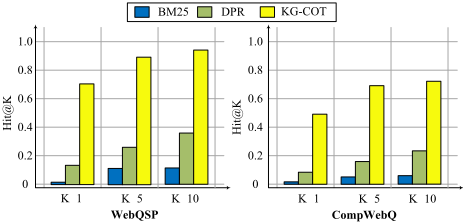
To validate the effectiveness of the reasoning paths, we conducted comparative experiments with other retrieval methods (e.g., BM25 and DPR) to evaluate whether the retrieved top-ranked knowledge facts contain the golden answer entity. As shown in Figure 3, the experimental results indicate that our proposed KG-CoT achieves a significant high hit rate (e.g., Hit@1) in locating reasoning paths to the answer entity. Specifically, when considering the top-10 candidate entities (e.g., K=10), KG-CoT yields a coverage rate of up to 91.4% for the WebQSP benchmark, surpassing that of conventional knowledge retrievers. Moreover, for the complex multi-hop question answering benchmark CompWebQ, the hit rate for answers reaches 72.5%, reflecting a substantial improvement in LLM reasoning.
4.7 Hyper-parameter Sensitivity Analysis
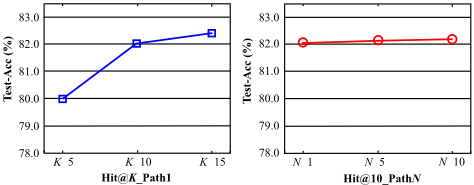
In KG-CoT, two parameters that can influence the performance of LLMs are the number of candidate answer entities K and the number of paths extracted for each entity N.
As shown in the left part of Figure 4, we conduct experiments on the WebQSP benchmark to investigate the influence of the candidate answer entity number K. We observed that increasing the number of candidate answer entities from the top-5 to the top-10 yields in a discernible improvement in the performance of LLMs. This enhancement can be attributed to an increased coverage of correct answer entities along the reasoning paths, consequently reducing misguidance caused by the absence of correct reasoning paths. However, when extending the candidate answers from the top 10 to the top 15, we found minimal changes in the performance of LLMs. One one hand, this lack of improvement is attributed to the marginal increase in answer coverage. Moreover, the lower confidence associated with lower ranking reasoning paths contributes marginally to the reasoning process of LLMs.
| Question | What is the source of the river which flows under the Dona Ana Bridge? |
|---|---|
| Reasoning Paths | Path 1: Dona Ana Bridge → transportation.bridge.body of water spanned → Zambezi River → geogra- phy.river.origin → Mwinilunga. Path 2: Dona Ana Bridge → geography.body of water.bridges rev → Zambezi River → geography.river.origin → Mwinilunga. |
| Outputs | IO: Willow Creek. CoT: The Dona Ana Bridge spans the Rio Grande, a significant river in the southwestern United States. The ultimate source of the Rio Grande is in the San Juan Mountains of Colorado. More precisely, the river originates from the snowmelt in the San Juan Mountains. The specific location where the Rio Grande begins is often cited as the Willow Creek, which is in the San Juan Mountains of Colorado. KG-CoT: Based on the reasoning paths, the Dona Ana Bridge spans a body of water, specifically the Zambezi River, which originates in the geographical location of Mwinilunga. |
| Ground Truth | Mwinilunga. |
| Method | KB | #API Call | Cost Per Call($) | Total Cost($) |
|---|---|---|---|---|
| GPT-3.5-turbo | ||||
| CoT | × | 2 | 0.0001 | 0.30 |
| ToG | ✓ | 11.2 | ∼0.0007 | ∼13 |
| KG-CoT (Ours) | ✓ | 1 | 0.0006 | 0.92 |
| GPT-4 | ||||
| CoT | × | 2 | 0.003 | 9.25 |
| ToG | ✓ | 11.2 | ∼0.025 | ∼400 |
| KG-CoT (Ours) | ✓ | 1 | 0.020 | 30.82 |
As shown in the right part of Figure 4, we investigate the impact of the number of reasoning paths corresponding to each candidate answer entity. We observed that increasing the number of reasoning paths has minimal effect on LLM reasoning. This is attributed to the fact that our proposed stepby-step reasoning model already provides the reasoning path with high confidence, which significantly contributes to the LLM reasoning. The inclusion of low-confidence reasoning paths leads to little improvement in LLMs.
4.8 Case Study
In Table 3, our further investigation reveals how KG-CoT enhances the reasoning capability of LLMs by providing accurate factual knowledge and interpretable reasoning paths. For the question: "What is the source of the river which flows under the Dona Ana Bridge?", original prompting methods are influenced by hallucination problems, resulting in an erroneous answer "Willow Creek". Instead, KG-CoT links the question entity to the Freebase and leverages our proposed step-by-step reasoning model to extract reasoning paths with high confidence, enabling LLMs to utilize the responsible and interpretable reasoning paths to generate the correct answer.
4.9 Adaptability
As shown in Table 4, we analyze the advantages of KG-CoT in practical application from two perspectives.
Bandwidth Occupancy. Since we utilize the "Large + Small" paradigm, we only need to extract reasoning paths from the small-scale graph reasoning model and perform joint reasoning with LLMs. This eliminates the necessity of LLMs generating CoT prompts or acting as retrievers to filter triplets and determine the next-hop entity (i.e., ToG [Sun et al., 2023]). On the one hand, KG-CoT reduces the number of API calls to 1 per question, achieving more efficient knowledge enhancement. On the other hand, it diminishes the bandwidth occupancy of LLMs, allowing them to allocate more bandwidth to handle requests from other users.
Inference Cost. In contrast to previous LLM+KG baseline ToG [Sun et al., 2023] which requires an average of 11.2 API calls, KG-CoT can significantly reduce the cost of API calls. Furthermore, our proposed graph reasoning model focuses on "relations" within the KGs, eliminating the need for retraining the model when countering emerging entities.
5 Conclusion
In this work, we propose a novel chain-of-thought prompting over knowledge graphs (KG-CoT), which utilizes a lightweight step-by-step graph reasoning model to augment LLMs with responsible factual knowledge and explicit reasoning paths in a plug-and-play manner. This "Large + Small" paradigm alleviates the burden of LLM reasoning and enables joint reasoning with external world knowledge. Extensive experiments on 4 knowledge-intensive question answering benchmarks demonstrate the effectiveness of our proposed KG-CoT and can provide explicit reasoning paths for improving interpretability. We show that KG-CoT can utilize less bandwidth and reduce inference costs to enhance the capability of various LLMs for knowledge-aware reasoning.
Acknowledgements
This work was supported in part by the National Key R&D Program of China under Grant 2023YFF0905503, National Natural Science Foundation of China under Grants No.62072203, No.62072257 and the Australian Research Council Under Grants DP22010371, LE220100078.
@inproceedings{ijcai2024p734,
  title     = {KG-CoT: Chain-of-Thought Prompting of Large Language Models over Knowledge Graphs for Knowledge-Aware Question Answering},
  author    = {Zhao, Ruilin and Zhao, Feng and Wang, Long and Wang, Xianzhi and Xu, Guandong},
  booktitle = {Proceedings of the Thirty-Third International Joint Conference on
               Artificial Intelligence, {IJCAI-24}},
  publisher = {International Joint Conferences on Artificial Intelligence Organization},
  editor    = {Kate Larson},
  pages     = {6642--6650},
  year      = {2024},
  month     = {8},
  note      = {Main Track},
  doi       = {10.24963/ijcai.2024/734},
  url       = {https://doi.org/10.24963/ijcai.2024/734},
}
TY - CPAPER TI - KG-CoT: Chain-of-Thought Prompting of Large Language Models over Knowledge Graphs for Knowledge-Aware Question Answering AU - Zhao, Ruilin AU - Zhao, Feng AU - Wang, Long AU - Wang, Xianzhi AU - Xu, Guandong T2 - Proceedings of the Thirty-Third International Joint Conference on Artificial Intelligence, IJCAI-24 PB - International Joint Conferences on Artificial Intelligence Organization PY - 2024 SP - 6642 EP - 6650 DO - 10.24963/ijcai.2024/734 UR - https://doi.org/10.24963/ijcai.2024/734 ER -Copied
Machine-readable versions of this paper, for tools and AI agents:





