
FairReFuse: Referee-Guided Fusion for Multi-Modal Causal Fairness in Depression Detection
Proceedings of the Thirty-Third International Joint Conference on Artificial Intelligence. AI for Good. Pages 7224-7232.
https://doi.org/10.24963/ijcai.2024/799
Keywords
- AI Ethics, Trust, Fairness: General
- Multidisciplinary Topics and Applications: General
- Machine Learning: General
Abstract
Machine learning (ML) bias in mental health detection and analysis is becoming an increasingly pertinent challenge. Despite promising efforts indicating that multimodal methods work better than unimodal methods, there is minimal work on multimodal fairness for depression detection. We propose a causal multimodal framework which consists of two modules. Module 1 performs causal interventional debiasing via backdoor adjustment for each modality to achieve group fairness. Module 2 adaptively fuses the different modalities using a referee-based individual fairness guided fusion mechanism to address individual fairness. We conduct experiments and ablation studies on three depression datasets, D-Vlog, DAIC-WOZ and E-DAIC, and show that our framework improves classification performance as well as group and individual fairness compared to existing approaches.
- [Alasadi et al., 2020] Jamal Alasadi, Ramanathan Arunachalam, Pradeep K. Atrey, and Vivek K. Singh. A fairness-aware fusion framework for multimodal cyberbullying detection. In (BigMM), pages 166-173, 2020.
- [Bailey and Plumbley, 2021] Andrew Bailey and Mark D Plumbley. Gender bias in depression detection using audio features. In 2021 29th European Signal Processing Conference (EUSIPCO), pages 596-600. IEEE, 2021.
- [Baltrušaitis et al., 2018] Tadas Baltrušaitis, Chaitanya Ahuja, and Louis-Philippe Morency. Multimodal machine learning: A sur- vey and taxonomy. IEEE transactions on pattern analysis and machine intelligence, 41(2):423-443, 2018.
- [Barsky et al., 2001] Arthur J Barsky, Heli M Peekna, and Jonathan F Borus. Somatic symptom reporting in women and men. Journal of general internal medicine, 16(4):266-275, 2001.
- [Bolukbasi et al., 2016] Tolga Bolukbasi, Kai-Wei Chang, James Y Zou, Venkatesh Saligrama, and Adam T Kalai. Man is to com- puter programmer as woman is to homemaker? debiasing word embeddings. NeurIPS, 29, 2016.
- [Booth et al., 2021] Brandon M Booth, Louis Hickman, Shree Kr- ishna Subburaj, Louis Tay, Sang Eun Woo, and Sidney K D'Mello. Bias and fairness in multimodal machine learning: A case study of automated video interviews. In ICMI, 2021.
- [Chen et al., 2022] Yingjie Chen, Diqi Chen, Tao Wang, Yizhou Wang, and Yun Liang. Causal intervention for subject- deconfounded facial action unit recognition. In AAAI, pages 374- 382, 2022.
- [Chen et al., 2023] Weixin Chen, Li Chen, Yongxin Ni, Yuhan Zhao, Fajie Yuan, and Yongfeng Zhang. Fmmrec: Fairness-aware multimodal recommendation. arXiv preprint, 2023.
- [Cheong et al., 2021] Jiaee Cheong, Sinan Kalkan, and Hatice Gunes. The hitchhiker's guide to bias and fairness in facial af- fective signal processing: Overview and techniques. IEEE Signal Processing Magazine, 38(6):39-49, 2021.
- [Cheong et al., 2022] Jiaee Cheong, Sinan Kalkan, and Hatice Gunes. Causal fairness for affect recognition. NeurIPS AFCP Workshop, 2022.
- [Cheong et al., 2023a] Jiaee Cheong, Sinan Kalkan, and Hatice Gunes. Causal structure learning of bias for fair affect recog- nition. In Proceedings of the IEEE/CVF Winter Conference on Applications of Computer Vision, 2023.
- [Cheong et al., 2023b] Jiaee Cheong, Sinan Kalkan, and Hatice Gunes. Counterfactual fairness for facial expression recognition. In Computer Vision-ECCV 2022 Workshops: Tel Aviv, Israel, Proceedings, Part V, pages 245-261. Springer, 2023.
- [Cheong et al., 2023c] Jiaee Cheong, Selim Kuzucu, Sinan Kalkan, and Hatice Gunes. Towards gender fairness for mental health prediction. In IJCAI 2023, 2023. IJCAI
- [Cheong et al., 2023d] Jiaee Cheong, Micol Spitale, and Hatice Gunes. "it's not fair!" -fairness for a small dataset of multi- modal dyadic mental well-being coaching. In ACII 2023, 2023.
- [Churamani et al., 2023] Nikhil Churamani, Jiaee Cheong, Sinan Kalkan, and Hatice Gunes. Towards causal replay for knowledge rehearsal in continual learning. In PMLR, pages 63-70, 2023.
- Elvan C ¸iftc ¸i, Heysem Kaya, Hüseyin Gülec ¸, and Albert Ali Salah. The turkish audio-visual bipolar disorder corpus. In 2018 First Asian Conference on Affective Computing and Intelligent Interaction (ACII Asia), pages 1-6. IEEE, 2018.
- [Dalal et al., 2023] Sumit Dalal, Sarika Jain, and Mayank Dave. Early depression detection using textual cues from social data: A research agenda. In IHIC, pages 393-406. Springer, 2023.
- [Dosovitskiy et al., 2020] Alexey Dosovitskiy, Lucas Beyer, Alexander Kolesnikov, Dirk Weissenborn, Xiaohua Zhai, Thomas Unterthiner, Mostafa Dehghani, Georg Heigold, Sylvain Gelly, et al. An image is worth 16x16 words: Transformers for image recognition at scale. In ICLR, 2020.
- [Dwork et al., 2012] Cynthia Dwork, Moritz Hardt, Toniann Pitassi, Omer Reingold, and Richard Zemel. Fairness through awareness. In Proceedings of the 3rd innovations in theoretical computer science conference, pages 214-226, 2012.
- [Feng and Shah, 2022] Yunhe Feng and Chirag Shah. Has ceo gen- der bias really been fixed? adversarial attacking and improving gender fairness in image search. In AAAI, volume 36, pages 11882-11890, 2022.
- [Garg et al., 2018] Nikhil Garg, Londa Schiebinger, Dan Jurafsky, and James Zou. Word embeddings quantify 100 years of gender and ethnic stereotypes. Proceedings of the National Academy of Sciences, 115(16):E3635-E3644, 2018.
- [Hall et al., 2000] Judith A Hall, Jason D Carter, and Terrence G Horgan. Gender differences in nonverbal communication of emo- tion. Gender and emotion: Social psychological perspectives, pages 97-117, 2000.
- [He et al., 2022] Lang He, Mingyue Niu, Prayag Tiwari, Pekka Marttinen, Rui Su, Jiewei Jiang, Chenguang Guo, Hongyu Wang, Songtao Ding, Zhongmin Wang, et al. Deep learning for depres- sion recognition with audiovisual cues: A review. Information Fusion, 80:56-86, 2022.
- [Hort et al., 2022] Max Hort, Zhenpeng Chen, Jie M Zhang, Fed- erica Sarro, and Mark Harman. Bias mitigation for machine learning classifiers: A comprehensive survey. arXiv preprint arXiv:2207.07068, 2022.
- [Janghorbani and De Melo, 2023] Sepehr Janghorbani and Gerard De Melo. Multi-modal bias: Introducing a framework for stereotypical bias assessment beyond gender and race in vision- language models. In EACL, pages 1717-1727, 2023.
- [Jansz and others, 2000] Jeroen Jansz et al. Masculine identity and restrictive emotionality. Gender and emotion: Social psycholog- ical perspectives, pages 166-186, 2000.
- [Kathan et al., 2022] Alexander Kathan, Shahin Amiriparian, Lukas Christ, Andreas Triantafyllopoulos, Niklas Müller, An- dreas König, and Björn W Schuller. A personalised approach to audiovisual humour recognition and its individual-level fairness. In MuSe '22', pages 29-36, 2022.
- [Kendler et al., 1994] Kenneth S Kendler, Ellen E Walters, Kim R Truett, Andrew C Heath, Michael C Neale, Nicholas G Martin, and Lindon J Eaves. Sources of individual differences in depres- sive symptoms: analysis of two samples of twins and their fami- lies. The American Journal of Psychiatry, 151(11), 1994.
- [Kingma and Ba, 2014] Diederik P Kingma and Jimmy Ba. Adam: A method for stochastic optimization. International Conference for Learning Representations, 2014.
- [Ma et al., 2016] Xingchen Ma, Hongyu Yang, Qiang Chen, Di Huang, and Yunhong Wang. Depaudionet: An efficient deep model for audio based depression classification. In 6th Intl. Work- shop on audio/visual emotion challenge, 2016.
- [Maj et al., 2020] Mario Maj, Dan J Stein, Gordon Parker, Mark Zimmerman, Giovanni A Fava, Marc De Hert, Koen Demyt- tenaere, Roger S McIntyre, Thomas Widiger, and Hans-Ulrich Wittchen. The clinical characterization of the adult patient with depression aimed at personalization of management. World Psy- chiatry, 19(3):269-293, 2020.
- [Mandhala et al., 2023] Venkata Naresh Mandhala, Debnath Bhat- tacharyya, and Divya Midhunchakkaravarthy. A novel study on tools and frameworks for mitigating bias in multimodal datasets. In ICCIC, pages 277-283. Springer, 2023.
- [Mukherjee et al., 2020] Debarghya Mukherjee, Mikhail Yurochkin, Moulinath Banerjee, and Yuekai Sun. Two simple ways to learn individual fairness metrics from data. In ICML, pages 7097-7107. PMLR, 2020.
- [Ogrodniczuk and Oliffe, 2011] John S Ogrodniczuk and John L Oliffe. Men and depression. Canadian Family Physician, 57(2):153-155, 2011.
- [Pearl, 2009] Judea Pearl. Causality. Cambridge Uni. Press, 2009.
- [Peña et al., 2023] Alejandro Peña, Ignacio Serna, Aythami Morales, Julian Fierrez, Alfonso Ortega, Ainhoa Herrarte, Manuel Alcantara, and Javier Ortega-Garcia. Human-centric multimodal machine learning: Recent advances and testbed on ai-based recruitment. SN Computer Science, 4(5):434, 2023.
- [Pessach and Shmueli, 2022] Dana Pessach and Erez Shmueli. A review on fairness in machine learning. ACM Computing Surveys (CSUR), 55(3):1-44, 2022.
- [Ringeval et al., 2019] Fabien Ringeval, Björn Schuller, Michel Valstar, Nicholas Cummins, Roddy Cowie, Leili Tavabi, Maxi- milian Schmitt, Sina Alisamir, Shahin Amiriparian, Eva-Maria Messner, et al. Avec 2019 workshop and challenge. AVEC 2019, 2019.
- [Schmitz et al., 2022] Matheus Schmitz, Rehan Ahmed, and Jimi Cao. Bias and fairness on multimodal emotion detection algo- rithms. arXiv preprint arXiv:2205.08383, 2022.
- [Sendak et al., 2020] Mark Sendak, Madeleine Clare Elish, Michael Gao, Joseph Futoma, William Ratliff, Marshall Nichols, Armando Bedoya, Suresh Balu, and Cara O'Brien. "the human body is a black box" supporting clinical decision-making with deep learning. In FAccT, 2020.
- [Song et al., 2018] Siyang Song, Linlin Shen, and Michel Val- star. Human behaviour-based automatic depression analysis us- ing hand-crafted statistics and deep learned spectral features. In FG 2018, pages 158-165. IEEE, 2018.
- [Touvron et al., 2021] Hugo Touvron, Matthieu Cord, Matthijs Douze, Francisco Massa, Alexandre Sablayrolles, and Hervé Jégou. Training data-efficient image transformers & distillation through attention. In ICML. PMLR, 2021.
- [Vabalas et al., 2019] Andrius Vabalas, Emma Gowen, Ellen Poli- akoff, and Alexander J Casson. Machine learning algorithm val- idation with a limited sample size. PloS one, 14(11), 2019.
- [Valstar et al., 2016] Michel Valstar, Jonathan Gratch, Björn Schuller, Fabien Ringeval, Denis Lalanne, Mercedes Torres Tor- res, Stefan Scherer, Giota Stratou, Roddy Cowie, and Maja Pan- tic. Depression, mood, and emotion recognition workshop and challenge. In Avec 2016, 2016.
- [Vaswani et al., 2017] Ashish Vaswani, Noam Shazeer, Niki Par- mar, Llion Jones, Aidan N Gomez, Łukasz Kaiser, and Illia Polo- sukhin. Attention is all you need. NeurIPS, 30, 2017.
- [Wang et al., 2007] Philip S Wang, Sergio Aguilar-Gaxiola, Jordi Alonso, Matthias C Angermeyer, Guilherme Borges, Evelyn J Bromet, Ronny Bruffaerts, Ron De Graaf, Oye Gureje, et al. Use of mental health services for anxiety, mood, and substance disor- ders in 17 countries in the who world mental health surveys. The Lancet, 370(9590):841-850, 2007.
- [Wang et al., 2019] Jingying Wang, Lei Zhang, Tianli Liu, Wei Pan, Bin Hu, and Tingshao Zhu. Acoustic differences between healthy and depressed people: a cross-situation study. BMC psychiatry, 19:1-12, 2019.
- [Wang et al., 2022] Yikai Wang, Xinghao Chen, Lele Cao, Wen- bing Huang, Fuchun Sun, and Yunhe Wang. Multimodal token fusion for vision transformers. In CVPR, 2022.
- [Williamson et al., 2016] James R Williamson, Elizabeth Godoy, Miriam Cha, Pooya Khorrami, Youngjune Gwon, Charlie Dagli, and Thomas F Quatieri. Detecting depression using vocal, fa- cial and semantic communication cues. In 6th Intl. Workshop on Audio/Visual Emotion Challenge, 2016.
- [Wu et al., 2022] Kan Wu, Jinnian Zhang, Houwen Peng, Mengchen Liu, Bin Xiao, Jianlong Fu, and Lu Yuan. Tinyvit: Fast pretraining distillation for small vision transformers. In ECCV. Springer, 2022.
- [Yan et al., 2020] Shen Yan, Di Huang, and Mohammad Soley- mani. Mitigating biases in multimodal personality assessment. In ICMI, pages 361-369, 2020.
- [Yang et al., 2012] Ying Yang, Catherine Fairbairn, and Jeffrey F Cohn. Detecting depression severity from vocal prosody. IEEE transactions on affective computing, 4(2):142-150, 2012.
- [Yin et al., 2022] Hongxu Yin, Arash Vahdat, Jose M Alvarez, Arun Mallya, Jan Kautz, and Pavlo Molchanov. A-vit: Adaptive tokens for efficient vision transformer. In CVPR, 2022.
- [Yoon et al., 2022] Jeewoo Yoon, Chaewon Kang, Seungbae Kim, and Jinyoung Han. D-vlog: Multimodal vlog dataset for depres- sion detection. AAAI, 36(11), Jun. 2022.
- [Yurochkin and Sun, 2021] Mikhail Yurochkin and Yuekai Sun. Sensei: Sensitive set invariance for enforcing individual fairness. In International Conference on Learning Representations, 2021.
- [Zanna et al., 2022] Khadija Zanna, Kusha Sridhar, Han Yu, and Akane Sano. Bias reducing multitask learning on mental health prediction. In ACII, pages 1-8. IEEE, 2022.
- [Zemel et al., 2013] Rich Zemel, Yu Wu, Kevin Swersky, Toni Pitassi, and Cynthia Dwork. Learning fair representations. In ICML, pages 325-333. PMLR, 2013.
- [Zheng et al., 2023] Wenbo Zheng, Lan Yan, and Fei-Yue Wang. Two birds with one stone: Knowledge-embedded temporal con- volutional transformer for depression detection and emotion recognition. IEEE Transactions on Affective Computing, 2023.
References were extracted automatically from the PDF and may contain errors.
Full text extracted automatically from the PDF; figures, tables and equations may differ. The PDF is the version of record.
1 Introduction
Mental health disorders (MHDs) are becoming increasingly prevalent [Wang et al., 2007]. Despite its severity, there is currently no effective clinical characterization of MHDs which makes their diagnosis difficult, time-consuming and subjective [Maj et al., 2020]. A substantial body of literature focuses on depression detection using text mining [Dalal et al., 2023]. However, as humans typically display and interpret affective states through a multitude of channels, nonverbal signals such as audio-visual cues [He et al., 2022; Yoon et al., 2022] are just as important for depression detection. Machine learning (ML) methods have been applied to many health-related areas [Sendak et al., 2020]. The natural extension of using ML for multimodal non-verbal behavioural MHD analysis and detection has proven promising [Yoon et al., 2022; Zheng et al., 2023; Cheong et al., 2022].
Concurrently, ML bias is becoming a growing source of concern [Bolukbasi et al., 2016; Cheong et al., 2021]. Given the high stakes involved in MHD analysis, it is crucial to investigate and mitigate the ML biases present. Research indicated the high prevalence of gender bias across a variety of tasks ranging from automated video interviews [Booth et al., 2021] and image search [Feng and Shah, 2022]. However, research in gender fairness for MH has been limited with only a handful of studies investigating the problem of unimodal bias in ML methods when deployed on MHD applications [Bailey and Plumbley, 2021; Zanna et al., 2022; Cheong et al., 2023c]. None of the existing works have addressed gender fairness in MHD within a multimodal setting, despite the evidence that multimodal methods often work better than unimodal approaches in terms of predictive performance [Yoon et al., 2022]. In order to address this gap, we have two main motivations in this paper:
∗This work was undertaken while Jiaee Cheong was a visiting PhD student at the Middle East Technical University (METU).
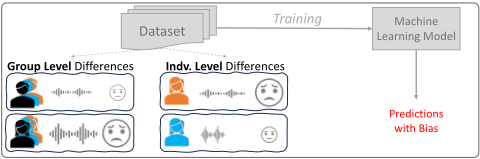

Figure 1: (a) Different individuals and groups manifest depression in different ways, causing vanilla approaches to have bias. (b) Our novel multimodal fusion approach targets both group and individuallevel differences to obtain better group and individual fairness.
Addressing Group Differences (M1). Literature indicates that females and males tend to show different behavioural symptoms when depressed [Barsky et al., 2001; Ogrodniczuk and Oliffe, 2011]. As an example, as illustrated in Fig. 1, both males and females are expressing depressive symptoms. However, there are gender-specific latent representation differences in depression manifestation. For instance, certain acoustic features (e.g. MFCC) are only statistically significantly different between depressed and healthy males [Wang et al., 2019]. On the other hand, compared to males, depressed females are more emotionally expressive and willing to reveal distress via behavioural cues [Barsky et al., 2001; Hall et al., 2000; Jansz and others, 2000]; i.e., group differences in depression manifestation. Gap: No existing ML for MHD detection approaches have considered this from a causal perspective. Regular depression detection models typically aim to approximate P(Y |X) (X and Y denotes input and target variables respectively). P(Y |X) may lead to bias since it may learn gender-specific representations that are not shared by new samples (Fig. 1). Contribution: This suggests that gender is a confounder which misleads a depression detection model to learn gender-specific latent representation in the training data, thus leading to prediction bias when tested on a subject of a different gender (Fig. 1). We adopt a causal approach as it provides a more principled way of representing and removing the effect of a confounder. Thus, we propose a method which approximates P(Y |do(X)) instead of P(Y |X). The do-operation [Pearl, 2009] denotes intervening on X in order to remove the confounding relationship of gender on X. To achieve group-level gender fairness, we implement causal interventional debiasing (CID) using backdoor adjustment [Pearl, 2009] in order to achieve fairer representational learning for each modality.
| Approach | Evaluation | Fairness Measures | ||||||||||
|---|---|---|---|---|---|---|---|---|---|---|---|---|
| Study | Task | Modality | Causal | FF | GF | IF | ND | SP | EOpp | EOdd | EAcc | IF-Cons |
| Alasadi et al. [2020] | Cyberbullying Detection | VT | N | ✓ | ✓ | N | 1 | ✓ | ✓ | |||
| Schmitz et al. [2022] | Emotion Detection | AVT | N | N | ✓ | N | 1 | ✓ | ✓ | |||
| Yan et al. [2020] | Personality Assessment | AV | N | N | ✓ | N | 1 | ✓ | ✓ | |||
| Kathan et al. [2022] | Humour Recognition | AV | N | N | ✓ | N | 1 | ✓ | ||||
| Chen et al. [2023] | Recommendation | AVT | N | N | ✓ | N | 2 | ✓ | ✓ | |||
| Janghorbani et al. [2023] | Vision-Language Models | VT | N | N | ✓ | N | 1 | |||||
| Pena et al. [2023] | Automatic Recruitment | VT | N | N | ✓ | N | 1 | ✓ | ||||
| FAIRREFUSE | Depression | AV | ✓ | ✓ | ✓ | ✓ | 3 | ✓ | ✓ | ✓ | ✓ | ✓ |
Addressing Individual Differences (M2). Individual-level differences in depressive symptoms [Kendler et al., 1994] are not accounted either in existing ML for MHD detection and analysis. Contribution: We propose to address this gap by taking into account individual-fairness when combining predictions across different modalities. First, we measure individual fairness using the individual consistency scores for each sample across the different modalities. Subsequently, we fuse the different modalities using a referee network that takes into account the individual fairness scores of each modality. To the best of our knowledge, we are the first to use and consider individual fairness in ML for MHD analysis.
Real-world Implication. Gender difference in depression manifestation has long been studied and recognised within fields such as medicine [Barsky et al., 2001] and psychology [Hall et al., 2000]. Anecdotal evidence have also often supported this view [Hall et al., 2000]. However, existing ML research is unable to account for this innate group and individual subjectivity. We present the first attempt towards addressing this problem by motivating our proposed method, FAIRREFUSE, which builds on existing research on depression findings rooted in literature adjacent to traditional ML. To the best of our knowledge, ours is the first work that attempts to address the well-recognised gender and individual difference in depression manifestation. These aims align with the United Nations Sustainable Development Goal
(SDG) 3 1 and SDG 5 2 respectively. The main contribution of this work is a dynamic referee-guided causal framework (FAIRREFUSE) that mitigates bias with causal intervention and individual fairness-guided fusion. We run experiments on three depression detection datasets, D-Vlog, DAIC-WOZ and E-DAIC. We demonstrate that our method was able to provide significant improvement in group and individual fairness across all datasets. The improvements are especially pronounced for D-Vlog. Results obtained on DAIC-WOZ and EDAIC were better compared to the baseline and other existing methods. We identify three key challenges: dataset curation (C1), appropriate evaluation (C2) and ethics and privacy (C3) as central topics that need to be tackled via collective efforts in order to promote real-world advancement in using ML to address the challenge of MHD in a fair and impactful manner.
Comparative Summary. In this work, we focus on multimodal gender fairness in MHD prediction on audio-visual datasets. To overcome the limitations in existing multimodal methods (see Table 1), we propose a referee network which dynamically learns how to fuse the different modalities. None of the current methods have combined this framework with causal intervention nor leveraged it to achieve multimodal fairness. Our work is distinct from existing work in several ways. First, we propose leveraging multimodal causal intervention to achieve multimodal fusion. Second, we use a individual fairness-guided referee network to adaptively learn the best way to fuse the different modalities. Third, we explore how the different modalities and fusion strategies impact gender fairness using both group and individual fairness measures to address the specific task of depression detection.
2 RelatedWork
Fairness in unimodal and multimodal ML. Fair ML can generally be categorised into group or individual fairness [Hort et al., 2022]. Group fairness metrics typically enforce some statistical constraints across groups while individual fairness metrics seek for similar individuals to be treated similarly. Most existing works typically consider a unimodal setup which may not map to a multimodal setting. There has been minimal literature which examines ML fairness in the context of multiple modalities. Booth et al. [2021] demonstrated how using multiple modalities marginally improves prediction at the cost of reducing fairness for automated video interviews. Schmitz et al. [2022] studied how different multimodal approaches affect gender bias in emotion recognition. Janghorbani et al. [2023] presented a visual-textual benchmark dataset to assess the bias present in existing multimodal models. Mandhala et al. [2023] summarised the tools and frameworks available to mitigate bias in multimodal datasets. Pena et al. [2023] presented a new dataset of synthetic resumes to evaluate how multimodal ML is affected by demographic bias. All of the above studies did not propose any mitigation strategies. Kathan et al. [2022] proposed a weighted fusion approach to achieve fairness in audiovisual humour recognition. Yan et al. [2020] focused on adversarial bias mitigation for multimodal personality assessment. Alasadi et al. [2020] proposed a fairness-aware fusion framework for cyberbullying detection using a weighted approach. Chen et al. [2023] proposed a fairness-aware method for multimodal recommendations. No existing work has investigated fairness in multimodal fusion for depression detection.
1 "Ensure healthy lives and promote well-being for all at all ages."
2 "Achieve gender equality and empower all women and girls."
Gender Fairness in ML for MHD. Only a few studies investigated gender fairness in ML-based MHD analysis [Zanna et al., 2022; Bailey and Plumbley, 2021; Cheong et al., 2023c]. Cheong et al. [2023d] proposed a data augmentation method to address the bias present within a small dataset of wellbeing coaching. Zanna et al. [2022] proposed an uncertainty-based approach to address the bias present in the TILES dataset. Bailey et al. [2021] used data re-distribution to mitigate the gender bias present in the DAIC-WOZ dataset. Cheong et al. [2023c] highlighted how existing bias mitigation methods do not fully address gender bias but did not propose any further mitigation strategies. Efforts have been partially hampered by the lack of datasets. Publicly available datasets are often in the form of extracted features to preserve the privacy of the subjects [Yoon et al., 2022]. Research suggests that the extracted features may contain bias due to the underlying training data [Bolukbasi et al., 2016; Garg et al., 2018].
3 Preliminaries and Background
3.1 Notation and ProblemDefinition
We have a dataset D = {(xi, yi)}i for a supervised classification problem, where xi ∈ X is the input representing information about an individual Ii ∈ I and yi ∈ Y is the classification target (e.g., depressed vs. non-depressed). Distinct from conventional classification settings, each input xi is composed of multiple modalities: i.e., xi = {xmi ∈ Xm}m, where m can be e.g., "image" or "audio". Each input xi is associated (through an individual Ii) with a sensitive attribute si ∈ S where, e.g., S = {male, female}. We are interested in finding a parameterised function f : X → Y . The function f( · ; θ) estimates the probabilities for all outcomes (classes) P(Y |xi). We use P(yi|xi) to denote the predicted probability for the correct class, yi, and ˆ yi ← argmaxy P(y|xi) to denote the predicted class. Finally, the pre-Softmax activations, i.e., logits, will be denoted by ϕi = ϕ(xi; θ).
3.2 Individual Fairness
Based on the principle of "similar individuals should have similar predictions", Dwork et al. [2012] defined individual fairness as the L-Lipschitz continuity of f:
where the notion assumes suitable distance metrics dy(·, ·) and dx(·, ·) to be available for the predictions and the inputs respectively. Aligned with existing work [Zemel et al., 2013; Mukherjee et al., 2020], we use consistency as a measure of individual fairness. Concretely:
where kNN(xi) denotes the k nearest neighbours of xi.
4 ProposedMethod: FAIRREFUSE
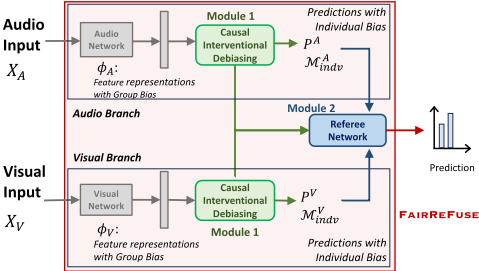
We introduce FAIRREFUSE for fairer predictions in a multimodal classification setting. As outlined in Fig. 2, for each modality m, we employ causal intervention via back-door adjustment to remove the bias caused by the sensitive attributes. Then, individual fairness score of a sample (Mmindv - Eq. 2) is used to dynamically fuse the predictions of each modality (Module 2). The pseudocode is shown in Algorithm 1. FAIRREFUSE mitigates bias with two novel modules:
Module 1: Causal Multimodal Interventional Debiasing for Group Fairness: Predictions made by individual modalities can have group-level biases (Fig. 1). To mitigate such modality-specific group-level bias, we adapt the unimodal work by Chen et al. [2022] to our multimodal setting.
Algorithm 1 FAIRREFUSE: a referee-guided fusion approach for multimodal causal fairness.
- 1: Input: Dataset D = {(xi, yi)}i
- 2: Output: Networks for each modality (f m) and RefNet. # Module 1 - Causal Multimodal Interventional Debiasing (CMID):
- 3: - Train each modality f m with causal debiasing (Eq. 9)
- 4: - CalculateMmindv, individual fairness scores (Eq. 2) # Module 2 - Referee Network:
- 5: - Train RefNet to maximize PRN with Cross-Entropy (Eq. 10)
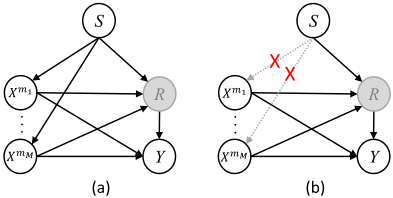
We attempt to remove the spurious confounding effect (see Fig. 3) of all modalities by intervening on the latent space of each modality, which is akin to attempting to remove the group-level modality-specific biases.
Module 2: Referee Network for Individual Fairness Guided Fusion for Individual Fairness: Module 1 addresses modality-specific group-level biases. As different modalities may have biases for different individuals (Fig. 1), we propose to estimate the modality-specific individual fairness (Eq. 2) and use these scores to fuse the different modalities. Note that, although Figs. 1 and 2 as well as the experiments focus on a bi-modal setting (with audio and vision), FAIRREFUSE can be applied to more than two modalities.
4.1 Module 1: CID
For each modality, we use causal intervention via back-door adjustment to remove the bias from the sensitive attributes.
Structural Causal Diagram
As shown in Fig. 3, there are four main variables involved. {Xm1 , ..., X mM } represents the data input across M modalities, S represents the sensitive attribute associated with the data input, R = ϕ represents the latent representation learnt by the classifier and Y represents the probability outcome. The causal relationships between variables are as follows:
S → {Xm1 , ...,X mM } : The sensitive attribute of the sample is bound to lead to attribute-specific features. For instance, in our setup where s represents gender, females are more likely to have higher pitched voice compared to males.
{Xm1 , ...,X mM } → R ← S : R is the latent representation of X and this causal relationship is captured by X → R. This latent representation R will also be determined by the sample's sensitive attribute S captured via R ← S.
{Xm1 , ...,X mM } → Y ← R : The final outcome Y is affected by the input sample X and latent representation R as captured by X → Y and Y ← R respectively.
Interventional Debiasing via Backdoor Adjustment
Since interventional debiasing is performed for each modality, to simplify notation, we drop m from all variables in this section. With reference to Fig. 3, for each modality, we attempt to model P(Y |do(X)) instead of P(Y |X) in order to remove the bias introduced by the confounder sensitive attribute s ∈ S. Using backdoor adjustment [Pearl, 2009], we model P(Y |do(X)) by removing the causal relationship of S → X by marginalising over the confounder (S) for all modalities. For each modality, the debiased network can therefore be represented by:
where g(x, s) is a function, as defined later in Eq. 5, which generates the latent representation R from X and s. We denote P (Y |do(X = x)) of each modality m using P m to simplify subsequent notation.
We adopt a similar approach to Chen et al. [2022] to estimate R from X and s. This involves a confounder dictionary, confounder attention and confounder priors. Given a confounder dictionary for each of the gender, male and female, and rs ∈ R is the prototype of gender s, there is one feature memory bank for each gender to store the latent features of training samples of a specific gender s. Thus,
where ϕ(xj) is the feature for a sample with sensitive attribute s and Ns is the number of samples for gender s. R is approximated as a weighted aggregation of all the prototypes of the specific gender s:
where P(s) is the ratio of the number of gender s samples to the total number of training samples and αs is the confounder attention for gender s in the confounder dictionary, calculated using scaled dot-product attention [Vaswani et al., 2017]:
where ϕ(x) represents the extracted features for the current sample x and WQ ∈ Rdm×din and WK ∈ Rdm×din are weight parameters are learned.
4.2 Module 2: Referee Network for Individual Fairness Guided Multimodal Fusion
The Referee Network (Fig. 2) takes in P m from each modality as features and attempts to learn to dynamically fuse the predictions using their individual fairness scores. We define individual fairness for a modality m by a simple extension of Mindv (Eq. 2):
There are many ways to combine P m and Mmindv (xmi ), which can be explored through experimental analysis. We observe that a linear layer provides the best results:
where xi = {xmi }m; [; ]m represents the concatenation over M modalities and FC denotes a linear layer.
4.3 Loss Functions
We use the Cross Entropy loss while causally-debiasing each modality m:
The Referee Network (RefNet) is trained also with the Cross Entropy loss (with xi = {xmi }m):
5 Experiment Setup and Details
5.1 Datasets
We performed our experiments using the following datasets.
| D-Vlog | DAIC-WoZ | E-DAIC | |||||||
|---|---|---|---|---|---|---|---|---|---|
| Y0 | Y1 | T | Y0 | Y1 | T | Y0 | Y1 | T | |
| M | 0.15 | 0.19 | 0.34 | 0.45 | 0.08 | 0.53 | 0.49 | 0.13 | 0.62 |
| F | 0.28 | 0.39 | 0.66 | 0.36 | 0.11 | 0.47 | 0.27 | 0.11 | 0.38 |
| T | 0.42 | 0.58 | 1.00 | 0.81 | 0.19 | 1.00 | 0.76 | 0.24 | 1.00 |
D-Vlog [Yoon et al., 2022] consists of Youtube vlog data. DAIC-WOZ [Valstar et al., 2016] and E-DAIC [Ringeval et al., 2019] contain audio recordings, extracted visual features and transcripts. For all datasets, we work with the extracted features and followed the train-validate-test split provided. Dataset Challenges: We identify three dataset challenges: small dataset sample size (C1a), class imbalance (C1b) and inconsistency in dataset distribution (C1c) which will be discussed in further detail in Section 7.
5.2 Implementation Details
We adopt Yoon et al.'s [2022] implementation to facilitate comparison. We train the model with the Adam optimizer [Kingma and Ba, 2014] at a learning rate of 0.0002 and a batch size of 32 for D-Vlog as stated in Yoon et al. For DAICWOZ and E-DAIC, we use a learning rate of 0.0005 and a batch size of 64. Weights are randomly initialised for all.
5.3 Baseline Models
For Module 1, we use the unimodal transformer encoder from Yoon et al. [2022] as the baseline. As Module 2 is a late fusion method, we compare RefNet against two other commonly used late fusion methods: (i) Ensemble method, where the final prediction is made according to the predicted class probability that is highest across all classifiers. (ii) Stacking method [Baltruˇsaitis et al., 2018], where another classifier, a logistic regression model, is used to to provide the final classification. Our proposed method is most similar to a stacking classifier with the key difference that it weighs each modality according to the individual fairness (IF) scores and debiases the individual modalities before providing the final outcome.
5.4 Evaluation Protocols
Model Performance. We adopted the evaluation methods of existing work [Yoon et al., 2022; Cheong et al., 2023b] by using precision, recall and F1 to evaluate model performance.
| Method | Modality | Prec. | Rec. | F1 | |
|---|---|---|---|---|---|
| D-Vlog | Dosovitskiy et al. [2020] | AV | 0.64 | 0.63 | 0.63 |
| Touvron et al. [2021] | AV | 0.64 | 0.64 | 0.64 | |
| Yin et al. [2022] | AV | 0.65 | 0.64 | 0.65 | |
| Wang et al. [2022] | AV | 0.65 | 0.64 | 0.65 | |
| Wu et al. [2022] | AV | 0.65 | 0.64 | 0.65 | |
| Zheng et al. [2023] | AV | 0.66 | 0.64 | 0.65 | |
| FAIRREFUSE | AV | 0.61 | 0.82 | 0.70 | |
| DAIC- WoZ | Ma et al. [2016] | A | 0.35 | 1.00 | 0.52 |
| Valstar et al. [2018] | A | 0.32 | 0.86 | 0.46 | |
| Williamson et al. [2016] | V | - | - | 0.53 | |
| Valstar et al. [2018] | V | 0.60 | 0.43 | 0.50 | |
| Valstar et al. [2018] | AV | 0.60 | 0.43 | 0.50 | |
| FAIRREFUSE | AV | 0.52 | 0.60 | 0.57 |
Group Fairness (GF). We use the most commonly used fairness metrics [Hort et al., 2022; Pessach and Shmueli, 2022]: Statistical Parity (MSP ), Equal Opportunity (MEOpp), Equalised Odds (MOdd) as well as Equal Accuracy (MEAcc) to evaluate group fairness. Specific formulations can be found in the appendix. We adopt the approach of existing work which considers 0.80 and 1.20 as the acceptable lower and upper fairness bounds [Zanna et al., 2022]. Values outside this range are considered unfair.
Individual Fairness (IF). As there is no prior work which evaluates individual fairness for depression detection, we use consistency (Eq. 2) as a measure of individual fairness which aligns with existing work [Yurochkin and Sun, 2021; Mukherjee et al., 2020; Zemel et al., 2013].
6 Results
6.1 Baseline Performance Comparison
Table 3 presents our results compared against other methods which also worked with extracted features. We are starting with this comparison in order to demonstrate that FAIRREFUSE outperforms other methods which also worked with extracted features. D-Vlog only provides extracted data hence all the recent state-of-the art (SOTA) methods were implemented on extracted features. DAIC-WOZ and E-DAIC provided raw files in addition to the extracted features. As a result, most of the recent methods worked directly with the raw files in order to obtain better benchmark performance. We have chosen to only include methods which rely only on extracted features in order for our method to be comparable. As seen in Table 3, there is a general precision-recall trade-off across all methods hence more emphasis should be placed on the F1-score when evaluating performance results. We observe that our results are comparable and often outperform existing SOTA methods especially across the F1-score.
Summary: Despite the dataset challenges (C1a-C1c), FAIRREFUSE still provides comparatively better results overall compared to existing methods for both datasets. This is significant as most of the recent studies which report higher accuracies typically work directly with the raw files. This may pose ethical and privacy concerns (C3) which will be discussed in further detail in Section 7.
| Approach | Method | Classification | Group Fairness | Indv. Fairness | |||||
|---|---|---|---|---|---|---|---|---|---|
| Prec. | Rec. | F1 | MSP | MEOpp | MEOdd | MEAcc | MIndv | ||
| Unimodal | Audio Network Visual Network | 0.60 0.57 | 0.58 0.62 | 0.63 0.64 | 1.07 1.23 | 0.71 1.42 | 0.59 1.28 | 0.82 1.11 | 0.54±0.22 0.56±0.22 |
| D-Vlog Fusion | Baseline-AV Ensembles | 0.58 0.59 | 0.58 0.83 | 0.59 0.69 | 0.92 1.20 | 1.23 0.97 | 1.86 0.95 | 1.24 1.04 | 0.62±0.22 0.61±0.23 0.60±0.25 |
| Stacking | 0.59 | 0.85 | 0.69 | 1.33 | 0.98 | 0.97 | 1.07 | ||
| FAIRREFUSE | CID&RefNet | 0.61 | 0.82 | 0.70 | 1.03 | 1.02 | 1.06 | 1.05 | 0.80±0.24 |
| Unimodal | Audio Network Visual Network | 0.54 0.58 | 0.66 0.62 | 0.56 0.53 | 0.38 0.76 | 0.89 0.81 | 0.80 0.83 | 0.66 0.66 | 0.48±0.20 0.56±0.24 |
| DAIC-WOZ | Baseline-AV | 0.56 | 0.52 | 0.53 | 0.75 | 0.88 | 0.77 | 0.87 | 0.56±0.20 |
| Fusion | Ensembles | 0.58 | 0.21 | 0.31 | 284.78 | 1.10 | 1.22 | 0.72 | 0.73±0.26 |
| Stacking | 0.53 | 0.35 | 0.42 | 0.00 | 1.12 | 0.69 | 0.68±0.28 | ||
| FAIRREFUSE | CID&RefNet | 0.52 | 0.60 | 0.57 | 22.58 | 1.05 1.08 | 1.10 | 0.74 | 0.80±0.20 |
| Unimodal | Audio Network | 0.50 | 0.51 | 0.50 | 0.53 | 0.64 | 0.70 | 0.74 | 0.52±0.21 |
| Visual Network | 0.50 | 0.52 | 0.52 | 0.58 | 0.65 | 0.76 | 0.75 | 0.54±0.22 | |
| EDAIC | 0.86 | ||||||||
| Fusion | Baseline-AV | 0.50 | 0.48 | 0.50 | 0.84 | 0.82 | 0.82 | 0.64±0.20 | |
| Ensembles | 0.54 | 0.19 | 0.29 | 281.78 0.00 | 1.09 | 1.21 | 0.69 0.72 | 0.68±0.22 0.70±0.23 | |
| FAIRREFUSE | Stacking CID&RefNet | 0.55 0.56 | 0.37 0.62 | 0.44 0.60 | 18.60 | 1.10 1.05 | 1.24 1.11 | 0.88 | 0.78±0.22 |
6.2 Comparison with Other FusionMethods
As our method can largely be considered a late fusion strategy, we compare FAIRREFUSE against other popular late fusion strategies: ensembles and stacking. With reference to Table 4, we see that our proposed method is comparable to or better than other fusion methods across most performance measures and especially the F1-score for all datasets. Across group fairness, our method generally ensures better group fairness for all datasets. For DAIC-WOZ and E-DAIC, across MEOpp and MEOdd, all fusion methods improved fairness in favour of the minority group (values > 1) whereas MEAcc still shows bias against the minority group (values < 1). It is noteworthy that according to the MSP measure, all the fusion methods exacerbated bias compared to baseline. For DAIC-WOZ, the MSP values for ensembles, stacking and FAIRREFUSE are 284.78, 0, and 22.58 respectively whereas for E-DAIC, theMSP values are 281.78, 0 and 18.6 respectively. Ensembles and stacking severely exacerbated the bias whereas FAIRREFUSE lead to the same though to a less severe degree. We provide further insights to this phenomena in Section 7. Across MIndv, FAIRREFUSE also provided the fairest MIndv score which exceeds theMIndv scores of other methods for all datasets.
Summary: FAIRREFUSE generally out-performs other methods across most measures and achieves more consistent group and individual fairness compared to the other methods. The results are significant especially for D-Vlog. We also noted how certain fairness metrics are unsuitable for the task of depression detecion (C2). We discuss C2 as well as the dataset challenges (C1a-C1c) that may have impacted the results for DAIC-WOZ and E-DAIC in Section 7.
6.3 Ablation Studies
The Effects of Module 1: CID
With reference to Table 5, for the unimodal results, we see that the CID module was able to provide improvements across most metrics compared to the unimodal baselines for all datasets. For instance, for E-DAIC's audio modality, CID improved the prec., rec. and F1 from 0.50, 0.51, and 0.50 to 0.54, 0.57 and 0.56 respectively. The corresponding group fairness results also improved from 0.53, 0.64, 0.70 and 0.74 to 0.83, 0.74, 0.77 and 0.82. This trend is consistent for both modalities across all datasets. This suggests that for each modality, gender may have been a confounder as hypothesised and CID was effective in helping the model achieve group-level fairness across gender. Across the multimodal approaches, CID improves most metrics compared to baseline. For instance, for DAIC-WOZ, CID improved the prec., rec. and F1 from 0.56, 0.52 and 0.53 to 0.58, 0.59 and 0.59 respectively. The corresponding group fairness results also mostly improved from 0.75, 0.88, 0.77 and 0.87 to 0.85, 0.81, 0.83 and 1.23. The results are more pronounced for D-Vlog than DAIC-WOZ and E-DAIC.
Summary: CID is effective at improving both performance and fairness. It is most effective when the source of bias is the group difference in depression manifestation. This is distinct from the typical class imbalance problem. Despite females being the majority as evidenced in Table 2, there is still bias against females as seen from the baseline model in Table 4. CID which addresses the group difference is thus able to address this source of bias which existing bias mitigation methods were unable to (see Table 4 in [Cheong et al., 2023c]).
The Effects of Module 2: RefNet
From Table 5, we see that RefNet improves performance and group fairness in addition to the increments provided by CID. For example, for D-Vlog, CID improves the rec. and F1 from 0.58 and 0.59 to 0.61 and 0.62 respectively. RefNet further improves the values to 0.82 and 0.70. For group fairness, we see RefNet improving beyond the CID results to achieve a near perfect group fairness score of 1.03, 1.02, 1.06 and 1.05. Across MIndv, RefNet combined with CID consistently provides the fairest MIndv score across all datasets. An analysis of the effects of k is within the Appendix of the full paper 3 .
Summary: RefNet improves the classification and group fairness measures beyond the increment provided by the CID module. This effect is more pronounced for D-Vlog than it is for DAIC-WOZ and E-DAIC. This may be due to the fact that DAIC-WOZ and E-DAIC are much more challenging datasets due to (C1a - C1c). This will be further discussed in Section 7. Our proposed method's efficacy is most effectively captured across the individual fairness measureMIndv across all datasets. This suggests that RefNet is particularly effective at achieving individual-level fairness.
3 https://www.repository.cam.ac.uk/handle/1810/368887
| Method | Classification | Group Fairness | Indv. Fairness | |||||||||
|---|---|---|---|---|---|---|---|---|---|---|---|---|
| CID | MM | RN | Mod. | Prec. | Rec. | F1 | MSP | MEOpp | MEOdd | MEAcc | MIndv | |
| ✓ ✓ | ✓ | A A V V AV | 0.60 0.68 0.57 0.61 | 0.58 0.72 0.62 0.67 | 0.63 0.69 0.64 0.68 | 1.07 0.97 1.23 1.12 0.92 | 0.71 1.12 1.42 1.05 | 0.59 0.78 1.28 1.17 1.86 | 0.82 1.08 1.11 1.19 1.24 1.09 | 0.54±0.22 0.61±0.21 0.56±0.22 0.66±0.20 0.62±0.22 0.60±0.19 | ||
| D-Vlog ✓ | 0.58 | 0.58 | 0.59 | 1.23 | ||||||||
| ✓ | AV | 0.63 | 0.61 | 0.62 | 1.29 | 1.11 | 1.18 | |||||
| FAIRREFUSE | ✓ | ✓ | ✓ | 0.80±0.24 | ||||||||
| AV | 0.61 0.54 | 0.82 | 0.70 | 1.03 | 1.02 0.89 | 1.06 | 1.05 | 0.48±0.20 | ||||
| ✓ ✓ | A A V | 0.55 0.58 0.58 | 0.66 0.64 0.62 0.63 | 0.56 0.58 0.53 0.60 | 0.38 0.69 0.76 0.73 | 0.88 0.81 0.76 | 0.80 0.76 0.83 0.75 | 0.66 0.90 0.66 1.12 | 0.67±0.22 0.56±0.24 0.71±0.24 | |||
| FAIRREFUSE | DAIC-WOZ ✓ | ✓ ✓ | V AV AV | 0.56 0.58 | 0.52 0.59 | 0.53 0.59 | 0.75 0.85 | 0.88 0.81 | 0.77 0.83 | 0.87 1.23 | 0.56±0.20 0.70±0.25 0.80±0.20 | |
| ✓ | ✓ | ✓ | AV | 0.52 | 0.60 | 0.57 | 22.58 | 1.08 | 1.18 | 0.74 | ||
| ✓ | A | 0.50 0.54 | 0.51 0.57 | 0.50 0.56 | 0.53 0.83 | 0.64 0.74 | 0.70 0.77 | 0.74 0.82 | 0.52±0.21 0.64±0.21 | |||
| ✓ | A V V | 0.50 0.53 | 0.52 0.58 | 0.52 0.58 | 0.58 0.88 | 0.65 0.81 | 0.76 | 0.75 0.80 | 0.54±0.22 0.70±0.22 | |||
| E-DAIC ✓ | ✓ | AV AV | 0.50 0.52 | 0.48 | 0.50 | 0.87 | 0.84 0.86 | 0.86 0.81 0.82 | 0.86 0.82 | 0.68±0.24 | ||
| FAIRREFUSE | ✓ | 0.52 | 0.51 | 0.84 | 0.72±0.20 | |||||||
| ✓ | ✓ | ✓ | AV | 0.56 | 0.60 | 18.60 | 1.05 | 1.11 | 0.88 | 0.78±0.22 | ||
| 0.62 | ||||||||||||
7 Conclusion and Discussion
Conclusion. We present a novel framework to achieve both group and individual level fairness for the task of depression detection. We focus specifically on extracted audio-visual data as this is less studied compared to text-based depression detection research. We show that both Module 1: CID and Module 2: RefNet were effective at improving ML performance and fairness. They are most effective when used together and are able to achieve good performance and fairness results without requiring access to the raw files. This respects the privacy and anonymity of the subjects. In addition, we highlight three key challenges as a call to the community to address the identified issues collectively. This is in tandem with the goal of addressing the real-world challenge of MHD in order to achieve social good for all.
Discussion. C1: Dataset Challenges. Compared to DVlog, the results seem less effective for DAIC-WOZ and EDAIC. From Table 2, we see that there are significantly less samples (C1a) in DAIC-WOZ (185) and E-DAIC (268) compared to D-Vlog (961). Second, there is class imbalance (C1b) as seen in Table 2. D-Vlog is balanced across classes (Y0: 0.42 vs Y1: 0.58) but imbalanced across gender (M: 0.34 vs F: 0.66). DAIC-WOZ (Y0: 0.81 vs Y1: 0.19) and E-DAIC (Y0: 0.76 vs Y1: 0.24) are both imbalanced across classes. Third, Table 6 within the Appendix, suggest a significant distribution shift (C1c) between the training and testing set for DAIC-WOZ and E-DAIC. For instance, for DAIC-WOZ, the training set contains more males than females whereas the testing set contains more females than males. The training set contains more males of class Y0 whereas the testing set contains more females of class Y0. The smaller sample size (C1a), class imbalance (C1b) and inconsistency in dataset distribution (C1c) may have impacted the results for DAICWOZ and E-DAIC. Vabalas et al. [2019] demonstrated that small datasets and small sample sizes cause ML in MHD to be more vulnerable or sensitive to changes in data distribution. Our results support the hypothesis that this may have lead to biased outcomes. Future dataset owners can consider providing more samples with lesser class imbalance and more consistent data distribution as well as identifying the root cause of bias [Cheong et al., 2023a] to mitigate this challenge.
C2: Inadequacy of Metrics. Moreover, existing fairness metrics are inadequate to deal with the small dataset challenge prevalent for depression detection. The small denominator resulting from the small sample size for DAIC-WOZ and E-DAIC inadvertently lead to massive numbers which cannot be interpreted without adequate context. Future work may consider proposing more appropriate fairness metrics or evaluation methods and adopting other approaches [Churamani et al., 2023] which takes this challenge into account.
C3: Ethics and Privacy. We lack publicly available datasets due to the sensitive nature of the problem setting. Some MH datasets (e.g., the Turkish BD Corpus [C¸ iftc¸i et al., 2018] and the Pittsburgh [Yang et al., 2012]) which were previously publicly available for research purposes are no longer made available. Recent datasets have only released the extracted features due to privacy concerns. This necessitates the urgency to advance research practices that takes ethical concerns into consideration. The data collection procedure and proposed methods should respect subjects' privacy and anonymity and perform well across classification and fairness. Our work presents the first step towards that direction.
Limitations. We assume the availability of sensitive attribute labels, which is the common setting in the bias mitigation literature. It is possible to extend our framework to work without this assumption. We only evaluated our methods on three datasets with two modalities. Future work should consider experimenting on more datasets and adapting this approach to other modalities beyond audio-visual sources.
Acknowledgements
Open access: The authors have applied a Creative Commons Attribution (CC BY) licence to any Author Accepted Manuscript version arising. Data access: This study involved secondary analyses of existing datasets. All datasets are described and cited accordingly. Funding: J. Cheong is supported by the Alan Turing Institute doctoral studentship, the Leverhulme Trust and further acknowledges resource support from METU. H. Gunes' work is supported by the EPSRC/UKRI project ARoEq under grant ref. EP/R030782/1.
@inproceedings{ijcai2024p799,
  title     = {FairReFuse: Referee-Guided Fusion for Multi-Modal Causal Fairness in Depression Detection},
  author    = {Cheong, Jiaee and Kalkan, Sinan and Gunes, Hatice},
  booktitle = {Proceedings of the Thirty-Third International Joint Conference on
               Artificial Intelligence, {IJCAI-24}},
  publisher = {International Joint Conferences on Artificial Intelligence Organization},
  editor    = {Kate Larson},
  pages     = {7224--7232},
  year      = {2024},
  month     = {8},
  note      = {AI for Good},
  doi       = {10.24963/ijcai.2024/799},
  url       = {https://doi.org/10.24963/ijcai.2024/799},
}
TY - CPAPER TI - FairReFuse: Referee-Guided Fusion for Multi-Modal Causal Fairness in Depression Detection AU - Cheong, Jiaee AU - Kalkan, Sinan AU - Gunes, Hatice T2 - Proceedings of the Thirty-Third International Joint Conference on Artificial Intelligence, IJCAI-24 PB - International Joint Conferences on Artificial Intelligence Organization PY - 2024 SP - 7224 EP - 7232 DO - 10.24963/ijcai.2024/799 UR - https://doi.org/10.24963/ijcai.2024/799 ER -Copied
Machine-readable versions of this paper, for tools and AI agents:





