
Unmasking Societal Biases in Respiratory Support for ICU Patients through Social Determinants of Health
Proceedings of the Thirty-Third International Joint Conference on Artificial Intelligence. AI for Good. Pages 7421-7429.
https://doi.org/10.24963/ijcai.2024/821
Keywords
- AI Ethics, Trust, Fairness: General
- Data Mining: General
- Machine Learning: General
Abstract
In critical care settings, where precise and timely interventions are crucial for health outcomes, evaluating disparities in patient outcomes is important. Current approaches often fall short in comprehensively understanding and evaluating the impact of respiratory support interventions on individuals affected by social determinants of health. Attributes such as gender, race, and age are commonly assessed and essential, but provide only a partial view of the complexities faced by diverse populations. In this study, we focus on two clinically motivated tasks: prolonged mechanical ventilation and successful weaning. We also perform fairness audits on the models' predictions across demographic groups and social determinants of health to better understand the health inequities in respiratory interventions in the intensive care unit. We also release a temporal benchmark dataset, verified by clinical experts, to enable benchmarking of clinical respiratory intervention tasks.
- [Bundy et al., 2023] Joshua D Bundy, Katherine T Mills, Hua He, Thomas A LaVeist, Keith C Ferdinand, Jing Chen, and Jiang He. Social determinants of health and premature death among adults in the usa from 1999 to 2018: a national cohort study. The Lancet Public Health, 8(6):e422-e431, 2023.
- [Celi et al., 2022] Leo Anthony Celi, Jacqueline Cellini, Marie-Laure Charpignon, Edward Christopher Dee, Franck Dernoncourt, Rene Eber, William Greig Mitchell, Lama Moukheiber, Julian Schirmer, Julia Situ, et al. Sources of bias in artificial intelligence that perpetuate healthcare disparities-a global review. PLOS Digital Health, 1(3):e0000022, 2022.
- [Chen et al., 2019] Irene Y Chen, Peter Szolovits, and Marzyeh Ghassemi. Can ai help reduce disparities in gen- eral medical and mental health care? AMA journal of ethics, 21(2):167-179, 2019.
- [Doyle et al., 1995] Ramona L Doyle, Nancy Szaflarski, Gunnard W Modin, Janine P Wiener-Kronish, and Michael A Matthay. Identification of patients with acute lung injury. predictors of mortality. American journal of respiratory and critical care medicine, 152(6):1818-1824, 1995.
- [Esquinas et al., 2017] Antonio M Esquinas, Maly Oron Benhamou, Alastair J Glossop, and Bushra Mina. Nonin- vasive mechanical ventilation in acute ventilatory failure: rationale and current applications. Sleep Medicine Clinics, 12(4):597-606, 2017.
- [Esteban et al., 2000] Andres Esteban, Antonio Anzueto, In- maculada Alia, Federico Gordo, Carlos Apezteguia, Fer- nando Palizas, David Cide, Rosanne Goldwaser, Luis Soto, Guillermo Bugedo, et al. How is mechanical ven- tilation employed in the intensive care unit? an interna- tional utilization review. American journal of respiratory and critical care medicine, 161(5):1450-1458, 2000.
- [Frat et al., 2017] Jean-Pierre Frat, Rémi Coudroy, Nicolas Marjanovic, and Arnaud W Thille. High-flow nasal oxy- gen therapy and noninvasive ventilation in the manage- ment of acute hypoxemic respiratory failure. Annals of translational medicine, 5(14), 2017.
- [Gupta et al., 2022] Mehak Gupta, Brennan Gallamoza, Nicolas Cutrona, Pranjal Dhakal, Raphael Poulain, and Rahmatollah Beheshti. An extensive data processing pipeline for mimic-iv. In Machine Learning for Health, pages 311-325. PMLR, 2022.
- [Harutyunyan et al., 2019] Hrayr Harutyunyan, Hrant Khachatrian, David C Kale, Greg Ver Steeg, and Aram Galstyan. Multitask learning and benchmarking with clinical time series data. Scientific data, 6(1):96, 2019.
- [Hashimoto et al., 2018] Tatsunori Hashimoto, Megha Sri- vastava, Hongseok Namkoong, and Percy Liang. Fair- ness without demographics in repeated loss minimization. In International Conference on Machine Learning, pages 1929-1938. PMLR, 2018.
- [Holmes Fee et al., 2023] Casey Holmes Fee, Rachel Scar- lett Hicklen, Sidney Jean, Nebal Abu Hussein, Lama Moukheiber, Michelle Foronda de Lota, Mira Moukheiber, Dana Moukheiber, Leo Anthony Celi, and Irene Dankwa- Mullan. Strategies and solutions to address digital determi- nants of health (ddoh) across underinvested communities. PLOS digital health, 2(10):e0000314, 2023.
- [Kondrup et al., 2023] Flemming Kondrup, Thomas Jiraler- spong, Elaine Lau, Nathan de Lara, Jacob Shkrob, My Duc Tran, Doina Precup, and Sumana Basu. Towards safe me- chanical ventilation treatment using deep offline reinforce- ment learning. In Proceedings of the AAAI Conference on Artificial Intelligence, volume 37, pages 15696-15702, 2023.
- [Lua et al., 2023] Iracema Lua, Andrea F Silva, Nathalia S Guimarães, Laio Magno, Julia Pescarini, Rodrigo VR An- derle, Maria Yury Ichihara, Mauricio L Barreto, Carlos AS Teles Santos, Louisa Chenciner, et al. The effects of social determinants of health on acquired immune de- ficiency syndrome in a low-income population of brazil: a retrospective cohort study of 28.3 million individuals. The Lancet Regional Health-Americas, 24, 2023.
- [Marmot, 2005] Michael Marmot. Social determinants of health inequalities. The lancet, 365(9464):1099-1104, 2005.
- [Moody and Mark, 1996] George B Moody and Roger G Mark. A database to support development and evaluation of intelligent intensive care monitoring. In Computers in Cardiology 1996, pages 657-660. IEEE, 1996.
- [Moukheiber et al., 2024] Dana Moukheiber, Saurabh Mahindre, Lama Moukheiber, Mira Moukheiber, and Mingchen Gao. Looking beyond what you see: An empirical analysis on subgroup intersectional fairness for multi-label chest x-ray classification using social determinants of racial health inequities. arXiv preprint arXiv:2403.18196, 2024.
- [Moy et al., 2017] Ernest Moy, Macarena C Garcia, Brigham Bastian, Lauren M Rossen, Deborah D Ingram, Mark Faul, Greta M Massetti, Cheryll C Thomas, Yuling Hong, Paula W Yoon, et al. Leading causes of death in nonmetropolitan and metropolitan areas-united states, 1999-2014. MMWR Surveillance Summaries, 66(1):1, 2017.
- [Nakagawa et al., 2023] Keisuke Nakagawa, Lama Moukheiber, Leo A Celi, Malhar Patel, Faisal Mah- mood, Dibson Gondim, Michael Hogarth, and Richard Levenson. Ai in pathology: what could possibly go wrong? In Seminars in Diagnostic Pathology, volume 40, pages 100-108. Elsevier, 2023.
- [Nazer et al., 2023] Lama H Nazer, Razan Zatarah, Shai Waldrip, Janny Xue Chen Ke, Mira Moukheiber, Ashish K Khanna, Rachel S Hicklen, Lama Moukheiber, Dana Moukheiber, Haobo Ma, et al. Bias in artificial intelligence algorithms and recommendations for mitigation. PLOS Digital Health, 2(6):e0000278, 2023.
- [Papoutsi et al., 2021] Eleni Papoutsi, Vassilis G Gian- nakoulis, Eleni Xourgia, Christina Routsi, Anastasia Kotanidou, and Ilias I Siempos. Effect of timing of in- tubation on clinical outcomes of critically ill patients with covid-19: a systematic review and meta-analysis of non- randomized cohort studies. Critical Care, 25:1-9, 2021.
- [Pham et al., 2023] Tài Pham, Leo Heunks, Giacomo Bel- lani, Fabiana Madotto, Irene Aragao, Gaëtan Beduneau, Ewan C Goligher, Giacomo Grasselli, Jon Henrik Laake, Jordi Mancebo, et al. Weaning from mechanical ventila- tion in intensive care units across 50 countries (wean safe): a multicentre, prospective, observational cohort study. The Lancet Respiratory Medicine, 11(5):465-476, 2023.
- [Purnell et al., 2016] Tanjala S Purnell, Elizabeth A Cal- houn, Sherita H Golden, Jacqueline R Halladay, Jessica L Krok-Schoen, Bradley M Appelhans, and Lisa A Cooper. Achieving health equity: closing the gaps in health care disparities, interventions, and research. Health Affairs, 35(8):1410-1415, 2016.
- [Purushotham et al., 2018] Sanjay Purushotham, Chuizheng Meng, Zhengping Che, and Yan Liu. Benchmarking deep learning models on large healthcare datasets. Journal of biomedical informatics, 83:112-134, 2018.
- [Rocheteau et al., 2021] Emma Rocheteau, Pietro Liò, and Stephanie Hyland. Temporal pointwise convolutional net- works for length of stay prediction in the intensive care unit. In Proceedings of the conference on health, infer- ence, and learning, pages 58-68, 2021.
- [Rubenfeld et al., 2005] Gordon D Rubenfeld, Ellen Cald- well, Eve Peabody, Jim Weaver, Diane P Martin, Margaret Neff, Eric J Stern, and Leonard D Hudson. Incidence and outcomes of acute lung injury. New England Journal of Medicine, 353(16):1685-1693, 2005.
- [Sayed et al., 2021] Mohammed Sayed, David Riano, and Jesús Villar. Predicting duration of mechanical ventila- tion in acute respiratory distress syndrome using super- vised machine learning. Journal of Clinical Medicine, 10(17):3824, 2021.
- [Schraufnagel et al., 2013] Dean E Schraufnagel, Francesco Blasi, Monica Kraft, Mina Gaga, Patricia W Finn, and Klaus F Rabe. An official american thoracic soci- ety/european respiratory society policy statement: dispari- ties in respiratory health. American journal of respiratory and critical care medicine, 188(7):865-871, 2013.
- [Suo et al., 2021] Daniel Suo, Naman Agarwal, Wenhan Xia, Xinyi Chen, Udaya Ghai, Alexander Yu, Paula Gradu, Karan Singh, Cyril Zhang, Edgar Minasyan, et al. Ma- chine learning for mechanical ventilation control. arXiv preprint arXiv:2102.06779, 2021.
- [Sweatt and Levitt, 2014] Andrew J Sweatt and Joseph E Levitt. Evolving epidemiology and definitions of the acute respiratory distress syndrome and early acute lung injury. Clinics in chest medicine, 35(4):609-624, 2014.
- [Thakur et al., 2014] Neeta Thakur, Meghan E McGarry, Sam S. Oh, Joshua M. Galanter, Patricia W Finn, Este- ban G Burchard, and ATS Health Equality Committee. The lung corps' approach to reducing health disparities in respiratory disease. Annals of the American Thoracic So- ciety, 11(4):655-660, 2014.
- [Vali et al., 2023] Mohebat Vali, Shahram Paydar, Mozh- gan Seif, Golnar Sabetian, Ahmad Abujaber, and Haleh Ghaem. Prediction prolonged mechanical ventilation in trauma patients of the intensive care unit according to ini- tial medical factors: a machine learning approach. Scien- tific Reports, 13(1):5925, 2023.
- [Wang et al., 2020] Shirly Wang, Matthew BA McDer- mott, Geeticka Chauhan, Marzyeh Ghassemi, Michael C Hughes, and Tristan Naumann. Mimic-extract: A data extraction, preprocessing, and representation pipeline for mimic-iii. In Proceedings of the ACM conference on health, inference, and learning, pages 222-235, 2020.
- [Wanis et al., 2023] Kerollos Nashat Wanis, Arin L Madenci, Sicheng Hao, Mira Moukheiber, Lama Moukheiber, Dana Moukheiber, Sulaiman Moukheiber, Jessica G Young, and Leo Anthony Celi. Emulating target trials comparing early and delayed intubation strategies. Chest, 164(4):885-891, 2023.
- [Ware and Matthay, 2000] Lorraine B Ware and Michael A Matthay. The acute respiratory distress syndrome. New England Journal of Medicine, 342(18):1334-1349, 2000.
- [Yang et al., 2023] Ming Ying Yang, Gloria Hyunjung Kwak, Tom Pollard, Leo Anthony Celi, and Marzyeh Ghassemi. Evaluating the impact of social determinants on health prediction. arXiv preprint arXiv:2305.12622, 2023.
- [Zhang et al., 2020] Haoran Zhang, Amy X Lu, Mohamed Abdalla, Matthew McDermott, and Marzyeh Ghassemi. Hurtful words: quantifying biases in clinical contextual word embeddings. In proceedings of the ACM Conference on Health, Inference, and Learning, pages 110-120, 2020.
- [Zuo et al., 2020] Mingzhang Zuo, Yuguang Huang, Wuhua Ma, Zhanggang Xue, Jiaqiang Zhang, Yahong Gong, and Lu Che. Expert recommendations for tracheal intuba- tion in critically ill patients with noval coronavirus disease 2019. Chinese Medical Sciences Journal, 35(2):105-109, 2020.
References were extracted automatically from the PDF and may contain errors.
Full text extracted automatically from the PDF; figures, tables and equations may differ. The PDF is the version of record.
1 Introduction
Critically-ill patients often find themselves in the intensive care unit (ICU) seeking specialized support for respiratory distress [Doyle et al., 1995; Ware and Matthay, 2000]. Despite advances in supportive treatments, the in-hospital mortality rate remains 40% for conditions such as acute lung injury and acute respiratory distress syndrome [Rubenfeld et al., 2005; Sweatt and Levitt, 2014]. Managing respiratory distress involves intricate treatment measures, including invasive mechanical ventilation [Esteban et al., 2000], non-invasive mechanical ventilation [Esquinas et al., 2017], and high-flow nasal cannula [Frat et al., 2017]. However, existing recommendations and outcomes, especially regarding intubation and weaning procedures for ICU patients, remain controversial and poorly understood [Zuo et al., 2020; Papoutsi et al., 2021; Suo et al., 2021; Wanis et al., 2023; Kondrup et al., 2023].
Health disparities are widespread within marginalized communities, particularly across respiratory diseases, acting as significant contributors to morbidity and mortality in the United States [Schraufnagel et al., 2013; Moy et al., 2017; Thakur et al., 2014]. These communities, facing systemic barriers and social inequalities, bear a disproportionate burden of adverse health outcomes due to factors such as economic instability, limited access to education, and housing insecurity [Purnell et al., 2016]. Recognizing and evaluating social determinants of health (SDOH) is important for addressing the complex factors that influence the quality of and access to healthcare [Holmes Fee et al., 2023; Bundy et al., 2023; Lua et al., 2023; Marmot, 2005; Nakagawa et al., 2023; Moukheiber et al., 2024]. A comprehensive understanding of SDOH can offer insight into potential disparities that might be overlooked within studies focused solely on traditional attributes such as age, race, gender, and health insurance, making it important for the evaluation of algorithmic bias [Celi et al., 2022; Nazer et al., 2023].
∗Corresponding author
Observational health data, derived from EHRs, presents a valuable resource with the potential to enhance healthcare. Although efforts have been made to establish benchmarks for EHR data [Harutyunyan et al., 2019; Purushotham et al., 2018; Wang et al., 2020; Gupta et al., 2022; Rocheteau et al., 2021], these benchmarks primarily focus on conventional clinical prediction tasks, such as mortality and lengthof-stay predictions. To the best of our knowledge, the current benchmark datasets lack dynamic aspects of pulmonary function, encompassing complex respiratory treatment strategies, ventilator settings, and pulmonary mechanics, along with other clinically-relevant variables for guiding decisionmaking. Furthermore, current ICU benchmark datasets often lack a link to SDOH, which limits the ability to fully understand and address the complexities influencing the recommendations for intubation and weaning in ICU patients. The recently released MIMIC-IV dataset, linked to SDOH features based on patient zip code [Yang et al., 2023], enables detailed fairness assessments of SDOH dimensions. Therefore, we use MIMIC-IV to benchmark clinical respiratory intervention tasks for ICU patients.
In this work, we benchmark two time-dependent clinicallymotivated prediction tasks, including successful weaning and prolonged mechanical ventilation. We further evaluate the differences in performance gaps across protected attributes, including age, gender, race, and English proficiency, as well as eight SDOH features. We also release a dataset with hourly intervals to enable benchmarking of respiratory intervention tasks. This dataset is enriched with ventilation data and a wide range of other covariates, including demographics, lab results, measurements, illness severity scores, treatment interventions, and outcome variables. It covers 50,920 patients admitted to the ICU, with records collected over 90 days. This dataset can help address weaning delays and failures, optimize strategies for respiratory support, identify efficiencies in clinical practices, provide decision support to attending physicians regarding intubation decisions in the ICU, and facilitate time-series and reinforcement learning applications.
2 Methods
2.1 DataSet
Dataset Overview
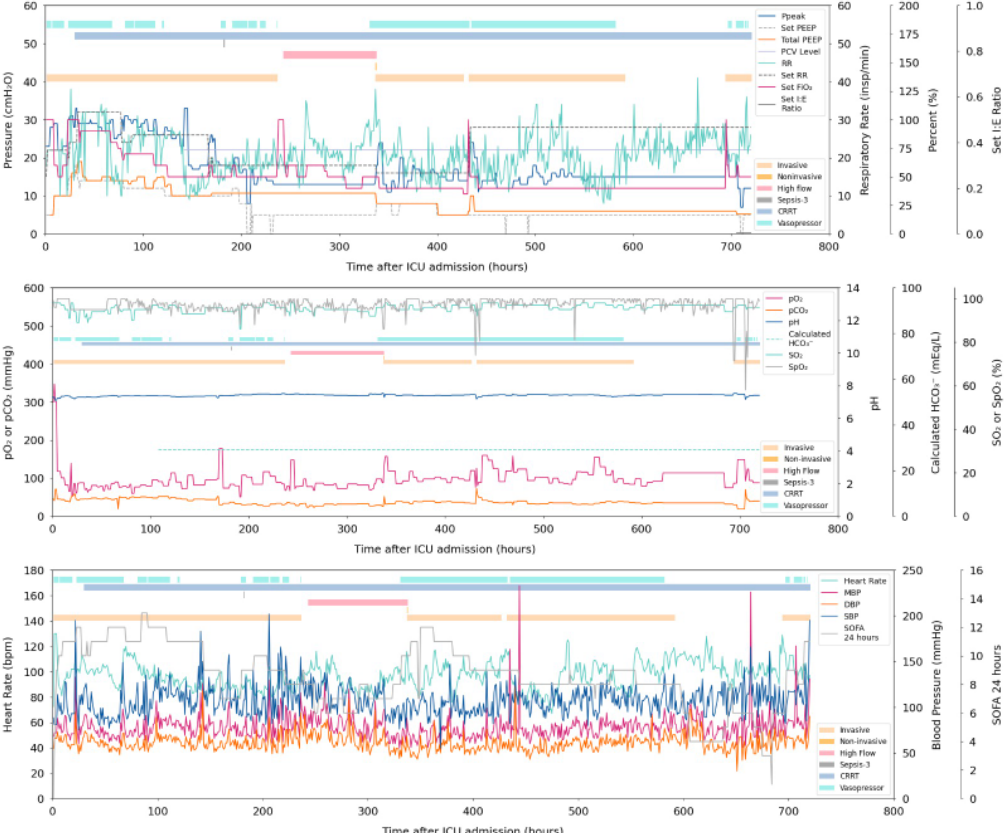
We introduce a temporal benchmark for clinical respiratory interventions, a 90-day hourly ventilation dataset derived from MIMIC-IV version 2.2. MIMIC-IV is an open-access, de-identified database compiled from electronic health records of patients admitted to the ICU or Emergency Department at the Beth Israel Deaconess Medical Center in Boston between 2008 and 2019. Our temporal data includes confounding variables categorized into static and dynamic variables. Figure1 depicts hourly characteristics for a single patient's ICU stay over 30 days.
Cohort Selection
In the MIMIC-IV database, a patient can have multiple ICU stays over the years or experience transitions between different ICUs during the same hospital admission. To prevent data leakage and maintain data integrity, we choose the first ICU stay with respiratory support for each patient. This approach ensures that data used for modeling is independent and not influenced by information from subsequent stays. Additionally, patients with a do not resuscitate or do not intubate directives and those who were on invasive ventilation 24 hours before ICU admission are excluded, resulting in a total of 50,920 patients.
Data Extraction and Preprocessing
The majority of timestamps for time-varying variables in the raw MIMIC data are presented in the year, month, day, hour, minute, and second format, offering the potential to derive granular data for comprehensive medical analysis. The sporadic recording of multiple observations allows us to aggregate the data into hourly bins to improve the data density and analytical consistency. Our dataset spans the period of 0 to 2160 hours (equivalent to 90 days) following ICU admission for each subject.
Patient-level Static Variables
Static parameters extracted for patients, as outlined in Table 1, encompass demographic variables, comorbidity scores assessing neurological function (such as the Glasgow Coma Scale and its components: eye opening, verbal, and motor responses), as well as an evaluation of patient organ dysfunction (based on the maximum Sequential Organ Failure Assessment score) performed 24 hours after admission to the ICU.
| Variable | Description |
|---|---|
| intime outtime gender anchor year anchor age insurance language marital status race first careunit pbw kg height inch elixhauser vanwalraven gcs gcs motor gcs verbal gcs eyes gcs unable sofa 24 hours | ICU admission time ICU discharge time patient gender patient shifted year patient age in anchor year patient insurance type English proficiency indicator patient marital status patient race ICU type during first admission patient predicted body weight (kg) patient height (inches) Elixhauser-VanWalraven score Glasgow Coma Scale (GCS) score GCS motor response component GCS verbal response component GCS eye-opening response component Endotracheal tube indicator Max 24-hour Sequential Organ Failure Assessment (SOFA) score |
Measurement Observations
The time-varying measurements in the data encompass ventilation settings, laboratory results, and vital signs. Ventilation settings and vital signs are extracted from the MIMIC chartevents table, while labs data are obtained from the MIMIC labevents table, each identified by their respective ItemIDs. To handle multiple values within a single hour for a subject, we aggregate the results by computing the median, as the median exhibits reduced sensitivity to noisy data. The labs are sourced from arterial blood gas (ABG) specimens, as arterial blood measurements are deemed to have greater clinical relevance and precision when evaluating parameters such as respiratory function, acid-base balance, and oxygenation status. Two parameters derived from ventilation settings are also presented: set pc draeger (set pressure for pressure-controlled ventilation from the Draeger ventilator) and set pc (set pressure for pressure-controlled ventilation). Set pc draeger is calculated as the difference between the inspiratory pressure from the Draeger ventilator (pinsp draeger) and the set peak inspiratory pressure (ppeak). Based on clinical knowledge, set pc is populated with pcv level (pressure controlled ventilation level) if present, pinsp hamilton (inspiratory pressure from Hamilton ventilator) if pcv level is absent, and set pc draeger (inspiratory pressure from Draeger ventilator) if both are absent. All variables related to ventilation parameters, vital signs, and labs, and their corresponding descriptions, are described in Table 2.
Treatment Interventions
Three respiratory support methods, including invasive ventilation (INV), non-invasive ventilation (NIV), and high-flow nasal cannula (HFNC), are presented as binary indicators per hour. The curation of these respiratory support variables is verified by clinical experts to ensure accuracy and reliability. In MIMIC, the procedureevents table identifies patients on INV or NIV during their ICU stay, while the chartevents table identifies patients on HFNC. INV and NIV in MIMIC have documented start and end times recorded by respiratory therapists, however, HFNC lacks a corresponding time interval; having only the time at which the measurement was observed. Therefore, we pre-process the data to establish a start time and end time for each HFNC event per ICU stay. In addition, multiple HFNC events could occur during a single ICU stay. Therefore, if the time gap between two consecutive HFNC events exceeded 24 hours, we treat them as separate events. For each HFNC event, the minimum and maximum time at which the HFNC is applied is used to obtain the HFNC start time and the end time. HFNC events with identical start and end times are excluded. In cases of overlapping mutually exclusive treatments, where patients are recorded to be on both non-invasive and invasive ventilation simultaneously, we prioritize the most invasive treatment strategy (INV > NIV > HFNC). The overlap of mutually exclusive treatments occurs due to the complexities involved in transitioning between ventilation therapies within the ICU, which often includes a series of procedures during the transition period. Furthermore, for short intervals (less than 6 hours) recorded between two different treatments, we attribute the gap to the less invasive treatment. This allows us to handle situations where the precise timing of treatments is unclear.
| Variable | Description |
|---|---|
| Ventilation parameters | |
| ppeak set peep total peep rr set rr total rr set tv total tv set fio2 set ie ratio set pc set pc draeger pinsp draeger pinsp hamilton pcv level | peak Inspiratory pressure (cmH2O) set peak inspiratory pressure (cmH2O) total peak inspiratory pressure (cmH2O) respiratory rate (insp/min) set respiratory rate (insp/min) total respiratory rate (insp/min) set tidal volume (mL) total tidal volume (mL) set fraction of inspired oxygen set inspiratory-to-expiratory ratio set pressure for pressure controlled ventilation (cmH2O) set pressure from Draeger Ventilator (cmH2O) inspiratory pressure from Draeger Ventilator (cmH2O) inspiratory pressure from Hamilton ventilator (cmH2O) pressure controlled ventilation level (cmH2O) |
| Labs | |
| calculated bicarbonate so2 pCO2 pO2 pH | calculated bicarbonate, whole blood (mEq/L) oxygen saturation (%) partial pressure of carbon dioxide (mmHg) partial pressure of oxygen (mmHg) pH |
| Vital Signs | |
| heart rate sbp dbp mbp sbp ni dbp ni mbp ni temperature spO2 glucose | heart rate (bpm) systolic arterial blood pressure (mmHg) diastolic arterial blood pressure (mmHg) mean arterial blood pressure (mmHg) systolic non-invasive blood pressure (mmHg) diastolic non-invasive blood pressure (mmHg) mean non-invasive blood pressure (mmHg) temperature (°C) oxygen saturation pulse oximetry (%) blood glucose |
Additional binary indicators for interventions include vasopressor administration and continuous renal replacement therapy. Vasopressors are extracted from the MIMIC inputevents table and matched to the corresponding hour using their respective start and end times. A patient is classified as being on vasopressors if they received norepinephrine, epinephrine, dopamine, phenylephrine, or vasopressin. Information regarding continuous renal replacement therapy (CRRT) is extracted from the MIMIC chartevents table. Patients are identified as being on CRRT if they have a positive value for blood flow rate or fluid removal during dialysis. A summary of all treatment interventions is presented in Table 3.
| Variable | Description |
|---|---|
| invasive noninvasive highflow vasopressor crrt | invasive ventilation indicator non-invasive ventilation indicator high-flow nasal cannula indicator vasopressor treatment indicator continuous renal replacement therapy indicator |
Outcome Variables
The majority of the outcome variables are recorded as binary indicators at each hour, with one denoting the occurrence of the event. These include discharge outcome, ICU out-time outcome, death outcome, and sepsis. Discharge outcome and ICU out-time outcome indicate if a patient was discharged from the hospital or ICU respectively. The death outcome variable denotes whether a patient died at a specific hour. The date of death in MIMIC is derived from hospital and state records. In cases where both data sources are available, in-hospital mortality is preferentially used over state-linked data. The state-derived date of death includes only the date component, so a default time of midnight is used when converting the date to a timestamp. The data also includes a sepsis outcome variable that identifies whether a patient is septic according to the Sepsis-3 diagnostic criteria. Additionally, it contains the length of stay variable, which indicates the duration of a patient's ICU stay in fractional days. A summary of the outcome variables is presented in Table 4.
| Variable | Description |
|---|---|
| discharge outcome icuouttime outcome death outcome sepsis los | hospital discharge indicator ICU discharge indicator death indicator presence of sepsis using sepsis 3 criteria ICU length of stay (fractional days) |
2.2 Benchmark Tasks
We consider two clinically motivated prediction tasks for respiratory interventions in ICU settings: prolonged mechanical ventilation and successful weaning.
Task definition for prolonged mechanical ventilation: Prolonged mechanical ventilation can increase the caregiver burden and affect a patient's quality of life [Vali et al., 2023; Sayed et al., 2021]. We aim to predict prolonged mechanical ventilation using the first 24 hours of data in the ICU. Specifically, we define prolonged mechanical ventilation as the initial attempt to ventilate a patient for more than 14 days in the ICU.
Task definition for prolonged successful weaning: Weaning has been studied in recent clinical trials [Pham et al., 2023]. In this study, we use the first attempt to separate a patient from a mechanical ventilator. We aim to predict prolonged successful weaning using five days of ICU stay data. Specifically, we define successful weaning as no re-intubation or death within seven days of extubation.
The pre-processed patient cohorts for prolonged mechanical ventilation and successful weaning includes 4,930 and 2,358 cases, respectively. The numerical features for each task are normalized by min-max scaling. For each task, we split the data into 70% training, 10% validation, and 20% testing, while ensuring no patient overlap in the sets to avoid data leakage. In our hybrid sequence-based models, we combine continuous and static features to capture both the hourly dynamics of a patient's condition and the patient's individual characteristics, providing a comprehensive basis for our binary classification tasks on a stay level. For our hybrid fully connected networks which do not involve recurrent connections, we employ static features in conjunction with the median of the time-series features.
Model Architecture
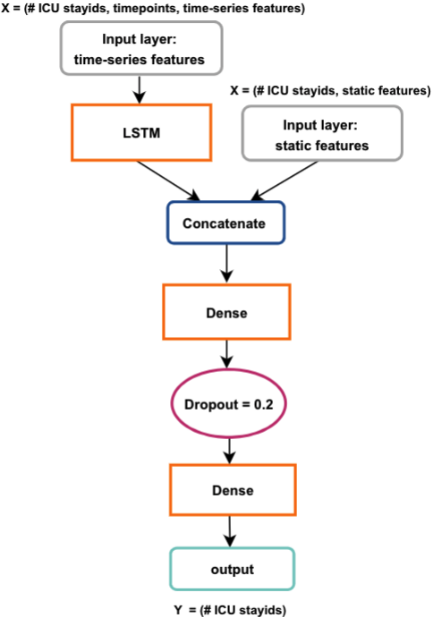
In our proposed benchmark, we employ five types of machine learning models to address the aforementioned tasks. We specifically focus on deep learning-based methodologies, including sequence models and a multilayer perceptron (MLP) aiming to assess whether models that operate over time-steps can enhance overall model performance. The sequence models encompass Gated Recurrent Units (GRU), Long ShortTerm Memory (LSTM), Bidirectional LSTM (BiLSTM), and Temporal Convolutional Neural Networks (TCN). For the sequence-based models, we apply a joint-fusion strategy to concatenate the hourly time-dependent variables with the static variables. Details of the sequence-based models are depicted in Figure 2. We fine-tune each model through an exhaustive hyperparameter search. The learning rate is initialized at 0.001 and decays by 5% for each epoch, with a batch size set to 512. The optimization algorithm used is the Adam Optimizer, and the loss function used is binary crossentropy. We stop the model training when the validation loss does not improve over three consecutive epochs.
Model Evaluation
We assess the models by evaluating their accuracy using the area under the receiver operating characteristic curve (AUROC). To perform binary classification on the predictions, we determine the optimal threshold value by selecting the threshold that maximizes the difference between true positive rate and false positive rate, and then we compare each prediction against this threshold. We report 95% confidence interval of the evaluation metrics, calculated by performing bootstrapping on the metric scores over 1000 iterations.
2.3 Fairness Audits Along SDOH&Demographic Attributes
We perform fairness audits by considering protected attributes, such as race, age, and gender, along with eight SDOH attributes. This provides deeper insights into the patient population beyond conventional demographic attributes. We utilize the MIMIC-IV census tract-level SDOH data to conduct fairness audits on our benchmark tasks [Yang et al., 2023]. Our analysis includes investigating the differences in fairness across subgroups based on SDOH attributes, such as whether a patient resides in areas with high employment rates, has a high reliance on public assistance or food stamps, lives close to healthcare facilities, engages frequently in heavy drinking or smoking, has high student expenditure, resides in homes with high electricity heating and lives in areas with few deaths from firearms.
We assess the performance of downstream classifiers based on three definitions of fairness, including, demographic parity (parity gap), equality of opportunity for the positive class (recall gap), and equality of opportunity for the negative class (specificity gap) [Chen et al., 2019]. We follow methods used in prior work to expand the demographic parity gap [Zhang et al., 2020; Hashimoto et al., 2018], and use a similar process to obtain the recall, and specificity gaps. These evaluations are conducted on the best-performing model for both tasks.
3 Results &Discussion
3.1 Benchmark Tasks
The AUROC for both prolonged mechanical ventilation and weaning are shown in Table 5. We found that the sequencebased model, the GRU (Hybrid) model, outperforms all other models on both binary prediction tasks.
| Model | AUROC (↑) | |
|---|---|---|
| Mechanical Ventilation | Successful Weaning | |
| MLP TCN (Hybrid) LSTM (Hybrid) BiLSTM (Hybrid) GRU (Hybrid) | 0.641 (0.638 - 0.643) 0.747 (0.745 - 0.749) 0.770 (0.768 - 0.772) 0.775 (0.773 - 0.777) 0.778 (0.776 - 0.780) | 0.749 (0.747 - 0.751) 0.743 (0.741 - 0.744) 0.764 (0.763 - 0.766) 0.752 (0.750 - 0.753) 0.776 (0.774 - 0.778) |
3.2 Fairness Audits on Benchmark Tasks
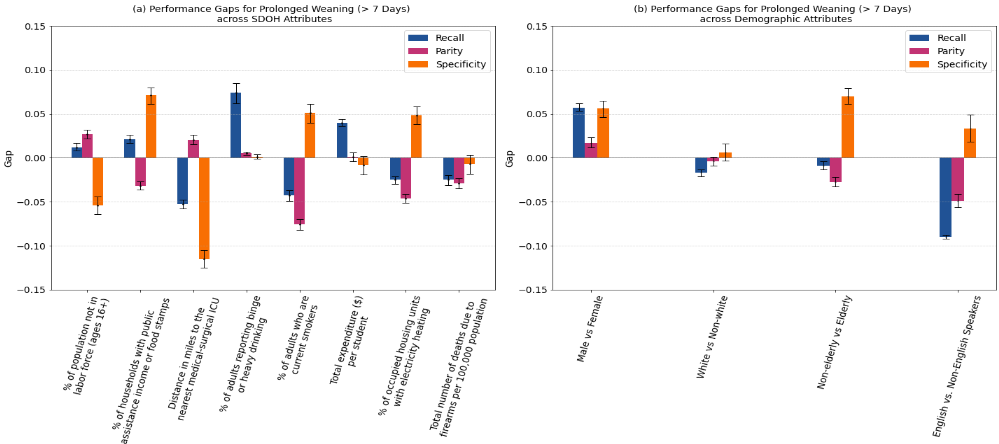
We illustrate the differences in parity, recall, and specificity for demographic and social determinants of health attributes in the mechanical ventilation (Figure 3) and successful weaning tasks (Figure 4) using the best performing model (GRU). Recall indicates the proportion of actual positive instances that the model correctly identifies. It is particularly relevant in clinical settings where minimizing false negatives is crucial for timely effective patient diagnosis. To analyze variations in model performance among continuous SDOH attributes, we discretize the attributes into two quantiles. A positive recall gap suggests that the model favors the low prevalence of the specified SDOH attribute over the high prevalence. For categorical variables like gender, race, age, and English proficiency, a positive recall gap indicates that the model favors males, whites, non-elderly individuals, or English speakers over their respective counterparts.
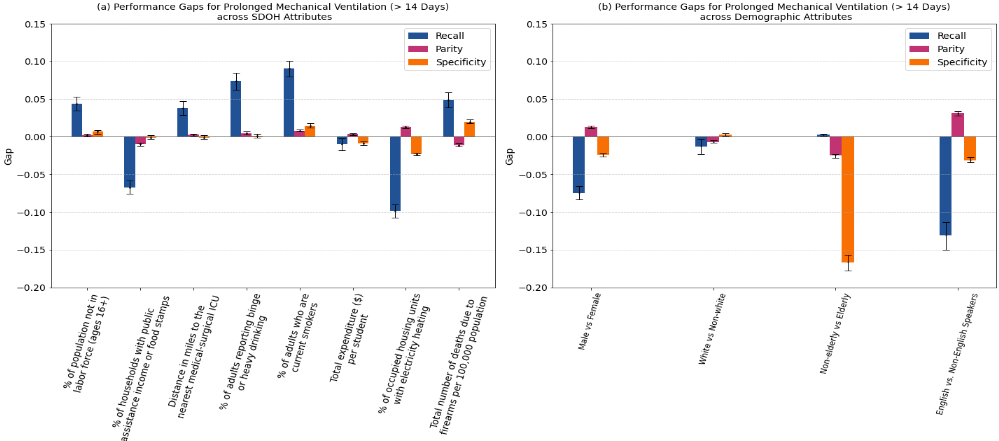
In Figure 3a, for the task of predicting prolonged mechanical ventilation the model favors individuals who reside in areas with high employment rate, have a high reliance on public assistance or food stamps, are close to a medical-surgical ICU, rarely engage in heavy drinking or smoking, have high student expenditure, reside in homes with high electricity heating, and live in areas with few deaths from firearms.
Additionally, as seen in Figure 3b the model favors certain demographic groups, including females, non-white individuals, younger individuals, and non-English speakers. On the other hand, as depicted in Figure 4a, for the task of predicting weaning, the model favors individuals who reside in areas with high employment rate, have a low reliance on public assistance or food stamps, are far from a medical-surgical ICU, rarely engage in heavy drinking, often smoke, have low student expenditure, reside in homes with high electricity heating, and live in areas with more deaths from firearms. Additionally, as seen in Figure 4b, the model favors certain demographic groups, including males, non-white individuals, elderly individuals, and non-English speakers.
The performance gaps illustrate the disparities in the model's predictive performance and the necessity for fairness auditing prior to model deployment. By assessing SDOH in addition to the previously studied traditional labels we hope to disentangle biases and uncover other hidden confounders and associations.
4 Conclusion
In critical care settings, it is important to carefully assess model biases across demographic and SDOH attributes before deployment. In this study, we benchmark two timedependent tasks, including successful weaning and prolonged mechanical ventilation. Using different fairness definitions, we evaluate the differences in performance gaps for both tasks across demographic and SDOH attributes. Furthermore, we release an hourly dataset to support the benchmarking of respiratory intervention tasks. Our work aims to enable the development of machine learning models for timely interventions in critical care, emphasizing the consideration of social determinants to promote equitable healthcare access and improve patient outcomes.
Data Availability
The temporal dataset for respiratory support in critically ill patients is hosted on PhysioNet [Moody and Mark, 1996], an NIH-funded repository that is widely used to support biomedical research and education worldwide. It is available at this link, https://doi.org/10.13026/0d8j-2w14. The presented dataset consists of 50,920 distinct adult patients admitted to the ICU of Beth Israel Deaconess Medical Center (Boston, MA, USA) between 2008 and 2019. We extract static, timevarying, and outcome variables from MIMIC-IV in an hourly materialized view and store the content for each patient in a *.csv format named after the patient's unique identifier (subject ID).
Code Availability
We provide the GitHub repository at https://github.com/ respiratory-support/respiratory-interventions which includes SQL scripts, offering tools for data management, querying, and analysis. Python scripts are also provided to demonstrate the application of the dataset in various clinical prediction tasks.
Acknowledgements
D.M., and L.M. are supported by grant NIH-R01-EB017205 from the National Institute of Health and by the National Institute of Biomedical Imaging and Bioengineering (NIBIB) under NIH-R01-EB030362. D.M. is also supported by NIH National Library of Medicine under 75N97020C00013, and Massachusetts Life Sciences Center. H.C. is supported by the Korea Health Technology Research and Development Project through the Korea Health Industry Development Institute, funded by the Ministry of Health and Welfare, Republic of Korea (grant number: HI21C107409). The authors would like to thank Dr. Leo Celi, Dr. Kerollos Wanis, and Sicheng Hao for their valuable feedback.
@inproceedings{ijcai2024p821,
  title     = {Unmasking Societal Biases in Respiratory Support for ICU Patients through Social Determinants of Health},
  author    = {Moukheiber, Mira and Moukheiber, Lama and Moukheiber, Dana and Lee, Hyung-Chul},
  booktitle = {Proceedings of the Thirty-Third International Joint Conference on
               Artificial Intelligence, {IJCAI-24}},
  publisher = {International Joint Conferences on Artificial Intelligence Organization},
  editor    = {Kate Larson},
  pages     = {7421--7429},
  year      = {2024},
  month     = {8},
  note      = {AI for Good},
  doi       = {10.24963/ijcai.2024/821},
  url       = {https://doi.org/10.24963/ijcai.2024/821},
}
TY - CPAPER TI - Unmasking Societal Biases in Respiratory Support for ICU Patients through Social Determinants of Health AU - Moukheiber, Mira AU - Moukheiber, Lama AU - Moukheiber, Dana AU - Lee, Hyung-Chul T2 - Proceedings of the Thirty-Third International Joint Conference on Artificial Intelligence, IJCAI-24 PB - International Joint Conferences on Artificial Intelligence Organization PY - 2024 SP - 7421 EP - 7429 DO - 10.24963/ijcai.2024/821 UR - https://doi.org/10.24963/ijcai.2024/821 ER -Copied
Machine-readable versions of this paper, for tools and AI agents:





