
GS2P: A Generative Pre-trained Learning to Rank Model with Over-parameterization for Web-Scale Search (Extended Abstract)
Proceedings of the Thirty-Third International Joint Conference on Artificial Intelligence. Sister Conferences Best Papers. Pages 8433-8438.
https://doi.org/10.24963/ijcai.2024/936
Keywords
- Data Mining: DM: Mining text, web, social media
Abstract
While Learning to Rank (LTR) is widely employed in web searches to prioritize pertinent webpages from the retrieved contents based on input queries, traditional LTR models stumble over two principal stumbling blocks leading to subpar performance: 1) the lack of well-annotated query-webpage pairs with ranking scores to cover search queries of various popularity, debilitating their coverage of search queries across the popularity spectrum, and 2) ill-trained models that are incapable of inducing generalized representations for LTR, culminating in overfitting. To tackle above challenges, we proposed a Generative Semi-supervised Pre-trained (GS2P) LTR model. Specifically, GS2P first generates pseudo-labels for the unlabeled samples using tree-based LTR models after a series of co-training procedures, then learns the representations of query-webpage pairs with self-attentive transformers via both discriminative and generative losses. Finally, GS2P boosts the performance of LTR through incorporating Random Fourier Features to over-parameterize the models into "interpolating regime", so as to enjoy the further descent of generalization errors with learned representations. We conduct extensive offline experiments on a publicly available dataset and a real-world dataset collected from a large-scale search engine. The results show that GS2P can achieve the best performance on both datasets, compared to baselines.
We also deploy GS2P at a large-scale web search engine with realistic traffic, where we can still observe significant improvement in real-world applications.
- [Belkin et al., 2019] Mikhail Belkin, Daniel Hsu, Siyuan Ma, and Soumik Mandal. Reconciling modern machine- learning practice and the classical bias-variance trade- off. Proceedings of the National Academy of Sciences, 116(32):15849-15854, 2019.
- [Belkin, 2021] Mikhail Belkin. Fit without fear: remark- able mathematical phenomena of deep learning through the prism of interpolation. Acta Numerica, 30:203-248, 2021.
- [Bruch et al., 2019] Sebastian Bruch, Masrour Zoghi, Michael Bendersky, and Marc Najork. Revisiting ap- proximate metric optimization in the age of deep neural networks. In Proceedings of the 42nd International ACM SIGIR Conference on Research and Development in Information Retrieval, pages 1241-1244, 2019.
- [Burges et al., 2005] Christopher J. C. Burges, Tal Shaked, Erin Renshaw, Ari Lazier, Matt Deeds, Nicole Hamilton, and Gregory N. Hullender. Learning to rank using gra- dient descent. In Machine Learning, Proceedings of the Twenty-Second International Conference, ICML, pages 89- 96, 2005.
- [Burges et al., 2006] Christopher J. C. Burges, Robert Ragno, and Quoc Viet Le. Learning to rank with nonsmooth cost functions. In Advances in Neural Information Processing Systems 19, Proceedings of the Twentieth Annual Confer- ence on Neural Information Processing Systems, pages 193-200, 2006.
- [Cao et al., 2007] Zhe Cao, Tao Qin, Tie-Yan Liu, Ming-Feng Tsai, and Hang Li. Learning to rank: from pairwise ap- proach to listwise approach. In Machine Learning, Pro- ceedings of the Twenty-Fourth International Conference, pages 129-136, 2007.
- [Chen and Guestrin, 2016] Tianqi Chen and Carlos Guestrin. Xgboost: A scalable tree boosting system. In Proceedings of the 22nd acm sigkdd international conference on knowl- edge discovery and data mining, pages 785-794, 2016.
- [Järvelin and Kekäläinen, 2017] Kalervo Järvelin and Jaana Kekäläinen. IR evaluation methods for retrieving highly relevant documents. SIGIR Forum, 51(2):243-250, 2017.
- [Ke et al., 2017] Guolin Ke, Qi Meng, Thomas Finley, Taifeng Wang, Wei Chen, Weidong Ma, Qiwei Ye, and Tie- Yan Liu. Lightgbm: A highly efficient gradient boosting decision tree. In Advances in Neural Information Process- ing Systems 30: Annual Conference on Neural Information Processing Systems, pages 3146-3154, 2017.
- [Li et al., 2020] Minghan Li, Xialei Liu, Joost van de Weijer, and Bogdan C. Raducanu. Learning to rank for active learn- ing: A listwise approach. In 25th International Conference on Pattern Recognition, pages 5587-5594, 2020.
- [Li et al., 2022] Yuchen Li, Haoyi Xiong, Linghe Kong, Rui Zhang, Dejing Dou, and Guihai Chen. Meta hierarchical reinforced learning to rank for recommendation: A compre- hensive study in moocs. In Joint European Conference on Machine Learning and Knowledge Discovery in Databases, pages 302-317, 2022.
- [Li et al., 2023a] Yuchen Li, Haoyi Xiong, Linghe Kong, Zeyi Sun, Hongyang Chen, Shuaiqiang Wang, and Dawei Yin. Mpgraf: a modular and pre-trained graphformer for learning to rank at web-scale. In 2023 IEEE International Conference on Data Mining (ICDM), pages 339-348. IEEE, 2023.
- [Li et al., 2023b] Yuchen Li, Haoyi Xiong, Linghe Kong, Qingzhong Wang, Shuaiqiang Wang, Guihai Chen, and Dawei Yin. S2phere: Semi-supervised pre-training for web search over heterogeneous learning to rank data. In Pro- ceedings of the 29th ACM SIGKDD Conference on Knowl- edge Discovery and Data Mining, pages 4437-4448, 2023.
- [Li et al., 2023c] Yuchen Li, Haoyi Xiong, Linghe Kong, Shuaiqiang Wang, Zeyi Sun, Hongyang Chen, Guihai Chen, and Dawei Yin. Ltrgcn: Large-scale graph convolutional networks-based learning to rank for web search. In Joint European Conference on Machine Learning and Knowl- edge Discovery in Databases, pages 635-651. Springer, 2023.
- [Li et al., 2023d] Yuchen Li, Haoyi Xiong, Linghe Kong, Rui Zhang, Fanqin Xu, Guihai Chen, and Minglu Li. Mhrr: Moocs recommender service with meta hierarchical rein- forced ranking. IEEE Transactions on Services Computing, 2023.
- [Li et al., 2023e] Yuchen Li, Haoyi Xiong, Qingzhong Wang, Linghe Kong, Hao Liu, Haifang Li, Jiang Bian, Shuaiqiang Wang, Guihai Chen, Dejing Dou, et al. Coltr: Semi- supervised learning to rank with co-training and over- parameterization for web search. IEEE Transactions on Knowledge and Data Engineering, 2023.
- [Liu et al., 2021] Yiding Liu, Weixue Lu, Suqi Cheng, Dait- ing Shi, Shuaiqiang Wang, Zhicong Cheng, and Dawei Yin. Pre-trained language model for web-scale retrieval in baidu search. In KDD '21: The 27th ACM SIGKDD Con- ference on Knowledge Discovery and Data Mining, pages 3365-3375, 2021.
- [Pobrotyn and Białobrzeski, 2021] Przemysław Pobrotyn and Radosław Białobrzeski. Neuralndcg: Direct optimi- sation of a ranking metric via differentiable relaxation of sorting. arXiv preprint arXiv:2102.07831, 2021.
- [Pobrotyn et al., 2020] Przemysław Pobrotyn, Tomasz Bartczak, Mikołaj Synowiec, Radosław Białobrzeski, and Jarosław Bojar. Context-aware learning to rank with self-attention. arXiv preprint arXiv:2005.10084, 2020.
- [Qin and Liu, 2013] Tao Qin and Tie-Yan Liu. Introducing letor 4.0 datasets. arXiv preprint arXiv:1306.2597, 2013.
- [Qin et al., 2010] Tao Qin, Tie-Yan Liu, and Hang Li. A general approximation framework for direct optimization of information retrieval measures. Inf. Retr., 13(4):375-397, 2010.
- [Rahimi and Recht, 2007] Ali Rahimi and Benjamin Recht. Random features for large-scale kernel machines. In Ad- vances in Neural Information Processing Systems 20, Pro- ceedings of the Twenty-First Annual Conference on Neural Information Processing Systems, pages 1177-1184, 2007.
- [Szummer and Yilmaz, 2011] Martin Szummer and Emine Yilmaz. Semi-supervised learning to rank with preference regularization. In Proceedings of the 20th ACM Confer- ence on Information and Knowledge Management, pages 269-278, 2011.
- [Vaswani et al., 2017] Ashish Vaswani, Noam Shazeer, Niki Parmar, Jakob Uszkoreit, Llion Jones, Aidan N. Gomez, Lukasz Kaiser, and Illia Polosukhin. Attention is all you need. In Advances in Neural Information Processing Sys- tems 30: Annual Conference on Neural Information Pro- cessing Systems, pages 5998-6008, 2017.
- [Wang et al., 2021] Ruoxi Wang, Rakesh Shivanna, Derek Zhiyuan Cheng, Sagar Jain, Dong Lin, Lichan Hong, and Ed H. Chi. DCN V2: improved deep & cross network and practical lessons for web-scale learning to rank systems. In WWW '21: The Web Conference, pages 1785-1797, 2021.
- [Werner, 2022] Tino Werner. A review on instance ranking problems in statistical learning. Mach. Learn., 111(2):415- 463, 2022.
- [Xia et al., 2008] Fen Xia, Tie-Yan Liu, Jue Wang, Wensheng Zhang, and Hang Li. Listwise approach to learning to rank: theory and algorithm. In Machine Learning, Proceedings of the Twenty-Fifth International Conference, pages 1192- 1199, 2008.
- [Yang and Ying, 2023] Tianbao Yang and Yiming Ying. AUC maximization in the era of big data and AI: A survey. ACM Comput. Surv., 55(8):172:1-172:37, 2023.
- [Zhang et al., 2016] Xin Zhang, Ben He, and Tiejian Luo. Training query filtering for semi-supervised learning to rank with pseudo labels. World Wide Web, 19(5):833-864, 2016.
- [Zhao et al., 2010] Shiqi Zhao, Haifeng Wang, and Ting Liu. Paraphrasing with search engine query logs. In COLING 2010, 23rd International Conference on Computational Linguistics, Proceedings of the Conference, pages 1317- 1325, 2010.
- [Zhao et al., 2011] Shiqi Zhao, Haifeng Wang, Chao Li, Ting Liu, and Yi Guan. Automatically generating questions from queries for community-based question answering. In Proceedings of 5th international joint conference on natural language processing, pages 929-937, 2011.
- [Zou et al., 2021] Lixin Zou, Shengqiang Zhang, Hengyi Cai, Dehong Ma, Suqi Cheng, Shuaiqiang Wang, Daiting Shi, Zhicong Cheng, and Dawei Yin. Pre-trained language model based ranking in baidu search. In Proceedings of the 27th ACM SIGKDD Conference on Knowledge Discovery & Data Mining, pages 4014-4022, 2021.
References were extracted automatically from the PDF and may contain errors.
Full text extracted automatically from the PDF; figures, tables and equations may differ. The PDF is the version of record.
1 Introduction
The booming increase of internet users and web content surges the demands on web search. In the current digital epoch, large-scale search engines manage an impressive archive of trillions of webpages, providing service to hundreds of millions of active users daily while handling billions of queries. The search procedure commences with a user query, often a text string, necessitating keyword or phrase extraction to comprehend user attempting [Zhao et al., 2010; Li et al., 2023d]. Post identification of keywords, search engines evaluate the relation between the query and webpages, subsequently retrieving highly relevant ones from their vast databases [Liu et al., 2021]. These webpages are then sorted based on content attributes and click-through rates, positioning the most relevant ones on top of the result [Li et al., 2023a].
The optimization of the user experience, achieved by catering to information needs, largely depends on the effective sorting of retrieved content. In this realm, Learning to Rank (LTR) becomes instrumental, requiring a considerable amount of query-webpage pairings with relevancy scores for effective supervised LTR [Li et al., 2023b; Qin and Liu, 2013; Li et al., 2023c]. Nevertheless, the commonplace scarcity of well-described, query-webpage pairings often compels semi-supervised LTR, harnessing both labeled and unlabeled samples for the process [Szummer and Yilmaz, 2011; Zhang et al., 2016]. Recent years have seen the integration of deep models in LTR, aimed at end-to-end ranking loss minimization [Li et al., 2020; Wang et al., 2021; Li et al., 2022; Yang and Ying, 2023]. However, these models occasionally falter in learning generalizable representations from structural data due to limited or noisy supervision, sometimes resulting in performance that is weaker compared to statistical learners [Bruch et al., 2019]. Further discussion on this subject can be found in a comprehensive review available in a recent scholarly work [Werner, 2022].
∗This work was initially presented at the 10th IEEE International Conference on Data Science and Advanced Analytics (DSAA) in 2023 and Machine Learning (MLJ) in 2024.
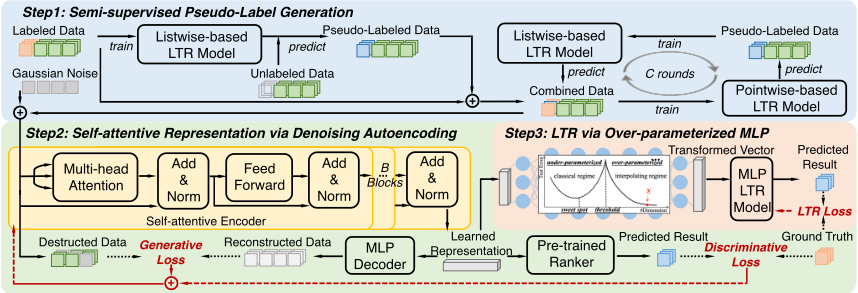
In order to tackle the above issues, we propose Generative Semi-Supervised Pre-trained LTR (GS2P) model. The proposed GS2P first generates high-quality pseudo labels for every unlabeled query-webpage pair through co-training of multiple/diverse LTR models based on various ranking losses, then learns generalizable representations with a selfattentive network using both generative loss and discriminative loss. Finally, given the generalizable representations of querywebpage pairs, by incorporating an MLP-based ranker with Random Fourier Features (RFF), GS2P pushes LTR models into so-called interpolating regime [Belkin, 2021] and obtains superb performance improvement. To demonstrate the effectiveness of GS2P, we conduct comprehensive experiments on a publicly available LTR dataset [Qin and Liu, 2013] and a real-world dataset collected from a large-scale search engine. We also deploy GS2P at the search engine and evaluate the proposed model using online A/B tests in comparison with the online legacy system.
2 Methodology
2.1 Preliminaries
Given a set of search queries Q = {q1, q2, . . . } and all archived webpages W = {w1, w2, . . . }, for each query qi ∈ Q, the search engine retrieves a set of relevant webpages denoted as Wi = {wi1 ,wi2 , . . . } ⊂ W. After annotating, are weight coefficients to balance two terms.
2.4 LTR via Over-parameterizedMLP
Given the learned representation zi,j ∈ Rn generated from Self-attentive Representation Learning via Denoising Autoencoding, GS2P converts this representation vector into an Ndimensional version, represented as hi,j = h(zi,j). This step is implemented using the feature transformation h(z). In this procedure, GS2P utilizes a transformation rooted in random Fourier features to execute h(z) [Rahimi and Recht, 2007], thereby mapping the original features of LTR into a higher dimensional feature space. An important point to con-
Denoised Self-attentive Autoencoder. Given an mdimensional feature vector ˜xi,j of a query-webpage pair (˜xi,j, yij ) in combined data, GS2P aims to utilize a selfattentive encoder to learn a generalizable representation zi,j. Specifically, given a vector ˜xi,j generated from Semisupervised Pseudo-Label Generation, GS2P (1) passes it through a fully-connected layer and produces a hidden representation. Then, GS2P (2) feeds the hidden representation into a self-attentive autoencoder, which consists of B encoder blocks of Transformer [Vaswani et al., 2017]. In particular, each encoder block incorporates a multi-head attention layer and a feed-forward layer, both followed by layer normalization. Eventually, GS2P (3) generates the learned representasider is that increasing the number of dimensions (N) leads to over-parameterization of the LTR model via the addition of more input features. This scenario brings about a featurewise 'double descent' phenomenon in predicting generalization errors [Belkin et al., 2019; Belkin, 2021]. GS2P sets the optimal value for N, stemming from cross-validation performed on the labeled dataset to ensure the best generalization performance. Therefore, incorporating hi,j for every pair of query-webpage paves the path for an over-parameterized LTR model. This advanced model operates in the interpolating regime and is projected to exhibit excellent generalization performance [Belkin, 2021]. In this way, GS2P transforms zi,j into a high-dimensional vector hi,j and constructs a Ranker (i.e., MLP-based LTR model) for the LTR task with several popular ranking loss functions.
| Methods | 5% | 10% | 15% | 20% | ||||
|---|---|---|---|---|---|---|---|---|
| @4 | @10 | @4 | @10 | @4 | @10 | @4 | @10 | |
| XGBoost | 31.76 | 34.10 | 36.72 | 39.12 | 39.93 | 41.01 | 42.60 | 45.84 |
| LightGBM | 35.72 | 39.32 | 39.89 | 42.05 | 43.90 | 45.67 | 46.56 | 48.52 |
| RMSE | 34.82 | 38.02 | 38.75 | 41.95 | 42.97 | 45.65 | 45.75 | 48.86 |
| RankNet | 34.06 | 37.43 | 38.12 | 41.32 | 42.24 | 45.08 | 45.01 | 47.89 |
| LambdaRank | 35.28 | 38.50 | 39.32 | 42.47 | 43.40 | 46.23 | 46.26 | 49.56 |
| ListNet | 34.36 | 37.94 | 38.31 | 41.76 | 42.51 | 45.40 | 45.32 | 48.42 |
| ListMLE | 33.47 | 36.95 | 37.52 | 40.84 | 41.53 | 44.43 | 44.39 | 47.26 |
| ApproxNDCG | 33.98 | 37.20 | 37.94 | 41.01 | 42.09 | 44.70 | 44.94 | 47.50 |
| NeuralNDCG | 35.15 | 38.26 | 39.07 | 42.10 | 43.32 | 45.97 | 46.08 | 49.20 |
| CRRMSE | 36.04 | 38.54 | 39.52 | 42.48 | 43.67 | 46.25 | 46.86 | 49.75 |
| CRRankNet | 35.90 | 38.42 | 39.44 | 42.37 | 43.45 | 45.98 | 46.70 | 49.61 |
| CRLambdaRank | 36.45 | 38.93 | 40.03 | 43.10 | 44.36 | 46.88 | 47.57 | 50.47 |
| CRListNet | 37.53 | 40.08 | 41.28 | 44.21 | 45.17 | 47.73 | 48.35 | 51.24 |
| CRListMLE | 35.67 | 38.16 | 39.40 | 42.35 | 43.28 | 45.86 | 46.62 | 49.48 |
| CRApproxNDCG | 37.93 | 40.41 | 41.47 | 44.32 | 45.53 | 48.03 | 48.81 | 51.69 |
| CRNeuralNDCG | 37.26 | 40.65 | 40.76 | 43.69 | 44.85 | 47.52 | 48.16 | 51.13 |
| GS2 PRMSE | 39.02 | 40.88 | 41.80 | 44.72 | 45.72 | 48.22 | 48.72 | 51.40 |
| GS2 PRankNet | 38.15 | 40.42 | 40.03 | 44.21 | 44.93 | 47.85 | 47.85 | 50.98 |
| GS2 PLambdaRank | 39.47 | 41.43 | 42.17 | 45.20 | 46.07 | 48.89 | 49.15 | 51.97 |
| GS2 PListNet | 39.53 | 41.62 | 42.28 | 45.42 | 46.15 | 49.16 | 49.18 | 52.20 |
| GS2 PListMLE | 37.66 | 39.87 | 39.80 | 43.70 | 44.52 | 47.28 | 47.41 | 50.24 |
| GS2 PApproxNDCG | 39.57 | 41.76 | 42.39 | 45.65 | 46.31 | 49.31 | 49.25 | 52.25 |
| GS2 PNeuralNDCG | 39.72 | 41.97 | 42.56 | 45.83 | 46.38 | 49.53 | 49.36 | 52.47 |
3 Experiments
3.1 Experimental Setup
Datasets. We carry out the offline experiments on a standard and publicly available dataset Web30K [Qin and Liu, 2013] and a real-world dataset commerical dataset collected from Baidu search engine. Specifically, the commercial Dataset contains 50,000 queries. The dataset is annotated by a group of professionals on the crowdsourcing platform, who assign a score between 0 and 4 to each query-document pair.
Metrics. To assess the performance of various ranking systems comprehensively, we leverage the following metrics. Normalized Discounted Cumulative Gain (NDCG) [J¨arvelin and Kek¨al¨ainen, 2017] is a standard listwise accuracy metric, which has been commonly used in research and industrial community. For our online evaluation, we utilize the Good vs. Same vs. Bad (GSB) [Zhao et al., 2011], which is an online pairwise-based evaluation methodology evaluated by annotators. Considering the confidentiality of commercial information, we only report the difference between the results of GS2P and the online legacy system [Zou et al., 2021].
Loss Functions and Competitor Systems In this work, we leverage the following advanced ranking loss functions to evaluate the proposed model comprehensively, such as RMSE, RankNet [Burges et al., 2005], LambdaRank [Burges et al., 2006], ListNet [Cao et al., 2007], ListMLE [Xia et al., 2008], ApproxNDCG [Qin et al., 2010], and NeuralNDCG [Pobrotyn and Białobrzeski, 2021]. As for the ranking model, we choose the following state-of-the-art ranking models as the competitor for GS2P, such as MLP, Context-aware Ranker (CR) [Pobrotyn et al., 2020], XGBoost [Chen and Guestrin, 2016] and LightGBM [Ke et al., 2017].
3.2 Offline Experimental Results
Overall Results. Table 1 and 2 present the average results for offline evaluation, where GS2P is compared with competitors on Web30K and the commercial dataset. Intuitively, we could observe GS2P outperforms all competitors with different losses under various ratios of labeled data on two datasets. More specifically, GS2P with NeuralNDCG gets 3.60% and nearly 3.57% higher NDCG@4 and NDCG@10 on Web30K dataset, compared with the pointwise-based self-trained MLP model with NeuralNDCG. On Commercial Dataset, GS2P on average obtains nearly 2.84% and 3.14% improvement on NDCG@4 and NDCG@10, when compared with NeuralNDCG. GS2P+NeuralNDCG could gain the most improvement under the less ratio of labeled data on both metrics on two datasets, which demonstrates the effectiveness of GS2P under low-resource situations.
| Methods | 5% | 10% | 15% | 20% | ||||
|---|---|---|---|---|---|---|---|---|
| @4 | @10 | @4 | @10 | @4 | @10 | @4 | @10 | |
| XGBoost | 48.39 | 52.12 | 52.83 | 56.45 | 56.14 | 60.03 | 58.03 | 62.61 |
| LightGBM | 50.48 | 53.50 | 54.13 | 59.04 | 57.00 | 62.14 | 60.47 | 65.82 |
| RMSE | 49.73 | 53.42 | 54.13 | 57.86 | 57.43 | 61.34 | 59.42 | 64.76 |
| RankNet | 49.32 | 53.07 | 53.76 | 57.37 | 57.08 | 60.92 | 59.17 | 64.25 |
| LambdaRank | 50.82 | 54.24 | 55.07 | 58.62 | 58.16 | 62.05 | 61.12 | 65.28 |
| ListNet | 50.26 | 53.61 | 54.52 | 58.04 | 57.81 | 61.47 | 59.74 | 64.82 |
| ListMLE | 48.73 | 52.46 | 53.08 | 56.70 | 56.32 | 60.25 | 58.42 | 63.68 |
| ApproxNDCG | 49.08 | 52.75 | 53.44 | 57.02 | 56.79 | 60.61 | 58.84 | 64.01 |
| NeuralNDCG | 50.68 | 53.89 | 54.88 | 58.31 | 58.02 | 61.82 | 61.03 | 64.97 |
| CRRMSE | 50.43 | 53.63 | 54.52 | 58.70 | 56.90 | 61.74 | 60.42 | 65.22 |
| CRRankNet | 50.86 | 54.06 | 54.98 | 58.26 | 57.32 | 61.82 | 60.83 | 65.61 |
| CRLambdaRank | 52.47 | 55.67 | 56.13 | 59.84 | 58.90 | 63.79 | 61.87 | 66.59 |
| CRListNet | 52.45 | 55.64 | 56.08 | 59.82 | 58.74 | 63.24 | 62.28 | 67.09 |
| CRListMLE | 51.05 | 54.30 | 54.76 | 58.46 | 57.53 | 62.01 | 61.04 | 65.83 |
| CRApproxNDCG | 51.92 | 55.08 | 55.68 | 59.40 | 58.42 | 62.87 | 62.00 | 66.75 |
| CRNeuralNDCG | 52.06 | 55.31 | 55.87 | 59.61 | 58.67 | 63.20 | 62.18 | 66.84 |
| GS2 PRMSE | 52.72 | 55.48 | 55.89 | 59.60 | 58.82 | 63.13 | 61.92 | 66.24 |
| GS2 PRankNet | 53.13 | 55.93 | 56.20 | 59.92 | 58.94 | 63.41 | 62.28 | 66.67 |
| GS2 PLambdaRank | 53.67 | 56.72 | 56.90 | 60.76 | 59.58 | 64.19 | 62.95 | 67.65 |
| GS2 PListNet | 54.00 | 57.18 | 57.28 | 61.04 | 59.93 | 64.50 | 63.38 | 67.96 |
| GS2 PListMLE | 53.41 | 56.24 | 56.51 | 56.51 | 59.20 | 63.72 | 62.50 | 66.88 |
| GS2 PApproxNDCG | 54.23 | 57.32 | 57.44 | 61.12 | 60.12 | 64.62 | 63.58 | 68.05 |
| GS2 PNeuralNDCG | 54.36 | 57.43 | 57.62 | 61.25 | 60.28 | 64.76 | 63.72 | 68.12 |
| GS2 PApproxNDCG | GS2 PNeuralNDCG | |||
|---|---|---|---|---|
| Random | Long-Tail | Random | Long-Tail | |
| ∆GSB | +3.00% | +4.00% | +5.50% | +6.50% |
3.3 Online Evaluation
To comprehensively evaluate our proposed model, we conduct a manual comparison experiment. Intuitively, manual comparison results are presented in Table 3. In particular, we observe that our proposed model outperforms the online legacy system by a large margin for random and long-tail (i.e., the search frequency of the query is lower than 10 per week) queries. Specifically, GS2P with NeuralNDCG loss achieves the largest improvement compared with the legacy system with 5.50% and 6.50% for random and long-tail queries, respectively. Moreover, GS2P with ApproxNDCG loss also improves the performance for random and long-tail queries.
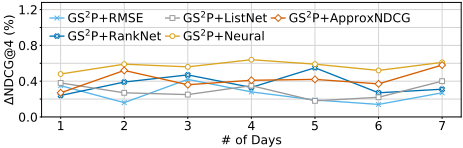
Figure 2 illustrates the relative performance between GS2P and the base model, expressed via ∆NCDG@4. Logically, GS2P shows marked enhancement in performance across all days when compared to the base system, evidencing its practical capability in upgrading the efficacy of a large-scale search engine. Even more impressively, GS2P has shown substantial growth on this large-scale platform. A prominent highlight is GS2P outperforming the online base model by a significant margin of 0.61% relative improvement on ∆NCDG@4, a feat achieved by the NeuralNDCG loss-trained model using a nominal 5% labeled data ratio. GS2P has showcased consistent performance across both online and offline platforms.
4 Conclusion
In this work, we design, implement and deploy a generative semi-supervised pre-trained model GS2P on a real-world largescale search engine to address the problems of LTR under semi-supervised settings. We substantiate the effectiveness of GS2P through comprehensive offline and online analyses, juxtaposed against an extensive lineup of rivals. The offline trials denote a considerable leap in GS2P's performance relative to other baselines. Furthermore, GS2P significantly enhances the online ranking efficacy in practical applications, mirroring the positive outcomes observed in the offline experiments.
Acknowledgments
This work was supported in part by NSFC grant 62141220, 61972253, U1908212, 62172276, 61972254, the Program for Professor of Special Appointment (Eastern Scholar) at Shanghai Institutions of Higher Learning, Shanghai Science and Technology Development Funds 23YF1420500, Open Research Projects of Zhejiang Lab No. 2022NL0AB01.
@inproceedings{ijcai2024p936,
  title     = {GS2P: A Generative Pre-trained Learning to Rank Model with Over-parameterization for Web-Scale Search (Extended Abstract)},
  author    = {Li, Yuchen and Xiong, Haoyi and Kong, Linghe and Bian, Jiang and Wang, Shuaiqiang and Chen, Guihai and Yin, Dawei},
  booktitle = {Proceedings of the Thirty-Third International Joint Conference on
               Artificial Intelligence, {IJCAI-24}},
  publisher = {International Joint Conferences on Artificial Intelligence Organization},
  editor    = {Kate Larson},
  pages     = {8433--8438},
  year      = {2024},
  month     = {8},
  note      = {Sister Conferences Best Papers},
  doi       = {10.24963/ijcai.2024/936},
  url       = {https://doi.org/10.24963/ijcai.2024/936},
}
TY - CPAPER TI - GS2P: A Generative Pre-trained Learning to Rank Model with Over-parameterization for Web-Scale Search (Extended Abstract) AU - Li, Yuchen AU - Xiong, Haoyi AU - Kong, Linghe AU - Bian, Jiang AU - Wang, Shuaiqiang AU - Chen, Guihai AU - Yin, Dawei T2 - Proceedings of the Thirty-Third International Joint Conference on Artificial Intelligence, IJCAI-24 PB - International Joint Conferences on Artificial Intelligence Organization PY - 2024 SP - 8433 EP - 8438 DO - 10.24963/ijcai.2024/936 UR - https://doi.org/10.24963/ijcai.2024/936 ER -Copied
Machine-readable versions of this paper, for tools and AI agents:





