
FD-UAD: Unsupervised Anomaly Detection Platform Based on Defect Autonomous Imaging and Enhancement
Proceedings of the Thirty-Third International Joint Conference on Artificial Intelligence. Demo Track. Pages 8619-8622.
https://doi.org/10.24963/ijcai.2024/993
Keywords
- Computer Vision: CV: Recognition (object detection, categorization)
- Computer Vision: CV: Applications
Abstract
In industrial quality control, detecting defects is essential. However, manual checks and machine vision encounter challenges in complex conditions, as defects vary among products made of different materials and shapes. We create FD-UAD, Unsupervised Anomaly Detection Platform Based on Defect Autonomous Imaging and Enhancement. It uses multi-sensor technology, combining RGB and infrared imaging, liquid lenses for adjustable focal lengths, and uses image fusion to capture multidimensional features. The system incorporates image restoration techniques such as enhancement, deblurring, denoising, and super-resolution, alongside unsupervised anomaly detection model for enhanced accuracy. FD-UAD is successfully used in a top diesel engine manufacturer, demonstrating its value in AI-enhanced industrial applications.
- [Angiulli and Pizzuti, 2002] Fabrizio Angiulli and Clara Piz- zuti. Fast outlier detection in high dimensional spaces. In European conference on principles of data mining and knowledge discovery, pages 15-27. Springer, 2002.
- [Bergmann et al., 2019] Paul Bergmann, Michael Fauser, David Sattlegger, and Carsten Steger. Mvtec ad-a com- prehensive real-world dataset for unsupervised anomaly detection. In Proceedings of the IEEE/CVF conference on computer vision and pattern recognition, pages 9592- 9600, 2019.
- [Bergmann et al., 2021] Paul Bergmann, Kilian Batzner, Michael Fauser, David Sattlegger, and Carsten Steger. The mvtec anomaly detection dataset: a comprehensive real- world dataset for unsupervised anomaly detection. Inter- national Journal of Computer Vision, 129(4):1038-1059, 2021.
- [Cai et al., 2023] Yuanhao Cai, Hao Bian, Jing Lin, Haoqian Wang, Radu Timofte, and Yulun Zhang. Retinexformer: One-stage retinex-based transformer for low-light image enhancement. arXiv preprint arXiv:2303.06705, 2023.
- [Chen et al., 2023a] Xiangyu Chen, Xintao Wang, Jiantao Zhou, Yu Qiao, and Chao Dong. Activating more pixels in image super-resolution transformer. In Proceedings of the IEEE/CVF Conference on Computer Vision and Pat- tern Recognition, pages 22367-22377, 2023.
- [Chen et al., 2023b] Xuhai Chen, Jiangning Zhang, Guanzhong Tian, Haoyang He, Wuhao Zhang, Yabiao Wang, Chengjie Wang, Yunsheng Wu, and Yong Liu. Clip-ad: A language-guided staged dual-path model for zero-shot anomaly detection. arXiv preprint arXiv:2311.00453, 2023.
- [Deng and Li, 2022] Hanqiu Deng and Xingyu Li. Anomaly detection via reverse distillation from one-class embed- ding. In Proceedings of the IEEE/CVF Conference on Computer Vision and Pattern Recognition, pages 9737- 9746, 2022.
- [Jeong et al., 2023] Jongheon Jeong, Yang Zou, Taewan Kim, Dongqing Zhang, Avinash Ravichandran, and Onkar Dabeer. Winclip: Zero-/few-shot anomaly classifica- tion and segmentation. In Proceedings of the IEEE/CVF Conference on Computer Vision and Pattern Recognition, pages 19606-19616, 2023.
- [Lee et al., 2022] Sungwook Lee, Seunghyun Lee, and Byung Cheol Song. Cfa: Coupled-hypersphere-based fea- ture adaptation for target-oriented anomaly localization. IEEE Access, 10:78446-78454, 2022.
- [Li et al., 2021] Chun-Liang Li, Kihyuk Sohn, Jinsung Yoon, and Tomas Pfister. Cutpaste: Self-supervised learn- ing for anomaly detection and localization. In Proceedings of the IEEE/CVF conference on computer vision and pat- tern recognition, pages 9664-9674, 2021.
- [Liu et al., 2008] Fei Tony Liu, Kai Ming Ting, and Zhi-Hua Zhou. Isolation forest. In 2008 eighth ieee international conference on data mining, pages 413-422. IEEE, 2008.
- [Roth et al., 2022] Karsten Roth, Latha Pemula, Joaquin Zepeda, Bernhard Schölkopf, Thomas Brox, and Peter Gehler. Towards total recall in industrial anomaly de- tection. In Proceedings of the IEEE/CVF Conference on Computer Vision and Pattern Recognition, pages 14318- 14328, 2022.
- [Schölkopf et al., 2001] Bernhard Schölkopf, John C Platt, John Shawe-Taylor, Alex J Smola, and Robert C Williamson. Estimating the support of a high-dimensional distribution. Neural computation, 13(7):1443-1471, 2001.
- [Schroeder, 1981] Manfred R Schroeder. Modulation trans- fer functions: Definition and measurement. Acta Acustica united with Acustica, 49(3):179-182, 1981.
- [Shyu et al., 2003] Mei-Ling Shyu, Shu-Ching Chen, Kanoksri Sarinnapakorn, and LiWu Chang. A novel anomaly detection scheme based on principal component classifier. In Proceedings of the IEEE foundations and new directions of data mining workshop, pages 172-179. IEEE Press, 2003.
- [Wang et al., 2022] Zhendong Wang, Xiaodong Cun, Jian- min Bao, Wengang Zhou, Jianzhuang Liu, and Houqiang Li. Uformer: A general u-shaped transformer for image restoration. In Proceedings of the IEEE/CVF conference on computer vision and pattern recognition, pages 17683- 17693, 2022.
- [Zavrtanik et al., 2021] Vitjan Zavrtanik, Matej Kristan, and Danijel Skočaj. Draem-a discriminatively trained recon- struction embedding for surface anomaly detection. In Proceedings of the IEEE/CVF International Conference on Computer Vision, pages 8330-8339, 2021.
- [Zhao et al., 2023] Qing Zhao, Yan Wang, Boyang Wang, Junxiong Lin, Shaoqi Yan, Wei Song, Antonio Liotta, Ji- awen Yu, Shuyong Gao, and Wenqiang Zhang. Msc-ad: A multiscene unsupervised anomaly detection dataset for small defect detection of casting surface. IEEE Transac- tions on Industrial Informatics, 2023.
- [Zhao et al., 2024] Qing Zhao, Yan Wang, Yuxuan Lin, Shaoqi Yan, Wei Song, Boyang Wang, Jun Huang, Yang Chang, Lizhe Qi, and Wenqiang Zhang. Mixed noise- guided mutual constraint framework for unsupervised anomaly detection in smart industries. Computer Com- munications, 216:45-53, 2024.
References were extracted automatically from the PDF and may contain errors.
Full text extracted automatically from the PDF; figures, tables and equations may differ. The PDF is the version of record.
1 Introduction
Inspection of industrial product appearance quality is essential for ensuring product quality. Traditional inspections rely on manual labor, characterized by high labor intensity, poor stability, and low efficiency. Existing machine vision systems are designed for specific scenarios and struggle to adapt to the diversity of materials, size variations, and irregular shapes in complex industrial conditions. The challenge lies in achieving multidimensional feature modeling and image restoration of appearance defects in uncertain environments, and developing defect detection systems with limited data labeling.
Industrial anomaly detection aims to identify and locate abnormal samples and their regions in images. Traditional anomaly detection uses machine learning methods, such as k-NN [Angiulli and Pizzuti, 2002], isolation forest [Liu et al., 2008], OCSVM [Sch¨olkopf et al., 2001], principal component analysis [Shyu et al., 2003], etc. Recent years have seen major advancements in industrial image defect detection thanks to artificial intelligence and deep learning. The high cost of acquiring abnormal images has led to a reliance on unsupervised or semi-supervised methods, utilizing unlabeled
∗Corresponding authors
FD-UAD Platform in Diesel Engine Manufacturing Factory
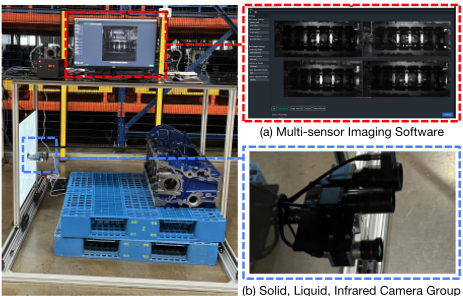
normal data for training models, such as DRAEM [Zavrtanik et al., 2021], CutPaste [Li et al., 2021], PatchCore [Roth et al., 2022], RD4AD [Deng and Li, 2022] and CFA [Lee et al., 2022]. The MVTec AD dataset [Bergmann et al., 2019; Bergmann et al., 2021], a benchmark for unsupervised industrial anomaly detection, exclusively comprises normal samples in its training set, highlighting the gap from realworld industrial imagery. Zero-shot and few-shots learning approaches mitigate the issues of limited data labeling and anomaly diversity, thereby enhancing models' capabilities to identify novel anomalies, as demonstrated by WinCLIP [Jeong et al., 2023] and CLIP-AD [Chen et al., 2023b]. Nonetheless, in complex industrial settings, the effectiveness of defect detection models heavily depends on the quality of data, underlining the importance of optimizing image acquisition and restoration techniques.
The quality inspection systems within optical imaging and industrial vision inspection, such as those developed by Panasonic, IBM, SICK, Omron, Keyence, and Dalsa, are flourishing. These systems perform well in detecting regular defects and in relatively simple scenarios. These systems efficiently detect standard defects in simple scenarios but face difficulties in complex industrial settings with varied materials, textures, reflectivity, and uncertain lighting. These challenges have become bottlenecks in advancing industrial intelligent production.
To address these challenges, we propose FD-UAD: Unsupervised Anomaly Detection Platform Based on Defect Autonomous Imaging and Enhancement. This platform utilizes industrial AI vision perception modeling through multi-scale and multi-modal imaging and image fusion, establishing an AI perception system capable of image restoration and unsupervised anomaly detection. As shown in Figure 1, we have developed an integrated industrial machine vision system that combines multi-sensors collaboration for imaging and defect detection, successfully achieving demonstrative applications and commercial promotion within the top industrial company.
In this work, we make the following four contributions:
- Multi-Sensors Imaging and Image Fusion. We designed and implemented a multi-sensors imaging system with biomimetic optical imaging units, capturing multidimensional image information across RGB, infrared, and various focal lengths. The system employs image fusion to precisely merge multi-modal and multi-scale image data, ensuring features captured in complex conditions.
- Advanced Image Restoration Techniques. We introduced several state-of-the-art (SOTA) image restoration models into our system, including Retinexformer model for brightness enhancement, Uformer model for deblurring and denoising, HAT model for super-resolution. These integrations effectively tackle low light, noise, blur, and low resolution issues in complex industrial scenes, enhancing image quality.
- Mixed Noise-guided Mutual Constraint Framework For Unsupervised Anomaly Detection. We develop a novel mixed noise generation model that emulates real defects and a mutual constraint framework to augment the distinctiveness of the teacher-student network's characterization of anomalous features, achieving excellent results in defect detection.
- FD-UAD Platform. FD-UAD platform elevates the defect detection process through a pipeline that includes multi-scale and multi-modal imaging, image restoration, and defect detection, all embedded within an integrated software-hardware platform. Successfully deployed in a top industrial firm, it enhances product quality inspection with AI value addition.
2 FD-UADOverview
As shown in Figure 2, FD-UAD melds industrial insights and real-world applications, harnessing optical sensors, AI-driven computer vision, deep learning, alongside software and hardware deployment innovations. It crafts an all-encompassing imaging process for industrial products, embracing their material, size, and shape diversity, to capture and fuse multiscale, multi-modal images. Utilizing image restoration, it sharpens image quality for unsupervised anomaly detection. Custom-designed hardware and software cater to the unique demands of industrial settings. Demonstrated in leading companies, FD-UAD propels AI's impact on quality inspection, offering substantial value.
2.1 Multi-Sensors Imaging and Image Fusion
This study addresses imaging challenges in complex industrial environments, by using a multi-sensors framework. It features a Hikvision ME2P-2621-15U3M solid camera and an RS-A1500-GM60 NIR infrared camera for capturing RGB and infrared images. Then it uses Optotune ELM-12-2.8-18C liquid lenses, adjusting focus via electric current in 5mA steps, enabling variable depth imaging of product surfaces from blur to clear. The Knife-edge method calculates the Modulation Transfer Function (MTF) [Schroeder, 1981] for the Region of Interest (ROI), automating image clarity evaluation based on the MTF. The image fusion method combines Gradient Magnitude Awareness (GMA) deep learning optical flow with a deep fusion network to integrate multi-modal and multi-scale images efficiently.
In summary, this multi-sensors framework allows the system to mitigate image quality issues caused by material thermal changes and uneven surfaces, capturing high-quality features across modes and scales, effectively tackling industrial imaging's inherent challenges.
2.2 Image Restoration
In industrial production environments, imaging systems often face challenges such as low light, noise interference, image blur, and low resolution. These issues significantly reduce image quality. To address these challenges, this study designed an image restoration process that integrates the most advanced deep learning models in image enhancement, denoising, deblurring, and super-resolution. This significantly improves image quality.
To combat low-light conditions, this study employed the latest low-light enhancement model, Retinexformer [Cai et al., 2023]. This model combines retinal theory with estimating lighting information and its restoration, effectively enhancing low-light images while maintaining their natural appearance and details. For the common issues of noise and blur in industrial imaging, we introduced the Transformer structure for image restoration tasks, Uformer [Wang et al., 2022]. Uformer uses self-attention mechanisms in feature maps to restore image details, achieving excellent denoising and deblurring effects while optimizing detail retention and computational efficiency. For low-resolution issues, we used HAT model [Chen et al., 2023a], which combines channel attention and self-attention mechanisms. This leverages the global information processing capability of channel attention and the high representational power of self-attention to activate more pixels for reconstruction, resulting in outstanding super-resolution performance.
FD-UAD Platform Structure Overview
FD-UAD Algorithm Structure
Software & System Structure
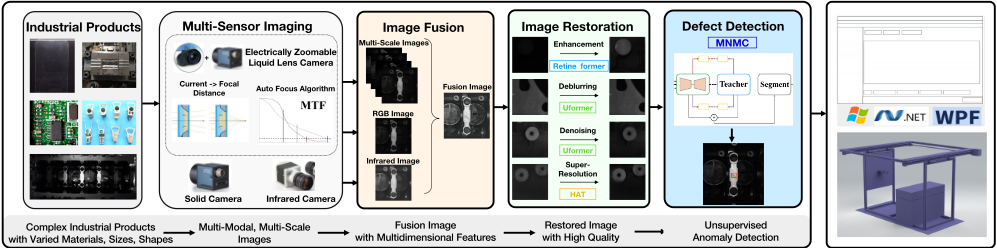
Figure 2: FD-UAD Platform Structure Overview: Designed for complex industrial products with varied materials, sizes, and shapes, system utilizes RGB, infrared, and multi-focal auto focus imaging for image fusion across modalities and scales, extracting multidimensional features. To address low-quality images, it employs several SOTA AI models for image enhancement, deblurring, denoising, and super-resolution, achieving high-quality image restoration. The MNMC model facilitates unsupervised anomaly detection. FD-UAD software, running on Windows platform and developed with .Net Framework and WPF, integrates imaging, image restoration, and defect detection algorithms. Incorporating a variety of industrial equipment, it forms a complete industrial system framework.
2.3 Defect Detection
We develop MSC-AD dataset [Zhao et al., 2023] and MNMC model [Zhao et al., 2024] for defect detection. The MSCAD dataset serves as the training data, providing a multiscene unsupervised anomaly detection dataset for small defect detection. MNMC is an unsupervised anomaly detection model designed to tackle the challenges of anomaly detection in complex industrial scenes. It consists of three main components: a mixed noise generation module for simulating real defects; a mutual constraint module for enhancing the student network's ability to learn normal features; and an anomaly segmentation module for detecting anomalies at different scales. The model adopts a mixed noise model to generate features closer to real anomalies. Through the mutual constraint framework, this method further enhances the learning of normal features and proposes a new evaluation metric to balance the importance of normal and abnormal areas. As shown in Figure 3, this approach achieved desired detection outcomes.
2.4 Software & System Structure
We evaluated the needs and environment of factory settings, creating a combined software-hardware system. The system includes an industrial light panel (K-WELL KW-BK700-W) and polarizer (GCL-050003) for balanced lighting and reduced overexposure. An electric slide rail (FUYU FMC4030) allows precise camera and object positioning. The setup uses various cameras (solid, infrared, liquid) for detailed object imaging. The software, based on .NET Framework 4.5 and Windows Presentation Foundation (WPF), manages operations and enhances user interaction. Algorithms run on an Intel i7-8565u processor and GeForce RTX 3080, ensuring model efficiency.
FD-UAD Image Restoration and Defect Detection Result
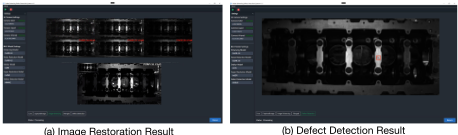
(a) Image Restoration Result
(b) Defect Detection Result
Figure 3: FD-UAD Platform Results Display
3 Demonstration
From 2021 to 2023, we carried out several field surveys in different industrial manufacturing sites to understand their requirements and surroundings. During this period, we developed and iterated on AI algorithms, software, and hardware configurations. As is shown in Figure 1, in December 2023, we successfully implemented FD-UAD platform in a top diesel engine manufacturing factory, establishing it as a benchmark demonstration of AI system application in actual production environments.
4 Conclusion
This paper introduces the FD-UAD platform, combining multi-sensor imaging and image fusion with deep learning for image restoration and unsupervised anomaly detection, covering both software and hardware aspects. It addresses challenges from diverse materials, lighting, and irregularities in industrial environments, showing a holistic AI-enhanced system design and implementation. Successfully implemented at a top manufacturer, FD-UAD is extending to automotive, electronics, and precision instruments sectors, supporting automated quality control, improving production efficiency, and reducing costs.
@inproceedings{ijcai2024p993,
  title     = {FD-UAD: Unsupervised Anomaly Detection Platform Based on Defect Autonomous Imaging and Enhancement},
  author    = {Chang, Yang and Lin, Yuxuan and Wang, Boyang and Zhao, Qing and Wang, Yan and Zhang, Wenqiang},
  booktitle = {Proceedings of the Thirty-Third International Joint Conference on
               Artificial Intelligence, {IJCAI-24}},
  publisher = {International Joint Conferences on Artificial Intelligence Organization},
  editor    = {Kate Larson},
  pages     = {8619--8622},
  year      = {2024},
  month     = {8},
  note      = {Demo Track},
  doi       = {10.24963/ijcai.2024/993},
  url       = {https://doi.org/10.24963/ijcai.2024/993},
}
TY - CPAPER TI - FD-UAD: Unsupervised Anomaly Detection Platform Based on Defect Autonomous Imaging and Enhancement AU - Chang, Yang AU - Lin, Yuxuan AU - Wang, Boyang AU - Zhao, Qing AU - Wang, Yan AU - Zhang, Wenqiang T2 - Proceedings of the Thirty-Third International Joint Conference on Artificial Intelligence, IJCAI-24 PB - International Joint Conferences on Artificial Intelligence Organization PY - 2024 SP - 8619 EP - 8622 DO - 10.24963/ijcai.2024/993 UR - https://doi.org/10.24963/ijcai.2024/993 ER -Copied
Machine-readable versions of this paper, for tools and AI agents:





