
Diversity-Aware Reinforcement Learning for de novo Drug Design
Proceedings of the Thirty-Fourth International Joint Conference on Artificial Intelligence. AI4Tech: AI Enabling Technologies. Pages 9194-9204.
https://doi.org/10.24963/ijcai.2025/1022
Keywords
- Advanced AI4Tech: Generative and LLMs-driven AI4Tech
- Domain-specific AI4Tech: AI4Medicine and AI4Drug
Abstract
Fine-tuning a pre-trained generative model has demonstrated good performance in generating promising drug molecules. The fine-tuning task is often formulated as a reinforcement learning problem, where previous methods efficiently learn to optimize a reward function to generate potential drug molecules. Nevertheless, in the absence of an adaptive update mechanism for the reward function, the optimization process can become stuck in local optima. The efficacy of the optimal molecule in a local optimization may not translate to usefulness in the subsequent drug optimization process or as a potential standalone clinical candidate. Therefore, it is important to generate a diverse set of promising molecules. Prior work has modified the reward function by penalizing structurally similar molecules, primarily focusing on finding molecules with higher rewards. To date, no study has comprehensively examined how different adaptive update mechanisms for the reward function influence the diversity of generated molecules. In this work, we investigate a wide range of intrinsic motivation methods and strategies to penalize the extrinsic reward, and how they affect the diversity of the set of generated molecules. Our experiments reveal that combining structure- and prediction-based methods generally yields better results in terms of diversity.
- [Atance et al., 2022] Sara Romeo Atance, Juan Viguera Diez, Ola Engkvist, Simon Olsson, and Rocío Mercado. De novo drug design using reinforcement learning with graph-based deep generative models. Journal of chemical information and modeling, 62(20):4863-4872, 2022.
- [Badia et al., 2020] Adrià Puigdomènech Badia, Pablo Sprechmann, Alex Vitvitskyi, Daniel Guo, Bilal Piot, Steven Kapturowski, Olivier Tieleman, Martín Arjovsky, Alexander Pritzel, Andew Bolt, and Charles Blundell. Never give up: Learning directed exploration strategies, 2020.
- [Bellemare et al., 2016] Marc G. Bellemare, Sriram Srini- vasan, Georg Ostrovski, Tom Schaul, David Saxton, and Rémi Munos. Unifying count-based exploration and in- trinsic motivation. In Daniel D. Lee, Masashi Sugiyama, Ulrike von Luxburg, Isabelle Guyon, and Roman Garnett, editors, Advances in Neural Information Processing Sys- tems 29: Annual Conference on Neural Information Pro- cessing Systems 2016, December 5-10, 2016, Barcelona, Spain, pages 1471-1479, 2016.
- [Bemis and Murcko, 1996] Guy W Bemis and Mark A Mur- cko. The properties of known drugs. 1. molecular frame- works. Journal of medicinal chemistry, 39(15):2887- 2893, 1996.
- [Blaschke et al., 2020a] Thomas Blaschke, Josep Arús- Pous, Hongming Chen, Christian Margreitter, Christian Tyrchan, Ola Engkvist, Kostas Papadopoulos, and Atanas Patronov. Reinvent 2.0: an ai tool for de novo drug design. Journal of chemical information and modeling, 60(12):5918-5922, 2020.
- [Blaschke et al., 2020b] Thomas Blaschke, Ola Engkvist, Jürgen Bajorath, and Hongming Chen. Memory-assisted reinforcement learning for diverse molecular de novo de- sign. Journal of cheminformatics, 12(1):68, 2020.
- [Burda et al., 2018] Yuri Burda, Harrison Edwards, Amos Storkey, and Oleg Klimov. Exploration by random net- work distillation. arXiv preprint arXiv:1810.12894, 2018.
- [DiMasi et al., 2016] Joseph A DiMasi, Henry G Grabowski, and Ronald W Hansen. Innovation in the pharmaceutical industry: new estimates of r&d costs. Journal of health economics, 47:20-33, 2016.
- [Gao et al., 2022] Wenhao Gao, Tianfan Fu, Jimeng Sun, and Connor W. Coley. Sample efficiency matters: A benchmark for practical molecular optimization. In Sanmi Koyejo, S. Mohamed, A. Agarwal, Danielle Belgrave, K. Cho, and A. Oh, editors, Advances in Neural Informa- tion Processing Systems 35: Annual Conference on Neu- ral Information Processing Systems 2022, NeurIPS 2022, New Orleans, LA, USA, November 28 -December 9, 2022, 2022.
- [Garivier and Cappé, 2011] Aurélien Garivier and Olivier Cappé. The kl-ucb algorithm for bounded stochastic ban- dits and beyond. In Sham M. Kakade and Ulrike von Luxburg, editors, Proceedings of the 24th Annual Con- ference on Learning Theory, volume 19 of Proceedings of Machine Learning Research, pages 359-376, Budapest, Hungary, 09-11 Jun 2011. PMLR.
- [Gaulton et al., 2017] Anna Gaulton, Anne Hersey, Michał Nowotka, A Patricia Bento, Jon Chambers, David Mendez, Prudence Mutowo, Francis Atkinson, Louisa J Bellis, Elena Cibrián-Uhalte, et al. The chembl database in 2017. Nucleic acids research, 45(D1):D945-D954, 2017.
- [Gummesson Svensson et al., 2024] Hampus Gummes- son Svensson, Christian Tyrchan, Ola Engkvist, and Morteza Haghir Chehreghani. Utilizing reinforcement learning for de novo drug design. Machine Learning, 113(7):4811-4843, 2024.
- [Guo and Schwaller, 2024] Jeff Guo and Philippe Schwaller. Augmented memory: Sample-efficient generative molecu- lar design with reinforcement learning. Jacs Au, 2024.
- [Hochreiter, 1997] S Hochreiter. Long short-term memory. Neural Computation MIT-Press, 1997.
- [Huang et al., 2021] Kexin Huang, Tianfan Fu, Wenhao Gao, Yue Zhao, Yusuf Roohani, Jure Leskovec, Con- nor W Coley, Cao Xiao, Jimeng Sun, and Marinka Zitnik. Therapeutics data commons: Machine learning datasets and tasks for drug discovery and development. Proceed- ings of Neural Information Processing Systems, NeurIPS Datasets and Benchmarks, 2021.
- [Huang et al., 2022] Kexin Huang, Tianfan Fu, Wenhao Gao, Yue Zhao, Yusuf Roohani, Jure Leskovec, Connor W Coley, Cao Xiao, Jimeng Sun, and Marinka Zitnik. Artifi- cial intelligence foundation for therapeutic science. Nature Chemical Biology, 2022.
- [Hughes et al., 2011] James P Hughes, Stephen Rees, S Bar- rett Kalindjian, and Karen L Philpott. Principles of early drug discovery. British journal of pharmacology, 162(6):1239-1249, 2011.
- [Jaccard, 1912] Paul Jaccard. The distribution of the flora in the alpine zone. 1. New phytologist, 11(2):37-50, 1912.
- [Jasial et al., 2016] S Jasial, Y Hu, M Vogt, and J Bajo- rath. Activity-relevant similarity values for fingerprints and implications for similarity searching. F1000Research, 5(591), 2016.
- [Landrum, 2006] Greg Landrum. Rdkit: Open-source chem- informatics. http://www.rdkit.org, 2006. Link
- [Laud, 2004] Adam Daniel Laud. Theory and application of reward shaping in reinforcement learning. PhD thesis, University of Illinois at Urbana-Champaign, 2004.
- [Liu et al., 2021] Xuhan Liu, Kai Ye, Herman WT van Vli- jmen, Michael TM Emmerich, Adriaan P IJzerman, and Gerard JP van Westen. Drugex v2: de novo design of drug molecules by pareto-based multi-objective reinforcement learning in polypharmacology. Journal of cheminformat- ics, 13(1):85, 2021.
- [Loeffler et al., 2024] Hannes H Loeffler, Jiazhen He, Alessandro Tibo, Jon Paul Janet, Alexey Voronov, Lewis H Mervin, and Ola Engkvist. Reinvent 4: Modern ai-driven generative molecule design. Journal of Cheminformatics, 16(1):20, 2024.
- [Olivecrona et al., 2017] Marcus Olivecrona, Thomas Blaschke, Ola Engkvist, and Hongming Chen. Molecular de-novo design through deep reinforcement learning. Journal of cheminformatics, 9:1-14, 2017.
- [Park et al., 2025] Jinyeong Park, Jaegyoon Ahn, Jonghwan Choi, and Jibum Kim. Mol-air: Molecular reinforcement learning with adaptive intrinsic rewards for goal-directed molecular generation. Journal of Chemical Information and Modeling, 65(5):2283-2296, 2025.
- [Pitt et al., 2025] Will R. Pitt, Jonathan Bentley, Christophe Boldron, Lionel Colliandre, Carmen Esposito, Eliza- beth H. Frush, Jola Kopec, Stéphanie Labouille, Jerome Meneyrol, David A. Pardoe, Ferruccio Palazzesi, Al- fonso Pozzan, Jacob M. Remington, René Rex, Michelle Southey, Sachin Vishwakarma, and Paul Walker. Real- world applications and experiences of ai/ml deployment for drug discovery. Journal of Medicinal Chemistry, 2025. PMID: 39772505.
- [Popova et al., 2018] Mariya Popova, Olexandr Isayev, and Alexander Tropsha. Deep reinforcement learning for de novo drug design. Science advances, 4(7):eaap7885, 2018.
- [Quancard et al., 2023] Jean Quancard, Anna Vulpetti, An- ders Bach, Brian Cox, Stéphanie M Guéret, Ingo V Har- tung, Hannes F Koolman, Stefan Laufer, Josef Messinger, Gianluca Sbardella, et al. The european federation for medicinal chemistry and chemical biology (efmc) best practice initiative: Hit generation. ChemMedChem, 18(9):e202300002, 2023.
- [Renz et al., 2019] Philipp Renz, Dries Van Rompaey, Jörg Kurt Wegner, Sepp Hochreiter, and Günter Klam- bauer. On failure modes in molecule generation and op- timization. Drug Discovery Today: Technologies, 32:55- 63, 2019.
- [Renz et al., 2024] Philipp Renz, Sohvi Luukkonen, and Guünter Klambauer. Diverse hits in de novo molecule design: Diversity-based comparison of goal-directed gen- erators. Journal of Chemical Information and Modeling, 64(15):5756-5761, 2024.
- [Reymond, 2015] Jean-Louis Reymond. The chemical space project. Accounts of chemical research, 48(3):722-730, 2015.
- [Rogers and Hahn, 2010] David Rogers and Mathew Hahn. Extended-connectivity fingerprints. Journal of chemical information and modeling, 50(5):742-754, 2010.
- [Segler et al., 2018] Marwin HS Segler, Thierry Kogej, Christian Tyrchan, and Mark P Waller. Generating focused molecule libraries for drug discovery with recurrent neural networks. ACS central science, 4(1):120-131, 2018.
- [Sun et al., 2017] Jiangming Sun, Nina Jeliazkova, Vladimir Chupakhin, Jose-Felipe Golib-Dzib, Ola Engkvist, Lars Carlsson, Jörg Wegner, Hugo Ceulemans, Ivan Georgiev, Vedrin Jeliazkov, et al. Excape-db: an integrated large scale dataset facilitating big data analysis in chemoge- nomics. Journal of cheminformatics, 9:1-9, 2017.
- [Thomas et al., 2022a] Morgan Thomas, Noel M. O'Boyle, Andreas Bender, and Chris De Graaf. Re-evaluating sam- ple efficiency in de novo molecule generation, 2022.
- [Thomas et al., 2022b] Morgan Thomas, Noel M O'Boyle, Andreas Bender, and Chris De Graaf. Augmented hill-climb increases reinforcement learning efficiency for language-based de novo molecule generation. Journal of cheminformatics, 14(1):68, 2022.
- [Velez-Arce et al., 2024] Alejandro Velez-Arce, Xiang Lin, Kexin Huang, Michelle M Li, Wenhao Gao, Bradley Pen- telute, Tianfan Fu, Manolis Kellis, and Marinka Zitnik. Signals in the cells: Multimodal and contextualized ma- chine learning foundations for therapeutics. In NeurIPS 2024 Workshop on AI for New Drug Modalities, 2024.
- [Wang and Zhu, 2024] Jing Wang and Fei Zhu. Exselfrl: An exploration-inspired self-supervised reinforcement learn- ing approach to molecular generation. Expert Systems with Applications, page 125410, 2024.
- [Weininger, 1988] David Weininger. Smiles, a chemical lan- guage and information system. 1. introduction to method- ology and encoding rules. Journal of chemical information and computer sciences, 28(1):31-36, 1988.
- [Wouters et al., 2020] Olivier J Wouters, Martin McKee, and Jeroen Luyten. Estimated research and development in- vestment needed to bring a new medicine to market, 2009- 2018. JAMA, 323(9):844-853, 2020.
- [Xie et al., 2023] Yutong Xie, Ziqiao Xu, Jiaqi Ma, and Qiaozhu Mei. How much space has been explored? measuring the chemical space covered by databases and machine-generated molecules. In 11th International Con- ference on Learning Representations (ICLR 2023). Inter- national Conference on Learning Representations (ICLR), 2023.
References were extracted automatically from the PDF and may contain errors.
Full text extracted automatically from the PDF; figures, tables and equations may differ. The PDF is the version of record.
1 Introduction
The development of a novel pharmaceutical drug is a highly intricate process that can span up to a decade and incur costs exceeding US $1 billion [Wouters et al., 2020; DiMasi et al., 2016]. A key part of such an effort involves the identification of novel drug candidates that exhibit the desired molecular properties [Hughes et al., 2011]. The success in identifying drug candidates primarily depends on selecting chemical starting points that surpass a certain threshold in bioactivity toward the desired target, known as hits. High-quality hits can substantially reduce the time required to identify a viable drug candidate and be the determining factor in the success of a drug discovery campaign [Quancard et al., 2023]. Designing novel pharmaceutical molecules, or de novo drug design, is extremely challenging given the estimated number of up to 1060 possible drug-like molecules [Reymond, 2015].
Recent advances in de novo drug design utilize reinforcement learning (RL) to navigate this vast chemical space by fine-tuning a pre-trained generative model [Popova et al., 2018; Gummesson Svensson et al., 2024; Guo and Schwaller, 2024; Atance et al., 2022; Liu et al., 2021; Olivecrona et al., 2017]. Evaluations by [Gao et al., 2022] and [Thomas et al., 2022a] have demonstrated good performance when using RL to fine-tune a pre-trained recurrent neural network (RNN) to generate molecules encoded in the Simplified Molecular Input Line Entry System (SMILES) [Weininger, 1988]. Also, this approach is widely adopted in real-world applications in drug discovery [Pitt et al., 2025]. However, RL-based de novo drug design methods can easily become stuck in local optima, generating structurally similar molecules- a phenomenon known as mode collapse. This is undesirable as it prevents the agent from discovering more diverse and potentially more promising local optima. To mitigate mode collapse, [Blaschke et al., 2020b] introduced a count-based method that penalizes generated molecules based on their structure. When too many structurally similar molecules have been generated, the agent observes zero reward, instead of the actual extrinsic reward, for future generated molecules with the same structure. This is a popular way to avoid mode collapse for RL-based de novo drug design [Thomas et al., 2022b; Guo and Schwaller, 2024; Loeffler et al., 2024; Gummesson Svensson et al., 2024].
Most work mainly focuses on avoiding mode collapse to find the most optimal solution. However, the quantitative structure-activity relationship (QSAR) models utilized for in silico assessment of molecules introduce uncertainties and biases due to limited training data [Renz et al., 2019]. Thus, it is important to explore numerous modes of these models to increase the chance of identifying potential drug candidates. 1 Also, the identified (local) optimal solution might not be optimal in terms of observed safety and therapeutic effectiveness in the body. Therefore, it is meaningful to generate a diverse set of molecules. Recent work by [Renz et al., 2024] focuses on the generated molecules' diversity, finding superior performance of SMILES-based autoregressive models using RL to optimize the desired properties. They use a penalization method based on the work by [Blaschke et al., 2020b] to enable diverse molecule generation. As an alternative to penalizing the extrinsic reward, previous work in RL has shown that providing intrinsic motivation to the agent can enhance the exploration [Bellemare et al., 2016; Burda et al., 2018; Badia et al., 2020]. Recent efforts by [Park et al., 2025] and [Wang and Zhu, 2024] show the potential of memoryand prediction-based intrinsic motivation approaches in de novo drug design, demonstrating their capability to enhance the optimization of properties.
1 Extended version of our paper, including supplementary material, is available at https://doi.org/10.48550/arXiv.2410.10431
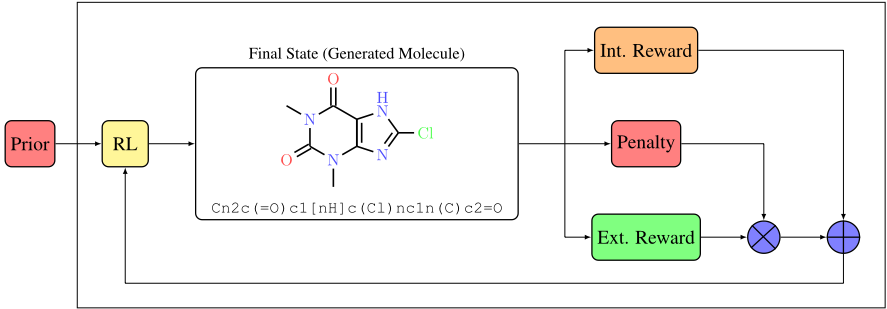
The generation of diverse sets of molecules with high (extrinsic) rewards is crucial in the drug discovery process. A diverse molecular library increases the likelihood of identifying candidates with unique and favorable pharmacological profiles, thereby enhancing the overall efficiency and success rate of drug development pipelines. While most prior research has concentrated on generating individual molecules with high (extrinsic) rewards, our work shifts the focus toward the generation of diverse molecular entities by systematically investigating various intrinsic rewards and reward penalties. This approach aims to counteract mode collapse and promote the exploration of a broader chemical space. Intrinsic rewards, inspired by human-like curiosity, encourage the RL agent to explore less familiar areas of the chemical space; while reward penalties discourage the generation of structurally similar molecules. By employing these strategies, we aim to investigate further the robustness and applicability of RL-based de novo drug design. To our knowledge, this is the first work to comprehensively study the effect such methods have on the diversity of the generated molecules. By doing so, we provide a novel framework that not only seeks optimal solutions but also ensures a wide-ranging exploration of the potential chemical space of bespoke drug candidates. This could significantly enhance the drug discovery process by providing a more diverse and promising set of molecules for further experimental validation.
2 ProblemFormulation
In this section, we introduce our framework for de novo drug design. The problem is string-based molecule generation, by fine-tuning a pre-trained policy. Following previous work, we formulate the generative process as a reinforcement learning problem where the task is to fine-tune a pre-trained generative model [Olivecrona et al., 2017]. An action corresponds to adding one token to the string representation of the molecule. A is the set of possible actions, including a start token astart and a stop token astop . The de novo drug design problem can be modeled as a Markov decision process (MDP). at ∈ A is the action taken at state st, the current state st = a0:t-1 is defined as the sequence of performed actions up to round t, the initial action a0 = astart is the start token. The transition probabilities P(st+1|st, at) = δst++at are deterministic, where P(terminal|st, astop ) = 1, ++ denotes the concatenation of two sequences and δz denotes the dirac distribution at z. If action astop is taken, the following state is terminal, stopping the current generation process and subsequently evaluating the generated molecule. The extrinsic reward is
We let T denote the round that a terminal state is visited, i.e., aT-1 = astop . The reward r(sT ) ∈ [0, 1] (only observable at a terminal state) measures the desired property, which we want to optimize, of molecule A = a1:T-2. Note that in practice, the string between the start and stop tokens encodes a molecule such that a1:T-2 is equivalent to a0:T-1 during evaluation. The objective is to fine-tune a policy πθ, parameterized by θ, to generate a structurally diverse set of molecules optimizing the property score r(·).
In practice, at each step i of the generative process, B full trajectories (until reaching a terminal state) are rolled out, to
Algorithm 1 Diversity-Aware RL framework
1: input: I,B, θprior, h 2: M← ∅ ▷ Initialize memory 3: θ ← θprior ▷ The pre-trained policy is fine-tuned 4: for i=1,. . . ,I do ▷ Generative steps 5: L(θ) ← 0 6: B ← ∅ 7: for b=1,. . . ,B do ▷ Generate batch of molecules 8: t ← 0 9: at ← a(start) ▷ Start token is always initial action 10: st+1 ← at 11: while st+1 is not terminal do 12: t ← t + 1 13: at ∼ πθ(st) 14: st+1 ← a0:t 15: end while 16: B ← B ∪ st+1 17: Observe property score r(st+1) 18: if r(st+1) ≥ h then 19: M ← M ∪ {st+1} 20: end if 21: Compute and store penalty f(st+1) 22: end for 23: for A ∈ B do 24: Compute intrinsic reward RI(A) 25: Compute diversity-aware reward ˆR(A) 26: Compute loss LA(θ) wrt ˆR(A) 27: L(θ) ← L(θ) + LA(θ) 28: end for 29: Update θ by one gradient step minimizing L(θ) 30: end for 31: output: Mobtain a batch B of generated molecules. Also, the diversityaware reward ˆR(A) (see Section 3) for each molecule A ∈ B is observed by the agent and subsequently used for finetuning. The diversity-aware reward ˆR(A) is computed using the penalty f(A) and/or intrinsic reward RI (depending on which reward function is used). Algorithm 1 illustrates our diversity-aware RL framework.
3 Diversity-Aware Reward Functions
In this section, we define the diversity-aware reward functions examined in this study. We investigate two approaches to encourage diversity among generated molecules by modifying the extrinsic reward: (1) penalize the extrinsic reward, and (2) provide intrinsic reward (intrinsic motivation). Moreover, we also investigate the combination of these approaches by integrating two intrinsic reward approaches with a penalty function on the extrinsic reward. Given an extrinsic reward R(A), the agent will receive a reward signal at the end of the generation sequence in the form of
for every generated molecule A. Hence, we impose reward shaping [Laud, 2004] where the reward observed by the agent is a linear function of the non-linear extrinsic reward, as illustrated in Figure 1. The penalty defines the importance of the extrinsic reward for each molecule to determine the exploitation rate adaptively. Sufficient exploitation is necessary to find high-quality solutions. In contrast, the intrinsic reward provides an additive bonus to encourage the agent to continually explore (independent of a molecule's extrinsic reward). We suggest several novel domain-specific penalties and intrinsic rewards, and, to the best of our knowledge, this domain-specific combination is novel. Such a linear combination avoids adding unnecessary complexity to the reward objective, but is necessarily not optimal. We want to optimize a complex extrinsic reward function while enforcing continuous exploration of a large solution space. The aim is to find a diverse set of high-quality solutions.
3.1 Extrinsic Reward Penalty
We propose and examine five different functions to penalize the extrinsic reward by discretely or continuously decreasing it based on the number of previously generated structurally similar molecules. These are based on binary, error, linear, sigmoid, or hyperbolic tan functions. To the best of our knowledge, utilizing error and hyperbolic tangent functions is novel for our application. Below, we define all penalty functions for clarity.
Non-binary functions will provide an incremental change of the (extrinsic) reward signal over time. Therefore, it is potentially more informative and can incrementally incentivize the agent to find new local optima, while still exploiting the current local optima. On the other hand, a binary function implies a sharp change of the reward function, where the agent quickly needs to find new optima.
Identical Molecular Scaffold Penalty (IMS). The IMS penalty was first introduced by [Blaschke et al., 2020b] and has thereafter been used in several works, e.g., [Loeffler et al., 2024; Guo and Schwaller, 2024]. It is based on molecular scaffolds, which is one of the most important and commonly used concepts in medicinal chemistry. The IMS penalty uses the molecular scaffold defined by [Bemis and Murcko, 1996], which is obtained by removing all side chains (or R groups). In this work, we also study the Topological scaffold, which is obtained from the molecular scaffold by converting all atom types into carbon atoms and all bonds into single bonds. Note that in this work we use the molecular scaffold since it is less general and has demonstrated good performance in earlier works [Blaschke et al., 2020b; Guo and Schwaller, 2024; Thomas et al., 2022b]. The Topological scaffold is therefore exclusively applied to assess the molecules' diversity and is not incorporated into any penalty or intrinsic reward method defined hereafter.
Let us define the reward function ˆRIMS(A) for the IMS penalty. For each generated molecule A with a reward of at least h, its molecular scaffold SA is computed and put in memory. A molecule fulfilling the (extrinsic) reward threshold h is commonly known as a predicted active molecule, denoted simply as active. If mmolecules with the same scaffold have been generated, future molecules of the same scaffold are given a reward of 0 to avoid this scaffold. Given a generated molecule A with an extrinsic reward of at least h and its corresponding molecular scaffold SA, the reward function of the IMS penalty method is then defined by
where SA is the molecular scaffold of molecule A and N[S] is the number of molecules with molecular scaffold S in memory, i.e., with an extrinsic reward of at least h. If a molecule A corresponds to an extrinsic reward smaller than h, the extrinsic reward is provided to the agent without any modification. Hence, only predicted active molecules are penalized.
Error Function Identical Molecular Scaffold Penalty (ErfIMS). The Error Function Identical molecular scaffold Penalty is a soft (non-binary) version of the IMS penalty method. It uses the error function to incrementally decrease extrinsic rewards based on the number of molecules in the molecular scaffold
where erf(x) = 2 √π ∫ x 0 e-t2 dt is the error function. Given the threshold h for the extrinsic reward R(·), the reward function for a molecule A is defined by
Linear Identical molecular scaffold Penalty (LinIMS). The linear identical molecular scaffold penalty linearly reduces the extrinsic score based on the number of generated molecules in memory with the same molecular scaffold. We define the linear penalty function by
The reward function of a molecule A is defined by, given the threshold h for the extrinsic reward R(·),
where [·]+ denotes the positive part of a function. This is equivalent to the linear penalty proposed by [Blaschke et al., 2020b].
Sigmoid Identical Molecular Scaffold Penalty (SigIMS). The sigmoid identical molecular scaffold penalty uses a sigmoid function to gradually reduce the extrinsic reward based on the number of molecules in memory with the same scaffold. A molecule is put in memory if it has an extrinsic reward of at least h. Given a molecule A, the sigmoid function in this work is defined as
This is equivalent to the sigmoid penalty function proposed by [Blaschke et al., 2020b]; therefore, we use the same parameters. Given a molecule A, we define the reward function as follows
Tanh Identical Molecular Scaffold Penalty (TanhIMS). The tanh identical molecular scaffold penalty utilizes the hyperbolic tangent function to incrementally decrease the extrinsic reward based on the number of molecules generated with the same molecular scaffold, up to and including the current step (i.e., those stored in memory). For a molecule A, the following hyperbolic tangent function is used to incrementally penalize the extrinsic reward
In the following experiments we use ctanh = 3 since this factor implies ftanh ≈ 0 around N[SA] = 25 for a bucket size m = 25. For a molecule A, we define the reward function for the TanhIMS penalty as follows
3.2 Intrinsic Reward
We examine eight methods to provide intrinsic reward to the agent, namely diverse actives (DA), minimum distance (MinDis), mean distance (MeanDis), minimum distance to random coreset (MinDisR), mean distance to random coreset (MeanDisR), KL-UCB, random network distillation (RND) and information (Inf). To the best of our knowledge, all methods, except for RND, are novel in the context of de novo drug design.
Diverse Actives (DA). We define the diverse actives intrinsic reward based on the diverse hits metric by [Renz et al., 2024], which is based on the #Circles metric proposed by [Xie et al., 2023]. Given a set of possible centers, the #Circles metric counts the number of non-overlapping circles with equivalent radius in the distance metric space. An active molecule is defined as a molecule with a reward of at least h. Following the work by [Renz et al., 2024] but using the terminology of predicted active molecules rather than hit molecules, we define the number of diverse actives for distance threshold D by
where H is a set of predicted active molecules, P is the power set, d(x, y) is the distance between molecules x and y. Note that there is a substantial difference between a set of actives and a set of diverse actives. Determining the number of diverse actives is analogous to determining the packing number of the set H in the distance metric space [Renz et al., 2024]. Let ∆µ be the difference in the number of diverse actives, between two sets H and ˜H of active molecules, defined by
Moreover, let Hi be the batch of generated actives in the current generative step i, Ci-1 the set of previously generated diverse actives and Ci = Ci-1 ∪ Hi. We define the reward function using diverse actives as an intrinsic reward by
Note that the intrinsic reward ∆µ (Ci-1 ∪Hi, Ci-1;D) is sparse since a new batch does not necessarily increase the number of non-overlapping circles. On the other hand, the intrinsic reward can be substantially larger than the extrinsic reward R(A) ∈ [0, 1], providing strong intrinsic motivation towards a specific area.
Minimum Distance (MinDis). Minimum distance is a distance-based intrinsic reward. A bonus reward is given based on the minimum distance to previously generated diverse actives (see definition of diverse actives above). Let Hi be a batch of generated actives in the current generative step i and Ci-1 be a set of previously generated diverse actives. Then the reward function of MinDis for a molecule A and reward threshold h (of predicted active molecules) is defined as follows
where ˜ Ci-1 := Ci-1 ∪ (Hi \ {A}), and d(x, y) is a distance metric between molecules x and y. In this work, we use the distance metric based on the Jaccard index [Jaccard, 1912], also known as the Tanimoto distance, widely used to measure chemical (dis-)similarity.
Mean Distance (MeanDis). Mean distance is also a distance-based intrinsic reward, but where the intrinsic reward is defined as the mean dissimilarity (distance) to previously generated diverse actives and the current batch of actives. Let Hi be a batch of generated actives in the current generative step i and Ci-1 be a set of previously generated diverse actives (see definition above of diverse actives). We then define the reward function of MeanDis of molecule A by
Minimum Distance to Random Coreset (MinDisR). Minimum distance to random coreset is a distance-based intrinsic reward similar to MinDis. The difference is that MinDisR is based on the distance between the actives from the current generative step and a random set of previously generated actives. Given the set Hi of actives generated in the current generative step i, a molecule A ∈ Hi generated in the current step, and a (uniform) random set X of previously generated actives, the reward function is defined by
where ˜ X := X ∪ (Hi \ {A}) and d(x, y) is the distances between molecules x and y. In this work, X consists of 5000 randomly sampled actives, uniformly sampled without replacement from the set of previously generated actives Hi-1. If 5000 actives have not been generated at generative step i, all previously generated actives are used.
Mean Distance to Random Coreset (MeanDisR). Mean distance to random coreset is an intrinsic reward given by the mean distance to a random coreset of actives. Given a set Hi of actives generated in the current generative step i, a molecule A generated in the current generative step and a random set X of previously generated actives, we define the reward function of MeanDisR as
KL-UCB. The KL-UCB intrinsic reward is based on the KL-UCB algorithm by [Garivier and Capp´e, 2011] for the multi-armed bandit problem. It defines an improved upper confidence bound to handle the trade-off between exploration and exploitation in the multi-armed bandit problem. In our study, this trade-off is crucial as the agent must determine the optimal balance between exploiting and exploring various molecular structures. We compute the KL-UCB intrinsic reward for a molecule A by
where n is the total number of generated molecules up to and including the current generative step i, KL(p, q) = p log pq + (1 - p) log 1-p 1-q is the Bernoulli Kullback-Leibler divergence and c = 0 is used for optimal performance in practice [Garivier and Capp´e, 2011]. Moreover, SA is the scaffold of molecule A, Σ[S] is the sum of rewards of actives with scaffold S in memory and N[S] is the total number of actives with scaffold S in memory. Given a molecule A, extrinsic reward R(A) and reward threshold h, we define the reward function of KL-UCB by
This implies that actives are given a reward corresponding to the upper confidence bound of the mean extrinsic reward of the actives with the same scaffold.
Random Network Distillation (RND). Random network distillation [Burda et al., 2018] is an exploration technique in reinforcement learning that provides an intrinsic reward based on the prediction error of a neural network. Specifically, it employs a fixed, randomly initialized neural network f and a predictive neural network ˆ fϕ trained to mimic the outputs of the fixed network. The intrinsic reward is derived from the prediction error between these two networks. This error serves as a measure of novelty, incentivizing the RL agent to explore less familiar regions of the parameter space, and potentially enhancing the exploration of less familiar regions of the chemical space. We adapt RND as an intrinsic reward for generated active molecules, i.e., molecules with an extrinsic reward of at least h. In this work, f and ˆ fϕ have identical architecture as the pre-trained policy (see Section 4). We let the predictive network ˆ fϕ be initialized to this pre-trained policy.
For a molecule A, we define
where πf(at|st) and πϕ(at|st) are the policies induced by the fixed and predictive network, respectively. Moreover, let ∆ ˆ f (A; ϕ) be the squared norm of the difference between these networks for a molecule A, defined by
where ϕ is the weights of the prediction network ˆ f of the current generative step.
Let ϕ be the weights of the predictive network ˆ f up to the current generative step, we define the reward function of a molecule A by
Since R(A) ∈ [0, 1], we rescale the prediction error over the batch of active molecules generated in the current generative step i by
Information (Inf). We define an information-inspired intrinsic reward function based on the number of actives in each scaffold and scaffolds generated up to and including the current generative step i. Let A be a molecule, SA its scaffold, N[S] the number of active molecules with scaffold S in memory, and S the set of unique molecular scaffolds in memory up to (including) current generative step i. We define the the scaffold (pseudo-)probability of molecule A by
We use this scaffold probability to define the scaffold information by
Given a set of active molecules Hi generated at the current generative step i, where A ∈ Hi, the normalized scaffold information is defined by
In practice, we only normalize if |Hi| > 2. Using the scaffold information to define the information-based intrinsic reward, we define the reward function by
3.3 Combining Penalty and Intrinsic Reward
We investigate two combinations of intrinsic reward and extrinsic reward penalty. To the best of our knowledge, combining these approaches is novel.
Tanh RandomNetwork Distillation (TanhRND). We define a soft version of random network distillation by combining RND and TanhIMS. The extrinsic reward is penalized as defined by TanhIMS and a (non-penalized) intrinsic reward based on RND is provided to the agent. We define the TanhRND reward function by
Tanh Information (TanhInf). We also propose and examine a reward function combining (extrinsic) reward penalty and information-based intrinsic reward. We use TanhIMS to penalize the extrinsic reward and Inf to provide a (nonpenalized) intrinsic reward. For a molecule A, we define the TanhInf reward function by
where h is the reward threshold, R(·) is the extrinsic reward, Hi is the set of active molecules generated in the current generative step.
4 Experimental Evaluation
We now describe experiments designed to examine the efficacy of our diversity-aware reward functions.
4.1 Experimental Setup
We run experiments on two extrinsic reward functions, namely the c-Jun N-terminal Kinases-3 (JNK3) and Glycogen Synthase Kinase 3 Beta (GSK3β) oracles provided by Therapeutics Data Commons [Huang et al., 2021; Huang et al., 2022; Velez-Arce et al., 2024]. These are well-established molecule binary bioactivity label optimization tasks. To compute an extrinsic reward in [0, 1], each oracle utilizes a random forest classifier trained on data from the ExCAPE-DB dataset [Sun et al., 2017] using extended-connectivity fingerprints with radius 3 [Rogers and Hahn, 2010]. These oracles only provide rewards to valid molecules and, therefore, we assign invalid molecules an extrinsic reward of -1 to distinguish them from the penalized molecules. Additionally, previously generated (predicted) active molecules are each assigned zero reward.
For distance-based intrinsic rewards, the Jaccard distance is computed based on Morgan fingerprints [Rogers and Hahn, 2010] computed by RDKit [Landrum, 2006], with a radius of 2 and a size of 2048 bits. The distance threshold for the diverse actives-based approaches is fixed to D = 0.7, as suggested by [Renz et al., 2024] since there is a significant decrease in the probability of similar bioactives beyond this threshold [Jasial et al., 2016]. Moreover, scaffoldbased diversity-aware reward functions (see Section 3) utilize molecular scaffolds and a bucket size of m = 25. The reward that the agents see is only modified for molecules with an extrinsic reward of at least 0.5, i.e., we define predicted active molecules as molecules reaching an (extrinsic) reward of at least h = 0.5.
The molecular generative model builds directly on REINVENT [Segler et al., 2018; Olivecrona et al., 2017; Blaschke et al., 2020a; Loeffler et al., 2024] and consists of a long short-term memory (LSTM) network [Hochreiter, 1997] using SMILES to represent molecules as text strings. REINVENT utilizes an on-policy RL algorithm optimizing the policy πθ to generate molecules with higher reward. The algorithm is based on the augmented log-likelihood defined by
where A = a1:T-2 is a generated molecule, σ is a scalar value, πθprior is the (fixed) prior policy. We use the pre-trained policy by [Blaschke et al., 2020a] as the prior policy. It is pre-trained on the ChEMBL database [Gaulton et al., 2017] to generate drug-like bioactive molecules. The action space A consists of 34 tokens including start and stop tokens, i.e., |A| = 34. The policy πθ is optimized by minimizing the squared difference between the augmented log-likelihood and policy likelihood given a sampled batch B of SMILES
Previous work has shown that minimizing this loss function is equivalent to maximizing the expected return, as for policy gradient algorithms [Guo and Schwaller, 2024]. Evaluations by both [Gao et al., 2022] and [Thomas et al., 2022a] have concluded good performance compared to both RL-based and non-RL-based approaches for de novo drug design. The generative process has a budget of I = 2000 generative steps, where a batch of |B| = 128 molecules is generated in each step. Each experiment is evaluated by 20 independent runs of the RL fine-tuning process.
4.2 Comparison of Diversity-Aware Reward Functions
For both the GSK3β- and JNK3-based extrinsic reward, we evaluate the quality by extrinsic reward per generative step, and diversity by the total number of molecular scaffolds, topological scaffolds and diverse actives after I = 2000 generative steps.
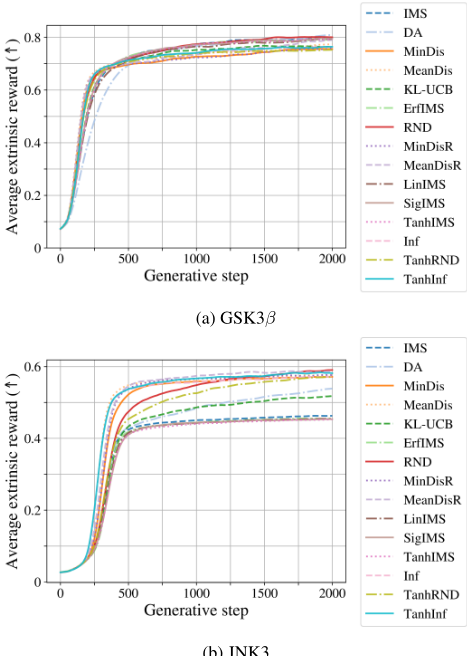
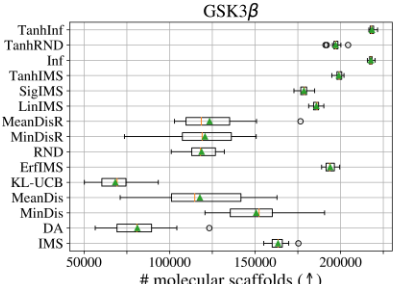
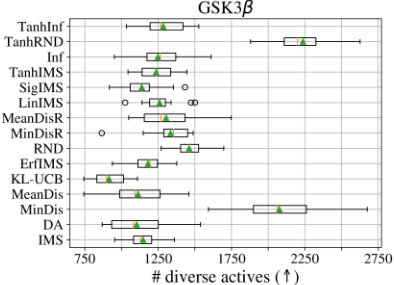
Glycogen Synthase Kinase 3 Beta (GSK3β). For the GSK3β oracle, Figure 2a compares the average extrinsic reward (moving average using a window size of 101), over 20 independent runs, per generative step. We observe that the extrinsic rewards converge to comparable values across the diversity-aware reward functions. To evaluate the diversity, Figures 3a to 3c display boxplots comparing the number
(b) JNK3
Figure 2: Average extrinsic reward (moving average using a window size of 101), over 20 independent runs, per generative step for both the GSK3β and the JNK3 oracle.
of molecular scaffolds, topological scaffolds and diverse actives, respectively, over 20 independent runs with a budget of 2000 generative steps. Only active molecules with an extrinsic reward of at least h = 0.5 are displayed, where each orange line and green triangle display the median and mean, respectively, across 20 reruns. Inf and TanhInf generate substantially more molecular and topological scaffolds, whereas TanhRND is also among the top methods. Concerning molecular scaffolds, we observe that the 7 most promising methods have a lower variability,i.e., interquartile range, among the 20 reruns, while the other methods often show a higher variability. Hence, the most promising methods can consistently generate a large number of molecular scaffolds. In terms of topological scaffolds, TanhRND exhibits both low variability and the largest number of topological scaffolds, together with TanhInf and Inf.
MinDis and TanhRND generate more diverse actives than the other methods we have investigated, but MinDis shows a higher variability among the reruns. Overall, we observe a higher variability for the number of topological scaffolds and diverse actives among the reruns. This can partially be explained by the fact that the scaffolds-based methods only consider molecular scaffolds, but more molecular scaffolds
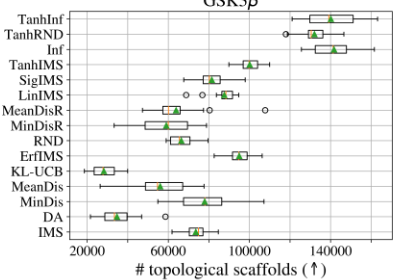
(c) Diverse actives do not necessarily lead to more topological scaffolds and diverse actives. However, as we observe here, if utilized appropriately, it can still enhance the overall diversity.
Figure 3: Evaluation of diversity on the GSK3β oracle. The boxplots compare the total number of molecular scaffolds, topological scaffolds and diverse actives after 2000 generative steps. Each boxplot displays the evaluation across 20 independent runs of each method, where the orange line and green triangle display the median and mean, respectively. Only active molecules are considered when computing the diversity metrics.
In general, applying RND alone does not yield among the highest diversities, but the combination of TanhIMS and RND can improve the diversity of TanhIMS, especially for topological and diverse actives. Hence, we observe that proper structure-based scaling of the extrinsic reward can help to improve diversity, while adding a prediction-based intrinsic reward, i.e., RND, can further enhance and stabilize diversity. Combining Inf, a structure-based intrinsic reward, with TanhIMS does not seem to enhance the diversity further, but it also does not reduce the diversity. We also observe enhanced performance in scaffold diversity for the non-binary penalty functions alone. Still, this structural information does not improve the similarity-based diversity, i.e., diverse actives.
c-Jun N-terminal Kinases-3 (JNK3). Figure 2b displays the average extrinsic reward (moving average using a window size of 101), over 20 independent runs, per generative step for the JNK3 oracle. We observe a substantially lower extrinsic reward when not using any intrinsic motivation. The extrinsic rewards are significantly lower compared to the GSK3β experiments, highlighting that this is a more difficult optimization problem where the agent is more prone to get stuck in a local optimum if not sufficient exploration is carried out. Note that the average extrinsic rewards of the penalty-based methods do not reach the threshold of h = 0.5, where extrinsic rewards are penalized. However, by combining the penalty with an intrinsic reward, it is possible to escape lowrewarding local optima.
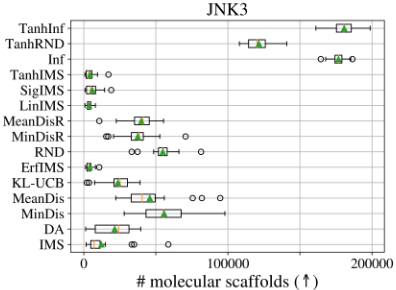
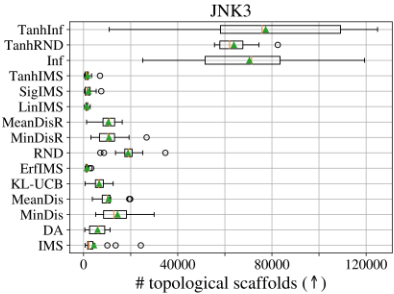
We will now also see how the diversity of the generation process has been affected by the different diversity-aware reward functions. Figures 4a to 4c show boxplots displaying the total number of molecular scaffolds, topological scaffolds, and diverse actives, respectively, after 2000 generative steps of 20 reruns. Only active molecules are considered, where each orange line and green triangle displays the median and mean, respectively, across 20 reruns. Generally, substantially fewer molecular scaffolds, topological scaffolds, and diverse actives are found compared to the experiments on the GSK3β extrinsic reward function (see Figures 3a to 3c). This is because the JNK3-based extrinsic reward is more difficult to optimize (see Figures 2a and 2b) and, therefore, the number of actives is lower. In terms of molecular and topological scaffolds (see Figures 4a and 4b), it is evident that the methods that only penalize the extrinsic reward generate less diverse molecules. We observe that TanhInf, TanhRND and Inf generate substantially more molecular and topological scaffolds while their boxes (in the boxplots) do not intersect with the other methods. However, for TanhInf and Inf, we observe a higher variability in terms of topological scaffolds, while TanhRND demonstrates a more consistent number of topological scaffolds among the 20 reruns.
The differences between the methods are not as apparent in terms of diverse actives, where most methods generate around 20 diverse actives. Only TanhRND shows the capability to generate more than 30 diverse actives. We notice that TanhRND has a higher variability in terms of diverse actives,
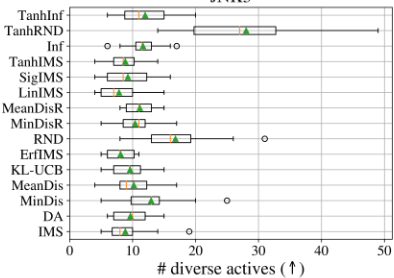
(c) Diverse actives but its box does not intersect with the other methods. The higher variability of TanhRND is possibly because it is difficult to improve the number of diverse actives and, therefore, there is a natural variability in how much it can be improved in each rerun.
Figure 4: Evaluation of diversity on the JNK3 oracle. The boxplots compare the total number of molecular scaffolds, topological scaffolds and diverse actives after 2000 generative steps. Each boxplot displays the evaluation across 20 independent runs of each method, where the orange line and green triangle display the median and mean, respectively. Only active molecules are considered when computing the diversity metrics.
Overall, TanhRND shows a high diversity, with only TanhInf and Inf showing significantly more molecular scaffolds. On the other hand, for RND and TanhIMS on their own, we observe no substantial improvement in diversity compared to the other methods. This is likely because JNK3 is more difficult to optimize (see Figure 2b) due to having fewer optima compared to GSK3β. Hence, we observe that the combination of RND and TanhIMS considerably improves the overall diversity for a more sparse optimization task.
5 Conclusion
Our comprehensive study proposes and evaluates several novel intrinsic rewards and reward penalties to enhance the diversity of de novo drug design using reinforcement learning (RL). Our approach balances exploration and exploitation to promote a more diverse generation of molecules. Our results consistently show that methods incorporating both intrinsic reward and reward penalty generate significantly more diverse actives, molecular scaffolds, and topological scaffolds. In particular, using structure-based scaling of the extrinsic reward and a prediction-based method to encourage exploration in the agent's state space, we observe improved diversity in terms of both structure and similarity. Yet, a single type of information does not fully enhance diversity. Our work opens several future directions for studying how to incorporate domain and agent information into the reward signal efficiently.
Acknowledgments
This work was partially supported by the Wallenberg AI, Autonomous Systems and Software Program (WASP) funded by the Knut and Alice Wallenberg Foundation. The experimental evaluation was enabled by resources provided by the National Academic Infrastructure for Supercomputing in Sweden (NAISS), partially funded by the Swedish Research Council through grant agreement no. 2022-06725.
@inproceedings{ijcai2025p1022,
  title     = {Diversity-Aware Reinforcement Learning for de novo Drug Design},
  author    = {Gummesson Svensson, Hampus and Tyrchan, Christian and Engkvist, Ola and Haghir Chehreghani, Morteza},
  booktitle = {Proceedings of the Thirty-Fourth International Joint Conference on
               Artificial Intelligence, {IJCAI-25}},
  publisher = {International Joint Conferences on Artificial Intelligence Organization},
  editor    = {James Kwok},
  pages     = {9194--9204},
  year      = {2025},
  month     = {8},
  note      = {AI4Tech: AI Enabling Technologies},
  doi       = {10.24963/ijcai.2025/1022},
  url       = {https://doi.org/10.24963/ijcai.2025/1022},
}
TY - CPAPER TI - Diversity-Aware Reinforcement Learning for de novo Drug Design AU - Gummesson Svensson, Hampus AU - Tyrchan, Christian AU - Engkvist, Ola AU - Haghir Chehreghani, Morteza T2 - Proceedings of the Thirty-Fourth International Joint Conference on Artificial Intelligence, IJCAI-25 PB - International Joint Conferences on Artificial Intelligence Organization PY - 2025 SP - 9194 EP - 9204 DO - 10.24963/ijcai.2025/1022 UR - https://doi.org/10.24963/ijcai.2025/1022 ER -Copied
Machine-readable versions of this paper, for tools and AI agents:





