
FastBlend: Enhancing Video Stylization Consistency via Model-Free Patch Blending
Proceedings of the Thirty-Fourth International Joint Conference on Artificial Intelligence. AI, Arts & Creativity. Pages 10072-10080.
https://doi.org/10.24963/ijcai.2025/1119
Keywords
- Application domains: Images, movies and visual arts
Abstract
With the emergence of diffusion models and the rapid development of image processing, generating artistic images in style transfer tasks has become effortless. However, these impressive image processing approaches face consistency issues in video processing due to the independent processing of each frame. In this paper, we propose a powerful, model-free approach called FastBlend to address the consistency problem in video stylization. FastBlend functions as a post-processor and can be seamlessly integrated with diffusion models to create a robust video stylization pipeline. Based on a patch-matching algorithm, we remap and blend the aligned content across multiple frames, thus compensating for inconsistent content with neighboring frames. Moreover, we propose a tree-like data structure and a specialized loss function, aiming to optimize computational efficiency and visual quality for different application scenarios. Extensive experiments have demonstrated the effectiveness of FastBlend. Compared with both independent video deflickering algorithms and diffusion-based video processing methods, FastBlend is capable of synthesizing more coherent and realistic videos.
- [Bar-Tal et al., 2022] Omer Bar-Tal, Dolev Ofri-Amar, Rafail Fridman, Yoni Kasten, and Tali Dekel. Text2live: Text-driven layered image and video editing. In European conference on computer vision, pages 707-723. Springer, 2022.
- [Barnes et al., 2009] Connelly Barnes, Eli Shechtman, Adam Finkelstein, and Dan B Goldman. Patchmatch: A randomized correspondence algorithm for structural image editing. ACM Trans. Graph., 28(3):24, 2009.
- [Blattmann et al., 2023a] Andreas Blattmann, Tim Dock- horn, Sumith Kulal, Daniel Mendelevitch, Maciej Kilian, Dominik Lorenz, Yam Levi, Zion English, Vikram Voleti, Adam Letts, et al. Stable video diffusion: Scaling latent video diffusion models to large datasets. arXiv preprint arXiv:2311.15127, 2023.
- [Blattmann et al., 2023b] Andreas Blattmann, Robin Rom- bach, Huan Ling, Tim Dockhorn, Seung Wook Kim, Sanja Fidler, and Karsten Kreis. Align your latents: High-resolution video synthesis with latent diffusion mod- els. In Proceedings of the IEEE/CVF Conference on Computer Vision and Pattern Recognition, pages 22563- 22575, 2023.
- [Brooks et al., 2023] Tim Brooks, Aleksander Holynski, and Alexei A Efros. Instructpix2pix: Learning to follow im- age editing instructions. In Proceedings of the IEEE/CVF Conference on Computer Vision and Pattern Recognition, pages 18392-18402, 2023.
- [Ceylan et al., 2023] Duygu Ceylan, Chun-Hao P Huang, and Niloy J Mitra. Pix2video: Video editing using im- age diffusion. In Proceedings of the IEEE/CVF Inter- national Conference on Computer Vision, pages 23206- 23217, 2023.
- [De Berg, 2000] Mark De Berg. Computational geometry: algorithms and applications. Springer Science & Business Media, 2000.
- [Dhariwal and Nichol, 2021] Prafulla Dhariwal and Alexan- der Nichol. Diffusion models beat gans on image synthe- sis. Advances in neural information processing systems, 34:8780-8794, 2021.
- [Duan et al., 2023] Zhongjie Duan, Lizhou You, Chengyu Wang, Cen Chen, Ziheng Wu, Weining Qian, and Jun Huang. Diffsynth: Latent in-iteration deflickering for re- alistic video synthesis. arXiv preprint arXiv:2308.03463, 2023.
- [Esser et al., 2023] Patrick Esser, Johnathan Chiu, Parmida Atighehchian, Jonathan Granskog, and Anastasis Ger- manidis. Structure and content-guided video synthesis with diffusion models. In Proceedings of the IEEE/CVF International Conference on Computer Vision, pages 7346-7356, 2023.
- [Fenwick, 1994] Peter M Fenwick. A new data structure for cumulative frequency tables. Software: Practice and ex- perience, 24(3):327-336, 1994.
- [Gal et al., 2022] Rinon Gal, Yuval Alaluf, Yuval Atzmon, Or Patashnik, Amit Haim Bermano, Gal Chechik, and Daniel Cohen-or. An image is worth one word: Personal- izing text-to-image generation using textual inversion. In The Eleventh International Conference on Learning Rep- resentations, 2022.
- [Goodfellow et al., 2014] Ian Goodfellow, Jean Pouget- Abadie, Mehdi Mirza, Bing Xu, David Warde-Farley, Sherjil Ozair, Aaron Courville, and Yoshua Bengio. Gen- erative adversarial nets. Advances in neural information processing systems, 27, 2014.
- [Grover and Lin, 2012] Vinod Grover and Yuan Lin. Com- piling cuda and other languages for gpus. In GPU Tech- nology Conference (GTC), pages 1-59, 2012.
- [Guo et al., 2021] Xiefan Guo, Hongyu Yang, and Di Huang. Image inpainting via conditional texture and structure dual generation. In Proceedings of the IEEE/CVF Inter- national Conference on Computer Vision, pages 14134- 14143, 2021.
- [Guo et al., 2023] Yuwei Guo, Ceyuan Yang, Anyi Rao, Yaohui Wang, Yu Qiao, Dahua Lin, and Bo Dai. An- imatediff: Animate your personalized text-to-image dif- fusion models without specific tuning. arXiv preprint arXiv:2307.04725, 2023.
- [Hertz et al., 2022] Amir Hertz, Ron Mokady, Jay Tenen- baum, Kfir Aberman, Yael Pritch, and Daniel Cohen-or. Prompt-to-prompt image editing with cross-attention con- trol. In The Eleventh International Conference on Learn- ing Representations, 2022.
- [Ho and Salimans, 2021] Jonathan Ho and Tim Salimans. Classifier-free diffusion guidance. In NeurIPS 2021 Work- shop on Deep Generative Models and Downstream Appli- cations, 2021.
- [Hu et al., 2021] Edward J Hu, Phillip Wallis, Zeyuan Allen- Zhu, Yuanzhi Li, Shean Wang, Lu Wang, Weizhu Chen, et al. Lora: Low-rank adaptation of large language models. In International Conference on Learning Representations, 2021.
- [Jamriška et al., 2019] Ondřej Jamriška, Šárka Sochorová, Ondřej Texler, Michal Lukáč, Jakub Fišer, Jingwan Lu, Eli Shechtman, and Daniel Sỳkora. Stylizing video by exam- ple. ACM Transactions on Graphics (TOG), 38(4):1-11, 2019.
- [Khachatryan et al., 2023] Levon Khachatryan, Andranik Movsisyan, Vahram Tadevosyan, Roberto Henschel, Zhangyang Wang, Shant Navasardyan, and Humphrey Shi. Text2video-zero: Text-to-image diffusion mod- els are zero-shot video generators. arXiv preprint arXiv:2303.13439, 2023.
- [Lei et al., 2023] Chenyang Lei, Xuanchi Ren, Zhaoxiang Zhang, and Qifeng Chen. Blind video deflickering by neu- ral filtering with a flawed atlas. In Proceedings of the IEEE/CVF Conference on Computer Vision and Pattern Recognition, pages 10439-10448, 2023.
- [Li et al., 2022] Haoying Li, Yifan Yang, Meng Chang, Shiqi Chen, Huajun Feng, Zhihai Xu, Qi Li, and Yueting Chen. Srdiff: Single image super-resolution with diffusion prob- abilistic models. Neurocomputing, 479:47-59, 2022.
- [Liu et al., 2021] Steven Liu, Xiuming Zhang, Zhoutong Zhang, Richard Zhang, Jun-Yan Zhu, and Bryan Russell. Editing conditional radiance fields. In Proceedings of the IEEE/CVF international conference on computer vision, pages 5773-5783, 2021.
- [Luebke, 2008] David Luebke. Cuda: Scalable parallel pro- gramming for high-performance scientific computing. In 2008 5th IEEE international symposium on biomedical imaging: from nano to macro, pages 836-838. IEEE, 2008.
- [Mou et al., 2023] Chong Mou, Xintao Wang, Liangbin Xie, Jian Zhang, Zhongang Qi, Ying Shan, and Xiaohu Qie. T2i-adapter: Learning adapters to dig out more control- lable ability for text-to-image diffusion models. arXiv preprint arXiv:2302.08453, 2023.
- [Mount, 2010] David M Mount. Ann: A library for approx- imate nearest neighbor searching. http://www. cs. umd. edu/˜mount/ANN/, 2010. Link
- [Ouyang et al., 2023] Hao Ouyang, Qiuyu Wang, Yuxi Xiao, Qingyan Bai, Juntao Zhang, Kecheng Zheng, Xiaowei Zhou, Qifeng Chen, and Yujun Shen. Codef: Content de- formation fields for temporally consistent video process- ing. arXiv preprint arXiv:2308.07926, 2023.
- [Qi et al., 2023] Chenyang Qi, Xiaodong Cun, Yong Zhang, Chenyang Lei, Xintao Wang, Ying Shan, and Qifeng Chen. Fatezero: Fusing attentions for zero-shot text-based video editing. arXiv preprint arXiv:2303.09535, 2023.
- [Ramesh et al., 2022] Aditya Ramesh, Prafulla Dhariwal, Alex Nichol, Casey Chu, and Mark Chen. Hierarchical text-conditional image generation with clip latents. arXiv preprint arXiv:2204.06125, 1(2):3, 2022.
- [Rombach et al., 2022] Robin Rombach, Andreas Blattmann, Dominik Lorenz, Patrick Esser, and Björn Ommer. High-resolution image synthesis with latent diffusion models. In Proceedings of the IEEE/CVF conference on computer vision and pattern recognition, pages 10684-10695, 2022.
- [Ruiz et al., 2023] Nataniel Ruiz, Yuanzhen Li, Varun Jam- pani, Yael Pritch, Michael Rubinstein, and Kfir Aberman. Dreambooth: Fine tuning text-to-image diffusion mod- els for subject-driven generation. In Proceedings of the IEEE/CVF Conference on Computer Vision and Pattern Recognition, pages 22500-22510, 2023.
- [Saharia et al., 2022] Chitwan
- Saharia, William Chan, Saurabh Saxena, Lala Li, Jay Whang, Emily L Denton, Kamyar Ghasemipour, Raphael Gontijo Lopes, Burcu Karagol Ayan, Tim Salimans, et al. Photorealistic text-to-image diffusion models with deep language un- derstanding. Advances in Neural Information Processing Systems, 35:36479-36494, 2022.
- [Schuhmann et al., 2022] Christoph Schuhmann, Romain Beaumont, Richard Vencu, Cade Gordon, Ross Wight- man, Mehdi Cherti, Theo Coombes, Aarush Katta, Clay- ton Mullis, Mitchell Wortsman, et al. Laion-5b: An open large-scale dataset for training next generation image-text models. arXiv preprint arXiv:2210.08402, 2022.
- [Singer et al., 2022] Uriel Singer, Adam Polyak, Thomas Hayes, Xi Yin, Jie An, Songyang Zhang, Qiyuan Hu, Harry Yang, Oron Ashual, Oran Gafni, et al. Make-a- video: Text-to-video generation without text-video data. In The Eleventh International Conference on Learning Representations, 2022.
- [Song et al., 2020] Jiaming Song, Chenlin Meng, and Ste- fano Ermon. Denoising diffusion implicit models. In Inter- national Conference on Learning Representations, 2020.
- [Teed and Deng, 2020] Zachary Teed and Jia Deng. Raft: Recurrent all-pairs field transforms for optical flow. In Computer Vision-ECCV 2020: 16th European Confer- ence, Glasgow, UK, August 23-28, 2020, Proceedings, Part II 16, pages 402-419. Springer, 2020.
- [Wang et al., 2021] Xintao Wang, Liangbin Xie, Chao Dong, and Ying Shan. Real-esrgan: Training real-world blind super-resolution with pure synthetic data. In Proceedings of the IEEE/CVF international conference on computer vi- sion, pages 1905-1914, 2021.
- [Xing et al., 2023] Zhen Xing, Qijun Feng, Haoran Chen, Qi Dai, Han Hu, Hang Xu, Zuxuan Wu, and Yu-Gang Jiang. A survey on video diffusion models. arXiv preprint arXiv:2310.10647, 2023.
- [Yang et al., 2022] Ling Yang, Zhilong Zhang, Yang Song, Shenda Hong, Runsheng Xu, Yue Zhao, Wentao Zhang, Bin Cui, and Ming-Hsuan Yang. Diffusion models: A comprehensive survey of methods and applications. ACM Computing Surveys, 2022.
- [Yang et al., 2023] Shuai Yang, Yifan Zhou, Ziwei Liu, and Chen Change Loy. Rerender a video: Zero-shot text-guided video-to-video translation. arXiv preprint arXiv:2306.07954, 2023.
- [Yu et al., 2021] Sihyun Yu, Jihoon Tack, Sangwoo Mo, Hyunsu Kim, Junho Kim, Jung-Woo Ha, and Jinwoo Shin. Generating videos with dynamics-aware implicit genera- tive adversarial networks. In International Conference on Learning Representations, 2021.
- [Zhang et al., 2023] Lvmin Zhang, Anyi Rao, and Maneesh Agrawala. Adding conditional control to text-to-image dif- fusion models. In Proceedings of the IEEE/CVF Interna- tional Conference on Computer Vision, pages 3836-3847, 2023.
- [Zhou et al., 2022] Shangchen Zhou, Kelvin Chan, Chongyi Li, and Chen Change Loy. Towards robust blind face restoration with codebook lookup transformer. Advances in Neural Information Processing Systems, 35:30599- 30611, 2022.
References were extracted automatically from the PDF and may contain errors.
Full text extracted automatically from the PDF; figures, tables and equations may differ. The PDF is the version of record.
1 Introduction
In recent years, there has been rapid development in the field of image processing. Notably, diffusion models [Saharia et al., 2022; Ramesh et al., 2022] trained on large-scale datasets have ushered in a transformative era in image synthesis. It has been demonstrated that diffusion models outperform Generative Adversarial Networks (GANs) [Goodfellow et al., 2014] comprehensively [Dhariwal and Nichol, 2021], even reaching a level of creative ability comparable to that of human artists [Yang et al., 2022]. Stable Diffusion [Rombach et al., 2022], which has become the most popular model architecture in open-source communities, has been applied to various domains, including image style transfer [Mou et al., 2023], super-resolution [Li et al., 2022], and image editing [Hertz et al., 2022], achieving noteworthy milestones in diffusionbased approaches.
However, when extending these image processing techniques to video processing, we encounter the issue of maintaining video consistency [Yu et al., 2021; Lei et al., 2023; Yang et al., 2023], particularly in video stylization. Since each frame in a video is processed independently, the direct application of image processing methods typically results in incoherent content, leading to noticeable flickering in generated videos. Recent approaches proposed to enhance the consistency of generated videos can be summarized as follows: 1) Pre-trained large models for coherent video synthesis [Blattmann et al., 2023a; Guo et al., 2023], 2) Zeroshot video processing utilizing image models [Qi et al., 2023; Ceylan et al., 2023; Khachatryan et al., 2023], 3) Video deflickering external to diffusion models [Lei et al., 2023; Ouyang et al., 2023]. Despite these efforts, highlighted in a recent survey [Xing et al., 2023], challenges remain. Pretraining large models on large-scale video datasets demands extremely high computational resources, and current models like Stable Video Diffusion [Blattmann et al., 2023a] can only generate minimal movement. Other studies aim to transfer image diffusion models to video synthesis without additional training. Some zero-shot methods [Qi et al., 2023; Ceylan et al., 2023; Khachatryan et al., 2023] have improved video consistency by modifying the generation process of diffusion models. Video post-processing methods [Lei et al., 2023], which do not alter the diffusion models' generation process, can also be employed in the video processing pipeline. However, they often yield sub-optimal outcomes, struggling to leverage motion features from the input video and to address issues such as frame flickering and tearing effectively.
In this paper, we propose a model-free approach called FastBlend, aiming to enhance video stylization consistency. To ensure compatibility with existing methods, we operate exclusively within the image space rather than the latent space [Rombach et al., 2022], thus avoiding modifications to diffusion models. Consequently, FastBlend functions as a post-processor and can be seamlessly integrated with diffusion models to create a robust video stylization pipeline. In video stylization tasks, we first employ a diffusion-based image processing pipeline to process each frame, transferring the overall style in accordance with given prompts. Subsequently, we leverage a patch-matching algorithm [Barnes et al., 2009] to estimate Nearest Neighbor Fields (NNFs) [Mount, 2010], which contain the necessary information for remapping images. On the videos processed by diffusion models, we utilize these NNFs to align and blend content within a sliding window, thereby improving video consistency while maintaining visual quality. To enhance computational efficiency, and drawing inspiration from tree-like data structures [Fenwick, 1994; De Berg, 2000], we devise a new data structure optimized for video blending, ensuring minimal time complexity. Furthermore, to improve visual quality, we introduce a novel alignment loss designed for precise content alignment across different frames. In our experiments, we construct a video dataset for evaluation, which will be publicly released. Human evaluation results unanimously indicate that FastBlend significantly outperforms baseline methods. Additionally, we implement FastBlend with a focus on highly parallel processing on GPUs [Luebke, 2008], achieving exceptional computational efficiency. The source code has been released on GitHub 1 . In summary, the main contributions of this paper include:
- We introduce FastBlend, an effective approach for producing consistent videos, making it possible to directly apply existing imege processing methods to video stylization tasks.
- We devise an efficient algorithmic framework for video consistency enhancement, including tree-like data structures and a highly parallel computational architecture, leading to remarkable computational efficiency.
- We construct a video dataset for the evaluation of video stylization techniques, demonstrating through human evaluation that our proposed method consistently outperforms baseline methods, including both standalone video deflickering approaches and diffusionbased methods.
2 RelatedWork
2.1 Image Synthesis with DiffusionModels
Diffusion models represent a class of generative models that generate images through iterative denoising processes. Stable Diffusion [Rombach et al., 2022], trained on a large-scale text-image dataset [Schuhmann et al., 2022], has emerged as a powerful backbone for image synthesis. Methods based on Stable Diffusion have achieved impressive success. For instance, ControlNet [Zhang et al., 2023] and T2I-Adapter [Mou et al., 2023] enable the redrawing of appearances while preserving the underlying image structure and the transformation of hand-drawn sketches into realistic photographs. Techniques such as Textual Inversion [Gal et al., 2022], LoRA [Hu et al., 2021], and DreamBooth [Ruiz et al., 2023] provide the flexibility to fine-tune Stable Diffusion for generating specific objects. In the realm of image editing, approaches such as Prompt-to-Prompt [Hertz et al., 2022], and InstructPix2Pix [Brooks et al., 2023] are capable of editing images according to user inputs in the form of text or sketches. Besides these diffusion-based methods, techniques such as Real-ESRGAN
1 https://github.com/Artiprocher/sd-webui-fastblend
[Wang et al., 2021], CodeFormer [Zhou et al., 2022], and other image super-resolution and restoration methods can be combined with diffusion models to further enhance image quality. These image synthesis methods have inspired subsequent advancements in video processing.
2.2 Video Stylization with DiffusionModels
Unlike image processing, video processing presents additional challenges, often requiring more computational resources to ensure video consistency. Recent research focuses on extending image diffusion models to video stylization. For example, Gen-1 [Esser et al., 2023] incorporates temporal structures into a diffusion model, training it to restyle videos. Training a video diffusion model is a resource-intensive endeavor, prompting researchers to explore zero-shot video stylization methods based on diffusion models from open-source communities. Examples include Text2LIVE [Bar-Tal et al., 2022], FateZero [Qi et al., 2023], Pix2Video [Ceylan et al., 2023], and Text2Video-Zero [Khachatryan et al., 2023]. These zero-shot video stylization methods process videos frame by frame, which requires substantial computational resources and poses challenges in maintaining video consistency. To address these issues, methods like Make-A-Video [Singer et al., 2022] and RerenderA-Video [Yang et al., 2023] employ keyframe rendering and video interpolation [Jamriˇska et al., 2019] to enhance video consistency. Similarly, CoDeF [Ouyang et al., 2023] aims to render an entire video using only a single keyframe. Moreover, independent video deflickering algorithms such as All-In-One Deflicker [Lei et al., 2023] can be integrated with diffusion models to marginally enhance video consistency, and some patch-based methods [Barnes et al., 2009; Jamriˇska et al., 2019] can render fluent videos using several keyframes, which motivates us to design a general approach for video consistency enhancement.
3 Methodology
3.1 Overview
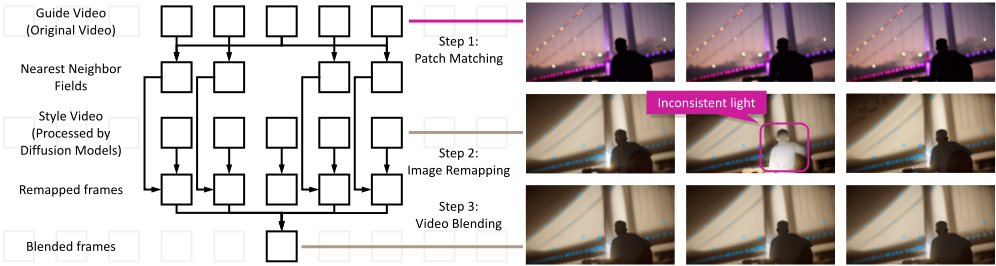
FastBlend is a model-free algorithm. To ensure compatibility, we use FastBlend solely as a post-processing method, without altering the generative process of the diffusion model. The overall workflow of FastBlend is illustrated in Figure 1. When applying diffusion models to video stylization, content inconsistencies often arise. For clarity, we denote the original video as the guide video {Gi}N-1 i=0 and the video processed by diffusion models as the style video {Si}N-1 i=0 . As presented in Figure 1, the core concept of FastBlend is to blend the aligned content within a sliding window, thereby covering the inconsistent content with content from neighboring frames. In this section, we begin by introducing each step of FastBlend, followed by a discussion on the enhancements in efficiency and quality.
3.2 PatchMatching
The first step is to extract the motion feature from the guide video {Gi}N-1 i=0 . Given a source frame Gi and a target frame Gj in the guide video, we compute an approximate Nearest Neighbor Field (NNF) F = NNF(Gi, Gj), which represents
Algorithm 1 Base Patch Matching
Input: Gi ∈ Rh×w×3 : source image; Gj ∈ Rh×w×3 : target image; L: customizable loss function; n: number of iterations (n = 5 by default) Randomly initialize F ∈ Nh×w×2 for each pyramid level (h′ , w′ ) do Resize images Gi,Gj to G′i,G′j ∈ Rh′×w′×3 Upsample F to Rh′×w′×2 Initialize error matrix E ← L(G′i, G′j , F ) ∈ Rh×w for i = 1 to n do for F ′ in updating sequence of F do E′ ← L(G′i, G′j , F ′ ) F(E′ < E) ← F ′ (E′ < E) E(E′ < E) ← E′ (E′ < E) end for end for end for return Fframe is converted into h × w patches, each with a shape of (2p + 1) × (2p + 1) × 3. Then, the patches are rearranged according to the NNF F. To obtain the reconstructed target frame, we compute the average at the overlapping parts. Note that the VRAM required to store the patches is (2p+1)2 times that of a single image, which poses a challenge for implementation due to storage constraints. To reduce the VRAM requirement and improve I/O efficiency, we directly compute each pixel in the reconstructed image, thus avoiding the storage of intermediate results. The pseudocode for this algorithm is presented in Algorithm 2, effectively reducing the space complexity fromO(hwp2 ) to O(hw). This function is compiled using the NVCC compiler [Grover and Lin, 2012] and runs on NVIDIA GPUs. Similar to Algorithm 1, this algorithm also supports batched data processing.
To make the style video {Si}N-1 i=0 consistent, we remap frames within a sliding window to align with a common frame. Note that the source frames are from the style video rather than the guide video, which can sometimes result in the remapped image appearing fragmented. Inspired by Ebsynth
the matches between the two frames. Unlike optical flow [Teed and Deng, 2020], NNF identifies the best patch-level matches and was originally proposed for tasks like image reconstruction [Guo et al., 2021; Liu et al., 2021]. For convenience, we use Gi[x, y] ∈ R(2p+1)×(2p+1)×3 to denote the patch centered around the position (x, y), with p being the patch radius. The patch size 2p + 1 is set to 5 by default. More precisely, F(x, y) = (x′ , y′ ) indicates that the patch Gj[x, y] matches Gi[x′ , y′ ]. The pseudocode for the base patch matching algorithm is presented in Algorithm 1. We construct an image pyramid and initially estimate the NNF at a low resolution, then upscale it for further refinement. We use a customizable loss function L to calculate the matching errors. The base loss function is formulated as
We also design several customized loss functions, which are detailed in subsequent subsections. The estimated NNF F is updated iteratively; in each iteration, we scan the updating sequence of F and replace the values that reduce the error. The updating sequence originates from two steps proposed by Barnes et al. [Barnes et al., 2009]:
- Propagation: Update matches using adjacent matches. F ′ (x, y) = F(x + dx, y + dy) - (dx, dy), where (dx, dy) ∈ {(-1, 0), (1, 0), (0, -1), (0, 1)} corresponds to the four cardinal directions.
- Random search: Search for better matches in the entire image. F ′ (x, y) = F(x, y) + (dx, dy), where (dx, dy) ∼ U[-r, r] and r decreases to zero during the iterative process.
To improve efficiency, we concurrently update each value in F. Additionally, we store images in batches to fully utilize the computing units on GPUs, making our implementation highly parallel.
3.3 Image Remapping
Once we have NNF(Gi,Gj), we can reconstruct the target frame ˆGj using the source frame Gi. Initially, the source
Algorithm 2 Memory-efficient Image Remapping
Input: Gi ∈ Rh×w×3 : source image; F ∈ Nh×w×2 : estimated NNF; (x, y): coordinate of the pixel to be computed ˆGj (x, y) ← 0 ∈ R3 for dx = -p to p do for dy = -p to p do (x′ , y′ ) ← F (x + dx, y + dy) - (dx, dy) ˆGj (x, y) ← ˆGj (x, y) + Gi(x′ , y′ ) end for end for ˆGj(x, y) ← ˆGj(x,y) (2p+1)2 return ˆGj(x, y)[Jamriˇska et al., 2019], we utilize an improved loss function:
where α is a hyperparameter that determines the extent to which motion information in the input video will be used for remapping. The default value for α is set to 10. ˆ Sj is the remapped frame and will be updated during the iterations. This loss function can significantly improve the visual quality of remapped frames, as evaluated by prior studies [Jamriˇska et al., 2019].
3.4 Video Blending
Leveraging the patch matching and image remapping algorithms, we can align the content in different frames. Next, we blend the remapped frames within a sliding window. Specifically, we define the blended frame Si as
where (Sj → Si) denotes the frame remapped from Sj to Si using NNF(Gj,Gi). After remapping and blending, the frames {Si}N-1 i=0 form a consistent video.
In certain application contexts, such as the film industry, the quality of video content is paramount, while in others, computational efficiency is prioritized. To meet diverse requirements, we have developed three distinct inference modes for video blending. The initial mode, without additional adjustments, is denoted as Balanced Mode. The other two modes, Fast Mode and Accurate Mode, are optimized to improve efficiency and video quality, respectively.
3.5 Efficiency Improvement
When implementing the blending algorithm naively, we require O(NM) NNF estimations, where M represents the size of the sliding window. If M is too large, this naive approach becomes prohibitively slow. To enhance efficiency, we propose a novel data structure called Remapping Table for fast remapping and blending. This structure is a treelike data structure reminiscent of certain tree-like arrays [Fenwick, 1994; De Berg, 2000]. Since the remapped and blended frames can be remapped iteratively, i.e.,
In other words, we can store some intermediate variables to reduce the time complexity. This data structure can compute the estimation of Si with low time complexity. For readers not familiar with tree-like data structures, it is advisable to approach this data structure as a black box, thereby alleviating the need for intimate understanding.
Overall, Fast Mode requires O(N logN) NNF estimations, which are independent of the sliding window size, thus enabling the use of large windows without a significant increase in computational cost.
3.6 Quality Improvement
When flicker noise in a video is excessively pronounced, simply blending the frames together may result in a smoggy appearance. This issue arises from the inconsistent remapping of content to identical positions across different frames. To mitigate this challenge, we adjust the loss function to more consistently align the contents between frames. Ideally, when different source frames {Si}N-1 i=0 are remapped to the same target frame Sj, the set {Si → Sj}N-1 i=0 should be nearly identical; otherwise, details may be lost during averaging. We first compute the average remapped image: Sj = 1N ∑N-1 i=0 (Si → Sj), where Sj is updated iteratively based on intermediate variables. We then calculate the distance between Sj and each remapped image. The modified alignment loss function is formulated as follows:
where the alignment term ∥Si[F(x, y)] -Sj [x, y]∥22 signifies the variance of the pixels remapped to position (x, y). By minimizing this term, the variance of {Si → Sj}N-1 i=0 is reduced, thus the details are aligned. The Accurate Mode necessitates O(NM) NNF estimations and image remappings. Additionally, the construction of a prefix remapping table is not required. As the frames are processed sequentially, the space complexity is reduced from O(N) to O(M). This reduction facilitates the processing of longer videos in Accurate Mode.
4 Experiments
To demonstrate the efficacy of FastBlend, we conduct evaluations comparing FastBlend with other baseline methods in the domain of video stylization. The goal is to transfer the style of a given video according to the provided textual prompt while retaining the structural information of the original content. We first present several video samples to illustrate the differences between the methods and then quantify the performance through quantitive metrics and human evaluation.
4.1 Experimental Settings
Baseline Methods. Considering that FastBlend functions as a post-processor, we compare it with both independent video
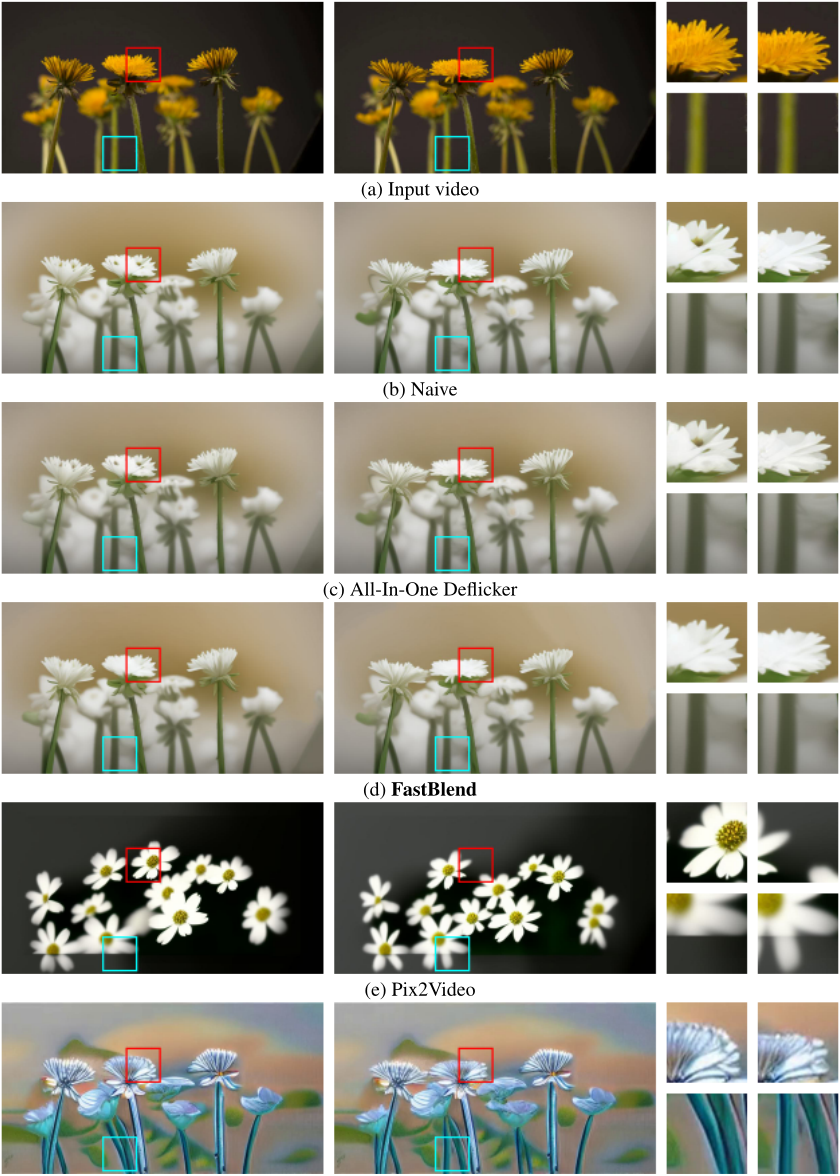
(f) Text2Video-Zero deflickering methods and video stylization methods that modify the diffusion model. The baseline methods in our experiments include: All-In-One Deflicker [Lei et al., 2023]: a state-of-the-art deflickering method that can eliminate flickering artifacts by leveraging a neural atlas in conjunction with a neural filtering strategy. Pix2Video [Ceylan et al., 2023]: a video-to-video translation method that uses self-attention feature injection to maintain frame consistency. Text2VideoZero [Khachatryan et al., 2023]: a training-free approach that leverages motion dynamics and cross-frame attention for consistent video processing.
Figure 2: Examples in video stylization. The prompt is "white flowers". "Naive" denotes directly processing each frame using the diffusion model. All-In-One Deflicker and FastBlend are post-processing methods on "Naive". Pix2Video and Text2Video-Zero are two video stylization methods that modify the generation process of diffusion models.
Dataset. For comparative experiments, we created a dataset named Pixabay100. This dataset contains 100 videos collected from Pixabay 2 . We manually crafted prompts for stylization and editing tailored to these videos. Since Pix2Video requires a prompt describing the original video, we also provide descriptions for each video. This dataset will be made publicly available. The resolutions of the videos vary, and we resize each frame to 512 × 960 for consistency.
Models and Parameters. When reproducing Pix2Video and Text2Video-Zero, we use the default models and settings provided by these baseline methods. In the comparison between FastBlend and All-In-One Deflicker, we first process the frames using diffusion models and then apply the two post-processing methods respectively. We utilize a widely acclaimed diffusion model, DreamShaper 3 , from open-source communities, to process each video frame by frame. To retain the original video's structural information, we employ two ControlNet [Zhang et al., 2023] models, SoftEdge and Depth. The number of sampling steps is set to 20, the ControlNet scale to 1.0, the classifier-free guidance scale [Ho and Salimans, 2021] to 7.5, and the sampling scheduler to DDIM [Song et al., 2020]. These hyperparameters were tuned empirically. Moreover, we enable cross-frame attention, a strategy widely proven to be effective for consistency [Yang et al., 2023; Duan et al., 2023; Qi et al., 2023; Ceylan et al., 2023; Khachatryan et al., 2023]. FastBlend's efficiency improvement feature is activated for fast processing, with a sliding window size of 30 and a batch size of 64.
4.2 Case Study
An illustrative video is shown in Figure 2, where the prompt is "white flowers" We enlarge some areas to compare the results intuitively. Using the aforementioned diffusion model, we process the video naively, and the processed video is shown in Figure 2(b). The color of the flowers in the processed video successfully changes to white. However, there is a noticeable inconsistency in the flowers. Comparing AllIn-One Deflicker with FastBlend, we observe that All-In-One Deflicker primarily mitigates slight flickering, as shown in Figure 2(c), whereas FastBlend effectively aligns the elements, as indicated by the coherent petals in Figure 2(d). The results from Pix2Video and Text2Video-Zero (Figure 2(e) and Figure 2(f)) also exhibit inconsistent content, where Pix2Video struggles to maintain the structural information from the input video and Text2Video-Zero cannot synthesize stable stems. This case study demonstrates that FastBlend, in combination with the diffusion model, can generate coherent and realistic videos in video stylization, significantly enhancing consistency.
3 https://civitai.com/models/4384/dreamshaper
| Method | Pixel-MSE ↓ |
|---|---|
| Pix2Video | 1203.04 |
| Text2Video-Zero | 342.85 |
| All-In-One Deflicker | 53.38 |
| FastBlend | 35.79 |
| FastBlend is better 75.64% | Tie 14.10% | Al-In-One Deflicker is better 10.26% |
| FastBlend is better 91.49% | Tie 4.26% | Pix2Video is better 4.26% |
| FastBlend is better 89.44% | Tie | Text2Video-Zero is better 3.73% |
| 6.83% |
4.3 Quantitative Evaluation
To quantitatively evaluate FastBlend and other baseline methods, we calculate the Pixel-MSE [Ceylan et al., 2023] for the videos generated by each method. The Pixel-MSE is the mean square error between the warped frame and its corresponding target frame. The results are presented in Table 1. FastBlend achieves the lowest Pixel-MSE, outperforming the other baseline methods by a large margin. Additionally, given that some prior studies [Blattmann et al., 2023b; Ouyang et al., 2023] have questioned the reliability of such evaluation metrics, we further invited 15 participants to partake in a double-blind evaluation. In each round of the evaluation, we randomly chose a video, presenting the participants with videos generated by two different methods. One video was generated by FastBlend, and the other by a randomly selected baseline method. The positions of these two videos were also randomized. Participants were asked to choose the video that appeared better in terms of consistency and clarity, or to select "tie" if they could not determine which video was superior. The results of the human evaluation are shown in Table 2, where participants unanimously agreed that FastBlend's overall performance was significantly better than that of the baseline methods.
4.4 Ablation Study
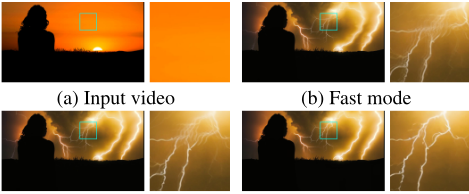
We compared the performance of the different inference modes. Figure 3 illustrates the results for three inference modes. The positions of lightning in the video are random and inconsistent. In the Balanced Mode (Figure 3(c)), there is a slight ghosting effect, where the lightning from different frames is blended together. This ghosting issue is more pronounced in the Fast Mode (Figure 3(b)). Conversely, in the Accurate Mode (Figure 3(d)), the alignment loss function (6) guides the optimization process toward the elimination of unnecessary details, resulting in a clearer representation by merging lightning elements from multiple frames.
(c) Balanced mode
(d) Accurate mode
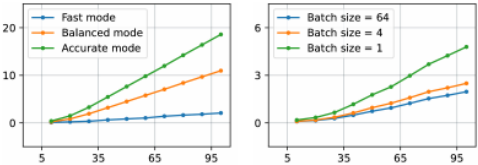
Figure 4: Inference time of different inference modes and batch sizes. The horizontal axis represents the number of video frames, and the vertical axis represents the inference time (in minutes).
This example demonstrates the efficacy of the quality improvement strategies discussed in Accurate Mode.
4.5 Efficiency Analysis
We assessed the computational efficiency of FastBlend using an NVIDIA RTX 4090 GPU, recording the time taken to render 100 frames. Given that Pix2Video and Text2Video-Zero are video processing methods tightly integrated with diffusion models, a direct comparison with other methods would not be equitable. When comparing All-In-One Deflicker and FastBlend, All-In-One Deflicker required 5.42 minutes, whereas FastBlend needed only 2.27 minutes. This demonstrates that FastBlend is significantly faster than All-In-One Deflicker. To further understand why FastBlend achieves such notable computational efficiency, we followed the settings from the previous experiments and evaluated the efficiency of different inference modes and batch sizes. The computation times are illustrated in Figure 4. As shown in Figure 4(a), the Fast Mode is considerably quicker than the other two inference modes. This speed increase is attributable to the data structure in Fast Mode, which substantially reduces time complexity. Additionally, as demonstrated in Figure 4(b), a larger batch size contributes to faster processing. By using a large batch size, FastBlend can fully utilize the computing resources of the GPU, thereby achieving high efficiency.
4.6 Parameter Sensitivity
We also conducted experiments to investigate the impact of different sliding window sizes. Figure 5 shows the first and last frames of a 125-frame video. When the sliding window size is set to 30 (Figure 5(b)), the color of the boat in the scene Figure 5: Comparison of different sliding window sizes. The prompt in this example is "a white sailboat, a lake, winter".

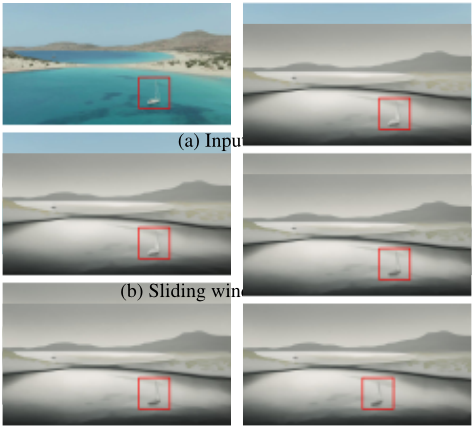
is different because the two frames are far apart. As the sliding window covers the entire video (Figure 5(c)), the color of the small boat becomes consistent. Larger sliding window sizes can improve the long-term consistency of videos but require more computation time.
5 Conclusion and FutureWork
In this paper, we propose a model-free video processing approach named FastBlend. This approach can significantly enhance video consistency through patch matching and can be seamlessly integrated with diffusion models to design robust video processing pipelines. By aligning and blending content across different frames, FastBlend effectively eliminates flickering in videos. To boost efficiency, we introduce a novel data structure that dramatically reduces the time complexity. Furthermore, we have designed an alignment loss function that facilitates content alignment, thereby improving visual quality. The extensive experimental results have underscored the superiority of FastBlend.
Looking ahead, we aim to combine FastBlend with additional video processing techniques to design more potent video processing pipelines for various application scenarios. Furthermore, we observe that FastBlend, as a standalone video processing algorithm, sometimes produces blurred videos when processing videos with large-scale rapid motion. This is another issue that we aim to optimize and improve upon in future work.
Acknowledgments
This work was supported by the National Natural Science Foundation of China under grant Number 62202170 and Alibaba Group through Alibaba Innovation Research Program.
@inproceedings{ijcai2025p1119,
  title     = {FastBlend: Enhancing Video Stylization Consistency via Model-Free Patch Blending},
  author    = {Duan, Zhongjie and Wang, Chengyu and Chen, Cen and Qian, Weining and Huang, Jun and Jin, Mingyi},
  booktitle = {Proceedings of the Thirty-Fourth International Joint Conference on
               Artificial Intelligence, {IJCAI-25}},
  publisher = {International Joint Conferences on Artificial Intelligence Organization},
  editor    = {James Kwok},
  pages     = {10072--10080},
  year      = {2025},
  month     = {8},
  note      = {AI, Arts & Creativity},
  doi       = {10.24963/ijcai.2025/1119},
  url       = {https://doi.org/10.24963/ijcai.2025/1119},
}
TY - CPAPER TI - FastBlend: Enhancing Video Stylization Consistency via Model-Free Patch Blending AU - Duan, Zhongjie AU - Wang, Chengyu AU - Chen, Cen AU - Qian, Weining AU - Huang, Jun AU - Jin, Mingyi T2 - Proceedings of the Thirty-Fourth International Joint Conference on Artificial Intelligence, IJCAI-25 PB - International Joint Conferences on Artificial Intelligence Organization PY - 2025 SP - 10072 EP - 10080 DO - 10.24963/ijcai.2025/1119 UR - https://doi.org/10.24963/ijcai.2025/1119 ER -Copied
Machine-readable versions of this paper, for tools and AI agents:





